
Moulson A.J., Herbert J.M. Electroceramics: Materials, Properties, Applications
Подождите немного. Документ загружается.

ferrites, but there are also important resonance effects. Table 9.1 shows that the
magnetocrystalline anisotropy of the NiZn ferrites is higher than that of the
MnZn ferrites. An equivalent statement is that when the magnetization vectors
are in the ‘easy’ direction the electron spin moments in NiZn ferrite are in a
higher anisotropy field H
A
than those in MnZn ferrite. In practice the applied
fields are usually small, and so H
A
is the dominant field.
When excited by an applied alternating magnetic field the magnetization
vector will precess around the anisotropy field as discussed more fully later
(Section 9.3.4). Resonance occurs when the frequency of the applied field
coincides with the natural precessional frequency, i.e. the Larmor frequency
o
L
¼ gm
0
H
A
, with the result that the permeability falls and losses increase, as
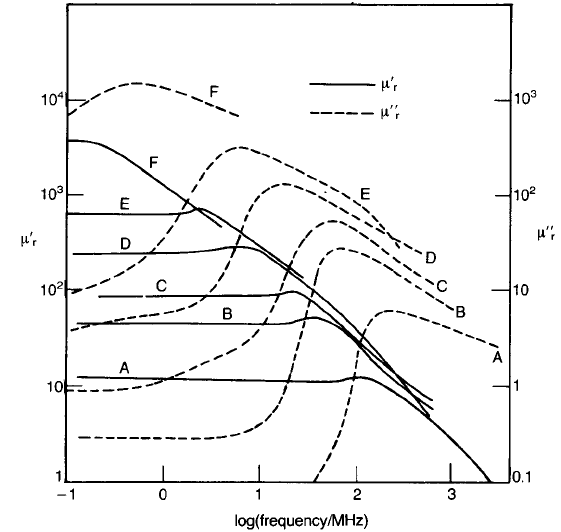
shown for a family of NiZn ferrites in Fig. 9.29. The onset of such ‘ferrimagnetic
resonances’ restricts the use of MnZn ferrites to frequencies of less than about
2 MHz. At higher frequencies, up to about 200 MHz, compositions from the
NiZn family are used.
There is another, quite distinct, resonance phenomenon concerned with
domain wall movements occurring at approximately one-tenth of the ferrimag-
netic resonance frequency. To understand this Bloch wall motion needs to be
502 MAGNETIC CERAMICS
Fig. 9.29 Magnetic properties of polycrystalline Ni
17d
Zn
d
Fe
2
O
4
as functions of d and
frequency: curve A, d ¼ 0: curve B, d ¼ 0.2; curve C, d ¼ 0.36; curve D, d ¼ 0.5; curve E,
d ¼ 0.64; F, d ¼ 0.7 (after [6]).
TEAMFLY
Team-Fly
®
considered in more detail. The initial part of the virgin magnetization curve is
associated with ‘reversible’ Bloch wall movements; when larger fields are applied
the movements are irreversible. This is best appreciated by considering the wall
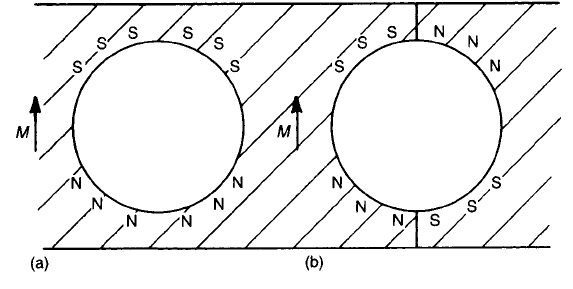
intersecting a second-phase inclusion, say a pore, as indicated in Fig. 9.30.
The pore in Fig. 9.30(a) possesses a high magnetostatic energy by virtue of the
free poles at its surface. When a Bloch wall intersects the pore (Fig. 9.30(b)), this
energy can be reduced. There is therefore a tendency for walls to intersect as
many pores and other second-phase inclusions as possible. The wall is said to be
‘pinned’ at the inclusion, and a certain threshold field must be applied to free it.
It is worth noting the close analogy that can be drawn between this situation and
grain boundary movement during sintering.
When a small external field is applied the wall is displaced only slightly from
the energy minimum position and, on removal of the field, the wall returns nearly
reversibly to its original configuration. When larger fields are applied the wall
may be displaced over a potential energy barrier to a new distant minimum. On
removal of the field, the wall cannot return to its original position because of the
intervening energy barrier. Such wall displacements are thus irreversible. Lattice
strain, lattice defects of all types and second-phase inclusions affect the extent to
which ‘reversible’ wall motion can occur and, in consequence, the magnetic
hardness of the material.
From what has been said it follows that small displacements of a pinned
domain wall introduce restoring forces and, since the wall has inertia and its
movement is accompanied by energy dissipation, an equation of motion can be
written for a sinusoidal applied field:
m
..
x þ b
.
x þ cx ¼ 2M
s
BðtÞð9:32Þ
where x is the displacement normal to the wall, m represents the inertia, b is a
damping coefficient and c is a stiffness coefficient. This equation describes
damped forced harmonic motion so that a resonance effect will occur at a
characteristic frequency o ¼ðc=mÞ
1=2
if the damping is small.
PROPERTIES INFLUENCING MAGNETIC BEHAVIOUR 503
Fig. 9.30 Intersection of a Bloch wall by a pore.
Microstructure control can be used to reduce domain wall resonance effects.
As the grain size is reduced the formation of domain walls becomes increasingly
energetically unfavourable (see Section 9.3.2) so that their total effect at
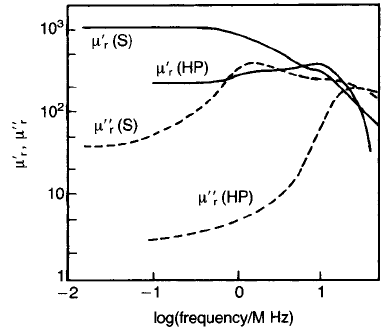
resonance is greatly diminished. Figure 9.31 shows the frequency dependence of
the permeability for two NiZn ferrites with the same composition, resistivity and
density but differing in grain size. The ‘normally’ sintered material has a grain
size of approximately 35 mm and the loss component m@ shows two maxima. The
lower-frequency maximum is due to wall resonance while the higher-frequency
maximum is a ferrimagnetic resonance effect. The hot-pressed material, which
has a grain size of approximately 1 mm, shows no domain wall resonance, only
evidence of the higher-frequency ferrimagnetic resonance. Although the fine-
grained material has a lower permeability, the loss factor (tan d)/m
ri
is improved
over a wide frequency range.
A further resonance effect depends upon the dimensions of the specimen and
so is referred to as ‘dimensional resonance’. The explanation is as follows. In a
loss-free medium the propagation velocity for electromagnetic waves is given by
v ¼ðmeÞ
1=2
¼ fl ð9:33Þ
where f is the frequency and l is the wavelength. For example, a MnZn ferrite
might have m
r
¼ 10
3
and e
r
¼ 5 10
4
and so, for a frequency of 1.5 MHz,
l ¼ 28 mm. The consequence of this is that if certain dimensions of the specimen
are close to l=2 then a standing-wave system can be established (c.f. Section
5.6.5). Under this resonance condition the net flux in the specimen is zero and so
the effective permeability falls to zero and, if the material is ‘lossy’ both m@ and e@
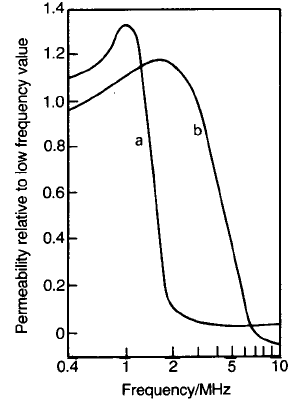
peak. The effect is shown in Fig. 9.32 for two different specimen sizes.
504 MAGNETIC CERAMICS
Fig. 9.31 Dependence of the permeability of the ferrite Ni
0.36
Zn
0.64
Fe
2
O
4
on frequency and
microstructure: S, normally sintered; HP, hot-pressed (after [9]).
9.3.2 Hard ferrites
Permanent magnetic materials are distinguished from the ‘soft’ variety by their
high coercivity H
c
, typically above 150 kA m
71
(see Fig. 9.11). The most common
engineering use to which permanent magnets are put is to establish a magnetic
field in a particular region of space. The magnet must be permanent in the sense
that it is capable of withstanding the demagnetizing effect both of its own internal
field and from externally applied fields such as those encountered in d.c. motors.
A magnet is not a store of energy to be tapped as required until exhausted;
rather, its function is to set up a magnetic potential field in much the same way as
the earth sets up its gravitational field. Work is done as magnetic materials are
moved around in the field, but the net energy change is zero.
The operating state of a permanent magnet lies in the second quadrant of
a B–H hysteresis loop since the magnet is always subject to its own
demagnetizing field. Apart from its coercivity and remanence, a permanent
magnet material is rated by its ‘maximum energy product’ (BH)
max
.
The various parameters are now considered separately by reference to the
important hexaferrites.
Remanence (B
r
)
Remanence is determined partly by the saturation magnetization M
s
and partly
by the extent to which domain development disorients the magnetization
PROPERTIES INFLUENCING MAGNETIC BEHAVIOUR 505
Fig. 9.32 The effect of dimensional resonance on permeability for two MnZn ferrite
components of different sizes; (a) larger and (b) smaller. Permeability values are expressed
relative to those measured at 1 kHz.
vectors on removal of the saturating field. There are two general points to be
made. First, because the magnetism in hexaferrites has its origin in
ferrimagnetic coupling and because a large proportion of the ions in the
crystal are non-magnetic (Ba, Sr, O), their saturation magnetization values (and
hence, in general, their B
r
values as well) are low compared with those of the
metallic magnets. Second, the hexaferrites have high uniaxial anisotropy and
thus B
r
can be improved by tailoring the microstructure so that the crystallites
are oriented to have their c axes (‘easy’ or ‘preferred’ direction) along a chosen
direction; this is also the case with the well-known metallic cobalt alloys
Columax, Alcomax, etc.
506 MAGNETIC CERAMICS
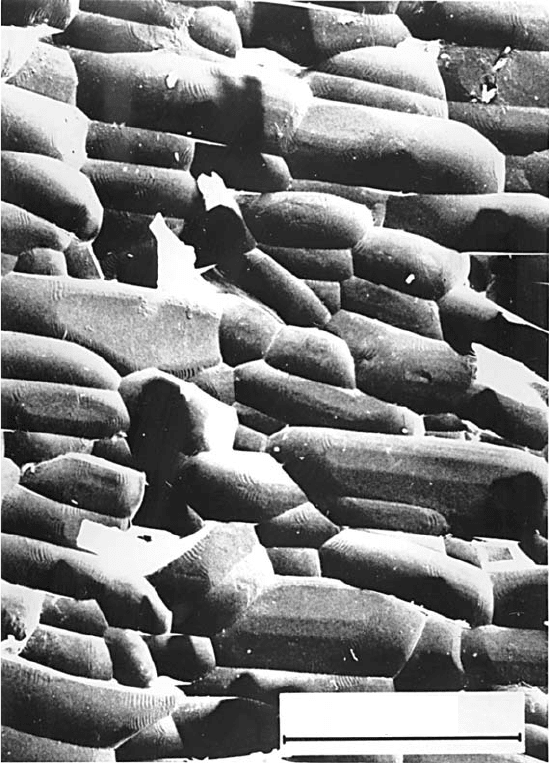
Fig. 9.33 Microstructure of an oriented barium hexaferrite. (Courtesy of Philips Technical
Review.)
5 mm
Although a single hexaferrite crystal might be anisotropic, a ceramic
comprising a very large number of randomly oriented microcrystals is normally
isotropic. Thus the ceramic has a lower remanent magnetization than that
offered by the intrinsic properties of the material. The situation can be
significantly improved by lining up the microcrystals so that their c axes all
point in the direction in which maximum magnetization is required. This is
achieved by subjecting the ferrite particles, usually in the form of a slurry, to a
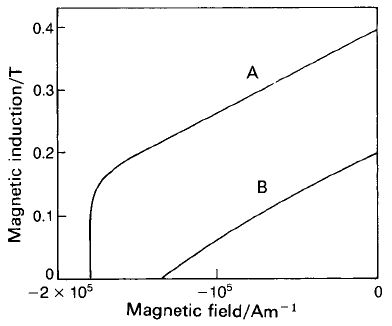
strong magnetic field during the ceramic forming process. Figure 9.33 is a
micrograph showing the alignment of particles and Fig. 9.34 shows the effect on
remanence. As can be seen, it is necessary to distinguish between an oriented
anisotropic and an isotropic hexaferrite ceramic, even though both consist of
anisotropic crystallites.
Coercivity (H
c
)
The high coercivity of the hexaferrites depends basically on their high
magnetocrystalline anisotropy which results in anisotropy fields of approxi-
mately 1400 kA m
71
. However, the coercive fields achieved in practice are only a
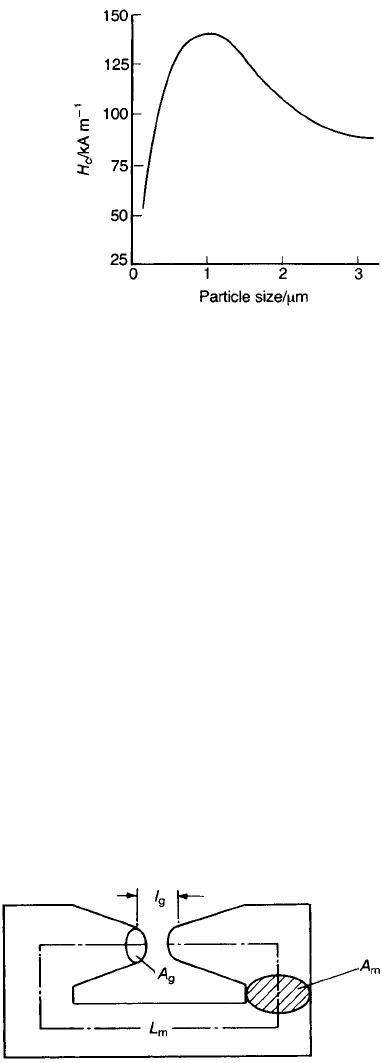
fraction of this value, because smaller fields can cause Bloch wall movements. It
is found that the coercive field is a maximum when the average grain size is
around 1 mm (Fig. 9.35). Reduction in particle size reduces the content of domain
walls because their existence becomes energetically unfavourable when the
volume they would occupy becomes an appreciable fraction of that of a particle
(the width of a domain wall is about 0.1 mm). Also, the small grain size indicates
an absence of grain growth during sintering, and it is during growth that the
grains free themselves from defects such as lattice irregularities, second-phase
PROPERTIES INFLUENCING MAGNETIC BEHAVIOUR 507
Fig. 9.34 Demagnetization curves for an oriented barium hexaferrite (curve A) and an
isotropic hexaferrite (curve B).
inclusions and porosity. Small grains are therefore likely to be highly defective so
that any domain walls are tightly pinned.
‘Maximum energy product’ (BH)
max
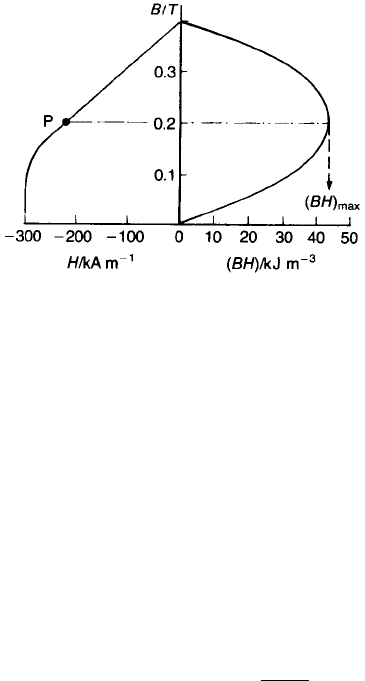
Consider a permanent magnet designed with the intention of setting up a
magnetic field between its pole pieces (Fig. 9.36).
Applying Ampe
`
re’s circuit theorem to the magnetic circuit and noting that the
total flux remains constant leads to
ðB
g
H
g
ÞV
g
¼ðB
m
H
m
ÞV
m
ð9:34Þ
where B
g
, B
m
and H
g
, H
m
are respectively the fluxes and fields in the air gap and
the magnetic material (H
m
is the demagnetising field), and V
g
and V
m
are the gap
and material volumes. Since the magnetic energy density is proportional to the
product of B and H, equation (9.34) states that, for a magnet of given volume
V
m
, the magnetic energy in the gap is a maximum when the product B
m
H
m
is a
maximum. Therefore (BH)
max
is a figure of merit for a permanent magnet
508 MAGNETIC CERAMICS
Fig. 9.35 The dependence of coercivity on the particle size of a barium hexaferrite powder.
Fig. 9.36 Permanent magnet with an air gap.
material. As is evident from Fig. 9.34, the energy product is also significantly
improved by the particle-orienting fabrication process.
Figure 9.37 shows a typical demagnetization curve for a hard ferrite together
with the energy product curve. A horizontal line from the ( BH)
max
point
intersects the demagnetization curve to define the optimum working point P. The
magnetic-circuit designer can arrange for the magnet to operate at P by
appropriate design of magnet shape, since this determines the demagnetizing
field.
Since at remanence B
r
¼ m
0
M
r
, where M
r
is the remanent magnetization, the
demagnetizing field is given by
H
D
¼N
D
M
r
¼
N
D
B
r
m
0
ð9:35Þ
If H
D
exceeds a certain field strength H
i
, it will reduce the remanent
magnetization permanently. For the magnet to retain its full strength it is
therefore necessary that H
i
4H
D
, i.e. H
i
4N
D
B
r
/m
0
or m
0
H
i
/B
r
4N
D
. This relation
indicates that shapes with large demagnetizing factors may not retain their
remanent magnetization. As a rough guide H
i
can be replaced by H
c
, and it is one
of the advantages of ceramic permanent magnet materials that the value of
m
0
H
c
=B
r
is close to unity so that they can be used in shapes with high
demagnetizing factors such as large thin discs. Ceramic magnets in the form of
discs are most efficient when their thickness-to-diameter ratio is 1:2 since they
then operate near the point P in Fig. 9.37, but they can also be used effectively
with much larger aspect ratios (i.e. flatter discs). Ni–Al–Co magnets, however,
have a m
0
H
c
=B
r
ratio of about 0.1, so that if they are in the form of cubes
(N
D
0.3), for example, the remanent magnetization would not be retained.
Such metal magnets operate most efficiently when in the form of rods with
length-to-diameter ratios of about 5.
PROPERTIES INFLUENCING MAGNETIC BEHAVIOUR 509
Fig. 9.37 Demagnetization and energy product curves.
510 MAGNETIC CERAMICS
Table 9.3
Typical properties of some important magnetic materials
m
ri
m
r max
(tan d=
m
ri
)/10
76
H
c
/A m
71
B
s
/T T
c
/8C
r=O m
Soft materials
Fe
150 5000
–
80
2.16 770 106
10
78
Fe+4%Si
2000 35 000
–
30
1.93 690 606
10
78
Mumetal
a
50 000 200 000
–
3.0
0.75 350 556
10
78
MnZn ferrites
500–10 000 – 1 at 10 kHz to
50 at 1000 kHz
5–100 0.35–0.50 90–280 0.01–1
NiZn ferrites
10–2000 – 20 at 100 kHz to
200 at 100 MHz
15–1600 0.10–0.40 90–500 10
3
–10
7
(BH)
max
/kJ m
73
H
c
/kA m
71
B
r
/T
T
c
/8C
Hard materials
Carbon steel
b
1.6
4.4 0.9
770
Ticonal GX
c
60
58
1.35 860
Nd
15
Fe
76
B
8
360
800
1.4
310
Isotropic barium ferrite
6.0
200
0.3
450
Anisotropic (oriented) barium
ferrite
35
320
0.4
450
a
77Ni–16Fe–5Cu–2Cr.
b
Approximately 1% C.
c
14Ni, 8Al, 24Co and 3Cu.

9.3.3 Summary of properties
Table 9.3 summarizes typical values of the relevant properties of some of the
important magnetic material types.
9.3.4 Microwave ferrites
Conventional electronic circuits handling frequencies of up to, say, 300 MHz
(l 1 m) usually comprise resistors, capacitors, inductors, diodes and transistors
to control energy flow. As the frequency increases so the wavelengths approach
the dimensions of the circuit and microwave techniques dominate. Although
there is no clear defining lower-frequency limit for microwaves, typically they lie
in the range 1–300 GHz (wavelengths in the range 30 cm to 1 mm). In the context
of waveguide technology microwave frequency bands are designated code letters
as listed in Table 9.4.
Microwaves can be propagated down a waveguide, which is simply a metal
‘pipe’, and since the advent of microwave technology materials have been
introduced into waveguides to change their propagation characteristics; devices
such as isolators, gyrators, phase shifters and circulators are based on this
approach. Certain ferrites play an important role in these devices, principally
because their high electrical resistivity coupled with low magnetic losses lead to
what in this context is called ‘low insertion loss’. Therefore microwaves can pass
some considerable distance through the ferrites and, while doing so, are modified
in a predetermined way by interaction between the magnetic and electric field
components of the wave and the magnetic and dielectric properties of the
material; when electromagnetic waves pass through non-magnetic dielectrics (cf.
Chapter 8) it is only the interaction between the electric field component and the
material which is significant.
When a magnetic field H is applied to a spinning electron the angular
momentum vector is inclined at an angle to the field direction. Because a
magnetic moment is associated with the angular momentum, the electron
experiences a torque and precesses around the field direction with the Larmor
angular frequency o
L
¼ 2p f
L
¼ gm
0
H. This is analogous to the precessional
motion of a spinning top with its axis of rotation inclined to the gravitational
field.
PROPERTIES INFLUENCING MAGNETIC BEHAVIOUR 511
Table 9.4 Microwave band designations
Frequency
range/GHz
1.12–
1.70
1.70–
2.60
2.60–
3.95
3.95–
5.85
5.85–
8.20
8.20–
12.4
12.4–
18.0
18.0–
26.5
26.5–
40.0
40.0–
60.0
60.0–
90.0
90.0–
140.0
140.0–
220.0
Designation L R S H C X Ku K Ka U E F G