
Moulson A.J., Herbert J.M. Electroceramics: Materials, Properties, Applications
Подождите немного. Документ загружается.

522 MAGNETIC CERAMICS
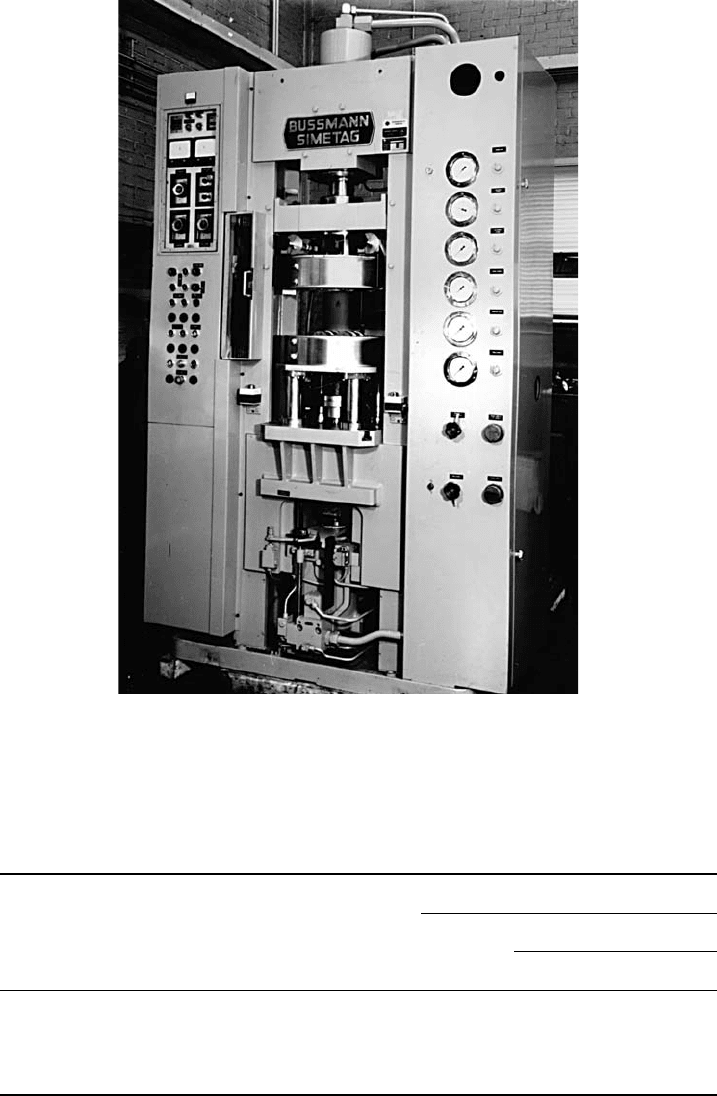
Fig. 9.43 Production press for oriented ferrite components. (Courtesy of Philips Technical
Review.)
Table 9.5 Properties of barium ferrites made using different processes
Sintered
Calendered with
Anisotropic
Property Unit polymer Isotropic Extruded Wet pressed
Remanence T 0.16 0.20 0.30 0.40
Coercivity kA m
71
112 140 150 180
(BH)
max
kJ m
73
5 7 15 30
Density kg m
73
3400 4800 4800 4800
TEAMFLY
Team-Fly
®
PREPARATION OF FERRITES 523
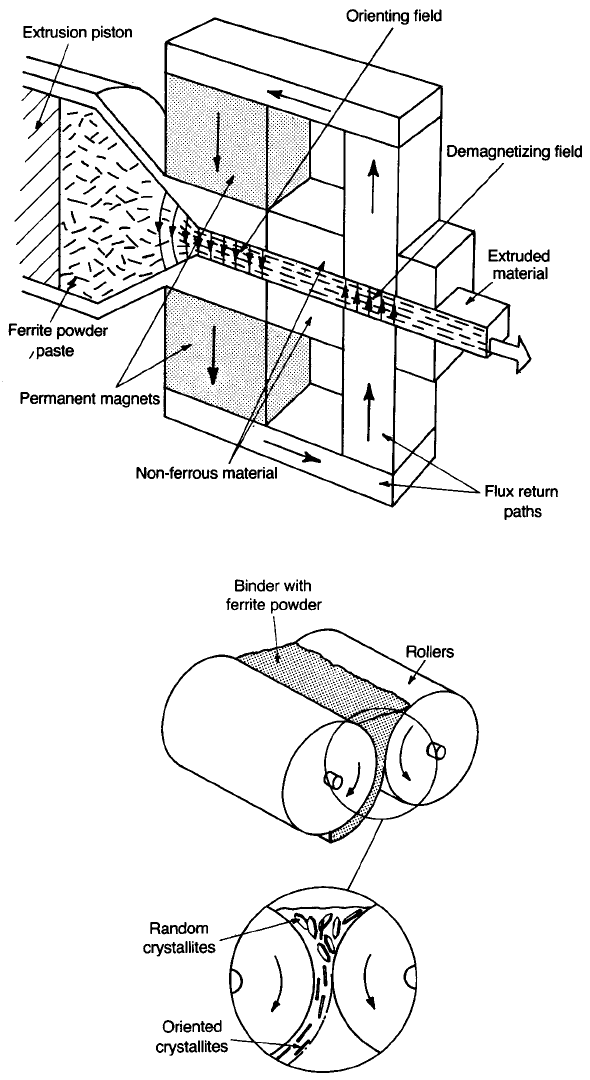
Fig. 9.44 Orientation of particles during extrusion.
Fig. 9.45 Orientation of particles during calendering.
calendering, that is by passing a mixture of polymer and ferrite between closely
spaced rollers rotating at different speeds. The strong shearing action as the
mixture passes through the nip between the rollers both disperses the powder and
orients the plate-like particles (Fig. 9.45). Some 20–30 passes through a nip 1 mm
wide may be needed to give the maximum effect.
The principal properties obtainable with the various processes are compared in
Table 9.5.
9.4.6 Finishing
Machining the sintered ferrite is expensive, so that all possible control over shape
and dimensions is concentrated in the pressing operation and the sintering
conditions must be sufficiently uniform to keep dimensions within specification.
However, certain surfaces may have to be improved in smoothness and flatness
so that they can form magnetic circuits by contact with other components with a
minimum air gap. Pot-cores have their mating surfaces lapped, and the E, C and
I cores used in high-frequency transformers have mating surfaces ground flat and
parallel. In many instances hard ferrite magnets are required to fit into metal
housings or onto other components, and some diamond grinding is usually
required to achieve the required dimensional tolerances.
9.5 Applications
9.5.1 Inductors and transformers for small-signal
applications
A major use of high-quality pot-core inductors is in combination with capacitors
in filter circuits. They were once extensively used in telephone systems but solid
state switched systems have replaced them. The soft MnZn and NiZn ferrite
systems are dominant for pot-core manufacture, although metal ‘dust cores’ are
used for certain applications. The important design principles can be understood
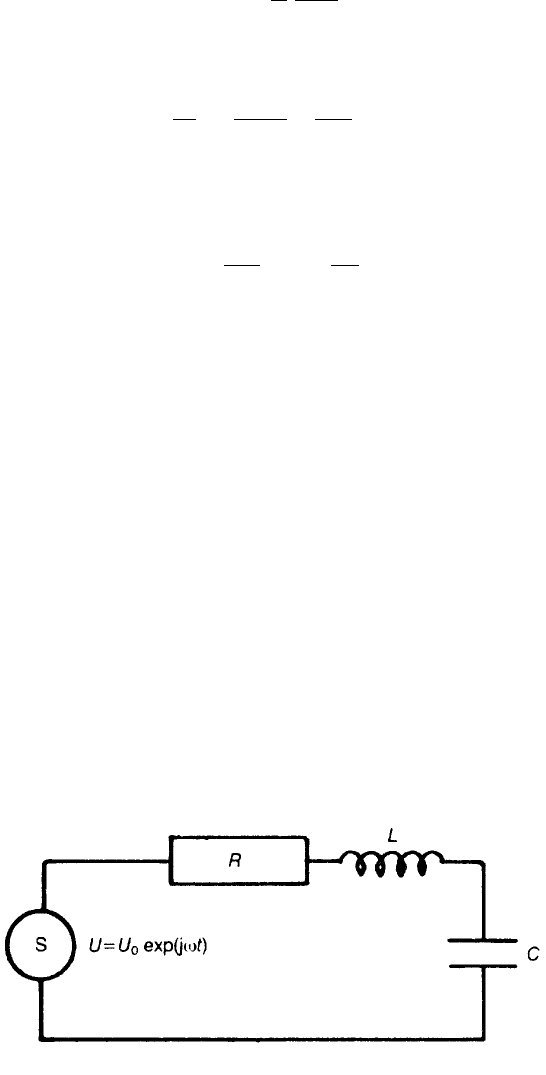
by reference to a simple series LCR circuit to which a sinusoidal voltage U of
angular frequency o is applied (Fig. 9.46). The circuit impedance
Z ¼ R þ jðoL 1=oCÞ is a minimum when oL ¼ 1=oC. Thus the resonant
frequency o
0
is given by
o
0
¼ðLCÞ
1=2
ð9:48Þ
At this frequency the current through the circuit is a maximum and the total
applied voltage U appears across R; the voltages across L and C are out of phase
by p. The current through the circuit is U/R and the voltage across C is
524 MAGNETIC CERAMICS
U
c
¼
U
R
1
jo
0
C
It therefore follows from this and Eq. (9.48) that
U
c
U
¼
1
o
0
RC
¼
o
0
L
R
¼ Q ð9:49Þ
where Q is the ‘circuit magnification factor’ or ‘quality factor’. It can also be
shown that
Q ¼
o
0
2do
or
f
0
2df
ð9:50Þ
where do (or df ) is the change in o (or f ) from o
0
(or f
0
) required to reduce the
power dissipated in the circuit to half the resonance value. Alternatively, in terms
of voltages, do is the change from o
0
required to reduce the voltage across C (or
L)to1/
p
2 of its peak resonance value. The circuit is therefore selective in its
response to signals of different frequency, and Q measures selectivity. The
practical aim is usually to maximize the circuit Q, and from Eq. (9.49) this
requires L and R to be maximized and minimized respectively. In order to
achieve a high circuit Q the materials which are used in the circuit components
must be chosen with care.
As discussed in Section 9.3.1, the quality of the ferrite is measured by its loss
factor (tan d)/m
ri
which should be as small as possible, and in the following
discussion it is assumed that this is the case.
The inductance L of the core is given by
L ¼ m
re
m
0
n
2
D ð9:51Þ
where m
re
is the effective relative permeability, n is the number of turns and D is a
constant depending upon core geometry. It follows that, for a given L, a higher
m
re
will allow n to be reduced proportionately to m
1=2
re
. A decrease in the number
APPLICATIONS 525
Fig. 9.46 Series LCR circuit.
of turns results in lower winding-resistance losses (the so-called ‘copper losses’)
and hence higher Q; a high m
re
also enables the core size to be kept small.
There are two ferrite material properties which were not discussed in Section
9.3.1 but which are important in the inductor context: they are the temperature
and time stabilities of the permeability which, of course, determine the stability
of the inductance. The temperature coefficient of permeability must be low, and
this has been achieved for certain MnZn ferrite formulations as indicated in
Fig. 9.18. A small residual temperature coefficient of inductance can be
compensated by a suitable coefficient of opposite sign in the capacitance of the
resonant combination.
526 MAGNETIC CERAMICS
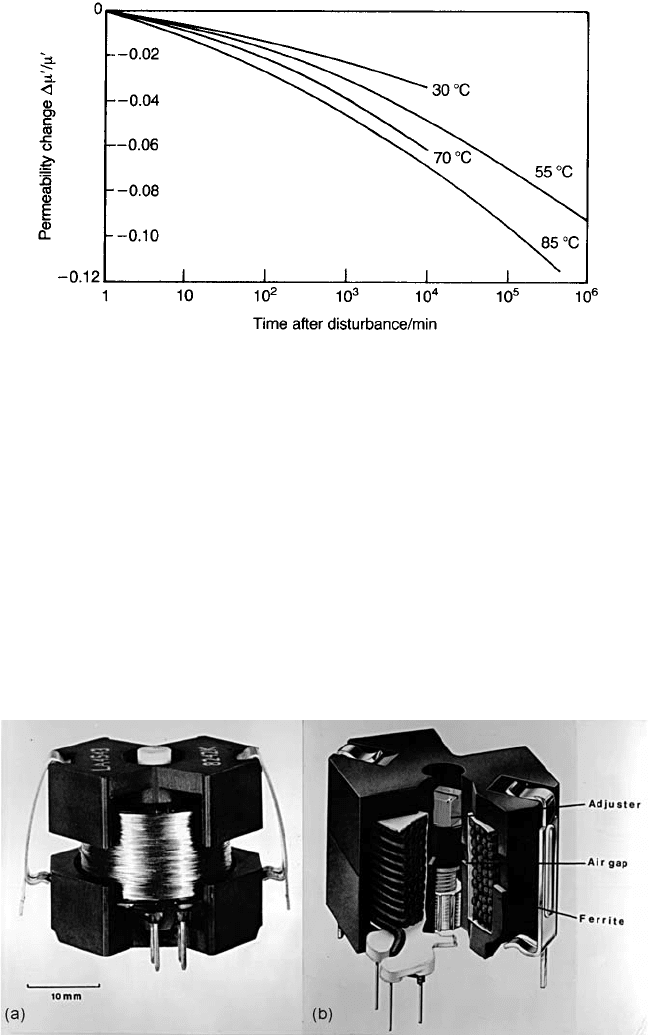
Fig. 9.47 Change in permeability with time or ‘disaccommodation’.
Fig. 9.48 Pot core: (a) complete unit; (b) schematic diagram of structure. (Courtesy of Philips
Components Ltd.)
A time variation in inductance arises because the permeability diminishes after
the establishment of a fresh magnetic state; this effect is known as
‘disaccommodation’ and is illustrated in Fig. 9.47.
The fall in permeability is roughly proportional to the logarithm of time.
Therefore, if there is a loss of 1.5% between 1 min and 1 week (approximately
10
4
min), it will take 10
4
weeks (about 200 years) for the loss of a further 1.5% to
occur! Disaccommodation is thought to be due to the directional ordering of ion
pairs such as Mn
2+
and Fe
2+
, and it is increased by a high concentration of
metal ion vacancies which favours ionic diffusion. The vacancy concentration
can be kept low by minimizing the oxygen in the sintering atmosphere.
The permeability is also affected by stress: the induced change decays
logarithmically with time as a form of disaccommodation. Inductors are usually
made in two parts so that the winding can be introduced on a bobbin; the parts
must then be joined closely together to prevent the permeability from being
affected by an uncontrolled air gap. If a mechanical clamp is used, the force must
not be excessive and must be the same in similar units. Its effect must be allowed
to decay before the inductance value is finally adjusted.
A typical design of a pot core for an inductor is shown in Fig. 9.48. There is a
gap in the central limb of the core when the surfaces of the outer parts are in
contact. There is also a hole through the centre of the core into which a
magnetizable rod can be inserted. The position of this rod relative to the gap can
be altered so as to adjust the value of the inductance. Apart from allowing this
adjustment, the gap reduces and controls the magnetic losses of the core (Eq.
(9.12)). If m
r
is the relative permeability without a gap and m
re
is the relative
permeability with a gap, the losses due to the core (tan d
m
¼ 1=Q), its
temperature coefficient and changes due to disaccommodation are all reduced by
the factor m
re
=m
r
(see Section 9.1.4). In many filter applications a constant
bandwidth is required over a wide range of frequencies so that the ratio of
bandwidth to centre frequency diminishes as the frequency increases. Q therefore
needs to be higher and tolerance on inductance variations less at higher
frequencies. This can be achieved, without altering either the core design or the
ferrite composition, by increasing the gap width. Cores are manufactured with
diameters ranging from 10 to 45 mm and inductance values ranging from the
order of microhenries to 5 H. Various core geometries are available (Fig. 9.17)
but no new principles are involved. Choice is determined mainly by considera-
tions such as size economy and compatibility with printed-circuit-board
technology.
In the use of ferrites as inductors for tuned circuits, the Q of the materials is of
prime importance. Wide-band transformers are also used extensively in
communications systems, for example to transform signal voltages and to
provide impedance matching and d.c. isolation of one part of a circuit from
another. Pulse transformers are of increasing importance because of the rapidly
growing use of pulsed signals in communications technology. Since a pulse can
APPLICATIONS 527
be synthesized from its Fourier components, a pulse transformer needs to be, in
effect, a wide-band transformer. An analysis of the equivalent circuit for a
transformer shows that core losses have little effect on the transformer’s
efficiency, provided that they are acceptable at the lower end of the frequency
band to be transmitted. For example, an MnZn ferrite is a perfectly acceptable
material for a wide-band transformer for the frequency range 100 kHz to
50 MHz. The reason for this is that as the frequency increases the core losses
(equivalent to a resistance shunting the transformer’s mutual inductance)
become less significant compared with the impedance of the transformer. For
wide-band transformers it is the high initial permeability of the MnZn ferrites
coupled with an acceptably low loss which makes them the favoured material.
Because mating surfaces must inevitably lead to a reduction in effective
permeability, the transformer cores are available in toroid as well as pot-core
forms.
An important application of ferrites is for shielding sensitive equipment (e.g.
data-processing, telecommunications and audio-visual equipment) from electro-
magnetic interference (EMI). Both NiZn- and MZn-based ferrites components
are capable of suppressing interference up to the GHz frequency range by virtue
of the high impedance they present to high frequency currents. The ferrite parts
are made in a variety of shapes to enclose the leads to be shielded, as shown in
Fig. 9.17.
Multilayer technology is exploited just as for multilayer capacitors (see Section
5.4.3) to EIA size specifications, and inductor chips can be bandoliered ready for
surface mounting, typical inductance values lying in the range 1 nH to about
20 mH. They find important applications as EMI suppressors as well as for a wide
range of applications as a lumped circuit component in equipment of all types –
communications, ‘entertainment’, computers, etc. (see Fig. 9.17).
9.5.2 Transformers for power applications
There are many high-frequency (typically 1 kHz to 1 MHz) applications where a
high saturation flux density is the prime requirement. Examples are power
transformers to transmit a single frequency, those required to transmit over a
narrow frequency band, as in the power unit of an ultrasonic generator, and
wide-band matching transformers to feed transmitting aerials. Television line
output transformers are, commercially speaking, important examples of power
transformers and, although not a transformer, the beam deflection yoke
(Fig. 9.17) falls into the same category.
The saturation magnetization of ferrites (about 0.5 T) is too low for them to
compete with Si–Fe laminations (about 2.0 T) at power frequencies. At higher
frequencies eddy current losses preclude the use of metallic ferromagnets, and
ferrites are widely used.
528 MAGNETIC CERAMICS
The growth in the demand for switch mode power supplies has led to a
corresponding demand for high-frequency ferrite-cored power transformers. The
switch-mode principle is not new, and it is the availability of suitable power-
switching transistors, rectifiers, capacitors and ferrite cores which has enabled
full advantage to be taken of the small size and inherent efficiency of the type of
supply. In a typical unit the mains supply is rectified, smoothed and chopped at a
high frequency, usually in the range 25–100 kHz, by a power transistor. This
chopped voltage is transformed to the desired voltage by a ferrite-cored
transformer and finally rectified and smoothed. Transformers capable of
handling up to 2 kW are readily available.
As far as material properties are concerned, the general requirements of
ferrites for power applications are similar to those for pot cores, but the
permeability can be allowed to vary more widely. As high fields are likely to be
applied, the hysteresis losses will be important. They can be minimized by
keeping the crystalline anisotropy to a low level, for instance by substituting
cobalt for about 1% of the nickel in (Ni,Zn)Fe
2
O
4
(cf. Table 9.1). The internal
shape anisotropy due to inhomogeneities and porosity can be minimized by
ensuring that mixing, pressing, and sintering conditions are such as to yield a
homogeneous high-density body.
As expected, the NiZn ferrite system is available for the higher frequencies (up
to approximately 5 MHz), whereas for frequencies up to about 100 kHz the
MnZn ferrites are favoured because of their higher permeabilities.
The shapes used are mostly simple E or C cores and I bars (Fig. 9.49). These
allow simple high-speed winding machines to be used either to put windings
directly on the ferrites or to wind bobbins which can be slipped onto the
accessible limbs. The C and E cores must have their magnetic circuits completed
by securing I cores across the appropriate limbs. The mating surfaces must be
ground so that the air gap is minimal. Alternatively, cores can be fabricated as
closed magnetic circuits and fractured into parts onto which windings can be
fitted. The ceramic texture must be such that the two parts can then be clamped
together without any damage to the mating surfaces. The process of fracturing is
assisted by pressing grooves into the ‘green’ shape and can be achieved either
mechanically or through thermal stress by the local application of a flame or a
hot wire. Careful production control is needed to give a good yield of suitable
fractures.
APPLICATIONS 529
Fig. 9.49 Transformer core shapes.

Ferrites having a square hysteresis loop (e.g. (Mg, Mn, Zn) Fe
2
O
4
), developed
for the now outdated computer core memories, have found applications in the
form of a toroidal ‘saturable inductor’ for regulating the output currents in
switched-mode power supplies.
9.5.3 Antennas
Small antennas comprising a suitable winding on a ferrite rod are needed for
radios, pagers and for RF identification transponders. In the case of a
transponder information is stored in a tag (an application for ferroelectric
memories – see Section 5.7.5), which can be read by a signal from an
interrogating unit. The cylindrical rods (Fig. 9.17) are precisely dimensioned
with sizes down to 0.76 mm diam. by 4.82 mm. The tag carries no battery,
sufficient power to transmit the stored information being derived from the
interrogating signal. Applications include car key identification so that if the
correct code is not detected then the steering wheel and fuel supply are blocked,
airport baggage checks, control of access to buidings and traceability in food
chains.
A short winding of n turns of area A will develop an e.m.f. of amplitude U if
placed in an alternating magnetic field of angular frequency o and amplitude H,
where
U ¼ m
0
oHAn ð9:52Þ
If a long rod of effective relative permeability m
re
is inserted in the coil the e.m.f.
becomes
U ¼ m
0
m
re
oHAn ð9:53Þ
Because the magnitudes of the electric and magnetic vectors of an electro-
magnetic wave are related by H ¼ðe
0
=m
0
Þ
1=2
E and the wave velocity in vacuo is
given by c ¼ðe
0
m
0
Þ
1=2
, it follows that
U ¼ m
re
o
An
c
E
A figure of merit for an antenna is the effective height h
e
, where
h
e
¼ U=E ð9:54Þ
and, since c ¼ðo=2pÞl where l is the wavelength,
h
e
¼ 2pm
re
An
l
ð9:55Þ
Therefore h
e
will increase at shorter wavelengths and with increased m
re
, which is
related to the material permeability m
r
by Eq. (9.9). Values of h
e
for two materials
530 MAGNETIC CERAMICS
are given in Table 9.6. The h
e
values are very small compared with, for example,
those for a correctly designed dipole interacting with the E vector of the
electromagnetic field. By comparison with a dipole the ferrite-cored antenna is
very inefficient, but very much more compact!
The signal power available to the first stage of a receiver is proportional to
h
e
2
Q
a
, where Q
a
is the inverse of the loss tangent for the rod and coil combination
together with any metal objects that may absorb or distort the radiation. It is
therefore important that the ferrite should have low losses in the frequency range
for which the antenna is designed. (Ni,Zn)Fe
2
O
4
is used at frequencies above
1 MHz since its losses are less than those of (Mn,Zn)Fe
2
O
4
. Figure 9.29 gives the
permeability and loss for some compositions of the former type as a function of
frequency and for a range of zinc contents.
Since the ferrite is required in rod form it is usually made by extrusion. A
simple circular section is sometimes replaced by one having ribs parallel to the
axis of a central cylinder. This structure is intended to avoid the effects of
dimensional resonance (see Section 9.3.1) which would cause the antenna to have
poor response over a small part of its total frequency range. The effect of a
ribbed structure is that only a fraction of the material will have a resonant
dimension at any particular frequency so that, compared with an unribbed rod,
there will be a minor drop in effective height over a wider frequency band. The
relatively high losses at megahertz frequencies usually damp the resonance and
their effects can be largely eliminated by suitable design.
9.5.4 Information storage and optical signal processing
Information storage
The continuously evolving technologies concerned with information storage are
many and complex and involve metals, ceramics and polymers in active roles.
The following discussion is concerned only with those aspects which involve
ceramics and is therefore very restricted. Comprehensive descriptions of the
APPLICATIONS 531
Table 9.6 Antenna rod dimensions and properties
m
r
Length/mm Diameter/mm
Demagnetizing
factor N
D
m
re
h
e
/mm
175 200 9.5 0.0043 100 5.9
175 150 12.7 0.0112 59 6.3
500 200 9.5 0.0045 154 9.1
500 150 9.5 0.0073 108 6.4
Short central winding of 40 turns; 1 MHz ( ¼ 300 m).