
Moulson A.J., Herbert J.M. Electroceramics: Materials, Properties, Applications
Подождите немного. Документ загружается.

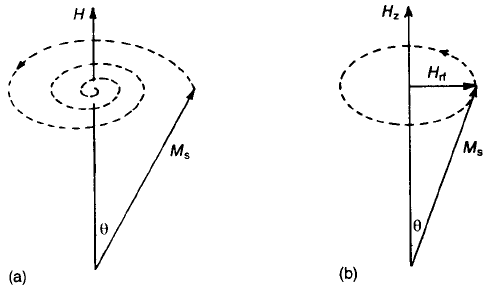
In the case of ferromagnetic and ferrimagnetic materials the spins are strongly
coupled over the region of a domain, but when a sufficiently strong magnetic
field is applied the domain structure disappears and the material possesses a
magnetization vector M
s
which precesses around H with the Larmor frequency.
Because of the spin–orbit lattice coupling the precessional energy is steadily
dissipated, and in consequence M
s
gradually spirals in towards the H direction as
indicated in Fig. 9.38(a). A measure of the time taken for the energy transfer to
occur is the relaxation time t.
The precessional motion can be maintained by a suitable radio frequency field
superimposed on the steady field. For example, in Fig. 9.38(b), when a steady
field H
z
is applied along the z axis and a radiofrequency field H
rf
is applied in the
x–y plane and rotates in the same sense and at the same frequency as the
precession, resonance occurs. ‘Gyromagnetic resonance’ as outlined above is in
principle the same as ‘ferrimagnetic resonance’ referred to earlier (Section 9.3.1),
except that in the former case the material is magnetically saturated by a strong
applied field. In practice the steady field, which determines the Larmor
frequency, is made up of the externally applied field, the demagnetizing field
and the anisotropy field, and is termed the effective field H
e
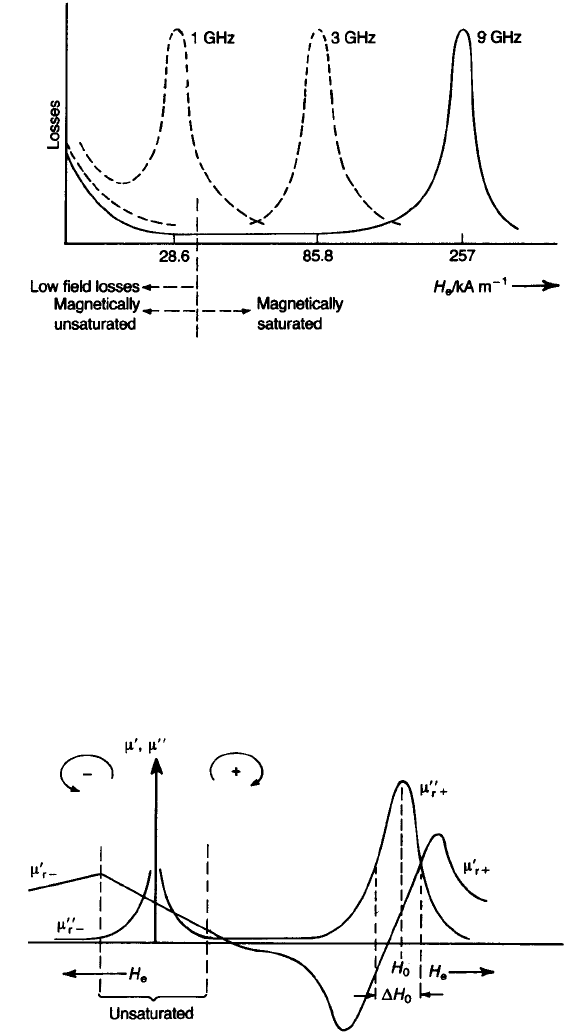
. Figure 9.39 shows
the H
e
values at which resonance occurs in some of the important communica-
tions and radar frequency bands.
At low applied fields, when the ferrite is magnetically unsaturated, broad-band
losses occur, the so-called ‘low-field losses’, and the increasing loss as H
e
decreases can be identified with that occurring on the high-frequency side of
the peaks in Figs 9.29 and 9.31. Low-field losses arise because the radio-
frequency field resonates with the magnetization in individual domains which
precesses around the anisotropy field H
A
. It can be shown that this resonance
occurs over a range of frequencies between m
0
gH
A
and m
0
gðH
A
þ M
s
Þ; thus, to
512 MAGNETIC CERAMICS
Fig. 9.38 Precessional motion of magnetization: (a) M
s
spiralling into line with H as the
precessional energy is dissipated; (b) precession maintained by an applied radio frequency
field.
TEAMFLY
Team-Fly
®
avoid the onset of low-field losses in low-frequency applications, it is necessary
for H
A
and M
s
to be as small as possible.
To understand the principle of operation of important ‘non-reciprocal’ (see
below) microwave devices, consider what occurs when a plane-polarized
microwave is propagated through a ferrite in the direction of a saturating field
H
e
. The wave can be resolved into two components of equal amplitude
but circularly polarized in opposite senses, i.e. into a ‘right-polarized’ and a
‘left-polarized’ component. These two components interact very differently with
the material, leading to different complex relative permeabilities
m*
r
þ
¼ m
0
r
þ
jm@
r
þ
and m*
r
¼ m
0
r
jm @
r
, as shown in Fig. 9.40. Because of the
PROPERTIES INFLUENCING MAGNETIC BEHAVIOUR 513
Fig. 9.39 Effective field values H
e
at which resonance occurs in some important frequency
bands.
Fig. 9.40 Dependence of the permeability on H
e
for ‘right’ and ‘left’ circularly polarized
components of a plane-polarized microwave of frequency o ¼ gm
0
H
0
.

different permeabilities, the phase velocities of the two components differ, so that
the negative, or left, component is retarded relative to the positive, or right,
component, causing a clockwise rotation of the plane of polarization. The sense
of the rotation relative to H
e
does not depend on the direction of propagation.
Thus, if a plane wave is rotated 458 in the clockwise sense during its passage
through a saturated ferrite, then if it were to be reflected back, it would suffer a
further 458 rotation. Because of this the process is said to be ‘non-reciprocal’.
A rigorous analysis of the interaction of the microwave field with the
precessing magnetization involves the tensor permeability and is beyond the
scope of the present text. For the case of a plane-polarized wave of angular
frequency o propagating through a magnetically saturated ferrite in the direction
of the saturating field, such an analysis yields
m
r
þ
¼ 1 þ
o
M
o
0
o
ð9:36Þ
and
m
r
¼ 1 þ
o
M
o
0
þ o
ð9:37Þ
in which m
r
þ
and m
r
are the relative permeability values for the right and left
circularly polarized components respectively, o
M
¼ m
0
gM
s
and o
0
¼ m
0
gH
0
, H
0
is
the resonance field and M
s
is the saturation magnetization.
Because the wave velocities
v
þ
and v
of the two components differ, a phase
difference f develops between them as they propagate. The plane of polarization
is thus rotated by an angle y ¼ f=2. The angular rotation y=L of the plane of
polarization per unit path length can be estimated as follows. Suppose that the
plane-polarized wave travels a distance L through a medium of relative
permittivity e
r
and relative permeabilities m
r
þ
and m
r
. If the average velocity is
v, then the fast and slow components travel distances of ðL=vÞv
þ
and ðL=vÞv
respectively, where v
þ
and v
are the fast and slow speeds. The path difference is
D ¼
L
v
ðv
þ
v
Þð9:38Þ
and the phase difference is
f ¼
L
v
ðv
þ
v
Þ
2p
l
ð9:39Þ
where l is the average wavelength. The plane of polarization is therefore rotated
through y where y ¼ f/2
y ¼
Lp
vl
ð
v
þ
v
Þ
and
514 MAGNETIC CERAMICS

y
L
¼
p
vl
ð
v
þ
v
Þð9:40Þ
Since
v
2
v
þ
v
y
L
¼
pv
l
1
v
1
v
þ
¼ p f
1
v
1
v
þ
ð9:41Þ
where f is the frequency of the wave. Because
v
¼
c
ðm
r
e
r
Þ
1=2
and v
þ
¼
c
ðm
r
þ
e
r
Þ
1=2
ð9:42Þ
where c is the velocity of light in a vacuum,
y
L
¼
oe
1=2
r
2c
ðm
1=2
r
m
1=2
r
þ
Þð9:43Þ
For a device operating below resonance the applied field is small compared
with H
0
, although sufficiently strong for the ferrite to be magnetically saturated.
Under these conditions o
0
o and o
M
5o, and therefore it follows from Eqs
(9.36) and (9.37) that
m
1=2
r
þ
1
1
2
o
M
o
ð9:44Þ
and
m
1=2
r
1 þ
1
2
o
M
o
ð9:45Þ
Therefore Eq. (9.43) becomes
y
L
¼
e
1=2
r
2c
o
M
¼
e
1=2
r
2c
m
0
gM
s
ð9:46Þ
In a typical case where e
r
¼ 10 and M
s
¼ 170 kA m
71
, y=L ¼ 108 mm
71
.
The width DH
0
of the resonance absorption curve measured at half peak
power – the ‘3 dB resonance line width’ – should in general be as small as
possible since this implies a narrow range of frequencies over which strong
interaction with the ferrite can occur; however, there are certain broad-band
applications where this would not be the requirement. There are two main
contributions to the linewidth:
1. the intrinsic linewidth characteristic of the single crystal and
2. additional effects arising in the case of polycrystalline materials and influenced
by magnetic anisotropy and microstructural features.
PROPERTIES INFLUENCING MAGNETIC BEHAVIOUR 515
The intrinsic single-crystal linewidth can be shown to be inversely proportional
to the relaxation time.
In a polycrystalline material each crystallite experiences its own effective field,
which is determined in part by magnetic anisotropy. Therefore, because of the
different orientations of the crystallites, there will be a distribution of resonant
frequencies; in consequence, narrow linewidths are associated with low
anisotropies. Magnetic inhomogeneities – inclusions and pores – also disturb
the local effective fields and so lead to line broadening. The effect of porosity on
resonance linewidth can be expressed by the relationship
DH
p
¼ 1.5M
s
pð1 pÞð9:47Þ
where p is the fractional volume porosity. Thus it is evident that a pore-free
single-phase microstructure is necessary for minimum linewidth.
There is also a strong dependence of resonance linewidth on surface finish,
which is exemplified by the following data for small (0.35 mm diameter) YIG
spheres in a resonant cavity. The linewidths for surfaces finished with 15 mm grit,
5 mm grit and ‘highly polished’ were 560 A m
71
, 240 A m
71
and 40 A m
71
respectively.
At high microwave powers ‘spin waves’ may be excited rather than the
uniform precession discussed so far. Power from the radiofrequency field is then
coupled into the spin-wave system and the energy dissipation shows a higher
than proportional increase with increasing power. The power threshold P
c
at
which spin-wave resonance sets in is measured in terms of a material parameter
DH
k
, the spin-wave linewidth, which is a measure of the damping of the spin
waves. There are two approaches to increasing DH
k
and thus the microwave
power-handling capability of the ferrite – tailoring the composition or tailoring
the microstructure. For example, the substitution of holmium and dysprosium
for gadolinium in Y
2.9
Gd
0.1
Fe
5
O
12
leads to an approximately tenfold increase in
516 MAGNETIC CERAMICS
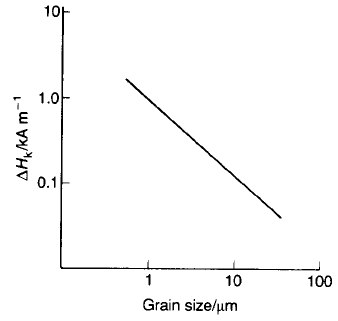
Fig. 9.41 Dependence of the spin-wave linewidth DH
k
on grain size.
DH
k
. In addition, the spin waves can be strongly damped if the grain size of a
polycrystalline ceramic is kept small. For example, Fig. 9.41 shows that a
reduction in grain size from 30 mmto1mm increases D H
k
by a factor of
approximately 30 and thus, because P
c
/ DH
2
k
, increases the power-handling
capability by a few orders of magnitude. Therefore, although single crystals offer
the optimum microwave properties at low fields, a fine-grained material performs
more satisfactorily at high power levels.
9.4 Preparation of Ferrites
The choice of composition of a soft ferrite is made to achieve one or more of the
following properties:
1. maximum permeability;
2. minimum losses;
3. temperature variation of properties between prescribed limits;
4. adequate saturation magnetization;
5. satisfactory behaviour over the required frequency band;
6. finally but by no means the least important, minimum cost.
The basic choice of composition for the great majority of applications lies
between MnZn and NiZn ferrites. The former have a lower material cost and are
superior in all the above properties except 5 and the latter are more suitable for
operation at higher frequencies. (MnZn)Fe
2
O
4
has the disadvantage of requiring
a low oxygen pressure atmosphere during sintering so that its manufacture
necessitates a special kiln with a supply of suitable gas for the atmosphere.
(NiZn)Fe
2
O
4
can be fired in air. Fabrication generally follows the lines described
in Chapter 3. Features unique to ferrites are outlined below.
9.4.1 Raw materials
The raw materials can be minerals that have only been purified by mechanical
methods or the purer products of chemical processes. Both haematite (Fe
2
O
3
)
and magnetite (Fe
3
O
4
) occur in large deposits of better than 90% purity that, for
some ferrites, require little more than grinding before use. A purer grade of
Fe
2
O
3
can be obtained from the pickle liquor that results from the removal of
oxide crusts during steel fabrication. The liquor contains iron chlorides and can
be converted into oxide by spraying into heated air in an apparatus similar to
that used in spray drying but operated at a higher temperature.
PREPARATION OF FERRITES 517
High-purity oxides can be obtained by calcining oxalates in an atmosphere
with a controlled oxygen content:
FeðCO
2
Þ
2
! Fe þ2CO
2
2Fe þ 3O
2
! 2Fe
2
O
3
The product consists of very small crystals that need little grinding. Co-
precipitation of mixed oxalates can also give intimate mixing.
Most transition elements are available in a pure state as metals which can be
dissolved in acids. A mixture of nitrates can be evaporated to dryness and
calcined to form precursor oxide mixtures for the preparation of spinel and
garnet ferrites. Alternatively, mixed oxides, carbonates or oxalates can be
precipitated. Microwave ferrites that are required to be of high purity can be
prepared by one of these chemical routes.
Barium ferrite adequate for certain permanent magnet applications can be
prepared from crude mineral iron oxide. A past interest in the material for
perpendicular magnetic recording stimulated studies of a variety of chemical
routes, including hydrothermal synthesis, to produce powders [12].
9.4.2 Mixing, calcining and milling
Mixing is usually carried out in a ceramic ball mill with steel balls. The inevitable
attrition of the mill balls leads to an addition of 0.5–1 wt% to the iron content
for which allowance must be made. Care must be taken to maintain the quantity
and size distribution of the mill balls and to remove those that have become so
small that they cannot be separated from the slip or powder on sieving.
Calcination (typically at temperatures in the range 1000 8–1100 8C, depending
on composition) is carried out in saggars or continuously in a rotating tube kiln.
An air atmosphere is used even though this results in a high Mn
3+
content in
MnZn ferrites, but the state of oxidation is rapidly rectified during sintering. A
low Mn
3+
content can be a disadvantage during the early stages of sintering
since, at about 430 8C, MnZn ferrites take up oxygen, converting Mn
2+
to Mn
3+
with a resulting lattice shrinkage. The temperature gradients within a furnace are
often considerable at this stage in firing and the pressings are weak. One part of a
large piece may be shrinking while another part is expanding, resulting in the
formation of cracks. At temperatures above 700 8C the thermal gradients are
greatly reduced because of the rapid interchange of radiant energy so that effects
of this type are less likely to cause problems.
9.4.3 Sintering
If a low oxygen pressure is required during sintering nitrogen is injected at a
point in the tunnel kiln where the temperature is approximately 1000 8C, and the
518 MAGNETIC CERAMICS
air is effectively displaced at a position where the temperature is 1300 8C. The
composition of the atmosphere is monitored by passing samples from the hot
zone through a paramagnetic oxygen meter or by using a zirconia solid state
electrolytic device (see Section 4.6.1) within the furnace. The low oxygen pressure
(around 1 kPa (7.5 Torr)) is maintained until the pieces have cooled to around
500 8C. A controlled atmosphere can also be obtained by burning methane or
town gas in a limited supply of air. The large-scale process in a continuous kiln
does not allow full atmosphere control because the extent to which oxygen gains
access to the hot zone is governed by so many variables, one of which is the
packing of the work on the trolleys which inevitably varies with the sizes and
shapes of the pieces concerned. Where close control is essential, as with pot
cores, the pieces are fired in well sealed batch kilns. In this case the oxygen
pressure can be programmed to correspond to the equilibrium pressure of the
desired balance of oxidation states at both the maximum temperature and as it
falls to around 900 8C. Below 900 8C the rate at which oxygen is exchanged
between the ferrite and the atmosphere is sufficiently slow that, provided that the
cooling is rapid, there is no need to maintain tight control. Means are often
provided for moving the sintered material into a cooled compartment when the
temperature has fallen sufficiently.
In the cases of NiFe
2
O
4
and the rare earth garnets for microwave use, in which
the losses due to conductivity must be minimized, an oxygen atmosphere may be
required for sintering so that the concentration of Fe
2+
ions is reduced to a very
low level.
9.4.4 Single-crystal ferrites
The growth of single crystals is discussed in Section 3.10. Because of a
combination of high permeability and abrasion-resistance single crystal Mn–Zn
ferrites are used for the read-out heads in VCRs. The crystals can be grown by
the Bridgman–Stockbarger method. Garnet ferrite crystals are required for many
microwave applications and as thin layers for magneto-optical devices. Since
these compounds melt incongruently they are grown from solutions based on
lead oxide. The gadolinium gallium garnet crystals melt congruently and can be
grown directly from the melt.
9.4.5 Magnets with oriented microstructures
For hard ferrites for use as permanent magnets relative permeability is
unimportant and is usually near to unity in the magnetized state. The important
parameters are a high coercive field, a high remanent magnetization and the
maintenance of a suitable combination of these properties over the operational
PREPARATION OF FERRITES 519
temperature range. Only ferrites with the hexagonal magneto-plumbite structure
with compositions close to MO6Fe
2
O
3
, where M is Ba or Sr, are used.
Somewhat better properties can be obtained with strontium, but the cost of the
raw material usually determines which is used at a particular time. In what
follows, barium ferrite only is referred to on the understanding that either
barium or strontium may be involved.
Production processes are broadly similar to those used for soft ferrites, but
various techniques can be introduced to orient the easy axes of magnetization of
the crystals in the sintered ceramics. Since all the iron is in the Fe
3+
state,
sintering can be carried out in air. Simple shapes can be pressed from a mixture
of Fe
2
O
3
and BaCO
3
and sintered at 1300 8C to form permanent magnets of
sufficient quality for some applications. More commonly a mixture of BaCO
3
and Fe
2
O
3
is calcined and treated in the way described for soft ferrites. The
milling of the calcine may be more prolonged since the coercive field is increased
by having a smaller crystal size. The calcination is often carried out in rotary
calciners (Fig. 3.1) on a continuous basis yielding the fully formed ferrite. When
milled this calcine forms tabular particles with the easy direction of magnetiza-
tion normal to their larger surfaces. These features permit some degree of particle
orientation during pressing.
Orientation of the single-crystal powder particles by an applied field
requires that they should be able to rotate relative to one another so that, on
average, their easy directions of magnetization are aligned. Only a limited
extent of alignment can be obtained using dry powders, and it is more
effective to make the ferrite powder into a slurry with water which is removed
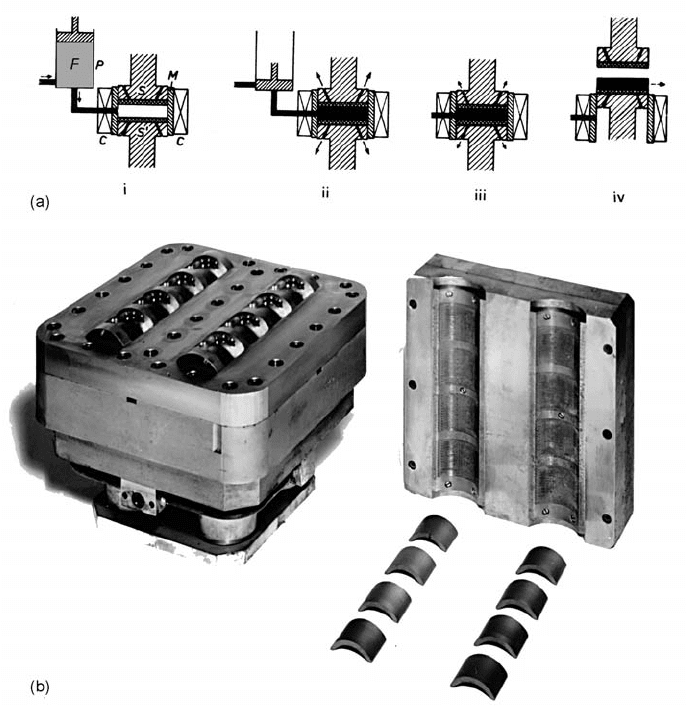
during pressing through a specially designed die. Demagnetizing and static
fields are applied in rapid succession from coils round the die, the water is
sucked out of the slurry while the static field is still applied and pressure is
exerted by a top punch (Fig. 9.42(a)). If suitable deflocculants are used, a
high degree of dispersion can be obtained in the slurry so that the particles
can be oriented effectively. The filter cake is subjected to moderate pressure
(15 MPa, 1 tonf in
72
) to compact it and remove excess water. It is usually
necessary to apply a demagnetizing field before the compact can be removed
from the die without the risk of its breaking. The direction of magnetization
required is usually normal to the major surfaces of the pressed piece so that
the magnetizing coils can be placed round the die to give a field parallel to
the motion of the punches. The process is slow compared with normal die
pressing, and the consequent higher cost can only be justified when the
improved energy product is needed in the intended application. A complex die
for producing small motor magnets is shown in Fig. 9.42(b) and a production
press in Fig. 9.43.
Some degree of anisotropy can also be achieved by applying a field during the
extrusion of a paste formed from barium ferrite powder and a viscous fluid
medium. In this case the plate-like shape of the particles also assists orientation
520 MAGNETIC CERAMICS
since the plane of the plates tends to align parallel to the direction of extrusion
(Fig. 9.44).
Barium ferrite powder is also incorporated in rubber or polymer matrices to
make, for instance, the familiar magnetic gaskets used to latch refrigerator doors.
In this case the particle size must be adjusted to an optimum of around 1 mm
since this gives maximum coercive field. The powder can be incorporated by
PREPARATION OF FERRITES 521
Fig. 9.42 (a) Diagram of the pressing cycle: M, Die; S,S
0
, punches; P, injection pump; F,
suspension; C, magnet coil. The punches contain filters and drainage channels for the water. (i)
Before and (ii) after the material is injected into the compression space; the slurry is densified
from 40% to 13% water content, and the particles are oriented by the magnetic field; (iii) after
densification by slight upward movement of the lower punch, the amount of the movement
depending on the thickness of the product; demagnetization; (iv) removal of the compacted
product. (b) Die for simultaneous pressing of eight oriented magnet segments. (Courtesy of
Philips Technical Review.)