
Schmuller J. Statistical Analysis with Excel For Dummies
Подождите немного. Документ загружается.


169
Chapter 9: The Confidence Game: Estimation
You still have to multiply TINV’s answer by the standard error of the mean
and do the arithmetic to find the upper and lower limits.
I advise against using the CONFIDENCE worksheet function if your sample size
is less than 30 and if you can’t assume your population is a normal distribu-
tion. Why? CONFIDENCE always assumes a normally distributed sampling
distribution, and that’s not always appropriate. So if your confidence level is
95 percent, for example, CONFIDENCE multiplies the standard error by 1.96
regardless of the sample size. The result is that the confidence interval is too
narrow for a small sample size.
15 454060-ch09.indd 16915 454060-ch09.indd 169 4/21/09 7:28:44 PM4/21/09 7:28:44 PM

170
Part III: Drawing Conclusions from Data
15 454060-ch09.indd 17015 454060-ch09.indd 170 4/21/09 7:28:44 PM4/21/09 7:28:44 PM

Chapter 10
One-Sample Hypothesis Testing
In This Chapter
▶ Introducing hypothesis tests
▶ Testing hypotheses about means
▶ Testing hypotheses about variances
W
hatever your occupation, you often have to assess whether some-
thing out of the ordinary has happened. Sometimes you start with a
sample from a population about whose parameters you know a great deal.
You have to decide whether that sample is like the rest of the population or
if it’s different.
Measure that sample and calculate its statistics. Finally, compare those sta-
tistics with the population parameters. Are they the same? Are they different?
Does the sample represent something that’s off the beaten path? Proper use of
statistics helps you decide.
Sometimes you don’t know the parameters of the population you’re dealing
with. Then what? In this chapter, I discuss statistical techniques and work-
sheet functions for dealing with both cases.
Hypotheses, Tests, and Errors
A hypothesis is a guess about the way the world works. It’s a tentative expla-
nation of some process, whether that process is natural or artificial. Before
studying and measuring the individuals in a sample, a researcher formulates
hypotheses that predict what the data should look like.
Generally, one hypothesis predicts that the data won’t show anything new
or interesting. Dubbed the null hypothesis (abbreviated H
0
), this hypothesis
holds that if the data deviate from the norm in any way, that deviation is due
strictly to chance. Another hypothesis, the alternative hypothesis (abbrevi-
ated H
1
), explains things differently. According to the alternative hypothesis,
the data show something important.
16 454060-ch10.indd 17116 454060-ch10.indd 171 4/21/09 7:29:22 PM4/21/09 7:29:22 PM

172
Part III: Drawing Conclusions from Data
After gathering the data, it’s up to the researcher to make a decision. The
way the logic works, the decision centers around the null hypothesis. The
researcher must decide to either reject the null hypothesis or to not reject
the null hypothesis. Hypothesis testing is the process of formulating hypoth-
eses, gathering data, and deciding whether to reject or not reject the null
hypothesis.
Nothing in the logic involves accepting either hypothesis. Nor does the logic
entail any decisions about the alternative hypothesis. It’s all about rejecting or
not rejecting H
0
.
Regardless of the reject-don’t-reject decision, an error is possible. One type
of error occurs when you believe that the data show something important
and you reject H
0
, and in reality the data are due just to chance. This is called
a Type I error. At the outset of a study, you set the criteria for rejecting H
0
. In
so doing, you set the probability of a Type I error. This probability is called
alpha (α)
The other type of error occurs when you don’t reject H
0
and the data are
really due to something out of the ordinary. For one reason or another, you
happened to miss it. This is called a Type II error. Its probability is called
beta (β). Table 10-1 summarizes the possible decisions and errors.
Table 10-1 Decisions and Errors in Hypothesis Testing
“True State” of the World
H
o
is True H
1
is True
Reject H0 Type I Error Correct Decision
Decision
Do Not Reject H0 Correct Decision Type II Error
Note that you never know the true state of the world. All you can ever do is
measure the individuals in a sample, calculate the statistics, and make a deci-
sion about H
0
.
Hypothesis tests and sampling
distributions
In Chapter 9, I discuss sampling distributions. A sampling distribution, remem-
ber, is the set of all possible values of a statistic for a given sample size.
16 454060-ch10.indd 17216 454060-ch10.indd 172 4/21/09 7:29:22 PM4/21/09 7:29:22 PM
173
Chapter 10: One-Sample Hypothesis Testing
Also in Chapter 9, I discuss the Central Limit Theorem. This theorem tells
you that the sampling distribution of the mean approximates a normal dis-
tribution if the sample size is large (for practical purposes, at least 30). This
holds whether or not the population is normally distributed. If the population
is a normal distribution, the sampling distribution is normal for any sample
size. Two other points from the Central Limit Theorem:
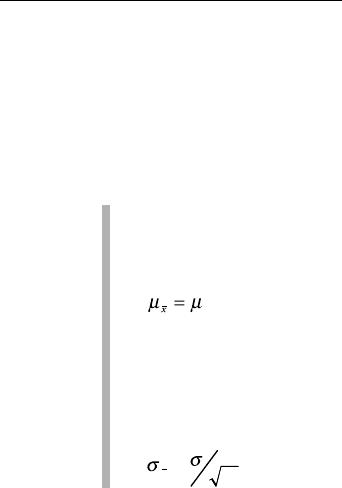
✓ The mean of the sampling distribution of the mean is equal to the popu-
lation mean.
The equation for this is
✓ The standard error of the mean (the standard deviation of the sampling
distribution) is equal to the population standard deviation divided by
the square root of the sample size.
This equation is
x
=
N
The sampling distribution of the mean figures prominently into the type of
hypothesis testing I discuss in this chapter. Theoretically, when you test a
null hypothesis versus an alternative hypothesis, each hypothesis corre-
sponds to a separate sampling distribution.
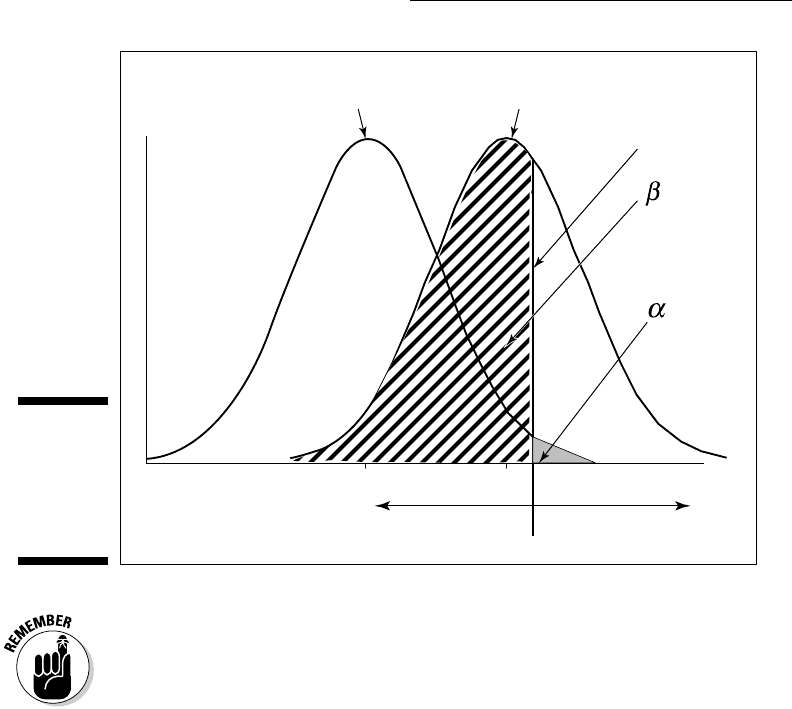
Figure 10-1 shows what I mean. The figure shows two normal distributions.
I placed them arbitrarily. Each normal distribution represents a sampling
distribution of the mean. The one on the left represents the distribution of
possible sample means if the null hypothesis is truly how the world works.
The one on the right represents the distribution of possible sample means if
the alternative hypothesis is truly how the world works.
Of course, when you do a hypothesis test, you never know which distribution
produces the results. You work with a sample mean — a point on the hori-
zontal axis. It’s your job to decide which distribution the sample mean is part
of. You set up a critical value — a decision criterion. If the sample mean is on
one side of the critical value, you reject H
0
. If not, you don’t.
In this vein, the Figure also shows α and β. These, as I mention earlier, are
the probabilities of decision errors. The area that corresponds to α is in the
H
0
distribution. I shaded it in dark gray. It represents the probability that a
sample mean comes from the H
0
distribution, but it’s so extreme that you
reject H
0
.
16 454060-ch10.indd 17316 454060-ch10.indd 173 4/21/09 7:29:22 PM4/21/09 7:29:22 PM
174
Part III: Drawing Conclusions from Data
Figure 10-1:
H
0
and H
1
each cor-
respond to
a sampling
distribution.
Sampling Distribution
H
0
Sampling Distribution
Critical
Value
H
1
0
0
Do Not Reject H
0
Reject H
Rejection Region
µ
1
µ
Where you set the critical value determines α. In most hypothesis testing, you
set α at .05. This means that you’re willing to tolerate a Type I error (incor-
rectly rejecting H
0
) 5 percent of the time. Graphically, the critical value cuts off
5 percent of the area of the sampling distribution. By the way, if you’re talking
about the 5 percent of the area that’s in the right tail of the distribution (as in
Figure 10-1), you’re talking about the upper 5 percent. If it’s the 5 percent in
the left tail you’re interested in, that’s the lower 5 percent.
The area that corresponds to β is in the H
1
distribution. I shaded it in light
gray. This area represents the probability that a sample mean comes from
the H
1
distribution, but it’s close enough to the center of the H
0
distribution
that you don’t reject H
0
. You don’t get to set β. The size of this area depends
on the separation between the means of the two distributions, and that’s up
to the world we live in — not up to you.
These sampling distributions are appropriate when your work corresponds
to the conditions of the Central Limit Theorem: if you know the population
you’re working with is a normal distribution, or if you have a large sample.
16 454060-ch10.indd 17416 454060-ch10.indd 174 4/21/09 7:29:22 PM4/21/09 7:29:22 PM
175
Chapter 10: One-Sample Hypothesis Testing
Catching Some Zs Again
Here’s an example of a hypothesis test that involves a sample from a nor-
mally distributed population. Because the population is normally distributed,
any sample size results in a normally distributed sampling distribution.
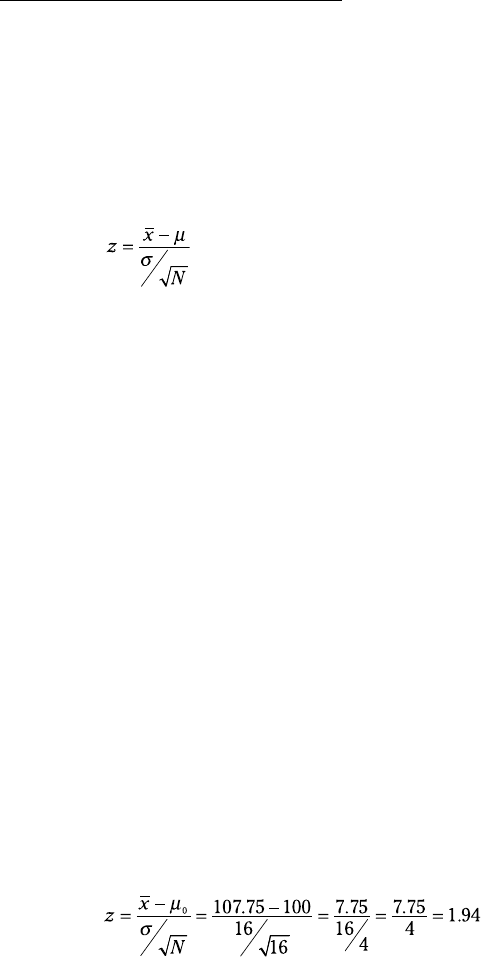
Because it’s a normal distribution, you use z-scores in the hypothesis test:
One more “because”: Because you use the z-score in the hypothesis test, the
z-score here is called the test statistic.
Suppose you think that people living in a particular zip code have higher-
than-average IQs. You take a sample of 16 people from that zip code, give
them IQ tests, tabulate the results, and calculate the statistics. For the popu-
lation of IQ scores, μ = 100 and σ = 16 (for the Stanford-Binet version).
The hypotheses are:
H
0
: μ
ZIP code
≤ 100
H
1
: μ
ZIP code
> 100
Assume α = .05. That’s the shaded area in the tail of the H
0
distribution in
Figure 10-1.
Why the ≤ in H
0
? You use that symbol because you’ll only reject H
0
if the
sample mean is larger than the hypothesized value. Anything else is evidence
in favor of not rejecting H
0
.
Suppose the sample mean is 107.75. Can you reject H
0
?
The test involves turning 107.75 into a standard score in the sampling distri-
bution of the mean:
Is the value of the test statistic large enough to enable you to reject H
0
with
α = .05? It is. The critical value — the value of z that cuts off 5 percent of the
16 454060-ch10.indd 17516 454060-ch10.indd 175 4/21/09 7:29:23 PM4/21/09 7:29:23 PM

176
Part III: Drawing Conclusions from Data
area in a standard normal distribution — is 1.645. (After years of working
with the standard normal distribution, I happen to know this. Read Chapter 8,
find out about Excel’s NORMSINV function, and you can have information like
that at your fingertips, too.) The calculated value, 1.94, exceeds 1.645, so it’s
in the rejection region. The decision is to reject H
0
.
This means that if H
0
is true, the probability of getting a test statistic value
that’s at least this large is less than .05. That’s strong evidence in favor of
rejecting H
0
. In statistical parlance, any time you reject H
0
the result is said to
be “statistically significant.”
This type of hypothesis testing is called one-tailed because the rejection
region is in one tail of the sampling distribution.
A hypothesis test can be one-tailed in the other direction. Suppose you had
reason to believe that people in that zip code had lower than average IQ. In
that case, the hypotheses are:
H
0
: μ
ZIP code
≥ 100
H
1
: μ
ZIP code
< 100
For this hypothesis test, the critical value of the test statistic is –1.645 if
α=.05.
A hypothesis test can be two-tailed, meaning that the rejection region is in
both tails of the H
0
sampling distribution. That happens when the hypotheses
look like this:
H
0
: μ
ZIP code
= 100
H
1
: μ
ZIP code
≠ 100
In this case, the alternate hypothesis just specifies that the mean is differ-
ent from the null-hypothesis value, without saying whether it’s greater or
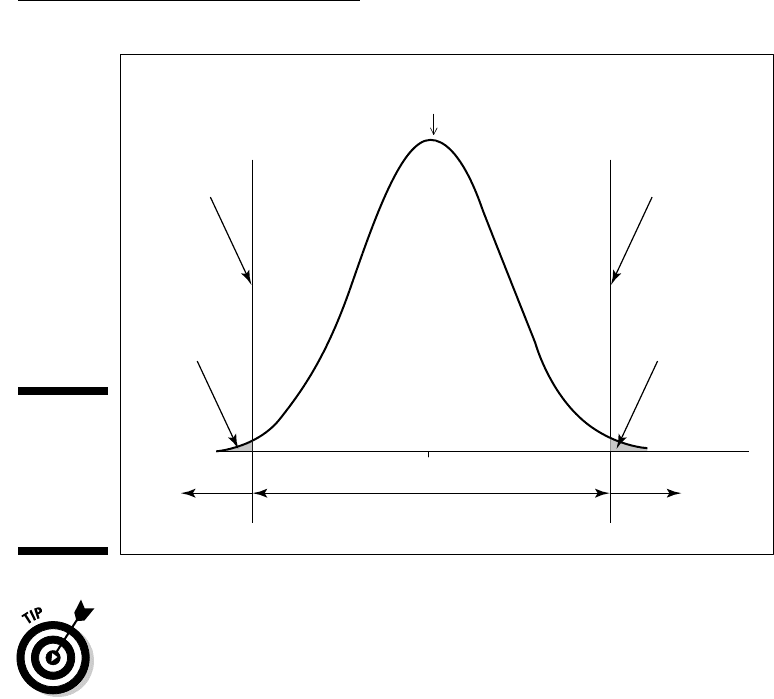
whether it’s less. Figure 10-2 shows what the two-tailed rejection region looks
like for α = .05. The 5 percent is divided evenly between the left tail (also
called the lower tail) and the right tail (the upper tail).
For a standard normal distribution, incidentally, the z-score that cuts off 2.5
percent in the right tail is 1.96. The z-score that cuts off 2.5 percent in the left
tail is –1.96. (Again, I happen to know these values after years of working with
the standard normal distribution.) The z-score in the preceding example,
1.94, does not exceed 1.96. The decision, in the two-tailed case, is to not
reject H
0.
16 454060-ch10.indd 17616 454060-ch10.indd 176 4/21/09 7:29:23 PM4/21/09 7:29:23 PM
177
Chapter 10: One-Sample Hypothesis Testing
Figure 10-2:
The two-
tailed
rejection
region for
α = .05.
Sampling Distribution
H
0
Critical
Value
Critical
Value
0
0
Do Not Reject H
0
Reject H
0
Reject H
Rejection Region
2½% 2½%
Rejection Region
μ
This brings up an important point. A one-tailed hypothesis test can reject H
0
,
while a two-tailed test on the same data might not. A two-tailed test indicates
that you’re looking for a difference between the sample mean and the null-
hypothesis mean, but you don’t know in which direction. A one-tailed test
shows that you have a pretty good idea of how the difference should come
out. For practical purposes, this means you should try to have enough knowl-
edge to be able to specify a one-tailed test.
ZTEST
Excel’s ZTEST worksheet function does the calculations for hypothesis tests
involving z-scores in a standard normal distribution. You provide sample
data, a null hypothesis value, and a population standard deviation. ZTEST
returns the probability in one tail of the H
0
sampling distribution.
This is a bit different from the way things work when you apply the formulas
I just showed you. The formula calculates a z-score. Then it’s up to you to
see where that score stands in a standard normal distribution with respect
to probability. ZTEST eliminates the middleman (the need to calculate the
z-score) and goes right to the probability.
16 454060-ch10.indd 17716 454060-ch10.indd 177 4/21/09 7:29:23 PM4/21/09 7:29:23 PM
178
Part III: Drawing Conclusions from Data
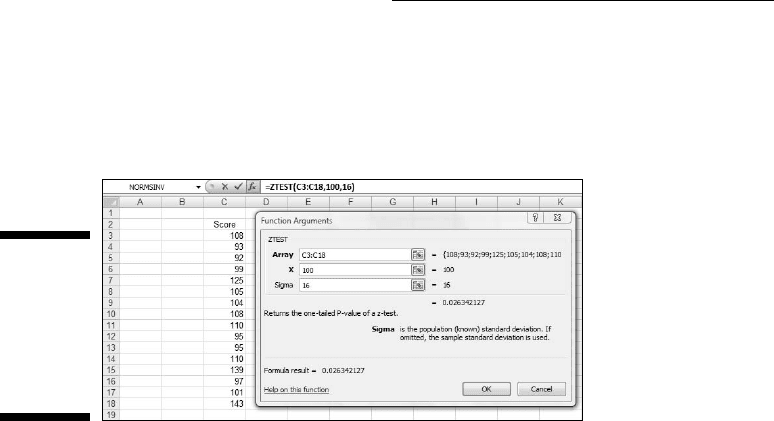
Figure 10-3 shows the data and the Function Arguments dialog box for ZTEST.
The data are IQ scores for 16 people in the zip code example in the preceding
section. That example, remember, tests the hypothesis that people in a par-
ticular zip code have a higher than average IQ.
Figure 10-3:
Data
and The
Function
Arguments
dialog box
for ZTEST.
Here are the steps:
1. Enter your data into an array of cells and select a cell for the result.
The data in this example are in cells C3 through C18.
2. From the Statistical Functions menu, select ZTEST to open the
Function Arguments dialog box for ZTEST. (See Figure 10-3.)
3. In the Function Arguments dialog box, enter the appropriate values
for the arguments.
In the Array box, I enter the array of cells that hold the data. For this
example, that’s C3:C18.
In the X box, type the H
0
mean. For this example, the mean is 100—
the mean of IQ scores in the population.
In the Sigma box, type the population standard deviation. The popu-
lation standard deviation for IQ is 16. After typing that number, the
answer (0.026342) appears in the dialog box.
4. Click OK to put the answer into the selected cell.
With α = .05, and a one-tailed test (H
1
: μ > 100), the decision is to reject H
0
,
because the answer (0.026) is less than .05. Note that with a two-tailed test
(H
1
: μ ≠ 100), the decision is to not reject H
0
. That’s because 2 × 0.026 is
greater than .05 — just barely greater (.052) — but if you draw the line at .05,
you cannot reject H
0
.
16 454060-ch10.indd 17816 454060-ch10.indd 178 4/21/09 7:29:23 PM4/21/09 7:29:23 PM