
Schmuller J. Statistical Analysis with Excel For Dummies
Подождите немного. Документ загружается.

189
Chapter 11: Two-Sample Hypothesis Testing
Within each pair, each sample comes from a different population. All the
samples are independent of one another, so that picking individuals for one
sample has no effect on picking individuals for another.
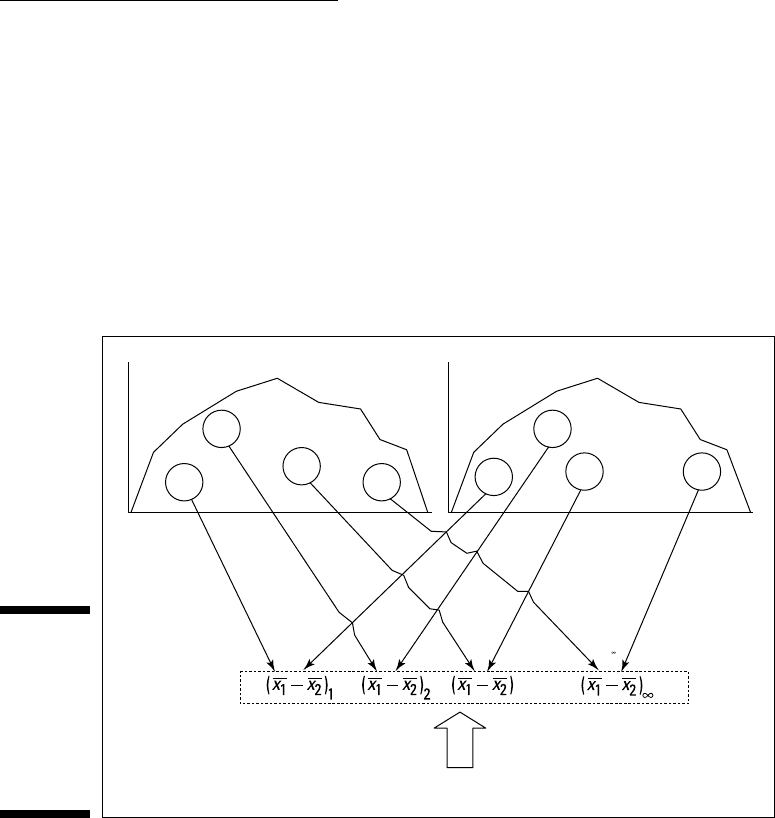
Figure 11-1 shows the steps in creating this sampling distribution. This is
something you never do in practice. It’s all theoretical. As the figure shows,
the idea is to take a sample out of one population and a sample out of another,
calculate their means, and subtract one mean from the other. Return the
samples to the populations, and repeat over and over and over. The result
of the process is a set of differences between means. This set of differences
is the sampling distribution.
Figure 11-1:
Creating the
sampling
distribu-
tion of the
difference
between
means.
Population 1 Population 2
3
Sampling Distribution of the Difference Between Means
Pair 1
...
Pair 2
PairPair 3
...
...
Sample
1
Sample
1
Sample
1
Sample
1
Sample
2
Sample
2
Sample
2
Sample
2
Applying the Central Limit Theorem
Like any other set of numbers, this sampling distribution has a mean and a
standard deviation. As is the case with the sampling distribution of the mean
(Chapters 9 and 10), the Central Limit Theorem applies here.
According to the Central Limit Theorem, if the samples are large, the sampling
distribution of the difference between means is approximately a normal distri-
bution. If the populations are normally distributed, the sampling distribution is
a normal distribution even if the samples are small.
17 454060-ch11.indd 18917 454060-ch11.indd 189 4/21/09 7:30:20 PM4/21/09 7:30:20 PM
190
Part III: Drawing Conclusions from Data
The Central Limit Theorem also has something to say about the mean and
standard deviation of this sampling distribution. Suppose the parameters for
the first population are μ
1
and σ
1
, and the parameters for the second popula-
tion are μ
2
and σ
2
. The mean of the sampling distribution is
The standard deviation of the sampling distribution is
N
1
is the number of individuals in the sample from the first population, N
2
is
the number of individuals in the sample from the second.
This standard deviation is called the standard error of the difference between
means.
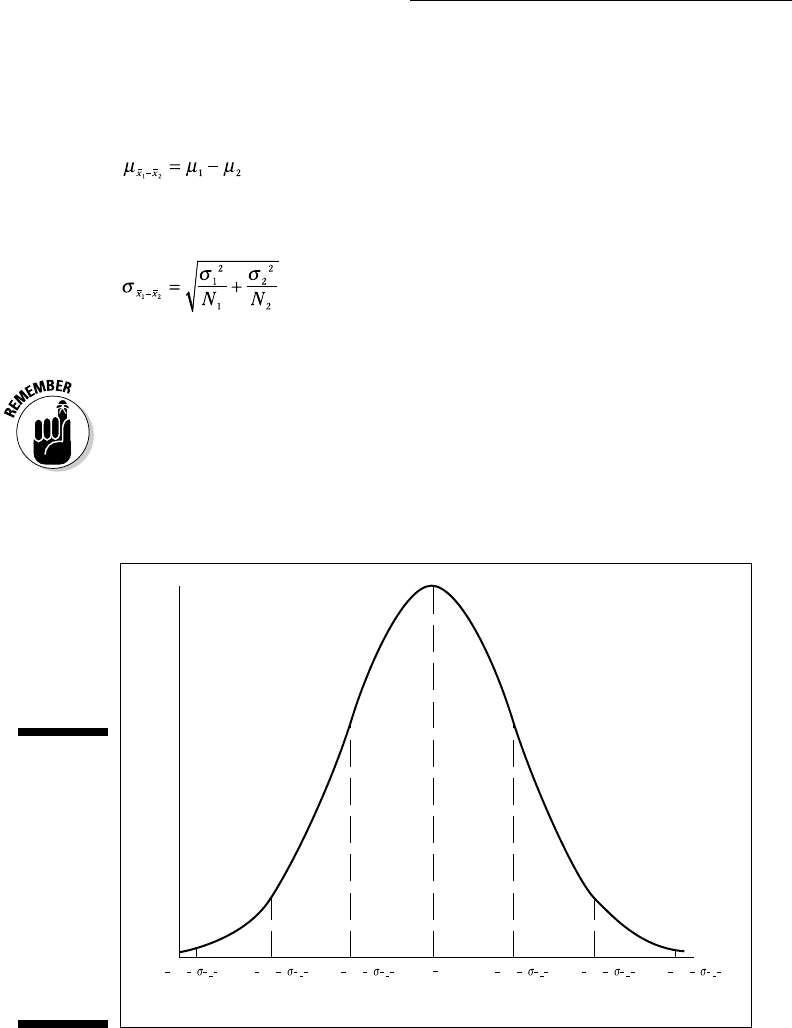
Figure 11-2 shows the sampling distribution along with its parameters, as
specified by the Central Limit Theorem.
Figure 11-2:
The
sampling
distribu-
tion of the
difference
between
means
accord-
ing to the
Central Limit
Theorem.
12
µµ
()
12
12
3
xx
µµ
()
12
12
3
xx
µµ
()
12
12
2
xx
µµ
()
12
12
2
xx
µµ
()
12
12
1
xx
µµ
()
12
12
1
xx
µµ
17 454060-ch11.indd 19017 454060-ch11.indd 190 4/21/09 7:30:20 PM4/21/09 7:30:20 PM
191
Chapter 11: Two-Sample Hypothesis Testing
Zs once more
Because the Central Limit Theorem says that the sampling distribution is
approximately normal for large samples (or for small samples from normally
distributed populations), you use the z-score as your test statistic. Another
way to say “use the z-score as your test statistic” is “perform a z-test.” Here’s
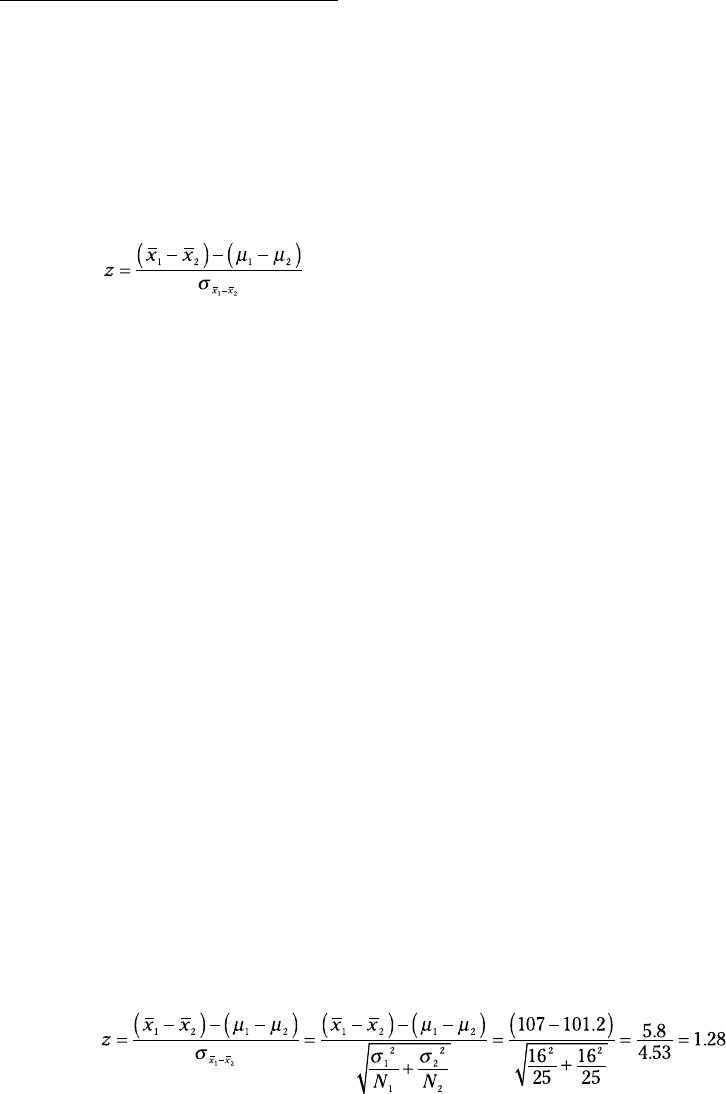
the formula:
The term (μ
1
–μ
2
) represents the difference between the means in H
0
.
This formula converts the difference between sample means into a standard
score. Compare the standard score against a standard normal distribution —
a normal distribution with μ = 0 and σ = 1. If the score is in the rejection region
defined by α, reject H
0
. If it’s not, don’t reject H
0
.
You use this formula when you know the value of σ
1
2
and σ
2
2
.
Here’s an example. Imagine a new training technique designed to increase IQ.
Take a sample of 25 people and train them under the new technique. Take
another sample of 25 people and give them no special training. Suppose that
the sample mean for the new technique sample is 107, and for the no-training
sample it’s 101.2. The hypothesis test is:
H
0
: μ
1
- μ
2
= 0
H
1
: μ
1
- μ
2
> 0
I’ll set α at .05
The IQ is known to have a standard deviation of 16, and I assume that stan-
dard deviation would be the same in the population of people trained on the
new technique. Of course, that population doesn’t exist. The assumption is
that if it did, it should have the same value for the standard deviation as the
regular population of IQ scores. Does the mean of that (theoretical) popula-
tion have the same value as the regular population? H
0
says it does. H
1
says
it’s larger.
The test statistic is
17 454060-ch11.indd 19117 454060-ch11.indd 191 4/21/09 7:30:21 PM4/21/09 7:30:21 PM
192
Part III: Drawing Conclusions from Data
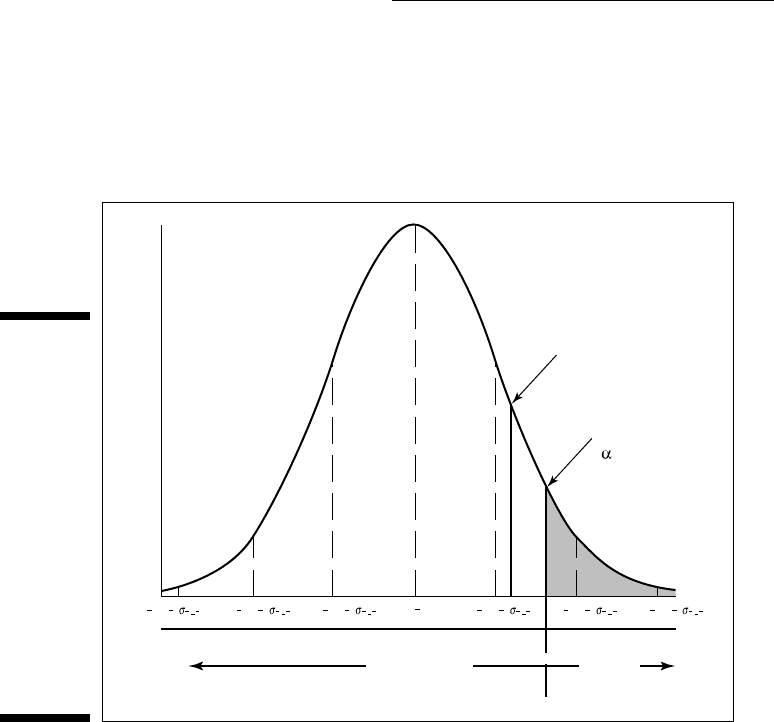
With α = .05, the critical value of z — the value that cuts off the upper 5 per-
cent of the area under the standard normal distribution — is 1.645. (You can
use the worksheet function NORMSINV from Chapter 8 to verify this.) The
calculated value of the test statistic is less than the critical value, so the deci-
sion is to not reject H
0
. Figure 11-3 summarizes this.
Figure 11-3:
The
sampling
distribu-
tion of the
difference
between
means,
along with
the critical
value for
α = .05 and
the obtained
value of the
test statistic
in the IQ
Example.
12
µµ
()
12
12
3
-3.00 -2.00 -1.00 +1.00 +2.00 +3.000
xx
µµ
()
12
12
3
xx
µµ
()
12
12
2
xx
µµ
()
12
12
2
xx
µµ
()
12
12
1
xx
µµ
()
12
12
1
xx
µµ
0
Do Not Reject H
Obtained
Value
Critical
Value for
a = .05
0
Reject H
+1.64
Data analysis tool: z-Test:
Two Sample for Means
Excel provides a data analysis tool that makes it easy to do tests like the one
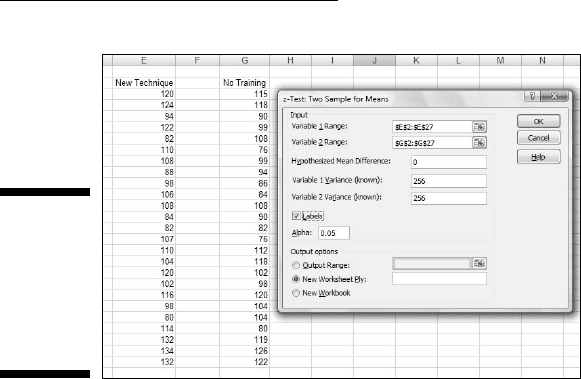
in the IQ example. It’s called z-Test: Two Sample for Means. Figure 11-4 shows
the dialog box for this tool along with sample data that correspond to the IQ
example.
17 454060-ch11.indd 19217 454060-ch11.indd 192 4/21/09 7:30:21 PM4/21/09 7:30:21 PM
193
Chapter 11: Two-Sample Hypothesis Testing
Figure 11-4:
The z-Test
data
analysis tool
and data
from two
samples.
To use this tool, follow these steps:
1. Type the data for each sample into a separate data array.
For this example, the data in the New Technique sample are in column E
and the data for the No Training sample are in column G.
2. Select Data | Data Analysis to open the Data Analysis dialog box.
3. In the Data Analysis dialog box, scroll down the Analysis Tools list
and select z-Test: Two Sample for Means. Click OK to open the z-Test:
Two Sample for Means dialog box (see Figure 11-4).
4. In the Variable 1 Range box, enter the cell range that holds the data
for one of the samples.
For the example, the New Technique data are in $E$2:$E$27. (Note the
$-signs for absolute referencing.)
5. In the Variable 2 Range box, enter the cell range that holds the data
for the other sample.
The No Training data are in $G$2:$G$27.
6. In the Hypothesized Mean Difference box, type the difference
between μ1 and μ2 that H0 specifies.
In this example, that difference is 0.
7. In the Variable 1 Variance (known) box, type the variance of the first
sample.
The standard deviation of the population of IQ scores is 16, so this vari-
ance is 256.
17 454060-ch11.indd 19317 454060-ch11.indd 193 4/21/09 7:30:21 PM4/21/09 7:30:21 PM
194
Part III: Drawing Conclusions from Data
8. In the Variable 2 Variance (known) box, type the variance of the
second sample.
In this example, this variance is also 256.
9. If the cell ranges include column headings, check the Labels checkbox.
I included the headings in the ranges, so I checked the box.
10. The Alpha box has 0.05 as a default.
I used the default value, consistent with the value of α in this example.
11. In the Output Options, select a radio button to indicate where you
want the results.
I selected New Worksheet Ply to put the results on a new page in the
worksheet.
12. Click OK.
Because I selected New Worksheet Ply, a newly created page opens with
the results.
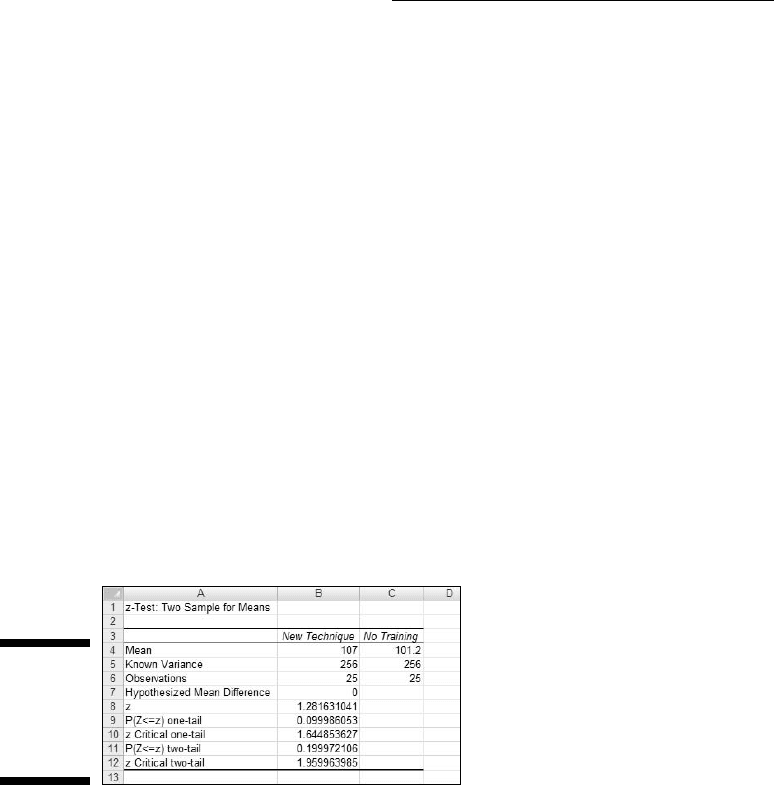
Figure 11-5 shows the tool’s results, after I expanded the columns. Rows 4, 5,
and 7 hold values you input into the dialog box. Row 6 counts the number of
scores in each sample.
Figure 11-5:
Results of
the z-Test
data analy-
sis tool.
The value of the test statistic is in cell B8. The critical value for a one-tailed
test is in B10, and the critical value for a two-tailed test is in B12.
Cell B9 displays the proportion of area that the test statistic cuts off in one
tail of the standard normal distribution. Cell B11 doubles that value — it’s the
proportion of area cut off by the positive value of the test statistic (in the tail
on the right side of the distribution) plus the proportion cut off by the nega-
tive value of the test statistic (in the tail on the left side of the distribution).
17 454060-ch11.indd 19417 454060-ch11.indd 194 4/21/09 7:30:21 PM4/21/09 7:30:21 PM
195
Chapter 11: Two-Sample Hypothesis Testing
t for Two
The example in the preceding section involves a situation you rarely
encounter — known population variances. If you know a population’s vari-
ance, you’re likely to know the population mean. If you know the mean, you
probably don’t have to perform hypothesis tests about it.
Not knowing the variances takes the Central Limit Theorem out of play. This
means that you can’t use the normal distribution as an approximation of the
sampling distribution of the difference between means. Instead, you use the
t-distribution, a family of distributions I introduce in Chapter 9 and apply to
one-sample hypothesis testing in Chapter 10. The members of this family of
distributions differ from one another in terms of a parameter called degrees
of freedom (df). Think of df as the denominator of the variance estimate you
use when you calculate a value of t as a test statistic. Another way to say
“calculate a value of t as a test statistic”: “Perform a t-test.”
Unknown population variances lead to two possibilities for hypothesis testing.
One possibility is that although the variances are unknown, you have reason to
assume they’re equal. The other possibility is that you cannot assume they’re
equal. In the subsections that follow, I discuss these possibilities.
Like peas in a pod: Equal variances
When you don’t know a population variance, you use the sample variance
to estimate it. If you have two samples, you average (sort of) the two sample
variances to arrive at the estimate.
Putting sample variances together to estimate a population variance is called
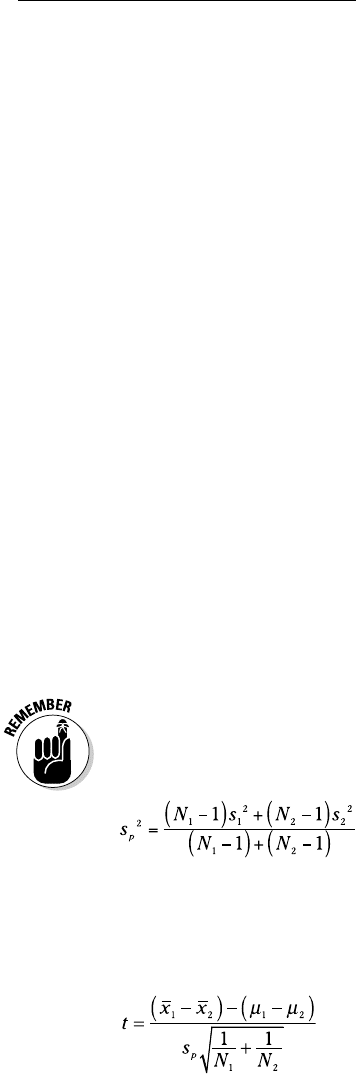
pooling. With two sample variances, here’s how you do it:
In this formula s
p
2
stands for the pooled estimate. Notice that the denomina-
tor of this estimate is (N
1
-1) + (N
2
-1). Is this the df? Absolutely!
The formula for calculating t is
17 454060-ch11.indd 19517 454060-ch11.indd 195 4/21/09 7:30:21 PM4/21/09 7:30:21 PM
196
Part III: Drawing Conclusions from Data
On to an example. FarKlempt Robotics is trying to choose between two
machines to produce a component for its new microrobot. Speed is of the
essence, so they have each machine produce ten copies of the component,
and time each production run. The hypotheses are:
H
0
: μ
1
-μ
2
= 0
H
1
: μ
1
-μ
2
≠ 0
They set α at .05. This is a two-tailed test, because they don’t know in
advance which machine might be faster.
Table 11-1 presents the data for the production times in minutes.
Table 11-1 Sample Statistics from the
FarKlempt Machine Study
Machine 1 Machine 2
Mean Production Time 23.00 20.00
Standard Deviation 2.71 2.79
Sample Size 10 10
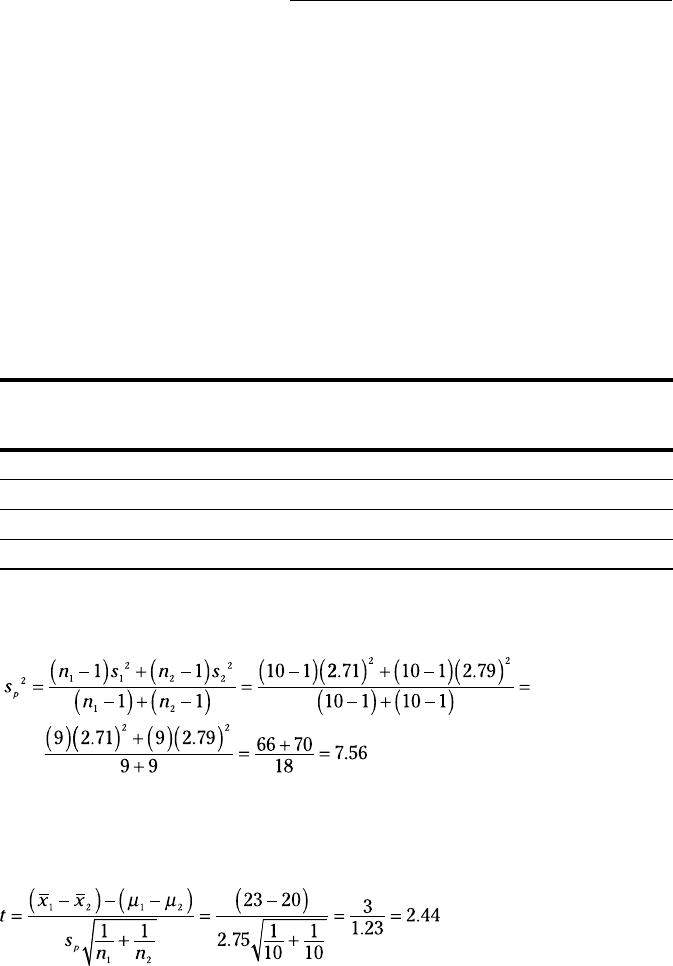
The pooled estimate of σ
2
is
The estimate of σ is 2.75, the square root of 7.56.
The test statistic is
For this test statistic, df = 18, the denominator of the variance estimate. In a
t-distribution with 18 df, the critical value is 2.10 for the right-side (upper)
tail and –2.10 for the left-side (lower) tail. If you don’t believe me, apply TINV
(Chapter 9). The calculated value of the test statistic is greater than 2.10,
17 454060-ch11.indd 19617 454060-ch11.indd 196 4/21/09 7:30:21 PM4/21/09 7:30:21 PM
197
Chapter 11: Two-Sample Hypothesis Testing
so the decision is to reject H
0
. The data provide evidence that Machine 2 is
significantly faster than Machine 1. (You can use the word “significant” when-
ever you reject H
0
.)
Like p’s and q’s: Unequal variances
The case of unequal variances presents a challenge. As it happens, when vari-
ances are not equal, the t distribution with (N
1
-1) + (N
2
-1) degrees of freedom
is not as close an approximation to the sampling distribution as statisticians
would like.
Statisticians meet this challenge by reducing the degrees of freedom. To
accomplish the reduction they use a fairly involved formula that depends on
the sample standard deviations and the sample sizes.
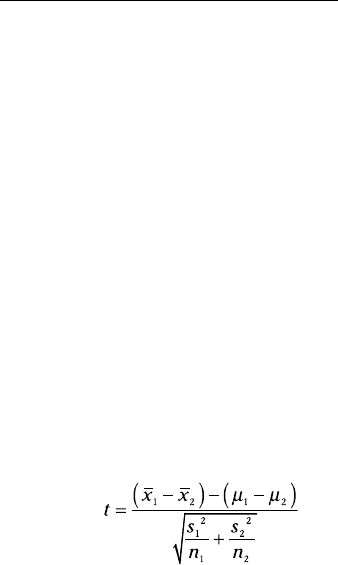
Because the variances aren’t equal, a pooled estimate is not appropriate. So
you calculate the t-test in a different way:
You evaluate the test statistic against a member of the t-distribution family
that has the reduced degrees of freedom.
TTEST
The worksheet function TTEST eliminates the muss, fuss, and bother of work-
ing through the formulas for the t-test.
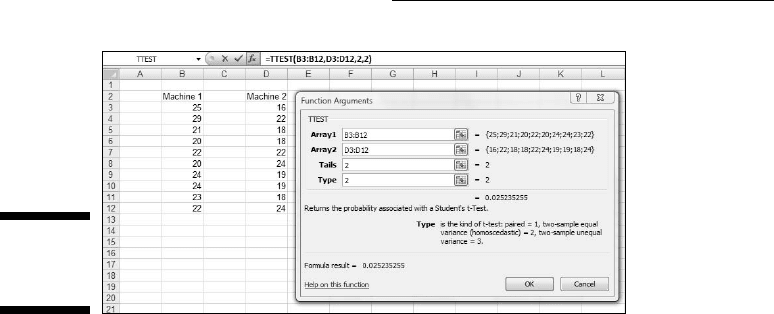
Figure 11-6 shows the data for the FarKlempt machines example I showed you
earlier. The Figure also shows the Function Arguments dialog box for TTEST.
Follow these steps:
1. Type the data for each sample into a separate data array and select a
cell for the result.
For this example, the data for the Machine 1 sample are in column B and
the data for the Machine 2 sample are in column D.
2. From the Statistical Functions menu, select TTEST to open the
Function Arguments dialog box for TTEST.
17 454060-ch11.indd 19717 454060-ch11.indd 197 4/21/09 7:30:22 PM4/21/09 7:30:22 PM
198
Part III: Drawing Conclusions from Data
Figure 11-6:
Working
with TTEST.
3. In the Function Arguments dialog box, enter the appropriate values
for the arguments.
In the Array1 box, enter the sequence of cells that holds the data for one
of the samples. In this example, the Machine 1 data are in B3:B12.
In the Array2 box, enter the sequence of cells that holds the data for the
other sample. The Machine 2 data are in D3:D12.
The Tails box indicates whether this is a one-tailed test or a two-tailed
test. In this example, it’s a two-tailed test, so I typed 2 in this box.
The Type box holds a number that indicates the type of t-test. The
choices are 1 for a paired test (which you find out about in an upcom-
ing section), 2 for two samples assuming equal variances, and 3 for two
samples assuming unequal variances. I typed 2.
With values supplied for all the arguments, the dialog box shows the
probability associated with the t value for the data. It does not show
the value of t.
4. Click OK to put the answer in the selected cell.
The value in the dialog box in Figure 11-6 is less than .05, so the decision is to
reject H
0
.
By the way, for this example, typing 3 into the Type box (indicating unequal
variances) results in a very slight adjustment in the probability from the
equal variance test. The adjustment is small because the sample variances
are almost equal and the sample sizes are the same.
17 454060-ch11.indd 19817 454060-ch11.indd 198 4/21/09 7:30:22 PM4/21/09 7:30:22 PM