
Schmuller J. Statistical Analysis with Excel For Dummies
Подождите немного. Документ загружается.

179
Chapter 10: One-Sample Hypothesis Testing
t for One
In the preceding example, I worked with IQ scores. The population of IQ
scores is a normal distribution with a well-known mean and standard devia-
tion. This enabled me to work with the Central Limit Theorem and describe
the sampling distribution of the mean as a normal distribution. I was then
able to use z as the test statistic.
In the real world, however, you typically don’t have the luxury of working
with such well-defined populations. You usually have small samples, and
you’re typically measuring something that isn’t as well known as IQ. The
bottom line is that you often don’t know the population parameters, nor do
you know whether or not the population is normally distributed.
When that’s the case, you use the sample data to estimate the population
standard deviation, and you treat the sampling distribution of the mean as a
member of a family of distributions called the t-distribution. You use t as a test
statistic. In Chapter 9, I introduce this distribution, and mention that you dis-
tinguish members of this family by a parameter called degrees of freedom (df).
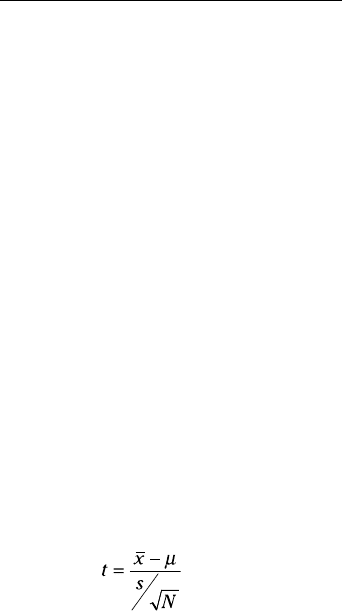
The formula for the test statistic is
Think of df as the denominator of the estimate of the population variance.
For the hypothesis tests in this section, that’s N-1, where N is the number of
scores in the sample. The higher the df, the more closely the t-distribution
resembles the normal distribution.
Here’s an example. FarKlempt Robotics, Inc., markets microrobots. They
claim their product averages four defects per unit. A consumer group
believes this average is higher. The consumer group takes a sample of 9
FarKlempt microrobots and finds an average of 7 defects, with a standard
deviation of 3.16. The hypothesis test is:
H
0
: μ ≤ 4
H
1
: μ > 4
α = .05
16 454060-ch10.indd 17916 454060-ch10.indd 179 4/21/09 7:29:23 PM4/21/09 7:29:23 PM
180
Part III: Drawing Conclusions from Data
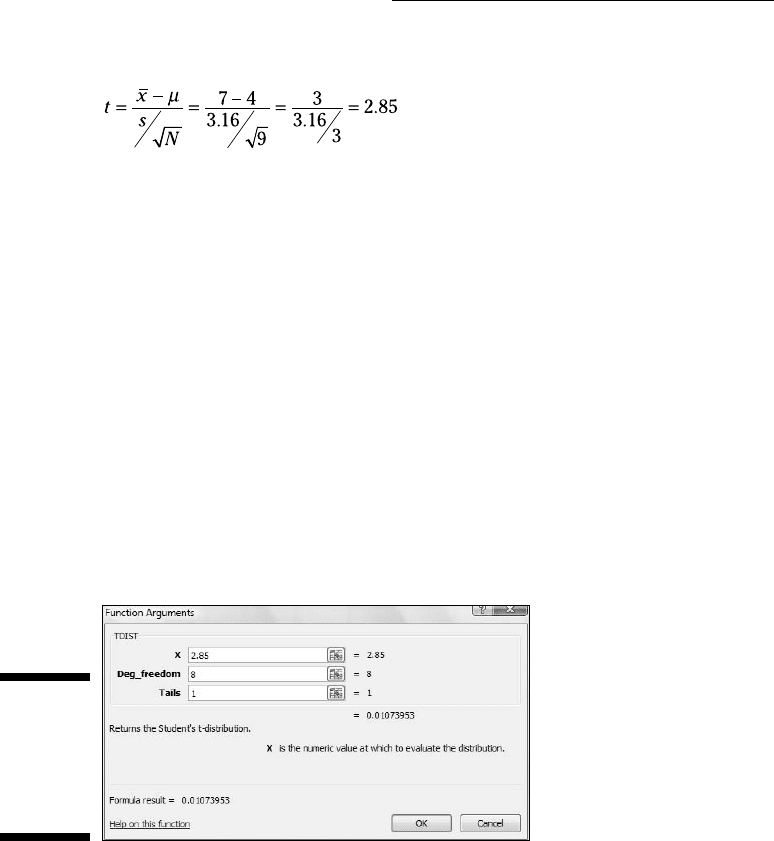
The formula is:
Can you reject H
0
? The Excel function in the next section tells you.
TDIST
You use the worksheet function TDIST to decide whether or not your calcu-
lated t value is in the region of rejection. You supply a value for t, a value for
df, and determine whether the test is one-tailed or two-tailed. TDIST returns
the probability of obtaining a t value at least as high as yours if H
0
is true. If
that probability is less than your α, you reject H
0
.
The steps are:
1. Select a cell to store the result.
2. From the Statistical Functions menu, select TDIST to open the Function
Arguments dialog box for TDIST. (See Figure 10-4.)
Figure 10-4:
The
Function
Arguments
dialog box
for TDIST.
3. In the Function Arguments dialog box, enter the appropriate values
for the arguments.
The calculated t value goes in the X box. For this example, the calculated
t value is 2.85.
The degrees of freedom go in the Deg_freedom box. The degrees of free-
dom for this example is 8 (9 scores – 1).
16 454060-ch10.indd 18016 454060-ch10.indd 180 4/21/09 7:29:23 PM4/21/09 7:29:23 PM
181
Chapter 10: One-Sample Hypothesis Testing
In the Tails box, the idea is to type 1 (for a one-tailed test) or 2 (for a
two-tailed test). In this example, it’s a one-tailed test. After I typed 1, the
dialog box shows the probability in the tail of the t-distribution beyond
the t value.
4. Click OK to close the dialog box and put the answer in the selected cell.
The value in the dialog box in Figure 10-4 is less than .05, so the decision is to
reject H
0
.
Testing a Variance
So far, I’ve told you about one-sample hypothesis testing for means. You can
also test hypotheses about variances.
This sometimes comes up in the context of manufacturing. For example, sup-
pose FarKlempt Robotics, Inc, produces a part that has to be a certain length
with a very small variability. You can take a sample of parts, measure them,
find the sample variability and perform a hypothesis test against the desired
variability.
The family of distributions for the test is called chi-square. Its symbol is χ
2
. I
won’t go into all the mathematics. I’ll just tell you that, once again, df is the
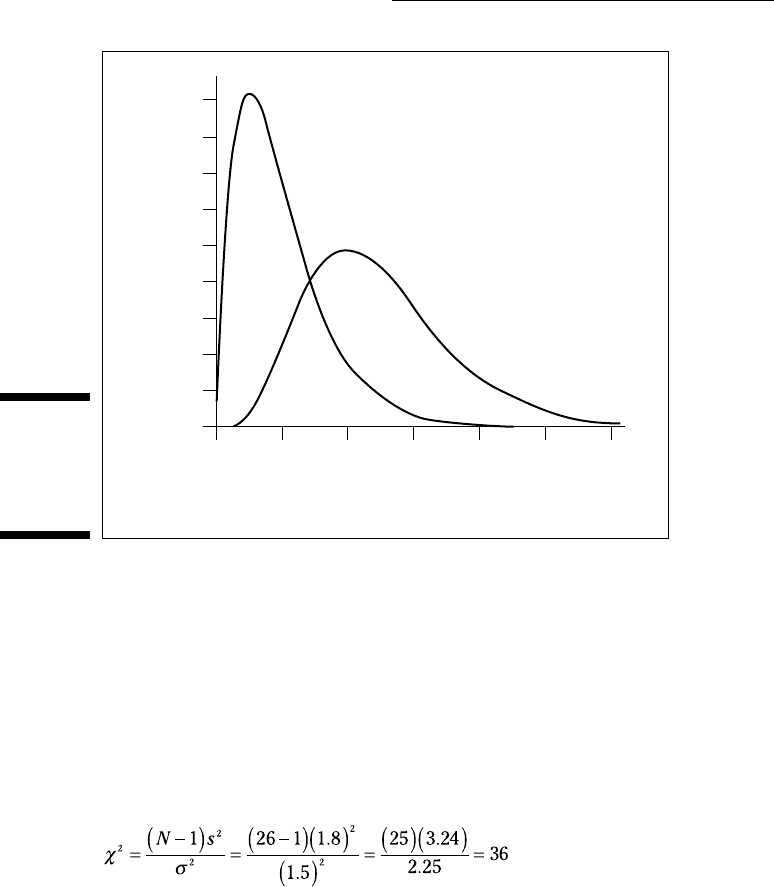
parameter that distinguishes one member of the family from another. Figure
10-5 shows two members of the chi-square family.
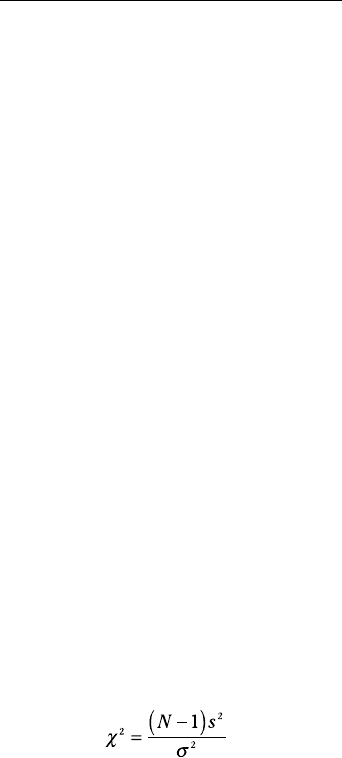
The formula for this test statistic is
N is the number of scores in the sample, s
2
is the sample variance, and σ
2
is
the population variance specified in H
0
.
With this test, you have to assume that what you’re measuring has a normal
distribution.
Suppose the process for the FarKlempt part has to have at most a standard
deviation of 1.5 inches for its length. (Notice I said standard deviation. This
allows me to speak in terms of inches. If I said variance the units would be
square inches.). After measuring a sample of 26 parts, you find a standard
deviation of 1.8 inches.
16 454060-ch10.indd 18116 454060-ch10.indd 181 4/21/09 7:29:24 PM4/21/09 7:29:24 PM
182
Part III: Drawing Conclusions from Data
Figure 10-5:
Two mem-
bers of the
chi-square
family.
f(x
2
)
18
16 df=4
df=10
14
12
10
08
06
04
02
0
04812162024
x
2
The hypotheses are:
H
0
: σ
2
≤ 2.25 (remember to square the “at-most” standard deviation of 1.5
inches)
H
1
: σ
2
> 2.25
α = .05
Working with the formula,
Can you reject H
0
? Read on.
CHIDIST
After calculating a value for your chi-square test statistic, you use the
CHIDIST worksheet function to make a judgment about it. You supply the
16 454060-ch10.indd 18216 454060-ch10.indd 182 4/21/09 7:29:24 PM4/21/09 7:29:24 PM
183
Chapter 10: One-Sample Hypothesis Testing
chi-square value and the df, and it tells you the probability of obtaining a
value at least that high if H
0
is true. If that probability is less than your α,
reject H
0
.
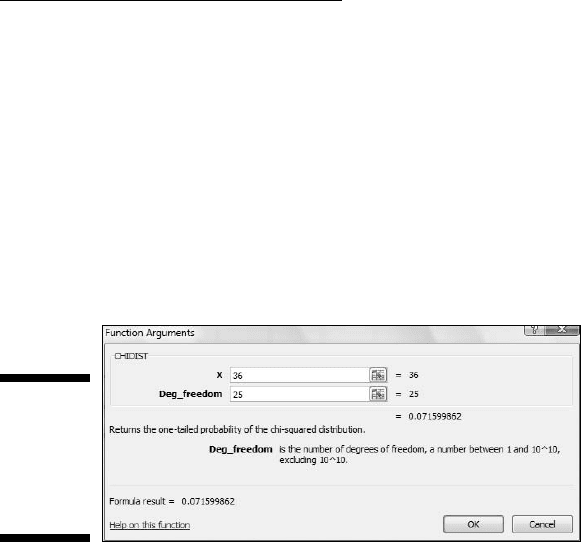
To show you how it works, I apply the information from the example in the
preceding section. Follow these steps:
1. Select a cell to store the result.
2. From the Statistical Functions menu, select CHIDIST to open the
Function Arguments dialog box for CHIDIST. (See Figure 10-6.)
Figure 10-6:
The
Function
Arguments
dialog box
for CHIDIST.
3. In the Function Arguments dialog box, type the appropriate values for
the arguments.
In the X box, I typed the calculated chi-square value. For this example,
that value is 36.
In the Deg_freedom box, I typed the degrees of freedom. The degrees
of freedom for this example is 25 (26 – 1). After typing the df, the dialog
box shows the one-tailed probability of obtaining at least this value of
chi-square if H
0
is true.
4. Click OK to close the dialog box and put the answer in the selected cell.
The value in the dialog box in Figure 10-6 is greater than .05, so the decision
is to not reject H
0
. (Can you conclude that the process is within acceptable
limits of variability? See the nearby sidebar “A point to ponder.”)
CHIINV
CHIINV is the flip side of CHIDIST. You supply a probability and df, and
CHIINV tells you the corresponding value of chi-square. If you want to know
16 454060-ch10.indd 18316 454060-ch10.indd 183 4/21/09 7:29:24 PM4/21/09 7:29:24 PM
184
Part III: Drawing Conclusions from Data
the value you have to exceed in order to reject H
0
in the preceding example,
follow these steps:
1. Select a cell to store the result.
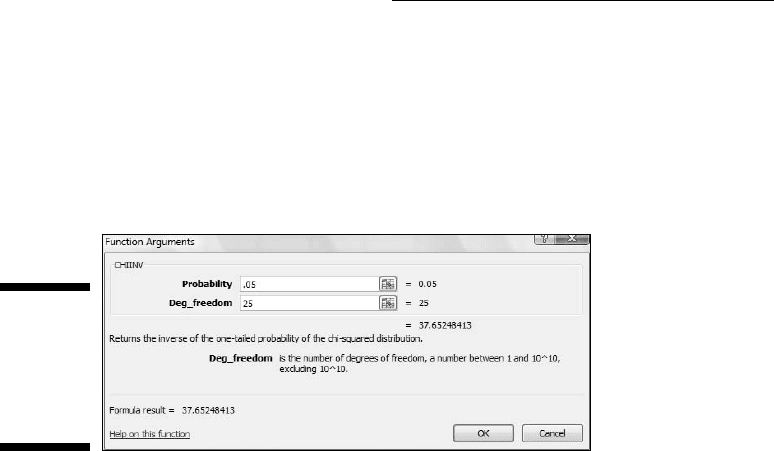
2. From the Statistical Functions menu, select CHIINV and click OK to
open the Function Arguments dialog box for CHIINV. (See Figure 10-7.)
Figure 10-7:
The
Function
Arguments
dialog box
for CHIINV.
3. In the Function Arguments dialog box, enter the appropriate values
for the arguments.
In the Probability box, I typed .05, the probability I’m interested in for
this example.
In the Deg_freedom box, I typed the degrees of freedom. The value for
degrees of freedom in this example is 25 (26 – 1). After I typed the df,
the dialog box shows the value (37.65248) that cuts off the upper 5 per-
cent of the area in this chi-square distribution.
4. Click OK to close the dialog box and put the answer in the selected cell.
As the dialog box in Figure 10-7 shows, the calculated value (36) didn’t miss
the cutoff value by much. A miss is still a miss (to paraphrase “As Time Goes
By”), and you cannot reject H
0
.
16 454060-ch10.indd 18416 454060-ch10.indd 184 4/21/09 7:29:24 PM4/21/09 7:29:24 PM

185
Chapter 10: One-Sample Hypothesis Testing
A point to ponder
Retrace the preceding example. FarKlempt
Robotics wants to show that its manufactur-
ing process is within acceptable limits of vari-
ability. The null hypothesis, in effect, says the
process is acceptable. The data do not pres-
ent evidence for rejecting H
o
. The value of the
test statistic just misses the critical value. Does
that mean the manufacturing process is within
acceptable limits?
Statistics are an aid to common sense, not
a substitute. If the data are just barely within
acceptability, that should set off alarms.
Usually, you try to reject H
0
. This is a rare
case when not rejecting H
0
is more desir-
able, because nonrejection implies something
positive — the manufacturing process is work-
ing properly. Can you still use hypothesis testing
techniques in this situation?
Yes, you can — with a notable change. Rather
than a small value of α, like .05, you choose
a large value, like .20. This stacks the deck
against not rejecting H
0
— small values of the
test statistic can lead to rejection. If α is .20 in
this example, the critical value is 30.6752. (Use
CHINV to verify that.) Because the obtained
value, 36, is higher than this critical value the
decision with this α is to reject H
0
.
Using a high α is not often done. When the
desired outcome is to not reject H
0
, I strongly
advise it.
16 454060-ch10.indd 18516 454060-ch10.indd 185 4/21/09 7:29:24 PM4/21/09 7:29:24 PM

186
Part III: Drawing Conclusions from Data
16 454060-ch10.indd 18616 454060-ch10.indd 186 4/21/09 7:29:24 PM4/21/09 7:29:24 PM

Chapter 11
Two-Sample Hypothesis Testing
In This Chapter
▶ Testing differences between means of two samples
▶ Testing means of paired samples
▶ Testing hypotheses about variances
I
n business, in education, and in scientific research the need often arises
to compare one sample with another. Sometimes the samples are inde-
pendent, sometimes they’re matched in some way. Each sample comes from
a different population. The objective is to decide whether or not the popula-
tions they come from are different from one another.
Usually, this involves tests of hypotheses about population means. You can
also test hypotheses about population variances. In this chapter, I show you
how to carry out these tests. I also discuss useful worksheet functions and
data analysis tools that help you get the job done.
Hypotheses Built for Two
As in the one-sample case (Chapter 10), hypothesis testing with two samples
starts with a null hypothesis (H
0
) and an alternative hypothesis (H
1
). The null
hypothesis specifies that any differences you see between the two samples
are due strictly to chance. The alternative hypothesis says, in effect, that any
differences you see are real and not due to chance.
It’s possible to have a one-tailed test, in which the alternative hypothesis
specifies the direction of the difference between the two means, or a two-
tailed test in which the alternative hypothesis does not specify the direction
of the difference.
17 454060-ch11.indd 18717 454060-ch11.indd 187 4/21/09 7:30:20 PM4/21/09 7:30:20 PM

188
Part III: Drawing Conclusions from Data
For a one-tailed test, the hypotheses look like this:
H
0
: μ
1
- μ
2
= 0
H
1
: μ
1
- μ
2
> 0
or like this:
H
0
: μ
1
- μ
2
= 0
H
1
: μ
1
- μ
2
< 0
For a two-tailed test, the hypotheses are:
H
0
: μ
1
- μ
2
= 0
H
1
: μ
1
- μ
2
≠ 0
The zero in these hypotheses is the typical case. It’s possible, however, to test
for any value — just substitute that value for zero.
To carry out the test, you first set α, the probability of a Type I error that
you’re willing to live with (see Chapter 9). Then you calculate the mean and
standard deviation of each sample, subtract one mean from the other, and
use a formula to convert the result into a test statistic. Compare the test sta-
tistic to a sampling distribution of test statistics. If it’s in the rejection region
that α specifies (see Chapter 10), reject H
0
. If not, don’t reject H
0
.
Sampling Distributions Revisited
In Chapter 9, I introduce the idea of a sampling distribution — a distribution
of all possible values of a statistic for a particular sample size. In that chap-
ter, I describe the sampling distribution of the mean. In Chapter 10, I show its
connection with one-sample hypothesis testing.
For this type of hypothesis testing, another sampling distribution is neces-
sary. This one is the sampling distribution of the difference between means.
The sampling distribution of the difference between means is the distribution
of all possible values of differences between pairs of sample means with the
sample sizes held constant from pair to pair. (Yes, that’s a mouthful.) Held
constant from pair to pair means that the first sample in the pair always has the
same size, and the second sample in the pair always has the same size. The
two sample sizes are not necessarily equal.
17 454060-ch11.indd 18817 454060-ch11.indd 188 4/21/09 7:30:20 PM4/21/09 7:30:20 PM