
Takadoum J. Materials and Surface Engineering in Tribology
Подождите немного. Документ загружается.

Tribology 85
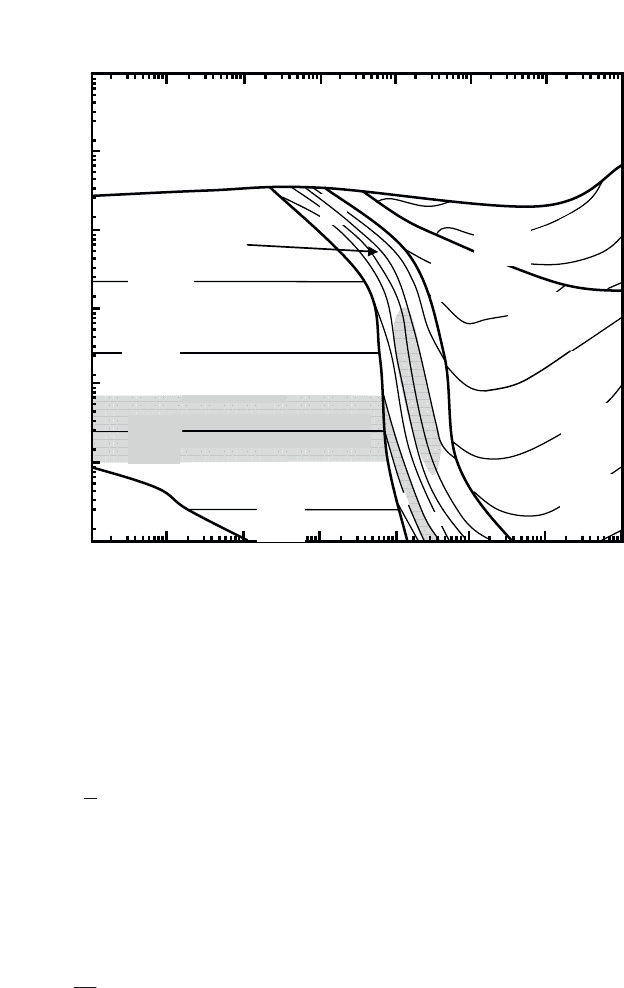
Figure 2.33. Wear map of steel including the different forms of wear as well as
corresponding values for the rates of wear [LIM 87]
The normalized speed V* is defined by:
a
Vv
k
[2.40]
where v is the sliding speed, a is the radius of the contact area and k is the thermal
diffusion coefficient of the metal.
The normalized pressure P* is given by:
n
n
F
PH
A
[2.41]
10
-2
Vitesse de glissement (m/s)
Usure par
délamination
Usure
ultra douce
Grippage
10
-9
10
-6
10
-5
10
-4
10
-6
10
-7
10
-8
10
-9
10
-10
10
-4
10
-5
Usure avec
fusion
Usure par
oxydation
sévère
Usure par
oxydation
douce
10
-
2
10
-6
10
-9
10
-8
Transition entre
usure douce et usure sévère
10
-4
10
-2
110
2
10
10
-1
10
-3
10
-5
110
2
10
4
Pression normalisée
(
P*
)
Vitesse normalisée (V*)
Sliding velocity (m s
–1
)
Normalized velocity (V*)
Mild
oxidational
wear
Severe
oxidational
wear
Seizure
Mild to severe
Normalized pressure (*)
Melt
wea
r
wear transition
Delamination
wea
r
Ultra
mild wear

86 Materials and Surface Engineering in Tribology
where F
n
is the applied load, A
n
the apparent contact surface area and H the
hardness.
The normalized rate of wear is:
n
W
W
A
[2.42]
where W is the rate of wear expressed in terms of the volume of removed matter per
unit of applied load and per unit of sliding distance and A
n
is the apparent contact
surface area.
2.6.3. Interface tribology: third body concept
Interface tribology distinguishes first bodies (those involved in the friction) from
the third body which comes in between and partially or completely separates this
material couple.
In dry (lubricant-free) friction, the third (or “natural”) body is made up of wear
debris forming a layer which can accommodate velocity differences between the
first two bodies. This layer ensures load-carrying capacity, protects the surfaces and
can act as a lubricant, as has been demonstrated in the case of silicon carbide
couples [TAK 94a, TAK 94b].
Liquid and solid lubricants are considered as artificial third bodies as they are
introduced into the contact area by external means.
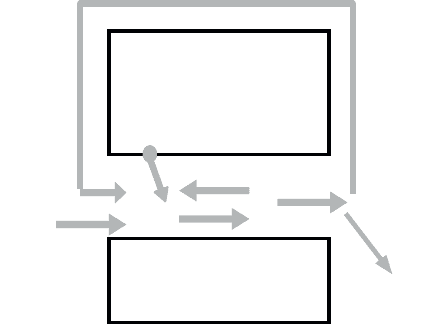
The notion of the tribological circuit was introduced to describe the evolution of
the third body in the contact area [BERTH 88] (see Figure 2.34). Initially, wear
particles are removed from the surfaces subjected to friction and come to provide an
internal source. If a solid lubricant (or external source) is used, the third body will
comprise torn particles and lubricant. As new wear particles are removed from the
antagonistic surfaces and enter the contact area, part of the third body particles are
evacuated from the surface.
Tribology 87
Figure 2.34. Principle of the tribological circuit and evolution of the third body [BERTH 88]
(Q
e
: flow of the third body escaping from the contact; Q
w
: wear flow; Q
r
: recirculation flow;
Q
s
(i): internal source flow, representing the particles detached from the first bodies; Q
s
(e):
external source flow, due to the artificial third body introduced in the contact; Q
i
: internal
flow, or flow of the third body circulating between the first bodies)
The third body can also be defined as an operator that separates the first bodies
and transmits the load (bearing) between the first bodies, while accommodating the
greater part of their difference in speed [BERTH 98].
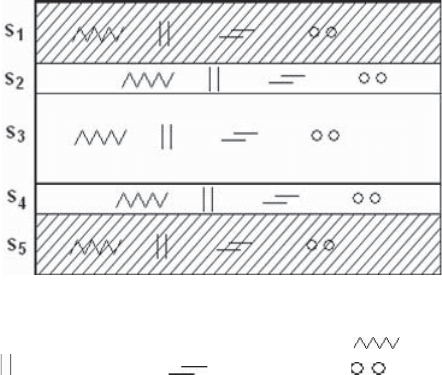
As shown in Figure 2.35, velocity accommodation between the first bodies can
occur in five different sites, i.e. the two first bodies, the third body and the two
intermediate layers between the two first bodies and the third body [BERTH 88,
BERTH 92]. Moreover, within each site, four modes of velocity accommodation can
occur: elastic, rupture, shear and roll. There are twenty velocity accommodation
mechanisms (5 sites u 4 modes) and, depending on the nature of the materials and the
conditions, one or more of these are activated. In fact, in the course of friction, one
particular mechanism can be stopped and one or several other mechanisms can be
triggered.
Berthier provides an overview of third body theory and its uses in solving
problems involving friction and wear [BERTH 05].
Q
r
Q
w
Q
e
Q
i
Q
s
(e)
Q
s
(i)
88 Materials and Surface Engineering in Tribology
Figure 2.35. The different mechanisms of velocity accommodation [BERTH 88, BERTH 92]:
S1, S5 = 1st bodies; S2, S4
=
screens; S3 = 3rd body; M1
=
elastic mode;
M2
=
rupture mode; M3
=
shear mode; M4
=
roll mode
2.6.4. The PV product
Even although we can currently identify and classify many different forms of
wear (abrasion, adhesion and surface fatigue), practical experience shows that wear
is often due to several mechanisms occurring simultaneously. This makes it difficult
to reliably predict the behavior of tribological systems. This complexity is mainly
due to the following six factors:
–
contact pressure varies with wear as the true contact area changes;
–
the chemical composition, texture and mechanical characteristics of a surface
are modified during frictional contact;
–
the exact transformation undergone by the third body and wear debris, as well
as the part they play in the wear mechanism itself, are not yet fully understood;
–
the results of laboratory tests can be influenced by the mechanical
characteristics of experimental instruments;
–
the chemical interaction of lubricants (in particular, certain additives) with the
surfaces subject to friction and the consequences for the tribocorrosion (and wear) of
materials are problems not yet fully understood; and
–
the dissipation of energy during friction is a problem not yet resolved.
From the practical point of view, the performance of a material can be described
by the maximum value of the PV product (pressure u speed) which it can withstand.
In the case of polymer–steel friction, values ranging between 0.06 MPa ms
–1
for
PTFE and 3.5 for polyimide have been reported. In car manufacturing, the PV
product can range from 60 to 250 MPa ms
–1
for a standard crankshaft (from 200 to

Tribology 89
250 MPa ms
–1
for a big end), and it can be as high as 650 MPa ms
–1
for racing
engines (1000 MPa ms
–1
for a big end) [GEO 00, LIG 04].
2.7. Lubrication
The purpose of lubrication is to extend the lifespan of those parts subject to
friction, as well as that of the mechanisms and machine parts in which they are
involved.
Three types of lubricants are used:
–
oils;
–
greases; and
–
anti-friction materials.
2.7.1. Oils [AYE 92, MANG 01, RUD 03]
2.7.1.1. The notion of viscosity
Lubrication oil composition is complex because, as well as containing standard
oil, they comprise a great many additives such as anti-oxidants, anti-rust products,
detergents, anti-foaming agents or extreme-pressure additives.
The principal characteristic of oil is its viscosity, usually noted Ș. This quantity
describes the fluid’s resistance to flow. In the SI system, it is expressed as Pa s and
in the CGS system, the unit is the Poise (1 Pa s = 10 Poises). For example, the
viscosity of water is 1 mPa s at 20°C while that of a car engine lubrication oil is
10 mPa s and that of a molten polymer is of the order of 1000 Pa s.
In place of the dynamic viscosity, we sometimes use the kinematic viscosity (
Q
)
which is defined by:
K
Q
U
[2.43]
where ȡ is the volumetric mass of the liquid.
Q
is given in m
2
s
–1
, but the Stokes (St)
where 1 cSt = 10
–6
m
2
s
–1
is also often used.
In order to facilitate the ease of flow and contact lubrication, oil must retain its
viscosity at high temperatures yet remain fluid at low temperatures. This is usually
achieved through the use of specific additives, such as polymethacrylates, which

90 Materials and Surface Engineering in Tribology
guarantee oil fluidity in cold weather while allowing it to remain viscous enough to
prevent metal–metal contact at high temperatures.
2.7.1.2. The viscosity index and the SAE standard
The viscosity index or VI accounts for variations in oil viscosity as a function of
temperature. If oil viscosity varies greatly with temperature, its viscosity index is
low; conversely, a high viscosity index characterizes oils that are relatively
impervious to temperature changes. This is determined relative to two reference oils
to which are assigned indices 0 and 100. The viscosity of the oil under study is
measured at 40°C and 100°C and the values obtained are then compared with those
of the reference oils.
VI is calculated using the following equation:
100
LU
VI
LH
[2.44]
where U is the viscosity of the oil under study and where L and H are the viscosities
of the reference oils with VI = 0 and VI = 100, respectively. All three oils must have
identical viscosity at 100°C.
To classify oils into categories, the American Society of Automotive Engineers
has established the SAE standard which is used universally. It defines 11 levels or
“grades” characterized by values of viscosity situated within an interval defined by
the standard. These levels of viscosity are measured in cold temperature conditions
(–5 to –40°C) for winter grades (W) and in hot conditions (100°C) for the summer
grades.
Oils satisfying the viscosity limits for either hot or cold conditions are called
monograde. Oils meeting the viscosity requirements for both hot and cold conditions
are called multigrade.
Examples of monograde oils include the following:
–
SAE 10W: smaller numbers are associated with oils that retain high fluidity
even in cold conditions. The number corresponds to one of the six grades: 0, 5, 10,
15, 20 or 25.
–
SAE 40: higher numbers are associated with oils that retain high viscosity even
at high temperatures. The number corresponds to one of the five grades: 20, 30, 40,
50 or 60.
Examples of multigrade oils include:
–
SAE 5W20; and
–
SAE 10W40.
Tribology 91
The numbers given before and after the letter W have the same meaning as those
described above for monograde oils.
2.7.1.3. The Stribeck curve
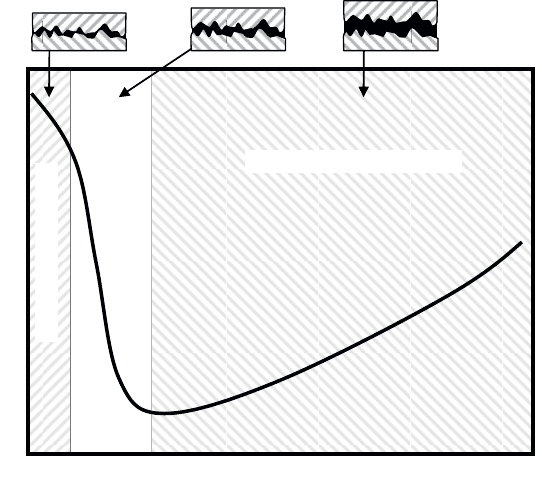
To illustrate the behavior of a lubricant in action, we consider in Figure 2.36 the
case of a plane bearing and monitor the evolution of the friction coefficient when it is
in use. The variation of this coefficient is plotted as a function of the Sommerfeld
number S = Ș V/P, where Ș is the oil’s dynamic viscosity, V is the relative velocity of
the opposing surfaces and P is the normal load.
Figure 2.36. The Stribeck curve
At the start we observe a high friction coefficient due to the metal–metal contact.
In this lubrication limit zone, the mean thickness of the lubricating film is lower
than the mean roughness height of the opposing surfaces.
The second phase is called mixed lubrication (see Figure 2.36) and corresponds
to metal–metal friction in the presence of a discontinuous lubricating film. When the
lubricating film completely separates the surfaces, the friction coefficient passes
through a minimum value and then begins to increase due to viscous friction within
the lubricant. From then on, it is the rheological properties of the lubricant and its
Nombre de Sommerfeld S = Ș V / P
Coefficient de frottement
Lubrification hydrodynamique
L
ub
rifi
cat
i
o
n limi
te
L
ub
rifi
cat
i
o
n mix
te
Hydrodynamic lubrication
Mixed lubrication
Boundary lubrication
Friction coefficient
Sommerfeld number S = Ș V/P
92 Materials and Surface Engineering in Tribology
adhesiveness to the surfaces in contact that determine the tribological behavior of
the system. This domain corresponds to the regime of hydrodynamic lubrication
(with a continuous lubricating film) and corresponds to the optimum operating zone
of the plane bearing.
2.7.1.4. The different types of oils
2.7.1.4.1. Mineral oils
These are petroleum-based oils containing several kinds of hydrocarbons whose
nature depends on the particular crude oil used. The main hydrocarbon families
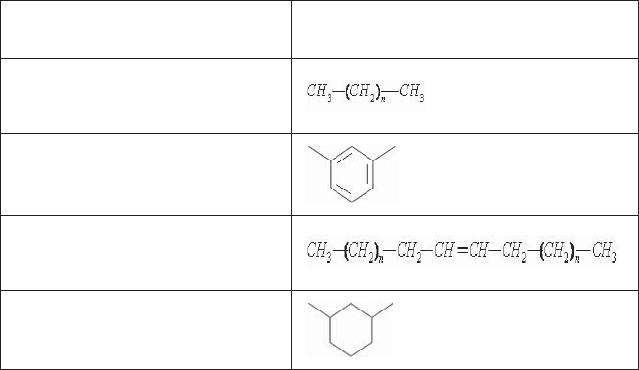
found in mineral-based oils are paraffinic, naphthenic and aromatic oils (see Table
2.4), the latter being the dominant component accounting for more than 70% of the
weight of mineral-based oils.
Name Chemical formula
Structure of linear (n-paraffin)
paraffinic-type hydrocarbon
Structure of aromatic-type
hydrocarbons
Structure of olefinic-type
hydrocarbons
Structure of naphthenic-type
hydrocarbons
Table 2.4. The main types of hydrocarbons found in mineral oils
Apart from these primary constituents, mineral oils also contain oxygenated,
nitrogenated and sulfurated components that can make up as much as 3% of the total
product weight.
Finally, we note that mineral oils have a generally poorer lubrication
performance than compared to synthetic oils and that they are also more
environmentally hazardous.
Tribology 93
2.7.1.4.2. Synthetic oils
Synthetic oils can be classified into four main categories based on their chemical
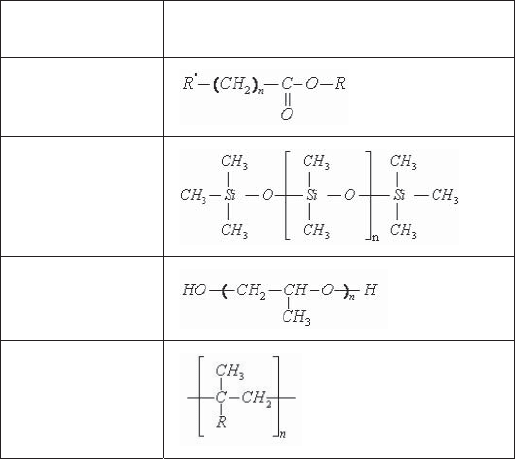
nature: polyolefins, polyglycols, silicones and esters (see Table 2.5).
Polyolefins are largely used in engines and gear lubrication, whereas polyglycol-
based oils are used as brake fluids or as lubricants to prevent metal wear. Silicone-
based oils are noted for their very high viscosity level and can be used, for example, as
a damping liquid or sliding lubricant. Ester-based oils provide excellent resistance to
oxidation and good thermal stability. They are therefore widely used in high-
temperature systems.
Name Chemical formula
Aliphatic ester
Silicone
Polyglycols
Polyalphaolefins
(PAO)
Table 2.5. The different types of synthetic oils
2.7.1.4.3. Vegetable oils
Vegetable oils are intrinsically biodegradable and non-toxic; sunflower, soya and
rapeseed oils can be as efficient as some mineral oils at low temperatures. The
development of new antioxidant additives has now overcome
the main drawback of
these lubricants – their limited resistance to oxidation – and many studies have
shown that these oils can now successfully rival mineral oils of similar viscosity
[KAB 95, MAS 99]. There are strong arguments for the increased use of vegetable
94 Materials and Surface Engineering in Tribology
oils as environmental standards become stricter and as costs of petroleum-based
products increase, particularly considering the opportunities to cultivate fallow land.
2.7.1.4.4. Additives
Lubrication oils are systematically used together with a range of additives which
improve their rheological and chemical properties. These are grouped in two classes:
–
additives acting on the properties of the lubricant such as anti-foaming,
antioxidant agents and viscosity index improvers; and
–
additives interacting with the opposing surface to form a protective film (i.e.
anti-wear and extreme-pressure additives, corrosion inhibitors, detergents and
dispersing agents).
2.7.1.5. Greases
Greases consist of basic mineral or synthetic oil that is mixed with a thickener
containing an alkaline or alkaline earth element such as lithium, calcium, potassium,
sodium or barium. The properties of a type of grease and its performance at high
temperature greatly depend on the nature of its constituents. In contrast to oils,
greases are advantageous in that they do not flow and remain in the contact areas
during friction.
2.7.1.6. Anti-friction materials
Anti-friction materials are used in those cases where oils or greases are
unsuitable. They must meet three essential requirements:
–
be soft and easy to shear;
–
be perfectly adherent to the surfaces of the materials to be protected; and
–
be stable and impervious to chemical or structural changes in the course of
their application.
These materials can be divided into four main categories:
–
lamellar solids;
–
sliding varnishes;
–
soft metals; and
–
fluorides, sulfides and oxides.
2.7.1.6.1. Lamellar solids
Graphite and molybdenum disulfide (MoS
2
) are the two most widely used. They
are characterized by a structure of fine layers known as a lamellar structure (see Figures
2.37 and 2.38). This results from the stacking of atomic planes that are loosely bound by
weak bonds. During friction, when shearing occurs parallel to these planes, they slide