
Takadoum J. Materials and Surface Engineering in Tribology
Подождите немного. Документ загружается.

Tribology 65
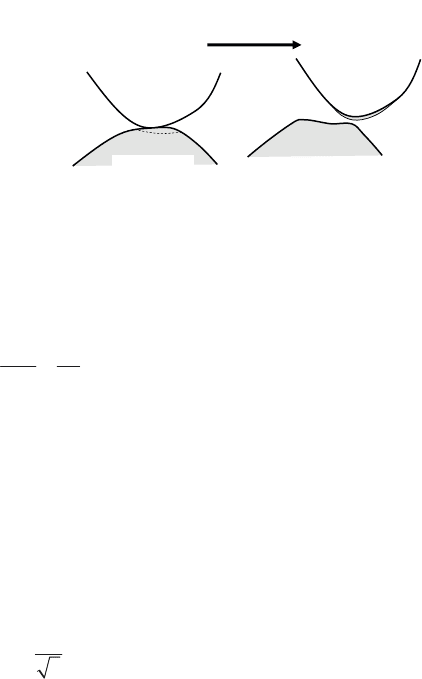
In Figure 2.17, we illustrate the case of two metallic surfaces in sliding contact
and the subsequent formation and shearing of a junction of area A, showing the
transfer of matter from the softest (B) to the hardest material (A).
Figure 2.17. Adhesion with transfer of matter
Under these conditions, if we rewrite equation [2.23], replacing F
t
with the
product AIJ and F
n
with the product AP
m
, we obtain:
mm
A
A
PP
WW
P
[2.24]
In this expression, IJ is the shear stress and P
m
is the mean contact pressure.
If we adopt the von Mises flow criterion since plastification has occurred, we can
write:
3
m
PY
[2.25]
and:
3
c
Y
WW
[2.26]
where Y is the yield stress and IJ
c
the critical shear stress of the softest material.
If we then rewrite equation [2.24], taking into account equations [2.25] and
[2.26], we obtain: μ § 0.2.
Although this is a simple model it can yield acceptable values for μ, even if they
are slightly low compared to mean values obtained for metal–metal pairs. Table 2.2
presents some values for coefficients of friction of different materials.
Sens du déplacement
Cor
p
s A
Corps B
Sliding direction
Material B
Material A

66 Materials and Surface Engineering in Tribology
Materials
Friction
coefficients
Metal–metal in vacuum (< 10
–7
Pa) > 3
Meta l–metal in air 0.2 to 1.5
Polymer–polymer in air 0.05 to 1
Metal–polymer in air 0.05 to 0.5
Metal–ceramic or ceramic–ceramic in air 0.2 to 0.5
Metal–metal with solid lubricant (PTFE, MoS2,
graphite)
0.05 to 1
Metal–metal with oil lubricant (outside hydrodynamic
regime)
0.1 to 0.2
Lubrication in the hydrodynamic regime 0.001 to 0.005
Table 2.2. Some values for friction coefficients
We recall that friction is extremely sensitive to the surface cleanliness and to the
ambient environment in which the materials are placed. In ultra-vacuum, there are
no adsorbed species on the surfaces and they are very reactive. This results in strong
adhesive contact and therefore high coefficients of friction. Conversely, in air or in a
reactive atmosphere, the surface is covered with a layer composed of reaction
products with the atmosphere as well as additional adsorbed species or
contaminants. This layer acts as a lubricant and considerably reduces the coefficient
of friction (see section 1.2.1).
Experiments carried out in an ultra-vacuum chamber (less than 10
–7
Pa) have
allowed measurement of friction coefficients exceeding 10 for many metal–metal
pairs (e.g. 12 for Fe/Fe, 40 for Zr/Zr and 60 for Ti/Ti). The introduction of
increasing amounts of oxygen (or other reactive gases) in the chamber results in a
systematic reduction of the friction coefficient. The effect is enhanced as the metal
presents stronger affinity to the gas introduced [BUC 81].
2.4.2. Tribometers
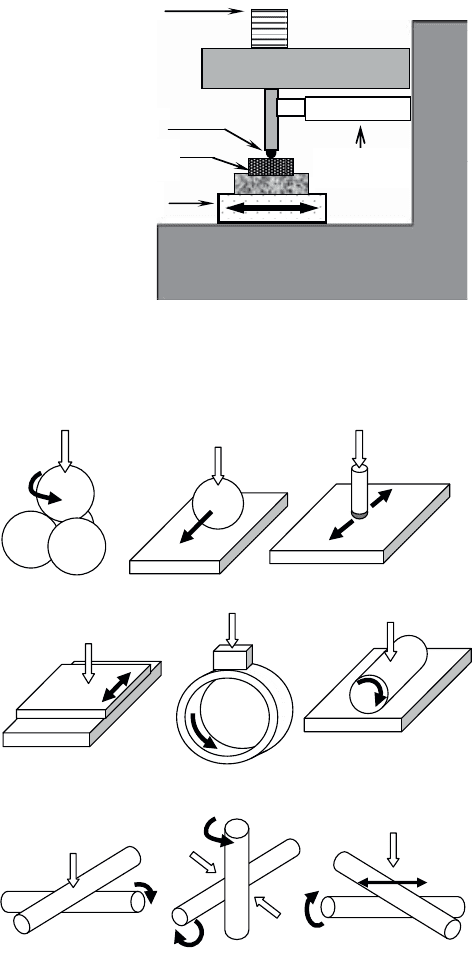
Tribological tests are performed with tribometers which can operate in air or in a
controlled atmosphere, with or without lubrication. Figure 2.18 shows an example of
a ball-on- disk laboratory tribometer with a reciprocating motion. The parameters
imposed are generally the applied load, the sliding speed and the environmental
conditions (humidity and controlled atmosphere i.e. nature and pressure of gases
introduced). The quantities measured are generally the friction force, the surface
temperature, the contact resistance and the wear.
Tribology 67
Figure 2.18. Ball-on- disk tribometer
Depending on the particular application, tests can be conducted using a number
of different contact geometries (see Figure 2.19).
a
)
b
)
c
)
d)
e
)
f
)
g)
h)
i
)
V
Figure 2.19. Variety of contact geometry in tribometers: a) four-ball; b) sphere/plane; c) pin-
on- disk; d) plane/plane; e) plane/cylinder; f) cylinder/plane; g–i) cylinder/cylinder
Charge
Capteur
piézoélectrique
Frotteur
Echantillon
Mouvement
alternatif
Loa
d
Ball
Piezoelectric
senso
r
Specimen
Reciprocating
motion
68 Materials and Surface Engineering in Tribology
2.4.3. Laws and theories of friction
Historically, it was Leonardo da Vinci who first attempted to provide a scientific
explanation for friction (circa 1500) and who introduced the notion of friction
coefficient. In the 1700s, Guillaume Amontons formulated the first two laws of
friction which still bear his name today:
–
the friction force is proportional to the normal applied load; and
–
the friction force is independent of the apparent contact area.
These laws have been verified with mostly metals. However, with very hard
materials or highly elastic materials (such as rubber), experimental results have not
agreed with theoretical predictions [BOW 50]. It also must be noted that even for
metals, when the contact pressure is lower than the plastic flow threshold, we
observe behavior which is the opposite to that described by the first law. It was
Charles-Augustin Coulomb who introduced a distinction between static and dynamic
friction coefficients, and formulated the third law of friction in the 1780s:
–
the friction coefficient is independent of the sliding speed.
All three of these rules have been verified in many cases, yet they should be used
with a degree of prudence as they do not apply to all materials regardless of the
environment and types of stress. This is particularly true when sliding speeds are too
high or when too large a range of loads is used [BLAU 95].
It was in the 1950s that a microscopic approach was introduced, based on the
formation and rupture of junctions at the contact points between opposing surfaces
[BOWD 50, BOWD 64]. Under the combined effects of the applied load and the
sliding speed, the interfacial temperature increase can lead to the growth of
numerous junction points between the solids. When these junctions are weak, shear
occurs within but with little or no transfer of matter. Conversely, when they are
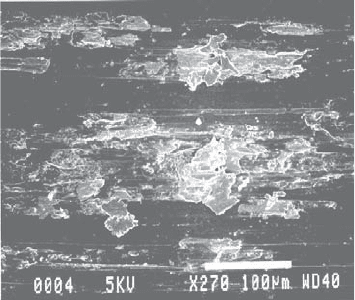
strong, shear occurs in the softest material which is transferred onto the harder
material. For example, this is what happens when a soft copper or copper-based
sphere is rubbed against a hard steel surface (see Figure 2.20).
Tribology 69
Figure 2.20. Bronze particles (light) transferred onto a steel surface (dark) by friction
In order to explain friction, a theory based on the overlapping of surface
asperities was also proposed but was soon abandoned when it was established that
carefully-polished surfaces could still have high friction coefficients.
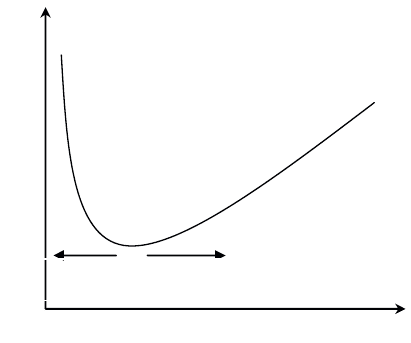
Today, however, we know that depending on the nature of materials and the
conditions of the surfaces in contact, there exists an optimal value of roughness that
minimizes the friction. The smoother the surface and the lower the roughness, the
greater the true contact surface will be and, consequently, the greater the adhesive
friction component will be (see equation [2.27]). Conversely, the rougher the surface
and the sharper and the more numerous the asperities, the greater the plastic
deformation component will be. Between these two extremes, there exists an
optimal roughness associated with a low friction coefficient (see Figure 2.21).
It should be noted that, for a given surface state, the evolution of the friction
coefficient relative to the normal applied load is similar to that shown in Figure 2.21.
There exists an optimal load that minimizes the friction coefficient [MYS 97].
70 Materials and Surface Engineering in Tribology
Figure 2.21. Impact of roughness on friction: definition of optimal roughness. The evolution
of friction relative to the applied load can be illustrated by a curve of similar shape
It is widely known that the friction force consists of two terms and can be
expressed as:
tda
F
FF
[2.27]
The term F
d
is due to the deformation of asperities and to the ploughing of the
softest surface by the hardest surface (plastic deformation component), whereas F
a
is
the force needed to shear the adhesive junctions between opposing materials
(adhesive component). For the case of polymers, friction also induces visco-elastic
losses which constitute, in most cases, the predominant factor [BRISCOEE 98].
During the friction process, only part of the dissipated energy is due to the wear
of the opposing materials. Indeed, [BRISCOEB 92] gives the following as a general
guide to the forms of energy into which “mechanical energy is converted during
friction:
–
heat energy, causing an increase in the temperature of rubbing bodies;
–
acoustic energy, producing audible effects;
–
optical energy, including the full spectral range;
–
electric energy, responsible for generating electrostatic charge;
–
mechanical energy, causing wear of contacting bodies; and
–
mechanical energy (or entropy), causing further comminution of wear
particles”.
Rugosité
Force de frottement
Adhésion déformation plastique
Friction force
Roughness
Adhesion
Plastic deformation
Tribology 71
The relative contribution of these different forms of mechanical energy
expenditure will differ according to the nature of the opposing materials, the
surrounding environment and the contact conditions. There is therefore no
correlation between wear and friction, and it is indeed possible to observe significant
friction without any surface wear. Wear can therefore only be correlated with a
fraction of the energy used in the wear process itself.
2.5. Nanotribology
2.5.1. Surface forces
Surface forces play an important part in friction and their impact is particularly
noticeable with microcontacts, especially when the forces involved are low (from a
few micronewtons to a few hundreds of micronewtons).
These forces are classified into three types:
–
electrostatic forces;
–
capillary forces; and
–
Van der Waals forces.
2.5.1.1. Electrostatic forces
These forces result from Coulomb interactions between pre-charged surfaces or
from surfaces which become charged through friction (triboelectricity). They can be
described using the classic equations of electrostatics.
2.5.1.2. Capillary forces
The humidity content of ambient air normally ranges from 30 to 60%. Under
these conditions, a film of water forms on the surface of materials and induces a new
adhesive force known as the capillary force.
Figure 2.22 illustrates the formation of a meniscus between two solids – a
sphere of radius R and a plane – separated by a liquid film. If the interaction
between the solids is negligible (as is the case when D is large relative to the range
of action of the surface forces), and if the sphere’s radius R is also large relative to
the sphere/plane distance, then the capillary force is given as a function of the
interfacial tension Ȗ
LV
between liquid/vapor by [DEGE 05, GEO 00]:
4cos
LV
FR
SJ T
[2.28]
This shows that the force reaches a maximum (F
max
for ș = 0) corresponding to a
capillary force that acts in the vertical direction (see Figure 2.23) [DEGE 05]. This
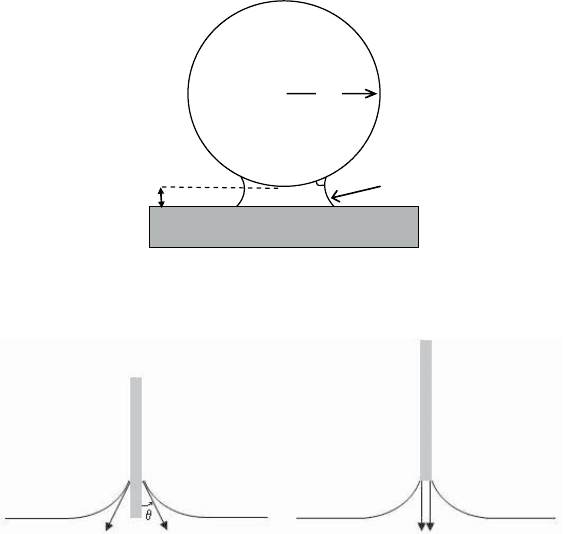
72 Materials and Surface Engineering in Tribology
result is related to equation [1.17] which shows that the liquid/solid adhesive energy
is greatest for ș = 0.
Finally, we note that if the solids are placed in a dry environment or immersed in
a liquid, then the capillary force is zero.
D
R
r
ș
Figure 2.22. Formation of a meniscus
between two surfaces separated by a liquid film
Figure 2.23. Variations in the capillary force when an object dipped in a liquid is withdrawn.
The capillary force reaches a maximum when ș = 0. Figure adapted from [DEGE 05]
2.5.1.3. Van der Waals forces
Van der Waals forces result from dipole–dipole interactions, either between
polar molecules or between polar and neutral molecules (induced dipoles). They can
also arise from dispersive effects (London dispersion forces) due to electron motion
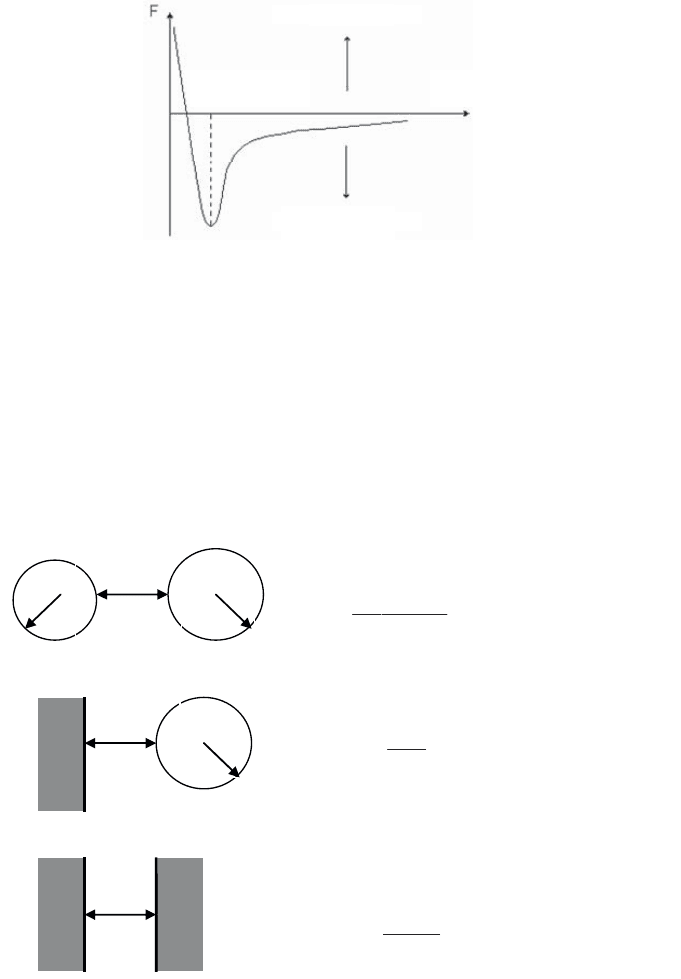
which causes the appearance of instantaneous dipoles with very short lifetimes. In
the case of solid–solid contacts, these forces can be observed by monitoring the
evolution of the force of interaction between a sharp tip and a plane surface slowly
brought into contact in a vacuum (see Figure 2.24).
Tribology 73
Répulsion
Attraction
§ 0,2 nm
Repulsion
Attraction
§ 0.2 n
m
d
Figure 2.24. Evolution of the force of interaction
relative to the distance between a sharp tip and a surface
When the two surfaces are sufficiently close they are attracted through the effect
of Van der Waals forces. However, when the distance becomes less than about
0.2 nm (equilibrium distance D
0
), nuclear repulsion becomes dominant. We note that
the intermolecular attraction can be stronger due to the generation of genuine
chemical bonds such as covalent or metallic bonds. On the other hand, when the
surfaces are immersed in a liquid, new forces develop which determine the nature
and the strength of the interactions [BHU 05]. Van der Waals forces can be
expressed as a function of the contact geometry, using equations [2.29–2.31] (Figure
2.25).
Figure 2.25. Interaction energy (W) between two solids of different geometry
Interaction entre deux sphères
)(6 21
21
RR
RR
D
A
W
Interaction entre une sphère et un plan
D
AR
W
6
Interaction entre deux plans
2
12 D
A
W
S
R
2
R
1
D
D
R
D
I
Interaction between two spheres
Interaction between two planes
Interaction between a sphere and a plane
[2.29]
[2.30]
[2.31]

74 Materials and Surface Engineering in Tribology
In these expressions, A represents Hamaker’s constant, a complex function of the
dielectric (dielectric permittivity İ) and optical (refractive index n) characteristics of
the materials under study and the medium separating them.
If we consider two media 1 and 2 interacting across a medium 3, Hamaker’s
constant can then be expressed:
2222
1323 1 32 3
2222 22 22
1323
1323 13 23
3()()
3
()( )
4
82
()()()()
e
hnnnn
AkT
nnnn nn nn
HHH H Q
HHHH
[2.32]
where İ
i
is the dielectric permittivity; n
i
the refractive index of medium i; k and h are
Boltzmann’s and Planck’s constants, respectively; T is the absolute temperature and
Q
e
is a frequency of the order 3 u 10
15
s
–1
[CAP 99, ISR 99]. Hamaker’s constant
usually takes values ranging between 10
–19
and 10
–20
J.
The expressions given in Figure 2.25 clearly show that, in all cases, the interaction
energy is proportional to Hamaker’s constant.
Consider two identical planes positioned at an equilibrium distance D
0
(state 1)
and separated by a sufficient distance that they do not interact (state 2). If only Van
der Waals forces are acting, the variation of the system energy will be:
state 2 state 1
22
00
0
12 12
AA
WW W
DD
SS
§·
'
¨¸
©¹
[2.33]
This energy is in fact twice the surface energy (Ȗ) of the planes’ material
(equation [2.20]), so we can write:
2
0
2
12
A
D
J
S
[2.34]
which allows us to write:
2
0
24
A
D
J
S
[2.35]
A number of experimental studies allow us to take D
0
= 0.165 nm [GEO 00,
ISR 99]. Equation [2.35] gives a simple relationship between surface energy and
Hamaker’s constant. To determine Hamaker’s constant, all that is required is
knowledge of the surface energy of the material determined with a simple
wettability test (see section 1.2.3).