
Takadoum J. Materials and Surface Engineering in Tribology
Подождите немного. Документ загружается.

Materials for Tribology 135
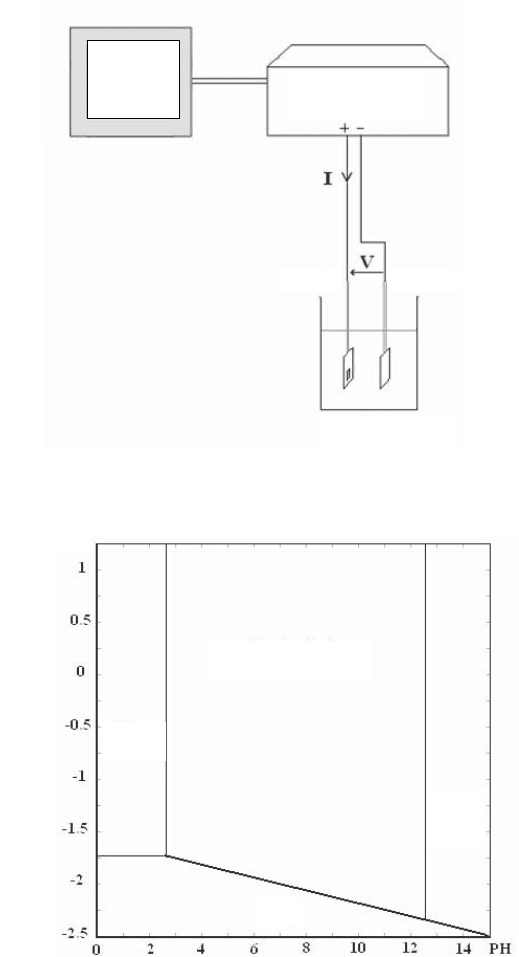
Generator
Anode Cathode
Computer
Cell
Figure 3.12. Experimental set-up for anodic oxidation: the surface to be treated is the anode
Figure 3.13. Pourbaix diagram (potential/pH) for aluminum
showing the domain of generation of alumina
Hydrated alumina
Al
3+
(aq)
AlO
–
2
(aq)
Al(S)
E (V/NHE)
136 Materials and Surface Engineering in Tribology
For the case of aluminum, the reaction mechanism can be divided into three
stages.
– Stage 1: metal dissolution
Al ĺ Al
3+
+ 3e
–
[3.17]
– Stage 2: dissociation of water and O
2–
ion formation
2 H
2
O ' H
3
O
+
+ OH
–
[3.18]
2 OH
–
' H
2
O + O
2
[3.19]
H
3
O
+
' H
2
O + H
+
[3.20]
– Stage 3: formation of alumina Al
2
O
3
(exothermic reaction)
2 Al
3+
+ 3 O
2–
ĺ Al
2
O
3
[3.21]
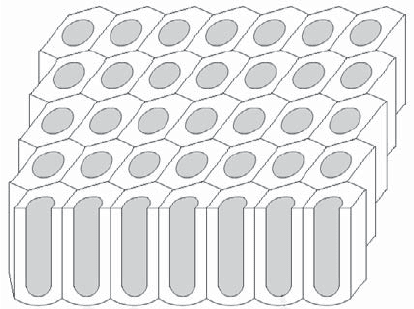
The structure of anodic alumina films consists of a hexagonal array of cells of
varying depth, typically ranging from a few tenths to a few tens of microns (see
Figure 3.14). These films are characterized by elevated hardness (600 HV compared
to 100–200 HV for untreated aluminum alloys) and improved resistance to wear.
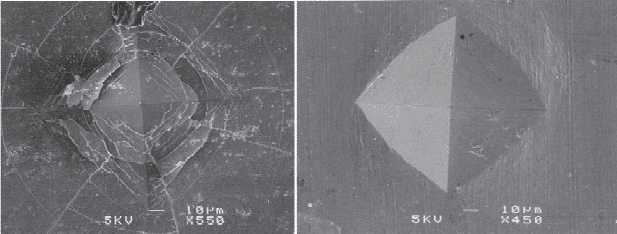
However, as can be seen in Figure 3.15, anodized aluminum films are more brittle
than non-anodized films.
Figure 3.14. Porous columnar alumina structure obtained through anodic oxidation
(thickness: a few microns; cell size: a few nanometers)
Materials for Tribology 137
a) b)
Figure 3.15. Vickers indentations showing a) the brittleness of anodized aluminum relative to
b) non-anodized aluminum which proves more ductile
The morphological and mechanical characteristics of anodic films can be
significantly improved by the use of pulsed signals (current or voltage) signals.
By imposing a current or voltage signal followed by a zero or weaker signal,
overheating due to the exothermic nature of the anodization is significantly reduced.
This prevents dissolution of the oxide film that is formed, reduces the time necessary
for electrolysis and ensures that uniform film thicknesses are obtained.
Depending on the experimental conditions (polarization potential, temperature
and composition of the electrolysis bath) alumina may naturally take on colors
ranging from light gray to dark brown, with all possible intermediate nuances. In
fact, it is possible to take advantage of the porous, columnar structure of alumina to
add coloring agents in the form of organic or mineral pigments, allowing the
manufacture of colored alumina (e.g. red, blue, green etc) for decorative purposes.
The columnar structure of alumina can equally be used as a lubricant reservoir,
thereby increasing efficiency for applications in lubricated friction.
3.3.1.2. Ion implantation
Ion implantation introduces energetic ions into the surface layers of a solid.
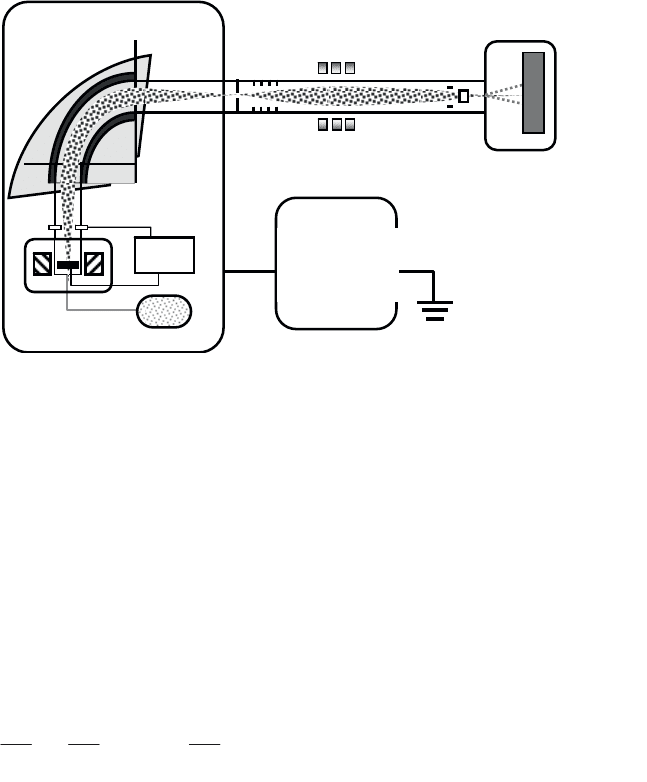
An ion implanter is a device comprising a source that allows particular ions to be
generated in the form of a beam (see Figure 3.16). An extraction system first
removes the target ions and subjects them to an initial acceleration. The beam then
passes through a separation magnet that filters out the ion species to select only the
isotope with the desired mass/charge ratio. These ions pass through an acceleration
column subjecting them to a voltage of several hundred kilovolts, and an
138 Materials and Surface Engineering in Tribology
electrostatic triplet then focuses the ion beam through a scanning system that
consists of horizontal and vertical electrostatic deflection plates. This system allows
the two-dimensional scanning of the sample and thus guarantees uniformity of the
surface treatment.
HT
200 kV
Power
su
pp
l
y
20 kV
Extraction
Ion source
Gas
Acceleration
column
Focalization
Deviation of
the ion beam
Specimen
Figure 3.16. Ion implanter
The penetration depth of the ions can range from a few nanometers to a few
microns, depending on their kinetic energy, their atomic number, their atomic mass
and the nature of the material to be implanted.
During propagation in the solid target, an incident ion loses part of its energy
through collisions with the target atoms. Atoms can then become displaced from
their sites in the solid matrix and then displace other atoms; this can lead to a
displacement cascade.
The mean energy loss for the implanted ion is expressed as the sum of two terms:
nuclear electronic
() ()
ne
dE dE dE
NS E S E
dx dx dx
§· §·
¨¸ ¨¸
©¹ ©¹
where:
– E is the energy of the implanted ion after propagation distance x within the
solid;
[3.22]

Materials for Tribology 139
– S
n
(E) is the nuclear stopping power (nuclear deceleration cross-section) arising
from the interaction between the implanted ion and the atomic nuclei in the solid;
– S
e
(E) is the electronic stopping power (electronic deceleration cross-section)
arising from the interaction between the implanted ion and the electrons of the solid;
and
– N is the atomic density of the solid (expressed as atoms per cubic centimeter).
Knowledge of analytical expressions for S
n
(E) and S
e
(E) allows the calculation
of the energy loss of the implanted ion throughout its path and allows the depth of
implantation to be determined.
The total distance covered by the ion within the solid (see Figure 3.17) is given
by:
0
1
() ()
E
L
ne
dE
R
NSE SE
³
[3.23]
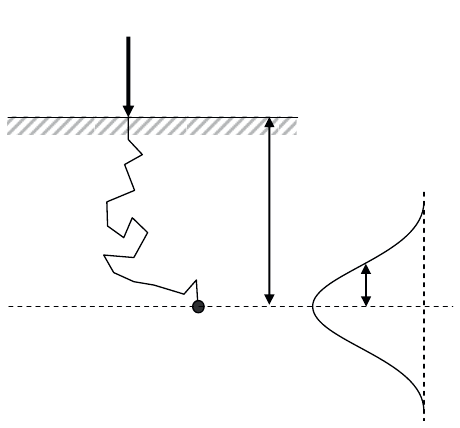
The distribution C(x) of implanted ions perpendicular to the surface of the target
is given by the following equation for a Gaussian distribution (see Figure 3.16):
2
2
() exp
2
2
p
p
p
xR
Cx
R
NR
I
S
ªº
«»
«»
'
'
¬¼
[3.24]
where
I
is the dose of implanted ions (expressed as atoms per cubic centimeters), R
p
is the mean projected range of ions and ǻR
p
is the standard deviation.
140 Materials and Surface Engineering in Tribology
Figure 3.17. Representation of the path taken by an ion implanted into a solid
and (right) Gaussian distribution of the implanted ions
Ion implantation induces two types of change to the surface of the solid:
structural alterations (creation of disorder) and chemical alterations (modification of
the chemical composition of the surface). These changes induce significant
modifications in the physical, mechanical and physico-chemical properties of the
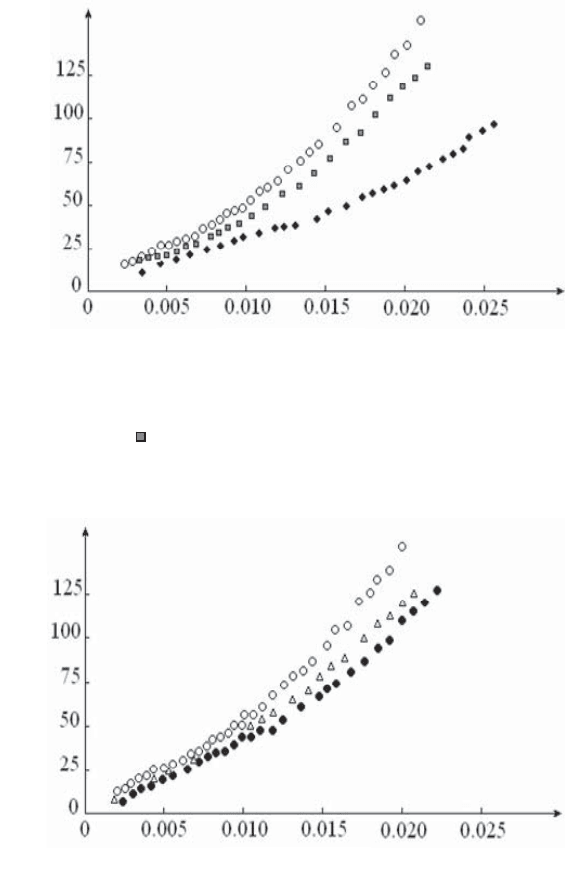
implanted surfaces. In tribology, boron and phosphorus implanted into nickel have
yielded significantly improved hardness (see Figures 3.18 and 3.19) and tribological
behavior for the treated substrate [TAK 85, TAK 86, TAK 87]. Although the friction
coefficient measured between pure nickel and a 100 Cr6 steel sphere of 5 mm in
diameter was 0.95, it was reduced to 0.6 following ion implantation of 5 u 10
16
B or
P cm
–2
, and to 0.3 following ion implantation of 2.5 u 10
17
P cm
–2
or 3 u 10
17
B cm
–2
. Nickel wear was thus reduced by over an order of magnitude following the
implantation of heavy doses of metalloids.
Similar results have been obtained with many other metals: for example nitrogen
ions implanted into steel [FAY 87], titanium [PIV 87] or the Ti6Al4V alloy
[RIV 99]. We also recall that ion implantation has been successfully used to improve
the mechanical and tribological properties of polymers (see section 3.2.2.7).
¨R
p
R
p
R
L
Ions
Solide
Solid
Ions
Materials for Tribology 141
Figure 3.18. Variation of the nano-indenter penetration as a function of the applied load for
pure nickel and ion-implanted nickel with various doses of boron at 50 keV:
(
|) pure nickel; ( ) Ni + 10
16
B cm
–2
; (¡) Ni + 2.3
u
10
17
B cm
–2
[TAK 87]
Figure 3.19. Variation of the nano-indenter penetration as a function of applied load for pure
nickel and ion-implanted nickel with various doses of phosphorus at 125 keV:
(
|) pure nickel; (U) Ni + 10
17
B cm
–2
; (x) Ni + 2.5
u
10
17
P cm
–2
[TAK 87]
Enfoncement (nm)
Penetration depth (nm)
(Load (N))
1/2
Enfoncement
(
nm
)
Penetration depth (nm)
(Load (N))
1/2
142 Materials and Surface Engineering in Tribology
3.3.1.3. Ion beam mixing
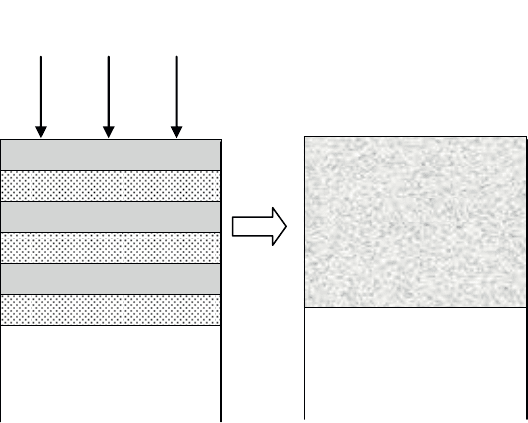
Ion beam mixing is a technique where a film previously deposited onto a
substrate is subjected to ionic bombardment. This treatment is generally carried out
using argon, neon, krypton or xenon beams of energies 100–500 keV, and aims to
induce substrate and film interdiffusion exchanges and the formation of a new alloy
on the surface (see Figure 3.20).
A
B
A
B
A
B
Substrat
Faisceau d’ions lourds
(Ar+, Xe+, Kr+, Ne+)
Alliage A
x
B
y
Substrat
Substrate Substrate
A
x
B
y
alloy
Heavy ions bea
m
(Ar+, Xe+, Kr+, Ne+)
Figure 3.20. Principle of ion beam mixing
Ion beam mixing with multi-layered films of Fe/Ag [AMI 04], Ni/Mo [WEI 97],
Si/C [RIV 95], Cr/V [BLAN 01] and Ti-TiN [HUB 01] has yielded the formation of
new phases. Specifically, ionic bombarding of a nickel film deposited onto a silicon
substrate under certain conditions has yielded a NiSi alloy with precipitation of the
Ni
2
Si phase [BOUS 05]. Alloys generated in this way generally possess remarkable
mechanical [BLAN 01, WEI 97], tribological [WEI 97] and anti-corrosion [HUB 01]
properties.
Metallic films have also been deposited onto ceramics and then subjected to ion
bombardment, for example, the deposition of silver on Al
2
O
3
, ZrO
2
and Si
3
N
4
, or the
deposition of niobium onto SiC. A significant improvement in the degree of
resistance to wear was obtained in all cases [ERC 91].
Materials for Tribology 143
3.3.1.4. Thermochemical treatment
Thermochemical treatments are mainly applied to steels [CONSTANT 92] and
consist of enriching the surface of the material to be treated with certain metalloids.
This process is referred to as carburizing when the metalloid in question is carbon
and nitridation when nitrogen is used. Carbonitridation indicates that both elements
are used and boronizing is used when boron is the metalloid involved.
The gaseous compound containing the carbon, nitrogen or boron, is reduced in
contact with the material undergoing treatment and the metalloid is thus deposited in
its solid state. As the material to be treated is generally heated to a temperature
ranging from 500 to 1,000°C, carbon, nitrogen or boron will diffuse to a depth
ranging from a few microns to several millimeters.
Carbon monoxide and methane are the gases used for carburizing, with the
production of carbon resulting from the three following reactions:
2CO ĺ C + CO
2
[3.25]
CH
4
ĺ C + 2H
2
[3.26]
CO + H
2
ĺ C + H
2
O [3.27]
Nitridation is obtained by decomposition of ammonia gas NH
3
in contact with
the surface of the material which is heated to 500°C. Ammonia decomposes into
hydrogen and nitrogen as:
2NH
3
ĺ 2N + 3H
2
[3.28]
Carburizing and nitdridation layers are characterized by significant hardness (of
700–1000 Vickers) and good residual compression stress.
Steels that have undergone this treatment are characterized by good resistance to
wear, abrasion and fatigue.
Iron borides are very hard compounds obtained by diffusion of boron. Their
hardness can range from 1,500 to 2,000 HV, which makes them particularly resistant
to abrasion. Steel boronizing is usually carried out in a solid state using boron
carbide.
3.3.1.5. Transformation hardening
Transformation hardening is another surface treatment that is also mainly applied
to steels. It consists of heating the surface of the material to be treated to 800–
1,000°C before cooling it down rapidly. Heating can be carried out under a flame,
144 Materials and Surface Engineering in Tribology
by induction or using an electron or laser beam. The depth thus treated can range
from a few tens of microns to several millimeters.
As this surface treatment enables hardening of the surface and embedding of
very high compression stresses, it can grant the material good resistance to both
superficial fatigue and abrasion.
3.3.1.6. Mechanical treatment
Mechanical treatments consist of modifying the surface characteristics of
materials through mechanical action. This can be carried out through sand blasting,
hammering or shot peening. The aim of these mechanical treatments is to induce
high compressive residual stresses into the surface layers, which can grant the
material improved resistance to fatigue and abrasive wear.
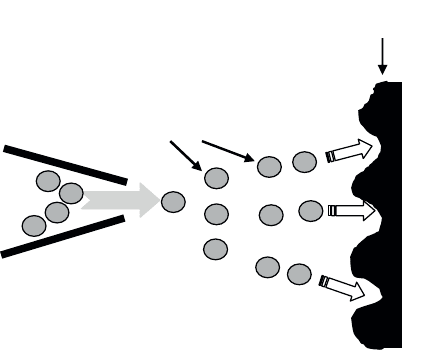
Of all these mechanical treatment techniques, shot peening is the most widely
used [CAS 91, FLA 91, LIE 87]. It consists of bombarding the surface being treated
with a small spherical shot at a speed of 50–100 m s
–1
(see Figure 3.21).
Grenailles projetées
à grande vitesse
Surface grenaillée
Spherical shot projected at
high speed
Surface treated
Figure 3.21. Principle of shot peening
The compressive residual stresses introduced into the surface are generally
between –300 and –1000 MPa. The shots used are spherical glass, steel or ceramic
particles with a diameter usually ranging from 0.02 to 2 mm. Steel shots are most
commonly used in the industrial sector as the high material density enables the
introduction of compressive stresses to significant depths, i.e. up to one or more
millimeters.