
Vaccari D.A., Strom P.F., Alleman J.E. Environmental Biology for Engineers and Scientists
Подождите немного. Документ загружается.

Rickettsias Ricke ttsias are obligate intracellular para sites—they grow within the cells
of their hosts. Rickettsia species are responsible for typhus (Section 12.5.4) and Rocky
Mountain spotted fever (Section 12.5.5). They are typically spread by fleas, lice, and ticks.
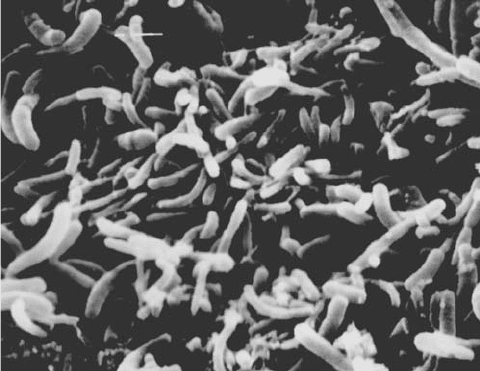
e-Proteobacteria Campylobacter (Figure 10.10) and Helicobacter are micro aerophilic,
motile, spiral, and usually, pathogenic. Campylobacter can cause serious cases of enteritis
and has been resp onsible for some waterborne outbreaks (Section 12.2.5). H. pylori has
been found to be responsible for many cases of stomach ulcers.
Other Proteobacteria In addition to the Proteobacteria described briefly above, there are
many other interesting and important species. For example, several bacteria, such as the
marine Magnetospirillum, contain organelles with small magnetic mineral deposits that
enable them to detect magnetic fields. Bdellovibrio hunts and feeds on other bacteria,
growing inside the cell wall of its prey. Legionella grows in relatively clean, warm aquatic
systems, including cooling towers and commercial hot-water and air-conditioning sys-
tems. If L. pneumophila becomes airborne and is inhaled, it can cause a severe form of
pneumonia known as Legionnaires’ Disease (Section 12.2.3).
10.5.7 Firmicutes: Gram Positives
This large kingdom is often broken into two broad groups based on G þ C content (low
G þ C and high G þ C) and then further subdivided (Table 10.7). It contains many
bacteria of interest to the environmental engineer and scientist, including common soil
organisms and normal inhabitants of ou r skin, muc ous membranes, and digestive tract,
as well as important pathogens. Members of the Firmicutes are also utilized in producing
many foods, in industrial processes, and as sources of antibiotics. They are chemoorganic
heterotrophs, including both aerobes and anaerobes.
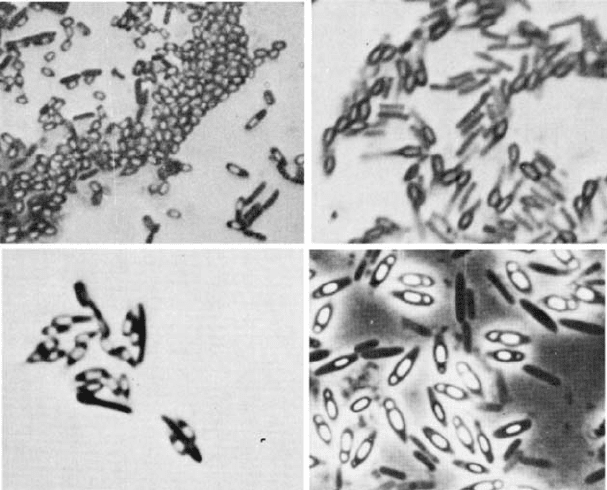
Some of the Clostridia and Bacill i form endospores, specialized resting structures that
are very resistant to heat, drying, and other environmental stresses. Many actinomycetes
(high G þ C) also produce spores, but these are not formed in the same way, nor are they
Figure 10.26 Desulfovibrio. Note the bent rods (vibrios).
258
MICROBIAL GROUPS

as resistant. The endospore develops within the vegetative cell (Fig ure 10.27) and is then
released through cell lysis. Under suitable conditions, the endosp ore can later germinate
to produce a new vegetative cell. This ability is of obvious survival value in the soil,
where conditions suitable for growth may alter nate with unsuitable conditions. The degree
of resistance shown by endospores is quite amazing, including survival in boiling water
and autoclaving (steam heating at 121
C for 20 minutes) of soil. Probably the most
incredible, however, was the recent finding of viable Bacillus endospores in the gut of
a bee preserved in amber for at least 25 million years!
Low G þ C The genus Clostridium contains anaerobic endosp oreforming rods. A vari-
ety of fermentation products (some have been used commercially) may be produced from
carbohydrates by different species, including carbon dioxide, hydrogen, acetate, acetone,
butanol, butyric acid, ethanol, isopropanol, lactic acid, propioni c acid, and succinic acid.
Cellulose-degrading species are probably the major decomposers of cellulose in anaerobic
soils. Similarly, nitrogen fixation by some species probably represents the major source of
new fixed nitrogen in anaerobic soils. Several species can ferment amino acids, producing
the highly unpleasant odors characteristic of putrefying protein by forming compounds
such as putrescine and cadaverine. Some species are thermophilic.
TABLE 10.7 Kingdom Firmicutes: The Gram-Positive Bacteria
a
Low G þ C High G þ C
Class 1. Clostridia Class 4. Actinobacteria
Clostridium Order Actinomycetales
Desulfotomaculum Actinomyces
Epulopiscium Arthrobacter
Eubacterium Micrococcus
Heliobacterium Brevibacterium
Sarcina Cellulomonas
Class 2. Mollicutes Microbacterium
Mycoplasma Corynebacterium
Class 3. Bacilli Gordonia
Order Bacillales Skermania
Bacillus Mycobacterium
Listeria Nocardia
Staphylococcus Rhodococcus
Order Lactobacillales Tsukamurella
Enterococcus Actinoplanes
Lactobacillus Micromonospora
Streptococcus Propionibacterium
Streptomyces
Microbispora
Streptosporangium
Thermomonospora
Frankia
Order Bifidobacteriales
Bifidobacterium
a
All classes are listed, but not all orders. Only some representative, important,
and interesting genera are included.
BACTE RIA
259
Several common and normally free-living soil species of Clostridium produce toxins
that may be fatal to humans, (Sections 12.3.1, 12.7.1, and 12.7.2). Botulism results from
production (usually in food) of an exotoxin (a toxin released outside the cel ls) by C. botu-
linum. If infected food is eaten, the fatality rate is close to 100%. Also, the reason that
infants should not be fed honey is the possibility of infection of the immature intestinal
tract with C. botulinum, leading to toxin production. C. tetani can grow in deep, anaerobic
wounds, releasing the exotoxin that causes tetanus, or ‘‘lockjaw.’’ C. perfringens can be a
normal inhabitant of the intestines (and has even been used as an indicator organism for
sewage sludge). However, it can also cause gastroenteritis and is one of the clostridia
responsible for gas gangrene.
Heliobacterium, a close relative of Clostridium, is of interest in that it is an endospore-
forming phototroph (Table 10.4). It is also an important nitrogen-fixing soil bacteria,
especially in paddies (rice fields). Desulfotomaculum is an endospore-forming sulfate-
reducing bacteria. Epulopiscium fishelsoni, a rod-shaped symbiont in surgeonfish, is of
interest because of its incredible cell size: 50 mm in diameter and up to 600 mm long!
Eubacterium is an anaerobic, non-spore-forming, rod-shaped bacteria that produces a
mixture of organic acids as fermentation products. It is found in soil but is also one of the
predominant intestinal bacteria. Some species are pathogens.
The Mollicutes lack a cell wall and hence are pleomorphic (of variable shape). They
include the smallest (0.2 mm) known free-living cells. This small size and lack of rigidity
means that they are sometimes able to pass through filtration systems intended to sterilize
Figure 10.27 Endospores in several species of Bacillus: (upper left) B. subtilis, (upper right)
B. circulans, (lower left) B. stearothermophilus, (lower right) B. popilliae (cause of milky spore
disease in Japanese beetles). (From Gordon et al., 1973.)
260
MICROBIAL GROUPS
water or media. There are both facultative and obligate anaerobes. A number, including
many Mycoplasma, are pathogenic.
Bacillus is a large, heterogeneous group of aerobic and facultative, rod-shaped endo-
spore-formers. They are very common in soil, degrading a wide variety of compounds,
and some are among the major species active during thermophilic composting (optimum
temperature for B. stearothermophilus is 65
C). Some produce antibiotics (e.g., bacitra-
cin), others are used commercially for industrial enzyme production. Several species
attack insects, and in fact the insecticide Bt, effective against a number of pests, is actually
B. thuringiensis. B. anthracis causes anthrax (Section 12.7.5), which is usually a disease
of animals such as sheep. However, because it is so easy to culture and store (since it
forms endospores), and because as an aerosol it can be very infective and nearly always
fatal in humans, it is also of concern as a biological warfare agent.
The lactic acid bacteria, which include Lactobacillus, Streptococcus, and Enterococ-
cus, grow mainly on sugars and produce lactic acid as their major fermentation product.
Although they are obligate anaerobes, they tend to be aerotolerant. They require complex
organic media, as they are unable to produce many basic cell constituents themselves
from only simple compounds. All are cocci, except for Lactobacillus (rods), and tend
to grow in chains. Lactobacillus is used to produce a number of foods, including some
cheeses, yogurt, sourdough, sauerkraut, pickles, and acidophilus milk (for lactose-intoler-
ant people), as well as being of great importance (because of the acids it produces) in the
agricultural crop preservation technique known as ensilage . It can still grow well at pH 5
and below. It is also a common inhabitant of the mouth, intestines, and vagina of humans
and other warm-blooded animals, but is not pathogenic.
Streptococcus species also are involved in ensilage, as well as production of some
foods, such as buttermilk. Others are important pathogens, causing strep throat, scarlet
fever, rheumatic fever, and pneumococcal pneumonia (Sections 12.4.1 and 12.4.2).
Some species are normal inhabitants of the respiratory tract, intestines, or mouth,
where they can be involved in dental caries (cavities). En terococcus species (formerly,
fecal streptococci) are common intestinal bacteria of warm-blooded animals; in fact,
they are typically more common than Escherichia coli and other coliforms, except in
humans.
Staphylococcus (Figure 10.9) are aerobic and facultatively anaerobic, typically grow in
clusters, and are halotolerant, usually able to grow in 15% NaCl. They are common inha-
bitants of the skin and mucous membranes. S. aureus, which is yellow, can be pathogenic,
causing pimples, abscesses, boils, and impetigo of the skin, pneumonia, meningitis, and
toxic shock syndrome. It also produces enterotoxins (exotoxins that affect the intestines),
which makes it the most common cause of food poisoning (Section 12.3.1).
Listeria is widespread in nature, being found in soil, vegetation, and fecal material, and
as an animal pathogen. One species causes listeriosis, which is most commonly a food-
borne illness (Section 12.3.2). The short rods are aerobic or microaerophilic and are able
to grow at refrigerator temperatures (4
C).
High G þ C The Actinobacteria include the actinomycetes and a number of related
organisms. Most are soil bacteria (in fact, the earthy odor of soil comes from the geos-
mins produced by many species of Actinobacteria and some cyanobacteria), but some are
aquatic, and a number are pathogens. Actinomycetes develop filamentous masses referred
to as mycelia (singular, mycelium), which superficially resemble fungal growths. The
BACTE RIA 261
individual filaments are called hyphae (singular, hypha). Special sporeforming structures,
called sporangia (singular, sporangium), may be produced, or filaments may fragment
into spores in some species, but endospores are not formed. Many actinomycetes produce
antibiotics, including such important ones (from Streptomyces) as streptomycin, tetracy-
cline, chloramphenicol, and neomycin.
Among the Actinobacteria that are not actinomycetes are the Corynebacteria, which
are aerobic or facultative, and include Corynebacterium, Cellulomonas, and Arthrobacter.
Corynebacterium are irregular or club-shaped rods, often in V-shaped groups. It includes
both free-living and pathogenic species, including C. diphtheriae, which causes
diphtheria. Cellulomonas are very similar, but degrade cellulose and are nonpat hogenic.
Arthrobacter, strict aerobes unable to utilize cellulose, are among the most common soil
bacteria. They begin as small cocci, which then elongate into irregular rods under growth
conditions, forming cocci again as the medium is exhausted.
Propionic acid bacteria, such as Propionibacterium, are anaerobes that produce propio-
nic acid as a main fermentation product. Th ey help give Swiss cheese its characteristic
taste, as well as its holes (from carbon dioxide production).
Mycobacterium are rod-shaped, sometimes forming filaments and even branches; how-
ever, they do not produce true mycelia. Included are free-living forms from soil and water,
as well as several important pathogens. A key characteristic of this group is that they are
acid fast; when stained with basic fuchsin and phenol , they are not decolorized by an
acid–alcohol mixture. This property has been found to be due to the presence of mycolic
acids on the cell surface, which occur only in this group. Mycobacterium tend to be slow
growing, but also resistant to many environmental stresses. M. tuberculosis is the cause of
tuberculosis (Section 12.4.3), a once-devastating disease that is still a major problem
worldwide and is increasing again in the United States. M. leprae causes leprosy
(Section 12.7.6).
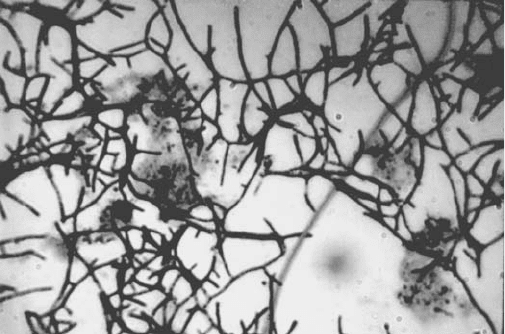
Nocardioform bacteria (Figure 10.28) are usually considered the simplest of the acti-
nomycetes, as well as being similar in some ways to the Corynebacteria and Mycobacteria.
Mycelia are typically formed, but as the culture ages they tend to fragment into small
sporelike elements. Almost all are strictly aerobic (a few are facultatively anaerobic),
and most grow relatively slowly. Nocardia are very common in soils, where they seem
to play a role in degradation of some recalcitrant compounds. A few are known to be
opportunistic pathogens. They also have been found to be involved in foaming problems
in activated sludge wastewater treatment plants, as have Rhodococcus, Gordonia, Skerma-
nia, and Tsukamurella (Section 16.1.3).
Actinomyces are anaerobic or facultative actinomycetes which produce easily frag-
menting hyphae and no extensive mycelium. Frankia is microaerophilic, forms true
mycelia, and is able to fix nitrogen. Streptomyces are very common, with the genus con-
taining over 500 species; they are aerobic, with extensive mycelia that produce spores. A
number of actinomycetes are thermophilic, including, for example, Thermomonospora,
and some Microbispora and Streptomyces, and several species may be important in
composting.
10.5.8 Planctomycetacia
Some authors break this kingdom into two, one for the Planctomycetales (containing
Planctomyces and a few other genera), the other for the Chlamydiales (containing only
262 MICROBIAL GROUPS
the genus Chlamydia). Planctomyces is a stalked, budding bacteria, but it is unrelated to
the more common appendaged and budding bacteria such as Caulobacter (see earlier dis-
cussion of proteobacteria; Section 10.5.6), with which it was previously grouped. The
stalk is made of protein (rather than cell wall and cytoplasm), and in fact the cell lacks
the peptidoglycan that in other bacteria gives the cell wall much of its strength. Plancto-
mycetes are heterotrophic chemoorganotrophs found mainly at the surface of freshwater
lakes but also occur in marine and other aquatic environments. Recent genetic probe stu-
dies suggest that they are present in activated sludge wastewater treatment systems.
Chlamydia are obligate intrac ellular parasites, usually of birds or mammals, and so
were originally grouped with the Rickettsias (a-proteobacteria). Trachoma, caused by
C. trachomatis, is the leading worldwide cause of human blindness. Strains of this species
also cause chlamydial infections of the genitourinary tract, which is probably the most
widespread sexually transmitted disease, and apparently can be involved in heart disease
through their role in the buildup of deposits on the interior walls of arteries. Other species
may cause pneumonia in humans, and the disease psittacosis in birds and sometimes
mammals, including humans. The bacteria have an infective form that invades a host
cell, then grows inside it.
10.5.9 Spirochetes
The spirochetes are heterotrophic chemoorganotrophs with distinctive, long, thin, tightly
coiled spiral cells. They have a ‘‘wriggling’’ type of motility that is now known to result
from an unusual arrangement of endoflagella. Instead of sticking out from the cell, spir-
ochete flagella bend back and run along the cell, and together with it are enclosed in a
flexible sheath.
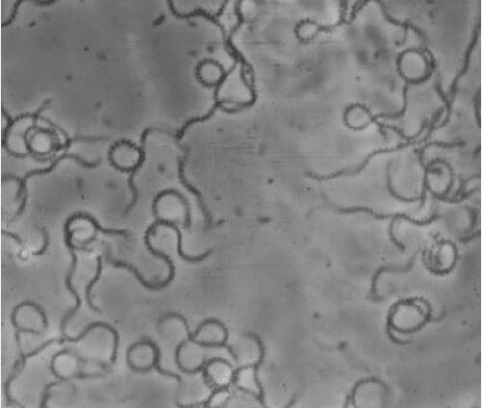
Members of the genus Spirochaeta are free-living obligate or facultative anaerobes.
They are probably the spirochetes occasionally seen in activated sludge wastewater treat-
ment systems (Figure 10.29), where they are indicat ive of anaerobic condi tions. In some
species the length may exceed 200 m m.
Figure 10.28 Nocardia-like filamentous bacteria in activated sludge foam (gram-stained
preparation).
BACTE RIA 263
Several other spirochetes are important pathogens of humans and other animals. One
species of Treponema (T. pallidum), which is microaerophilic or anaerobic, is the cause of
the important venereal disease syphilis (Section 12.6.1). Other Treponema species cause
yaws and other diseases in humans and animals, and many live com mensally in the mouth
or digestive tract, including in the rumen (the cellulose-digesting forestomach of rumi-
nant animals, such as cattle, sheep, and deer). Microaerophilic Borrelia is the cause of
Lyme disease (Section 12.5.6) and relapsing fever. Leptospira is aerobic and can be
free living or pathogenic, causing leptospirosis (Section 12.2.3).
10.5.10 Fibrobacter
This kingdom contains only a few known species. Fibrobacter are gram-negative, rod-
shaped (usually), non-spore-forming anaerobes that ferment cellulose and a few other
compounds. They are found in the intestin es or rum en.
10.5.11 Bacteroids
Bacteroids are obligately anaerobic chemoorganotrophic heterotrophs. Members of the
genus Bacteroides are the most common bacteria in the human lower digestive tract,
with concentrations in feces usually exceeding 10
10
per gram. Bacteroids are often an
important part of anaerobic environments (including the rumen) in which organics are
being degraded to simpler compounds that can then be utilized by methanogens (archaea
that generate methane; Section 10.6.3).
10.5.12 Flavobacter ia
Flavobacteria also are chemoorganotrophic heterotrophs, but they are aerobic or occasion-
ally facultatively anaerobic and are widely distributed in aquatic, marine, and soil sys-
tems. Colonies of the common genus Flavobacterium are often yellowish.
Figure 10.29 Spirochetes in activated sludge.
264
MICROBIAL GROUPS
10.5.13 Sphingobacteria
The Sphingobacteria are aerobic or facultatively anaerobic chemoorganotrophic hetero-
trophs. Cytophaga are common in water and soil, have gliding motility, and can produce
small spherical resting stages called microcysts. Cytophaga are able to digest cellulose
and chitin, making them very important in the cycling of carbon in aerobic environments.
They can also digest the agar that is used routinely for solidifying media in microbiology
labs. Haliscomenobacter is a common small filament in activated sludge.
10.5.14 Fusobacteria
The Fusobacteria are gram-negative, anaerobic or facultative, non-spore-forming rods.
Fusobacterium is typical ly found in the mouth or intestines and is sometimes pathogenic.
Streptobacillus is usually found in the mouth of rats and can cause one type of rat bite
fever.
10.5.15 Verrucomicrobia
There are only two known genera of Verrucomicrobia, both unicellular nonmotile che-
moorganotrophic heterotrop hs. Prosthecobacter has a single prostheca, is strictly aerobic,
and is oligotrophic (grows at low levels of available nutrients). It is found in aquatic sys-
tems, soils, and wastewater treatment plants. Verrucomicrobium has numerous prosthecae,
is facultatively anaerobic, and has been found in soils and a eutrophi c (nutrient-rich) lake.
10.6 ARCHAEA
Although a number of Archaea species have been known for many years, until recently
they were considered bacteria and not recognized as belonging to a separate major
domain. Three kingdoms of Archaea (Table 10.8) are now recognized, and with the excep-
tion of the methane producers (methanogens), most of the known species are extremo-
philes (high temperature, high or low pH, and/or high salinity). They include both
aerobes and anaerobes, chemoorganotrophs and chemolithotrophs, heterotrophs and auto-
trophs. Some are flagellated, others are nonmotile. None are known to be pathogenic.
However, it is still too early in the investigation of these organisms to tell how diverse
and widespread the group may truly be.
10.6.1 Korarchaeota
Members of the Korarchaeota have been observed in hot springs but have only recently
been cultured. For this reason, little is yet known about them other than that the ones
observed are hyperthermophiles. They are of particular interest to microbiologists because
they may be the closest living relatives to the earliest life-forms to develop on Earth.
10.6.2 Crenarchaeota
Most of the known Crenarchaeota are hyperthermophiles, including Pyrolobus, the organ-
ism with the highest known growth temperatures (minimum, 90
C; optimum, 106
C;
maximum, 113
C). Such organisms growing at temperatures above 100
C are found in
ARCHAEA 265

marine hydrothermal vents, areas of volcanic activity on the ocean floor (where high pres-
sures raise the boiling point of water). Pyrolobus is a chemolithotrophic autotroph that
grows on hydrogen, utilizing nitrate (which is reduced to ammonium), thiosulfate, or oxy-
gen as an electron acceptor. Pyrodictium can grow at 110
C (optimum, 105
C), utilizing
hydrogen or organic material, with elemental sulfur as the electron acceptor. Other species
(such as Pyrobaculum) can also utilize ferric iron (Fe
3þ
) as an electron acceptor.
Other Crenarchaeota grow in hot springs. Sulfolobus, for example, grows aerobically,
oxidizing hydrogen sulfide to sulf uric acid and ferrous iron (Fe
2þ
) to ferric form. Its max-
imum temperature is ‘‘only’’ 87
C, but it is also an acidophile.
Not all Crenarchaeota are thermophilic. They have now been found to be widespread in
the marine environment, including in Antarctic waters, where temperatures are typically
below 0
C.
10.6.3 Euryarchae ota (Including Methanogens)
The Euryarchaeota include thermophiles and hyperthermophiles, hyperhalophiles, and
methanogens. Among the thermophiles are Thermoplasma (optimum, 55 to 60
C), an
acidophile (optimum, pH 1 to 2) found in hot springs and in coal refuse piles (large
mounds of waste soil and rock from coal mining operations). Interestingly, Thermoplasma
(like the mycoplasmas) lacks a cell wall, despi te the harsh environments in which it
thrives. Picrophilus (which does have a cell wall) can grow at a pH below zero.
Coal refuse piles represent an interesting ecosystem. They cont ain residual coal,
iron pyrite (FeS
2
), and other organic and inorganic compounds. Aerobic chemolithotrophs
TABLE 10.8 The Archaea: A Proposed Phylogeny Including Some
Representative, Interesting, and Environmentally Important Genera
a
Kingdom 1. Korarchaeota Order 2. Methanomicrobiales
Kingdom 2. Crenarchaeota Methanomicrobium
Class 1. Thermoprotei Methanospirillum
Order 1. Thermoproteales Order 3. Methanosarcinales
Pyrobaculum Methanosarcina
Order 2. Desulfurococcales Class 3. Halobacteria
Pyrodictium Halobacterium
Pyrolobus Natronococcus
Order 3. Sulfolobales Class 4. Thermoplasmata
Sulfolobus Picrophilus
Kingdom 3. Euryarchaeota Thermoplasma
Class 1. Methanobacteria Class 5. Thermococci
Methanobacterium Pyrococcus
Class 2. Methanococci Thermococcus
Order 1. Methanococcales Class 6. Archaeoglobi
Methanococcus Archaeoglobus
Ferroglobus
Class 7. Methanopyri
Methanopyrus
a
All classes and orders are listed if more than one.
266 MICROBIAL GROUPS
oxidize the pyrites, leading to highly acidic condi tions (see acid mine drainage,
Section 13.4.3), while oxidation of organics leads to self-heating (see composting,
Section 16.2.3) and further depletion of oxygen. The elevated temperatures are believed
to effect a partial chemical breakdown of high-m olecular-weight organics present in the
coal into smaller, more readily biodegradable compounds. This sets the stage for Thermo-
plasma to utilize the organics aerobically or through sulfur respiration.
Hyperthermophilic Euryarchaeota include Thermococcus, which grows on organic
matter using elemental sulfur as its electron acceptor, and Archaeoglobus, a sulfate redu-
cer. Ferroglobus can oxidize ferrous iron to ferric form utilizing nitrate.
The hyperhalophiles, such as Halobacterium, are found in very salty waters, such as
the Dead Sea (Israel/Jordan) and Great Salt Lake (Utah), as well as in salt drying ponds
and on salted fish. Others, including Natronococcus, thrive in highly alkaline soda lakes,
such as those of the African Rift Valley. Of particular interest to some biochemists is that
several of these organisms contain pigments that allow them to obtain energy (produce
ATP) from light through a nonphotosynthetic pathway.
Methanogens are strict anaerobes that produce methane. Most commonly this is done
by the reduction of carbon dioxide used as an electron acceptor during growth on hydro-
gen, but some methanogens can reduce methanol or other methyl compounds, cleave acet-
ate (to methane and carbon dioxide), or carry out a very small number of related reactions.
Methanogens are found in a variety of natural habitats, such as freshwater sediments and
flooded soils (producing ‘‘swamp gas’’) and the digestive tracts of animals ranging from
termites to humans. One genus found at hydrothermal vents, Methanopyrus, is hyperther-
mophilic (optimum 100
C, maximum 110
C).
The methanogens are the Archaea of greatest interest to environmental engineers and
scientists. In addition to their critical role in the carbon cycle in anaerobic environments,
their activities are widely utilized in such anaerobic organic waste treatment processes as
anaerobic digestion of sewage sludge. Without the final conversion of anaerobic metabolic
products to methane (and the potential for energy recovery), such anaerobic processes
would be of very limited usefulness. Methanogens are also responsible for the production
of methane at sanitary landfills.
10.7 EUKARYA
As discussed earlier, the third domain of life is Eukarya. Early biologists recognized only
two kingdoms, Plants and Animals. Fungi and algae (and later bacteria) were considered
plants, and protozoans, once they were discovered, were placed with the animals. (Inte-
restingly, recent evidence suggests that fungi may actually be more closely related to ani-
mals than to plan ts!) Later, the eukar yotes were broke n into four kingdoms (with the
prokaryotes considered a fifth): Animals; Plants; Fungi; and Protista, which included pro-
tozoans, algae, and slime molds. However, as with the prokaryotes, genetic testing (in this
case, 18S rRNA) has shown that if the differences between plants and animals warrants
assignment to separate kingdoms, the protists can be considered to consist of a fairly large
number of ‘‘kingdoms,’’ including several each of protozoans and algae, two of slime
molds, and one that was formerly considered a fungus. Here though, for convenience,
we will still use the three groupings within the ‘‘protists.’’ Also, although many fungi
and algae and the slime molds may be large, multicellular, macroscopic organisms,
they will still be discussed below with their microscopic ‘‘cousins’’.
EUKARYA 267