
Vaccari D.A., Strom P.F., Alleman J.E. Environmental Biology for Engineers and Scientists
Подождите немного. Документ загружается.

structures called chlorosomes, in which much of their bacteriochlorophyll is concen-
trated. They are mostly autotrophic, but some photoheterotrophy has also been observed.
Chlorobium is the best known genus.
10.5.6 Proteobacte ria
The Proteobacteria is a vast kingdom, including many of the gram-negative species and
many of the metabolic activities known among the bacteria. Based on 16S rRNA, it is
broken into five classes, but these are more often referred to as the a, b, g, d, and e sub-
divisions. Interestingly, the 16S rRNA of mitochondria (in eukaryotes) places them in this
group also (Figure 10.19), suggesting that this organelle evolved from endosymbiotic
early Proteobacteria. Table 10.5 lists some of the important and interesting genera.
Because the kingdom is so large, and because organisms with similar activities may
belong to different classes, we discuss them based mainly on phenotypic characteristics
(i.e., based more on observable traits rather than on genetic similarity).
Phototrophs: Purple Sulfur and Nonsulfur Bac teria The purple sulfur bacteria, such as
Chromatium, and the purple nonsulfur bacteria, such as Rh odospirillum, are both anoxy-
genic phototrophic Proteobacteria (Table 10.4). Both groups show considerable morpho-
logical variability. They include species that are rods, spheres, and spirals, and may be
flagellated or not. The purple nonsulfur group also includes some budding and appendage
forming bacteria. All of the known purple sulfur bacteria, which deposit sulfur granules
internally (unlike the external deposits of green sulfur bacteria), are g ¼ Proteobacteria.
Purple nonsulfur bacteria are found in both the a and b groups.
How do the different photo trophs all survive—or where are their places (i.e., niches;
see Chapter 14)? The Cyanobacteria occupy the upper, oxygenated regions of a lake, or
other oxic environments, perhaps competing with algae and plants. The purple sulfur bac-
teria are normally found in the anoxic depths of lakes, where hydrogen sulfide has been
released from the underlying sediments. The green sulfur bacteria, which typically can
tolerate higher concentrations of hydrogen sulfide, and which also can survive with
lower levels of light, would be found in even deeper zones. Both might also occupy
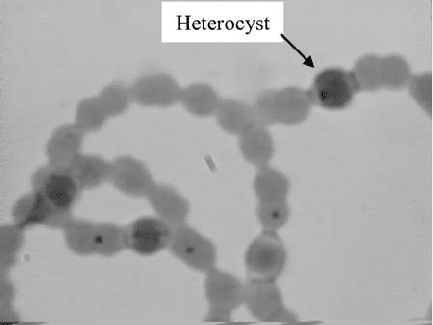
Figure 10.20 Anabaena, a filamentous cyanobacteria; with heterocyst.
248
MICROBIAL GROUPS

other anaerobic environments where light and reduced sulfur are present, such as some
hot springs. Purple nonsulfur bacteria have an advantage in lighted anaerobic environ-
ments in which organic matter is present, since they are able to grow well heterotrophi-
cally. Green nonsulfur bacteria also grow heterotrophically and in low light, particularly
in thick microbial mats found in hot springs and shallow marin e systems. Because of dif-
ferences in the chlorophylls and other pigments each contain, the groups also have light
absorption profiles with optima at different wavelengths (Figure 10.21).
TABLE 10.5 Kingdom Proteobacteria: Many of the
Gram-Negative Bacteria
a
Class 1. Alphaproteobacteria
Acetobacter
Agrobacterium
Azospirillum
Beijerinckia
Brucella
Caulobacter
Hyphomicrobium
Magnetospirillum
Methylocystis
Nitrobacter
Paracoccus
Rhodospirillum
Rickettsia
Rhizobium
Sphingomonas
Xanthobacter
Class 2. Betaproteobacteria
Achromobacter
Alcaligenes
Bordetella
Burkholderia
Gallionella
Leptothrix
Methylovorus
Neisseria
Nitrosomonas
Nitrosospira
Ralstonia
Sphaerotilus
Spirillum
Thiobacillus
Zoogloea
Class 3. Gammaproteobacteria
Acinetobacter
Aeromonas
Azotobacter
Beggiatoa
Chromatium
Francisella
Haemophilus
Legionella
Methylomonas
Moraxella
Nitrococcus
Nitrosococcus
Pasteurella
Photobacterium
Pseudomonas
Thiothrix
Vibrio
Xanthomonas
Family Enterobacteriaceae
Citrobacter
Enterobacter
Escherichia
Klebsiella
Leminorella
Proteus
Salmonella
Serratia
Shigella
Yersinia
Class 4. Deltaproteobacteria
Bdellovibrio
Desulfovibrio
Myxococcus
Nitrospina
Polyangium
Class 5. Epsilonproteobacteria
Campylobacter
Helicobacter
a
All five classes (subdivisions a to e) are listed, but not orders or families (except
Enterobacteriaceae). Only some representative, important, and interesting genera
are included.
BACTE RIA
249

Chemolithotrophs The Proteobacteria include a number (but not all) of the organisms
able to obtain energy from the oxidation of reduced inorganic compounds, including
hydrogen and forms of nitrogen, sulfur, and iron (Table 10.6). Most of these organisms
are also autotrophic (getting their carbon from carbon dioxide), and aerobic, although
some are also able to use nitrate as an electron acceptor. They also tend to be slow grow-
ing, probably because the amount of energy available from oxidizing most of these com-
pounds is relatively small.
The ability to utilize hydrogen is actually quite widely distributed. Examples of hydro-
gen-oxidizing Proteobacteria include some species of Pseudomonas and Alcaligenes.
Most such bacteria are able to utilize organic substrates as well (unlike most other che-
molithotrophs). Some (e.g., Xanthobacter) can fix nitrogen gas. Since hydrogen is typi-
cally produced under anaerobic conditions, and because the enzyme (hydrogenase)
involved in its oxidation is oxygen sensitive, most h ydrogen oxidizers prefer lower oxy-
gen conditions (i.e., 5 to 10% O
2
rather than the 21% of air). Some hydrogen oxidizers are
also able to grow on carbon monoxide, and such carboxydotrophic bacteria probably
play a major role in elimination of this toxic gas.
Cyanobacteria
Purple bacteria
Green bacteria
400 600 1000800
Figure 10.21 Schematic of light absorption characteristics (absorption vs. wavelength in nm) of
phototrophic bacteria. (Based on Prescott et al., 1999.)
250
MICROBIAL GROUPS

Nitrifying bacteria are aerobic autotrophs that oxidize reduced nitrogen in two sepa-
rate steps. Ammonium oxidizers such as Nitrosomonas, Nitrosospira, and Nitrosococcus
convert ammonium to nitrite. (The first two are b-Proteobacteria, the third a g-Protoebac-
teria.) Nitrite oxidizers convert nitrite to nitrate; examples are Nitrobacter (a-Proteob ac-
teria) and Nitrococcus (g-Proteobacteria). (Another nitrite oxidizer, Nitrospira,isa
member of the Xenobacteria.) Th ere appear to be relatively few types of nitrifying bac-
teria, but they are widespread (soil, freshwater, and marine systems), common, and play a
crucial role in the nitrogen cycle. They are relied on in most wastewater treatment systems
that control ammoni a, may exert a substantial oxygen demand on streams receiving
ammonia in effluents, and play an important role in nitrate contamination of groundwater.
All known nitrifiers prefer slightly alkaline, mesophilic conditions; they are inhibited by
even moderately acidic pH, and none appear able to grow at temperatures much above
40
C.
Nonphototrophic prokaryotes able to oxidize various forms of reduced sulfur can be
found among the Archaea and several bacterial kingdoms. Hydrogen sulfide is the most
commonly used form, but elemental sulfur, metal sulfides, and thiosulfate also are used by
many species . Some sulfur-oxidizing Proteobacteria, including members of the genus
Thiobacillus, produce so much sulfate (sulfuric acid) from the oxidation of pyritic
(metal sulfide) minerals that the pH may drop to below 2. This is a major cause of the
environmental problem known as acid mine drainage (Section 13.4.3) and can also
occur in clay soils containing pyrites if they are exposed to the air. Some hot springs
and marine thermal vents also are sources of sulfides.
TABLE 10.6 Examples of Chemolithotrophic Proteobacteria
Representative Reduced Electron Oxidized
Group Genera
a
Substrate Acceptor Product
Hydrogen- Alcaligenes H
2
(hydrogen) O
2
(or NO
3
)H
2
O
oxidizing Pseudomonas (nitrate)
Ralstonia
Carboxydo- Xanthobacter
trophic Alcaligenes
Nitrifying Pseudomonas CO (carbon monoxide) O
2
CO
2
Step 1 Nitrosomonas NH
3
/NH
þ
4
O
2
NO
2
Nitrosospira (ammonia/ammonium)
Step 2 Nitrobacter NO
2
(nitrite) O
2
NO
3
Nitrococcus
Nitrospina
Sulfur- Beggiatoa H
2
S (hydrogen O
2
(or NO
3
)S
0
and
oxidizing Thiobacillus sulfide), S
0
(elemental SO
2
4
Thiothrix sulfur), and/or (sulfate)
S
2
O
2
3
(thiosulfate)
Iron-oxidizing Gallionella Fe
2þ
(ferrous) O
2
Fe
3þ
(ferric)
Leptothrix
Thiobacillus
Manganese- Leptothrix Mn
2þ
(manganous) O
2
Mn
4þ
oxidizing (manganic)
a
Not necessarily all strains can carry out the indicated reaction.
BACTE RIA
251
Other sulfur oxidizers prefer or require neutral pH. Many of these rely on the produc-
tion of sulfide by the anaerobic sulfate-reducing bacteria (see later) growing on organic
material (rather than release from minerals). Since they need oxygen (or in some cases
nitrate), such bacteria tend to grow at the interface between aerobic and anaerobic envir-
onments (e.g., the surface sediments in salt marshes). One of these is the filamentous form
Thiothrix, which may occasionally cause settling problems in activated sludge wastewater
treatment plants if sufficient sulfide is present in the influent or generated in the process.
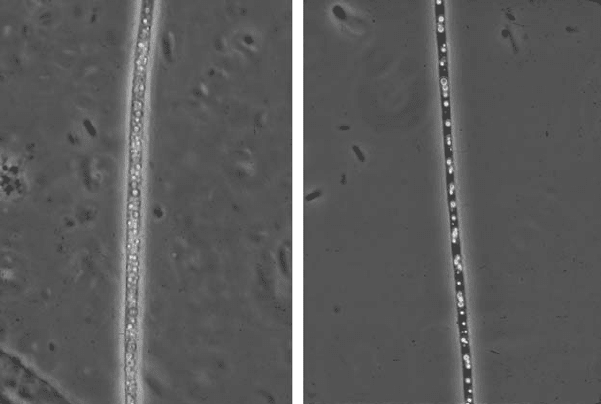
Another, the gliding bacteria Beggiatoa (Figure 10.22), is the most common filamentous
organism observed in rotating biological contactor (RBC) treatment plants, sometimes
producing such heavy growths that the steel shafts collapse. Deeper layers of the biofilm
become anaerobic in many such plants, so that hydrogen sulfide is then produced and
released to the overlying aerobic portion of the film. It is thought that Beggiatoa’s ability
to glide helps it in remaining at the interface of the aerobic and anaerobic zones. Unlike
many other lithotrophs, Thiothrix and Beggiatoa are also able to use small organic mole-
cules as their carbon source and are thus referred to as mixotrophs.
Some bacteria are able to utilize the oxidation of ferrous (II) iron as a source of energy.
For example, some of the acidophilic Thiobacillus (especially T. ferrooxidans) that grow
on iron pyrites also are iron oxidizers. Ferrous iron is stable at low pH, allowing time for
biochemical activity, but at neutral pH it is chemically oxidized to the ferric (III) form
fairly rapidly. Interestingly, some bacteria, such as Gallionella and Leptothrix, can
grow at the interface b etween oxic and anoxic zones and oxidize the iron before the che-
mical reactions occur. This is sometimes a problem when anaerobic well waters contain-
ing soluble ferrous iron are brought to the surface, as the growths (containing large
amounts of insoluble ferric iron) can cause clogging. Similarly, some manganese-oxidiz-
ing bacteria can oxidize the manganous (II) to the manganic (IV) form.
Figure 10.22 Two species of Beggiatoa in samples from RBC wastewater treatment plants; a
gliding filamentous sulfur-oxidizing proteobacteria. Note internally deposited sulfur granules.
252
MICROBIAL GROUPS
Methanotrophs Methane (CH
4
) is a major product of the anaerobic degradation of
organic material, especially in the absence of large amounts of sulfate. Methanotrophs
(e.g., Methylomonas and Methylocystis) are a relatively specialized but environmentally
widespread group of obligately aerobic Proteobacteria (mainly a and g groups) able to
oxidize this methane. They are autotrophic, and some are also able to fix nitrogen.
Most species produce a resting stage resistant to desiccation, either a cyst or an exospore
(which is also quite heat resistant) produced by budding.
Most methanotrophs are also able to utilize methanol (CH
3
OH) and many can utilize at
least some other one-carbon compounds , such as formaldehyde (CH
2
O), formic acid
(CHOOH), methyl amine (CH
3
NH
2
), or carbon monoxide (CO), or other compounds
without carbon–carbon bonds such as dimethylamine [(CH
3
)
2
NH], dimethyl sulfide
[(CH
3
)
2
S], or dimethyl ether [(CH
3
)
2
O]. The ability to utilize such compounds is referred
to as methylotrophy and is more widespread (e.g., including some Bacillus, a gram-
positive bacteria) than growth on methane.
There has been recent interest in the use of methanotrophs for soil bioremediation sys-
tems. Their activity can be promoted by pumping methane into the subsurface environ-
ment, leading to increased generation of the enzyme methane monooxygenase (MM O).
This enzyme can cometabolically convert a number of industrial contaminants, such as
trichloroethylene, to less hazardous or harmless products (Section 16.7.2).
Nitrogen-Fixing Proteobacteria Nitrogen fixation, the conversion of elemental nitro-
gen (N
2
) to a more readily utilizable form, is an ability that is found scattered among
many bacterial kingdoms (e.g., many of the Cyanobacteria and the gram-positives
Clostridium and Frankia). Among the Proteobacteria this includes som e methan otrophs,
and most strains of the enteric bacteria Klebsiella. Rhizobium, and some simi lar species
are of special importance because of the mutualistic (beneficial to both organisms) rela-
tionship they have with legumes (plants such as beans, peas, soybeans, alfalfa, clover,
vetch, and mimosa). They are able to infect the plant roots to form special nodules in
which they grow. Thereafter, they fix nitrogen (which is often in limited supply in
soils), to the benefit of the plant, while they utilize organic substrates produced by the
plant. Other important nitrogen fixers in soils (and water) are free-living, such as Azoto-
bacter. Both the symbiot ic (having a close relationship with another organism) and the
free-living nitrogen fixers are aerobic, even though the required nitrogenase enzyme is
sensitive to oxygen.
Proteobacteria with Special Morphologies: Appendaged, Sheathed, and Spiral
Forms A number of the Proteobacteria are known for their specialized morphologies,
although these are not always indicative of phylogenetic relationships. Hyphomicrobium
is a common aerobic soil and aquatic Proteobacteria whose prosthecae take the form of
short hyphae from which buds are produced. Caulobacter is another common aerobic
prosthecate bacteria; it uses its stalk for attachment. The chemolithotrophic iron oxidizer
Gallionella also produces a stalk, but it consists of twisted exocellular fibrils coated with
ferric hydroxide.
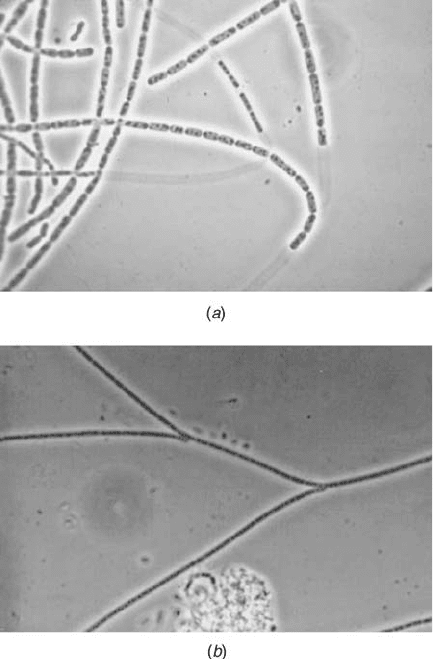
Sphaerotilus is a filamentous bacteria that produces a sheath (Figure 10.23). As part of
its life cycle, single cells with polar flagella are formed that swim away to start new fila-
ments. It is aerobic, but can still grow well at low dissolved oxygen concentrations (e.g.,
0.5 mg/L). As a result, it is a common inhabitant of polluted streams and biological waste-
water treatment systems. Large masses, commonly referred to as sewage fungus (although
BACTE RIA 253
they are not fungi), sometimes form on rocks or other aquatic surfaces in such systems.
Heavy growths in activated slud ge wastewater treatment systems are one cause of the set-
tling problem known as bulking. Leptothrix, mentioned above as an iron- and manganese-
oxidizing organism, is a related species.
Spirillum is an example of a spiral Proteobacteria (not related to the spirochetes,
Section 10.5.9). It is motile by tufts of flagella at both ends and is aerobic or microaer-
ophilic.
Myxobacteria The fruiting myxobacteria do not appear to be particularly important in
environmental engineering and science but are of great interest to some microbiologists
because of their life cycle, the most complex of any known prokaryote. The single,
usually rod-shaped vegetative cells have gliding motility and often leave a slime trail
as they move about on solid surfaces. When nutrients become limiting, the cells
‘‘swar m,’’ coming together to form a visible, often brightly colored fruiting body. Cells
within the fruiting body develop into myxospores, which are resistant to drying and some
other environmental stresses. These spores can later germinate to form new vegetative
cells.
Figure 10.23 Sphaerotilus natans:(a) pure culture showing sheath and PHB granules;
(b) branching filament in activated sludge sample.
254
MICROBIAL GROUPS
Myxobacteria are aerobic chemoorganotrophs found in soil. Many, such as Myxococ-
cus, are bacteriolytic (they lyse, or rupture, bacteria to feed on their cellular constitu-
ents—particularly proteins), and commonly occur on animal dung (which includes a
high percentage of bacteria). However, a number (including some species of Polyangium)
are instead cellulolytic (digest cellulose), and grow on decaying vegetation.
Pseudomonads The pseudomonads are a large group of aerobic (although a few can uti-
lize nitrate or nitrite when oxygen is unavailable), nonfermentative, chemoorganotrophic
(except that a few can grow on hydrogen or carbon monoxide), heterotrophic, non-spore-
forming gram-negative rods with polar flagella. Pseudomonas (Figure 10.8) is the major
genus; however, when it was realized that bacteria called Pseudomonas were members of
the a- and b- as well as the g-proteobacteria (based on 16S rRNA), it was split into several
genera, including Sphingomonas, Burkholderia, and Ralstonia. Still, there is much diver-
sity in this group and disagreement among characterization methods as to where the nat-
ural groupings lie.
Pseudomonads are common soil and water bacteria, and becau se of their metabolic
diversity, many are important in biodegradation of a very wide variety of natural and
human-made organic compounds (including for bioremediation applications). A few,
such as Ps eudomonas aeruginosa, are opportunistic path ogens of humans. Some Pseudo-
monas and most Xanthomonas are plant pathogens . Another pseudomonad, Zoogloea
ramigera, is found in some activated sludge wastewater treatment systems, where it
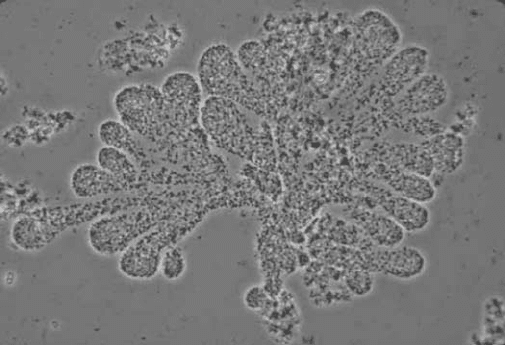
forms a special type of zoogloeal floc (randomly organized aggregations) that can lead
to poor settling conditions (Figure 10.24).
Other Aerobic Proteoba cteria Other aerobic proteobacteria include the nonflagellated
species Neisseria, Moraxella, and Acinetob acter and the flagellated Acetobacter. Several
Neisseria (including N. gonorrhoeae, the cause of gonorrhea; Section 12.6.2) and
Moraxella (e.g., Section 12.7.4) are pathogenic to humans or other animals. Neisseria
are cocci, whereas Moraxella are plump rods. Moraxella, which gives negative results
for many classic biochemical tests, is of interest for another reason as well: Bacteria
Figure 10.24 Characteristic Zoogloea ramigera floc from activated sludge.
BACTE RIA 255
isolated from the environment are also often negative for these tests, and hence have been
misidentified as Moraxella. Acinetobacter is unusual in that it is an aerobe that is oxidase
negative. These rods are common in soil and water. It sometimes shows twitching moti-
lity, as do some Moraxella.
Some Acinetobacte r strains have been reported as phosphate accumulating organisms
(PAOs) in activated sludge systems that achieve biological phosphorus removal (BPR).
(This identification has since been challenged, and other aerobic proteobacteria using
the same mechanism are now believed to be the major PAOs in these systems.) They con-
tain metachromatic (volutin) granules composed of polyphosphate, which is used as a
method of energy storage. This type of BPR is induced by having an anaerobic zone fol-
lowed by an aerobic zone in the reactor. In the anaerobic zone, the PAOs utilize the stored
polyphosphate for energy (releasi ng phosphate) to accumulate and store fermentation pro-
ducts. Subsequently, in the aerobic zone, they utilize the stored organics and remove phos-
phorus to very low levels (storing it again as polyphosphate). The low-P water is then
separated and discharged, and the PAOs are recycled to the anaerobic zone to repeat
the reaction. This is a fascinating application in which favoring a strictly aerobic organism
in an ecosystem is accomplished by including a periodic anaerobic condi tion!
Acetic acid bacteria such as Acetobacter, although obligate aerobes, produce acetic
acid from ethanol. This can lead to spoilage of alcoholic beverages but is also used com-
mercially for vinegar production. Some Acetobacter are also able to produce a very pure
form of cellulose.
The Family Enterobacteriaceae The Enterobacteriaceae includes many bacteria of
importance to humans and hence has been studied extensively. They also form a relatively
stable taxonomic grouping; although origina lly based on testing by traditional (phenoty-
pic) methods, there has been little change after genotype testing was employed. These
members of the g-proteobacteria are gram-negative, nonsporeforming rods that are typi-
cally facultatively anaerobic, capable of fermenting sugars. They either have peritrichous
flagella or are nonmotile. Many live within the intestinal tract of warm-blooded animals
(where they may play an important role in digestion) and hence are referred to as enteric
bacteria. Some are important pathogens; others live in soil or water.
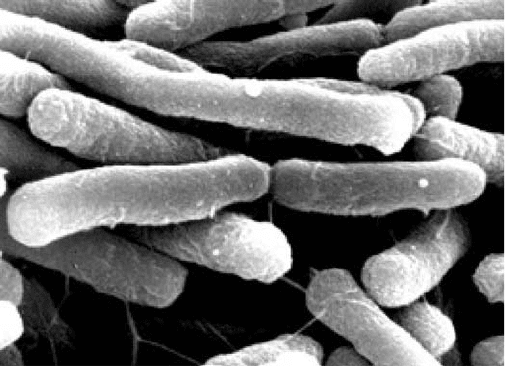
Escherichia coli (Figure 10.25) is probably the best known of all bacteria. E. coli is
present in large numbers in the human intestines and is one of the coliforms used as indi-
cator organisms to monitor fecal pollution of water (Section 12.9.2). A few strains are
pathogenic (Section 12.3.2).
Important pathogenic members of this family include Salmonella, the cause of typhoid
fever (S. typhi) and salmonellosis (but also used for testing chemical mutagenicity in the
Ames test; Section 20.1.13); Shigella, which causes bacterial dysentery; and Yersinia
(Y. pestis is the cause of plague). Other common species that may be intestin al or envir-
onmental (soil and water) include Enterobacter (formerly called Aerobacter), Citrobacter,
and Klebsiella. K. pneumoniae , which is able to fix nitrogen, can also occasionally cause
pneumonia. Proteus is well known to microbiologists because of the characteristic
swarming of cells of some strains on the surface of agar plates. Serratia is also widely
recognized in the lab because of the red colonies it often produces on plates.
Other Facultatively Anaerobic Proteobacteria Other facultative bacteria include
Vibrio, Photobacterium, Aeromonas, and Chromobacterium. These species differ from
the Enterobacteriaceae in that they are polarly flagellated (Chromobacterium may have
256 MICROBIAL GROUPS
other flagella as well) and usually oxidase positive. They differ from Pseudomonas in that
they are capable of fermentative metabolism. They are common soil and/o r water organ-
isms but include a few pathogens, such as Vibrio cholerae (cause of cholera) and V. para-
haemolyticus (a marine species that can cause enteritis, usually from eating raw fish). V.
fischeri and Photobacterium are marine species that are luminescent: They emit blue-
green light (at 490 nm) through reactions similar to those of the firefly. Some live in
the specialized light-emitting organs of certain fish; others live freely and give some sea-
waters their luminescence. They are also utilized in the Microtox (Azur Environmental,
Strategic Diagnostics Inc., Newark, Delaware, www.azurenv.com) toxicity test. Aeromo-
nas sometimes gives false-positive results in the coliform test. It is an aquatic organism
sometimes associated with diseases of fish and frogs. Chromobacterium produces a violet
pigment (violacein), so that colonies on agar plates are very noticeable.
Sulfur-Reducing Proteobacteria Some strictly anaerobic proteobacteria, such as
Desulfovibrio (Figure 10.26), are able to utilize oxidized forms of sulfur, especially sul-
fate and elemental sulfur, as the terminal electron acceptor for respiratory metabolism. As
their energy source they use fermentation products (such as hydrogen, lactate, and pyru-
vate) produced by other bacteria in the same ecosystem. Sulfate reducers are very com-
mon in habitats containing organic material and sulfate, such as salt marsh sediments and
animal intestinal tracts. They may also be active in anaerobic digesters used for sewage
sludge treatment, and in the deeper layers of the biofilms in wastewater treatment pro-
cesses such as trickling filters and rotating biological contactors. The hydrogen sulfide
produced may be released, giving the characteristic rotten egg odor, and/or may combine
with iron or some other metals to give the black color characteristic of such anaerobic
systems. In confined spaces, hydrogen sulfide can build up to toxic levels. In sewers
with inadequate flushing, the hydrogen sulfide released can cause odor problems and
also dissolve in the moist films that form on the aerobic, unsubmerged surfaces; there
the sulfide may undergo biological oxidation by chemolithotrophic bacteria, resulting
in production of sulfuric acid and crown corrosion of the sewer.
Figure 10.25 Escherichia coli. (SEM image courtesy of the University of Iowa Central
Microscopy Research Facility.)
BACTE RIA 257