
Vaccari D.A., Strom P.F., Alleman J.E. Environmental Biology for Engineers and Scientists
Подождите немного. Документ загружается.

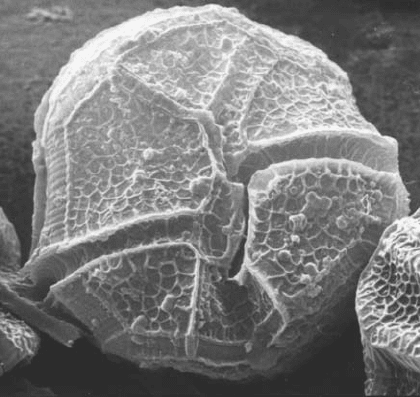
They have two flagella, one wrapped beltlike around the middle in a transverse groove, the
other extending backward in a longitudinal groove. This gives them a toplike motion, from
which they get their name (from the Greek for ‘‘whirl’’). Although most are free-living,
some are symbionts growing in reef-forming corals, and some are parasitic. The Pyrrophyta
are believed to be close relatives of the ciliated protozoans.
Blooms of dinoflagellates in coastal or estuarine waters may sometimes become suffi-
ciently dense to cause red tides (Section 15.2.2). Further, a few dinoflagellate species,
such as Gymnodinium, Gonyaulax, and Pfisteria, are able to release a neurotoxi n into
the water, which may lead to fish kills or to human poisoning due to the consumption
of contaminated shellfish (Section 12.3.3). In recent years, Pfisteria has received consid-
erable attention in the Chesapeake Bay, apparently finding a selective advantage by killing
fish to secure degradable substrates!
Rhodophyta: The Red Algae The red algae, such as Porphyra, are mostly multicellular
and marine, although there are also a few unicellular forms, and some that are freshwater
or soil inhabitants. They have pigments similar to those of cyanobacteria, from which
their chloroplasts may be derived. They produce no flagellated cells, further suggesting
they are not derived from flagellates, as most other algae appear to be. Several red
algae produce mucilaginous polymers that are used com mercially, including the widely
used food additive, carrageenan. Microbiolo gists also owe them a debt of gratitude, as
they are the source of the agar widely used to solidify laboratory media for plating.
Chlorophyta: The Green Algae The green algae are believed to be the group from
which higher plants evolved, and in fact they have the same pigments, cell wall composi-
tion, and storage products. This is an extremely varied and ecologically widespread group,
with habitats that not only include soils and waters (both fresh and salt) but also the
surfaces and internal regions of other organisms. Many are unicellular, but there are
Figure 10.40 Peridinium. (SEM image courtesy of C. J. O’Kelly, D. H. Hopcroft, and R. J.
Bennett.)
278
MICROBIAL GROUPS
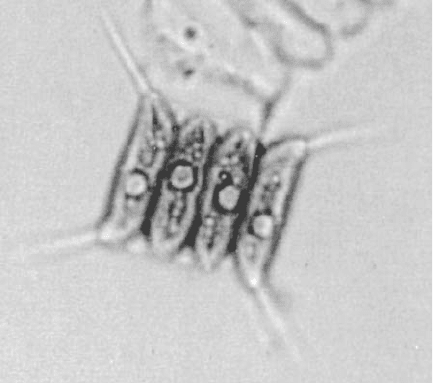
also colonial (e.g., Scenedesmus Figure 10.41) and multicellular (but undifferentiated)
forms, and a few that are coenocytic (filaments in which the cross-walls between cells
deteriorate or do not form, so that they become single cells with many nuclei), like fungi.
10.7.3 Slime Molds
The slime molds are aerobic, mainly terrestrial (a few are aquatic) chemoorganotrophs.
Although they appear to have no major role in environmental engineering or science,
they will be discussed briefly for completeness and because of their interesting life
cycle. There are two separate phyla (Table 10.11), both with similarities to some protozoa.
Myxomycota Myxomycetes, or plasmodial slime molds, often form colorful visible
growths on decaying wood or vegetation. An example is the genus Physarum, which is
bright yellow. The vegetative form is composed of a plasmodium, which is a macroscopic
multinucleated mass of cytoplasm with a single plasma membrane enclosing it (hence,
their other common name, acellular slime molds). Other genera, such as Echinostelium,
however, produce only microscopic plasmodia. The plasmodium crawls over surfaces
with amoeboid motion (cytoplasmic streami ng), engulfing food particles—mainly bac-
teria, but also yeasts, spores, and small pieces of organic material—through phagocytosis.
Thus, it behaves much like a giant amoeba. However, when there is insufficient food, or
the surface dries, the plasmodium forms a stalked sporangium and, after meiosis, releases
haploid spores. Under proper conditions a spore germinates to produce a swarm cell
(biflagellated) if there is sufficient water for swimming, or a myxamoeba (amoeboid
cell) if the surface is only moist enough for crawling. Two such cells fuse to produce a
diploid cell, which then undergoes mitosis (without cell division) to produce a new plas-
modium.
Acrasiomycota Cellular slime molds, such as Dictyostelium and Polysphondylium,
spend most of their active life as free amoeboid cells. Under unfavorable conditions
Figure 10.41 Scenedesmus.
EUKARYA 279

(inadequate food or water), these individuals aggregate to form a macroscopic pseudo-
plasmodium (because the cells remain individuals with separate membranes), or
‘‘slug’’ (unrelated to true slugs, which are mollusks), which crawls to an exposed location,
forms a fruiting body, and releases spores. (In this way they resemble superficially the
prokaryotic myxobacteria.) The spores can later germinate to produce new amoeboid
TABLE 10.11 The Fungi, Oomycetes (Water Molds), and Slime Molds
Common
Group Phyla Name Motility Feeding Comments Examples
Fungi Zygo- Lower fungi None Absorption Most Entomphthora
mycota mycorrhyzae Mucor
Pilobolus
Rhizopus
Asco- Sac fungi None Absorption Most yeasts and Ceratocystis
mycota lichens; truffles Claviceps
and morels Endothia
Morchella
Neurospora
Tuber
Basidio- Club fungi None Absorption Most Agaricus
mycota mushrooms Amanita
Coprinus
Phanerochaete
Psilocybe
Deutero- Fungi None Absorption Sexual stage Arthrobotrys
mycota imperfecti unknown Aspergillus
(most are Candida
probably Coccidioides
Ascomycetes) Dactylella
Epidermophyton
Fusarium
Geotrichum
Histoplasma
Monilia
Penicillium
Rhizoctonia
Saccharomyces
Trichophyton
Verticillium
Water Oo- Water molds Flagella Absorption Mycelia Allomyces
molds mycota produce Phytophthora
flagellated Plasmopara
zoospores Pythium
Saprolegnia
Slime Myxo- Plasmodial Plasmodium/ Phago- Like giant Echinostelium
molds mycota or acellular amoeboid/ cytosis amoeba; forms Physarum
slime molds flagella sporangium
Acrasio- Cellular Amoeboid/ Phago- Amoebas Dictyostelium
mycota slime molds slug cytosis swarm, Polysphondylium
produce ‘‘slug’’
280 MICROBIAL GROUPS
cells. In addition to this asexual process, cellulose encased macrocysts may occasionally
form in which two amoeba fuse.
10.7.4 Fungi
Fungi are chemoorganotrophic heterotrophs. Most are saprobic, but some are parasites
(the majority of plant pathogens are fungi, as are some animal pathogens) or symbionts.
Although some are found in aquatic or marine environments, most are terrestrial. In addi-
tion to not being photosynthetic, they also differ from plants and algae in having cell walls
composed primarily of chitin rather than cellulose. Fungi are nonmotile, unlike protozo-
ans and slime molds (and some algae). Mitosis in fungi is different from that in plants and
animals.
Like some bacteria, fungi excrete enzymes to digest food externally, then absorb the
smaller organic molecules produced. This makes them especially suited for degradation of
organic solids and for their important ecological role as decomposers of dead biomass
(such as leaves and wood) as well as high-molecular-weight anthropogenic compounds.
They play a major role in the globa l carbon cycle, especially because of the ability of
many to degrade cellulose and of some to attack lignin. Fungi store energy either as gly-
cogen or in lipids.
Fungi usually have one of two growth forms, although a few can take both. Both may
reproduce sexually through spores. Yeasts are unicellular and reproduce asexually by bud-
ding (see below). Molds, which are the much more common form, are multicellular, fila-
mentous organisms and usually reproduce asexually with spores. As with the bacterial
actinomycetes (Section 10.5.7) , an individual filament is referred to as a hypha (plural,
hyphae), and the intertwined, matted growths they form are known as mycelia (singular,
mycelium). However, unlike with bacterial filaments, which are essentially colonies of sin-
gle-celled organisms, molds are multicellular. Typically, there is considerable interchange
of materials among cells within the filament. In fact, often the cross-walls separating cel ls
have holes in them or disappear completely. This can lead to the presence of several nuclei
within a single ‘‘cell,’’ a growth form referred to as coenocytic. Hyphae are usually hap-
loid and produce microscopic spores, usually at the tips of specialized filaments called
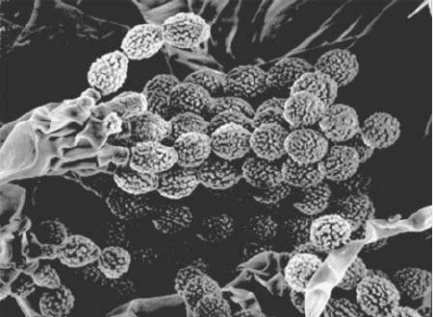
conidia (singular, conidium; Figure 10.42) or in sacs called sporangia (singular, sporan-
gium). After dispersal, the spores may germinate and grow into new hyphae if deposi ted
on a suitable substrate.
The fungal mycelium typically permeates the soil or substrate on which the organism is
growing. Mushrooms are the familiar, large, fruiting bodie s of some fungi and do not
represent the major portion of the organism, which consists of the mycelia below the sur-
face.
Both bacteria and fungi degrade organic material, but bacteria typically grow faster.
However, fungi are less inhibited by dry conditions than bacteria, and so often make
up a majority of the living biomass in drier soils and at the dry edges of compost piles.
Fungi are also able to withstand higher concentrations of salt and sugar, allowing them to
cause spoilage in foods that most bacteria cannot grow on. Some thermophilic fungi can
grow at temperatures up to 62
C. As a group, fungi also can tolerate lower pH than many
common organotrophic bacteria, allowing them to grow competitively, for example, on
fermented fruit. In activated sludge plants for wastewater treatment, if the pH drops
below 5.5 to 6, fungi may grow excessively and interfere with the settling process (fungal
bulking).
EUKARYA 281
The fungi are now classified into four phyla or divisions: Zygomycetes, Ascomycetes,
Basidiomycetes, and Deuteromycetes (Table 10.11). Previously, another phylum, the
Oomycetes, was included, and is discussed here, but they are now considered a separate
protist group.
Zygomycota The Zygomycetes, or lower fungi, include about 800 known species,
including Rhizopus stolonifer, the common black bread mold. Zygomycete sporangia con-
sist of small stalks that produce spores. In Pilobolus, the ‘‘shotgun fungus,’’ which grows
on horse and cow dung, spore release is dramatic—the sporangium can be shot to a height
of 6 feet! Sexual reproduction occurs through contact of two hyphae (which are haploid)
of opposite mating types (call ed þ and ) and fusing of their nuclei, leading to the pro-
duction of a diploid zygospore. This resistant form later undergoes meiosis, germination,
mitosis, production of a sporangium, and release of haploid spores. Most zygomycetes,
such as the common Mucor, are decomposers in soils and decaying plant material, with
some causing food spoilage. One group forms mycorrhyzae (see below), and a few are
parasitic on plants or animals. Entomophthora, for example, parasitizes houseflies, even-
tually killing them. (Look for a white powdery halo of spores around the next dead fly you
find on a windowsill.)
Ascomycota The Ascomycetes, or sac fungi , is the largest funga l phylum, with 30,000
species known, including most yeasts, a few mushrooms (such as truffles, morels, and cup
fungi), and many molds. The blue-green mold that grows on citrus fruit and the pink bread
mold Neurospora are Ascomycetes. Many plant diseases are caused by ascomycetes,
including powdery mildew, apple scab, and several rots. Chestnut blight, caused by
Endothia parasitica, has virtually eliminated the American chestnut, once a major forest
tree in the northeastern United States. Ceratocystis ulmi, the cause of Dutch elm disease,
has had a similar effect on the American elm, another major forest and shade tree. Cla-
viceps purpurea infects rye and other cereals, leading to production of a structure called
an ergot in the seed head. Ingestion by cattle or humans can lead to severe nervous system
disorders, including delusions, spasms, and often, death. [One of the chemicals present is
lysurgic acid, a precursor of the hallucinogen, lysurgic acid diethylamide (LSD).] In
Figure 10.42 Aspergillus with conidia. (SEM image courtesy of the University of Iowa Central
Microscopy Research Facility.)
282
MICROBIAL GROUPS
Europe in the Middle Ages, whole villages would sometimes appear to go insane from
eating bread made with infected rye.
Ascomycete molds (yeasts are described below) reproduce asexually by pinching off
conidiospores from special hyphae called conidia. Sexual reproduction occurs through
fusing of two hyphae to form a sac called an ascus (plural, asci), in which (after meiosis
and mitosis) ascospores develop.
Basidiomycota The Basidiomycetes, or club fungi, consist of over 16,000 species,
including most of the familiar mushrooms, toadstools, stinkhorns, puffballs, and jelly
and shelf fungi. In fact, Basidiomycetes are thought to form the major part of living bio-
mass in most soil. Although some mushrooms (e.g., the commercially produced Agaricus
campestris bispo rus) are edible, others are poisonous (e.g., Amanita verna, the destroying
angel) or hallucinogenic (e.g., Psilocybe). Mushrooms are the fruiting bodies that result
from sexual reproduction, serving to release the haploid spores. Some important crop
parasites, such as the rusts and smuts, also are basidiomycetes.
White rot fungi (e.g., Phanerochaete) are basidiomycetes that cause decay of wood by
digesting lignin and cellulose. Because the lignin-degrading enzymes are also effective
against many xenobiotic compounds, P. chrysosporium is being studied for use in engi-
neered processes to degrade industrial pollutants. Brown rot fungi attack cellulose but not
lignin.
Deuteromycota The Deuteromycetes are also referred to as fungi imperfecti, reflecting
the fact that they have no known sexual reproduction phase. This is not a true phylum but
rather a form-phylum, containing more than 11,000 ‘‘form-species.’’ Once the sexual
phase is discovered, species in this group are reclassified into one of the other phyla.
Almost all appear to be Ascomycetes, but a few are Basidiomycetes. Included are
molds of the genus Penicillium, well known as the source of the antibiotic penicillin
and also the source of the flavor and color of Roquefort and other ‘‘blue’’ cheeses. Asper-
gillus (Figu re 10.42) is a common soil saprobe, but during growth on peanuts or other
stored foods, some make aflatoxins, among the most toxic natural compounds known.
Aspergillus also can be an aeroallergen (cause allergic reactions) when the spores
become airborne in agriculture and at composting sites, and occasionally can be respon-
sible for lung disease in immunocompromised hosts. Other species of Aspergillus are used
in fermentation of soy sauce and saki. Verticillium cause pink rot of apples and also a wilt
that is affecting many Norway maples planted as municipal street trees in the northeastern
United States. Fusarium causes wilts of several plants, and Rhizoctonia (a Basidiomycete)
can cause damping off and root rot.
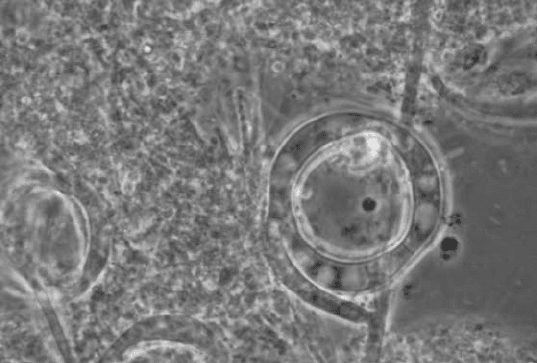
On the other hand, some fungi have been found to be helpful in cont rolling nematode
damage of plants. Arthrobotrys and Dactylella, for example, trap and feed on these small
animals—serving as the Venus flytraps of the microbial world! These fungi also are occa-
sionally observed in wastewater treatment systems (Figure 10.43). Geotrichum is another
fungus that is sometimes found in activated sludge plants, where its excessive growth (at
low pH) leads to a problem referred to as fungal bulking.
Among the Fungi Imperfecti that are human pathogens are several species (e.g.,
Epidermophyton and Trichophyton) that cause the skin infections known as athlete’s
foot and ringworm (Section 12.7.7). Hist oplasmosis, which is a potentially fatal
respiratory disease (Section 12.4.7), is cause d by Histoplasma capsulatum. Candida is
a common source of vaginal yeast infections (Section 12.6.7). Both Histoplasma and
EUKARYA 283
Candida are soil organisms and opportunistic pathogens and can invade a variety of
tissues in compromised hosts. They also grow in both yeast and mold form.
Oomycota Because they are nonphotosynthetic, have a cell wall, and produce a myce-
lium, the Oomycetes, or water molds, were considered fungi until fairly recently. How-
ever, unlike fungi, they produce motile spores, and whereas the cell wall contains chitin in
some species, it is made of cellulose in others. Analysis of their 18S rRNA has now con-
firmed that they are a separate group. Asexual reproduction is by release of biflagellated
zoospores from a sporangium that forms at a hyphal tip. Sexual reproduction involves
contact of male and female hyphae, leading to production of oospores. Most oomycetes
are aquatic, with a few, such as Saprolegnia parasitica, parasitic on fish. A few are
terrestrial, including some very important plant pathogens. Late potato blight,
which may have led to the starvation of as many as 1 million Irish in the 1840s (and
prompted emigr ation of millions more), is caused by Phytophthora infestans. Pythium
causes damping-off disease of seedlings, and Plasmopara and other Oomycetes cause
downy mildew.
Yeasts Yeasts are single-cell ed fungi. There are 60 genera with 500 known species.
Most are ascomycetes, but some are basidiomycetes, zygomycetes, or deuteromycetes.
They reproduce asexually by budding, a mitotic division producing a large and a small
cell (the bud). Yeasts can respire using oxygen, but in the absence of oxygen, they are
limited to glycolysis, which feeds into a fermentation pathway to produce ethanol and
CO
2
. The ascomycete Saccharomyces cerevisiae has been ‘‘domesticated’’ and developed
into both baker’s and brewer’s yeast.
Mycorrhyzae Some molds, called mycorrhyzae (‘‘fungus roots’’), grow either within or
surrounding the roots of many plants as a symbiotic infection. Their mycelia extend into
the soil, increasing the surface area available for absorption. This increases a plant’s abil-
ity to extract nutrients. In return, the fungus shares in the primary productivity of the
Figure 10.43 Nematode trapping fungus.
284
MICROBIAL GROUPS
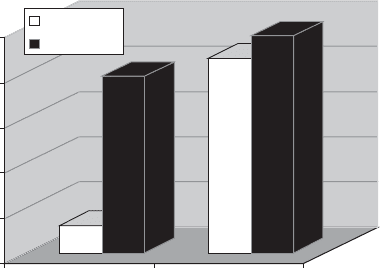
plant. The effect is particularly significant when minerals are scarce. For example, in one
study (Figure 10.44) tomato plants grown in sterile soil deficient in phosphate grew 6.5
times as much leaf mass when a mycorrhyzal fungus was inoculated into the soil.
Mycorrhyzal fungi are associated with some 90% of terrestrial plants. Most are zygo-
mycetes that grow within the root, with mycelia extending out. Certain trees and shrubs
have mycorrhyzal fungi that grow only on the outside of the root. Most of these are basi-
diomycetes, but some are ascomycetes such as truffles. Mycorrhyzae seem to help plants
grow under adverse conditions such as high altitudes or acidic soils. Plants of the heather
family (Ericaceae) show increased resistance to toxic heavy metals when mycorrhyzae
are present. Orchid seeds will not germinate if an associated fungus is not present.
Lichens Lichens are symbiotic associations between ascomycetes and either algae or
cyanobacteria. The fungus receives carbohydrates and other nutrients from the algae,
and in return, it provides moisture and protection. Lichens are familiar to hikers as the
often-colorful flat growths adhering to rocks. About 17,000 lichen combinations are
known. One of their ecological roles is to hasten the breakdown of the rock substrate,
forming soil. They are very sensitive to sulfur dioxide, and thus can be used as an indi-
cator of air pollution.
10.8 NONCELLULAR INFECTIVE AGENTS: VIRUSES, VIROIDS,
AND PRIONS
Viruses, viroids, and prions are submicrosco pic particles that are not composed of cells.
They can carry out no metabolic activities on their own, and therefore are not considered
‘‘alive.’’ However, they can infect living host cells and cause them to produce new copies
of the infective agent. Thus, many of them produce disease. The viruses (from the Latin
virus, meaning ‘‘poison’’) are the major type of such agent, but we also discuss the others
briefly below.
0
0.2
0.4
0.6
0.8
1
g Dry Weight of Leaf
0.6 1.2
mEq Phosphate per Plant
w/o Fungus
w/ Fungus
Figure 10.44 Combined effect of mycorrhyzal fungus and phosphate fertilizer on tomato growth.
(Based on Ricklefs, 1993.)
NONCELLULAR INFECTIVE AGENTS: VIRUSES, VIROIDS, AND PRIONS 285
10.8.1 Viruses
A virus particle, or virion, is composed of a nucleic acid core and a protein coat, or capsid
(Figure 10.45). Some also have an outer envelope composed mainly of lipid and protein.
They are too small—typically 20 to 300 nm (0.02 to 0.3 mm)—to be visible with a light
microscope (or to be removed by normal filtration), but they can be ‘‘seen’’ using electron
microscopy. Although they are strictly intracellular parasites , they also are characterized
by having an extracellular form in which they can be transmitted to infect other host cells.
Although individual virus types often are very specific as to the organisms (often a single
species, or even a single strain) they can attack, there are varieties of viruses for almost (if
not) all hosts, including animals, plants, fungi , and algae. Viruses that attack bacteria are
called bacteriophage, or simply phage.
The nucleic acid in a virus genome is either DNA or RNA (but not both) and is either
single or double stranded. It encodes for replication of the virion by the host cell. Some
RNA viruses first produce a strand of DNA during replication (the reverse of the normal
production of an RNA strand from DNA); such viruses are called retroviruses. The
human immunodeficiency virus (HIV), which causes the disease acquired immune defi-
ciency syndrome (AID S; Section 12.6.4) , is a retrovirus. Other RNA viruses are able to
replicate their RNA directly without the intermediate DNA.
The protein coat is composed of subunits called capsomeres, which self-assemble after
production by the host to form the capsid. The two basic forms are helical and the 20-
sided icosahedron (which looks almost spherical), but some capsids are combinations
of the two (e.g., an icosahedron head with a helical tail).
The classification of viruses usually depends on the nature of the genetic material, the
kingdom of the host, and the form of the capsid. The Baltimore classification system
(Table 10.12) has established six different major groups with a variety of subgroups on
this basis. A ‘‘negative’’ RNA strand must be reversed (by transcription) to the comple-
mentary RNA strand before it can be used as a templat e for the synthesis of proteins.
There are typically several stages to a virus infection. First the virus will attach to the
new host cel l. It must then penetrate the cell surface and inject its genome into the host.
With lytic viruses, replication of the nucleic acid and synthesis of the capsid protein then
occurs, followed by assembly of the new virions. Finally, the host cell lyses (ruptures),
releasing the new viruses.
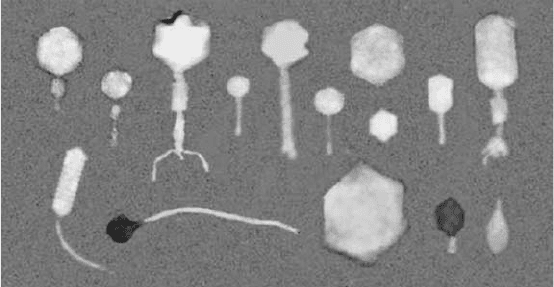
Figure 10.45 Tableau of viruses (mostly bacteriophage) from saline wetland ponds in
Saskatchewan, Canada. (Photo by David Bird; courtesy of D. Bird and R. Robarts.)
286
MICROBIAL GROUPS

TABLE 10.12 Baltimore Classification Groups for Animal, Plant, and Bacteria Viruses
Class Form Host Group Architecture
a
Representative
I Double- Bacteria Myoviridae C T2, T4
stranded DNA Syphoviridae C l
Podoviridae C T7
Animal Papovaviridae I Papillomavirus,
polyomavirus
Adenoviridae I Adenovirus
Herpesviridae I Herpes simplex,
mononucleosis
Poxviridae C Smallpox
Hepadnaviridae I Hepatitis B
Plant Caulimoviruses I Cauliflower mosaic
II Single- Bacteria Microviridae I fX174
stranded DNA Animal Parvoviridae I Parvovirus
Plant Geminiviruses I Maize streak
III Double- Bacteria f6
stranded RNA Animal Reoviridae Rotavirus
Plant
IV Positive- Bacteria Leviviridae I MS2, F2
strand RNA Animal Picornaviridae I Poliovirus, rhinovirus,
hepatitis A,
coxsackievirus
Togaviridiae I Rubella
Flaviviridae I Yellow fever, dengue,
West Nile
Coronaviridae H Murine hepatitis
Caliciviridae I Norwalk virus
Plant Potyvirus H Potato Y
Tymovirus I Turnip yellow mosaic
Tobamovirus H Tobacco mosaic
Comovirus I Cowpea mosaic
V Negative- Bacteria
strand RNA Animal Rhabdoviridae H Rabies
Filoviridae H Ebola
Paramyxoviridae H Mumps, measles,
distemper
Orthomyxoviridae H Influenza
Bunyaviridae H Hantavirus
Arenaviridae H Lassa
Plant
VI Retrovirus Bacteria
Animal Retroviridae I HIV, oncoviruses
Plant
a
C, complex; H, helical; I, icosahedral.
Source: Based in part on Voyles (2002).
NONCELLULAR INFECTIVE AGENTS: VIRUSES, VIROIDS, AND PRIONS
287