
Vaccari D.A., Strom P.F., Alleman J.E. Environmental Biology for Engineers and Scientists
Подождите немного. Документ загружается.

10.7.1 Protozoans
Protozoans are chemoorganotrophic unicellular heterotrophic eukar yotes. They may
absorb dissolved nutrients, but most feed mainly by ingestion of small particles (such
as bacteria, algae, bits of organic matter, or macromolecules) through one of three meth-
ods. In pinocytosis water droplets are drawn into a channel formed by the cell membrane,
while in phagocytosis solid particles are engulfed and enclosed by the membr ane. In
many ciliates, feeding is by a mouth and gullet through which particles are pushed—
like swallowing in animals. In each case the ingested particle is enclosed in a mem-
brane-bound food vacuole into which digestive enzymes are secreted. (This is in contrast
to the fungi, which excrete enzym es to digest food particles externally.) Since they do n ot
have a cell wall, to maintain osmotic pressure most freshwater protozoans also have a
contractile vacuole that is used to expel excess water. Both asexual reproduction
(often by fission) and sexual reproduction occur in many species. Most are aerobic, but
a few contain a special structure, the hydrogenosome, instead of mitochondria, and are
obligate anaerobes. Most protozoans are aquatic or marine, but a large number are
parasitic or symbiotic, and others are important members of soil ecosystems. Many
free-living types are seen in wastewater treatment systems, where they are thought to
aid in purification.
Protozoans are usually motile by one (or more) of four means, at least in one part of
their life cycle, and this has led to their being broken into the four major groups described
below (Table 10.9). However, it is now recognized that protozoans are a highly diverse
group, and include several different phyla and probably even distinct kingdoms. Although
there are some colonial forms, no protozoans are multice llular (unlike some algae and
most fungi). Still, the single cell may be highly complex, with many specialized orga-
nelles, especially among the ciliates. Although some of the simpler flagellates may be
only 5 to 10 mm in siz e, many of the ciliates are 30 to 500 mm, and some Sarcodina exceed
1 mm (although most are muc h smaller).
Mastigophora (Flagellates) The Mastigophora are motile by means of one or more fla-
gella. This group actually includes several distinct lineages, including the Diplomonads
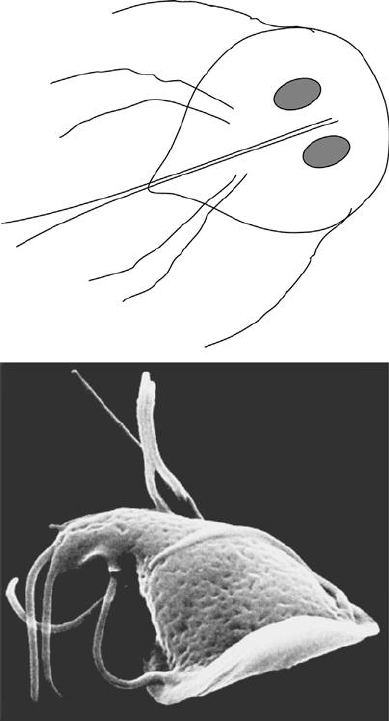
[e.g., Giardia (Figure 10.30), a waterborne human parasite that causes giardiasis; Section
12.2.5], which lack mitochondria and are the most phylogenetically ancient known
Eukarya. Another relatively ancient lineage, the Trichomonads, includes the human para-
site Trichomonas vaginalis, which can cause vaginal and urinary tract infections
(Section 12.6.6). Other flagellates include the Trypanosomes, such as Trypanosoma
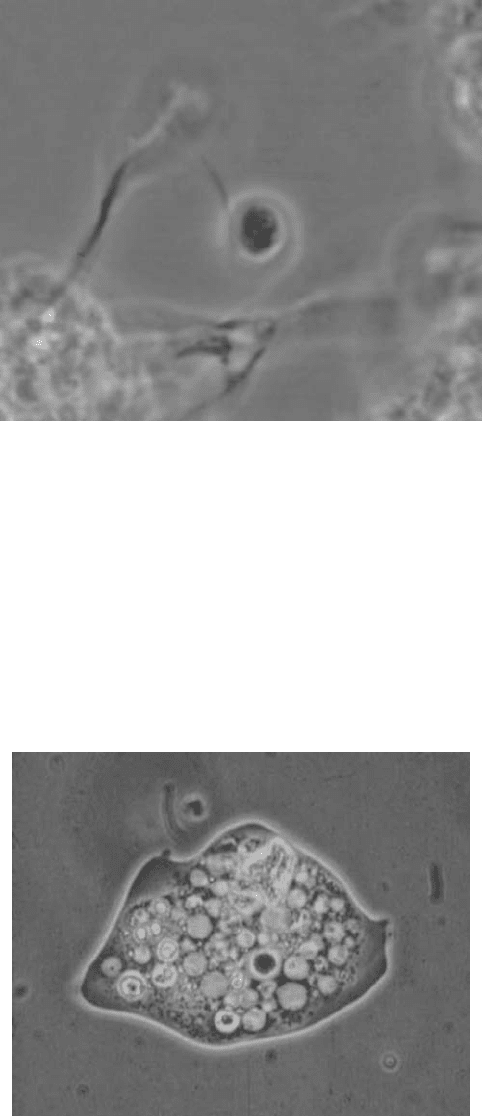
gambiense, the cause of African sleeping sickness (Section 12.5.2). Bodo is a common
free-living flagellate (Figure 10.31) frequently seen in biological wastewater treatment.
Other flagella tes live in a small individual case called a lorica , often attached to the
surface of a rock or another organism. Another group of flagellates, the Euglenophyta,
contains chloroplasts and are discussed with the algae. (Often, the flagellates without
chlorophyll have been ref erred to as ‘‘Zoomastigophora,’’ to distinguish them from
these ‘‘Phytomastigophora.’’) Sponges may have evolved from some of the flagellates.
Some flagellates produce resistant cysts , helping them to withstand unfavorable
conditions such as drying or exposure to toxic compounds (including disinfection).
Anaerobic flagellates include symbiotic inhabitants of the hindgut of termites and
wood-eating cockroaches. In fact, it is the flagellates (or actually, probably the endosym-
biotic bacteria within the flagel lates) that produce the enzymes to digest the wood.
268 MICROBIAL GROUPS

If ‘‘cured’’ of its flagellates, the insect starves to death no matter how much wood it
eats.
Sarcodina (Amoebas) Sarcodina, such as amoeba (Figure 10.32), typically move by
pseudopodia (‘‘false feet’’) formed by cytoplasmic streaming, and feed by phagocytosis.
Some, such as Arcella (Figure 10.33; common in activated sludge), form shells, or tests.
A few are pathogens, such as Entamoeba histolytica, the cause of amoebic dysentery
(Section 12.2.4). Resistant cyst formation occurs in many species. Foraminiferans are
often considered a separate phylum of marine testate organisms; deposits of their shells
helped formed the famed white cliffs of Dover in England. Actinopods, which have
numerous long projections protruding from their tests, also are now being considered a
separate phylum.
Ciliophora (Ciliates) The ciliates appear to be a relatively recent lineage. Unlike other
protozoans, they contain two different nuclei; a macronucleus, which carries out most
normal nuclear functions, and a micronucleus, which is involved in sexual reproduction.
A typical member of this phylum, such as Paramecium (Figure 10.34a), has numerous
short hairlike project ions, called cilia, which can be moved in a coordinated way for
locomotion. In Aspidisca and Euplotes (Figure 10.34b and c) additional cilia fused
together form organelles that act like legs for walking over a surface, and perhaps as
spines for protection. Food particles are usually ingested by means of a gullet. As opposed
to these free-swimming ciliates, some attach to a surface by a stalk; by coordinating the
TABLE 10.9 The Protozoans
Group Motility
a
Feeding
a
Comments Examples
Flagellates Flagella Pinocytosis Several distinct groups Bodo
Giardia
Leishmania
Monas
Trichomonas
Trypanosoma
Sarcodina Pseudopodia Phagocytosis Some have tests Amoeba
Arcella
Chaos
Difflugia
Entamoeba
Ciliates Cilia Gullet Micro- and macro-nuclei Aspidisca
Colpidium
Epistylis
Euplotes
Paramecium
Podophrya
Tetrahymena
Vorticella
Sporozoans None; flexing Absorption Obligate parasites Cryptosporidium
Plasmodium
Toxoplasma
a
Primary or characteristic method.
EUKARYA
269
movement of its cili a, such a stalked ciliate can create water currents (like small whirl-
pools) that pull particles into its mouth. Other than the common Vorticella (Figure 10.35),
which is solitary, most stalked ciliates (e.g., Epistylis) are colonial, with many organisms
on a single branched stalk. One group of ciliates, the suctoreans (e.g., Podophrya,
Figure 10.36), are stalked predators, waiting for a free-swimming ciliate to swim by;
upon contact, a suctorean holds its prey by means of tentacles, and sucks out its cyto-
plasm. Some ciliates are anaerobic and are common members of the rumen ecosystem.
Apicomplexa (Sporozoans) The sporozoans are all obligate parasites. They feed by
absorption of soluble nutrients from their host. The adult phases lack flagella or cilia
but can move by flexing. They usually have a complex life cycle and form sporelike spor-
ozoites to infect new hosts. Malaria (Section 12.5.1), one of the most important diseases
worldwide, is caused by Plasmodium. Cryptosporidium (Figure 10.37), which has become
a major concern in drinking water systems because of its extreme resistance to disinfection
Figure 10.30 Giardia: sketch and electron micrograph. (SEM courtesy of the US National Park
Service.)
270
MICROBIAL GROUPS
by chlorination, is also a member of this group. In 1993, over 400,000 people were
sickened in Milwaukee, Wisconsin—the largest known outbreak of any waterborne
disease in the United States (Section 12.2.5). Toxoplasmosis (Section 12.3.3) , caused
by Toxoplasma, is of particular concern for pregnant women who eat undercooked
meat or come in contact with cat feces.
10.7.2 Algae
Algae are photosynthetic, oxygenic autotrophs. Most are unicellular, but many are colo-
nial, and some are multicellular. Unlike plants, they do not have fully differentiated roots,
Figure 10.31 Bodo in activated sludge.
Figure 10.32 Amoeba in activated sludge.
EUKARYA 271
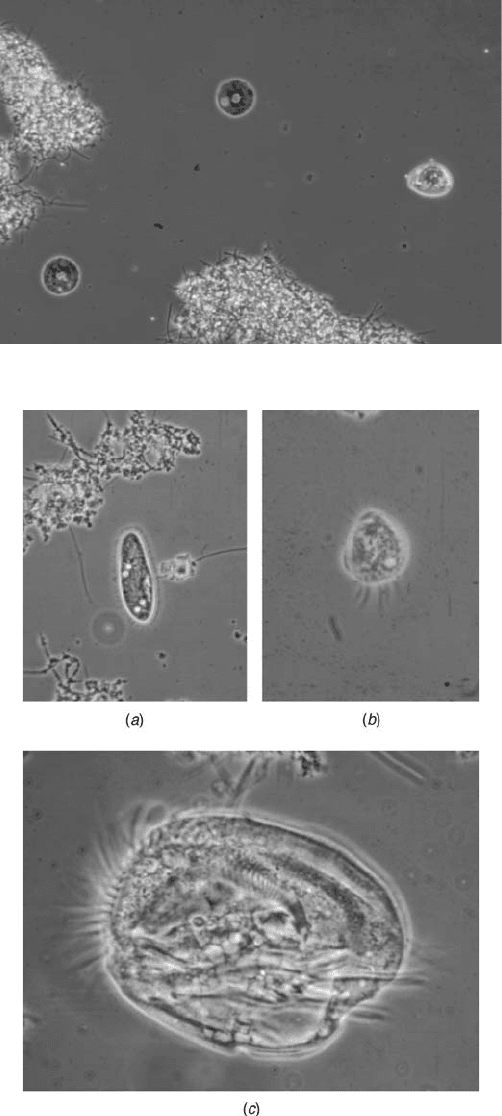
Figure 10.33 Arcella, a testate amoeba.
Figure 10.34 Free-swimming ciliates: (a) Paramecium;(b) Aspidisca;(c) Euplotes.
272
MICROBIAL GROUPS
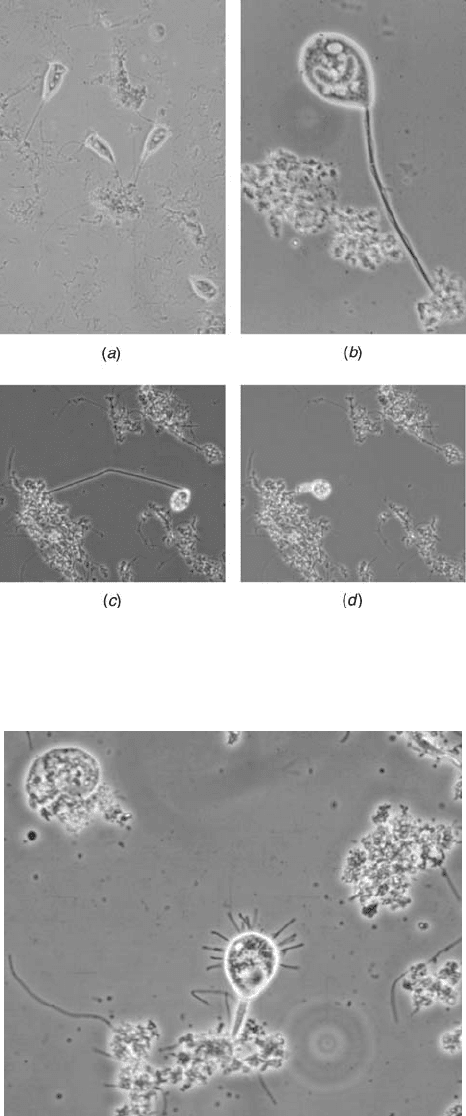
Figure 10.35 Vorticella, a stalked ciliate: (a) feeding; (b) with mouth closed and myoneme visible
(dark line in stalk); (c) stalk extended; (d) seconds later, myoneme contracted to form a corkscrew-
shaped stalk.
Figure 10.36 Podophrya, a suctorean.
EUKARYA 273
stems, and leaves, although some of the brown algae, especially, have superficially similar
structures. Six phyla (Table 10.10) are generally recognized by phycologists (scientists
who study algae). The phyla are distinguished mainly on pigments, food storage materi-
als, cell walls, and flagella. For the most part, the phyla are not considered to be closely
related; in fact, it is now believed that they evolved separately from different nonphoto-
synthetic ancestors.
In Eukarya, photosynthesis occurs within membrane-bound organelles called chloro-
plasts. Since the photosynthetically active range (PAR) of light absorbed by algae is
roughly from wavelengths of 400 to 700 nm, several different types of pigments are
involved. These include various chlorophylls (including a, which is found in all algae,
and b, c,ord ), caretenoid s, and phycobilins, which are associated with proteins to
form light-harvesting complexes. Some of these pigments may also provide protection
against harmful ultraviolet radiation. It is the combination of photosynthetic pigments pre-
sent within algal cells that give them their distinctive coloration (e.g., green, red, brown).
Algae are the major primary producers of organic material in most aquatic and marine
ecosystems, and hence many other organisms are directly or indirectly dependent on
them. Some algae may also be found in or on soil and on terrestrial surfaces (e.g.,
trees, rocks). On a global level, they are of critical importance because of their production
of oxygen and absorption of carbon dioxide.
From the perspective of environmental engineering and science, algae also can be pro-
blematic. If waters receive increased amounts of nutrients from wastewater discharges or
runoff, excessive growth of algae, cyanobacteria, and plants can occur. This can lead to a
number of problems, ranging from physical interference with recreation (or even naviga-
tion) to fish kills from oxygen depletion or production of toxins. In fact, this problem,
referred to as eutrophication (Section 15.2.6), can even lead to the rapid filling in of a
lake or pond, converting it eventually to a wetland and then dry land. On the other
hand, algae are also utilized in some wastewater treatment processes to produce oxygen
or remove nutrients. Standard Methods (Clesceri et al., 1998), a reference book available
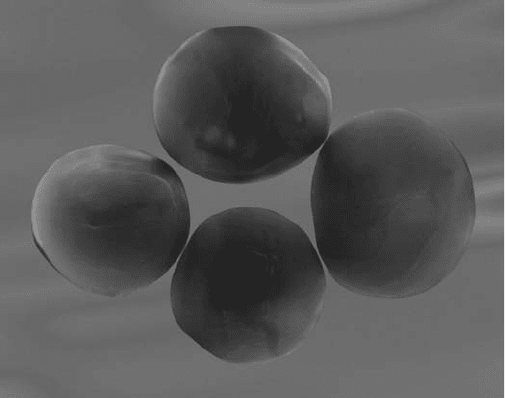
Figure 10.37 Cryptosporidium oocysts. (SEM copyright Dennis Kunkel Microscopy, Inc.)
274
MICROBIAL GROUPS

TABLE 10.10 The Algae
Phylum Euglenophyta Phaeophyta Chrysophyta Pyrrophyta Rhodophyta Chlorophyta
Common name Euglenoids Brown algae Golden algae/
diatoms
Dinoflagellates Red algae Green algae
Pigments
a
chl.-b chl.-c, xanthophylls chl.-c chl.- c chl.-d, phycobilins chl.-b
Cell wall None Cellulose Silica (diatoms) Cellulose plates Cellulose Cellulose
Main storage
product
b
b-1,2-glucan b-1,3-glucan Lipids a-1,4-glucan a-1,4- and a-1,
6-glucan
a-1,4-glucan
Motility Two flagella
(one very short)
Two flagella
(reproductive
cells)
Gliding (some)
c
Two flagella None Zero, two, or four
flagella
Major habitats Mostly freshwater Mostly marine Freshwater, marine,
soil
Mostly marine Mostly marine Mostly freshwater,
soil
Usual form Single cell Multicellular Single cell, colonial Single cell Multicellular Single cell, colonial,
multicellular
Example genera Euglena
Phacus
Fucus
Laminaria
Sargassum
Golden:
Tribonema
Diatoms:
Asterionella
Diatoma
Fragilaria
Navicula
Nitzschia
Synedra
Tabellaria
Ceratium
Gonyaulax
Gymnodinium
Peridinium
Pfisteria
Polysiphonia
Porphyra
Ankistrodesmus
Chlorella
Chlamydomonas
Cladophora
Scenedesmus
Selenastrum
Spirogyra
Ulothrix
Volvox
a
In addition to chlorophyll-a (chl.-a) and carotenoids.
b
Starch is a-1,4-glucan; b-1,2-glucan is called paramylon, and b-1,3-glucan is laminarin.
c
Some chrysophytes have one or two flagella.
275
to most environmental engineers and scientists, includes very useful (and beautiful!) clas-
sic color drawings (by C. M. Palmer) of many important freshwater algae.
Euglenophyta The Euglenophyta are considered to be the first of the algae to evolve,
probably from unpigmented flagellates. In fact, they are considered protozoans (Phyto-
mastigophora) as well as algae, mainly because they usually have two flagella (one so
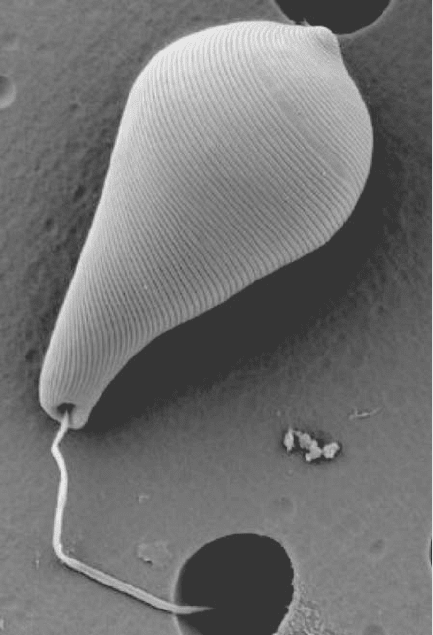
short it may be internal) and have no cell wall. Most, such as Euglena (Figure 10.38),
are able to live chemoorganotrophically in the dark and can also survive in this way if
their chloroplasts are removed. Their pigments are similar to those of the green algae
and plants, but they are not felt to be closely related to these groups.
Phaeophyta: The Brown Algae The brown algae are multicellular and mainly marine.
They include most seaweeds. Giant kelp can exceed 60 m in length. The Sargasso Sea in
the North Atlantic Ocean is known for its extensive beds of floating Sargassum. Brown
algae are thought to have evolved from early pigmented flagellates and still produce
flagellated asexual spores and sexual reproductive cells. Many produce leaflike blades
and a holdfast, but not true leaves, stems, or roots.
Figure 10.38 Euglena gracilis. (SEM image courtesy of Brian Leander and Michael A. Farmer,
Center for Ultrastructural Research, University of Georgia, Athens, GA.)
276
MICROBIAL GROUPS
Chrysophyta: Chrysophytes an d Diatoms The Chrysophyta, named from the Greek
chrysos (gold), includes three major classes: yellow-green, golde n-brown, and diatoms .
They may be either unicellular or colonial. The yellow-green and golden-brown algae
(chrysophytes) are mainly found in fresh water, although there are also a few marine spe-
cies. Diatoms are common in both fresh and salt water, as well as in moist soils. Diatoms
are typically single celled, although there also are filamentous species . They do not have
flagella, but some have gliding motility.
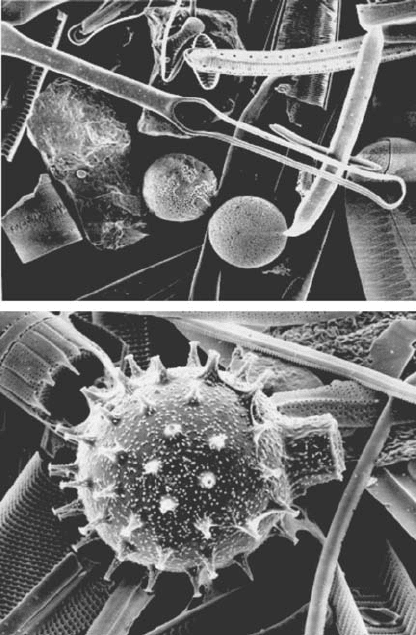
Diatoms form silica-rich frustules as their cell walls; the two halves fitting together
like a petri dish, with one side overlapping the other. These shell-like structures, such
as those shown in Figure 10.39, give many diatoms a distinctive, often beautiful appear-
ance, which frequently can be used for classification purposes. Geologic deposits of dia-
toms are mined to produce the diatomaceous earth used as a common filtration medium.
During asexual reproduction, each half of the shell becomes the larger half of one of the
two new frustules. Thus, one of the daughters is smaller than the parent. This continues
until very small cells are formed, at which point sexual reproduction will occur.
Pyrrophyta: The Dinoflagellates Most dinoflagellates,suchasPeridinium (Figure 10.40),
are single-celled, mainly marine algae with a cell wall made of tough cellulose–silica plates.
Figure 10.39 SEM images of various diatom frustules. (Courtesy of the University of Iowa
Central Microscopy Research Facility.)
EUKARYA 277