
Vaccari D.A., Strom P.F., Alleman J.E. Environmental Biology for Engineers and Scientists
Подождите немного. Документ загружается.

15.2.2 Biota
Aquatic organisms are classified according to their habitats. The plankton are small free-
floating organisms. Planktonic plants, called phytoplankton, include cyanobacter, green
algae, and diatoms. Planktonic animals are zoopl ankton and include protozoans, small
crustaceans such as Daphnia species and larval forms of other animals. Organisms
such as duckweed that float on the surface are called neuston. Active swimmers that
live in the pelagic zone, such as fish, are called nekton. The community of microscopic
bacteria, fungi, and small plants and animals that live attached to submerged surfaces such
as rocks are referred to as aufwuchs. A subset of these are the periphyton, which are
algae that grow attached to surfaces. (Aufwuchs and periphyton are what makes sub-
merged rocks so slippery to step on.) All organisms that live on the bottom or within
the sediments, whether in the littoral or profundal zones, are called benthic organisms,
or simply the benthos.
Lotic ecosystems have planktonic organisms only in the slowest of rivers. Periphyton
dominate over phytoplankton, and benthos over zooplankton.
Prokaryotes Three types of autotrophic bacteria are typically found in lakes: cyanobac-
ter, chlorobacter, and chemoautotrophs. Cyanobacter (blue-green bacteria) are found in
the epilimnion. Chlorobacteria peaks just below the thermocline, their numbers decreasing
with depth. If the hypolimnion becomes anoxic, sulfate-reducing bacteria will appear to
produce hydrogen sulfide. However, most of the bacteria are heterotrophs. Heterotrophic
concentrations peak in the thermocline and near the sediment. In highly polluted streams
the filamentous bacteria Sphaerotilus can form lush gray mats waving in the current .
One of the notable roles of cyanobacter, espec ially Aphanizomenon, is in the fixation of
atmospheric nitrogen. This allows it to grow whe n nitrogen limitations apply to other
algae. Some cyanobacter, such as Oscillatoria or Microcystis, cannot fix N
2
. The latter
depends on ammonia recycled by animal or bacterial excretion or by solubilization
from the sediments. In rivers, Nostoc or Rivularia may fix considerable amounts of
nitrogen.
Gas vacuoles enable cyanobacter to float to the surface during the calm night, where
they can be found forming a scum at dawn. As the sun rises higher, the cyanobacter can be
damaged by ultraviolet radiation, so they tend to sink by midmorning. Anabaena does this
by collapsing gas vesicles by osmotic pressure which has increased as a result of glucose
formed by photosynthesis. Colonies of Microcystis and Aphanizomenon, as well as fila-
ments of Anabaena, also regulate their buoyancy by manufacturing glycogen, which is
about 1.5 times as dense as normal cell material. At night they use up the glycogen
and start to rise again. By moving up and down, the algae not only control their light
exposure but take advantage of nutrients farther below the surface.
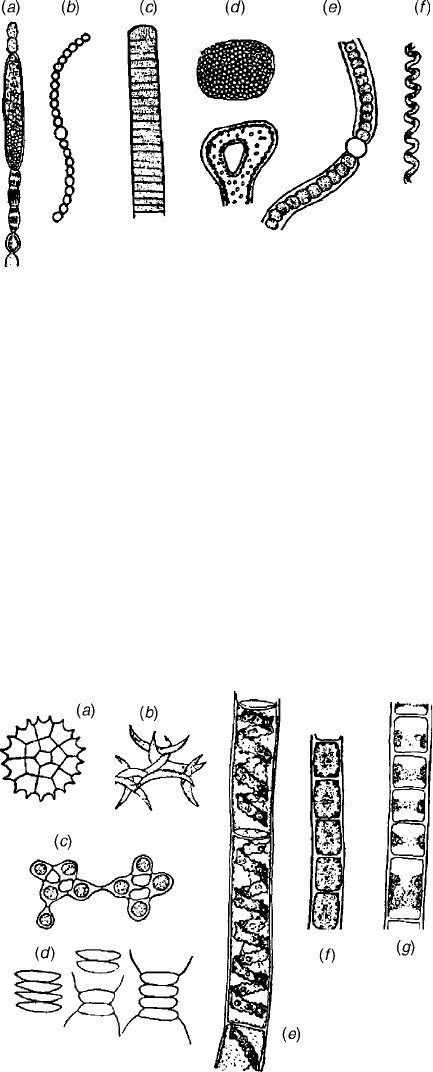
Cyanobacter (Figure 15.5) make chemicals that inhibi t feeding by zooplankton. They
make compounds that have been known to poison cows and pigs that drank from
eutrophic sources of water. Cyanobacter and some actinomycetes also produce geosmin
and methyl isoborneol, the most common causes of taste and odor problems in drinkin g
water. These compounds are contained in the cells, but released when the cells break
down.
Green Plants Algae are plantlike protists (Figure 15.6). They are distinguished from
plants in that they do not have stems, roots, or leaves. They can be unicellular, colonial
508 ECOSYSTEMS AND APPLICATIONS
(forming usually small groups of cells), or filamentous. Some, such as the dinoflagellates,
are motile, enabling them to migrate in response to light. Periphyton are usually green
algae, cyanobacter, or diatoms. The long, bright green filaments attached to rocks in
streams are often cyanobacter. Other filamentous forms are green algae such as Uloth rix
and Cladophora.
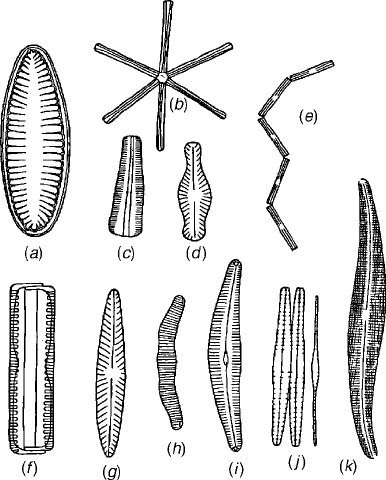
Diatoms (Figure 15.7) have an advantage over other plants in that their cell wall, being
made of silica, requires about 12 times less energy to manufacture than cellulose. (Cya-
nobacter, which are prokaryotes, make cell walls of peptidoglycan, which requires more
energy than cellulose. The ability of cyanobacter to control their light input by controlling
buoyancy compensates them for this added cost.) However, diatoms are denser as a result,
so under low-turbulence conditions they may settle out of the photic zone and be replaced
by cyanobacter or dinoflagellates.
Figure 15.5 Cyanobacter: ðaÞ Aphanizomenon; ðbÞ Anabaena; ðcÞ Oscillatoria; ðdÞ Polycystis;
ðeÞ Nostoc; ðf Þ Spirulina. (From Standard Methods, 12th ed. # 1965 American Public Health
Association.)
Figure 15.6 Green algae: ðaÞ Pediastrum; ðbÞ Selenastrum; ðcÞ Coelastrum; ðdÞ Scenedesmus;
ðeÞ Spirogyra; ðf Þ Microspora; ðgÞ Ulothrix. (From Standard Methods, 10th ed. # 1955 American
Public Health Association.)
FRESHWATER ECOSYSTEMS 509
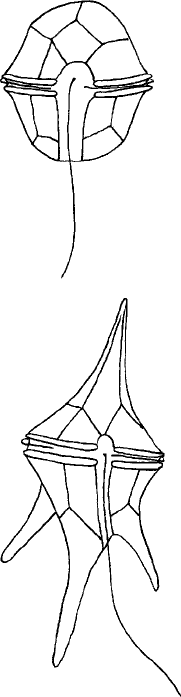
Dinoflagellates (Figure 15.8) can swim several meters per hour. They use their motility
to swim upward in the morning to collect more light for photosynthesis, and then down-
ward in the afternoon to avoid predation. In a condition called the red tide, dinoflagellates
sometimes accumulate to nuisance levels in lakes, estuaries, and oceans, coloring the sur-
face of the water blood-red. They can be toxic to fish and invertebrates and irritating to the
skin of humans exposed by swimming. Examples of red tide genera include Noctiluca and
Gymnodinium in marine systems and Peridinium and Ceratium in lakes.
In the open sea, the condition has been associated with salinity fronts where estuarine
water converges with ocean currents. This leads to stratification between the estuarine
water on top and the more saline water below. These waters may be comple mentary in
the sense that each contains nutrients that may be limit ing in the other. Algae grow pre-
ferentially at the boundary, where there will be some mixing. Dinoflagellat es have the
advantage of being able to move between the two layers, taking advantage of both.
Large plants are called macrophytes. Most are from the plant kingdom, although some
are large algae (Table 15.4 ). Roots may be used for obtaining nutrition from the sediment
or may be primarily for attachment. Nutrients can be obtained directly from the water.
Besides their obvious role as primary producers, macrophytes are important as shelter
and substrate for other organisms. Periphyt on, which in this case are considered epiphytic,
grow on the stems and leaves of the macrophytes. Protozoans roam the epiphytic cultures,
and snails graze among them. Amphibians and small fish find shelter from predatory fish
and birds. The macrophytes contribute greatly to the detritus food chain as dead plants
settle to the bottom. Freshwater angiosperms will grow only at shallow depths. Deeper
plants consist of ferns, mosses, and large algae. Emergent plants are those that grow
Figure 15.7 Diatoms: ðaÞ Surirella; ðbÞ Asterionella; ðc; dÞ Gomphonema; ðeÞ Tabellaria; ðf ; gÞ
Navicula; ðhÞ Eunotia; ðiÞ Cymbella ; ðjÞ Fragilaria; ðkÞ Gyrosigma. (From Standard Methods, 10th
ed. # 1955 American Public Health Association.)
510
ECOSYSTEMS AND APPLICATI ONS
out of the water. Some plants have only reproductive parts that are emergent. Many plants
that are primarily emergent occur in marshe s and are discussed in Section 15.3.
Zooplankton and Invertebrates Aquatic ecosystems can have all the trophic levels at
microscopic size, as we are accustomed to seeing on a large scale in terrestrial ecosys-
tems. The zooplankton include protozoans, small crustaceans, rotifers, and other small
invertebrates (Figures 15.9, 15.10, and 15.11). These may have roles of herbivore and pri-
mary and secondary carnivore. The nymph or larvae of many insects are aquatic and have
similar roles.
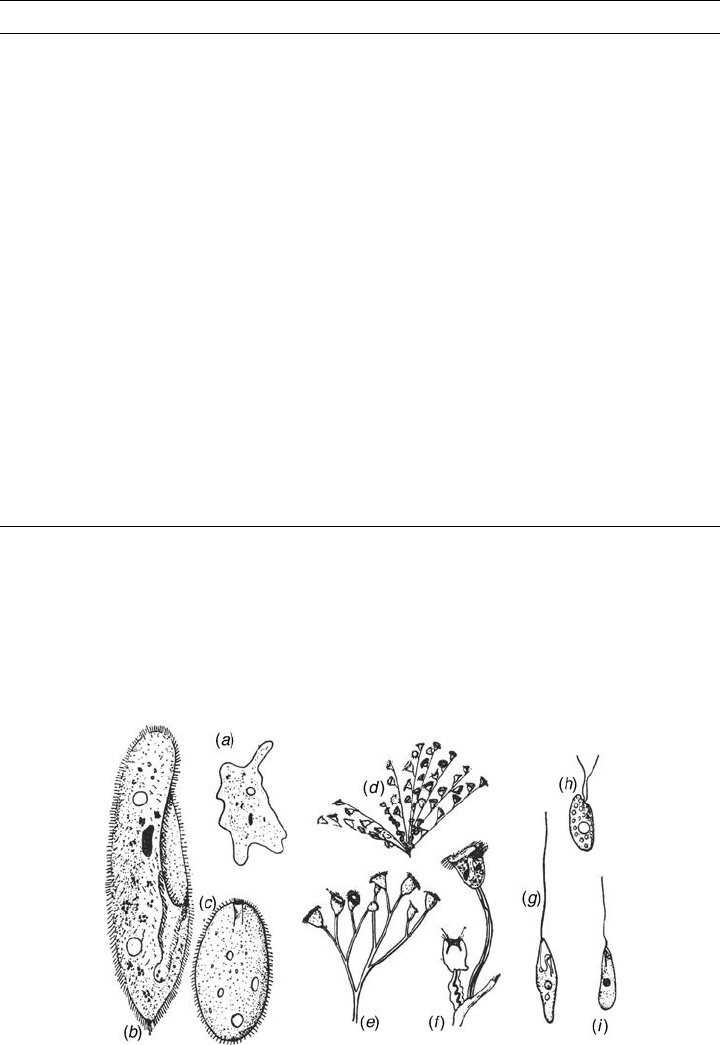
Protozoans are widely dispersed, and tend to be most abundant in waters with large
amounts of organic matter (Table 15.5). They feed on detritus and other single-celled
organisms, whether bacteria, algae, or other protozoans. Some are obligate parasites,
with hosts ranging from algae to fish. The presence of parasites can change the species
composition of an aquatic ecosystem, such as by bringing an algal bloom to an end.
Rotifers are among the more interesting creatures to observe under a microscope as
they move and feed. Most are sessile (nonmotile); many are motile but attach themselves
Figure 15.8 The dinoflagellates Peridinium and Ceratium.
FRESHWATER ECOSYSTEMS 511
periodically to substrates b y several ‘‘toes.’’ A few have a ring of cilia that gives the
impression of circular motion (accounting for the name) as it sweeps in suspe nded matter
for food. Some are parasites or predators.
Arthropods include two important aquatic groups: the crustaceans and the insects. Both
have exoskeletons com posed of chitin. Most of the larger zooplankton are crustaceans
TABLE 15.4 Common Aquatic Macrophytes
Habitat Taxonomic Group Examples
Free-floating
Subtropical and tropical lakes, slow streams Monocot Pistia (water lettuce)
Monocot Eichhornia (water hyacinth)
Fern Salvinia (water fern)
Temperate ponds Fern Azolla (water fern)
Monocot Lemna (duckweed)
Rooted
Temperate marshes Monocot Phragmites (giant reed)
Dicot Rorippa (watercress)
Tropical marshes Monocot Scirpus (bulrush)
Monocot Papyrus (reed)
Dicot Victoria (water lily)
Ponds and slow streams Dicot Nuphar (water lily)
Moncot Potamogeton (pond weed)
Dicot Ceratophyllum (coontail)
Estuaries Dicot Myriophyllum (milfoil)
Monocot Zostera (eel grass)
Monocot Ruppia (widgeon grass)
Deep in oligotrophic lakes Lycosida Isoetes (quillwort)
Large algae Chara (stonewort)
Large algae Nitella (stonewort)
Moss Fontinalis (willow moss)
Source: Horne and Goldman (1994).
Figure 15.9 Protozoans. Amoebae: ðaÞ Amoeba; ciliates: ðbÞ Paramecium, ðcÞ Frontonia; stalked
ciliates: ðdÞ Carchesium, ðeÞ Epistylis, ðf Þ Vorticella; flagellates: ðgÞ Peranema, ð hÞ Chilomonas,
ðiÞ Astasia. (From Standard Methods, 10th ed. # 1955 American Public Health Association.)
512
ECOSYSTEMS AND APPLICATI ONS
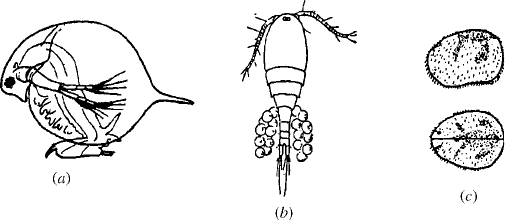
(Table 15.6). Cladocerans, such as Daphnia, and copepods, such as Cyclops, combine
with protozoans to form the majority of aquatic zooplankton.
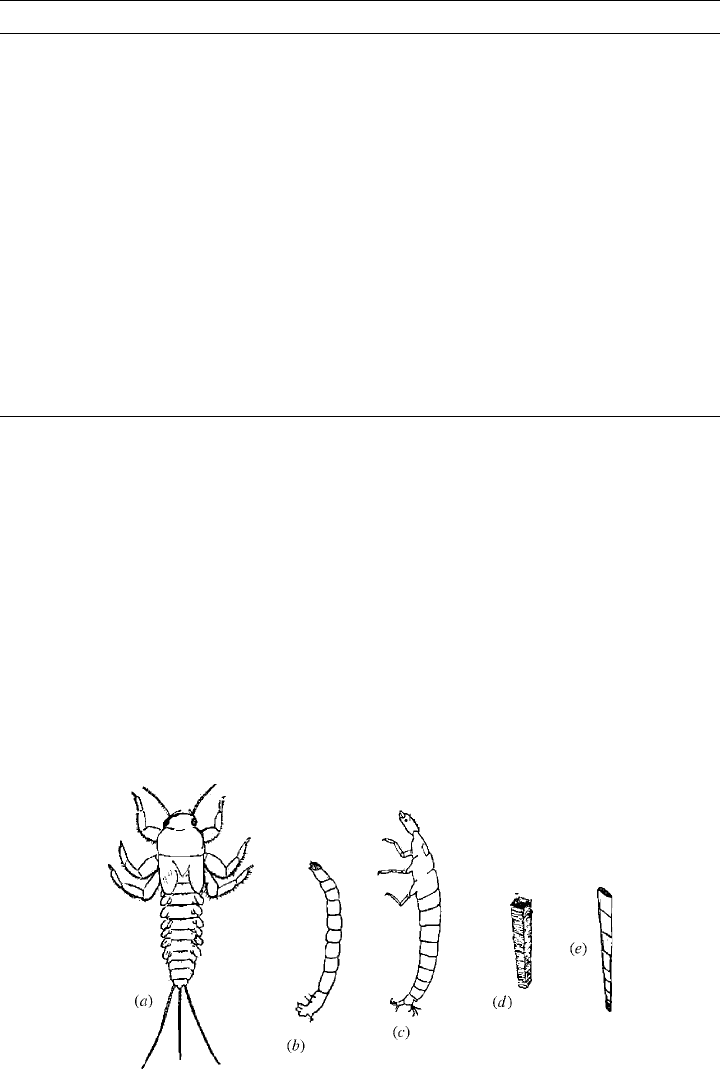
The presence of some of the insect larvae or nymphs are indicators of a healthy aquatic
environment (Table 15.7 and Figure 15.12). Examples include nymphs of stoneflies, may-
flies, and caddisfly larvae. Recall that a nymph is an immature stage of that minority of
insects that go through gradual metamorphosis. It is usually similar in form to the adult,
except possibly lacking the adult’s wings, coloration, and sexual maturity. The immature
form of insects that go through complete metamorphosis, called a larva, may be very
different in form (often, a worm or caterpillar) and habitat from the adult. The caddisfly
larvae may be housed in a case made of bits of plant matter, as shown in Figure 15.12.
The insects occupy trophic levels between the primary producers and the fish. Hatching
of adult insects may occur en mass and results in a feeding frenzy among the fish.
Benthos The benthos contains o rganisms on and beneath the surface of the sediment.
Their food web is based on detritivores: bacteria, fungi, protozoans, and invertebrate ani-
mals. The source of the energy is the primary productivity of the water column, for lakes,
or the watershed, for rivers. Transport of pollutants through the pores of the sediments
cannot be predicted using the diffusion methods from groundwater pollution hydrology.
This is because burrowing organisms actively mix and transport chemicals in sediment
(and the sediment itself), move water through the sediment, and provide channels for
increased circulation and diffusion.
Two distinct benthic environments are the littoral and the profundal, according to
whether they are above or below the thermocline, respectively. The littoral zone tends
to have higher species diversity, although the profundal zone may have greater total num-
bers of organisms. The littoral benthos is subject to significant daily and seasonal changes.
The profundal benthos may experience seasonal changes in oxygen in eutrophic lakes.
The littoral benthos consist of relatively more herbivores, grazers, and filterers than the
profundal. Macrophytes can greatly increas e the available habitat. Wave action and the
proximity of the surface usually ensure an ample oxygen supply.
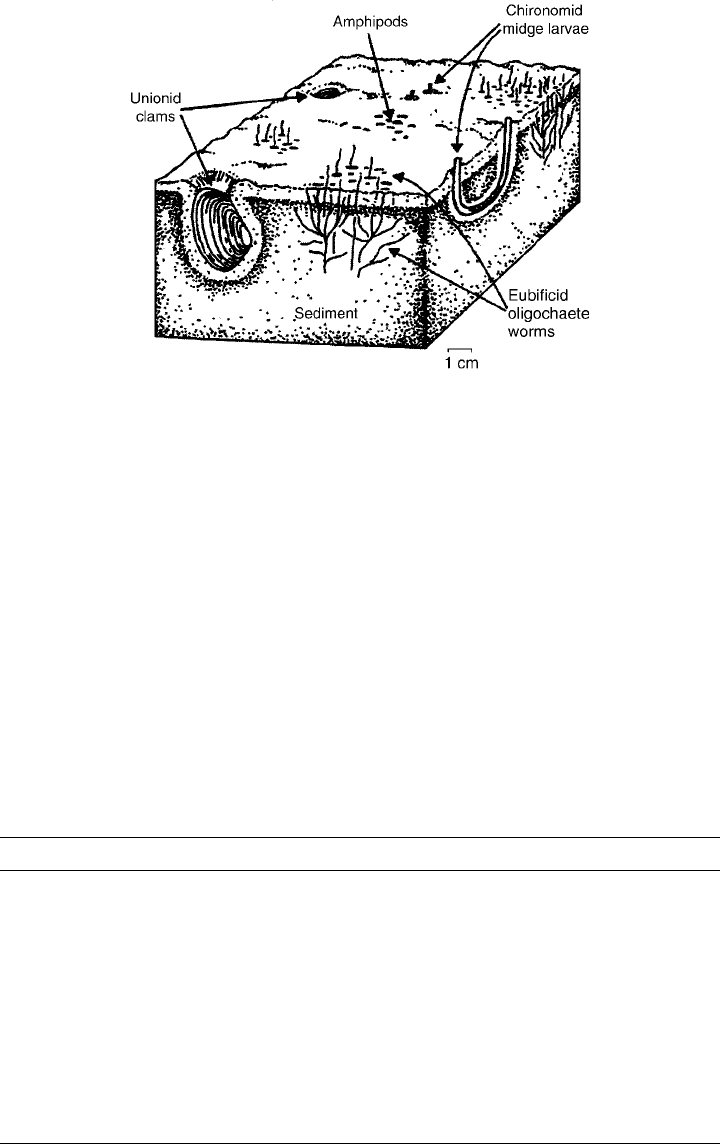
The profundal benthos consist mainly of worms and mollusks in four groups: oligo-
chaete worms (only in cold waters), amphipods (crustaceans, including mys id shrimp),
insect larvae, and clams (Figure 15.13). Most of these are detritus feeders, although
there may be some predators, such as the midges. Most of the food input to the profundal
benthos comes from the spring algae bloom, especially diatoms, which sink readily . The profun-
dal benthos can store large amounts of lipids to get them through the rest of the year.
Figure 15.10 Planktonic crustaceans: ðaÞ the cladoceran Daphnia; ðbÞ the copepod Cyclops;
ðcÞ the ostracod Cipridopsis. (From Standard Methods, 10th ed. # 1955 American Public Health
Association.)
FRESHWATER ECOSYSTEMS 513
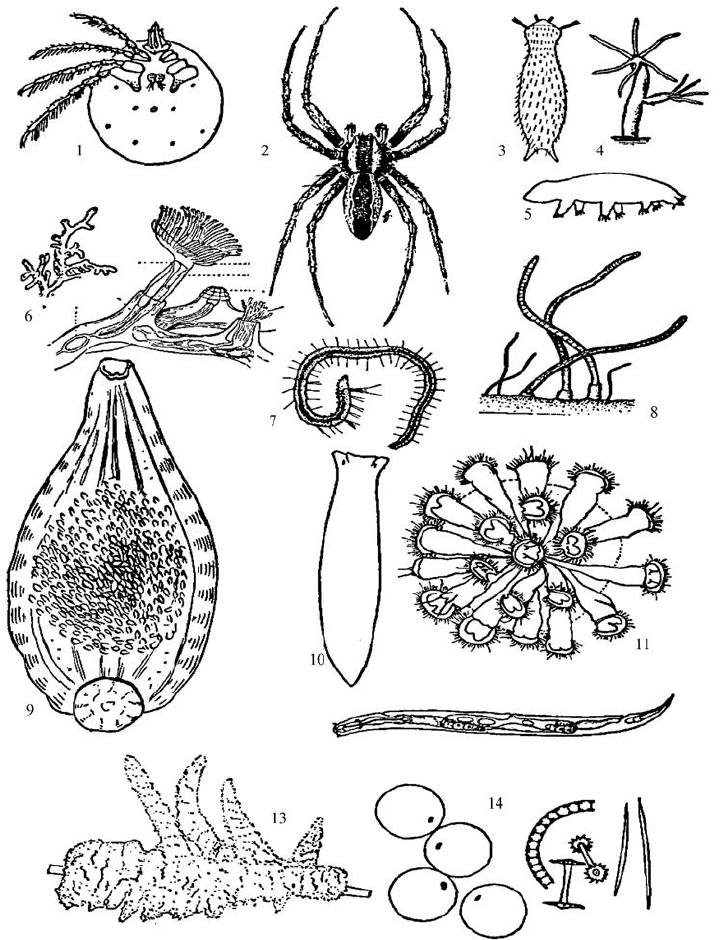
Figure 15.11 Other invertebrates: (1) hydrachnid, or water mite; (2) water spider; (3) gasterotrich,
Chaetonotus; (4) coelenterate, Hydra; (5) tardigrade, Macrobiotus; (6) bryozoan, Plumatella; (7),
bristle worm, Nais; (8) sewage worm, Tubifex; (9) leech, Clepsine; (10) flatworm, Planaria; (11)
colonial rotifer, Conochilus; (12) nematode worm; (13) freshwater sponge; (14) gommules and
spicules from the sponge. (From Standard Methods, 10th ed. # 1955 American Public Health
Association.)
514
ECOSYSTEMS AND APPLICATI ONS

The differences in adaptation between littoral and benthic organisms can be repre-
sented by a comparison of the littoral amphipod Gammarus pulex and the benthic chiro-
nomid midge Chironomus anthracinus. Midges are larvae of predatory gnats. They feed
on rotifers and burrow into the sediments at night. When the water is saturated, both
species use oxygen at the rate of about 250 mg/g. But for Gammarus the rate decreases
proportionally as oxygen saturati on in its environment decreases. At 30% of saturation its
respiration rate drops from to about 100 mgO
2
per gram of organism. The mi dge, on the
other hand, maintains a fairly constant respiration rate down to 30% saturation; 100 mg/g
TABLE 15.5 Some Important Aquatic Protozoans
Phyla Habitat Examples
Flagellates (some are algae) Lakes; oceans; some are Synura (Chrysomonad)*
parasites Ceratium (Dinoflagellate)*
Euglena*
Oikomonas
Ciliates Ponds, streams, detritus, Paramecium
some parasitic Vorticella
Amoeboid Most waters Difflugia
Globigerina (Foraminifera)
Actinosphaerium (Radiolaria)
Vampyrella (algal parasite)
Sporozoans (all parasitic) Aquatic organisms Henneguya (on fish)
Plasmodium (human malaria)
Source: Horne and Goldman (1994).
TABLE 15.6 Common Aquatic Crustaceans
Taxonomic Most Common
Group Habitat
a
Feeding Method Examples
Cladocera FW, P Predator Leptodora
(water fleas) FW, P Filter Daphnia
FW, P Filter Bosmina
FW, P, B Filter Sida
FW, P, B Filter Chydorus
FW, S, P Predator Polyphemus
Copepoda FS, S, B Filter and parasitic Nitocra
FS, S, B, P Predator on animals Cyclops, Megacyclops
Predator on algae Thermocyclops, Eucyclops
FW, S, P Filter Limnocalanus, Boeckella, Diaptomus
Mysidacea FW, P Predatory and Misis
(opossum shrimp) detritovore
Amphipoda S, FW, B Predatory Gammarus
Astacus
Decapoda S, FW, B Predatory Pacifastacus
(freshwater crayfish) Cancer
a
FW, freshwater; S, saline; B, benthic or attached; P, planktonic.
Source: Horne and Goldman (1994).
FRESHWATER ECOSYSTEMS
515
is not reached until about 5% of saturation. This is attributed to the presence of hemoglo-
bin in the blood of the midge, which improves the efficiency of oxygen transfer.
Other invertebrates include various worms and mollusks (Table 15.8). Included are
nematodes, oligochaetes, leeches, bivalves (clams), and snails. Most are detritivores.
Leeches are predators that attach to fish. Some nematodes are internal fish parasites.
Bivalves are becoming uncommon in American rivers. Snails feed on macrophytes and,
along with insect larvae, can control their abundance. Tubifex can become so abundant in
highly polluted streams that they form red mats on the bottom.
The zebra mussel, Dreissena polymorpha , is an exotic species imported to North
America from Europe. It probably hitched a ride in the ballast water of a ship that released
it near Detro it, Michigan, in 1985 or 1986. Since then it has been spreading rapidly, car-
ried by currents and shipping. Zebra mussels cause great ecological and economic harm
TABLE 15.7 Characteristics of Some Common Insect Larvae
Common Name and Order Habitat Food Habits Examples
Nymphs
Stoneflies (Plecoptera) Rapids Mainly Nemoura
carnivorous
Mayflies (Ephemeroptera) All waters Mainly Baetis, Ephemerella
herbivorous
Damselflies (Odonata) Slow and stagnant Carnivorous
Dragonflies (Odonata) Slow and stagnant Carnivorous Libellula
Water bugs (Hemiptera) All waters Carnivorous Notonecta (backswimmer)
Gerris (water strider)
Larvae
Caddisfly (Trichoptera) All waters Carnivorous
Water beetles (Coleoptera) Slow or stagnant Carnivorous Dytiscus (diving beetle)
Order Diptera (and family)
Mosquitoes Pools at surface Herbivorous Culex
Blackflies Rocks in rapids Herbivorous Simulium
True midges (chironomids) All waters Herbivorous Chironomus
Horseflies Beds in pools Carnivorous
Source: Needham and Needham (1962); Horne and Goldman (1994).
Figure 15.12 Insect larvae and nymphs: ðaÞ Ephemeroptera (mayfly); ðbÞ Diptera, Chironomus; ðcÞ
Trichoptera (caddisfly); ðd; eÞ Trichoptera case. (From Standard Methods,10thed.# 1955 American
Public Health Assoc., Inc.)
516
ECOSYSTEMS AND APPLICATI ONS
by occupying growing surfaces formerly used by other organisms and by growing on
intake structures of power plants and drinking water plants, obstructing their flow.
Fish and Fisheries Fish occupy and often dominate all the trophic levels from detriti-
vore to herbivore to top carnivore (Table 15.9). They serve as prey to other fish and to
aquatic birds or other animals. Since streams receive most of their nutrient input from
terrestrial sources, harvesting of fish by b irds, bears, or humans represents a return of
some of those nutrients. Fish are the most motile of aquatic species; thus, they can live and
breed in different places, and move in response to changes in food supply or other conditions.
Freshwater fish are hypertonic: Their bodily fluids are more saline than the water they
swim in. Thus, they tend to absorb water by osmosis and lose salts by passive diffusion.
To counter this, they discharge large volumes of dilute urine, and their cells absorb salt by
active transport. They do not drink.
Figure 15.13 Zoobenthos of the profundal zone. (From Horne and Goldman, 1994. # McGraw-Hill,
Inc. Used with permission.)
TABLE 15.8 Common Invertebrates Other Than Insects
Taxonomic Group Feeding Method Examples
Turbellaria (flatworms) Carnivores Dugesia
Nematodes (roundworms) Carnivores, herbivores, parasites Dolichodorus
Annelida
Oligochaeta (segmented worms) Sediment grazers Tubifex (red worms)
Hirudinea (leeches) Carnivores, detritivores Haemopis (horse leech)
Mollusca
Gastropoda (snails) Grazer Limnaea (pond snail)
Planorbis (ramshorn snail)
Palacypoda (bivalves) Filterer Anodonta (swan mussel)
Crustacea
Malacostraca Detritivores Gammarus
(crayfish, amphiphods) Astacus
Source: Horne and Goldman (1994).
FRESHWATER ECOSYSTEMS
517