
Vaccari D.A., Strom P.F., Alleman J.E. Environmental Biology for Engineers and Scientists
Подождите немного. Документ загружается.


but controlled energy input (organics in the wastewater) takes its place. This system is
called heterotrophic succession. Respiration (per organism) peaks, then is reduced as sub-
strate concentrations drop and respiration achieves balance with energy input.
As succession proceeds, nutrien ts are stored in biomass, and in soil in the case of pri-
mary succe ssion. As these reservoirs build up, internal recycling increases, improving the
efficiency of nutrient use. Species diversity may increase throughout the succession,
although climax communities sometimes have less diversity than a peak. For example,
relatively moist forests in the Great Lakes region showed a peak diversity in middl e
ages, whereas drier forests increase in diversity continuously.
The succession just described has a single direction of change. Some ecosystems exhibit
cyclical changes even in the absence of external disturbance. The Calluna heath in Scotland
has a cycle of 20 to 30 years. Heather establishes itself on bare ground and matures in
about 7 to 15 years. After 14 to 25 years, this perennia l loses its vigor, and other lichens
and mosses invade. They eventually die out, leaving bare ground, and the cycle repe ats.
14.4.4 Distribution vs. Abundance: Spatial Structure of Communities
Earlier sections treated the population of each species within an ecosystem as if it were a
variable that depended only on time. However, their spatial distributions are interesting as
well. Factors that control where an organism will be found include:
TABLE 14.10 Trends Expected During Undisturbed (Autogenic) Succession
Energetics
Biomass (B) and organic detritus increase.
Gross productivity (P) increases in primary succession, little change in secondary.
Respiration (R) increases.
P/R ratio moves toward unity (balance).
B/P ratio increases.
Nutrient cycling
Element cycles increasingly closed.
Turnover time and storage of essential elements increase.
Cycling ratio (recycle/throughput) increases.
Nutrient retention and conservation increase.
a
Population and community structure
Species composition changes.
Species diversity peaks in middle or end of sere.
Species evenness peaks in middle or end of sere.
r-Selected organisms replaced by K-selected.
Life cycles increase in length and complexity.
Size of organism and/or propagule (seed, offspring, etc.) increases.
Mutualistic symbiosis increases.
a
Stability
Resistance increases.
a
Resilience decreases.
a
Overall strategy
Increasing efficiency of energy and nutrient utilization.
a
a
Trend based on theoretical considerations, not yet validated in the field.
Source: Based on Odum (1987).
488 ECOLOGY: THE GLOBAL VIEW OF LIFE
Method of dispersal
Physical factors
Habitat selection
Interactions with other species (predation, competition, disease)
Organisms disperse to colonize new areas in many ways. Plant seeds may be spread by
wind, water, or animals, or they may be confined to the margins of the parent. Animals
may disperse by their own motility or may be carried passively, like seeds, as in the case
of insects. If the environment in the new area fits within their niche, they may thrive.
Some of the most general physical factors include climate, light availability, and the
chemical environment. Geo graphically, these translate to such factors as latitude, altitude
or depth (in soil or water), and position on a moun tain slope. Soil or water chemistry may
vary locally or regionally. Fire can alter the balance between grassland and forest, con-
trolling the position of their border.
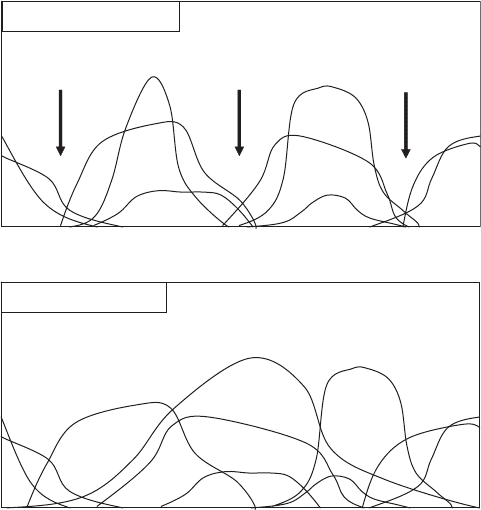
These factors vary in gradients throughout the world. For example, temperature, rain-
fall, depth of soil and light all vary with elevation along the slope of a moun tain. Along
the gradient various species rise and fall in abundance. In what are known as open com-
munities, the population distributions overlap considerably, resulting in continuous var-
iation in species along the gradient (Figure 14.19a). In the other extreme, known as closed
communities, population abundances are strongly correlated (Figure 14.19b ).
Closed communities
Ecotone
Ecotone
Ecotone
Abundance
Environmental gradient
Open communities
Abundance
Environmental
g
radient
Figure 14.19 Population distributions along a hypothetical environmental gradient for both closed
and open communities.
POPULATIONS AND COMMUNITIES 489
Closed communities are more easily defined as communities, since their boundaries
are marked more clearly. Sharp boundaries between closed communities are called
ecotones. They are especially prominent when the environmental gradient is fairly
rapid, such as the transition between a wetland and adjacent woodlands. Nevertheless,
they can also be present along gradual boundaries, such as the transition between grass-
lands and forest along long-ra nge moisture gradient s. In this case the boundaries are main-
tained by mutual inhibition, as when grasses prevent tree seeds from germinating and
trees prevent grasses from growing by shading them.
Ecotones have greater species diversity not only because they may have representatives
of two communities, but because some species benefit directly from both communities.
This is called the edge effect, a concept that is attributed to Aldo Leopold. Many
birds, such as the American robin, for example, nest in the forest but feed in
fields. Human alterat ions to the landscape, such as by clearing fields or putting roads
through wilderness areas, result in increasing the edges. This also has the effect of
decreasing the area of each community, which can reduce the number of species each
can support [equation (14.34)], and particular species with large area requirements may
be eliminated.
We saw previously how the number of species tends to increase with the area of the
ecosystem. However, each species may not necessarily range over the entire area, but
rather, be limited by environmental conditions to a subset. It turns out, that most species
have sma ll ranges, and fewer have large ranges. Species with larger ranges also tend to
have greater population density. These tendencies may be due to the differing dispersion
capabilities of species or (as some think) to the artifacts of sampling, which are b iased
against rarer species.
Individuals within a popul ation tend to distribute themselves more or less evenly due to
intraspecies competition. Individuals or groups of vertebrates tend to restrict themselves
to an area known as the home range. If the home range is defended aggressively and does
not overlap with those of neighbors, it is called a territory. Species with complicated
reproductive behavior, such as nest building and extended care of young, are more likely
to be territorial. Birds form territories more often than other groups. Territoriality is a way
to avoid the need for aggressiveness, since once a territory is formed and marked, others
of the same species tend to respect it.
14.5 HUMANS IN THE BALANCE
As of the year 2005, the human population exceeds 6.4 billion people, versus 3.5 billion
in 1950 and 1.6 billion at the start of the twentieth century. The growth rate in 2005 is
74 million per year (almost 1.2% per year). However, growth in food production is not
keeping pace.
The amount of fish caught has increased 4.6 times from the 1950s to the late 1980s.
Over the same period, world grain produc tion has tripled. But since then, fishing has
reached the sustainable-yield limit and has stopped increasing, and grain production
has slowed its increase to 0.5% per year, far less than world population growth. Thus,
the world’s annual per capita grain production has dropped almost 10% from its highest
value of 346 kg in 1984 to 313 kg in 1996.
Agricultural food production can be increased by either increasing the area
under cultivation or by increasing the yield. The oldest means of increasing yield is to
490 ECOLOGY: THE GLOBAL VIEW OF LIFE
initiate irrigation. In the twentieth century, fertilizer use provided the most dramatic
improvement. But fertilizer use is linked to water use. The more rain or irrigation that
is applied, the more fertilizer the crops can utilize. World fertilizer use has actually
dropped recently, as farmers have learned to apply it more precisely. A final way to
improve yields was to develop better varieties of crops, but the high-yielding varieties
require higher fertilizer doses.
Some of these practices cannot be extended or even be sustained. The per capita area
under cultivation has been falling sinc e the 1950s, and the total area has been dropping
since 1981. Increasing the area now means bringing marginal lands under cultivation and/
or destroying sensitive ecosystems such as tropical rainforests or wetlands. In the former
Soviet Union the marginal land was subject to soil erosion. Over the 18 year s leading to
1995, 26% of the land used for grain production had to be abandoned for this reason.
Agricultural practices tend to increase erosion and do not contribute much organic matter
by which natural systems rejuvenate the soil. Since 1950 some 20% of the world’s topsoil
has been lost. Industrial and urban development is also taking much prime farmland out of
production, even in China.
The per capita amount of land under irrigation has been dropping since 1979. A
principal reason is the depletion of underground aquifers. Twen ty-one percent of U.S.
cropland under irrigation gets its water from aquifers that are being drawn down.
Many of the world’s great rivers are pumped dry before they reach the sea. In the United
States, these include the Colorado River and the Arkansas River. The river feeding
the Aral Sea in Uzbekistan has run dry, and the sea itself is disappearing. China’s
Yellow River first ran dry in 1972, and does so now each year for longer and longer
periods.
These dismal statistics call for an evaluation of the carrying capacity of Earth. The total
world grain production is currently about 1.82 billion tons per year. This might be
increased to 2 billion tons. Am ericans use about 800 kg per person per year, much of
it indirectly in the form of meat and dairy products . Indians on average use only 200 kg
per person per year, in a diet consisting mostly of grain only. Some think that the health-
iest diet is what is known as the Mediterranean diet, which is lower in fat and protein than
the American diet. It requires about 400 kg per person per year. Thus, the world’s grain
supply could support 2.5 billion people on the American diet, 5 billion on the Mediterra-
nean diet, or 10 billion on the Indian diet.
The world population growth rate is 1.2% per year. The good news is that this is a
slowing, down from a peak of 2.5% per year in the 1960s. Fertility has fallen significantly
in most of the large developing countries. Modern contraceptives are becoming more
accepted by these countries. For example, they are used by 66% of married women in
Brazil. Indonesia is a model for population control in developing countries because it
has linked it to health care and educa tion for women and children, reducing infant mor-
tality from 133 per 1000 births in the 1960s to 57 in the 1990s. Some think that feelings of
economic security are an even more potent factor in controlling population than birth con-
trol education.
However, we are already beyond the number that could be supported on the Mediter-
ranean diet. Even if population control is pursued aggressively by developing countries,
the population will continue to grow because of the high proportion that is yet to reach
childbearing age. Under this scenario the population is expected to level off at about 10 to
16 billion during the twenty-first century.
HUMANS IN THE BALANCE 491
14.6 CONCLUSION
In the next chapter we study particular types of ecosystems. Based on what we have
learned from this chapter, we can formulate a few questions to think about when examin-
ing any ecosyste m:
What is its primary productivity? Which organisms are responsible for most of its
productivity?
How much energy is stored and transferred at each trophic level? How much
biomass?
What do the biogeochemical cycles look like for this ecosystem? What are the
amounts of nutrient storage and the flux rates between compartments?
What are the important organisms and groups of organisms in this ecosystem? What
adaptations make them abundant in this ecosystem?
What is the niche of each of these organisms (habitat; food source; is it food for
another organism; in what type s of speci es interactions does it participate)?
What limits the population of each species?
What stage of development is the ecosystem in?
How do human activities affect all of these factors?
In the next several chapters we travel from the land to the sea, examining several types
of ecosystems with these questions in mind.
PROBLEMS
14.1. Decay of radi oactive elements deep within the Earth produces a flux of heat
energy toward the surface in the form of geothermal energy. Visible results include
hot springs, geysers, and volcanoes. Humans can extract this energy to run
machines. Could plants or microorganisms use this energy directly for primary
productivity in nature? Explain.
14.2. The net primary productivity of a tall form of cord grass (Spartina alterniflora) has
been measured to be 5800 g/m
2
yr in a Georgia salt marsh. What is the efficiency
of energy capture assuming an average solar energy input for the southeastern
United States of 3888 kcal/m
2
day? Comment on the result.
14.3. The United States as a whole receives an energy subsidy in the form of fuels in the
amount of about 1:8 10
3
kcal/m
2
yr. The world receives about 100 kcal/m
2
yr.
Compare these figures to the gross and net primary productivity figures given in
the text for the United States and for particular ecosystems.
14.4. Tommy’s Pond av erages 2.0 f deep and has an area of 0.40 acres (1 acre ¼43,560 ft
2
).
The stormwater entering the pond was measured to have an average phosphorus
concentration of 0.300 mg/L. The average flow rate of the stormwater may be
assumed to be 5000 ft
3
/day (1 ft
3
¼28.3 L). Thirty ducks live on the pond. Each
duck is estimated to contribute phosphorus at the rate of 0.50 kg/y.
492 ECOLOGY: THE GLOBAL VIEW OF LIFE
(a) What will be the steady state phosphorous concentration in the pond?
(b) What is the turnover rate for phosphorus in Tommy’s Pond at steady state?
14.5. It can be difficult to visualize the huge quantities in global biogeochemical cycles.
Earth has a land area of 148,429,000 km
2
and a water area 361,637,000 km
2
.
Normalize the fluxes and reservoirs in the carbon cycle as shown in Figure 14.5 on
a per square meter basis. Separate the atmosphere into the portions over land
(29.1%) and over water (70.9%). How does productivity on land compare to that
on water?
14.6. Look at the magnitude of abiotic fixation of nitrogen. How long would it take to
convert all the atmospheric nitrogen to nitrate if life suddenly disappeared from
Earth? Use information from Figures 14.7 and 14.8, plus Earth’s area from
Problem 14.4.
14.7. Write a the balanced chemical equation for the reaction of water, oxygen, and
nitrogen to nitric acid. How many moles of oxygen are needed for each mole of
nitrogen? Would there be an excess left over of either, based on the current
atmosphere of 79 mol% N
2
and 21 mol% O
2
? Are there any other sources of
oxygen?
14.8. Write a spreadsheet program to solve matrix (14.8). To do this in Microsoft Excel,
first place the coefficients in a 4 4 array of cells, then the right-hand-side (RHS)
vector in an adjacent column of cells. Say that the matrix is in cells A1 to D4 and
the RHS vector is in cells E1 to E4. Use the cursor to highlight another empty
4 4 array: say, cells A6 to D9. Then type the following: ‘‘¼minverse(A1:D4).’’
Now, hit ‘‘Cntrl-Alt-Enter.’’ Cells E1 to E4 will display the inverse of the matrix.
To get the solution, we must multiply the inverse by the RHS vector. To do this,
highlight four empty cells in a vertical column. Then type
‘‘¼mmult(A6:D9, E1:E4)’’ and hit ‘‘C ntrl-Alt-Enter.’’ The cells will now hold
the solution of the matrix system in order.
Notice that you can now change entries in the original matrix without reentering
the functions. The solution changes automatically. The coefficients in Table 14.4
represent summer conditions. In winter the situation can be represented by the
following values: k
1
¼ 1:0; k
2
¼ 8:0; k
3
¼ 4:4 ; k
4
¼ 2:5; k
5
¼ 1:7. Use your pro-
gram to compute the resulting distribution of nitrogen forms in this ecosystem.
Compare and explain the differences between summer and winter.
14.9. What type of species interaction describes the human–mosquito pair?
14.10. To see how doubling can rapidly cause populations to outstrip their resources, try
the following math experiment. Suppose that you were to take a piece of paper
0.1 mm thick and fold it in half twice. This would quadruple the thickness to
0.4 mm. Suppose, instead, that you had folded it 50 times, if you could. Before
computing the thickness, take a guess (a big guess). Then do the calculation. To
what physical distance can you compare this?
14.11. A population of insects lives for two years. The first year they are a juvenile form
that does not reproduce; the second year is an adult form that reproduces and then
dies. Sampling finds 1000 juveniles and 10 adults per square meter. Create a life
table for this insect. Compute the natality and mortality for each age group, and
PROBLEMS 493
use the results to compute the net reproductive rate, the mean length of a
generation, and the growth rate. Is the growth rate what you would expect?
14.12. For a carrying capacity K, what population, N, would result in a specific growth
rate that is one-half of the max imum?
14.13. Both the logistic equation and the Monod model produce sigmoidal growth curves.
(a) Why do we not use the logistic model for microorganism growth in wastewater
treatment plants? (b) Conversely, why not use the Monod model for ecological
population modeling?
14.14. (a) How many possible pairwise interactions are there among nine species? (b)If
each species has, on average, only two interactions, how many interactions will
there be in this case?
14.15. As of the year 2005, the human population exceeds 6 billion people vs. 3.5 billion
in 1950 and 1.6 billion at the start of the twentieth century. Find the values of r and
K that make the logistic equation fit these data. According to this, what is the
carrying capacity of Earth? How does this compare with the estimates given in the
text? What are possible explanations for the discrepancy?
14.16. In the Lo tka–Volterra predator–prey model, the period of the oscillations depends
on the initial conditions. But in the vicinity of the steady-state solution given in
Section 14.4.1, it approaches 2pðadÞ
1=2
. Thus, a decrease in the host growth rate
or the predator death rate would increase the period. Can you explain in words
why this is so?
14.17. Suppose that someone were to enter a large temperate-zone hardwood forest and
harvest all of the trees in a 100-ft circle. Describe the changes that might occur at
the site if it were left undisturbed for the next 100 years.
14.18. Compute the Simpson and Shannon–Weaver diversity indices and Pielou’s
evenness index for a community consisting of four species that each comprises
one-eighth of the organisms and a fifth species that comprises the other 50%.
Which species distribution in Table 14.9 does this community mos t resemble?
REFERENCES
Berner, E. K., and R. A. Berner, 1987. The Global Water Cycle: Geochemistry and Environment,
Prentice Hall, Englewood Cliffs, NJ.
Brown, L., C. Flavin, H. French, et al,, 1997. State of the World 1997, W.W. Norton, New York.
Krebs, C. J., 1994. Ecology, HarperCollins, New York.
Mattson, C. P., and N. C. Vallario, 1975. Hackensack Meadowlands Development Commission report.
Murray, J. D., 1993, Mathematical Biology, Springer-Verlag, New York.
Odum, E. P., 1987. Basic Ecology, Saunders College Publishing.
Odum, E. P., 1993. Ecology and Our Endangered Life-Support Systems, Sinauer Associates,
Sunderland, MA.
Prigogine, Ilya, 1972. Introduction to Nonequilibrium Thermodynamics Wiley, New York.
Prigogine, Ilya, 1978. Time structure and fluctuations, Science, Vol. 201, pp. 777–785.
494
ECOLOGY: THE GLOBAL VIEW OF LIFE
Prigogine, Ilya, G. Nicolis, and A. Babloyantz, 1972. Thermodynamics and evolution, Physics Today,
Vol. 25, No. 11, pp. 23–38 and Vol. 12, pp. 138–144.
Raven, P. H., R. F. Evert, and S. E. Eichhorn, 1992. Biology of Plants, Worth Publishers, New York.
Ricklefs, R. E., 1993. The Economy of Nature: A Textbook in Basic Ecology, 3rd ed., W. H. Freeman,
New York.
Smil, Vaclav, 1997. Global population and the nitrogen cycle, Scientific American, Vol. 277, No. 1,
pp. 76–81.
U.S. Census Bureau, 2004. International data base, September, http://www.census.gov/ipc/www/
idbsum.html.
Utida, Syunro, 1957. Population fluctuation, and experimental and theoretical approach, Cold Spring
Harbor Symposia on Quantitative Biology, Vol. 22.
Whittaker, R. H., 1975. Communities and Ecosystems, Macmillan, New York.
REFERENCES 495

15
ECOSYSTEMS AND APPLICATIONS
The major ecosystem types, or biomes, were listed in Table 14 .1. Some of these are
described in more detail here in a sequence from terrestrial to marine ecosystems, with
stops along the way for aquatic and wetland systems. The gross primary productivity of
the major ecosystems is listed in Table 15.1. The most productive ecosystems are estu-
aries, reefs, and tropical forests. Some of Earth’s environments are practically sterile,
such as the ice sheets of the Arctic and Antarctica and new land formed from volcanic
ash or lava flows. The volcanic landscapes, will, however, soon be colonized if environ-
mental conditions are favorable.
15.1 TERRESTR IAL ECOSYSTEMS
Terrestrial biomes can be distinguished on the basis of the dominant climax vegetation.
The basic factors determining terrestrial ecosystems are temperature and moisture. Some
of these determinations can be made based on annual temperature and precipitation (see
Figure 15.1). Some biomes do not fit into this scheme, such as the chaparral, which
depends on wet and dry seasons. Also note the overlap in regimes, since other factors
may affect the ecosystem type that results. Fire affects whether a region will have forest
or grassland, and the north slope of a mountain may have a different biome than the south-
facing side.
The tundra is essentially a wet grassland that exists in cold climates at high latitudes
(arctic tundra) or high altitudes (alpine tundra). The harsh climate excludes trees but
supports shrubs and lichens. Altho ugh the growing season is short, arctic tundra has long
photoperiods in the summer. This can result in primary productivity as high as 5 g of
biomass per square meter per day. This can suppor t a substantial animal population,
the larger of which tend to be migratory. Only the upper few inches thaws during the
Environmental Biology for Engineers and Scientists, by David A. Vaccari, Peter F. Strom, and James E. Alleman
Copyright # 2006 John Wiley & Sons, Inc.
496
summer. Below this is the deep, permanently frozen soil called permafrost. Tundra is
notoriously sensitive to disturbance and slow to recover. A footprint is said to remain
visible for years.
The taiga, also called boreal (northern) forest, occupies vast area s of Canada and
Russia and other areas of similar latitude. The dominant plants are conifers, including
TABLE 15.1 Gross Annual Primary Productivity of Some
Major Ecosystems
a
Ecosystem GPP (kcal/m
2
)
Marine
Open ocean 1,000
Coastal ocean 2,000
Upwelling zones 6,000
Estuaries and reefs 20,000
Salt marsh 36,000
Terrestrial
Deserts and tundras 200
Grasslands and pastures 2,500
Dry forests 2,500
Boreal coniferous forests 3,000
Cultivated lands without energy subsidy 3,000
Moist temperate forests 8,000
Cultivated lands with energy subsidy
(mechanized agriculture) 12,000
Wet tropical and subtropical forests 20,000
Average for the biosphere 2,000
a
Recall that 1000 g corresponds to about 4100 kcal.
Source: Odum (1987).
Arctic-Alpine
Cold temperate
Warm temperate
Tropical
Tropical
Rainforest
Tropical
seasonal
forest
Temperate
forest
Temperate
rainforest
Woodland
Savanna
Thorn scrub
Woodland
Grassland
Shrubland
Desert
Taiga
Tundra etc.
Precipitation
Temperature
Figure 15.1 Temperature–moisture regimes of terrestrial biomes.
TERRESTRIAL ECOSYSTEMS 497