
Vaccari D.A., Strom P.F., Alleman J.E. Environmental Biology for Engineers and Scientists
Подождите немного. Документ загружается.

This equatio n has the following analytical solution for N at time t, N(t), based on the
initial population N(0):
NðtÞ¼
K
1 þ be
r
0
t
b ¼
K Nð0Þ
Nð0Þ
ð14:26Þ
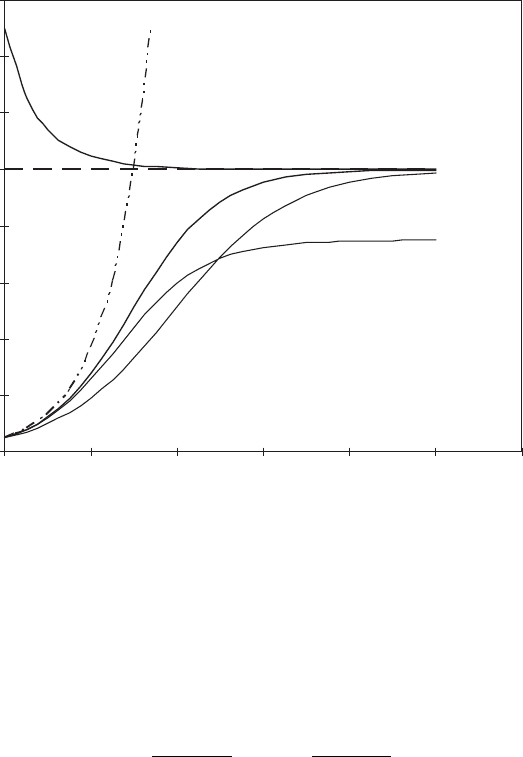
The solution has a sigmoid shape if Nð0Þ < K=2 (Figure 14.15), sometimes referred to
by ecologists as the S-shaped growth curve. This distinguishes the logistic growth curve
from exponential growth, which is called the J-shaped growth curve (Figure 14.15e).
Exponential growth is essentially like logistic growth but with an infinite carrying capa-
city. Curves (b) and (c) show the effect of varying the parameters, and curve (d) shows
what happens if the initial population is greater than the carrying capacity.
Compare the logistic equation with the Monod model for microorganism growth [equa-
tion (11.6), Section 11.7.2]. The Monod model specifically includes the limiting resource
needed for growth (substrate, S). In the Monod model, exponential growth is possible at
any resource level as long as the resource concentration is held constant. Growth limita-
tion will occur only if the disappearance of the reso urce is modeled separately. In the
logistic equatio n, the organisms in a population are assumed to have to compete with
each other for the resources, so as population increases, the growth rate decrease s. The
total amount of resource available to the population is assumed to be held constant.
0
20
40
60
80
100
120
140
160
024681012
t
N
(a)
(b)
(c)
(d)
(e)
Figure 14.15 Logistic equation solution (14.26) with several parameter values, compared to
exponential growth equation (14.18). The dashed line is N ¼ 100. (a) logistic equation with
r
0
¼ 1:0, K ¼ 100, Nð0Þ¼5:0; ( b) logistic equation with r
0
¼ 0:75, K ¼ 100, Nð0Þ¼5:0; (c)
logistic equation with r
0
¼ 1:0, K ¼ 70, Nð0Þ¼5:0; (d) logistic equation with r
0
¼ 1:0, K ¼ 100,
Nð0Þ¼150; (e) exponential equation with r
0
¼ 0:7, Nð0Þ¼5:0.
478
ECOLOGY: THE GLOBAL VIEW OF LIFE
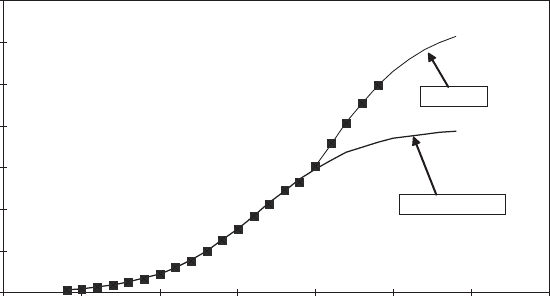
The parameters of the logistic equation may be obtained by fitting the equation to
laboratory or field data. For example, Pearl and Reed, who originally proposed the logis-
tical equation in 1920, fitted it to U.S. population data from 1790 to 1910, when the popu-
lation was about 92 million. They obtained r
0
¼ 0:03134 per year and K ¼ 197; 273; 000.
Thus, they projected a doubling of the U.S. population, followed by a leveling off. Notice
that their prediction held for four more decades (Figure 14.16).
In 1950, however, the population started increasing much faster than predicted. The
model fell victim to a basic problem with any model: The conditions on which it is
based may change, resulting in either different parameter values or an altogether different
model. In this case, the growth rate stopped decreasing as the logistic equation would have
predicted. An updated model fitted to the data from 1950 to 1990 predicts almost the
same r
0
¼ 0:03281 but a much higher K ¼ 324; 796; 000. Thus, the carrying capacity
of the United States seems to have increased, suggesting that the U.S. population will
approach 325 million in the next century if things remain the same. (The population in
2005 is about 296 million.) The increased carrying capacit y may have been due to the
postwar prosperity and exploitation of new resources (raw materials, markets for our
products). This result was a jump in the growth rate of the U.S. population called the
‘‘baby boom.’’
The logistic equation has led to a terminology to describe two basic reproductive stra-
tegies of organisms. An organism is called K-selected if it prospers by making efficient
use of its resources, maximizing its carrying capacity. These organisms are more likely to
be associated with crowded, stable ecosystems. They produce relatively small numbers of
young but may nurture them to ensure their survival. Other organisms, called r-selected,
adopt a strategy of rapid reproduction. These organisms are described as opportunistic.
They can quickly take advantage of stressed conditions. They tend to produce large num-
bers of offspring but have much higher mortality. Weed species often fall into this cate-
gory, as does that urban nuisance, the rat. The r-selected organisms will also have an
advantage in temperate or arctic climates, where the short growing season favors rapidly
growing species.
0
50
100
150
200
250
300
350
1750 1800 1850 1900 1950 2000 2050 2100
Year
Population (millions)
Updated
Pearl & Reed
Figure 14.16 U.S. population data with logistic equation fit by Pearl and Reed, and updated
logistic equation fitted to years 1950–1990.
POPULATIONS AND COMMUNITIES 479

Laboratory experiments with single species populations have revealed behaviors that
cannot be described by the models described above. Some species of Daphnia overshoot
their carrying capacity and then oscillate around it. They are able to store food in the form
of fat deposits, which delays the effects of resource limitations. This behavior can be
described by using models with time-delay elements. For example, the logistic equation
may be modified by using populations taken from \tau time units in the past, Nðt tÞ:
dN
dt
¼ r
0
NðtÞ
K Nðt tÞ
K
ð14:27Þ
Each of the foregoing models is deterministic, meaning that for each set of initial con-
ditions, there is a unique prediction. However, the outcome in reality will be affected by
unknown factors which produce random variation. A model that treats the variables as a
random variable is a stochastic model. Each of the preceding models could be made sto-
chastic by adding an inde pendently and randomly distributed ‘‘error’’ at fixed intervals of
time, before continuing the prediction to the next time step. The prediction of a stochastic
model is not just a single value, but a value that has a probability distribution.
None of these models reflect interactions with other species. Whatever is the source of
food for the organism will certainly be subject to its own population dynamics, in
response to the predation. In the next several sections we address some of these issues.
Competition The final term in equation (14.25) represents the effect of individuals from
a single population competing among themselves. If another organism, species j, is using
the same limi ting resource as the population being modeled, species i, the logistic equa-
tion can be modified to take this into account:
dN
i
dt
¼ r
i
N
i
K
i
N
i
b
ij
N
j
K
i
ð14:28Þ
where N
i
is the population of species i, N
j
the population of species j, and b
ij
the positive
number coefficient of competition. The coefficient of competition expresses how much
the competing population effectively reduces availability of the resource to population i.
A similar equation would be written for species j by switching the subscripts. If more than
two species are interacting, additional terms of the form of b
ik
N
k
would be included. A
differential equation similar to (14.28) must be written for each interacting species, and
the equations solved simultaneously.
A stability analysis of equation (14.28) reveals the conditions under which each species
can survive. For two species we can form the dimensionl ess groups a
12
¼ b
12
ðK
2
=K
1
Þ and
a
21
¼ b
21
ðK
1
=K
2
Þ. If both a
12
< 1 and a
21
< 1, the species can coexist, although at a
lower population than each by itself. If both a
12
1 and a
21
1, only one species can
survive; which one depends on the exact dynamics and the initial conditions. If a
12
1
and a
21
< 1, species 1 will always win out. These dimensionless numbers can be inter-
preted as a measure of the competitiveness of each species. If both numbers are less than
1, competition is weak and the species can coexist. If both are greater than 1, competition
is strong and only one species can survive.
Study of this model has led to the development of the principle of competitive exclu-
sion, which states that species with identical resource requirements cannot coexist. Strong
competition tends to result in the elimination of one species from the ecosystem. Thus,
480 ECOLOGY: THE GLOBAL VIEW OF LIFE

strong competition does not often occur in nature. In cases of apparent strong competition,
it has often been found that the two species may have some significant difference. For
example, five similar species of warblers in New England forests all eat inse cts. However,
they feed at different parts of the forest canopy and in different ways, and they nest at
different times. Strong predation by another species can keep several species sufficiently
far below their carrying capacity that competition does not seriously limit the availability
of the mutual resource. Darwin noticed this when he pointed out that grazing increases the
diversity of plants in meadows. When the predation is limited, a single species tends to
dominate. This is what has happened in many ecosystems affected by human activities.
People have tended to remove top carnivores, such as grizzly bears and wolves in western
North America. This actually had a negative impact on most of their prey, by increasing
the role of competition among them. Thus, conservationists have the goal of reintroducing
many of these predators to increase the diversity of the ecosystems.
The principle of competitive exclusion is linked to the concept of niche. The niche can
be described as the resources and other factors favored by a species. Then the principle of
competitive exclusion is equivalent to the statement made above that no two organisms
can occupy the same niche.
Mutualism and Symbiosis Mutualism and symbiosis are simply the opposite of compe-
tition. Instead of a species reducing the carrying capacity of another species, it increases it.
This can be modeled simply by changing the sign of the interaction term in equation (14.28):
dN
i
dt
¼ r
i
N
i
K
i
N
i
þ b
ij
N
j
K
i
ð14:29Þ
If b
12
b
21
< 1, there is a stable steady-state population for both species, which for each
is greater than their respective carrying capacities. However, the model is not realistic for
b
12
b
21
> 1, in which case the mutual benefit is so great that both populations grow with-
out limit.
Predator–Prey: Lotka–Volterra Equations One of the most interesting types of interac-
tions are those between consumers (predators, parasites, and herbivores) and their hosts.
Lotka and Volterr a derived independently a model which although somewhat simplistic
for modeling real populations, is nevertheless capable of describing some of the important
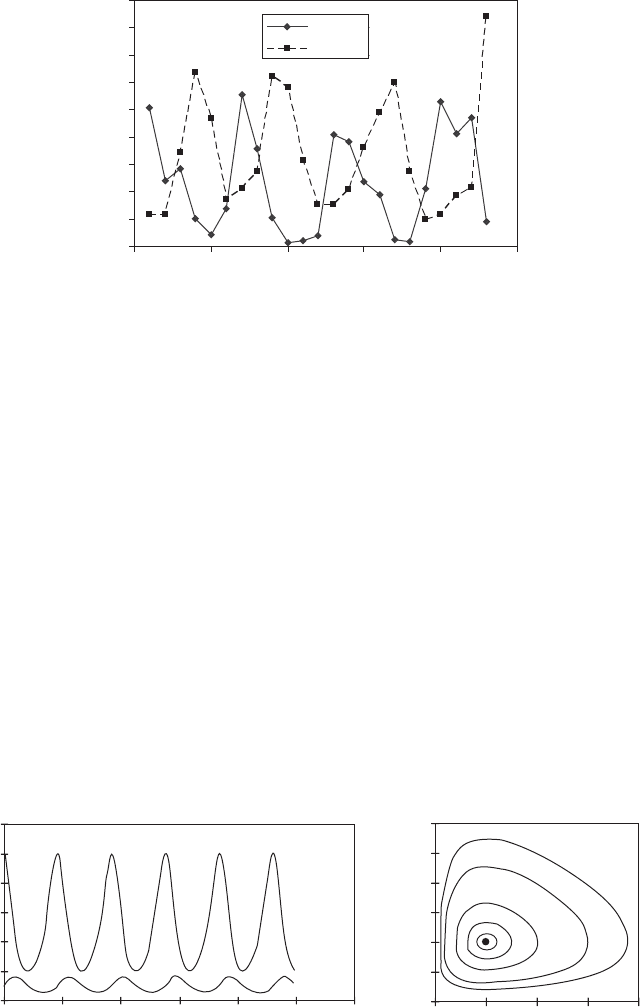
behaviors found in predator–prey relat ionships. One important behavior is cycles in pre-
dator and prey populations (Figure 14.17). Intensive predation can cause a collapse in
prey population. This is followed by a drop in predator population, due to the drop in
food supply. As a result, the prey population can boom, followed by the predator to com-
plete one cycle.
The Lotka–Volterra predator–prey model has the following form:
dH
dt
¼ Hða bPÞ
dP
dt
¼ PðcH dÞ
ð14:30Þ
where H is the host or prey population, P is the predator population, and a, b, c, and d are
coefficients. Multiplying through, the host equation is seen to have two terms: The aH
POPULATIONS AND COMMUNITIES 481
term gives it exponential growth when the predator is absent. The bHP term is a nega-
tive interaction due to predation. The predator equation has a positive interaction corre-
sponding to the negative one for the host. The dP term provides an exponential death
rate without which the popul ation could never decrease. There is no exponential growth
term for the predator, and there is no carrying capacity for either equation.
The Lotka–Volterra model has a stable steady-state or equilibrium solution (other than
H ¼ P ¼ 0) when H ¼ d=c and P ¼ a=b. If values other than these are used as an initial
condition, the solution will be a sta ble oscillation. The plot of host and predator popula-
tions vs. time (Figure 14.18a) shows that predator population peaks just after the host
population. Examination of the phase-plane plot (Figure 14.18 b) suggests that predator
population peaks when the host population is at its greatest rate of decline.
More realistic models have been developed. For example, adding a term of the form
eH
2
to the host equation makes it equivalent to a logistic equation with a negative self-
interaction. Other modifications place an upper limit on the amount of prey that each
predator can consume. Other factors that affect predator–prey dynamics include the
0
100
200
300
400
500
600
700
800
900
0 5 10 15 20 25
Generation
Population
Host
Predator
Figure 14.17 Oscillations in predator–prey populations: the predatory wasp Heterospilus
prosopidis and its host the weevil Callosobruchus chinensis. (Data from Utida, 1957.)
0.0
20.0
40.0
60.0
80.0
100.0
120.0
0 0.1 0.2 0.3 0.4 0.5 0.6
t
Population
P
H
0.0
5.0
10.0
15.0
20.0
25.0
30.0
0.0 50.0 100.0 150.0 200.0
H
P
(a)
(b)
Figure 14.18 Simulation results of the Lotka–Volterra equations: (a) time-domain plot with
Hð0Þ¼100 and Pð0Þ¼10; (b) phase-plane plot (P vs. H) for various initial conditions, and the
equilibrium point.
482
ECOLOGY: THE GLOBAL VIEW OF LIFE

availability of safe refuges, which limits predation when host population drops, and the
presence of alternative food sources for the predator. Some of these factors make multiple
steady-state values possible. This can lead to epidemics, when some environmental dis-
turbance stimulates the system to jump to a different steady-state condition. Also, preda-
tor–prey populations can stabilize by some sort of accommodation to each other, reducing
the amplitude of oscillations.
Empirical Models Another way to model single populations is to use autoregressive
models of the form
NðiÞ¼f
1
Nði 1Þþf
2
Nði 2Þþf
3
Nði 3Þþ ð14:31Þ
in which N(i) represents the population at equispaced time intervals, and Nði kÞ is the
population k time steps earlier (lagged by k). The coefficients can be obtained by multi-
linear regression techniques. Because this method is empirical, the coefficients cannot
necessarily be identified with particular phenomena, such as growth, death, or predation
rates. It is common to perform regressions of the form of equation (14.31) using loga-
rithm-transformed variables instead of raw data. This can make the errors of the regres-
sion more normally distributed, and eliminates the possibility of negative predictions from
the model. In addition, variables other than lagged population, such as the population of
other species, can be used as dependent variables.
Multilinear regression software is capable of determining which coefficients, and
therefore which independent variables, contribute significantly to the predictive ability
of the model. Thus, it is possible to tes t which populations affect the dependent population
and whether that effect is positive or negative.
Notice that the models discussed previously, including the exponential growth model
(14.17), the logistic model (14.25), the competition model (14.28), the mutualism mode l
(14.29), and the Lotka–Volterra predator prey model (14.30), can all be expressed as mul-
tivariable polynomials of the following form by combining terms and coefficients:
dN
1
dt
¼ a
1
N
1
þ a
2
N
2
1
þ a
3
N
1
N
2
ð14:32Þ
Effects of even more species can be modeled by adding appro priate terms to the model,
such as a
4
N
1
N
3
. By examining the signs of the coefficients of a pair of interacting species
and comparing to the signs in Table 14.5, the type of interaction can be determined from
population dynamics. This information can even help analyze the trophic structure of an
ecosystem.
Terms such as a
4
N
1
N
2
N
3
test for three-way interactions. Statistical tests can show
whether such effects are significant. Otherwise, they can be dropped from the model.
As Krebs has sta ted: ‘‘Spec ies interactions are rarely one-on-one in natural communities,
and the untangling of complex sets of species interactions is an important focus in ecology
today.’’
Stochastic Extinction A population that is in equi librium (birth rate ¼ death rate ¼ b)
can nevertheless experience population fluctuations due to random variations. Thus,
there is a finite probability that a population could go extinct just by chance. The
POPULATIONS AND COMMUNITIES 483

probability, p(t), of this occurring in a finite amount of time t can be estimated from b and
from the average population:
pðtÞ¼
bt
1 þ bt
N
ð14:33Þ
For example, for a population with a birth rate of 0.5 per year, which is reasonable for
terrestrial vertebrates, Table 14.8 shows the probabilities for various population sizes
and periods of time. The table shows that the chance of extinction after a fixed period
increases greatly as the size of the population decreases. For example, a population of
100 has a 14% chance of disappearing over the next century, whereas a population of
10 has an 82% chance.
This effect has been observed in nature in island ecosystems. On average the lost spe-
cies are balanced by immigration or by evolution of new species. However, the role of
humans is disturbing this balance. Urban and agricultural development may destroy
only part of an ecosystem. Yet, even if a portion is preserved out of concern for the wild-
life, the chances are increased that the species contained within will be lost. Simply put-
ting a road through a wilderness divides it into two smaller parts. If movement of
organisms of a particular species is inhibited from crossing, the overall chances of survi-
val will have been decreased.
These concepts have led to the idea of mi nimum viable population, which is a level
sufficient to protect a species not only from stochastic extinction but also from calamities
such as fire or extreme weather. Furthermore, protection of a species requires that a spe-
cies have multiple populations for two reasons: First, if one population is wiped out, it
could be reintroduced from another. Second, having multiple centers of population main-
tains genetic diversity, which may be necessary to develop protection against evolving
diseases.
14.4.2 Species Richness and Diversity: Synoptic Structure of Communities
Now we begin to look at communities instead of the individual populations that constitute
them. Why do similar environmental conditions produce similar sets of species? The
interactions between species are what stabilize a community. The more species that are
present, the more interactions there can be. Removing any single organism eliminates its
interactions, affecting those species with which it interacted. But the more overall species
there are, the easier it will be for an affected organism to find a substitute. For example,
TABLE 14.8 Extinction Probability for Birth Rate ¼ 0.5 per Year
Time (yr)
Population 1 10 100 1000
1 0.33 0.83 0.98 0.998
10 10
4
0.16 0.82 0.980
100 10
48
10
7
0.14 0.819
1000 10
99
10
79
10
8
0.135
Source: Ricklefs (1993).
484 ECOLOGY: THE GLOBAL VIEW OF LIFE

suppose that mice are the primary food source for owls in a particular forest, and the mice
are eliminated. If other small mammals, say rabbits, are available, the owls might be able
to substitute them. Therefore, it is thought that species diversity is an indication of com-
munity stability and resistance to disturbance. Th e conce pt of species diversity bringing
stability is used by conservationists to argue for the protection of ecosystems from human
impacts.
There are a numb er of caveats to this idea. Di sturbance, itself, can increase diversity.
Well-developed ecosystems can settle into a lower-diversity state than they had during
their stages of development. Also, it is observed that natural systems do not seem to
have maximized their diversity as measured by the indices described below. This
would require an even distribution of species. Instead, there are always some relatively
rare species and others more dominant. Finally, it is possible that diversity is a conse-
quence of ecosystem stability rather than a cause.
The Number of Species in an Ecosystem The simplest measure of diversity is simply
the number of species, S. It may be difficult to measure this in an ecosystem without
impractically large samples. However, it can be estimated from a limited sample by
assuming a lognormal probability distribution for species abundance. Generally, smaller
geographic areas can be expected to have fewer species. An empirical rule relating S and
area, A,is
S ¼ cA
z
ð14:34Þ
where c is a parameter that varies with type of ecosystem and z is a parameter that has
consistently been found to fall in the range 0.20 to 0.35 for islands. For large continental
areas, the exponent ranges from 0.15 to 0.24, apparently due to the greater ability to
import species. The number of species in ecosystems tends to increase toward the tropics,
as does species diversity.
The equilibrium theory of biogeography, also calle d island biogeography, proposed
by Robert MacArthur and E. O. Wilson, explains the relationship between area and num-
ber of species. They suggested that S is a result of a balance between immigration and
extinction. Smaller areas would support smaller populations and thus would have higher
rates of stochastic extinction [equation (14.33)]. Islands closer to the mainland have
higher immigration rates and thus higher numbers of species. A similar balance occurs
on the mainland itself, except that instead of immigration providing new species, it occurs
by evolution. Of course, this acts more slowly, so the turnover of species is much slower.
Diversity Indices A number of mathematical diversity indices have been developed to
quantify species diversity better, giving more weight to more dominant species. Measure-
ment of diversity may be subject to the sample-size limitation mentioned above. Also,
measurements of diversity are usually limited to a subset of the community, such as a
single taxa (birds, grasses, aquatic invertebrates, etc.) or a single trophic level. Despite
these measurement problems and the caveats mentioned above with regard to their signif-
icance, diversity indices can be useful for making comparisons or for tracking trends.
Several of the mos t popular indexes can be computed from the proportions, p
i
, of each
of the S species. One is the Simpson index, D:
D ¼
1
p
2
i
ð14:35Þ
POPULATIONS AND COMMUNITIES 485

The Shannon–Weaver index, H, is based on information theory. It gives more weight
to rare species than does Simpson’s index. It has the advantage of being normally distrib-
uted, making it possible to use statistical tests of significance to compare different values.
H ¼ðp
i
ln p
i
Þð14:36Þ
Table 14.9 shows examples for several different distributions of five species. Note that for
H it is necessary to ignore zero values in the calculation (you can’t take the log of zero).
The Shannon–Weaver index is often reported as its exponential form, since e
H
is equal
to S when the populations are evenly distributed. Both D and e
H
vary from 1.0 whe n only
one species is represented, to S if the species are evenly distributed. The Shannon–Weaver
index can be used to compute an evenness parameter, Pielou’s index, e. The evenness
index varies from zero for maximally uneven, to 1.0 for p erfectly uniform distribution:
e ¼
H
ln S
ð14:37Þ
Because e depends explicitly on the number of species, its value is affected by including
species with zero population in the count. Potentially, we could add any number of species
which are absent from the ecosystem. Therefore, there would have to be some indepen-
dent criteria for including such species, such as because they were formerly present in that
ecosystem or because they are typically found in similar ecosystems.
A graphical approach that gives more information is to plot the probability distribution
of the species. This plot is called the dominance-diversity curve. It is made by sorting
the species by p
i
, and plotting p
i
vs. rank order. Evenness will be related to the slope of the
curve.
Food web diversity has also been defined as a diversity index computed with abun-
dances classified by trophic level instead of species.
14.4.3 Development and Succession: Temporal Structure of Communities
Previously, we looked at how to describe changes in individual populations. The basic
population growth models often presuppose that environmental conditions, as reflected
in carrying capacity, are constant. Community changes occur in nature as a result of
disturbances that alter individual populations and environmental conditions. The most
TABLE 14.9 Species Diversity Indexes for Hypothetical Communities Having Different
Abundances
Shannon– Pielou’s,
Proportion of Total Population Simpson, D Weaver, H exp H Evenness, e
0.20 0.20 0.20 0.20 0.20 5.00 1.609 5.00 1.000
0.30 0.25 0.20 0.15 0.10 4.44 1.544 4.69 0.960
0.35 0.30 0.20 0.10 0.05 3.77 1.431 4.18 0.889
0.50 0.25 0.15 0.10 0.00 2.90 1.208 3.35 0.751
1.00 0.00 0.00 0.00 0.00 1.00 0.000 1.00 0.000
Source: Based on Ricklefs (1993).
486 ECOLOGY: THE GLOBAL VIEW OF LIFE
commonplace of these are the changes of seasons. More catastrophic changes include
floods, fires, extreme weather, or volcanic eruptions. The time scales of human distur-
bances can range from practically instantaneous (nuclear explosions) to decades or
more (global warming or soil depletion by agriculture). These disturbances affect the
entire ecosystem, which responds as a unit. Although potentially, we could describe
these ecosystem-wide changes using population models for all the individual species,
we can note some holistic patterns.
A new habitat can be caused by a large event, such as a forest fire or clearcutting of a
forest, or by a small local change such as the falling of a tree or a pile of dung left by a
bear. In each case, the new habitat will be colonized by pioneers who are especially good
at invading. These are often the r-selected organisms. Eventually, they will be replaced by
more efficient K-selected species. In between, a variety of species may come and go in
abundance. The process of sequential population changes initiated by a disturbance is
called succession. The actual sequence of commun ities is called a sere. Barring further
disturbances, succession ends when ecosystems develop a stable condition called a
climax. The climax community is ultimately a community that can succe ed itself. A
climax community may form within a season or it make take decades, as in the case of
forests.
As an example, an abandoned farm field may be colonized by grasses, which inhibit
the germi nation of trees. The grasses attract herbivores, which create openings for shrubs
by intense grazing. The shrubs provide shade, which enables pine to germinate and even-
tually to dominate. However, when the cover becomes too dense, the pine seedlings will
not grow, and hardwood trees gain an advantage. Eventually, a climax community is
formed as a hardwood forest. Populations of birds and other animals change as the
food supply changes.
Another example is algal succession in temperate-zone lakes. As the water warms in
the spring, the first species that dominate may be the cyanobacter. Some cyanobacter fix
nitrogen and so are limited only by phosphorus. Eventually, they deplete the available
phosphorus, removing it from the water column as they die and settle to the bottom.
Other algae, such as diatoms, may flourish. But these require silicon for their shells,
and when that is depleted, they may make way for green algae.
There are several forces driving succession. A community may change its environ-
ment, making it more suitable for others that succeed it as the shrubs made way for the
pines. Succeeding communities are oft en those that tolerate a lower level of resources, as
the diatoms that followed the cyanobacter. Sometimes the succeeding community must
overcome inhibition by the previous residents, as the shrubs were inhibited by the grasses.
Newly exposed soils may experience a gradual drop in pH from the accumulating pro-
ducts of plant decay.
Overall, succession seems to be related to a balance of colonizing ability of some spe-
cies vs. the competitive ability of others. A particular sequence may not be uniquely deter-
mined by environmental conditions. One could wind up with one of several communities,
depending on contingent factors during succession. However, chance factors seem to
operate most strongly in earlier stages of succession.
Odum (1987) has listed a number of trends identified with succession in the absence of
further disturbances (Table 14.10). Gross primary productivity tends to form a peak dur-
ing succession and then declines as a community approaches the climax. Succession
occurs in a biological wastewater treatment plant whenever conditions are changed.
Plant startup is a prime example of this. Primary productivity is negligible in this system,
POPULATIONS AND COMMUNITIES 487