
Vaccari D.A., Strom P.F., Alleman J.E. Environmental Biology for Engineers and Scientists
Подождите немного. Документ загружается.

spruce, fir, and pine. Dense shade inhibits other plants, but the trees support small seed-
eating animals. Larger animals are less common, as they require broadleafed plants for
food. A form of coniferous forest called the temperate rain forest exists in humid coastal
regions of North America from northern California to Alaska. The tree needles degrade
slowly, building into a thick detritus mat on the forest floor.
The temperate deciduous forest occupies milder climate zones with ample rainfall.
The canopy cover is less impenetrable, and smaller trees and shrubs (the understory) can
grow. A large number of subdivisions exist, based on the type of domin ant hardwoods
that are present. Nuts, berries, and broadleaf plants support a well-developed food
pyramid. The rate at which litter falls to the forest floor increases toward the equator,
up to 1100 g/m
2
per year.
Where rainfall is insufficient to support the deciduous forest, a grassland will be found
instead. A variety of types occur, depending on rainfall, as this type of ecosystem grades
into desert. Moister regions support tall grasses and sod-forming grasses. More arid areas
are characterized by short bunchgrasses. Grasses produce a large amount of litter and
therefore organically rich soil. Most of the biomass is below ground. Large grazing
animals are typically present, such as bison, gazelles, and kangaroos.
Grassland ecosystems are often maintained by fire, without which they would be suc-
ceeded by shrubland or forest. Forest can give way to grassland if fire follows an extended
drought. Once the grasses are established in the resulting opening, fires become more
frequent, due to the rapid production of leaf litter. This makes it difficult for trees to
reestablish themselves.
Fire occurs naturally and can be a force in preserving an ecosystem. Even in forests,
periodic fires confined to the understory (surface fires) eliminate deadwood, which other-
wise could fuel a much more devastating crown fire. A crown fire destroys the mature
trees as well as seeds and organic matter in the soil. A surface fire can release nutrients
and stimulate germination of tree seeds. Pines tend to be more resistant to fire than
hardwoods. Some mature coastal pine forests are called a fire climax ecosystem.
Woodlands tend to give way to shrublands under maritime influence. The chaparral is
a shrubland that dominates in warm areas that have plenty of moisture in winter but are
very dry in summer.
The desert includes regions with less than about 25 cm (10 in.) of rain per year,
depending on the temperature. Primary productivity is proportional to rainfall, the limit-
ing factor for this ecosystem. The dominant plants are either rapi d-growing annuals, cacti,
or specially adapted desert shrubs. The creosote bush dominates the hot deserts of south-
eastern North America. This plant exhibits allelopathy, in which it inhibits nearby com-
petition chemically. In cooler northwestern deserts, sagebrush dominates. Desert animals
are specially adapted to conserve water. Lizards are suited to the desert because they
excrete dry uric acid instead of urea with water as mammals do. Nevertheless, some
small rodents survive by excreting a very concentrated urine and by nocturnal life-styles.
Irrigation of deserts can make them productive for agriculture. However, since the eva-
poration rate will be high, salts can slowly accumulate in the soil unless extra water is
provided to remove the sal ts by runoff and infiltration. (In the Central Valley of California,
selenium from irrigation and natural groundwater sources is accumulating in the soil. It is
thought that the productive life of this important agricultural region may be limited to a
matter of decades by this problem.)
Seasonal tropical forests occur in places such as south Asia, which has monsoon rains
and a pronounced dry season, during which the trees lose their leaves. Tropical rain
498 ECOSYSTEMS AND APPLICATIONS
forests occur where there is more than 200 cm of rain per year, distributed thr oughout the
year. They are typically found at low elevations near the equator. They tend to be very rich
in both plant and animal species. Some tracts of a few acres can have more species of trees
than are found in all of Europe. A 6-square mile area of Panama was found to have at least
20,000 species of insects, compared to several hundred in all of France. Ants, termites,
moths, and butterflies are important. A larger proportion of both plants and animals
live in the upper layers of the forest, compared to temperate forests. In one forest, 50%
of the mammals live in the trees. Plants that grow supported by other plants, with no roots
reaching the ground, are called epiphytes. Many animals have formed symbiotic relation-
ships with epiphytes. An important feature of tropical rain forests is the rapid cycling of
nutrients within the ecosystem. Litter is decomposed rapidly, and the nutrients soon reab-
sorbed by the plants. Therefore, most of the nutrients are stored in the biomass, and the
soil remains poor in nutrients. The rich growth of the rain forests made the early settlers
think the soil must be rich. Many attempts at agriculture failed for a lack of this und er-
standing.
15.1.1 Forest Nutrient Cycles
Besides participating in global biogeochemical cycles, ecosystems cycle nutrients
internally. When the ecosystem is harvested, such as in logging, the nutrients must be
replaced if the productivity of the ecosystem is to be sustained. For example, a forest
ecosystem receives nutrient input from the atmosphere and from weathering of the
bedrock. Atmospheric input includes nitrogen that is fixed by nitrification as well as
nitrogen oxides from natural and human-made sources, and from dust and aerosols.
Forests export nutrients to the atmosphere and by streamflow. Stre ams leach mineral
nutrients and carry away biomass that has fallen in. Microbes in anaerobic environments
such as bog sediments eliminate nitrogen by denitrification and sulfur by reduction to
H
2
S. Trees also emit ammonia, H
2
S, and organic compounds such as terpenes. The
organic emission is famous for causing the haze in the Great Smokey Mountains of the
southeastern United States and for giving President Ronald Reagan a reason to discount
anthropogenic pollution, saying that ‘‘trees poll ute.’’ (Actually, it is true that plants may
emit more hydrocarbons to the environment than comes from human activities. Aspen and
oak leaves emit as much as 2% of the carbon produced by photosynthesis as isoprenes.
The isoprenes may play a role in protecting photosynthetic membranes. However, photo-
chemical smog found in urban air is caused not only by hydrocarbon emissions, but by
nitrogen oxides produced together with them.)
The fluxes of nutrients within the forest are usually much greater than the external
flows. These fluxes amount to an internal recycling. Nutrients taken up by trees are
returned to the soil by leaf fall. Biodegradation by saprophytes releases the nutrients,
whereupon they are again absorbed by the roots. The nutrient cycles operate faster in
warmer climates, as biomas s in the litter decays more rapidly. Plants develop thick root
systems close to the surface to intercept nutrients before they leach away. As a result,
more than half of the organic carbon in temperate forests is in the soil and litter; whereas
in tropical rain forests the figure is 10 to 25%. Thus, tropical soils tend to be very poor in
nutrients. As a result, harvesting the trees to convert a tropical forest to farmland often
leaves the soil depleted of nutrients. Thus, ironically, these highly productive lands
become unproductive in their new use. Temperate forest lands, on the other hand,
make productive farmland.
TERRESTRIAL ECOSYSTEMS 499

When leaves and other detritus falls to the forest floor, nutrients are removed by leach-
ing of soluble components, consumption by soil invertebrates, and mineralization by bac-
teria and fungi. Rate of degradation depends largely on the lignin content of the litter. For
example, the highly digestible mulberry was found to lose 64% of its weight in a year on
the ground in eastern Tennessee. Oak degraded by 39%, beech only 21%. Pines and
conifers also degraded slowly. Lignins break down much more slowly than cellulo se or
hemicellulose, the other components of wood. Few bacteria can do the job. Most lignin
decomposition is done by the white rot fungi, Phanerochaete chrysosporium.
Nutrient relationships have been studied using large-scale long-term experiments. One
of the best known is the Hubbard Brook Experimental Forest. Stream and rainfall flow and
composition were measured for a number of watersheds there (Table 15.2). A net loss of
calcium, magnesium, potassium, sodium, aluminum, sulfate, silica, and bicarbonate are
presumably balanced by inputs from weathering of bedrock. Amm onium, nitrate, and
chloride showed greater inputs than outputs. The nitrogen species may also be lost by
transformation.
About 60% of the rainfall that falls on undistur bed Hubbard Brook watersheds even-
tually leaves via the streams. The area is underlain by a tight bedrock formation, so losses
to groundwater are negligible. Thus, most of the loss is by evaporation and transpiration.
If a watershed is logged, streamflow increases drastically. Nitrate concentration in the
streams also increases greatly, since nitrification proceeds normally in the soil, but uptake
by trees is eliminated. As with anions in general, nitrate is weakly bound to soil and so is
rapidly leached out in runoff.
15.1.2 Soil Ecology
Engineers are trained to think of soil just as a structural material. In fact, one of the first
acts of developing a property is removal of the topsoil, the part mos t associated with the
biosphere. The biomass in it makes it unstable and unpredictable from a structural point of
view. To the biologist the soil is a living material, intimately connected with living things,
and both created by and sustaining them.
TABLE 15.2 Annual Mineral Balances for Several Watersheds of the Hubbard Brook
Experimental Forest, 1963–1969
Input by Rain Output in Stream Stream Conc.
Mineral (kg/ha) (kg/ha) Net (kg/ha) (mg/L)
Calcium 2.6 11.8 9.2 1.58
Magnesium 0.7 2.9 2.2 0.39
Potassium 1.1 1.7 0.6 0.23
Sodium 1.5 6.9 5.4 0.92
Aluminum Very small 1.8 1.8 0.24
Ammonium 2.7 0.4 þ2.3 0.05
Nitrate 16.3 8.7 þ7.6 1.14
Sulfate 38.3 48.6 10.3 6.40
Dissolved silica Very small 35.1 35.1 4.61
Bicarbonate Very small 14.6 14.6 1.90
Chloride 5.2 4.9 þ0.3 0.64
Source: Krebs (1994).
500 ECOSYSTEMS AND APPLICATIONS
Soil is the part of terrestrial ecosystems with the slowest turnover time (Table 15.3).
This makes it the part that regenerates slowest if disturbed. A forest fire can kill all above-
ground life in an area, but if the soil is not deeply burned, the forest can soon grow back.
But if erosion carries away the topsoil with its organic matter and nutrients, the area may
remain desolate for a long time. Thus, one of the most important goals for conservation-
ists should be preservation of an ecosystem’s soil.
The mineral portion of soil is produced by weathering of bedrock, either locally or at a
distant location followed by transport by wind or water. Weathering is caused by physical,
chemical, and biological factors. Physical weathering is caused mainly by the expansion
of water when it freezes in cracks. Chemical weathering is caused by water dissolving
the more or less soluble components, and by acids from atmospheric carbon dioxide
(which forms carbonic acid in water) or from acid rain. Biological weathering contri-
butes to chemical weathering by adding more CO
2
plus organic acids to the water.
Roots can help break up rocks by penetrating and forcing open cracks. Lichens produce
acids that dissolve rocks.
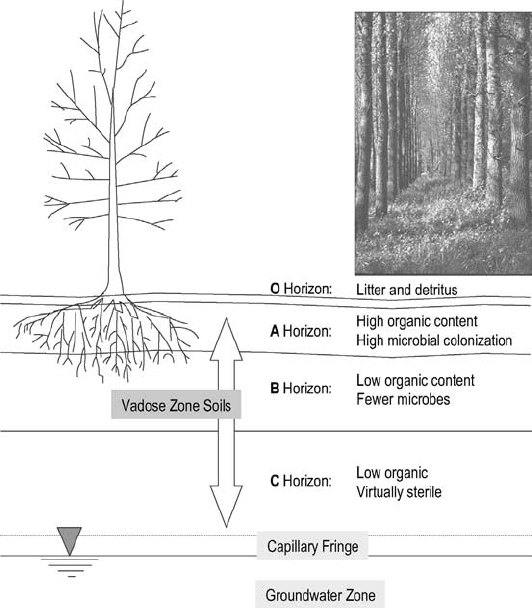
A well-developed soil is divided into three main layers, or horizons (Figure 15.2). The
A horizon, often called the topsoil, is the uppermost portion of the soil. The A horizon is
rich in organic matter from decayed plants and animals. It is the site of most of the bio-
logical activity in the soil. Below this is the B horizon, which is lower in organic content
and contains soil part icles that are less weathered than the A horizon. The B horizon is a
zone in which minerals, clay particles, and to a lesser extent organic matter are deposited
after leaching from the A horizon. Next comes the C horizon, which is made up of par-
tially broken-down and weathered rocks from which the soil of the upper layers is formed.
Below this is the bedrock. Some classifications include the layer of decaying plant and
animal matter above the A horizon, called the O horizon, which has little mineral matter.
The portion of the soil that is subject to the influence of plan t roots is called the rhizo-
sphere or root zone.
When rocks weather, less soluble components such as silicates remain as solid parti-
cles. Particles larger than 20 mm are classified as sand; between 2 and 20 mm as silt, and
particles smaller than 2 mm as clay. Soil with a preponderance of larger particles drain
well, holding less moisture and nutrients. Clay particles tend to retain both. Mineral sur-
faces tend to have a net negative charge that enables them to adsorb cationic nutrient ions
such as Ca
2þ
,Mg
2þ
,K
þ
,Na
þ
,NH
þ
4
, and H
þ
. Anionic nutrients such as NO
3
,SO
2
4
,
Cl
, and HCO
3
are not strongly adsorbed and leach more easily from soil. PO
3
4
is an
exception since it forms very low solubility precipitates and adsorbs to mineral surfaces
containing iron, aluminum, or calcium.
TABLE 15.3 Average Turnover Time (years) for Organic Matter (OM) and Nutrients
in Forest Soil
Region OM N K Ca Mg P
Boreal coniferous 353 230.0 94.0 149.0 455.0 324.0
Boreal deciduous 26 27.1 10.0 13.8 14.2 15.2
Temperate coniferous 17 17.9 2.2 5.9 12.9 15.3
Temperate deciduous 4 5.5 1.3 3.0 3.4 5.8
Mediterranean 3 3.6 0.2 3.8 2.2 0.9
Source: Krebs (1994); original source Cole and Rapp, 1981, in Dynamic Properties of Forest Ecosystems,D.E.
Reichle (Ed). Cambridge University Press, Cambridge.
TERRESTRIAL ECOSYSTEMS
501
The capacity of soil to adsorb cations is called its cation-exchange capacity (CEC).
The CEC describes the soil’s capacity to serve as a reservoir for nutrients for plants.
Because clay particles have a large surface area per unit mass, they have a relatively
high CEC. For example, the CEC of kaolinite clay ranges from 3 to 15 milliequivalents
(mEq) per 100 g. Montmorillonite clay, which has about an order-of-magnitude smaller
particle size than kaolinite, has a CEC of 80 to 100 mEq per 100 g. The CEC of a whole
soil will be strongly affected by its clay content as well as by organic matter (see below).
The relative strength of attraction of cations to clay particles is
H
þ
> Ca
2þ
> Mg
2þ
> K
þ
> Na
þ
Thus, acidic conditions displace the other ions from the soil, allowing them to be leached.
A low pH can also cause charge reversal on clay particles, enabling adsorption of anionic
nutrients. In a process called podsolization, acidity breaks down the clay particles in the
A horizon, precipitating their soluble salts in the B horizon. This reduces the CEC of the
soil and therefore its capacity to hold nutrients. Podsolization commonly occurs in con-
iferous forests in cold regions, where the heavy fall of needles produce organic acids as
they decay. This type of soil is called spodisol.
In low-lying tropical regions such as the Amazon basin, warm, moist conditions result
in faster weathering than erosion. As a result, soil accumulates to great depths. Since the
Figure 15.2 Soil horizons.
502
ECOSYSTEMS AND APPLICATI ONS
soil at the surface is so far from the parent mineral, the clay is leached out, leaving iron
and aluminum oxides. These minerals do not retain nutrients as well as clay and can con-
solidate into a hard, concretelike material. This is called laterite soil,orlatisol.
Soils with about 20% clay and 40% each of sand and silt are called loam. Increasing
the fraction of one or the other component produces soils classified as ‘‘sandy loam,’’
‘‘clay loam,’’ ‘‘silty clay loam,’’ and so on. Soil with a clay content above 40 to 60%
has a low permeability to water, which makes it a poor substrate for plants. A very
sandy soil does not retain water well and has too low a CEC to store significant quantities
of nutrients.
Thirty to fifty percent of soil volume is occupied by pore space. This fraction is cal led
the porosity. If soil that is initially saturated with water is allowed to drain freely by grav-
ity, a point is reached when the weight of the water is balanced by capillary forces holding
the water in the pores. This point is called the field capacity. The moisture content can
drop further by the action of air drying or by absorption by plant roots. The water content
can be described in terms of the soil water potential or suction pressure, which
expresses the pressure needed to extract the moisture from the soil. Free pure water
has a soil water potential of zero.
The maximum pull most plants can exert on soil water is 1.5 MPa (abou t 15 atm).
If the soil water potential falls below that level, it is considered to be below the perma-
nent wilting point for that soil, and plants in that soil will be irreversibly wilted. A typical
loam containing a fairly even distribution of sand, silt, and clay has a saturation of about
45 g of water per 100 g of dry soil. This corresponds to a porosity of 25%. Its field capa-
city is about 32 g per 100 g dry weight (d.w.; about 16% by volume), and the wilting point
is about 7 g per 100 g d.w. (about 3% by volume). Thus, the amount of usable water in soil
at the field capacity is about 25 g per 100 g d.w. (9% by volume). Soils with higher clay
content have more of their water bound at the 1.5 MPa water potential, and therefore
have a higher wilting point.
The bedrock is the ultimate source of most of the minerals for the ecosystem. Carbon
and nitrogen, of course, come mostly from the atmosphere, and mineral input from the
atmosphere, from dust, can also be significant. The bedrock provides the macronutrients
phosphorus, potassium, calcium, magnesium, and sulfur, p lus the micronutrients boron,
copper, chlorine, iron, manganese, molybdenum, and zinc. The importance of bedrock
is dramatized by the example of serpentine soils, which overlie serpentine rock, a mag-
nesium iron silicate. These soils are deficient in calcium, nitrogen, phosphorus, and
molybdenum, and high in magnesium, nickel, and chromium. Serpentine soils have
poor plant coverage. What plants exist are characterized by specially adapted vegetation
that tolerates these conditions. These plants cannot compete in normal soils, and normal
plants cannot survive serpentine conditions.
Living things affect soil properties in other ways besides causing biological weather-
ing. Living things in the soil mix and burrow, changing its structure, and living things
contribute organic matter. Soil organic matter consists of plants and animals and the pro-
ducts of their degradation. Most of it is from plant material such as leaf litter in various
states of decay. The conversion of dead biomass to soil organic matter is called humifica-
tion. Biological materials that are degraded to the point of being unrecognizable are
called humic substances (or humus). They represent about 5 to 10% of the dry weight
of topsoil.
Humic substances are divided into three groups, based on whether they are soluble
in acids, bases, or neither. The groups are called fulvic acid, humic acid, and humins.
TERRESTRIAL ECOSYSTEMS 503
Fulvic acid is the fraction that is soluble in strong acid and base solutions; humic acid is
soluble in acids but insoluble in bases; humins are insoluble in both. None of these have a
definite chemical structure. They are dominated by randomly polymerized phenolic rings
with a variety of side groups, many of them acidic, and by numerous cross-links. Molar
masses range from about 700 to 400,000, with fulvic acids tending to be the smallest
molecules and humins the largest. Their structure makes them resistant to further bio-
degradation. The presence of large numbers of acidic groups, such as hydroxyl and
carboxylate, makes humic substances a substantial component of the CEC of soil.
Humification occurs in several stages. First, organic polymers such as cellulose, hemi-
cellulose, and lignin are broken down to monomers such as phenols, quinones, amino
acids, and sugars. In the second stage of biodegradation, the monomers polymerize due
to spontaneous reactions and due to enzyme catalysis, producing the humic substances.
Following humification, the process of mineralization slowly converts humic substances
to inorganic materials. In natural ecosystems the formation of humic substances tends to
be in equilibrium with their mineralization.
Humification is caused mainly by saprotrophic bacteria and fungi. Sugars, fats, and
proteins are decomposed fairly readily. Cellulose breaks down more slowly, and lignin
even more slowly. Lignin may be the source of the phenolic rings that form the major
building block of humic substances. As was mentioned previously, the fungus P. chrysos-
porium plays a major role in lignin degradation. The saprotrophic microbes are also
important for the organic compounds they release to the soil environment. These include
inhibitory compounds such as antibiotics, and stimulating compounds such as vitamins
and essential amino acids.
In some ecosystems, organic matter accumulates to high levels. Grasslands produce
large amounts of biomass. Humification proceeds rapidly, but mineralization is slow.
Forests, on the other hand, recycle nutrients more efficiently. Thus, grasslands typically
have five to 10 times as much soil organic matter as forests. This makes them particularly
suitable for conversion to agriculture. Oxygen limitations in wetlands may slow both
humification and mineralization. Biomass can accumulate to great depths in wetlands,
forming peat. Coal is formed when peat is buried under heat and pressure over geologic
time.
Experiments have shown that invertebrates play a major role in humification. Important
groups include protozoans, nematodes, ostracods, snails and slugs, and earthworms. They
act not primarily by digesting the biomass, but more by breaking up the biomass into
smaller pieces, increasing its surface area, and by grazing the bacteria and fungi, which
increases their activity. This is similar to the role of invertebrates found in biological
wastewater treatment processes.
Humic substances are a major source of CEC in soil and increase its water-holding
capacity as well as its nutrient capacity. Humic substances form chemical complexes,
called chelation, with metal ions. This increases the bioavailability of the metals. Metals
may be less toxic when chelated. For example, copper toxicity to phytoplankton depends
on the free copper ion concentration. In marine environments the same copper concentra-
tion will be less toxic close to shore, where humic substances are more available, then in
the open ocean. Soil organic matter also improves the soil structure, especially its
friability. Friability is the ability of a soil to crumble. This property makes it easier for
roots to penetrate. The increased CEC and friability are the primary reasons that we add
composted manure to gardens and agricultural fields, not because of the nutrients they
carry.
504 ECOSYSTEMS AND APPLICATIONS
Agriculture removes organics by harvesting. This removes nutrients and reduces the
generation of humic substances. Tilling increases erosion, removing existing topsoil. Add-
ing fertilizers compensates for nutrient loss, but not for soil structure. A new development
is no-till farming, in which weeds are controlled by the use of chemical herbicides
instead of plowing. Crop residues and winter cover are left on the field as a mulch,
which controls soil temperature and evaporation of moisture. The residue s add to the
production of humus and reduce erosion.
Agriculture, deforestation, and overgrazing all expose bare soil and increase the rate of
erosion. Some estimate that as much as 1% of Earth’s topsoil is lost each year. By one
estimate, 25% of all farmland in the United States is losing topsoil at a rate exceeding a
‘‘tolerable’’ 1 in. every 34 years.
Humic and fulvic acids lower the pH of the soil. Another organic acid produced by
degradation of biomass is oxalic acid, (COOH)
2
. Oxalic acid can form complexes with
otherwise insoluble iron and aluminum. The complex then leaches to lower soil horizons,
where the metals are precipitated upon oxidation of the oxalic acid to CO
2
. Oxalic acid
also catalyzes the chemical weathering of rocks. Oxidation of sulfide minerals such as
iron pyrite produces sulfuric acid. Soil pH was once thought to be a major factor control-
ling plant distribution. However, now it is known that although some plants have narrow
pH tolerances, many are not strict. Even in some of those with strict limitations, it may be
due to the effect of pH on nutrient availability rather than the effect of pH on the plant
directly.
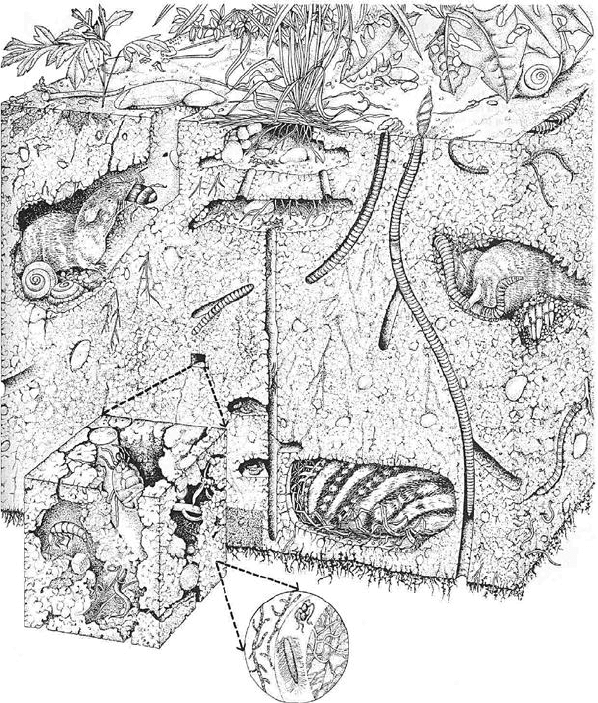
Animals are an important com ponent of the soil community (Figure 15.3). Nematodes,
annelids, and insects form the base of the detritus food web, along with fungi and bacteria.
They aid in humification by digesting and reducing the size of biomass particles. Nema-
todes, or roundworms, are microscopic worms that are very abundant in soil. Up to 3 bil-
lion can be found 1 m
3
of soil. Ants and earthworms are important for their role in
aeration of the soil, which they do by their burrowing activity. Mammals such as moles
and shrews also form large burrows.
Earthworms are particularly important to the soil. Besides their function of aerating the
soil by burrowing, they process the soil through their gut. Finally, they mix or till the soil
by ingesting soil at depth, then discharging it at the surface when they come out at night.
The discharged material can often be seen as twisted strands of soil, called castings, on
the surface. Darwin spent a significant amount of time studying the role of earthworms in
the years after he published The Origin of Species. He found that rocks in a field gradually
became buried as soil was moved from underneath to atop.
Soil typically has 10
6
to 10
9
bacteria per gram. Most are associated with the decaying
biomass in the O and A horizons. In the A horizon, more are associated with roots of
plants than in free soil. Bacteria and fungi that perform the initial degradation of biomass
include Pseudomonas, Bacill us, Penicillium, Aspergillus, and Mucor. About 10 to 33%
of the bacteria are Actinomycetes, especially the genera Streptomyces and Nocardia.
Azotobacter and some of the anaerobic Clostridium speci es can fix atmospheric nitrogen
in free soil.
Chemolithotrophs include the nitrifiers Nitrospira, Nitrosomonas, Nitrobacter, and the
Thiobacillus, the last of which oxidizes inorganic sulfur and ferrous iron. In agriculture,
nitrification can increase leaching of nitrogen. Addition of nitrification inhibitors
increases crop yield 10 to 15% and reduces groundwater pollution by nitrate.
Most kinds of fungi can be found in soil, usually in the top 10 cm, where they may
constitute a major fraction of the soil biomass. Protozoans also occupy the upper layers;
TERRESTRIAL ECOSYSTEMS 505
populations are typically from 10
4
to 10
5
per gram of soil. They function as predators on
bacteria and algae. Algae exist mostly on the surface, but they also have been found to
exist heterotrophically at depths up to 1 m. Mycorrhyzal fungi are an important group, as
has been discussed (see Section 10.7.4).
15.2 FRESHWATER ECOSYSTEMS
The three basic types of freshwater ecosystems are:
Lentic Slow-moving water, including pools, ponds, and lakes
Lotic Rapidly-moving water, such as rivers and streams
Wetlands Areas the soil is saturated or inundated at least part of the time
Wetlands are considered separately in Section 15.3, where we also consider salt
marshes. The science of inland waters is called limnology. The specialized science of
Figure 15.3 Soil community. (From Raven et al., 1992.)
506
ECOSYSTEMS AND APPLICATI ONS
rivers and streams is called potomology (which has the same root as hippopotomus, which
in turn means ‘‘river horse.’’) Limnology and potomology include the physics and chem-
istry of the respective systems. Here, of course, we emphasize the biology.
15.2.1 Aquatic Environments
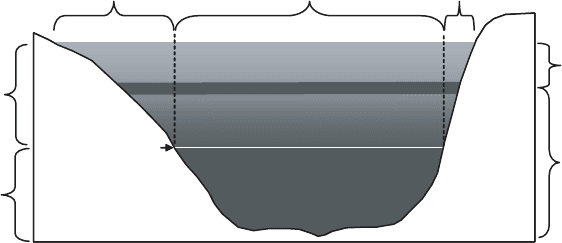
The lacustrine (lake) environment can be divided into categories by total depth and by the
depth within the water column, by light availability, and by habitats. The shallow envir-
onment along the shore where rooted aquatic plants (including completely submerged
plants) can grow is called the littoral zone. Deeper water is called the limnetic or pelagic
zone. The upper layer reached by sunlight and therefore dominated by phytoplankton is
called the photic zone. Below the photic zone, where light is attenuated to less than 1%, is
the profundal zone. This is dominated by heterotrophic organisms subsisting on food that
falls from above.
Deep waters may also be physically divided by thermal stratification in the winter and
summer (Figure 15.4). Because water has a maximum density at 4
C, colder water in the
winter and warmer water in the summer form a distinct layer that floats. The upper layer is
called the epilimnion, the lower layer is the hypolimnion. Each of these layers is fairly
uniform and, especially in the epilimnion, well mixed. These layers are separated by
an area of rapid temperature and density change called the thermocline. The density
gradient is very stable and prevents mixing between the two layers. The thermocline
protects the profundal zone from the impacts of pollution. The littoral zone, on the other
hand, is more susceptible because of its proximity to sources of pollution. The stratifica-
tion shown in Figure 15.4 is typical of sufficiently deep lakes in summer in the temperate
zone. Stratification varies significantly with season and local climate.
The basic characteristic of riverine (river or stream) environments is the velocity of
flow. Riffles are relatively fast, shallow, and turbulent, whereas pools are laminar in
flow, approaching lakes in their charact eristics. Rivers generally lack the stratification
found in lakes. Flow greatly affects dispersal of organisms and import and export of nutri-
ents. Systems (whether rivers or lakes) that depend on their own productivity are called
autochthonous. Those that depend on imported energy or nutrients are allochthonous.
Lakes tend to be autochthonous. Rivers are more likely to be allochthonous, obtaining
their organic matter from terrestrial sources such as leaf litter and other detritus in runoff.
Compensation
depth
Thermocline
Profundal zone Photic zone
Epilimnion
Hypolimnion
Pelagic zoneLittoral zone
Figure 15.4 Lake zones classified by depth, light, and stratification. (Based on Horne and
Goldman, 1994.)
FRESHWATER ECOSYSTEMS 507