
Vaccari D.A., Strom P.F., Alleman J.E. Environmental Biology for Engineers and Scientists
Подождите немного. Документ загружается.


Certainly, one of the most frequent problems with suspended-growth systems is exces-
sive filament presence, which leads to a condition referred to as bulking. Healthy, well-
structured floc usually contains a nominal-to-moderate level of filament presence
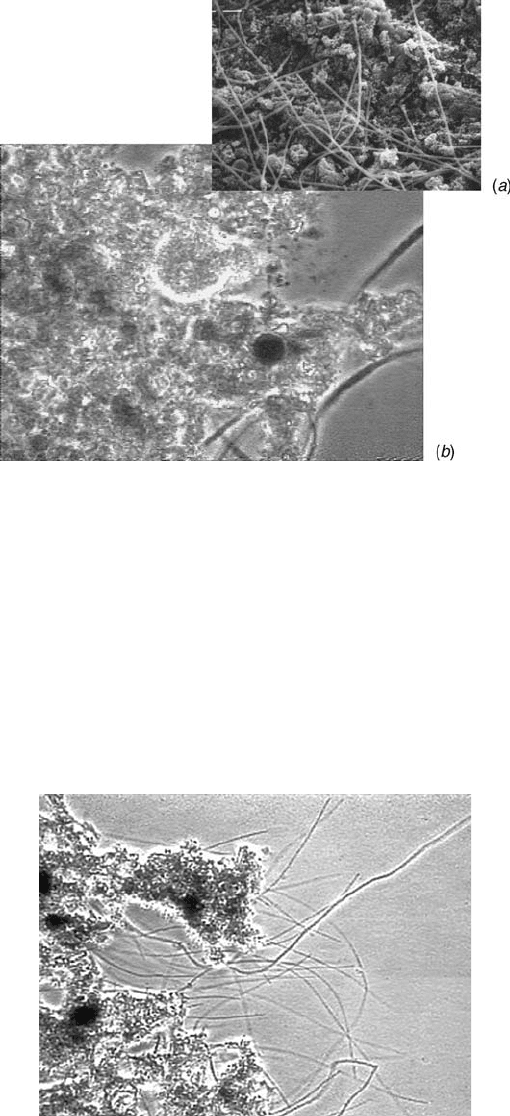
(Figures 16.25 and 16.26). In fact, it has been proposed that filaments may serve as a
‘‘backbone,’’ giving strength to floc and allowing them to grow larger. Recent advance-
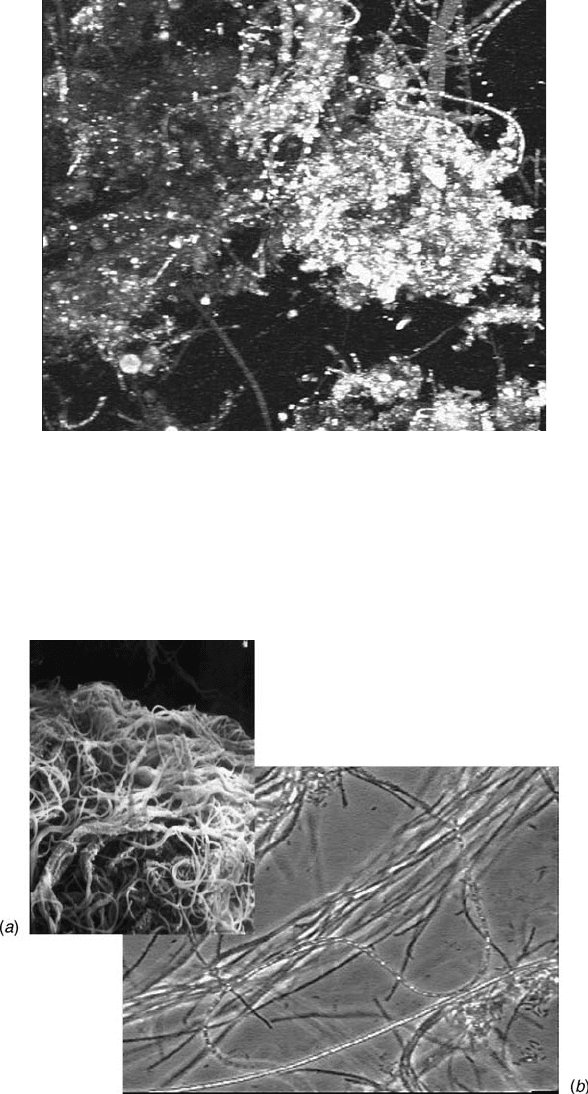
ments with confocal microscopy have helped to confirm this backbone role with the fila-
ments found in floc partic les. The image shown in Figure 16.27 was clipped from an
animated video sequence whose sequential frames depict the progressive rotation of a
floc particle with a loosely arrayed, and highly nonhomogeneous, structure bearing
several backbone-type filament threads. However, these filamentous forms are sometimes
present in excessive amounts, extending out from the floc into the bulk solution, thereby
leading to bulking behavior. Under these conditions the filaments can impede sedimenta-
tion in the secondary settling tank by two mechanisms. First, they act as a sort of para-
chute, increasing viscous drag and reducing the settling velocity of the flocs. Second, the
filaments act to fend the flocs off from each other, preventing them from compacting
TABLE 16.5 Suspended-Growth Floc Problems and Possible Contributing Factors
Type of Floc Problem Operational Difficulties Possible Contributing Factors
Bulking floc Poor thickening, resulting in
secondary settler overloading
Low dissolved oxygen concentration
Low F/M loading
Insufficient soluble BOD
Nutrient deficiency
Low pH
Completely mix reactor mode
Septic wastewater
High wastewater sulfide
concentration
Zoogleal floc Branched, fingerlike floc filaments High F/M loading
Low SRT
Jelly floc Excessive floc exocellular slime Nutrient deficiency
Dispersed floc Floc destabilization and
breakdown
Hazy, cloudy effluent
High influent salt concentration
High influent surfactant
concentration
Extreme high or low SRT
Pin floc Elevated effluent suspended
solids
High SRT
Rising sludge Floc flotation vs. settling Denitrifying sludge blanket and gas
release
Anaerobic sludge blanket and gas
release
Foaming Stabilization of bubbles
Floc solids bubble entrapment
High influent surfactant
concentration
Hydrophobic cell surfaces
Possible oil and grease recycle in
skimmings
608
BIOLOGICAL APPLICATIONS FOR ENVIRONMENTAL CONTROL
toward the bottom of the tank, such that the sludge then takes on a ‘‘bulky’’ condition,
with SVI values in excess of 150 mL/g.
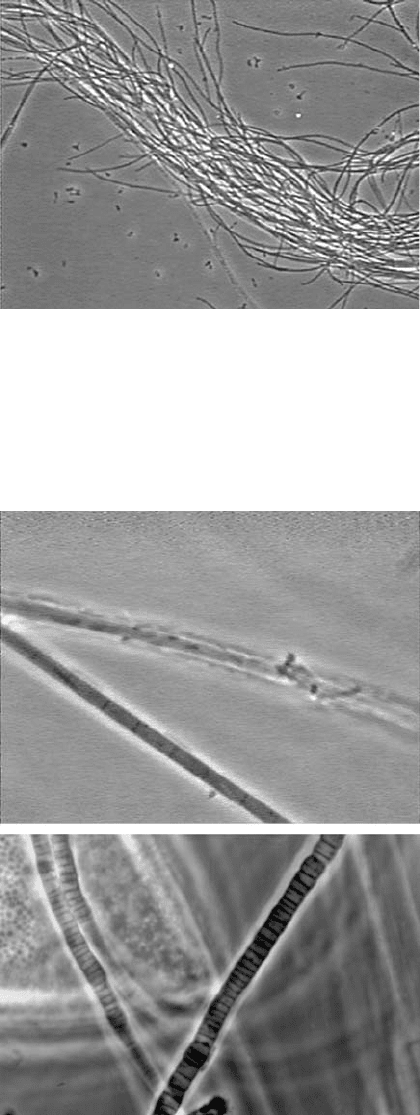
Taken to an extreme, filaments may replace almost completely any semblance of a nor-
mal floclike structure (Figures 16.28 to 16.30). For many years, one particular sheathed
bacteria, Sphaerotilus natans, was blamed routinely as the responsible agent for filamen-
tous bulking problems, but further study demonstrated that several other bacterial forms,
and occasionally fungi, could be involved. During the early 1970s the work of D. H.
Eikelboom in The Netherlands developed a systematic microscopic method which
Figure 16.25 Suspended-growth floc with nominal filaments: (a) light microscope view at 400;
(b) SEM view at 600.
Figure 16.26 Suspended-growth floc (400) with moderate filament growth.
WASTEWATER TREATMENT 609
recognized more than two dozen different filament types that coul d contribute to bulking
events (Eikelboom and van Buijsen, 1981). Eikelboom’s classic work, which was then
continued and expanded by a group working with David Jenkins in the United States,
strongly suggested that several causes were possible, each as a result of the excessive
growth of a different type of filamentous organism. Table 16.6 provides an overview of
Figure 16.27 Confocal microscopy image of suspended growth floc structure.
Figure 16.28 Suspended-growth floc with heavy filament growth: (a) light microscope view at
400,(b) SEM view at 800.
610
BIOLOGICAL APPLICATIONS FOR ENVIRONMENTAL CONTROL
the various filamentou s forms they typically found, including some forms that have only
been distinguished with numbers (as originally assigned by Eikelboom) since they have
not been formally identified and given official genus and species names (Jenkins et al.,
1993). Table 16.7 provides a synopsis of the correlation observed between the various
microbial filaments and their contribution to bulking problems.
Figure 16.29 Solely filamentous suspended-growth matrix (400).
Figure 16.30 Magnified images of floc filaments.
WASTEWATER TREATMENT 611

Knowing which condition is the cause of a particular bulking episode—by deter-
mining which filamentous types are present—is o f course ver y helpful in developing
control strategies. Bulking often appears in relation to extremely low organic loadings
(extremely low F/M or high SRT) or low dissolved oxygen concentrations in the aera-
tion tank. Occasionally, high sulfide concentrations, either from the influent wastewater
or produced in anaerobic zones within the treatment plant, can promote growth of
filamentous sulfur-oxidizing bacteria. Low pH can also lead to fungal bulking, but
this is a rather rare occurrence when pH control is available. Inadequate nutrients,
especially nitrogen and probably phosphorus, can also lead to a form of bulking or to
jelly sludge, in which excessive levels of exocell ular slime materials are produc ed.
However, this behavior i s more apt to occur with unique industrial wast ewaters (e.g.,
TABLE 16.6 Microbial Factors with Filamentous Bulking and Foaming in Activated Sludges
Percentage of Facilities Experiencing
Designated Problematic
Bacterial Growth
Rank Bacterial Agent Primary Secondary
1 Nocardia sp. 31 17
2 Type 1701 bacteria 29 24
3 Type 021N bacteria 19 15
4 Type 0041 bacteria 16 47
5 Thiothrix sp. bacteria 12 20
6 Sphaerotilus natans 12 19
7 Microthrix parvicella 10 3
8 Type 0092 Bacteria 9 4
9 Haliscomenobacter hydrossis 945
10 Type 0675 bacteria 7 16
Other forms Bacterial types 0803, 1851, 0961,
0581, and 0914, plus Nostoicoida sp.,
Beggiatoa sp.; undefined fungi
Source: Adapted from Grady et al. (1999).
TABLE 16.7 Correlations Between Filamentous Organism Types
and Causes of Bulking
Cause of Bulking Indicative Filament Types
Major (occurring commonly)
Low organic load 0041, 0092, Microthrix parvicella,
Nocardia-like spp. 0581, 0803
Low dissolved oxygen 1701, 021N, Sphaerotilus natans, 1863
Minor (occurring infrequently)
Low pH Fungi
Sulfides Thiothrix-like, Beggiatoa, 021N
Low N (or P) S. natans
612
BIOLOGICAL APPLICATIONS FOR ENVIRONMENTAL CONTROL
with canning operations), since domestic sewage usually has a considerable excess of
nitrogen and phosphorus.
Yet another type of bulking, which is rather less common than the filamentous version,
is caused by a particular type of floc structure largely composed of the bacterium,
Zoogloea ramigera, and for this reason this problem is referred to as zoogloeal bulking.
These flocs are characterized by branched, fingerlike projections that can have an effect
on settling similar to that of other filaments. Whereas zoogloeal flocs are seen in small
numbers in perhaps 10% of suspended-growth systems, they are present occasionally in
excessive amounts and cause bulking. They are favored by high organic loading rates
(high F/M, low SRT). At one time, early investigators thought that these zoogl eal species
were the dominant, and perhaps only, floc-forming microorganisms in suspended-growth
systems. This assumption is now known to be incorrect, but the (improper) use of the term
zoogloea in reference to all floc forms (rather than the specific unusual type of floc) per-
sists among some in the field.
Note that not every filamentous type has been linked directly with a specific cause of
bulking. Also, there is still some debate about some of the relationships. For example, one
filament, generically referred to as type 021N, in addition to being a sulfide oxidizer, has
been associated by some with low dissolved oxygen (DO) and by others with low F/M.
Part of this disagreement may stem from the likelihood that some of the filamentous types
established using only the microscope may actually be composed of more than one spe-
cies. Future efforts to apply molecular biology tools will undoubtedly help to clear up
some of this confusion.
Reactor design may also influence bulking. For example, with completely mixed reac-
tor designs, wastewater and recycled sludge are vigorously mixed and rapidly distributed
throughout the tank, such that the incoming wastewater is rapidly diluted as it enters the
reactor. This circumstance then leads to uniformly low substra te concentrations within the
aeration tank, a condition that favors the low-F/M filamentous bacteria. Bacteria living
within these flocs would be at a disadvantage to the extended filaments, which reach
out into the bulk solution to an extent where they have far higher access to substrates.
By comparison, an alternative plug-flow reactor configuration has no such initial mixing,
with wastewater and return sludge being introduced at the head end of the linear reactor
and then flowing together down the length of the tank, or through several tanks in series.
In turn, there is far less initial dilution of the incoming substrates, and the elevated initial
substrate concentration facilitates a higher rate of diffusion into the floc to an extent which
then negates the physical advantage of extended filament growth. However, plug-flow sys-
tems are more apt to experience higher initial oxygen uptake rates at the head end of their
operations, and unless care is taken to meet this higher demand, there may still be a con-
trary opportunity for filament growth due to low-DO bulking. Yet another innovative
approach to the control of filament bulking is to use a special reactor configuration
designed specifically to optimize and select for the growth of floc-forming bacteria at
the expense of filaments. These selector systems with suspended-growth proce sses are
typically quite small, usually less than 1% of the total aeration tank volume and placed
just ahead of the main aeration tank and then mixed and/or aerated to promote aerobic or
anoxic conditions favorable to floc formers.
Another approach for control of nuisance filaments would be to apply chlorine or other
strong oxidant (e.g., hydrogen peroxide) to the return sludge on an intermittent basis.
Because the filaments are more exposed to the solution than are the floc formers, being
extended outward from the floc into the surr ounding bulk solution, they are also more
WASTEWATER TREATMENT 613
susceptible to toxins such as these oxidants. However, the recurring necessity for using
this method can be costly, and in the case of high-level chlorination there are also second-
ary concerns stemming from the potential formation of toxic trihalomethane compounds
within the mixed liquor.
Contrasted with the circumstance of excess filaments and bulking, though, there are
also problems with settling stemming from other difficulties tied to unusual floc confor-
mations or problems. One such condition, referred to as pin floc or pin-point floc, stems
from the absence of any filaments whatsoever. These small-diameter floc forms are
affected particularly by high-level aeration, which imposes excessive shear forces leading
to floc disaggregation. Since there is no ‘‘net’’ of filaments that would otherwise strain out
these particles physically, pin floc end up getting left behind during settling and thus con-
tribute to a higher-than-desired effluent suspended solids concentrations.
Undesired floc breakdown and dispersed growth can also be encountered in a variety
of instances. High-level influent concentrations of salt or surfactants have been found to
destabilize floc structures, and short SRT systems with high-rate bacterial growth rates
have shown a tendency toward dispersed rather than flocculated growth, due to a lack
of exocellular polymer release. Toxic shock impacts have also been proposed as a factor
behind dispersed growth, where a toxic shock initially kills off a portion of an existing
biomass, and then the remaining organisms grow extremely fast, in an unflocculated fash-
ion, because of the reduced competition for substrates.
Foaming is yet another problem that can occur in mixed li quors. Occasional ly, this
may be the result of a nonbio degradable surfactant (a surface-active agent) that enters
the system. Other times, degradable detergents and other foaming materials (including
proteins and DNA) that are present in the wastewater may not be degraded quickly enough
and may lead to surface tension reductions that trigger the release of foam. This typically
occurs either during startup of a plant and with very short SRTs, or after washout of
sludge during a storm. Both of these types of foam are usually white and can be controlled
with defoaming compounds or water sprays. The most common and serious foaming
problems, however, are the result of excessive growths of certain gram-positive filamen-
tous bacteria. These seem all to be actinomycetes, and most are highly branched. They
were originally called Nocardia, but it is now recognized that they also include several
related genera, including Gordonia, Skermania, Rhodococcus, and Tsukamurella.
Occasionally, the bulking organism Microthrix parvicella (which is not branched) also
causes this type of foaming. These bacteria seem to have a waxy coating, which makes
it hard to rewet them once they get lifted into the foam layer. They are slow-growing and
therefore are favored by longer SRT conditions. However, once they form a foam, they
may accumulate on the surface of the aeration and/or secondary settling tanks to an
extent that control of waste to achieve a desired SRT is extremely difficult. In severe
cases, half of the system’s biomass may actually be in the foam, since it gets so thick.
The foam may even overflow the tank, or get pushed out by the wind, creating a
slippery safety hazard on walkways as well as an aesthetic problem. The foaming bacteria
appear to be able to utilize hydrocarbons and other fats and oils that may not readily
be available to many of the other organisms present. Defoaming compounds are not
effective in their control, and in some cases may even be utilized by the organisms as
a carbon and energy source. Instead, a combination of decreased sludge age and physical
removal of the foam (by skimming or vacuum) is generally used. Improved oil and
grease removal in primary treatment, and spray chlorination of the foam, may also be
beneficial.
614 BIOLOGICAL APPLICATIONS FOR ENVIRONMENTAL CO NTROL
Occasionally, sludge will settle well in the clarifier and then suddenly bob back up to
the top. This results from gas bubble formation in the sludge blanket while it is sitting at
the bottom of the settling tank. This is called rising sludge if the bubbles are composed of
nitrogen gas (N
2
), formed as the result of denitrification. Since denitrification can take
place only if nitrate and/or nitrite are present while oxygen is absent, this means that
sludge rising can occur only if nitrification has first occurred in the aeration tank and
then the sludge has gone anoxic in the settling tank. In cases where no nitrate or nitrite
are present, anaerobic sludge can float to the top as a result of the production of other
gases, especially hydrogen (H
2
). These problems can be controlled by increasing the rate
at which sludge is returned to the aeration tank, so that settled biomass within the clar-
ifier’s sludge blanket does not have a chance to go anoxic or anaerobic.
Another important aspect in the microbial makeup of a suspended-growth reactor’s
biomass involves the absence, or presence, of special ized bacteria uniquely acclimated
for the metabolic uptake or conversion of specific contaminant species, including not
only nutrients such as nitrogen and phosphorus but also a wide range of potentially inhi-
bitory, and yet still biodegradable, compounds (e.g., phenolics, thiocyanates) (Bitton,
1999). The desired acclimation and retention of these specialized bacteria would be ana-
logous to that of their development within fixed-film systems, and there is limited evi-
dence to suggest that floc particles may also provide, at least partially, a comparable
sequencing of cometabolic aerobes and anaerobes located within the exterior and interior
regions resp ectively.
In the particular case of pursuing complementary oxidative and reductive nitrogen
removal steps, design and control measures to secure the presence and vitality of
nitrogen-oxidizing and nitrogen-reducing bacteria within biomass will determine whether
nitrification and denitrification were able to occur. Given the low growth rates commonly
maintained by nitrifying bacteria, the key to achieving nitrification within an activated
sludge is that of retaining reactor biomass for periods (maintaining an SRT) in excess
of 4 days (and perhaps as much as 8 to 10 days during cold -weather periods). At this
point, a sufficient (albeit, even then rather small—at levels of a few percent or lower of
the total viable cells) inventory of these nitrifying lithotrophs can be kept to effect the
desired oxidation of ammonia to nitrate.
This strategy for securing nitrifiers has subtle aspects that are inherently similar to that
associated with fixed-film systems. A competitive advantage for nitrifiers in fixed-film
systems is maintained by limiting the amount of incoming organics available to compet-
ing heterotrophs; on the other hand, suspended-growth nitrifying reactors maintained at
high solids retention times are able to produce similarly low bulk solution levels of avail-
able organic carbon, such that the faster-growing heterotrophs are energetically con-
strained and unable to impose competitive stress. In fact, the process of nitrification
has now become a rather com monplace requirement for a considerable number of waste-
water treatment facilities given the inhibitory impact caused by low-level (sub-ppm) free
ammonia concentrations on fish living within downstream receiving waters. Taken one
step further, many newer activated sludge systems are also being designed to encompass
full nitrogen removal, ther eby matching ammonia oxidation (via aero bic nitrification)
with nitrate reduction (via anoxic denitrification).
This combined nitrification–denitrification practice provides a number of potential
benefits, including (1) the ability to achieve enhanced levels of overall nitrogen removal,
thereby reducing the downstream impact of this prospective nutrient; (2) the ability to
secure a recovery of the oxidizing ‘‘power’’ provided by nitrates, thereby conserving
WASTEWATER TREATMENT 615
the energetic investment previously made to create these oxidized products during aerobic
nitrification; and (3) the ability to achieve a similar recovery of alkalinity during deni tri-
fication, thereby partially offsetting the alkalinity loss realized during prior nitrification.
Suspended-growth systems designed for combined nitrification and denitrification sys-
tems tend to fall into one of two alternative design categories, including zoned and tem-
porally sequenced (i. e., flip-flopped aeration and mixing) arrangements to secure the
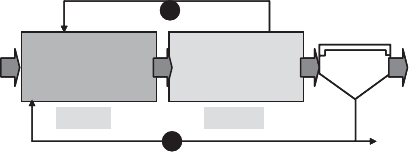
necessary aerobic and anoxic phases. One such popular, zoned design strategy, known
as the modified Ludzack–Ettinger (MLE) scheme is depicted in Figure 16.31. The first,
anoxic stage in this MLE system mixes incoming raw wastewater with a nitrate-bearing
flow brought back from the trailing aerobic nitrification reactor by way of an internal
feedback recycle stream, thereby facilitating the conditions necessary for efficient reduc-
tion and removal of this recycled nitrogen. Within this initial anoxic zone, therefore, deni-
trifiers employ incoming organics as their electron donor while reductively using nitrates
as an electron acceptor, thereby producing nitrogen gas.
Example 16.2: Preliminary Activated Sludge Design After presenting their preliminary
design estimate for a standard trickling filter with the Deer Creek, Illinois, community
(see Example 16.1), the community’s consulting engineer was asked to develop yet
another preliminary design estimate for a standard secondary activated sludge system
which might be used alternatively for this facility’s secondary treatment process. As
explained in Example 16.1, the expected average daily wastewater flow for this commu-
nity will be 605.7 m
3
/day, and the carbonaceous organic loading (CBOD) entering this
secondary activated sludge reactor system will be 72.7 kg BOD/day.
Preliminary Design Details
Hydraulic
loading,
system
sizing,
and retention
times
Design hydraulic retention time (HRT): 4 h (see Table 16.4)
Design solids retention time (SRT): 8 days (see Table 16.4)
Design reactor depth: 5 m
Projected reactor volume: (605.7 m
3
/day) (4 h ) ¼ 100.9 m
3
Projected reactor surface area: 100.9 m
3
/5 m ¼ 20.2 m
2
Clarifier
and
and
(Nitrification)
Internal feedback recyle
returning nitrates back to
the denitrifying anoxic zone
Raw
wastewater
influent
Waste
sludge
Underflow recyle
returning settled biomass back to
the denitrifyin
g
anoxic zone
Treated
effluent
1
2
Aerobic
Organic carbon oxidation
and
nitrate reduction
(Denitrification)
Anoxic
Organic carbon oxidation
and
ammonia oxidation
(Nitrification)
1
2
Figure 16.31 Representative two-tank plus two-recycle design scheme for biological nitrogen
removal. (Note: This particular arrangement is referred to as the modified Ludzack–Ettinger system,
based on its modified addition of an internal feedback recycle stream to the original Ludzack–
Ettinger design scheme.)
616
BIOLOGICAL APPLICATIONS FOR ENVIRONMENTAL CONTROL
Biomass
content
Estimated theoretical biomass yield (Y
T
): 0.5
Estimated biomass endogenous decay and death rate: 0.05 day
1
Estimated active reactor biomass concentration:
ðSRT=HRTÞðY
T
=ð1 þ k
d
SRTÞðCBOD
influent
CBOD
effluent
Þ¼
1920 g=m
3
Estimated active biomass mass: (1920 kg/m
3
) (100.9 m
3
) ¼193.8 kg
Estimated total suspended solids mass: (active biomas s/0.75) ¼
258.4 kg
Organic
loading
Projected organic loading:
ð72:7 kg CBOD=dayÞ=ð100:9m
3
Þ¼0:73 kg=m
3
day
Projected F/M (food/microorganism) ratio:
ð72:7 kg BOD=dayÞ=ð258:4kgÞ¼0:38 day
1
Related notes 1. As with Example 16.1, this preliminary design was based on a sin-
gle reactor receiving an average daily flow, as compared to multi-
ple reactors and peak etc. design flow conditions.
2. The total suspended solids vs. active biomass differences was
based on a typically observed biomass fraction of 75% vs. an
additional inert solids content of 25%.
3. The biomass concentration derivation given above takes into
account composite biomass growth for CBOD depletion, plus
decay and death, with an assumed effluent BOD of 10 mg/L);
further details regarding this analysis can be found in Wastewater
Engineering (Metcalf and Eddy, 2003).
4. In comparison to the prior trickling filter design estimate, there are
several important design differences, including:
a. Considerably different contact times (hours at activated
sludge vs. seconds or minutes for the trickling filter).
b. Considerably different total reactor volumes (the activated
sludge system is 2þ times smaller).
c. Roughly comparable active biomass levels but sizably different
total biomass levels (with a total of 4þ times higher in the
trickling filter, due to attached underlying anaerobic and inert
biofilm).
Going beyond nitrogen removal, biological phosphorus removal can also be achieved
in full biological nutrient removal (BNR) systems designed specifically to provide
sequenced anaerobic and aerobic zones which would encourage the growth of a highly
unique bacterial group largely believed to fall within the Acinetobacter genus. These unu-
sual cells consume low-molecular-weight volatile fatty acids (VFAs) during an initial
anaerobic zone while releasing internal reserves of polymerized phosphate (i.e., a poly-
phosphate known as volutin). Moving from the anaer obic to aerobic zones, though, these
same cells reverse the process, balancing their accelerated upta ke of soluble phosphorus
against the oxidation of previously stored VFAs. The end result, therefore, is that of
a biochemically mediated phase transfer of phosphate, shifting incoming soluble
WASTEWATER TREATMENT 617