
Vaccari D.A., Strom P.F., Alleman J.E. Environmental Biology for Engineers and Scientists
Подождите немного. Документ загружается.

portion of bed volume open to liquid and air flow rather than being occupi ed by the media
itself ), which subsequently helps to avoid problems with solids clogging that historically
tended to affect the older rock media units.
As compared to the original stationary media mode, there have also been a number of
recent developments based on rotational or fluidized media movement options. One such
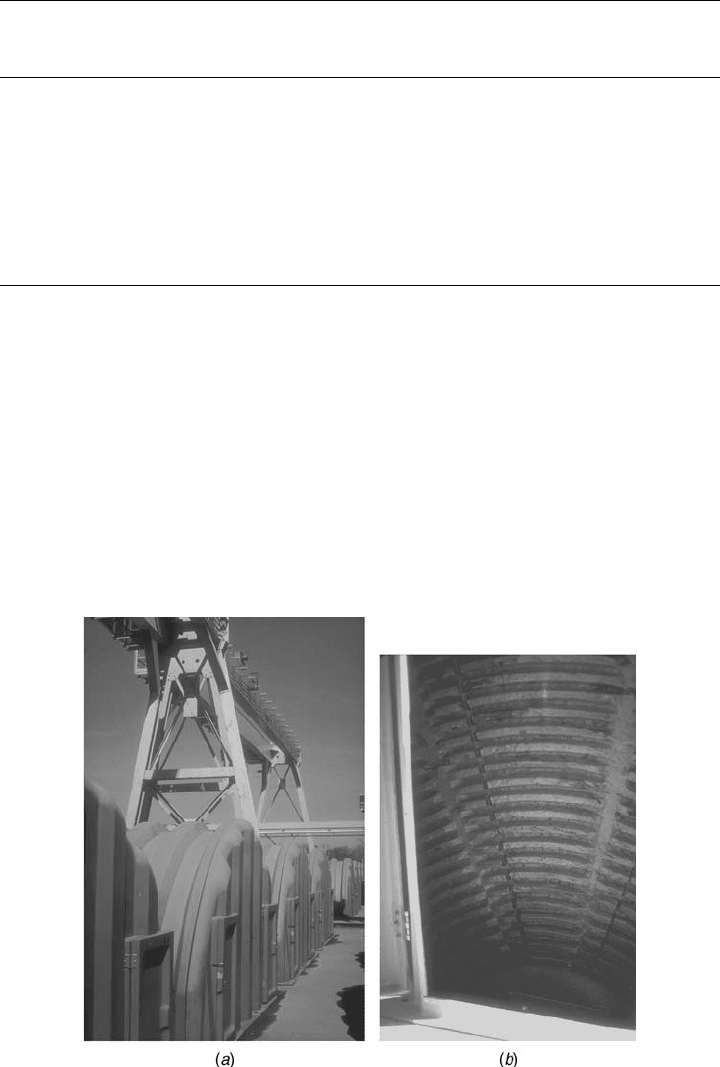
version shown in Figure 16.17 is called the rotating biological contactor (RBC). RBC
TABLE 16.3 Attached-Growth Media Options
Biofilm Media
Option
Nominal Size
(cm)
Specific Media
Surface Areas
(m
3
/m
2
)
Media Void
Fraction (%)
Media Density
(kg/m
3
)
Old rock media 10–12 30–60 40–60 800–1400
Standard plastic
media
a
60–100 95–97 32–96
Standard random
packed media
3–10 60–120 92–95 48–96
High-high plastic
media
a
100–200 95–97 32–48
Ultrahigh random
packed media
1–3 200–600 95–97 40–55
a
Plastic media sheets are typically configured in 60 60 120 cm bundles.
Source: Adapted from Metcalf and Eddy (2003).
Figure 16.17 Attached-growth rotating biological contactor system: (a) covered tanks and gantry;
(b) interior media view.
598
BIOLOGICAL APPLICATIONS FOR ENVIRONMENTAL CONTROL
reactors are built as cylindrical media bundles with densely packed, rotating plastic sheets
which may either be partially or fully submerged into the waste stream. During rotation of
the partially submerged units, the attached biofilm is exposed sequentially to the waste-
water and to the air, while submerged units may be operated in an aerated or even an
anoxic or anaerobic mode.
Over the past two decades, several new strategies for attached-growth processing have
been developed, including two options where the involved biofilms are maintained as sus-
pended, millimeter-scale microbial clusters rather than using a traditional sheetlike con-
figuration. The first such approach is typically aerobic, with small-diameter, inert med ia
particles (typically, plastic or low-density fired-clay beads, sand, or activated carbon gran-
ules, etc., in the size range 1 to 4 mm) used as a biofilm carrier, with varied media den-
sities used alternatively to secure either settleable or buoyant behavior. Because of the
elevated biomass densities found in the latter options, their elevated oxygen uptake
rates will require high-level aeration, such that these operations are commonly referred
to as biological aerated filter (BAF) systems. These types of small media biofilm systems
are typically operated in an up-flow operating regime, possibly with partial or full fluidi-
zation of the media during its operation on either a continuous or an intermittent basis and
with intermittent backwashing being used (possibly with coaeration) to flush and extract
entrapped solids. There are several advantages with the latter type of BAF reactor. First,
the media usually has a cumulative surface area that is far higher than would be attainable
had the same bed been packed with standard plastic media, and this increased surface area
raises the mass of biofilm able to grow inside the reactor. To some extent the magnitude of
this increase is tempered by the fact that physical rubbing of granules against one another
keeps the biofilm thinner than what is usually seen in conventional trickling filter systems.
However, the cumulative effect of having a denser and more active biomass is that the
reactor loadings can be increased dramatically. In fact, volumetric organic loadings sev-
eral times higher than that of standard fixed-film systems (Rittman and McCarty, 2001)
have been reported with many of these newer BAF biofilm systems (e.g., at levels mea-
sured in the range 5 to 10 kg CBOD
5
/daym
3
).
Yet another innovative quasi-attached-growth concept uses suspended granular biofilm
clusters whose dense, multimillimeter microbial matrix develops in a self-aggregated
bead configuration rather than relying on the preceding inert support materials. These
granulated biofilm clusters are then suspended in an upflow anaerobic sludge blanket
(UASB) process, where inco ming soluble COD is rapidly fermented to gaseous methane
and carbon dioxide, which then rises and is released from the reactor through an overlying
inverted-cone degasification cover. Internal recirculation of the granular biofilm cluster
blanket is then achieved by upwelling lift provided via wastewater flow and initial gas
buoyancy followed by subsequent downward settling of the denser microbial beads
after gas detachment. Here again, these UASB systems carry extremely high granular bio-
film densities, to the point where their permissible loadings with industrial-type soluble
organics are among the highest possible with wastewater operations, ranging from 12 to
20 kg CBOD
5
/daym
3
(Metcalf and Eddy, 2003).
Yet another hybrid approach for these biofilm systems couples attached-growth with
suspended-growth processes using a trickling filter/solids contactor (TF/SC) scheme.
These designs include a solids aeration tank placed between the biofilm tower and clari-
fier, with settled solids drawn from the clarifier underflow being recycled back to the inter-
mediate solids contactor unit to enhance the uptake and separation of fine particulates.
These intermediate tanks are typically not all that large, with HRTs usually below
WASTEWATER TREATMENT 599
1 hour, and their suspended solids levels are usually not all that high compared to con-
ventional suspended-growth reactors at 700 to 1500 mg/L, but their ability to facilitate
improve bioflocculation elevates the overall efficiency of the TF/SC process beyond
that of standard biofilm processes, with expected removal efficiencies for BOD and
suspended solids 10 to 15% higher than those of standard biofilm processes.
16.1.3 Suspended-Gro wth Syste ms
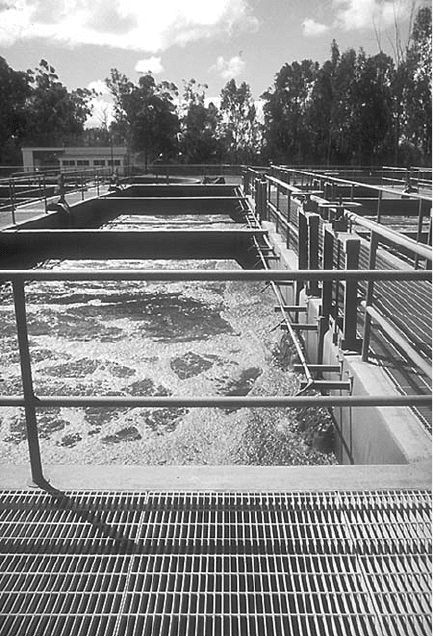
Suspended-growth processes used for wastewater treatment, such as that shown in
Figure 16.18, have largely surpassed the attached-growth options over the past half-
century in terms of general application, to the point where they have becom e the accepted
state-of-the-art, best available prac tice for wastewater processing. There are several rea-
sons for this preference, covering both performance and economic issues. These systems
do have a higher energy demand to aerate and mix their suspended biomass, but they have
earned a higher degree of confidence in terms of expected performance levels. These
suspended-growth processes, commonly referred to as activated sludge systems, also tend
to have better economy of scale in construction costs, whereas attached-growth is often used
in smaller installations, due to its ease of operation and simpler mechanical design.
Figure 16.18 Suspended-growth (i.e., activated sludge) wastewater treatment facility.
600
BIOLOGICAL APPLICATIONS FOR ENVIRONMENTAL CONTROL
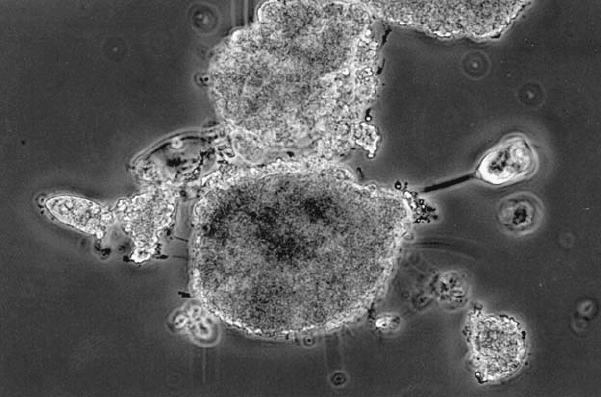
The key biological structure within suspended-growth processes is that of an amor-
phous, clustered structure (see Figure 16.19) known as floc, whose constituent microbial
population sustains a desired biochemical oxidation of wastewater contaminants. Like its
biofilm counterpart, floc is composed of a com plex aggregate of various bacterial and
higher life biota, plus an added quantity of nonliving organic and inorganics material.
Suspended-growth floc particles exist as free-floating structures whose physical, chemical,
and biological exchange with the surrounding bulk solution functions in three dimensions,
as compared to a biofilm sheet which is confined against the inert surface to which it is
attached. Floc suspensions are referred to as mixed liquor, and the suspended solids
concentration of this is denoted mixed liquor suspended solids (ML SS). These floc con-
centrations are usually maintained at total volatile suspended solids concentrations ran-
ging from 1 to several grams per liter.
As was the case with biofilm development, the circumstance of having bacterial cells
stick together in floc particles depends on starvation conditions which trigger an exocel-
lular release of adhesive exocellular polysaccharides. In turn, individual cells are able to
self-adhere or flocculate into larger, enmeshed floc clusters. Floc dimensions are consid-
erably smaller than multimillimeter biofilms, though, with typical diameters of 250 to
500 mm, and this limit is probably controlled by shear forces encountered during routine
mixing, aeration, and pumping. Given that floc biomass is composed largely of bacterial
cells, the specific gravity of these particles also tends to be only slightly higher than water
(about 1.03 to 1.05), such that these relatively light floc particles can be kept in suspension
with only moderate agitation and aeration.
Flocculation behavior also plays a role in terms of bacterial survival as a whole. When
an organism metabolically releases any substance outside its boundaries, there is a cost
that must be accompanied by a return. Only under conditions of scarcity is this investment
worthwhile for the microbe, and in the case of floc physiology the benefit is that of enhan-
cing the entrapment of particulate substrates. The secretion of exocellular digestive
Figure 16.19 Typical light microscope image of suspended-growth (i.e., activated sludge) floc
conformation.
WASTEWATER TREATMENT 601
enzymes by a single cell could result in most of that enzyme uselessly diffusing away
from the cell, such that a large fraction of any dissolved substrate formed by dige stion
of a particle would also diffuse away. While clustered within an aggregated floc commu-
nity, though, bacteria are cooperating by releasing enzymes that benefit them collectively.
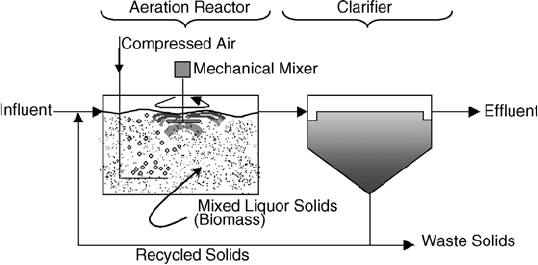
The physi cal structures used in suspended-growth or activated sludge systems include
both a reactor basin and a settling tank (Figure 16.20). Within the reactor basin, biode-
gradable substrates are then absorbed by the floc particles, along with oxygen and other
key metabolic elements (e.g., nutrients, trace metals), and used to sustain a complex set of
catabolic and anabolic reactions by whi ch the wastewater is then cleansed biochemically.
In turn, a subsequent settling tank is used to settle suspended floc biomass in preparation
for recycle or wastage.
To maintain desired aerobic conditions inside the reactor, oxygen must be added rou-
tinely either by introducing compressed air or oxygen via dispersed air bubbles or
through various mechanical aerat ion mechanisms. Extending beyond these reactor and
clarifier components and their affiliated aeration equipment, suspended-growth systems
will also require a complementary set of valves, pipes, and pumps used to control the
reactor feed, as well as additional hardware for clarifier underflow recycling and wastage
plus effluent discharge.
The settling tank, also called the secondary clarifier, has one basic function, to sepa-
rate the floc biomass from the effluent. This operation can be divided into two comple-
mentary functions: clarification and thickening. Clarification is intended to produce a
clear effluent that is nearly free of suspended solids. Thickening is the production of a
concentrated underflow sludge which is then pumped from the bottom of the clarifier.
Most of the thickened sludge is returned to the aeration tank [as a recycle or return acti-
vated sludge (RAS) stream], but a portion of the sludge will also be wasted and removed
from the process for further sludge processing. In turn, this wastage turns out to be the
key control parameter for a suspended-growth process, which by varying the age of this
biomass (its SRT) controls net growth rate, will then regulate overall operational efficiency.
In this context of qualifying discrete reactor and settling operations, though, it should
be noted that some suspended-growth systems do not follow this convention. For example,
sequencing batch reactor (SBR) systems use individual tanks as both reactors and clari-
fiers, where aeration and settling phases are then sequenced during batchwise operating
cycles. Another suspended-growth system, which is just beginning to see wider utilization
in full-scale systems, is that of the membrane bioreactor (MBR), where semipermeable
Figure 16.20 Suspended-growth design schematic.
602
BIOLOGICAL APPLICATIONS FOR ENVIRONMENTAL CONTROL

synthetic membranes are used for biomass separation in lieu of a settling tank. In these
units, mixed liquor is passed across and through the membranes to obtain an effluent
that is essentially free of all suspended solids, thereby directly retaining floc biomass
within the aeration tank.
Numerous design options exist with respect to the manner in which the waste is intro-
duced to these suspended-growth reactors, how the reactor system might be arranged in
physically or temporally separated stages, the condition (i.e., aerobic, anoxic, anaerobic)
of these stages, and the rates employed for hydraulic throughput and solids discharge. The
vast majority of systems are maintained in a fully aero bic state for oxidative biodegrada-
tion of incoming organics, and in recent years an escalating number of these aerobic sys-
tems have also been used to maintain an additional oxidation of reduced nitrogen
(ammonia and organic nitrogen) to nitrate by way of nitrification. In addition, there are
also a variety of suspended-growth design options by which full nitrogen removal, includ-
ing denitrification, as well as biological phosphorus removal can be achieved by, respec-
tively, using an additional complement of suitably designed and controlled anoxic and
anaerobic phases.
Six design variables are considered in the development of suspended-growth systems,
including hydraulic residence time, solids residence time, specific substrate loading (mass
substrate applied per mass cells per time), volumetric loading, reactor configuration, and
recirculation rate (recycle flow relative to raw influent flow) ratio. Table 16.4 provides a
general synopsis of the typical design criteria relative to four of the basic options for con-
figuring these reactor s, including conventional, high-rate, extended aera tion, and nitrifica-
tion systems. In addition, further engineering consideration must be given to the
anticipated reactor solids levels, excess sludge production rates, solids–liquid separation
methodologies, and overall environmental conditions (e.g., operating temperature).
The HRT and SRT were described in Section 16.1.1. The third variable, specific sub-
strate loading, is often referred to in terms of a food-to-microorganism (F/M ) ratio.Of
course, the form of the food term will vary according to the purpose of the reactor and
whether its intended goal was that of carbonaceous BOD, COD, ammonia-nitrogen, and
so on, removal. Similarly, there are several techniques for quantifying ‘‘mass,’’ but the
most common procedure is to use mixed liquor volatile suspended solids (MLVSS).
At steady state, the F/M ratio is inversely related to SRT. Specifying one is equivalent
to specifying the other, and either one can be used for design purposes.
TABLE 16.4 Typical Suspended-Growth System Design Criteria
Suspended-
Growth
Design
Factors
Hydraulic
Residence
Time (h)
Solids
Residence
Time (days)
Specific Substrate
Loading (F/M) Rate
(kg/kg VSS day)
Volumetric
Substrate
Loading Rate
(kg CBOD/m
3
day)
Recirculation
Ratio Q
r
Q,
Relative to
Influent Flow
Conventional 4–8 5–15 0.2–0.4 (as CBOD) 0.32–0.64 0.25–0.75
High-rate 2–4 3–5 0.4–1.5 (as CBOD) 1.6–16 1–5
Extended
aeration 18–36 20–30 0.05–0.15 (as CBOD) 0.16–0.4 0.5–1.5
Nitrification 6–12 >8* 0.05–0.15 (as N) 0.2–0.4 (as N) 0.5–1.5
a
Operating SRTs necessary for nitrification vary with temperature: >4 days in summer, >8 days in winter.
Source: Adapted from Metcalf and Eddy (2003).
WASTEWATER TREATMENT
603

The control strategies used with suspended-growth systems are more sophisticated than
those used in attached-growth wastewater processes (Bailey and Ollis, 1977), including
that of controlling the aeration plus clarifier recycle and wastage flow rates. The major
operational objectives for suspended-growth systems, though, are to maximize effluent
quality while minimizing costs for disposal of waste biomass or sludge (the production
of which decrease with SRT) and energy used with mixing and aeration (which increase
with SRT), and in this context, controlled biomass wastage represents the key control fac-
tor. In turn, there is a delicate balance with controlling SRT to maximize effluent quality
while minimizing operating costs, to an extent that considerable experience is necessary
for optimal process control given the dynamic impacts of seasonal temperatures, changes
in wastewater character, and so on.
In general, control regimes designed to sustain higher rather than lower SRT conditions
are often preferable, in that their correspondingly reduced (i.e., starvation) growth rates
would correspond with low-level effluent substrate concentrations. As was the case with
similarly starved biomass growth within adhesively bound biofilms, suspended-growth
biomass maintained at these elevated SRT levels will also tend to produce beneficial,
floc-forming exocellular polysaccharides.
In turn, the development of improved floc-formi ng biomass would be similarly bene-
ficial in terms of desired settling performance. It is imperative that the suspe nded biomass
be able to settle and compact effectively, forming a sludge blanket, so that these solids
can be recycled back to the aeration tank rather than being lost in the settling tank’s efflu-
ent. Settling behavior is, consequently, tracked in most systems. The oldest and still likely
to be the most common method of monitoring settling is that of the sludge volume index
(SVI). The SVI is defined as the volume in milliliters occupied by 1 g of sludge after
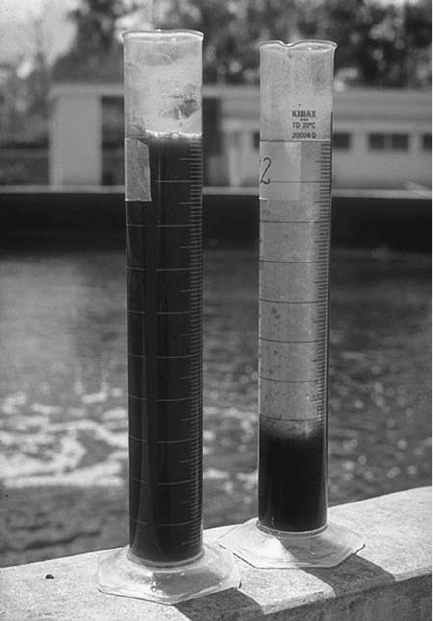
30 minutes of settling. A settling test is completed by adding mixed liquor to a settleo-
meter (a vertical glass or plastic cylinder) or standard laboratory graduate cylinder
(Figure 16.21). Although there are a number of variations, the basic test consists of allow-
ing the sludge to settle for 30 minutes, then noting the volume of settled sludge [settled
volume (SV)]. This value is then divided by the MLSS concentration:
SVI ðmL=gÞ¼
SVðmL=LÞ
MLSSðg=LÞ
ð16:2Þ
An acceptable SVI value (i.e., producing good settling) is considered to be in the neigh-
borhood of 100 mL/g. An SVI greater than about 200 indicates bulking conditions, where
settling performance is less than satisfactory. Values in between must be judged depend-
ing on the design and operating conditions of a partic ular plant. The settled 1-L sample
shown on the right-hand side of Figure 16.21, for instance, has a 30-minute settled volume
of 250 mL, and with a solids concentration of 2.5 g/L, the corresponding SVI would be
100 mL/g. Although rather crude, this simple test provides an approximate feel for the
settleability of these solids, and when tracked on a recurring basis, the operating staff
can predictably qualify ‘‘good’’ vs. ‘‘bad’’ behavior.
Beyond the SVI test, though, suspended-growth reactors are monitored in a fashion
that pays a higher level of attention to the biological aspects of the involved biomass
than is the case with the various attached-growth processes, taking into account such
issues as expected rates of cell growth, decay, and respiration, as well as the overall mor-
phology and consortia maintained within the involved biomass. For example, dissolved
oxygen levels in the aeration reactors are monitored routinely, both to ensure appropriate
604 BIOLOGICAL APPLICATIONS FOR ENVIRONMENTAL CO NTROL
oxygen transfer and to track biomass activity qualitatively. More precise measurements of
mixed-liquor oxygen utilization rate (OUR) levels are also completed at many facilities
on a frequent basis, using respirometers to evaluate biomass oxygen uptake such that
they might quickly pinpoint potential problems with incoming wastewater toxins or
other problematic metabolic conditions.
In yet another attempt to upgrade their monitoring efforts, many suspended-growth
operations have also adopted routine measures to examine their floc with a light micro-
scope on a recurring basis. This effort can be used to track chronological changes in its
overall appearance, conformation, and approximate average diameter of a system’s floc
particles. At the same time, density counts taken with other higher life-forms, including
those for protozoans and rotifers, may be recorded to evaluate their relative presence, or
absence, as this factor may also signal symptomatic changes.
Floc particles may, in fact, have less microbial and metabolic diversity than biofilms
(which often contain both aerobic and anaerobic zones), but they do enjoy several appar-
ent advantages in terms of potentially securing maximal degradation rates. First and fore-
most, the combined effects of submillimeter floc diameters and their inherently open
structure as a whole means that their cells will have far closer proximity, and easier
access, to substrates and oxygen coming from the surround ing bulk solution. In turn, it
Figure 16.21 Sludge volume index testing for suspended-growth biomass.
WASTEWATER TREATMENT 605
is highly likely that a far larger fraction of the biomass will be able to sustain oxidative,
aerobic activity compared to that found in biofilms. Furthermore, this enhanced transport
of substrates and nutrients into the floc would be mirrored by a comparable improvement
in the release of unwanted metabolic products. Finally, the overall surface area of these
floc particles, on a cumulative basis that factors in both outer surface and internal subsur-
face exposure, will be considerably higher than that of a comparably sized (similarly
loaded) biofilm system. Here again, the higher surface area not only provides for better
kinetics but also contributes to improvements in a range of supplemental impacts, includ-
ing sorption, filtration, and chelation.
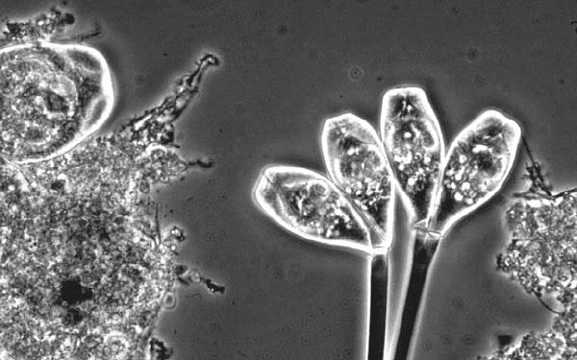
Most floc structures will also include any num ber of higher life-forms, includ-
ing attached and free-swimming protozoans (Figures 16.22 and 16.23) and rotifers
(Figure 16.24). These organisms are highly beneficial and symptomatic of desirable
floc conditions in that their presence sets up a tiered food chain which at the bottom
end helps to maintain a clean effluent by scavenging finer, unattached solids and free-
swimming bacteria that might otherwise linger during clarification as a fine, turbid
haze. The stalked protozoan species, Vorticella, seen in Figures 16.22 and 16.23 repre-
sents one such desirable scavenger, whose life-style and mode of operation is similar to
that of a free-wheeling vacuum cleaner. This organism’s contracted cilia, seen in top-
down view in Figure 16.23, will open and extend outward into the bulk solution and
then whirl rhythmically to create rotational fluid currents that pull unattached particulates
in the bulk solution toward, and then into, this organism’s mouthlike opening, where they
are then ingested.
Problems with floc conformation and behavior may, however, be encountered, includ-
ing various difficulties with settling or clarification. Table 16.5 provides a synopsis of
these conditions. In fact, a considerable number of suspended-growth process problems
are related to poor settling and clarification. Although settling is a purely physical step,
it is largely floc mi crobiology and conformation that determines the settling characteris-
tics of the sludge.
Figure 16.22 Light microscope image of suspended-growth floc structure with Vorticella
protozoans.
606
BIOLOGICAL APPLICATIONS FOR ENVIRONMENTAL CONTROL
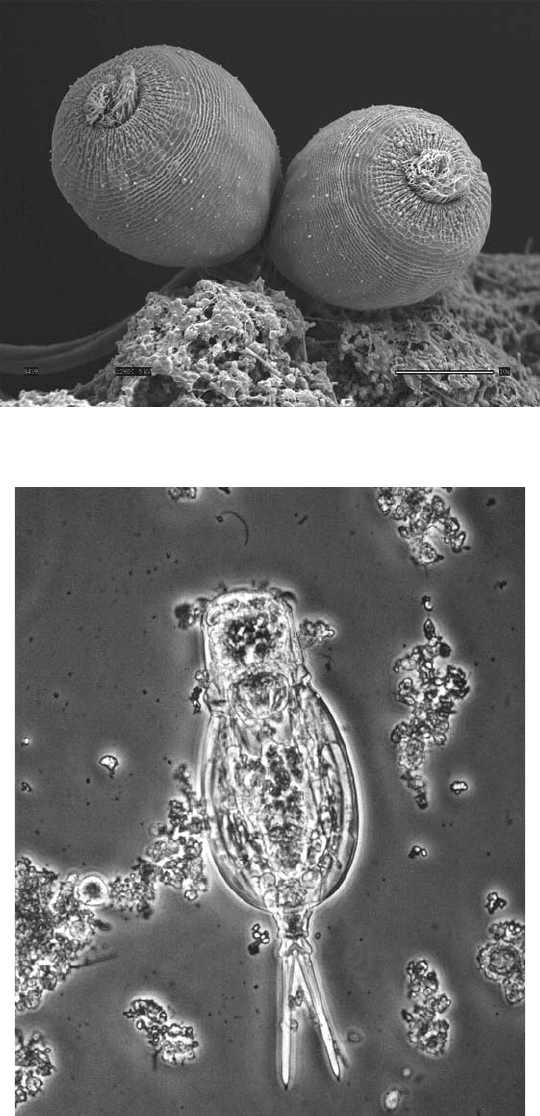
Figure 16.23 SEM image of suspended-growth floc with Vorticella protozoans.
Figure 16.24 Light microscope image of suspended-growth floc structure with rotifer.
WASTEWATER TREATMENT 607