
Vaccari D.A., Strom P.F., Alleman J.E. Environmental Biology for Engineers and Scientists
Подождите немного. Документ загружается.

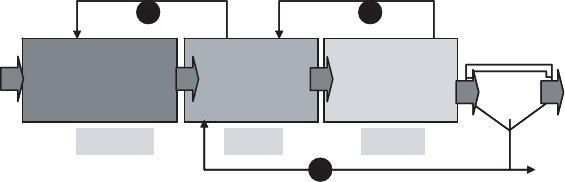
phosphorus contained within the raw wastewater stream into phosphate-rich solid-phase
intracellular storage granules contained within cells eventually wasted from the system.
Further design refinements to secure an overall goal of complete biological nutrient
removal, encompassing both nitrogen and phosphorus, typi cally involve the addition of
yet another separate, anaerobic zone or phase at the head end of the reactor train, as
shown schematically in Figure 16.32. The second and third reactors in this sequence,
offering anoxic and aerobic environments, respectively, will again play much the same
roles, including oxidation of organic carbon in both stages as well as nitrification in the
aerobic stage and denitrification in the anoxic stage. By adding an additional internal
feedback recycle loop, though, biomass moved from the anoxic stage to the new head-
end anaerobic stage is able to shift rapidly into an anaerobic condition (since it carries
little, if any, nitrate or dissolved oxygen). In turn, fermentative transformation of incom-
ing organics into volatile fatty acids sets up the initial conditions necessary for Acineto-
bacter’s phosphorus-related metabolism.
16.1.4 Stabilization Lagoon Systems
Stabilization lagoons represent one of the simplest possible options for wastewater treat-
ment, with a level of engineering sophistication and cost below that of the preceding
attached- and suspended-growth processes. As explained in an oft-quoted anonymous
description—that ‘‘the design engineer drives a bulldozer and the rest is left to Mother
Nature’’—most lagoons are built as simple earthen basins, albeit with liners, and only lim-
ited operational oversight is provided. Given their simplicity, though, and ease of opera-
tion, lagoon system s are widely used in small rural communities and industries throughout
the world.
There are three basic lagoon design options, including two that are solely aerobic or
anaerobic, and a third, facultative version that has both overlying aerobic and underlying
anaerobic layers. Whereas the aerobic and facultative lagoon options can be used for com-
plete treatment of most municipal waste streams, anaerobic lagoon systems are more
Clarifier
Aerobic
Organic carbon
oxidation and
nitrate reduction
(Denitrification)
Anoxic
2
nd
internal feedback recyle
returning nitrates back to
the denitrifying anoxic zone
Organic carbon
Oxidation and
ammonia oxidation
(Nitrification)
Organic carbon fermentation,
VFA formation and update,
Acinetobacterpromotion
Anaerobic
1
st
internal feedback recyle
returning biomass back to
the initial anaerobic zone
1
2
Raw
wastewater
influent
3
Treated
effluent
Waste
sludge
Underflow recyle
returning settled biomass back to
the denitrifying anoxic zone
Aerobic
Organic carbon
oxidation and
nitrate reduction
(Denitrification)
Anoxic
Organic carbon
oxidation and
ammonia oxidation
(Nitrification)
Organic carbon fermentation,
VFA formation and update,
Acinetobacter promotion
Anaerobic
1 2
3
Figure 16.32 Representative three-tank plus three-recycle design scheme for combined biological
nutrient removalm including nitrogen and phosphorus removal. (Note: This particular arrangement
is often referred to as UCT or VIP systems, based on their respective geographic development at the
University of Cape Town and Virginia; there are numerous alternatives using similar sets of
anaerobic, anoxic, and aerobic reactors.)
618
BIOLOGICAL APPLICATIONS FOR ENVIRONMENTAL CONTROL
commonly used with high-strength industrial wastes (e.g., rendering plants, slaughter-
houses, food processing residuals), and even then as a means of pretreatment prior to a
following polishing step (e.g., followed by an aerobic lagoon, spray irrigation over land,
or some other means of treatment).
All three of these basic lagoon design options have yet another subgroup set of design
alternatives, depending on their projected organic loading rates and the means by which
they will secure their necessary oxygenation and/or mixing.
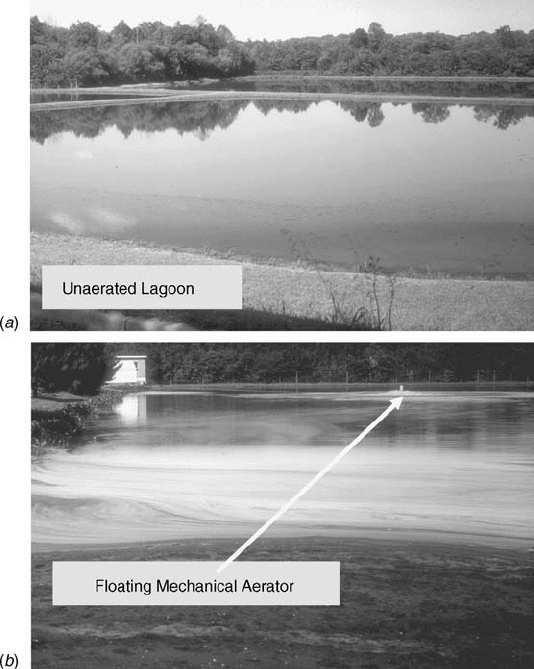
Aerobic lagoons of the sort shown in Figure 16.33 rely on natural wind-induced mixin g
and/or surface aeration, plus algal photosynthesis, for oxygen resupply, and tend to be
fairly shallow (with typical depths of about 2 m) and less heavily loaded. On the other
hand, forced mixing and aeration using either mechanical agitation or subsurface com-
pressed-air distribution (Figure 16.33) is also practiced with many aerobic lagoons,
such that their design depths can be increased (to the range 3 to 4 m), along with receiving
higher organic loadings. Anaerobic systems will be even deeper, often reaching depths of
4 to 5 m, to provide sufficient depths for the lower strata of the lagoon to fully reach a
Figure 16.33 Stabilization lagoons: (a) unaerated; (b) aerated.
WASTEWATER TREATMENT 619
point of oxygen depletion, and in many instances an overlying floating scum blanket will
be allowed to collect on the lagoon surface to further constrain surface reaeration.
There is also a considerable range in the hydraulic detention times used with these var-
ious systems. Design HRTs below 1 week in length, at 3 to 6 days, may be used with high-
rate operations, or for anaerobic or facultative pretreatment units ahead of a second,
downstream aerobic poli shing lagoon. However, many stand-alone lagoons, particularly
those not provided with supplement al aeration hardware, are sized to provide detention
times in excess of a week and possibly extending to month-plus periods. Pretreatment
focused largely on screening solids from the influent waste prior to entering the lagoon
may also be provided, particularly in the case of high-strength industrial or commercial
operations for which prescreening might effectively pull out a substantial level of incom-
ing contaminant solids loading.
Example 16.3: Preliminary Stabilization La goon Design After completing the trickling
filter and activated sludge preliminary designs, suppose that a third design overview is
requested for the same Deer Creek, Illinois, community, with its 400 homes and 1600
residents. Given that their expected discharge point into a local creek has seasonal low-
flow conditions that warrant high-level ammonia removal levels (i.e., to avoid summer-
time ammonia inhibition of sport fish in this Midwest city’s regional area), it is assumed
that a controlled-release, unmixed aerobic oxidation pond with a 6-month retention time
will be required to handle the daily average wastewater flow of 605.7 m
3
/day and its com-
mensurate total BOD loading of 121.2 kg BOD/day (Note: This design will be based on
the community’s full BOD load , since pri mary settling units are not typically included
with these types of stabilization pond designs.)
Preliminary Design Details
Hydraulic loading,
system sizing,
and retention
times
Design hydraulic retention time (HRT): 6 months
Note: HRTs for these systems typically range from 1 to 6 months,
depending on discharge restrictions into the receiving water
body (e.g., a stream).
Design reactor depth: 2 m
(Note: This depth is appropriate for unmixed lagoons; facultative
and mechanically mixed aerobic lagoons have depths of 3 to
4 m, while anaerobic lagoons handling higher strength wastes
are considerably deeper.)
Projected reactor volume: (605.7 m
3
/day)(6 months) ¼ 110,600 m
3
Projected reactor surface area: (110,600 m
3
)/(1.5 m) ¼ 55,300 m
2
(Note: This area is equivalent to 13.7 acres, which would corre-
spond to a per-area loading of approximately 116 people/acre.)
Organic loading Projected organic loading:
ð121:2 kg CBOD=dayÞ=ð110; 600m
3
Þ¼0:0011 kg=m
3
day
Related notes 1. This lagoon is rather large in surface area given its long HRT
and shallow, unmixed depth; deepe r, mixed ponds with lower
HRTs often have per-capita loadings of 1 acre per 300 to 600
people.
620 BIOLOGICAL APPLICATIONS FOR ENVIRONMENTAL CO NTROL
2. As compared to either the activated sludge or trickling filter
design options, this controlled (i.e., low-rate seasonal) dis-
charge oxidation pond design would have a physical footprint
roughly 1000 times larger.
3. Although it does require significantly more space, this type of
facility should be less costly to build and apt to require less
operational attention, although the stability of this system’s
effluent quality will probably be much lower.
To some extent, it is reasonable to classify these lagoons as quasi-suspended-growth
systems given their content of suspended bacterial and algal biomass, although in this
case the level of entrained biomass concentration tends to be several fold lower (i.e., gen-
erally measured in 100s of mg/L as opposed to 1000s). At the same time, most aerobic
and facultative lagoon volumetric organic loading rates (ranging from 0.001 to 0.01 kg/
m
3
day) are also much lower than the more advanced attached- and suspended-growth
processes, such that the biomass found in these lagoons tends to have a greater proportion
of higher life-forms (e.g., scavenging protozoans, rotifers) and a lower net mass fraction
of lower bacteria than what would be seen in a more highly loaded attached- or
suspended-growth process.
Yet another unique aspect with open, aerobic lagoons (and to a lesser degree in mixed
lagoons, due to the higher entrained solids levels and lower opacities) is that they have
considerably more involvement with algal growth, due to the reduced density of their sus-
pended solids and the fact that light can penetrate much deepe r than is the case with most
other waste treatment systems. With the incoming waste stream continuously introducing
a fresh supply of readily available nutrients, algal and other small-scale plant growth can
undergo large seasonal swings and will have a correspondingly significant impact on sus-
pended solids levels in the effluent as well as the soluble oxygen and carbon dioxide
levels.
The preferred circumstance for lagoons in terms of their algal composition it that of
having suspended, submerged algal cells, where their metabolism often has a distinct,
diurnal impact, resulting in sizable swings in dissolved oxygen and pH [i.e., higher DO
and higher pH during the day, when algal photosynthesis and oxygen release offset bac-
terial respiration (at the same time, algae also removes CO
2
); lower DO and lower pH at
night, while both bacteria and algae are respiring and jointly releasing CO
2
]. These algae
are also effective scavengers of solu ble nutrients, including both nitrogen and phosphorus,
assimilating them routinely into solid-phase algal cell mass and then removing them once
these cells die and settle onto the lagoon bottom.
However, there is also a smaller number of lagoons whose algal or plant content is
established in a free-floating fashion, such as that of the classic duckweed plant form
shown in Figure 16.34, where their presence tends to result in a more extensive mat
stretched across the lagoon surface. These mats may appear quite green and healthy,
but their activity and presence are somewhat contrary to conditions normally considered
optimal for these lagoons. Free-hanging duckweed roots, called fronds, extend only a few
centimeters in depth, and they contribute little, if any, dissolved oxygen via photosynth-
esis. Even worse, they physically block wind-induced surface reaeration, to a degree that
their subsurface conditions are more likely anoxic to quasi-anaerobic. BOD and
suspended solids removal can still be secured in these matted lagoons, albeit with
WASTEWATER TREATMENT 621
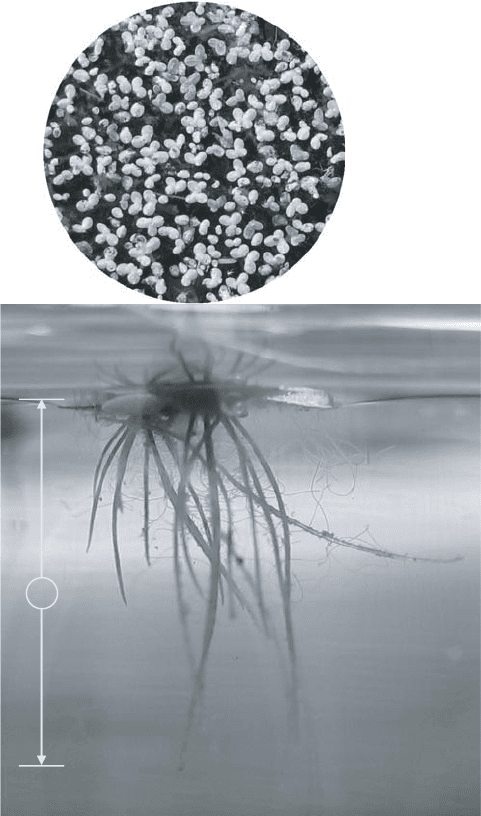
lower loading rates, and nutrient uptake will still occur, but effective long-term operation
may require surface harvesting measures.
As for the issue of exactly what happens to the accumulation of dead algae, bacteria,
and other waste solids once they settle and accumulate on the bottoms of these lagoons,
this topic still represents a highly variable circumstance for most lagoons. Ideally, the
input of biodegradable solids settling into a lagoon’s bottom sludge blanket would then
undergo decay at a rate not much different from that of their addition. If, indeed, this
rate of accumulation were to be low, the sludge blanket depth would not increase,
there would be no need to clean (i.e., remove sludge from) the lagoon periodically, and
there would be no reduction over time in the lagoon’s active (as opposed to settled
2cm
16-34a
2cm
(a)
(b)
Figure 16.34 Duckweed plant: (a) overview; (b) closeup.
622
BIOLOGICAL APPLICATIONS FOR ENVIRONMENTAL CONTROL
sludge) volume. Unfortunately, the history with most lagoons is that they tend to accumu-
late settled solids at a rate that warrants their cleaning at multiyear to decade-long
intervals, without which there would be a debilitating, progressive drop in effective
lagoon volume.
Of course, there is also a negative side to large, exposed lagoon surface s, particularly in
regions faced with colder seasons, in that they will experience sizably higher levels of
evaporative cooling that could lead to significant drops in temperatures during cold-
weather periods. In turn, these reduced temperatures will then affect bacterial efficacy
in the lagoon, particularly that of ammonia oxidation by highly sensitive nitrifying bac-
teria. From a regulatory perspective, this circumstance of decreased nitrification during
cold-weather periods is most important for lagoons that discharge into creeks and streams
with a high degree of variation in their seasonal flow, where low-level dilution of a high-
level effluent ammonia discharge might then cause downstream ammonia toxicity pro-
blems for fish. In fact, many sport fish, such as trout, which might be found in streams,
rivers, and lakes downstream of these lagoons, are highly sensitive to quite low ammonia
levels, to an extent where 0.1 mg NH
3
-N/L concentrations might incur serious, possibly
fatal, stress. To resolve this problem, therefo re, there is yet another lagoon option which
incorporates a control led-discharge release, with far longer HRTs extending up to, and
even beyond, 6 months in time, to ensure that the effluent release can be delayed until
the receiving water body provides an acceptable level of dilution that would negate this
type of ammonia toxicity concern.
Lagoon effluent quality as a whole is not usually comparable to that of the more
advanced waste treatment processes (e.g., activated sludg e), with effluent BOD levels
typically in the range 40 to 60 mg/L and even higher solids levels, typically 60þ mg/L.
Algae represent a large fraction of these solids, however, and as a result, regulatory
criteria levels with lagoon suspended solids concentrations are either set higher to accom-
modate this circumstance or filtration hardware (i.e., mechanical screens or sand, etc.
filters) will need to be installed if deemed necessary to remove the latter solids prior to
discharge. Therefore, disregarding discharge sites whose low-level dilution might incur
nitrification concerns, lagoon effluents are commonly considered acceptable for general
discharge.
16.1.5 Constructed Wetland Systems
Wetland systems have played an important role in the process of cleansing surface waters
since the original evolution of Earth’s hydrological and biological ecosystems eons ago.
However, our own efforts with extrapolating this natural concept into controlled treatment
systems for remediation of wastewater and stormwater runoff have been far shorter,
roughly covering only the past half-century.
The involved processing strategy is that of densely clustering water-loving plants
within shallow (60 to 75 cm deep) basins and then allowing the incoming waste or run-
off flow to experience a prolonged period of contact with these plants and their extensive
root matrixes. Rather naturally, the public’s qualitative perception of these types of envir-
onmentally ‘‘green’’ plant-based systems inherently tends to be more positive than is the
case with traditional, concrete-intensive wastewater treatment options, and as such, these
systems have recently drawn considerable appeal (Cole, 1998).
Indeed, the purported benefits of green wetland systems, compared to the conventional
approach of hardware-intensive wastewater treatment, are as follows (U.S. EPA, 2000):
WASTEWATER TREATMENT 623
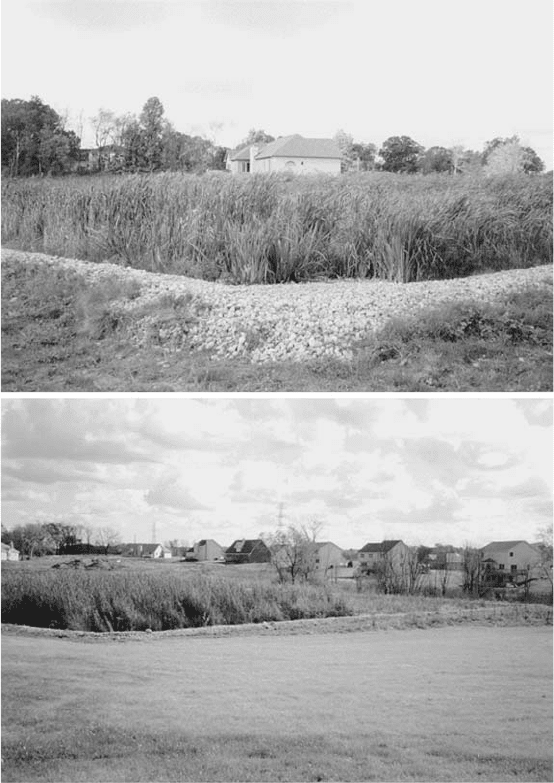
They can be constructed in highly attractive, environmentally friendly configurations
(see, e.g., Figure 16.35).
They may offer lower capital costs (at least for smaller applications).
They will almost certainly have lower operating costs.
They should requi re relatively less operating attention.
Clearly, a primary benefit of constructed wetlands, in terms of their engineered design,
construction, and operation, is that of their simplicity. Wetland cells are typically con-
structed to use a gravity-based flow scheme that has few, if any, moving parts; most
systems use only solar energy; and their demands on operator attention and care are
quite low (being limited to occasional flushing of the influent and effluent lines to
avoid plugging, and seasonal removal of dead, senescent plant debris) .
Figure 16.35 Constructed wetland wastewater treatment systems.
624
BIOLOGICAL APPLICATIONS FOR ENVIRONMENTAL CONTROL
However, these systems can also have a number of related disadvantages that mus t be
recognized, particularly in terms of performance. One key issue is that their best levels of
effluent quality (e.g., BOD , TSS, ammonia) are seldom realized in a matter of weeks or
months after a new facility is installed, but instead, will probably require a year-plus per-
iod for system maturation. In addition, these systems are also apt to experience a higher
degree of seasonal variability than what is typically the case with conventional wastewater
systems, and these seasonal variations will be difficult to control. At the same time, these
natural systems also tend to be susceptible to problems of a sort that would otherwise not
be an issue with standard wastewater treatment operations. For example, the performance
of the plants could be partially disrupted or completely curtailed by plant infestation and
disease. Given the inherent plug-flow mode of wastewater passage through these units, an
incoming slug of potentially harmful household chemicals (e.g., paint thinner, lawn care
chemicals, bleach) could also kill a substantial front-end area of this biological operation
for an extended period. In the particular case of wetlands with which their waste stream is
open to the atmosphere, they have been known to encounter troublesome problems with
mosquito growth as well as occasional odor generation.
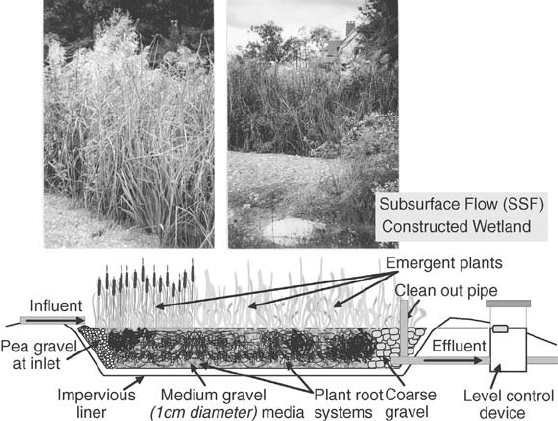
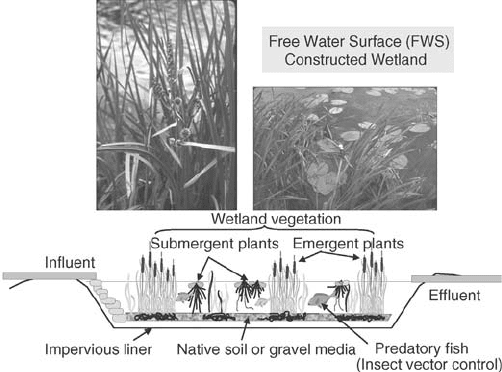
These constructed wetland designs can be roughly subdivided into two major options,
including those that rely on emergent plants and those that use submerged plants either
alone or in combination with emergent plants. The names given to these two options are,
respectively, that of a subsurface flow (SSF) and a free water surface (FWS) constructed
wetland. In either case, it should be noted that some form of pretreatment (e.g., using a
septic tank) is routinely provided ahead of wetlands receiving wastewater flows, to
remove set ttleable solids and floating oils and grease that might otherwise pass into the
wetlands, where they might degrade system performance. In general, submerged-flow
wetland systems tend to require somewhat less opera tional attention than free-water sys-
tems, and they may also have a slight advantage in terms of required land areas for com-
parable flows.
Figure 16.36 Subsurface flow constructed wetland schematic.
WASTEWATER TREATMENT 625
The SSF options (see Figur e 16.36) are commonly constructed with one or more cells
filled with various forms of a porous media, such as coarse and fine gravel washed
previously to remove fine solids that would otherwise reduce necessary void volume,
and planted with various forms of emergent wetland plants. Larger-diameter media
(i.e., 4- to 5-cm coar se gravel) is normally placed across the head-end face of the cell
to spread laterally and distribute the incoming waste uniformly, and then again spread
across the back of the cell to recollect the effluent and direct it smoothly to the system’s
outlet piping. Within the wetland itself, a small-diameter medium (e.g., typically a
washed, 0.75- to 1.5-cm-diameter river gravel) is used to sustain plant rooting. Waste-
water introduced into these cells subsequently flows horizontally through the open,
void space of the porous, subsurface medium at a relatively low velocity, during which
it comes into contact with both the plant’s extensive root system and its affiliated rhizo-
sphere consortia of microorganisms.
The FWS option (depicted schematically in Figure 16.37) for constructed wetlands is
built much the same as those in the SSF mode, with single or serial open cells that are
similarly lined with much the same barrier material. These free-water cells, however, are
only partially filled (10 ! 15 cm deep) with soil or a small-diameter (0.5- to 1-cm) gravel
medium to support the plant root systems, such that the remaining depth is then filled with
water and with floating plus rooted plant mass. Both emergent and submergent plant vari-
eties can be grown in these cells; emergent plants will root themselves in the bottom med-
ium, while the submerged plants can either exist in a free-floating mode whose roots
dangle downward or are again embedded into the bottom medium. When given a
means of supplemental aeration (e.g., using compressed air diffusers), the depths used
with free-water systems are sometimes extended somewhat beyond 1-m depths.
Hydraulic residence time (HRT) is a primary design factor for all of these constructed
wetlands, with minimal recommended values of 5 to 7 days (Hammer, 1989). Conserva-
tive designers may opt for considerably longer times, and many systems are built with
HRTs extending into multiweek periods. However, when provided with supplemental
aeration, or in the case of most subsurface flow designs, these residence times are typi-
cally reduced downward to values around 1 week.
Figure 16.37 Free-water surface constructed wetland schematic.
626
BIOLOGICAL APPLICATIONS FOR ENVIRONMENTAL CONTROL
Example 16.4: Preliminary Constructed Wetland Design Having completed their three
prior preliminary designs, one final process design overview is requested for the Deer
Creek, Illinois, community, in terms of a constructed wetland system. Given the pro-
longed subfreezing winter temperatures typically encountered at this northern midwest
U.S. community, a subsurface-flow (SSF) constructed wetland will be sized preliminarily
to handle a daily average wastewater flow of 605.7 m
3
/day and its commensurate total
BOD loading of 121.2 BOD/day (Note: Although these construc ted wetlands are com-
monly built with preliminary septic tank units, this example design will be based on
the community’s full BOD load as a conservative measure in light of potential septic
tank upset conditions).
Preliminary Design Details
Hydraulic loading,
system sizing,
and residence
times
Design hydraulic residence time (HRT): 7 days
Design wetland media depth: 0.61 m (i.e., 24 in.)
Projected wetland liquid depth: 0.46 m (i.e., 18 in.)
(Note: Typically, only the lower two-thirds of the media depth is
saturated.)
Expected media porosity ¼ 0.4
Projected wetland volume:
ð605:7m
3
=dayÞð7 daysÞð1=0:4Þ¼10; 600 m
3
Projected wetland surface area: (10,600 m
3
)/(0.46 m) ¼23,043 m
2
(1.9 ha)
Projected wetland total media volume: (23,043 m
3
)/(0.61 m) ¼
14,046 m
3
(Note: The latter volume would include both coarse inlet
and outlet media plus smaller 0.75- to 1.5-cm river
gravel.)
Organic loading Projected organic loading:
ð121:2 kg CBOD=dayÞ=ð10;600 m
3
Þ¼0:0069 kg=m
3
day
Hydraulic loading Projected hydraulic loading:
ð605:7m
3
=dayÞ=ð1:9haÞ¼318 m
3
=ha day
Related notes 1. As with the stabilization lagoon option, a constructed wetland
system will need to be considerably larger than the activated
sludge or trickling filter designs for this community, in both
surface area and volume.
2. Construction costs for constructed wetlands can escalate
rapidly with larger facilities (e.g., beyond a daily flow of
500 m
3
/day) due to the capital cost of the media (e.g., washed
coarse and fine gravel) and its on-site delivery.
3. Constructed wetlands are also apt to require less operational
attention, but their cold-weather ability to secure nitrification
may require additional treatment steps depending on regulatory
requirements for effluent ammonia.
WASTEWATER TREATMENT 627