
Velten K. Mathematical Modeling and Simulation: Introduction for Scientists and Engineers
Подождите немного. Документ загружается.


4.6 The Finite Difference Method 265
Section 4.5. Principally, problems of this kind can be solved as matrix equations
using the standard methods of linear algebra such as Gaussian elimination and
LU decomposition techniques [159]. This kind of solution methods are called direct
solution methods since they solve the general matrix problem Ax = b in a single
step, basically by inverting the matrix A. Direct methods, however, are usually
expensive in terms of computer memory since you need to keep the matrix (at least
the nonzero elements) in the memory, and also in terms of their computational
requirements, that is, in terms of the number of arithmetical operations needed
until the solution is obtained [160]. This is a problem even though the matrices
arising in the numerical treatment of PDEs are usually sparse matrices in the sense
that most matrix entries are zero, which reduces the memory requirements.
Thus, linear equations derived from PDEs are usually solved based on another
class of methods called iterative methods. These methods start with an initial guess
for the unknowns, which is then successively improved until a sufficiently precise
approximation of the solution of the PDE is achieved. In the above example, we
could start with an initial guess U
(0)
i,j
(i, j = 0, ..., N)andthenuseEquation4.99to
compute U
(1)
i,j
, U
(2)
i,j
, ...from
U
(k+1)
i,j
=
1
4
U
(k)
i+1,j
+ U
(k)
i−1,j
+ U
(k)
i,j+1
+ U
(k)
i,j−1
+ πρ
i,j
2
(4.100)
This particular iterative method is called the Jacobi method, but there are more
effective methods such as the Gauss–Seidel method and relaxation methods,which
are discussed in [111, 160]. In [111] you may find an example application of Equation
4.99, along with a program solving this equation using a relaxation method.
Note 4.6.1 (Nested iterations) The numerical solution of nonlinear PDEs may
involve several nested iterations (which often can be observed in the output of
PDE solving software): for example, outer iterations resolving the time scale (for
instationary equations) and/or the nonlinearity (Section 4.3.1.3), and an inner
iteration solving the resulting system of linear equations.
4.6.8
Billions of Unknowns
As was just mentioned, iterative methods are used mainly due to the large size of
the linear equation systems derived from PDEs, which may increase the memory
and computation time requirements of direct methods beyond all limits. Referring
to the FD approach just discussed, it can be demonstrated why the linear equation
systems derived from PDEs can be so large. Assume we want to use the FD method
to compute some unknown quantity U inthecube[0,1]
3
. Let us assume that we
use the same spatial step = 1/N (N ∈ N) in all three space directions. Then, an
application of the FD method similar to above would generate a linear equation

266 4 Mechanistic Models II: PDEs
system with about N
3
unknowns U
i,j,k
(the real number of unknowns may be
slightly different due to the application of the appropriate boundary conditions.)
The value of N will depend on your application. N = 10 may be sufficient in some
cases, which would give about N
3
= 1000 unknowns. If, however, your application
requires a very fine resolution, you might need N = 100 and then come up with an
overall number of unknowns in the order of millions.
Now you should note that this example refers to the computation of only one state
variable U. Many applications require the solution of systems of PDEs involving
the computation of several state variables on your computational grid, for example,
the pressure and several velocity components in CFD applications. In the N = 1000
case, you would get a billion unknowns for each of your state variables. Then, you
may want to observe the development of your state variables in time, that is,
you may want to solve your problem as an instationary problem, which means
you have to solve problems involving billions of unknowns in every single time
step of your numerical algorithm. In applications of the FE method (Section 4.7),
your geometry may involve tiny structures that need to be resolved by a very fine
computational grid, and again every point of that fine grid will increase the number
of the unknowns. In this way, your PDE application may easily generate far more
than a billion unknowns, and hence it is not surprising that the solution of PDEs
can be very expensive in terms of memory requirements and computation time.
Note 4.6.2 (Need for computational efficiency) Computational efficiency is an
important issue in the numerical treatment of PDEs. It involves a proper analysis
of the dimensionality and symmetry of the problem (Section 4.3.3) as well as the
use of fast and efficient iterative methods to solve the equations.
Note that N = 100 would generate only about 10 000 unknowns (instead of a
million) if you can solve the problem in 2D (instead of 3D), or about 500 000
unknowns would suffice if you can do your computation in half of the original
domain due to symmetry considerations.
4.7
The Finite-Element Method
As was discussed in Section 4.5, a main disadvantage of the FD method is its
lack of geometrical flexibility. It always needs regular computational grids to be
mapped onto the computational domain, which restricts the complexity of the
geometries that can be treated. The finite-element method (FE method), on the
other hand, is particularly well suited for complex geometries. It uses grids made
up of simple geometrical forms such as triangles in 2D or tetrahedra in 3D. These
simple geometrical forms are called finite elements, and by putting together a great
number of these finite elements virtually any imaginable geometrical object can be
4.7 The Finite-Element Method 267
(a) (b)
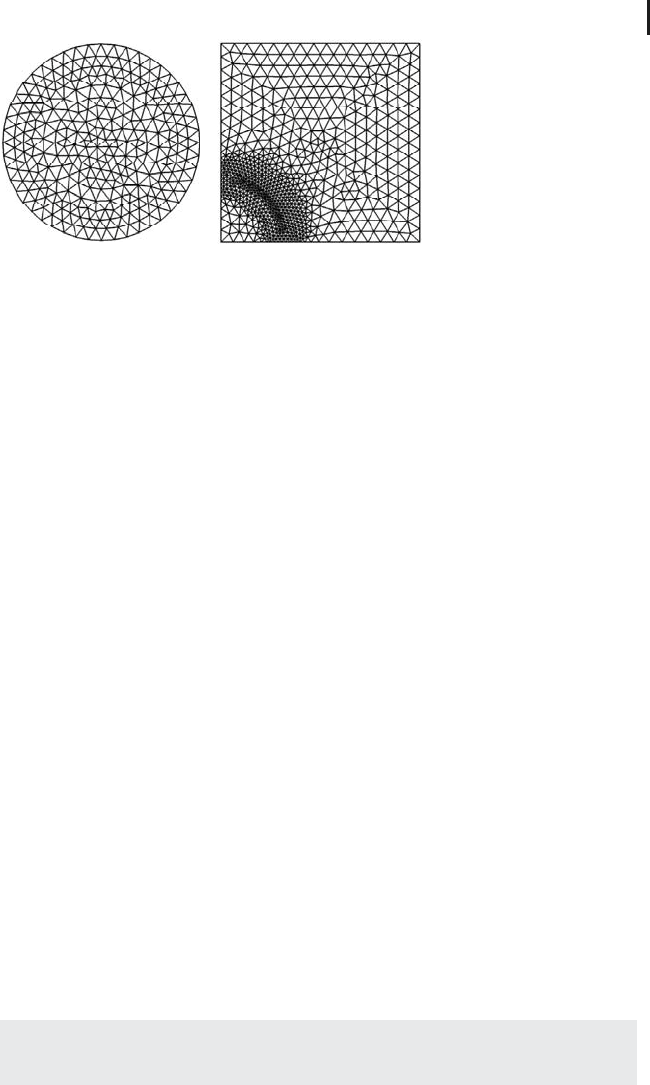
Fig. 4.7 (a) Example triangulation of a circle. (b) Example of a locally refined mesh.
constructed. As an example, Figure 4.7a shows the construction of a circular domain
using triangles as finite elements. A construction as in Figure 4.7a is called a mesh
or grid, and the generation of a mesh covering the geometry is an important step of
the finite-element method (see the discussion of mesh generation using software
in Section 4.8). If a 2D grid is constructed using triangles similar to Figure 4.7a,
the resulting mesh is also called a triangulation of the original geometry.
Note that the geometry shown in Figure 4.7a cannot be covered by the structured
grids that are used in the FD method (Section 4.6). The grid shown in Figure 4.7a
is called an unstructured grid, since the crossing points of the grid – which are also
called the knots of the grid – do not have any kind of regular structure (e.g. in
contrast to the FD grids, they do not imply any natural ordering of these crossing
points). Similar to the FD method, the crossing points of an FE mesh are the points
where the numerical algorithm produces an approximation of the state variables
(more precisely, weights of basis functions are determined at the crossing points,
see below). Depending on your application, you might need a higher or lower
resolution of the numerical solution – and hence a higher or lower density of those
crossing points – in different regions of the computational domain. This can be
realized fairly easily using unstructured FE meshes. Figure 4.7b shows an example
where a much finer grid is used in a circular strip. Such meshes are called locally
refined meshes. Locally refined meshes can not only be used to achieve a desired
resolution of the numerical solution but may also help to circumvent inherent
problems with the numerical algorithms [161–163].
4.7.1
Weak Formulation of PDEs
The difference between the computational approaches of the FD and FE methods
can be phrased as follows:
Note 4.7.1 TheFDmethodapproximatestheequationandtheFEmethod
approximates the solution.

268 4 Mechanistic Models II: PDEs
To make this precise, consider the Poisson equation in 2D (Section 4.6.6):
∂
2
U(x , y)
∂x
2
+
∂
2
U(x , y)
∂y
2
= f (x, y) (4.101)
where (x, y) ∈ ⊂ R
2
and f is some real function on . Now following the idea
of the FD approach and using the central difference approximation described in
Section 4.6.1, this equation turns into the following difference equation:
U(x + x, y) +U(x − x, y) −2U(x, y)
x
2
+
U(x , y + y) +U(x, y − y) − 2U(x, y)
y
2
= f (x, y)
(4.102)
Equation 4.102 approximates Equation 4.101, and in this sense it is valid to
say that ‘‘the FD method approximates the equation’’. Now to understand what
it means that the ‘‘FE method approximates the solution’’, let us consider a 1D
version of Equation 4.101:
u
(x) = f (x) x ∈ (0, 1) (4.103)
u(0) = u(1) = 0 (4.104)
Of course, this is now an ODE, but this problem is, nevertheless, very well suited
to explain the idea of the FE method in simple terms. Let v be a smooth function
which satisfies v(0) = v (1) = 0. Here, ‘‘smoothness’’ means that v is assumed to be
infinitely often differentiable with compact support, which is usually denoted as
v ∈ C
∞
0
(0, 1), see [138] (we do not need to go into more details here since we are
not going to develop a theory of PDEs). Equation 4.103 implies
1
0
u
(x)v(x) dx =
1
0
f (x)v(x) dx (4.105)
Using v(0) = v(1) = 0, an integration by parts of the left-hand side gives
−
1
0
u
(x)v
(x) dx =
1
0
f (x)v(x) dx (4.106)
Let H
1
0
(0, 1) be a suitable set of real functions defined on (0, 1). H
1
0
(0, 1) is a
so-called Sobolev space, which is an important concept in the theory of PDEs (see
the precise definitions in [138]). Defining
φ(u, v) =
1
0
u
(x)v
(x) dx (4.107)
for u, v ∈ H
1
0
(0, 1), it can be shown that the following problem is uniquely solv-
able [80]:
Find u ∈ H
1
0
(0, 1) such that
∀v ∈ H
1
0
(0, 1) : −φ(u, v) =
1
0
f (x)v(x) dx
(4.108)

4.7 The Finite-Element Method 269
Problem (4.108) is called the variational formulation or weak formulation of
Equations 4.103 and 4.104. Here, the term weak is motivated by the fact that some
of the solutions of problem (4.108) may not solve Equations 4.103 and 4.104 since
they do not have a second derivative in the usual sense, which is needed in Equation
4.103. Instead, solutions of problem (4.108) are said to be weakly differentiable,and
these solutions themselves are called weak solutions of the PDE in its original
formulation, that is, of Equations 4.103 and 4.104. Although we confine ourselves
to a discussion of Equations 4.103 and 4.104 here, you should note that similar
weak formulations can be derived for linear second-order PDEs in general, and
these weak formulations can then also be approximated in a similar way using
finite elements as will be explained below [138].
4.7.2
Approximation of the Weak Formulation
The idea of the finite-element method is to replace the infinite-dimensional space
H
1
0
(0, 1) by a finite-dimensional subspace V ⊂ H
1
0
(0, 1), which turns Equation 4.108
into the following problem:
Find u ∈ V such that
∀v ∈ V : −φ(u, v) =
1
0
f (x)v(x) dx
(4.109)
Remember from your linear algebra courses that the dimension of a vector
space V is n ∈ N if there are linear independent basis vectors v
1
, ..., v
n
∈ V that
can be used to express any w ∈ V as a linear combination w = a
1
v
1
+···+a
n
v
n
(a
1
, ..., a
n
∈ R ). For the space H
1
0
(0, 1) used in problem (4.108), no such basis can
be found which means that this is an infinite-dimensional space [138]. Such a space
is unsuitable for a numerical algorithm that can perform only a finite number of
steps, and this is why problem (4.108) is replaced by problem (4.109) based on the
finite-dimensional subspace V.Ifv
1
, ..., v
n
is a set of basis functions of V,any
function u ∈ V canbewrittenas
u =
n
j=1
u
j
v
j
(4.110)
where u
1
, ..., u
n
∈ R . Problem (4.109) can now be written as
Find u
1
, ..., u
n
∈ R such that for i = 1, ..., n
−
n
j=1
φ(v
i
, v
j
) ·u
j
=
1
0
v
i
(x)f (x) dx
(4.111)
Using the definitions
A = (φ(v
i
, v
j
))
i=1...n,j=1...n
(4.112)
u = (u
j
)
j=1...n
(4.113)
f =
1
0
v
i
(x)f (x) dx
i=1...n
(4.114)

270 4 Mechanistic Models II: PDEs
problem (4.111) can be written in matrix form as follows:
Find u ∈ R
n
such that
A · u = f
(4.115)
The FE method thus transforms the original PDE Equations 4.103 and 4.104 into
a system of linear equations, as was the case with the FD method discussed above.
Remember that it was said above that the FD method approximates the equation
expressing the PDE, while the FE method approximates the solution of the PDE
(Note 4.7.1). This can now be made precise in terms of the last equations. Note
that the derivation of Equation 4.115 did not use any discrete approximations of
derivatives, which would lead to an approximation of the equation expressing the
PDE similar to the FD method. Instead, Equation 4.110 was used to approximate the
solution of the PDE – which lies in the infinite-dimensional Sobolev space H
1
0
(0, 1)
as explained above – in terms of the finite-dimensional subspace V ⊂ H
1
0
(0, 1).
4.7.3
Appropriate Choice of the Basis Functions
To simplify the solution of Equation 4.115, the basis v
1
, ..., v
n
of V is chosen in
a way that turns the matrix A into a sparse matrix, that is, into a matrix with most
of its entries being zero. Based on a decomposition of [0, 1] into 0 = x
0
< x
1
<
x
2
···< x
n+1
= 1, one can, for example, use the piecewise linear functions
v
k
(x) =
⎧
⎪
⎪
⎪
⎨
⎪
⎪
⎪
⎩
x − x
k−1
x
k
− x
k−1
if x ∈
[
x
k−1
, x
k
]
,
x
k+1
− x
x
k+1
− x
k
if x ∈
[
x
k
, x
k+1
]
,
0otherwise
(4.116)
Then, the functions v
k
for k = 1, ..., n span up an n-dimensional vector space
V thatcanbeusedasanapproximationofH
1
0
(0, 1) as discussed above. More
precisely, these functions span up the vector space of all functions being piecewise
linear on the subintervals [x
k−1
, x
k
](k = 1, ..., n + 1). In terms of our above
discussion, 0 = x
0
< x
1
< x
2
···< x
n+1
= 1 defines a decomposition of [0, 1] into
finite elements where the subintervals [x
k−1
, x
k
] are the finite elements, and the
mesh (or grid) consists of the points x
0
, ..., x
n+1
.
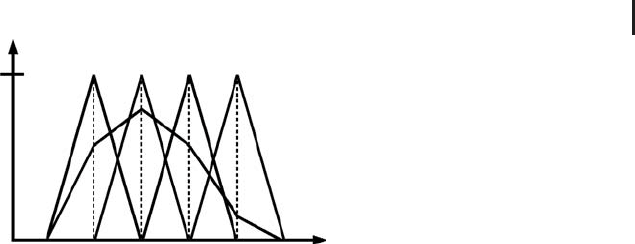
Figure 4.8 shows an example for n = 4. The figure shows four ‘‘hat functions’’
centered at x
1
, x
2
, x
3
, x
4
corresponding to the basis functions v
1
, v
2
, v
3
, v
4
,anda
function being piecewise linear on the subintervals [x
k−1
, x
k
](k = 1, ...,5), which
is some linear combination of the v
k
such as
u(x) =
4
k=1
a
k
v
k
(x) (4.117)
4.7 The Finite-Element Method 271
1
x
0
= 0
x
1
x
2
x
3
x
4
x
5
= 1
Fig. 4.8 Example one-dimensional ‘‘hat’’ basis functions, and
a piecewise linear function generated by a linear combina-
tion of these basis functions.
where a
1
, a
2
, a
3
, a
4
∈ R .Sincev
k
is nonzero only on the interval [x
k−1
, x
k+1
], the
entries of the matrix A in Equation 4.115
φ(v
i
, v
j
) =
1
0
v
i
(x)v
j
(x) dx (4.118)
are zero whenever |i − j| > 1, which means that these basis functions, indeed,
generate a sparse matrix A as discussed above. Obviously, the sparsity of A is a
consequence of the fact that the basis functions v
k
are zero almost everywhere.
Since the set of points where a function gives nonzero values is called the support
of that function, we can say that a basic trick of the FE method is to use basis
functions having a small support.
4.7.4
Generalization to Multidimensions
The same procedure can be used for higher-dimensional PDE problems. For
example, to solve the Poisson equation (4.101), the first step would be to find an
appropriate weak formulation of Equation 4.101 similar to Equation 4.108. This weak
formulation would involve an appropriate Sobolev Space of functions, which would
then again be approximated by some finite-dimensional vector space V. Asabasis
of V, piecewise linear functions could be used as before (although there are many
alternatives [138]). A decomposition of [0, 1] into 0 = x
0
< x
1
< x
2
···< x
n+1
= 1
was used above to define appropriate piecewise linear functions. In 2D, the
corresponding step is a decomposition of the two-dimensional domain into finite
elements, similar to the decomposition of a circular domain into triangles in
Figure 4.7a. In analogy with the above discussion, one would then use piecewise
linear basis functions v
k
, which yield 1 on one particular crossing point of the
finite-element grid and 0 on all other crossing points. Using linear combinations of

272 4 Mechanistic Models II: PDEs
these basis functions, arbitrary piecewise linear functions can then be generated.
In 3D, the same procedure can be used, for example, based on a decomposition of
the computational domain in tetrahedra (Section 4.9.2 and Figure 4.17).
The FE method as described above is an example of a more general approach
called the Galerkin method [161, 162], which applies also, for example, to the
boundary element method for solving integral equations [164, 165] or to Krylov
subspace methods for the iterative solution of linear equation systems [160].
4.7.5
Summary of the Main Steps
The general procedure of the FE method can be summarized as follows:
Main steps of the FE method
1. Geometry definition: definition of the geometry of the domain in
which the PDE is to be solved.
2. Mesh generation: decomposition of the geometry into geometric
primitives called finite elements (e.g. intervals in 1D, triangles in
2D, and tetrahedra in 3D).
3. Weak problem formulation: formulationofthePDEinweakform.
Finite-dimensional approximation of the weak problem using
the mesh.
4. Solution: solution of a linear equation system derived from the
weak problem or of an iterated sequence of linear equation
systems in the case of nonlinear and/or instationary PDEs (Note
4.6.1).
5. Postprocessing: generation of plots, output files, and so on.
The geometry definition step corresponds to the definition of the interval [0, 1] in
the above discussion of Equations 4.103 and 4.104. If we want to solve, for example,
the two-dimensional Poisson equation (4.101) in a circular domain, this step would
involve the definition of that circular domain. Although these examples are simple,
geometry definition can be quite a complex task in general. For example, if we want
to use the PDEs of CFD to study the air flow within the engine of a tractor, the
complex geometry of that engine’s surface area needs to be defined. In practice, this
is done using appropriate CAD software tools. FE software (such as Salome-Meca,
Section 4.8) usually offers at least some simple CAD tools for geometry construction
as well as options for the import of files generated by external CAD software.
The mesh generation step involves the decomposition of the geometry into finite
elements as discussed above. Although triangles (in 2D) and tetrahedra (in 3D) are
used in most practical applications, all kinds of geometrical primitives can be used
here in principle. For example, some applications use rectangles or curvilinear
shapes in 2D or hexahedra, prisms, or pyramids in 3D. Of course, mesh generation

4.7 The Finite-Element Method 273
is an integral part of any FE software. Efficient algorithms for this task have been
developed. An important issue is the mesh quality generated by these algorithms,
that is, the compatibility of the meshes with the numerical solution procedures.
For example, too small angles in the triangles of a FE mesh can obstruct the
numerical solution procedures, and this can be avoided, for example, by the use
of Delaunay triangulations [166]. Another important aspect of mesh generation is
mesh refinement. As was discussed above, one might want to use locally refined
meshes such as the one shown in Figure 4.7b to achieve the desired resolution
of the numerical solution or to avoid problems with the numerical algorithms.
FE software such as Salome-Meca offers a number of options to define locally
refined meshes as required (Section 4.9.2). The mesh generation step may also be
coupled with the solution of the FE problem in various ways. For example, some
applications require ‘‘moving meshes’’, such as coupled fluid–structure problems
where a flowing fluid interacts with a deforming solid structure [167]. Some
algorithms use adaptive mesh refinement strategies where the mesh is automatically
refined or coarsened depending on a posteriori error estimates computed from the
numerical solution [139].
The weak problem formulation step is the most technical issue in the above
scheme. This step involves, for example, the selection of basis functions of the
finite-dimensional subspace V in which the FE method is looking for the solution.
In the above discussion, we used piecewise linear basis functions, but all kinds of
other basis functions such as piecewise quadratic or general piecewise polynomial
basis functions can also be used [166]. Note that some authors use the term finite
element as a name for the basis functions, rather than for the geometrical primitives
of the mesh. This means that if you read about ‘‘quadratic elements’’, the FE method
is used with second-order polynomials as basis functions. If the PDE is nonlinear,
the weak problem formulation must be coupled with appropriate linearization
strategies [139]. Modern FE software such as Salome-Meca (Section 4.8) can be used
without knowing too much about the details of the weak problem formulation step.
Typically, the software will use reasonable standard settings depending on the PDE
type specified by the user, and as a beginner in the FE method it is usually a good
idea to leave these standard settings unchanged.
The solution step of the FE method basically involves the solution of linear
equation systems involving sparse matrices as discussed above. As was mentioned
in Section 4.6.7, large sparse linear equation systems are most efficiently solved
using appropriate iterative methods. In the case of instationary PDEs, the FE
method can be combined with a treatment of the time derivative similar as was
done above for the heat equation (Section 4.6). Basically, this means that a sequence
of linear equation systems must be solved as we move along the time axis [166]. In
the case of nonlinear PDEs, the FE method must be combined with linearization
methods such as Newton’s method [139], which again leads to the solution of an
iterated sequence of linear equation systems. Again, all this as well as the final
postprocessing step of the FE method is supported by modern FE software such as
Salome-Meca (Section 4.8).

274 4 Mechanistic Models II: PDEs
Note 4.7.2 (Comparison of the FD and FE methods) The FD method is relatively
easy to implement (Section 4.6), but is restricted to simple geometries. The FE
method can treat complex geometries, but its implementation is a tedious task
and so it is usually efficient to use existing software tools such as Salome-Meca.
4.8
Finite-element Software
As was mentioned above, the software implementation of the FE method is a
demanding task, and this is why most people do not write their own FE programs.
A great number of both open-source and commercial FE software packages are
available, see Table 4.1 for a list of examples which is by no means exhaustive.
Generally speaking, there is a relatively broad gap between open-source and
commercial FE software. It is relatively easy to do your everyday office work, for
example, using the open-source OpenOffice software suite instead of the commercial
Microsoft Office package, or to perform a statistical analysis using the open-source
R package instead of commercial products such as SPSS, but it is much less easy
to work with open-source FE software if you are used to commercial products
such as Fluent or Comsol Multiphysics. Given a particular FE problem, it is highly
likely that you will find open-source software that can solve your problem, but
you will need time to understand that software before you can use it. Having
solved that particular problem, your next problem may be beyond the scope of that
software, so you may have to find and understand another suitable open-source
FE package. The advantages of commercial FE software can be summarized as
follows:
•
Range of application: commercial FE software usually
provides a great number of models that can be used.
•
User-friendliness: commercial FE software usually provides
sophisticated graphical user interfaces, a full integration of
all steps of the FE analysis from the geometry definition to
the postprocessing step (Section 4.7.5), a user friendly
workflow involving, for example, the extraction of
parameters from material libraries, and so on.
•
Quality: commercial FE software usually has been
thoroughly tested.
•
Maintenance and support: commercial FE software usually
provides a continuous maintenance and support.
Of course, these points describe the general advantages of commercial software
not only in the field of finite-element analysis. All these have particular relevance
here due to the complexity of this kind of analysis: an enormous amount of
resources is needed to set up general FE software packages such as Fluent or
Comsol Multiphysics.