
Velten K. Mathematical Modeling and Simulation: Introduction for Scientists and Engineers
Подождите немного. Документ загружается.


2.2 Linear Regression 65
2.2
Linear Regression
Generally speaking, regression models involve the analysis of a dependent variable
in terms of one or several independent variables. In regression, the dependent
variable is expressed in terms of the independent variables using various types
of regression equations. Parameters in the regression equations are then tuned
in a way that fits these equations to data. The idea of the regression method has
already been explained based on the spring data
spring.ods in Section 1.5. As
it was discussed there referring to the black box input–output system in Figure
1.8, one can say that regression is a really prototypical method among the existing
phenomenological modeling approaches. It contains all the essential ingredients:
an input x,anoutputy, a black box–type system transforming x into y,and
the attempt to find a purely data-based mathematical description of the relation
between x and y.Thetermregression itself is due to a particular regression study
that was performed by Francis Galton who investigated human height data. He
found that, independent of their parents’ heights, the height of children tends to
regress toward the typical mean height [40].
2.2.1
The Linear Regression Problem
Assume we have a dataset (x
1
, y
1
), (x
2
, y
2
), ...,(x
m
, y
m
)(x
i
, y
i
∈ R , i = 1, ..., m,
m ∈ N). Then, the simplest thing one can do is to describe the data using a
regression function or model function of the form
ˆ
y(x) = ax + b (2.27)
The coefficients a and b in Equation 2.27 are called the regression coefficients or the
parameters of the regression model. x is usually called the explanatory variable (or
predictor variable,orindependent variable), while
ˆ
y (or y) is called the response variable
(or dependent variable). Note that the hat notation is used to distinguish between
measured values of the dependent variable (written without hat as y
i
)andvaluesof
the dependent variable computed using a regression function (which are written
in hat notation, see Equation 2.27). A function
ˆ
y(x ) as in Equation 2.27 is called
a linear regression function since this function depends linearly on the regression
coefficients, a and b [41].
Note 2.2.1 (Linear regression) A general one-dimensional linear regression
function
ˆ
y(x ) computes the response variable y based on the explanatory vari-
able x and regression coefficients a
0
, a
1
, ..., a
s
(s ∈ N). If the expression
ˆ
y(x )
depends linearly on a
0
, a
1
, ..., a
s
, it can be fitted to measurement data us-
ing linear regression. Higher-dimensional linear regression functions involving
multiple explanatory variables will be treated in Section 2.3, the nonlinear case
in Sections 2.4 and 2.5.
66 2 Phenomenological Models
Equation 2.27 fits the data well if the differences y
i
−
ˆ
y(x
i
)(i = 1, ..., m)are
small. To achieve this, let us define
RSQ =
m
i=1
y
i
−
ˆ
y(x
i
)
2
(2.28)
This expression is called the residual sum of squares (RSQ). Note that RSQ
measures the distance between the data and the model: if RSQ is small, the
differences y
i
−
ˆ
y(x
i
) will be small, and if RSQ is large, at least some of the
differences y
i
−
ˆ
y(x
i
) will be large. This means that to achieve a small distance
between the data and the model, we need to make RSQ small. In regression, this
is achieved by an appropriate tuning of the parameters of the model. Precisely, the
parameters a and b are required to solve the following problem:
min
a,b∈R
RSQ (2.29)
Note that RSQ depends on a and b via
ˆ
y. The solution of this problem can
be obtained by an application of the usual procedure for the minimization of a
function of several variables to the function RSQ(a, b) (setting the partial derivatives
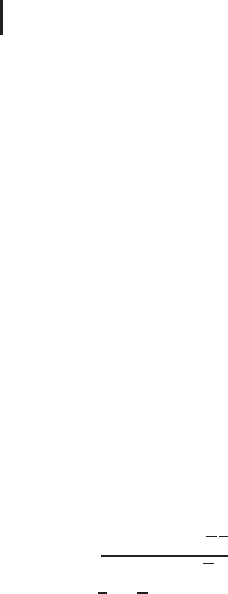
of this function with respect to a and b to zero etc.) [17], which gives [19]
a =
m
i=1
x
i
y
i
− mx y
m
i=1
x
2
i
− mx
2
(2.30)
b =
y − ax (2.31)
The use of RSQ as a measure of the distance between the model and the data
may seem somewhat arbitrary since several other alternative expressions could
be used here (e.g. RSQ could be replaced by a sum of the absolute differences
|y
i
−
ˆ
y(x
i
)|). RSQ is used here since it leads to maximum likelihood estimates of the
model parameters, a and b, if one makes certain assumptions on the statistical
distribution of the error terms, y
i
−
ˆ
y(x
i
) (see below). Using these assumptions, the
maximum likelihood estimates of the model parameters derived from minimizing
RSQ make the data ‘‘more likely’’ compared to other choices of the parameter
values [41].
2.2.2
Solution Using Software
Now let us see how this analysis can be performed using software. We refer
to the data in
spring.csv as an example again (see Section 1.5.6). Start the R
Commander asdescribedinAppendixBanthenimportthedata
spring.csv into
the R Commander using the menu option ‘‘Data/Import data/From text file’’. Then
choose the menu option ‘‘Statistics/Fit models/Linear regression’’ and select x and
y as the explanatory and response variables of the model, respectively. This gives
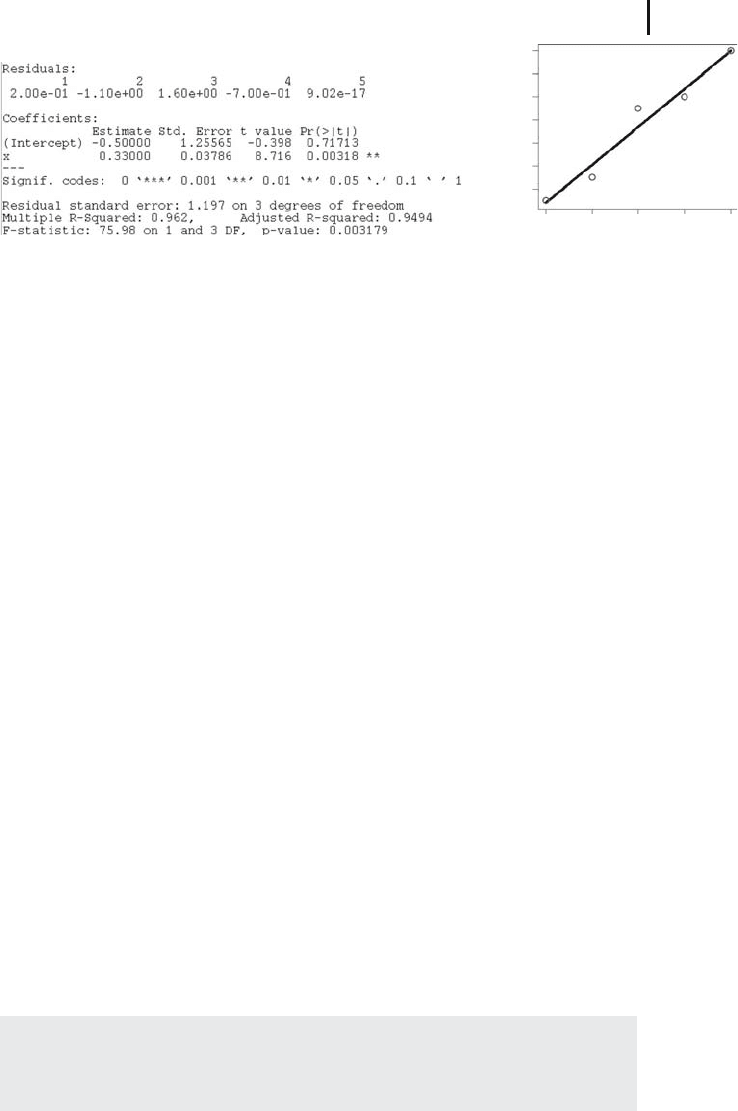
the result shown in Figure 2.2a.
2.2 Linear Regression 67
x(N)
2010 30 40 50
y(cm)
16
14
12
10
8
6
4
(a) (b)
Fig. 2.2 (a) Linear regression result obtained using the R
Commander and the data in
spring.csv. (b) Compar-
ison of the regression line Equation 2.32 with the data
spring.csv.FigureproducedusingLinRegEx1.r.
The R output shown in Figure 2.2a first reports the residuals between the data
and the model, that is, the differences y
i
−
ˆ
y(x
i
)(i = 1, ..., m), which yields 5 values
in this case since
spring.csv contains 5 lines of data. You can get an idea about
the quality of the fit between data and model based on these values, but it is of
course better to see this in a plot (see below). After this, R reports on the regression
coefficients, in a table comprising two lines, the first one (labeled
Intercept)
referring to the coefficient b in Equation 2.27 and the second one (labeled
x)
referring to the coefficient a in the same equation. The labels used in this table are
justified by the fact that b describes the intercept of the line given by Equation 2.27,
that is, the position where this line crosses the y-axis, while a is the coefficient that
multiplies the x in Equation 2.27. In the ‘‘
Estimate’’ column of Figure 2.2 you see
that a =−0.5andb = 0.33 have been obtained as the solution of Problem (2.29).
Using Equation 2.27, this means that we have obtained the following regression
line:
ˆ
y(x) = 0.33x − 0.5 (2.32)
Figure 2.2b compares the regression line, Equation 2.32, with the data in
spring.csv. This figure has been generated using the R program LinRegEx1.r
in the book software. A similar figure can be produced using the R Commander
based on the menu option ‘‘Graphs/Scatterplot’’, but you should note that the R
Commander offers a limited number of graphical options only. Unlimited graphical
options (e.g. to change line thicknesses and colors) can be accessed if you are using
R programs such as
LinRegEx1.r. You will find a few comments on the content
of
LinRegEx1.r further below in this section.
Note 2.2.2 (Regression coefficients) Estimates of the regression coefficients
in regression equations such as Equation 2.27 can be obtained using formulas
such as Equations 2.30 and 2.31, the R-Commander, or R programs such

68 2 Phenomenological Models
as LinRegEx1.r. Note that no formulas are available for general nonlinear
regression equations, as discussed in Section 2.4.
As Figure 2.2b shows, the regression line captures the tendency in the data. It is
thus reasonable to use the regression line for prediction, extrapolating the tendency
in the data using the regression line. Formally, this is done by inserting x values
into Equation 2.32. For example, to predict y for x = 60, we would compute as
follows:
ˆ
y(60) = 0.33 ·60 − 0.5 = 19.3 (2.33)
Looking at the data in Figure 2.2b, you see that
ˆ
y(60) = 19.3 indeed is a reasonable
extrapolation of the data. Of course, predictions of this kind can expected to be
useful only if the model fits the data sufficiently well, and if the predictions are
computed ‘‘close to the data’’. For example, our results would be questionable if we
used Equation 2.32 to predict y for x = 600, since this x-value would be far away
from the data in
spring.csv. The requirement that predictions should be made
close to the data that have been used to construct the model applies very generally to
phenomenological models, including the phenomenological approaches discussed
in the next sections.
Note 2.2.3 (Prediction) Regression functions such as Equation 2.27 can be
used to predict values of the response variable for given values of the explanatory
variable(s). Good predictions can be expected only if the regression function fits
the data sufficiently well, and if the given values of the explanatory variable lie
sufficiently close to the data.
2.2.3
The Coefficient of Determination
As to the quality of the fit between the model and the data, the simplest approach
is to look at appropriate graphical comparisons of the model with the data such
as Figure 2.2b. Based on that figure, you do not need to be a regression expert to
conclude that there is a good matching between model and data, and that reasonable
predictions can be expected using the regression line. A second approach is the
coefficient of determination, which is denoted as R
2
. Roughly speaking, the
coefficient of determination measures the quality of the fit between the model and
the data on a scale between 0 and 100%, where 0% refers to very poor fits and 100%
refers to a perfect matching between the model and the data. R
2
thus expresses the
quality of a regression model in terms of a single number, which is useful e.g. when
you want to compare the quality of several regression models, or if you evaluate
multiple linear regression models (Section 2.3) which involve higher-dimensional
regression functions
ˆ
y(x
1
, x
2
, ..., x
n
) that cannot be plotted similar to Figure 2.2b

2.2 Linear Regression 69
(note that a plot of
ˆ
y over x
1
, x
2
, ..., x
n
would involve an n + 1-dimensional space).
In the R-output shown in Figure 2.2a, R
2
is the Multiple R Squared value, and
hence you see that we have R
2
= 96.2% in the above example, which reflects the
good matching between the model and the data that can be seen in Figure 2.2b. The
Adjusted R Squared value in Figure 2.2a will be explained below in Section 2.3.
Formally, the coefficient of determination is defined as [37]
R
2
=
n
i=1
ˆ
y
i
− y
2
n
i=1
y
i
− y
2
(2.34)
wherewehaveused
ˆ
y
i
=
ˆ
y(x
i
). For linear regression models, this can be rewritten as
R
2
= 1 −
n
i=1
y
i
−
ˆ
y
i
2
n
i=1
y
i
− y
2
(2.35)
The latter expression is also known as the pseudo-R
2
and it is frequently used to
assess the quality of fit in nonlinear models. Note that R
2
according to Equation 2.35
can attain negative values if the
ˆ
y
i
values are not derived from a linear regression
(whereas Equation 2.34 guarantees R
2
> 0), and if these values are ‘‘far away’’
from the measurement values. If you observe negative R
2
values, then your model
performs worse than a model that would yield the mean value
y for every input
(i.e.
ˆ
y(x
i
) = y, i = 1, ..., m), since such a mean value model would give R
2
= 0in
Equation 2.35.
In a linear model, it can be easily shown that R
2
expresses the ratio between the
variance of the predicted values (
ˆ
y
1
, ...,
ˆ
y
1
) and the variance of the measurement
values (y
1
, ..., y
n
). R
2
= 100% is thus usually expressed like this: ‘‘100% of the
variance of the measurement data is explained by the model.’’ On the other hand,
R
2
values substantially below 100% indicate that there is much more variance in
the measurement data compared to the model, and this means that the variance of
the data is insufficiently explained by the model, which means that one has to look
for additional explanatory variables. For example, if a very poor R
2
is obtained for a
linear model
ˆ
y = ax + b, it may make sense to investigate multiple linear models
such as
ˆ
y = ax + bz + c which involves an additional explanatory variable z (see
Section 2.3 below).
Note 2.2.4 (Coefficient of determination) The coefficient of determination, R
2
,
measures the quality of fit between a linear regression model and data. On a scale
between 0 and 100%, it expresses how much of the variance of the dependent
variable measurements is explained by the explanatory variables of the model. If
R
2
is small, one can try to add more explanatory variables to the model (see the
multiple regression models in Section 2.3) or use nonlinear models (Sections 2.4
and 2.5).

70 2 Phenomenological Models
2.2.4
Interpretation of the Regression Coefficients
You may wonder why the values of a and b appear in a column called Estimates in
the R output of Figure 2.2a, and why standard errors are reported for a and b in the
next column. Roughly speaking, this is a consequence of the fact that measurement
data typically are affected by measurement errors. For example, a measurement
device might exhibit a random variation in its last significant digit, which might
lead to values such as 0.856, 0.854, 0.855, and 0.854 when we repeat a particular
measurement under the same conditions several times (beyond this, there may
be several other systematic and random sources of measurement errors, see [42]).
Now suppose that we analyze measurement data (x
1
, y
1
), (x
2
, y
2
), ...,(x
m
, y
m
)as
above using linear regression, which might lead us to regression coefficients a and
b. If we repeat the measurement, the new data will (more or less) deviate from the
original data due to measurement errors, leading to (more or less) different values
of a and b in a regression analysis. The parameters a and b thus depend on the
random errors in the measurement data, and this means that a and b can be viewed
as realizations of random variables α and β (see Section 2.1.2.1).
Usually, it is assumed that these random variables generate the measurement
data (x
1
, y
1
), (x
2
, y
2
), ...,(x
m
, y
m
) as follows:
y
i
= αx
j
+ β +
i
, i = 1, ..., m (2.36)
where the
i
expresses the deviation between the model and the data, which
includes the measurement error. The error terms
i
are typically assumed to be
normally distributed with zero expectation and a constant variance σ
2
independent
of i (so-called homoscedastic error terms). Using these assumptions, the standard
errors of α and β can be estimated, and these estimates are reported in the column
Std.Error of the R output in Figure 2.2a. As you see there, the standard error
of α is much smaller than the standard error of β, which means that you may
expect larger changes of the estimate of β compared to the estimate of α if you
would perform the same analysis again using a different dataset. In other words,
theestimateofβ is ‘‘less sharp’’ compared to that of α. The numbers reported
in the column ‘‘
t value’’ of Figure 2.2a refer to the Student’s t distribution, and
they can be used e.g. to construct confidence intervals of the estimated regression
coefficients as explained in [19]. The values in the last column of Figure 2.2a are
the p values that have been discussed in Sections 2.1.3.2 and 2.1.3.4.
2.2.5
Understanding
LinRegEx1.r
AbovewehaveusedtheR program LinRegEx1.r to produce Figure 2.2b. See
Appendix B for any details on how to use and run the R programs of the book

2.2 Linear Regression 71
software. The essential commands in this code can be summarized as follows:
1: eq=y~x
2: FileName="Spring.csv"
3: Dataset=read.table(FileName,
...)
4: RegModel=lm(eq,data=Dataset)
5: print(summary(RegModel))
6: a=10
7: b=50
8: xprog=seq(a, b, (b-a)/100)
9: yprog=predict(RegModel, data.frame(x = xprog))
10: plot(xprog,yprog,
...)
(2.37)
As mentioned before, the numbers ‘‘1:’’,‘‘2:’’, and so on in this code are not
a part of the program, but just line numbers that are used for referencing in our
discussion. Line 1 defines the regression equation in a special notation that you
find explained in detail in R’s help pages and in [43]. The command in line 1 stores
the regression equation in a variable
eq whichisthenusedinline4tosetupthe
regression model, so
y∼x is the part of line 1 that defines the regression equation.
Basically,
y∼x can be viewed as a short notation for Equation 2.27, or for Equation
2.36 (it implies all the statistical assumptions expressed by the last equation, see
the above discussion). The part at the left hand of the ‘‘∼’’-sign of such formulas
defines the response variable (y in this case), which is then expressed on the
right-hand side in terms of the explanatory variable (x in this case). Comparing the
formula
y∼x with Equation 2.27, you see that this formula notation automatically
implies the regression coefficients, a and b, which do not appear explicitly in the
formula. You should note that the variable names used in these formulas must
correspond to the column names that are used in the dataset. In this case, we are
using the dataset
spring.csv where the column referring to the response variable
is denoted as
y and the column referring to the explanatory variable is denoted as
x. If, for example, we would have used the column names elongation instead of
y and force instead of x, then we would have to write the regression equation as
elongation∼force instead of y∼x.
Lines 2 and 3 of program 2.37 read the data from the file
spring.csv into the
variable
Dataset (see LinRegEx1.r for the ‘‘long version’’ of line 3 including all
details). Using the regression equation
eq from line 1 and Dataset from line 3,
the regression is then performed in line 4 using the
lm command, and the result
is stored in the variable
RegModel.
Note 2.2.5 (R’s lm function) Linear regression problems (including the mul-
tiple linear problems treated in Section 2.3) are solved in R using the
lm
command.
72 2 Phenomenological Models
The variable RegModel is then used in line 5 of program 2.37 to produce the R
output that is displayed in Figure 2.2a above. Lines 6–9 show how R’s
predict
command can be used to compute predictions based on a statistical model such as
RegModel. In lines 6–8, an array xprog is generated using R’s seq command that
contains 101 equally spaced values between
a=10 and b=50 (just try this command
to see how it works). The
predict command in line 9 then applies the regression
equation 2.27 (which it takes from its
RegModel argument) to the data in xprog
and stores the result in yprog. xprog and yprog are then used in line 10 to plot
the regression line using R’s
plot command as it is shown in Figure 2.2b (again,
see
LinRegEx1.r for the full details of this command).
2.2.6
Nonlinear Linear Regression
Above it was emphasized that there are more general regression approaches. To see
that there is a need for regression equations beyond Equation 2.27, let us consider
the dataset
gag.csv which you find in the book software. These data are taken from
R’s
MASS library where they are stored under the name GAGurine.Asexplained
in [44, 45] (and in R’s help pages), these data give the concentrations of so-called
glycosaminoglycans (GAG) in the urine of children aged from 0 to 17 (in units
of milligrams per millimole creatinine). GAG data are measured as a screening
procedure for a disease called mucopolysaccharidosis. As Figure 2.3a shows, the
GAG concentration decreases with increasing age. Pediatricians need such data to
assess whether a child’s GAG concentration is normal. Based on
GAG.csv only, it
would be relatively time consuming to compare a given GAG concentration with
the data. A simpler procedure would be to insert the given GAG concentration into
a function that closely fits the data in the sense of regression. So let us try to derive
an appropriate regression function similar to above. In
GAG.csv,theAge and GAG
columns give the ages and GAG concentrations, respectively. Using the regression
function Equation 2.27 and proceeding as above, the regression equation can be
0 5 10 15
Age (years)
20
15
10
5
0
GAG (mg mmol
−1
)
GAG (mg mmol
−1
)
0 5 10 15
Age (years)
30
25
20
15
10
5
(a) (b)
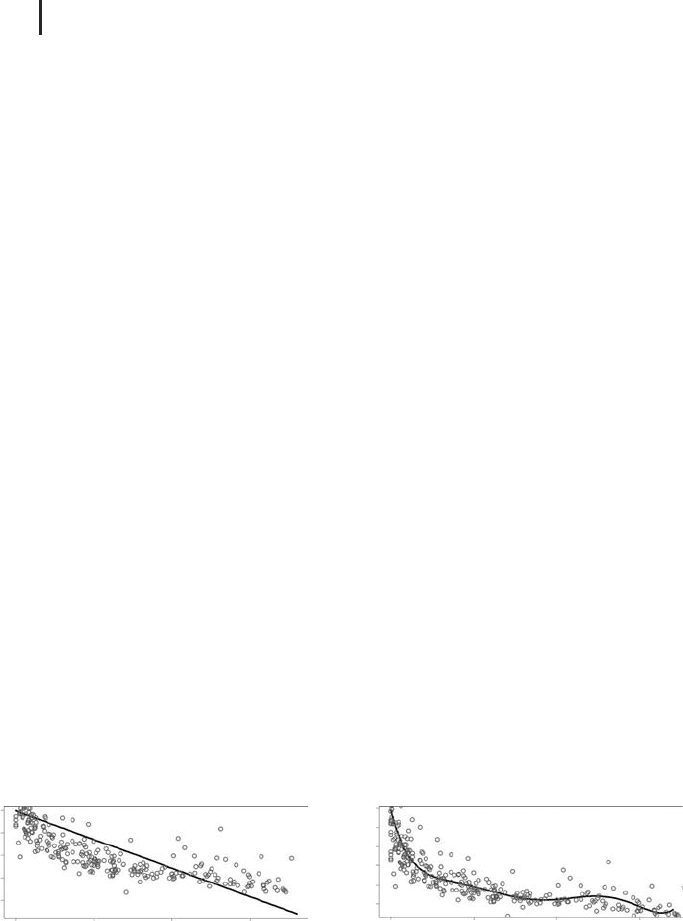
Fig. 2.3 (a) Comparison of the regression line Equation
2.39 with the data
GAG.csv.Figureproducedusing
LinRegEx4.r. (b) Comparison of the regression function
Equation 2.43 with the data
GAG.csv.Figureproducedusing
LinRegEx5.r.

2.2 Linear Regression 73
described in R as follows:
eq=GAG~Age
(2.38)
Inserting this into LinRegEx1.r (and changing the file name etc. appropriately),
one arrives at
LinRegEx4.r which you find in the book software. Analyzing the R
output generated by
LinRegEx4.r as above, we obtain the following equation of
the regression line:
GAG(x) =−1.27 · Age + 19.89 (2.39)
Figure 2.3a compares this linear regression function with the data. As can be
seen, the regression function overestimates GAG for ages below about nine years,
and it underestimates GAG for higher ages. For ages above 15.7 years, the GAG
concentrations predicted by the regression function are negative.
This is due to the fact that the data follow some nonlinear, curved pattern which
cannot be described appropriately using a straight line. An alternative is to replace
Equation 2.27 by a polynomial regression function of the general form
ˆ
y(x) = a
0
+ a
1
x + a
2
x
2
+···+a
s
x
s
(2.40)
You may wonder why such a regression function is treated here in a section
on ‘‘linear regression’’, since the function in Equation 2.40 can of course be a
highly nonlinear function of x (depending on s, the degree of the polynomial). But
remember, as was explained above in Note 2.2.1, that the term linear in ‘‘linear
regression’’ does not refer to the regression function’s dependence on x,butrather
to its dependence on the regression coefficients. Seen as a function of x,Equation
2.40 certainly expresses a function that may be highly nonlinear, but if x is given,
ˆ
y
is obtained as a linear combination of the regression coefficients a
0
, a
1
, ..., a
s
.In
this sense, all regression functions that can be brought into the general form
ˆ
y(x) = a
0
+ a
1
f
1
(x) + a
2
f
2
(x) +···+a
s
f
s
(x) (2.41)
can be treated by linear regression (where a
0
, a
1
, ..., a
s
are the regression coeffi-
cients as before, and the f
i
are arbitrary real functions). Whether linear or nonlinear
in x , all these functions can be treated by linear regression, and this explains the
title of this subsection (‘‘nonlinear linear regression’’).
To perform an analysis based on the polynomial regression function 2.40, we can
use R similarly as above. Basically, we just have to change the regression equation
in the previous R program
LinRegEx4.r. After some experimentation (or using
the more systematic procedure suggested in [45]) you will find that it is a good idea
to use a polynomial of degree 6, which is written in the notation required by R
analogous to Equation 2.38 as follows:
eq=GAG~Age+I(Ageˆ2)+I(Ageˆ3)+I(Ageˆ4)+I(Ageˆ5)+I(Ageˆ6)
(2.42)

74 2 Phenomenological Models
In this equation, the R function I() is used to inhibit the interpretation of
terms like
Age^2 based on the special meaning of the ‘‘^’’ operator in R’s formula
language. Written as ‘‘
I(Age^2)’’, the ‘‘^’’ operator is interpreted as the usual
arithmetical exponentiation operator. The R program
LinRegEx5.r in the book
software uses the regression function described in Equation 2.42. Executing this
program and analyzing the results as before, the following regression function is
obtained (coefficients are rounded for brevity):
GAG(x) = 29.3 − 16.2 · Age + 6 · Age
2
− 1.2 · Age
3
+0.1 · Age
4
− 5.7e-03 · Age
5
+ 1.1e-04 · Age
6
(2.43)
Figure 2.3b compares this regression function with the data. As can be seen,
this regression function fits the data much better than the straight line that
was used in Figure 2.3a. This is also reflected by the fact that
LinRegEx4.r
(regression using the straight line) reports an R
2
value of 0.497 and 4.55 as the
mean (absolute) deviation between the data and the model, while
LinRegEx5.r
(polynomial regression) gives R
2
= 0.74 and a mean deviation of 2.8. Therefore the
polynomial regression obviously does a much better job in helping pediatricians to
evaluate GAG measurement data as described above. Note that beyond polynomial
regression, R offers functions for spline regression that may yield ‘‘smoother’’
regression functions based on a concatenation of low-order polynomials [45, 46].
Note 2.2.6 (Regression of large datasets) Beyond prediction, regression func-
tions can also be used as a concise way of expressing the information content of
large datasets similar to the GAG data example.
2.3
Multiple Linear Regression
In the last section, we have seen how the regression approach can be used to
predict a quantity of interest, y , depending on known values of another quantity,
x. In many cases, however, y will depend on several independent variables such
as x
1
, x
2
, ..., x
n
(n ∈ N). This case can be treated by the multiple (linear) regression
method. As we will see, the overall procedure is very similar to the approach
described in the last section.
2.3.1
The Multiple Linear Regression Problem
Let us begin with an example. Note that we could really take all kinds of examples
here due to the generality of the regression approach that can be used in all fields of
science and engineering. Every dataset could be used that consists of at least three
columns: two (or more) columns for the explanatory variables x
1
, x
2
, ...,andone