
Yam, Kit L. (ed.). The Wiley encyclopedia of packaging technology
Подождите немного. Документ загружается.

value at sea level and is, therefore, easily compared from
one laboratory to another.
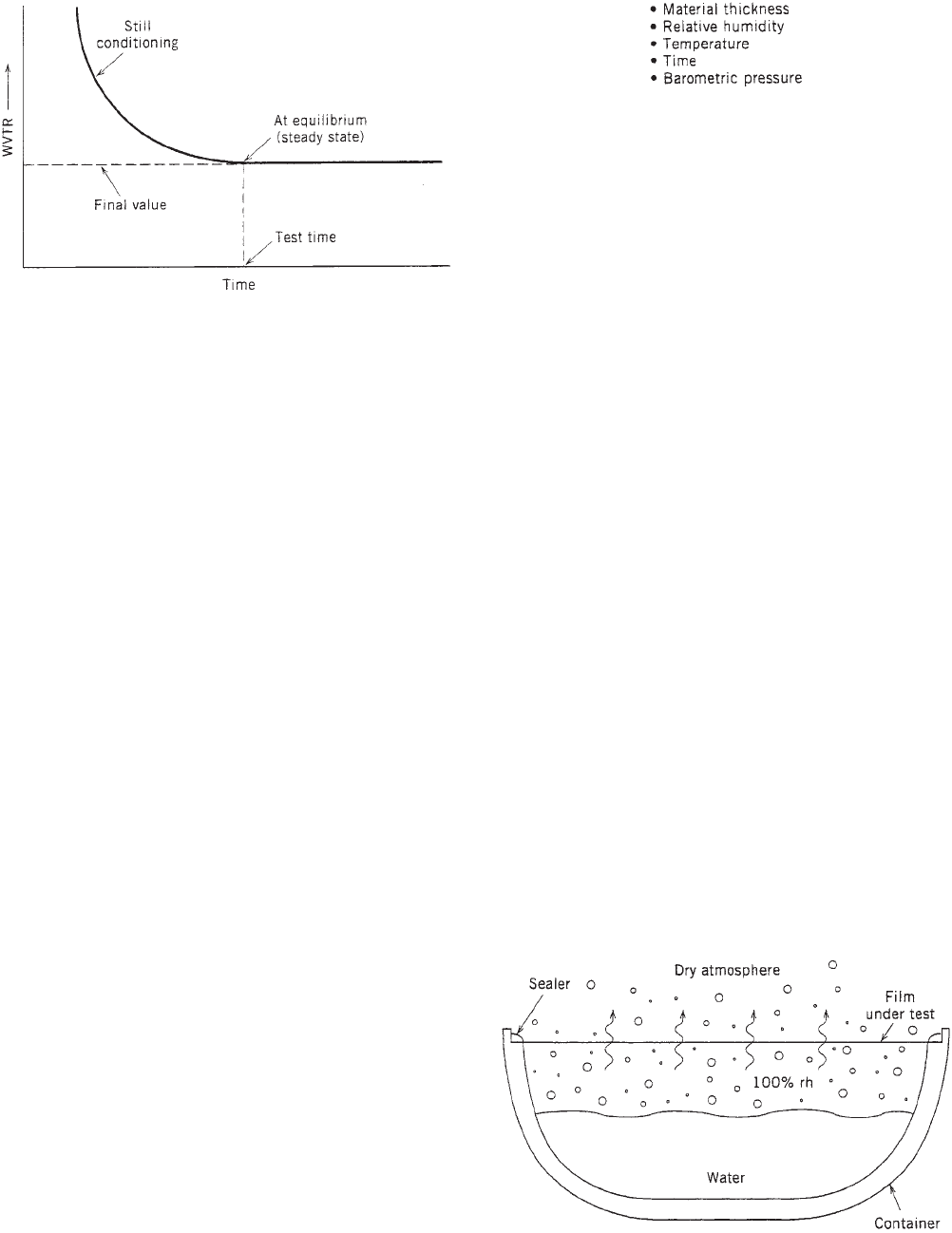
Equilibration. A sample of barrier film is mounted in a
permeation instrument test cell and the test is started.
Note the time data in Figure 1. The results of a test are
valid only once the barrier material has reached
equilibrium.
. Material thickness
. Relative humidity
. Temperature
. Time
. Barometric pressure
The time for the sample to reach equilibrium cannot be
appreciably accelerated or shortened. Time is a physical
function of the material. The better the barrier, the longer
it takes to get results. For example, 1 mil (25 mm) PET
takes 1 h, whereas 5 mils (125 mm) PET takes 8 h to
stabilize. If the result is taken prematurely, it will be
wrong, as steady state has not yet been reached.
Five major factors that affect permeation rate through
a barrier polymer are listed in Figure 2.
PIONEERING METHODS
We must acknowledge some of the pioneer work in the field
of permeation, in particular the water-vapor permeation
cup test (1, 2) (see also Figure 3) developed in the early
1940s. These test methods determine the loss of water from
a cup through a barrier sealed on top of the cup and are still
used in a few locations. Permeation does have disadvan-
tages, such as a long time to obtain results (days vs. hours),
limited testing range, being labor intensive, requiring
expensive climate-control chambers, and being operator
dependent. However, steady progress has been made in
instrumented testing systems that allow shorter test times,
greater limits, better repeatability, increased sensitivity,
computerized control, and documentation.
Also, recognition is due to other early developments as
listed in ASTM D1434 (M) on the manometric cell (also
known as the Dow cell) and ASTM D1434 (V) on the
volumetric cell. These were gallant attempts, but are no
longer in widespread use.
CURRENT METHODS
Oxygen Transmission Rate (O
2
TR). Oxygen is often re-
ferred to as the ‘‘thief’’ of flavor, texture, color, nutrition,
and shelf life. The importance of testing O
2
TR was recog-
nized early in the development of barrier materials such
as coated papers and plastics. The coulometric sensor (also
known as the coulox sensor) soon dominated because it
could detect O
2
down to the parts per billion (ppb) level,
was stable, and was easy to maintain and reliable.
Initially only ‘‘dry’’ tests were performed, 0% rh, which
was adequate for many of the barriers of that day. How-
ever, subsequent barrier materials were developed that
had superior O
2
permeation characteristics, but the O
2
TR
of these new materials was a function of humidity.
Oxygen permeation testing has advanced in capability
to allow testing of the most recent developments in barrier
materials. The ability to control the percent relative
humidity (% rh) independently on each side of the barrier
has been one of the most significant advancements. This
allows a better simulation of true-to-life shelf conditions
and, therefore, more credible results.
The effect of % rh and temperature on O
2
TR can be
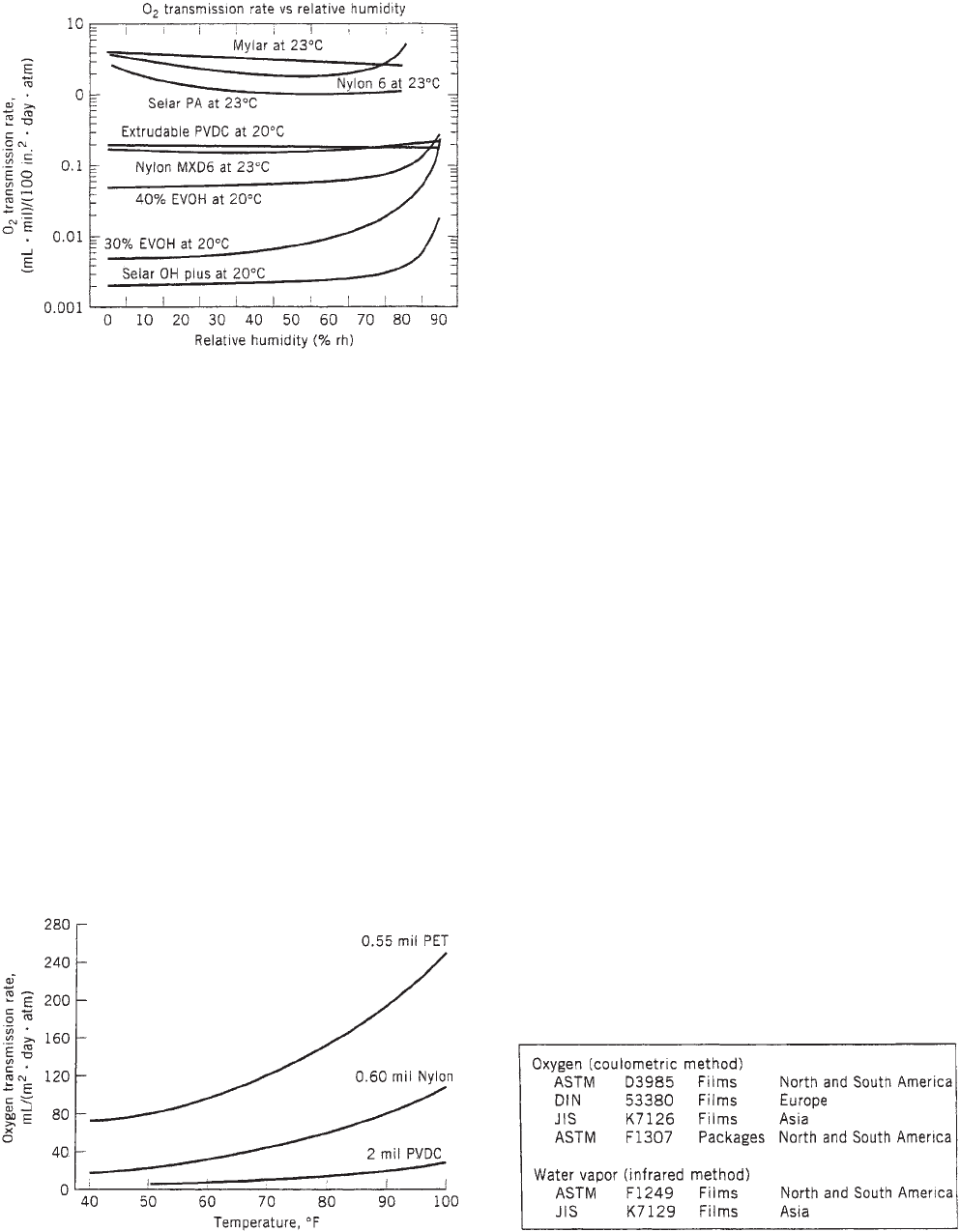
observed in Figures 4 and 5.
Performance expectations are important. The measur-
able range of O
2
transmission rates is 0.001 mL/(m
2
day)
to over 1,000,000 mL/(m
2
day). The following list is spe-
cifications on Ox-Tran systems,
3
as used in ASTM D3985
and F1307:
Sensitivity—films, 0.01 mL/(m
2
day) [0.0006 mL/
(100 in.
2
day)]; packages, 0.00005 mL/package day)
Figure 1. Typical example of time to condition specimen.
Figure 2. Five major factors affecting permeation rate.
Figure 3. Wet cup test.
1208 TESTING, PERMEATION AND LEAKAGE
Repeatability—films, 70.05 mL/(m
2
day) [0.003 mL/
(100 in.
2
day)] or 1% of reading; packages,
70.00025 mL/(package day) or 1% of reading
A new high-sensitivity method and apparatus now
makes it possible to attain the following specification:
Sensitivity—films, 0.001 mL/(m
2
day) [0.00006 mL/
100 in.
2
day)]; packages, 0.000005 mL/(package day)
Repeatability—films 70.005 mL/(m
2
day) [0.0003 mL/
(100 in.
2
day)] or 1% of reading; packages,
70.000025 mL/(package day) or 1% of reading
The importance of temperature control cannot be over
emphasized. Relative humidity is a function of tempera-
ture, and to control % rh is not an easy task because it can
vary by 5% rh/ 1 C in a region of the test.
Measuring High O
2
TR Values. At first, all efforts were
directed toward low permeation readings (high barriers).
An emerging need also exists to measure high O
2
TR
values. Initially, the use of a mask (to decrease the
permeation test-cell area) was used for years. As higher
O
2
TR were required, new test techniques were developed
to yield more repeatable results and to keep the O
2
sensor
from swamping. With care, values of r155,000 mL/
(m
2
day) can be measured. So the measurable range of
O
2
TR is 0.001 mL/(m
2
day) to over 155,000 mL/(m
2
day).
The following international test methods, as shown in
Figure 6, were written around the use of the coulox sensor
for oxygen and the infrared method for water vapor, which
makes it possible for laboratories in different parts of the
world to compare O
2
TR and water vapor transmission rate
(WVTR) test results.
Water-Vapor Transmission Rate. After the cup test, in-
strumented systems (ASTM F372, F378, TAPPI 378), and
infrared (IR) systems were developed that achieved re-
sults in a shorter time (hours vs. days). Comparison of
WVTR using the IR method and the cup test revealed
remarkably similar results. Today, it is estimated that
95% of WVTR testing in the United States is done using
ASTM method F1249 and TAPPI method T557 pm-95.
It was standard practice, at one time, to run all WVTR
tests at a given rh, (e.g., 100% rh). Then, if the WVTR at
another % rh was desired, then one would simply multiply
the 100% rh results by the % rh of interest. For example,
the 100% rh result was multiplied by 0.8 if a result at 80%
rh was of interest. This was done because there was no
convenient, clean method to generate precise % rh values.
The results using this technique, called factoring, can
be observed in Figure 7.
Notice the excellent correlation between these two
methods of creating the driving-force RH. The test results
from four common packaging films were almost identical,
no matter whether the actual rh was created with salts or
distilled water, and the result then factored.
Considerable advantages have been obtained with
factoring, including
1. Elimination of messy, uncontrollable salt solutions
2. Greatly reduced possibility of instrument corrosion
3. Increased ease of equipment operation
This method of testing without salts is widespread today.
By about 1990, however, it became apparent that this
technique may not work for all barrier materials, most
notably hydrophilic polymers. In these cases, water vapor
is so soluble that the ‘‘factoring’’ relationship does not
Figure 4. Effect of relative humidity on O
2
transmission rates of
several plastic films.
Figure 5. Effect of temperature on O
2
transmission rate of 0% rh
for several plastic films.
Figure 6. International standards for permeation and transmis-
sion-rate testing.
TESTING, PERMEATION AND LEAKAGE 1209
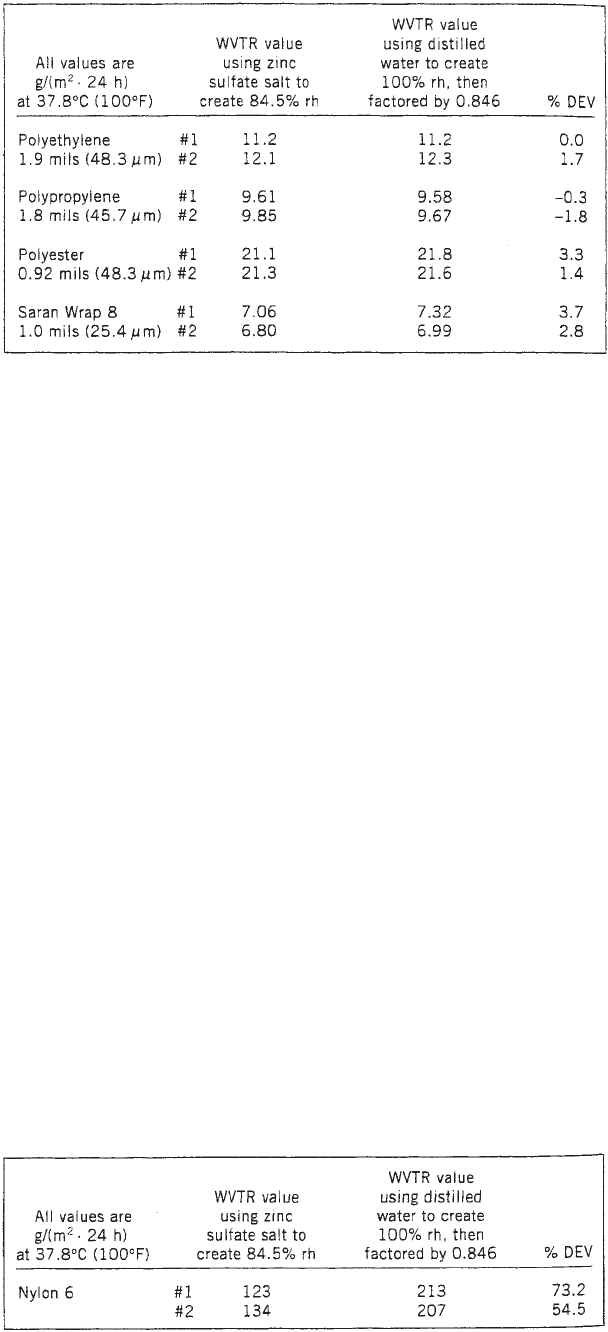
seem to hold true. Nylon 6 is a good example of this (see
Figure 8).
As can be observed, factoring does not work for all
barriers. Therefore, a system was developed that is more
universally applicable by creating humidity and tempera-
ture test conditions close to actual shelf conditions of the
package. The advantages are as follows:
1. Tests can be conducted close to actual shelf conditions.
2. A range of RH values is available.
3. Relative-humidity values easily changed.
4. No mess.
The water-vapor transmission rate is expressed in g/
(m
2
day), or g/(100 in.
2
day). The measurable range of
WVTR is 0.0001 g/(m
2
day) to 1000 g/(m
2
day). The spe-
cifications of some WVTR systems are as follows:
Sensitivity—films, 0.0001 g/(m
2
day) [0.000006 g/
(100 in.
2
day)]; packages, 0.000001 g/(package day)
Repeatability—films, 70.002 g/(m
2
day) [70.00015 g/
(100 in.
2
day) or 1% of reading; packages, 70.00
001 g/ (package day) or 1% of reading
Carbon Dioxide Transmission Rate (CO
2
TR). An IR sen-
sor is used to detect CO
2
, and when incorporated in an
instrument system to detect permeation, it yields CO
2
TR.
The major applications are for cola drinks (CO
2
escaping
from PET containers), cheese packaging, and other CO
2
-
sensitive products. There is no way to extrapolate the
action of one gas to determine the action of another gas.
Each gas is independent of the other gases and must be
tested as an individual gas to determine its TR.
The measurable range of CO
2
transmission rate is
1.0 mL/(m
2
day) up to 100,000 mL/(m
2
day). Specifica-
tions for CO
2
systems are
Sensitivity—films, 1 mL/(m
2
day) [0.07 mL/(100 in.
2
day)]; packages, 0.005 mL/(package day)
Repeatability—films 75 mL/(m
2
day) [7 0.35 mL/
(100 in.
2
day)] or 1% of reading; packages,
70.025 mL/(package day) or 1% of reading
CO
2
TR permeation systems can detect 100 ppm CO
2
.
This is an important factor when considering permeation
or leakage. Efforts have to be made to keep the CO
2
from
being diluted during the testing process. Diluting the CO
2
level can make a bad situation look good. This is just the
opposite for O
2
. Diluting a low-O
2
signal with air (20.8%
O
2
) will make it worse, not better.
An outstanding example of partial pressure can be
observed using CO
2
. Fill a PET container with 100%
CO
2
and seal securely. The partial-pressure phenomenon
happens over a period of time. CO
2
leaves the PET
container much faster than O
2
or N
2
air enters the
container. As CO
2
leaves, a vacuum is formed, which
eventually causes the container to collapse. Even though
CO
2
was removed, it left a vacuum, and O
2
and N
2
followed the partial-pressure law. The vacuum seems to
play no part in the permeation process in this case.
Aromas and Flavors. As stated above, these need to be
tested as individual gases, and there are a host of these in
Figure 7. Comparison of four films ‘‘factored’’
with 100% rh vs tests with a saturated salt solution
of zinc sulfate. (Saran Wrap is a registered trade-
mark of Dow Chemical USA.)
Figure 8. Comparison of nylon 6 ‘‘factored’’ with
100% rh vs tested with a saturated salt solution.
1210 TESTING, PERMEATION AND LEAKAGE
organics. This is a developing field with many opportu-
nities, such as citrus flavor,
D-limonene from an orange-
juice container, citrus flavor into other food products (e.g.,
breakfast cereals), petroleum gases out of packages and
into other packaged goods, and so on. Fortunately, a
technique has been developed to handle all these organic
molecules, however, only one at a time.
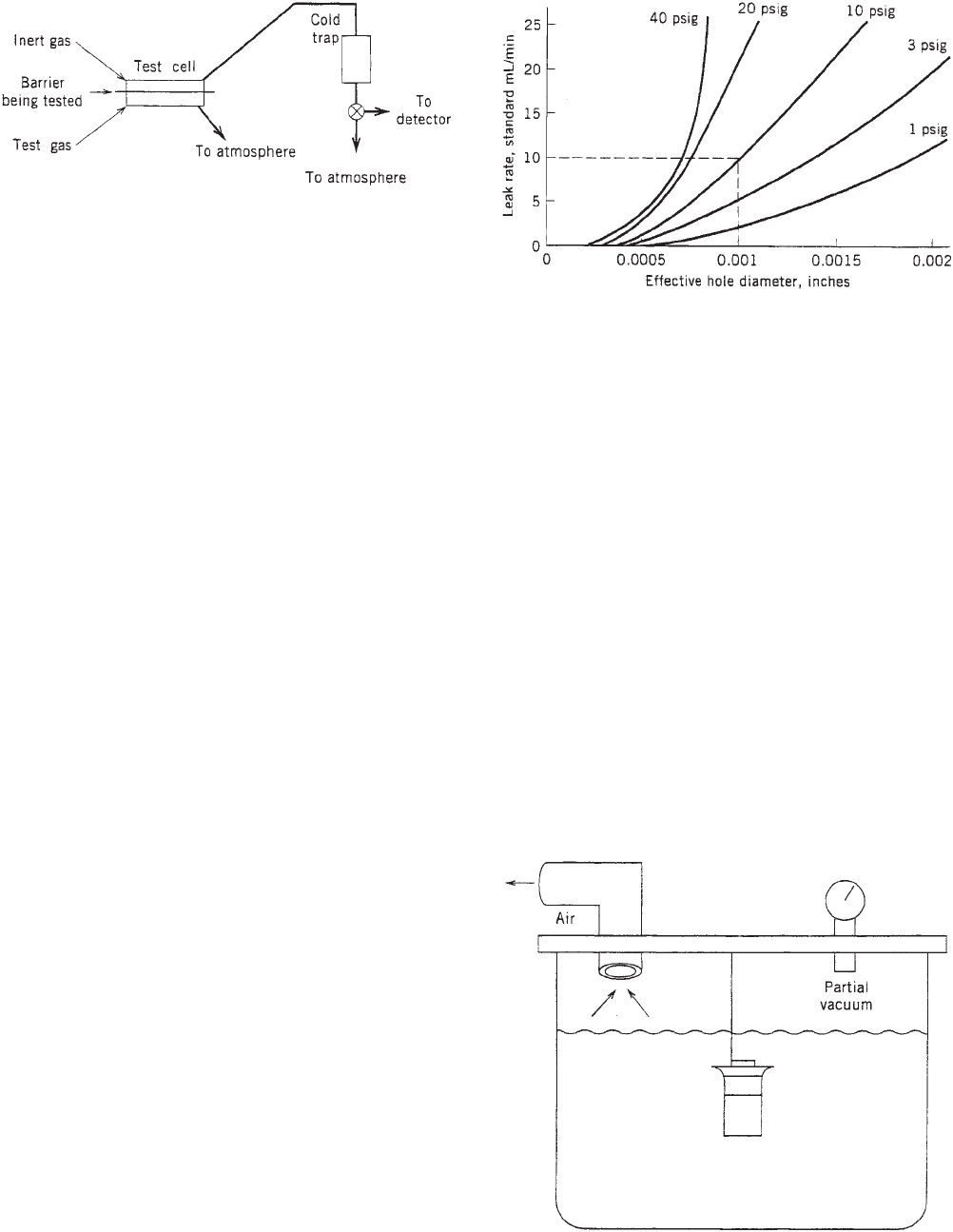
In brief (referring to the Aromatran schematic in
Figure 9) a carrier gas (helium, N
2
, or any number of
inert gases) carries the test gas (
D-limonene, butane,
methane, apple flavor, etc.), which has permeated through
a barrier to a cold trap, where it is captured and accumu-
lated over a period of time. At the end of the ‘‘accumulate’’
time, the cold trap is heated quickly, which thereby
releases the test gas molecules that had been captured.
The carrier gas, which is not affected by the cold trap,
continues to flow and carries the test-gas molecules to a
sensor. The sensor is an FID that is set up to detect the
amount of test gas captured.
The results are given in common permeation terms:
X TR ¼ mL=ðm
2
dayÞ at 30
C
Permeation becomes more critical as the shelf life is
extended. Not only is there concern about gases, such as
O
2
, water vapor, and CO
2
entering and leaving packages,
but also the effects of aromas and flavors are playing an
important role in the industry.
LEAKAGE
Everyone knows what a leak is—leaks in the roof, a leak in
a tire, even a secret can be leaked out. It is something
everyone can define, and everyone has an opinion on the
subject.
In the previous section, we discussed permeation. Both
permeation and leakage do the same thing: shorten shelf
life.
Permeation can be determined, as described above;
however, leaks are more erratic, evasive, and unpredict-
able. Where a permeation value might hold true for a
production run of plastic film, leaks can vary from one
package to the next. The ideal is to have 100% leak testing
on a production run. This is ideal but not practical in most
applications.
The perpetual issue of ‘‘hole size’’ is debated among
manufacturers of food, pharmaceutical, and sterile medi-
cal products. Each has different criteria. The hole that will
allow bacteria to enter a sterile package is much smaller
than a hole that will allow gravy to drip out of a microwave
entre
´
e. First, we must agree on a term called ‘‘effective
hole size.’’ This is the summation of all the holes in the
package. It could be the summation of round holes, square
holes, holes with long tunnels, slight tears, big tears,
hairline cracks, and so on. Let one hole represent the
combination of all the leaks. By so doing, we provide a way
of comparing one package to the next. Figure 10 illus-
trates the flow rate that one would expect through a
round-style hole under various differential pressures
across the hole. These curves apply to air at ambient
temperature through a hole in a thin material.
DESTRUCTIVE TESTING FOR LEAKS
Waterbath or dye–leak test. (See Figure 11). Throughout
most of the twentieth century, package integrity has been
verified by placing the package under water and looking
for bubbles. Variations of the ‘‘waterbath’’ test have gen-
erally involved attempts to improve on the problems
inherent in looking for bubbles. The ‘‘dye test’’ was an
Figure 9. Aromatran schematic.
Figure 10. Flow rate of air through a round hole.
Figure 11. Waterbath or dye leak test.
TESTING, PERMEATION AND LEAKAGE 1211
improvement, but the two remaining problems are lack of
repeatability and destruction of the package. Advantages
and disadvantages of these tests are as follows:
1. The waterbath test
a. Advantages
(1) Can provide sensitivity
(2) Inexpensive equipment requirements
(3) Low-level technology, easy to train operator
b. Disadvantages
(1) Destructive
(2) Results are very operator-dependent
(3) Expensive labor requirements
(4) Messy
(5) Capillary attraction can give false results
2. The dye test
a. Advantages
(1) Ability to test many samples at once
(2) Inexpensive equipment requirements
(3) Low-level technology, easy to train operator
b. Disadvantages
(1) Destructive
(2) Unreliable and operator dependent
(3) Slow and labor intensive
(4) Messy
(5) One-way valve effect
Pressure/Pressure-Decay Method. This technique allows
two tests to be run sequentially: (a) burst/seal strength
and (b) leak.
Burst/Seal Strength. This is a practical starting point. It
is important to ensure that handling and shipping does
not destroy the package, which left the plant without
leaks. It must remain sealed to maintain adequate shelf
life and/or the desired quality when it reaches the con-
sumer. Air pressure is introduced into the package until it
bursts! The burst-point pressure is held so that it can be
recorded. This burst test should be repeated several times
to obtain an average. Analysis of this data would be
required if damaged packages were discovered by a con-
sumer. This also allows research and development (R&D)
to investigate new packaging materials and sealing tech-
niques. The average test time is 15 s.
Leakage. Once the burst/seal strength has been deter-
mined, look for leaks. Introduce a pressure into a new
package at less than 50% burst pressure and monitor
pressure decay. Pressure decay is a function of effective
hole size and pressure differential and is inversely propor-
tional to the volume of the package under test. It has been
shown that holes as small as 1-mil diameter are detectable
in small packages such as pharmaceutical bubbles, but it
would be almost impossible or impractical to sense a 1-mil
hole in a blimp. This method does not indicate the location
of leak(s). The average test time is 10 s.
Other techniques that are destructive include halogen
detection where a halogen agent, such as iodine, bromine,
or fluorine, is used as a tracer gas. The system is pressur-
ized with the tracer gas, and a probe is used to detect a
leakage point. Although this test does detect leakage
points, it is highly operator dependent; thus, a poor
operator will get the best results, only on the basis of
fewer rejects. The instrument response is slow and lacks
quantitative accuracy. Food or drug products are not
normally tested by this technique.
Halide Torch. Similar to the halogen system described
above, in the halide-torch test, the tracer gas is sucked
into a burner through a hose attached to the bottom of a
burner. A change in the color of the flame indicates a leak.
Thermal-conductivity detector. A tracer gas, such as
helium, carbon dioxide, or butane, is pressurized in the
package, and a probe senses a change in gas thermocon-
ductivity as the tracer gas enters the probe. This
method does detect the leakage point; however, it also is
highly operator dependent because if the probe is moved
too fast or too far away from a hole, nothing will be
indicated.
Helium Leak Detector. This has the greatest sensitivity.
Inflate the package with helium. Then, using a probe, sniff
around the package to find a leak. The major disadvan-
tages are, besides high operator dependence, initial costs
(for supplies, etc.) and unit maintenance, that if the
instrument is swamped, it takes hours or days for a skilled
technician to get it back on line.
Headspace analysis. A practical way to check for leaks is
to measure the headspace of a package, and this can be
done at any time, such as immediately following sealing or
later, or even years later. Using a syringe, a sample of the
headspace is taken from the package and injected into an
instrument. If the O
2
content is to be determined, a
zirconium oxide sensor is used; if CO
2
content is to be
determined, an IR sensor is used. The results are given in
percentage of contents, such as 0.5% O
2
or 30% CO
2
, and
within a few seconds after injection of the sample into the
instrument. Applications include checking for cap/map
effectiveness, shortly after testing to determine whether
sealing was effective and met specifications and much
later, to determine whether permeation had any effect.
Note, in this latter case, that the long-term effect could be
either a slow leak or permeation; this instrument cannot
separate the two.
Nondestructive Testing for Leaks. The CO
2
leak detector
is most commonly used in nondestructive testing of food
and pharmaceutical packages. It is ideal if the package
has been flushed with CO
2
before sealing or if CO
2
is
generated inside, as in the case of coffee.
Leak Detection Using CO
2
Tracer Gas. Figure 12 shows
the flow diagram of a CO
2
leak detector. The pump
pictured is always running, sweeping room air in from
the left and purging the test fixture and CO
2
sensor. When
the test sequence is initiated, the dwell solenoid closes,
thus causing the pump to draw a vacuum on the package
inside the test fixture, which draws CO
2
out of the leaks.
At the end of the test cycle, room air is again allowed to
1212 TESTING, PERMEATION AND LEAKAGE
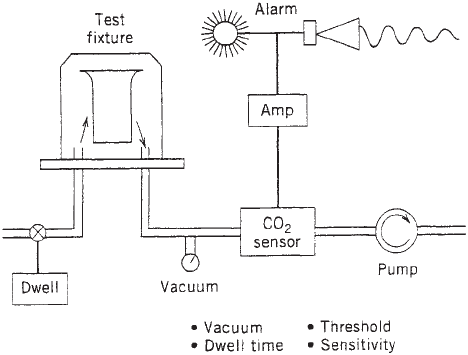
sweep into the test fixture. This flushes any CO
2
gas into
the CO
2
sensor. If this CO
2
concentration exceeds the
alarm threshold, the instrument signals that a leak is
present. Throughout this cycle, room CO
2
concentration is
viewed as the unit’s zero, i.e., reference, point.
An important factor is the size of the test fixture
compared with the package under test. The sensitivity is
inversely proportional to the space outside the sample
being tested. As mentioned, care must be taken to avoid
diluting the CO
2
signal. Therefore, a specially designed
fixture is needed for best results, i.e., to sense small leaks,
and in most foods and/or pharmaceutical applications,
small leaks are important.
In those cases where no CO
2
is in the package, CO
2
can
be forced into the packages through the leaks by use of a
pressure chamber filled with CO
2
. The vacuum, shown in
Figure 14 then draws CO
2
out of the package, which is
sent to the CO
2
sensor. The tests that use this technique
take 15 s on average.
Carbon dioxide trace-gas leak detection has been
shown to be a sensitive, repeatable, and nondestructive
alternative to traditional waterbath and dye-leak techni-
ques. Justification is easiest when the product is expen-
sive, as this nondestructive test procedure enables product
to be exposed to additional laboratory tests, or to be
returned to the production line.
CONCLUSION
The search for better leak-testing methods continues. The
challenge is to devise a system that is nondestructive, can
conduct 100% inspection at high speed, and, of course, is low
cost. To date, the diversity of applications has precluded this.
Each application must be evaluated to determine the best
solution. Testing-systems manufacturers are challenged to
write their specification legibly, clearly, and precisely to
ensure that they are understood and can be applied.
Permeation is well defined and accepted in American
Society for Testing and Materials (ASTM) specifications.
Leakage requires the same attention.
BIBLIOGRAPHY
1. ASTM E96, American Society for Testing and Materials,
Philadelphia, PA.
2. TAPPI 464, Technical Association of the Pulp and Paper
Industry, Atlanta, GA.
TESTING, PRODUCT FRAGILITY
H. H. S CHUENEMAN
San Jose State University,
San Jose, California
The vast majority of products undergo a certain amount of
handling and transportation from the time they are
manufactured until they are ultimately used. This is
especially true in a global economy. Normally, products
are enclosed in a protective-package system during the
time they are exposed to the hazards of the distribution
environment. This article outlines engineering principles
and procedures that optimize the protective function of a
package system and help guarantee the product’s safe
arrival at favorable cost.
The waste of resources caused by improper packaging
is enormous. Whether this waste shows up as damaged
product or an overly expensive package system, it is still
waste that can be avoided. The application of sound
engineering principles to optimize the product protection
system must receive significant endorsement by product
managers, quality assurance (see Specifications and qual-
ity assurance), and all those concerned with delivering a
quality product to the customer.
To develop a protective-package system, three impor-
tant pieces of data are necessary: (i) information on the
likely hazards (shock and vibration) from the distribution
environment; (ii) product fragility characteristics and
sensitivities in terms of the environmental inputs; and
(iii) the performance characteristics of commonly avail-
able packaging materials.
The engineering process for developing a protective-
package system involves a step-by-step problem-solving
approach similar to other engineering disciplines. The
principal focus is on product characteristics because it is
impossible to optimize a package system without first
knowing basic engineering data of the product itself.
Once the environmental hazzards have been defined,
and product fragility has been determined, the engineer
can evaluate the economic feasibility of possible product
modifications. For example, if a certain component within
the product keeps failing at a relatively low input level, it
may be economically more desirable to modify that com-
ponent and increase its ruggedness rather than design an
expensive and inefficient package system for the entire
product based on the sensitivity of that one component. If
it is economically feasible to modify the product in order to
effect a package-cost savings, this option should be studied
carefully. Many examples exist where slight product
Figure 12. Co
2
trace-gas leak detection; nondestructive.
TESTING, PRODUCT FRAGILITY 1213
modifications have resulted in substantial cost savings in
packaging materials, reduced damage in shipment, and
potentially large savings from improved logistics and
shipping costs.
There are many potential hazards in the distribution
environment, including shock, vibration, temperature or
humidity extremes, electrostatic discharge, magnetic
fields, and compression. This article deals primarily with
shock and vibration inputs; however, it is important to
explore carefully those areas where the product is sensi-
tive or a large environmental input is likely.
The steps involved in designing an optimized package
system are as follows:
1. Define the environment in terms of shock and
vibration inputs likely during the product’s manu-
facturing and distribution cycle.
2. Define product fragility in terms of shock and
vibration.
3. Obtain product improvement feedback; that is,
examine product improvements in light of the eco-
nomic tradeoffs between packaging/distribution
costs and product modification costs.
4. Evaluate cushion material performance; that
is, evaluate the shock and vibration characteristics
of available cusion materials and systems.
5. Design the package system; that is, select cushion
materials and design for optimum shock and vibra-
tion performance and minimum cube.
6. Test the final package; that is, verify that the
package system performs as designed and properly
protects the product.
The primary purpose of this article is to examine
product fragility testing in detail, and therefore the other
steps are not covered in a comprehensive fashion. Refer to
the bibliography for excellent background material on the
other steps in this process (1–6) (see also Cushioning,
design; Distribution hazards).
DEFINING THE ENVIRONMENT
The end result of defining the environment should be the
establishment of a design drop height and a resonant-
frequency spectrum for a particular product in a given
distribution environment. That is, based on the size and
weight of a packaged product, the engineer selects a drop
height that represents a given probability of input. Also,
vibration profiles for likely modes of transportation are
selected. Both of these pieces of information are used in
the last step, testing of the package system (7–10).
DEFINING PRODUCT FRAGILITY
The term product fragility is misunderstood by many
people and often conjures up images of totally destroyed
products, broken bottles, and the like. In reality, product
fragility is simply another product characteristic such as
size, weight, and color. Just as other product characteristics
are determined by measurement, product fragility (or
product ruggedness) can be measured with shock inputs.
This measurement takes the form of a damage-boundary
curve for shock and resonant frequency plots for vibration.
In both cases, the importance of determining these char-
acteristics cannot be overemphasized. Most people would
not think of buying a pair of shoes based on guessing their
foot size. It is just as short-sighted to design a package
system by guessing at product fragility.
Shock Fragility Assessment
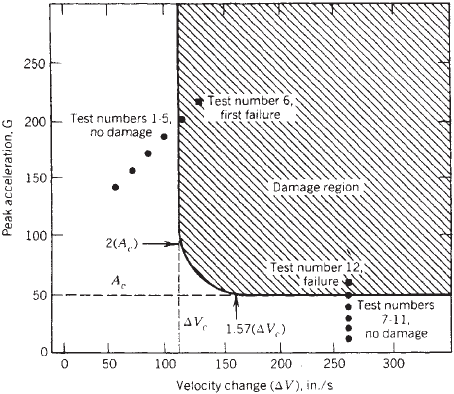
The damage boundary is the principal tool used to deter-
mine the ruggedness of a product; it takes the general
shape shown in Figure 1. This plot defines an area on a
graph bounded by peak acceleration on the vertical axis
and velocity change on the horizontal axis. Any shock
pulse that can be plotted inside this boundary will likely
cause damage to the product regardless of whether it is
packaged or not. (This is a product test.)
Acceleration is a vector quantity describing the time
rate of change of velocity of a body in relation to a fixed
reference point; that is, it describes the rate at which
velocity is increasing (acceleration) or decreasing (decel-
eration). The terms acceleration and deceleration are often
used interchangeably because most products respond
similarly to a rapid start or a rapid stop. Both terms are
expressed in G values, multiples of earth’s gravitational
constant, g.
The SI units
are m/s
2
.
Velocity change is the difference in a system’s velocity
magnitude and direction from the start to the end of shock
pulse. Velocity change is the integral of the acceleration
versus time pulse and is directly related to drop height.
To run a damage boundary, mount the product to be
tested on the table of a suitable shock-test machine (see
Figure 2). Secure the product with a rigid fixture that
lends even support to the product over its entire surface.
Figure 1. Damage boundary (single orientation). A
c
, critical
acceleration; V
c
, critical velocity. To convert in. to cm, multiply
by 2.54.
1214 TESTING, PRODUCT FRAGILITY
The fixture must be as rigid as possible so that it does not
distort the shock pulse transmitted to the product.
Set the shock machine to produce a low velocity-change
shock pulse with a duration of approximately 2 ms (a half-
sine waveform is generally used for this test). After the
shock pulse is delivered to the product, examine it to
determine if damage has occurred. If not, set the shock
machine to produce a slightly higher velocity change and
repeat the test. Continue this process with small incre-
mental increases in velocity change until damage occurs.
The last nonfailure shock input defines critical velocity
change DV
c
for the product in that orientation.
Next, fasten a new test specimen to the shock table and
set the machine to produce a trapezoidal pulse with a low
acceleration level and a velocity change at least two times
that of the critical velocity determined in the previous test.
Program the shock pulse into the product and, as before,
examine the product to determine if failure occurs. If no
failure has occurred, set the shock machine to produce a
higher acceleration level at approximately the same velo-
city change. Repeat this procedure with small increments
in acceleration until the failure level is reached. The last
nonfailure shock input defines the critical acceleration, A
c
,
for the product in that orientation (11).
The damage boundary curve may now be plotted by
drawing a vertical line through the critical velocity change
point and a horizontal line through the critical accelera-
tion point. The intersection of these two lines (the knee) is
a smooth curve as shown in Figure 1. A rectangular corner
may be used as a conservative approximation of the
damage region (12).
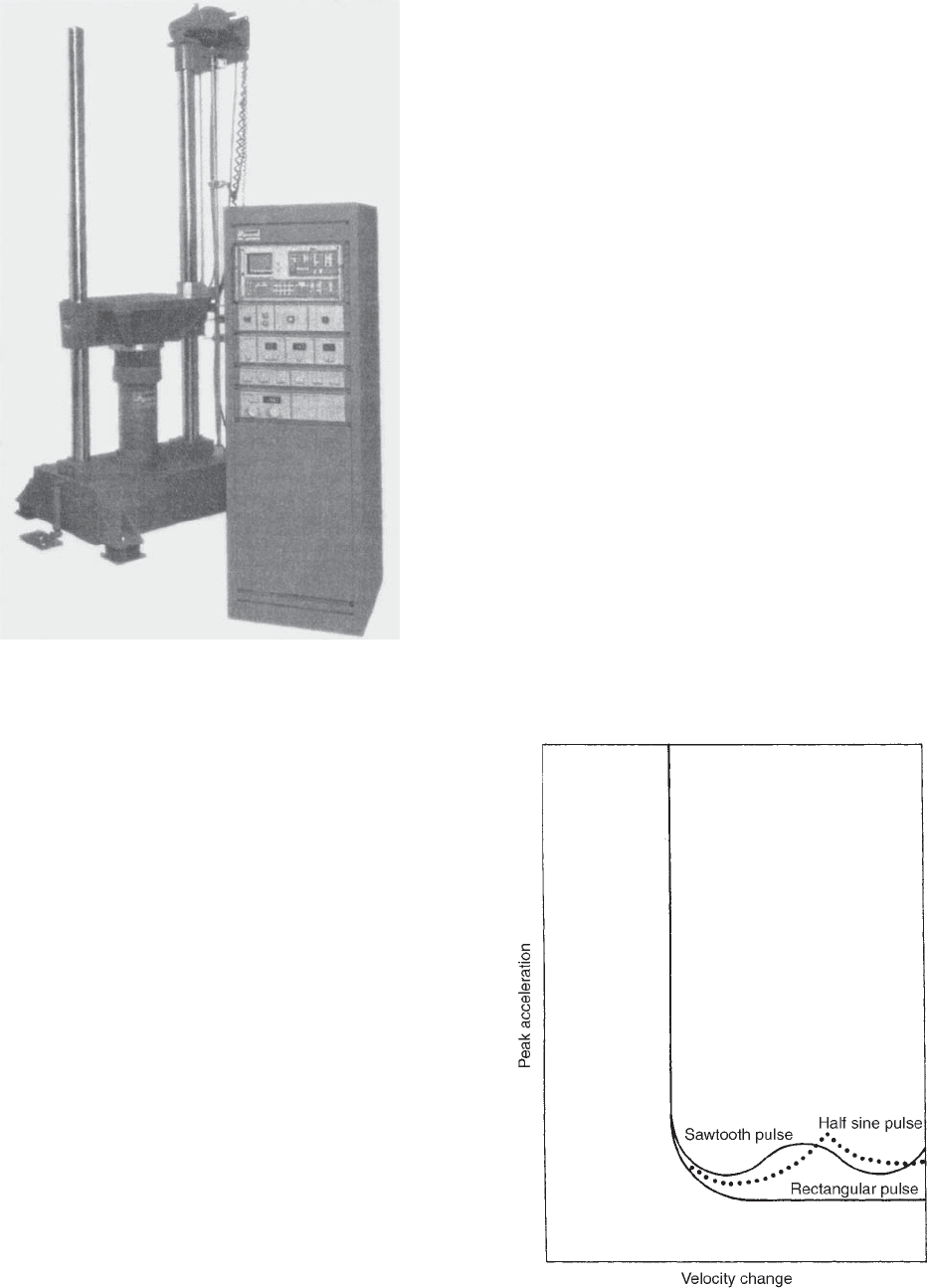
Note that the critical acceleration as determined by a
trapezoidal pulse is conservative when compared to that
generated through the use of other waveforms; that is, a
trapezoidal pulse is more damaging than other waveforms
of the same peak acceleration and duration. This is shown
graphically in Figure 3.
Since the shape of the waveform transmitted through
various packaging materials during impact is generally
not known, the use of a trapezoidal wave during damage
boundary testing results in a higher confidence level in a
packaging system and is recommended for this purpose. It
should also be pointed out that the use of the trapezoidal
waveform results in a nearly linear abscissa on the
damage boundary. This means that it is necessary to
determine only one point on that axis in order to deter-
mine the critical acceleration for the product in that
orientation. Other waveforms result in critical accelera-
tions that are a complex function of the natural frequency
of components within the product. The procedure de-
scribed is based on ASTM D3332 (13).
The damage boundary is a valuable and powerful tool.
Critical velocity change is equated to equivalent free
drop height from the formula DV ¼ð1 þ eÞ
ffiffiffiffiffiffiffiffiffi
2gh
p
, where e
is the coefficient of restitution of the impact surfaces (V
i
/
V
r
), g is acceleration of gravity [386 in./s
2
at sea level
(9.8 m/s
2
)], and h is equivalent free-fall drop height in in.
(or m). The critical velocity change tells the designer how
high the unpackaged product can fall onto a rigid surface
before damage occurs in that axis. If this equivalent drop
Figure 2. Shock-test machine.
Figure 3. Damage boundary for various pulses.
TESTING, PRODUCT FRAGILITY 1215
height is likely to be exceeded in the distribution environ-
ment, then the product must be cushioned. The perfor-
mance requirements of the cushion are that no more than
the critical acceleration be transmitted to the product.
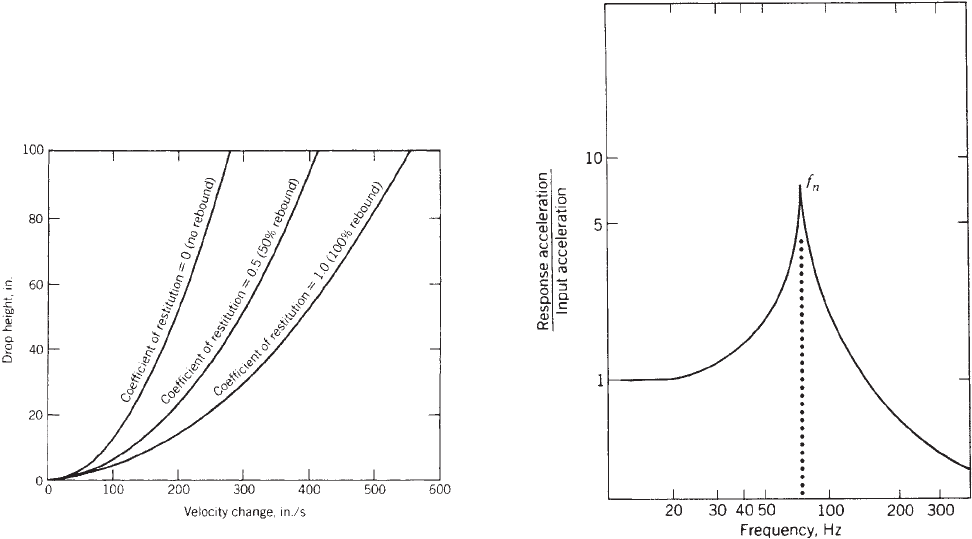
In theory, the value of e (coefficient of restitution) can
vary from zero to one. A value of zero would imply a totally
plastic impact with no rebound whatsoever. A value of one
implies a perfectly elastic impact where the rebounded
velocity is exactly equal to the impact velocity. As a
practical matter, a range of e = 0.25–0.75 produces good
accuracy in calculating the range of equivalent freefall
drop height. The chart in Figure 4 shows the effect of e.
The damage boundary also tells the engineer that at
low velocity changes, infinite accelerations are possible
and that at low acceleration levels, infinite velocity
changes are possible without product damage. That
means that it is necessary to define both critical accelera-
tion and critical velocity change to properly characterize
the fragility (or ruggedness) of a product.
Before running the damage-boundary test, the engi-
neer must define what constitutes damage to the product.
On one extreme, damage may be catastrophic failure.
However, there are many less severe damage modes that
can make a product unacceptable to the customer. In some
cases, damage can be determined by observation of the
product; at other times it involves running sophisticated
functional checks. Once the determination of damage is
made, the definition must remain constant throughout the
testing and must be consistent with what is deemed
unacceptable to the customer.
In general, damage-boundary tests must be run for
each axis in each orientation of the product. In the case of
a rectangular product such as a television set, this means
that a total of 12 specimens are necessary for a rigorous
test. However, since this testing should be done in the
product prototype stage, this quantity is rarely available
for a potentially destructive test. As a practical matter,
much information can be gained from a limited number of
samples, and multiple damage boundaries are often run
on the same unit in different orientations.
Vibration-Fragility Assessment
Determining product-vibration sensitivities involves iden-
tifying resonant frequencies of components within the
product in each of the principal axes. Resonance is that
characteristic displayed by all spring/mass systems
wherein at a given frequency, the response acceleration
of a component is greater than the input acceleration. This
characteristic is shown graphically in Figure 5.
As a general rule, the product will not be damaged due
to nonresonant inertial loading caused by vibration in the
distribution environment. This is because the acceleration
levels of most vehicles are relatively low when compared to
the critical acceleration of most products. It is only when a
component within a product is excited or forced by vibra-
tion at its natural frequency that damage is likely to occur.
At frequencies below the resonant frequency, the re-
sponse of a critical component is roughly equal to the
input (the response/input ratio is 1). At frequencies higher
than the resonant frequency, the response acceleration is
lower than the input. In this region a component acts as
its own isolator and results in a condition known as
attenuation.
At (and near) the product resonant frequency, however,
the response acceleration can be very much greater than
the input, causing product fatigue and ultimate failure in
a relatively short time. The purpose of vibration sensitiv-
ity assessment is to identify those critical frequencies
likely to cause damage to the product.
A resonant frequency search test is run by attaching a
product to the table of a suitable vibration test machine
(Figure 6) and subjecting it to an acceleration input at a
low level (typically 0.25–0.5 G) over a suitable frequency
Figure 4. Coefficients of restitution. To convert inches to centi-
meters, multiply by 2.54.
Figure 5. Resonant frequency plot.
1216 TESTING, PRODUCT FRAGILITY
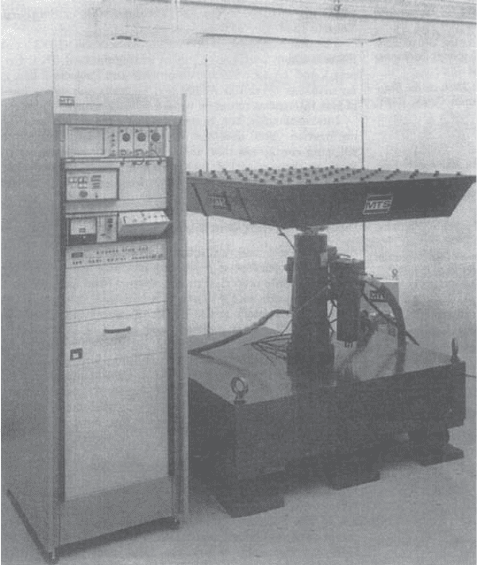
range, typically 1–300 Hz (cycles per second). Acceler-
ometers are fastened to critical components within the
product in order to determine the components’ responses
to the input acceleration. The response/input ratio is
plotted as a function of frequency for each ‘‘critical’’
componant. This ratio reaches a maximum at the compo-
nent resonant frequency. The test usually involves mon-
itoring many components in each axis of the product in
order to characterize its overall vibration sensitivities
(14). Sinusoidal or random excitation can be utilized for
this test, but random vibration excitation has gained wide
popularity due to the ease of use, test efficiency, and
potentially more accurate data.
The importance of vibration teting cannot be over-
emphasized. Any product shipped from point A to point
B is subject to vibration because of the transit vehicle it is
riding. The probability of this input is 100%. In contrast,
the probability of a shock input because of a drop is exactly
that, a probability function. In some cases, the drop height
experienced by a product may be severe, in most cases, it is
hardly measurable. However, any product that is shipped
in a vehicle is subject to vibrational input and it should be
tested for sensitivity to that input.
CONCLUSION
At this point, the engineer has sufficient data to make
intelligent decisions about tradeoffs between the product
modifications and package costs. If a fragile component
can be ruggedized at minimal cost, resulting in
substantial package savings, then it makes sense to
pursue the product modification.
The package-design process uses environmental data,
product-fragility information, cushion-performance data
(see Foam cushioning; Testing, cushion system), and a
healthy dose of designer creativity. Knowledge of package-
fabrication techniques, as well as other vital information
on flammability restrictions, maximum weight and cube
for storage and transportation, recyclability of the pack-
age components, future cost trends of various key materi-
als, and so on. (1, 3, 5, 6, 15), is essential.
Once the design has been finalized and a prototype
fabricated, it must be tested to verify compliance with
product requirements. It is important to specify the cor-
rect inputs, both their magnitude (or duration) and se-
quence, in order to closely duplicate the potentially
damaging effects of the distribution environment. Test
procedures such as ASTM D4169 (7) and a variety of new
ISTA test procedures (17) have done much for improving
the correlation between laboratory tests and field experi-
ence (2, 4, 16).
A properly engineered packaged system is now within
reach of all manufacturers, distributors, and other pack-
age-system users. The wasteful practice of overpackaging
can virtually disappear along with damage-in-shipment
reports. The tools are available and the technology is
straightforward. Optimized packaging is indeed an attain-
able goal.
BIBLIOGRAPHY
1. M. E. Gigliotti, Design Criteria for Plastic Package Cushion-
ing Materials, Plastic Technical Evaluation Center, Picatinny
Arsenal, Dover, NJ, 1962.
2. T. J. Grabowski, Design and Evaluation of Packages Contain-
ing Cushioned Items Using Peak Acceleration Versus Static
Stress Data, Shock, Vibration and Associated Environments
Bulletin, No. 39, part II, Office of the Secretary of Defense,
Research and Engineering, Washington, DC, 1962.
3. C. Henny and F. Leslie, An Approach to the Solution of Shock
and Vibration Isolation Problems as Applied to Package
Cushioning Materials, Shock, Vibration and Associated En-
vironments Bulletin, No. 30, part II, Office of the Secretary of
Defense, Research and Engineering, Washington, DC, 1962.
4. M. T. Kerr, ‘‘The Importance of Package Testing in Today’s
Data Processing Industry’’ in Proceedings of Western Regional
Forum Packaging Institute, USA, 1981.
5. R. D. Mindlin, Bell System Tech. J. 24(304), 352 (1945).
6. S. Mustin, Theory and Practice of Cushion Design, Shock and
Vibration Information Center, U.S. Department of Defense
Washington, DC 1968.
7. ASTM D4169-05, Standard Practice for Performance Testing
of Shipping Containers and Systems, American Society for
Testing and Materials, Philadelphia, 2005.
8. S. G. Guins, in Shock and Vibration Handbook, Part II,
McGraw-Hill, New York, 1961, Chapter 45.
9. F. E. Ostrem and B. Libovicz, A Survey of Environmental
Conditions Incident to the Transportation of Materials, Report
PB-204 442, General American Transportation Corp., Niles,
IL, 1971.
Figure 6. Vibration-test machine.
TESTING, PRODUCT FRAGILITY 1217