
Yam, Kit L. (ed.). The Wiley encyclopedia of packaging technology
Подождите немного. Документ загружается.

first-out (FIFO) policy. The time-based FIFO policy fails
when the food-chain temperature exceeds certain critical
limits. In such cases, time–temperature-based policies
such as shortest remaining shelf life (SRSL), using the
TTIs, offers several advantages (2). For example, SRSL
policy ensures more consistent quality at the final con-
sumption of food items that may have been exposed to
different abusive temperature conditions during storage
and distribution. In the SRSL policy, using TTIs, those
foods that receive an elevated temperature exposure are
moved more rapidly through the system.
The TTIs are smart labels that offer a new and im-
proved method to manage the food storage and distribu-
tion system, with the ultimate goal of providing a higher-
quality food for the consumer.
BIBLIOGRAPHY
1. P. S. Toukis, B. Fu, and T. P. Labuza, ‘‘Time–Temperature
Indicators,’’ Food Technol. 45(10), 70–82 (1991).
2. J. H. Wells, and R. P. Singh, ‘‘The Application of Time–
Temperature Indicator Technology to Food Quality Monitoring
and Perishable Inventory Management’’ in S. Thorne, ed.,
Mathematical Modeling of Food Processing Operations, Else-
vier Applied Sciences, London, 1992, Chapter 7.
TOTAL QUALITY MANAGEMENT
MARK B. EUBANKS
MBE Associates, Alpharetta,
Georgia
OVERVIEW
Since the early 1980s the packaging industry, as well as
other industries, have been working with an organizational
concept called by various names but generally referred to
as continuous quality improvement or total quality man-
agement. And, as with other industries, the degree of
success among packaging companies that use the process
ranged from successful to not so successful.
A significant problem for the packaging community has
been its traditional view of quality as an internal process
focused on compliance to regulations and/or specifications.
This issue is particularly true of segments that deal with
the food, beverage, and pharmaceutical markets. As a
result, the industry has maintained much of its historic
dependence on quality control, quality assurance, and
technical audit concepts. Statistical process control now
is used broadly; however, this control has been seen as a
technical tool rather than as a management process.
Also, generations of managers had been taught to
believe that quality was for specialists and certainly not
for executives and that the results of quality techniques
were not the appropriate concern of the total organization.
In the last three years, certain elements of the general
news media, industry press, and the consulting profession
have proclaimed that ‘‘TQM is dead.’’ These same pundits
also would say that if a ship misses a harbor and runs
aground, then it is the harbor’s fault. What we have seen
as an industry is the need to refine the concept of quality
and apply it as a management system aimed at managing
change and optimizing business performance.
It is the purpose of this article to present a summary of
lessons learned from past experiences of companies that
use quality management and the key success factors that
will enable organizations to satisfy customers, involve
employees, improve work processes, and increase profits.
MANAGING CHANGE
A strong negative perception of quality management is
that it takes too much time to effect a change in the way
companies do business and obtain positive results. Cer-
tainly one of the primary lessons learned from the experi-
ences of businesses large and small is that the quality
process must be managed with short- and long-range
objectives in mind.
This observation is especially true of the packaging
industry. With the tremendous changes occurring in in-
dustry consolidation, materials substitution, processing
and distribution technology, global competition, intensi-
fied government regulation, and environmental concerns,
no organization can afford to spend years waiting for
major improvements to take place in operating results.
One industry response to this situation has been reengi-
neering, which has had mixed results to say the least.
The fact is that, although it does take time to complete
a culture change in all except the smallest companies, it is
not true that results need to be a long time in coming.
Identification and quantification of improvement op-
portunities within critical processes can be accomplished
within weeks of the start of a quality initiative. Common
analysis techniques employed include process mapping,
value-chain analysis, activity-based cost of quality bench-
marking, customer service measures, and variability
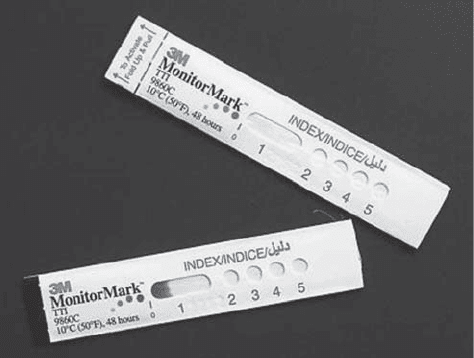
Figure 3. 3Mt Monitor Markt time–temperature indicator
(http://www.3m.com/product/information/MonitorMark-Time-Temp-
erature-Indicator.html).
1238 TOTAL QUALITY MANAGEMENT
studies. Cross-functional teams of internal subject matter
experts can be educated quickly in advanced problem-
solving methodologies and can be supported by specialized
software to facilitate planning, decision making, and
project tracking, reducing or completely eliminating the
need for time-consuming status review meetings. Many
companies have shown dramatic results in six months’
time.
A ROSE BY ANY OTHER NAME
One important principle is so straightforward as to be
considered trivial by some. Focus on organizational and
business results and do not worry about what the process
is called. Many organizations fall victim to the name game
and fail to endorse quality management because of the
negative stigma associated with ‘‘TQM.’’
The U.S. General Accounting Office report, released in
May 1991, was one of the first studies that linked certain
organizational competences to improved business results
(1). These positive characteristics are further defined in
the criteria established by the Malcom Baldrige National
Quality Award. If customer focus, cost reduction, em-
ployee participation, and competitive advantage are
among an organization’s desired results, then the name
of the process used to achieve these results should not be a
major concern.
A STRATEGIC IMPERATIVE
Quality is not a function but a strategic plan for change.
Corporate leadership must ensure that quality is defined
and integrated into the strategic plan at all levels of the
organization. Several areas are critical and are as follows:
Leadership—executives must provide vision, direction,
resources, ongoing personal support, and must re-
move cultural obstacles.
Commitment—executives first must understand the
positive business results to be expected from quality
management, and they must establish and deploy
policies that guide the organization toward the
realization of these results.
Evaluation—all levels of management must evaluate
the quality process systematically using measure-
ments appropriate to each level.
ALIGNMENT
For quality-management processes to produce superior
business results, all functions, areas, systems, processes,
groups, and individuals must operate congruently. Inter-
nal capabilities must match customer needs. Marketing
and sales plans must be based on customers’ expectations
for product and service excellence rather than on quotas or
commission schedules. Financial plans must reflect an
investment in customer satisfaction and employee invol-
vement, not just an abstract reference to bottom-line
results. Employees must be educated and dedicated to
performing their roles in the business, and they must
understand the rewards that they, and their workgroups,
will receive for minimizing waste and improving their
work processes.
CUSTOMER FOCUS
Virtually all companies have learned to say that they are
customer-driven. And it is generally agreed upon that the
packaging industry has gotten closer to its customers.
However, abundant evidence exists that the voice of the
customer may not be heard as clearly as it should be
throughout many companies.
Communication with customers is one of the major
areas where important lessons have been learned over
the past decade. Customers were at one time considered to
be the responsibility of a few groups or individuals within
a company. Typically, this position was a sales/marketing
function with some top managements that join in for key
accounts. Today, everyone in an organization must be able
to listen for and respond to customer messages.
Successful organizations use a variety of tools to moni-
tor present and future customer needs and expectations—
surveys, focus groups, formal and informal audits, quality-
function-deployment models, and decision matrices, to
name a few The old comment, ‘‘We know what the
customer wants,’’ without actual use of actionable custo-
mer data, is being heard less and less.
The key principles are to identify and translate custo-
mer requirements from broad categories, e.g., ‘‘customer
satisfaction,’’ ‘‘superior quality,’’ and ‘‘competitive price,’’
into specific work-process improvements all levels of the
organization can implement.
FINANCIAL IMPACT
One of the major reasons given by senior managers for
their disaffection with quality-management process is
that a financial payoff does not exist. This attitude is
disturbing to quality professionals, because quality man-
agement can have a major impact on bottom-line results
and stakeholder value.
In their widely quoted book, The PIMS Principles, Gale
and Buzzell present a compelling case that quality has a
major positive effect on market share and profitability (2).
Financial impact tools—cost of quality, customer value
analysis, and others—have been available for many years
but are under used for several reasons, which are as
follows:
. General
fear or distrust
of measurement in general.
. Traditional accounting systems do not lend them-
selves to process costing.
. Data-collection systems are considered too complex
to maintain.
. Cost-of-quality systems are considered to be an ex-
tension of the finance function.
. Employees are not properly educated on the use of
the financial impact system.
TOTAL QUALITY MANAGEMENT 1239
. No constructive action is taken once the data are
gathered.
. Interdepartmental turf issues prevent cooperation.
. Financial impact systems are used for punishment or
are not linked to compensation.
Financial impact systems are vital to the continued suc-
cess of quality management processes. They provide a
primary means of measuring business success, secure
management’s involvement and support, and help to
identify and prioritize opportunities for improvement.
EMPLOYEE INVOLVEMENT
The word ‘‘employees’’ in the subheading above refers to
all individuals in the organization, from senior manage-
ment through all levels of the workforce. All individuals
require an understanding of the quality process and their
role in the new culture. They should be aware of several
factors that includes the following: the common language
of quality, how to apply the concepts to their jobs on a day-
to-day basis, and the use of selected skills such as problem
solving or statistical process control to cause improve-
ments to happen in their workgroups.
Quality tools and skills are organizational, managerial,
individual, and technical. Most organizations concentrate
on implementing individual and technical tools before
they do anything about the organization and its manage-
ment. This issue occurs when the senior management does
not understand the philosophy behind the quality process.
Executives and managers want to satisfy customers in an
effective manner, but they must also learn to see quality
as a system, and they must learn their role in the system.
When employees have learned their roles, tools, and
techniques, they must then be formally (and sometimes
forcefully) able to use this knowledge to carry out the
business objectives of the company. Many companies are
frustrated when recently educated employees fail to par-
ticipate actively in the quality process. The reasons are
clear and include the following: employee involvement
was not a part of the traditional corporate culture; they
did not understand that they had permission to get
involved; they did not see this new behavior as consistent
with what their supervisors were doing; they did not know
how they fit into the new quality plan; and they had not
been convinced of what their benefits would be if they
participated.
Next to the lack of sustained management commitment
for the reasons cited in the ‘‘Financial Impact’’ section, the
biggest obstacle to most companies in achieving success in
their quality processes has been the lack of employee
involvement. The keys are education, recognition, and
compensation.
CUSTOMER–SUPPLIER RELATIONSHIPS
Many packaging companies have established successful
partnerships with their key customers and suppliers.
Several elements are vital to establishing such productive
relationships.
As a part of their strategic planning process, successful
companies involve customers and suppliers extensively in
planning for new and improved products as well as higher
levels of product and service performance. Systems, such
as quality-function deployment, aid customers and sup-
pliers in matching customer needs with supplier capabil-
ities and communicating these factors throughout both
organizations.
Measurement systems are developed jointly between
partners and used as a means of improvement. Measure-
ment extends to the development and sharing of testing
methods, equipment, and research techniques.
Vendor certification and rating systems are being used
more as companies seek to develop a common language of
quality improvement. The exact form of these systems is
specific to each customer. Many formats, however, follow
the general structure of the Malcom Baldrige or ISO 9000
criteria.
SUMMARY AND CONCLUSIONS
In the remainder of the 1990s and beyond, the packaging
industry will be faced with an increasing challenge to
manage within narrower time limits and to be even more
focused on customers and customers’ customers. At the
same time, companies will be required to spend more time
and effort developing the ‘‘people side’’ of the business at
all levels.
Quality-management processes are an effective system
for managing 21st Century organizations and maximizing
total business performance in the age of intense competi-
tion and dramatic change.
The successful organizations will employ the following
key success factors:
. Strong management commitment to leading and
supporting a quality-improvement process.
. Aggressive customer focus that uses quantitative
techniques for requirement identification.
. A planning system that involves broad participation
and integrates quality objectives into strategic and
operational planning.
. Immediate identification of critical work processes
and major business success drivers.
. Effective, open communication system.
.
Quality-process education for all employees, suppli-
ers
, and customers
.
. Measurement systems that support continuous
improvement.
. Collaborative relationships with customers and
suppliers.
. Compensation system for all employees tied to qual-
ity improvement.
. Recognition of all who participate in the quality
process.
1240 TOTAL QUALITY MANAGEMENT
BIBLIOGRAPHY
1. GAO/NSIAD-91-190, U.S. Companies Improve Performance
through Quality Efforts, A. Medelowitz, 1991.
2. R. Buzzel and B. Gale, The Pims Principles, Macmillan, New
York, 1987.
TRANSPORT PACKAGING
ALFRED H. MCKINLAY
Consultant, Pattersonville,
New York
The objective of transport packaging is preservation of the
product in its delivery from point of manufacture to the
customer. Without packaging, most products would have a
difficult and expensive trip through handling and trans-
portation, many of them delivered to customers in a
damaged condition. Transport packaging actually adds to
the value of the product, by lowering the cost for customers
to obtain possession of the product from its origination.
Transport packaging is a term used throughout the
world—except in North American, where it is often known
as distribution or protective packaging. It includes the
shipping container, interior protective packaging, and any
unitizing materials for shipping. It does not include
packaging for consumer products such as the primary
packaging of food, beverages, pharmaceuticals, and cos-
metics. In the United States, transport packaging repre-
sents about one-third of the total purchases of packaging;
the balance is attributable to primary packaging for
consumer products.
The goal in transport packaging is to provide the
correct design for packaging such that its contents will
arrive safely at the destination, without using too much or
too little packaging material. In other words, the package
designer must ensure that this equation is maintained:
Product þpackage ¼ distribution environment
The following text will show how to determine the right
amount of each of the three variables so that the equation
will always balance, with no excessive overpackaging cost
or loss from damage.
FUNCTIONS AND GOALS OF TRANSPORT PACKAGING
The functions of transport packaging can be summarized
as follows:
Containment. The basic purpose of packaging is to
contain the product. Packaging permits products to
move from their source to the customer, supplying
use value to products that are otherwise useless to
the customer, who is usually remote from the source.
Protection. Most products require some degree of
protection from the hazards in distribution. Packa-
ging furnishes the degree of protection needed to
safely transport products from source to customer.
Performance. Packaging aids in transportation, hand-
ling, storing, selling, and use of the product. This
function includes such things as orientation of the
product, ease of identification, appropriate quantity,
ease of disposal, and handling features.
Communication. The package must identify its con-
tents and inform about package features and hand-
ling requirements. It generally provides space for
shipping information as well.
To design a transport package, one must have goals in
mind. These will vary with products, customers, distribu-
tion systems, manufacturing facilities, and so on, but most
transport packaging should address the following
objectives:
Product Protection. The primary purpose of any
transport package is to ensure the integrity and
safety of its contents through the entire distribution
system.
Ease of Handling and Storage. All parts of the dis-
tribution system should be able to economically
move and store the packaged product.
Shipping Effectiveness. Packaging and unitizing
should enable the full utilization of carrier vehicles
and must meet carrier rules and regulations.
Manufacturing Efficiency. The packing and unitizing
of goods should utilize labor and facilities effectively.
Ease of Identification. Package contents and routing
should be easy to see, along with any special hand-
ling requirements.
Customer Needs. The package must provide ease of
opening, dispensing, and disposal, as well as meet
any special handling or storage requirements the
customer may have.
Environmental Responsibility. In addition to meeting
regulatory requirements, the design of packaging
and unitizing should minimize solid waste by any of
the following: reduction–return–reuse–recycle.
Since transport packaging must always be economical, all
the above goals should be balanced to achieve the lowest
overall cost.
TAKING A TOTAL SYSTEM APPROACH TO PACKAGE
DESIGN
The scope of design in transport packaging must consider
all aspects of the distribution system, including custo-
mers, carriers, and distributors as well as the manufactur-
ing plant, packaging line, warehousing, and shipping.
Successful
package design is
a total-system approach.
TRANSPORT PACKAGING 1241
Once created, a package does not magically form
around the product, float through shipping, travel hun-
dreds of miles in isolation, arrive at the customer’s site,
and then disappear. It has an influence on and is influ-
enced by everyone and everything it encounters. Many of
these encounters will affect either (a) manufacturing and
distribution costs or (b) product integrity with indirect
impact on sales. Therefore, such events should be consid-
ered in the design process.
Unfortunately, there is often too much focus on the cost
of packaging materials to the exclusion of other factors,
including cost-related ones in handling, storage, and
transportation. If the package is slightly larger and/or
heavier than it really has to be, costs in all three areas will
be higher than necessary, perhaps producing an even
greater effect on profits than would higher packaging
costs for a smaller and/or lighter package. For instance,
although each industry and company is different, a gen-
eral rule of thumb states that transportation will cost
between 3 and 10 times as much as packaging on average
for all shipments. A small reduction in package size or
weight could mean much more savings in transportation
plus handling and storage. For example, a small kitchen
appliance in bulky wraparound die-cut may involve less
material cost, but molded packaging may pack faster and
require less cube, permitting more pieces per unit load,
fewer handling trips, more units per storage cube, and
more units per truckload, for an overall savings.
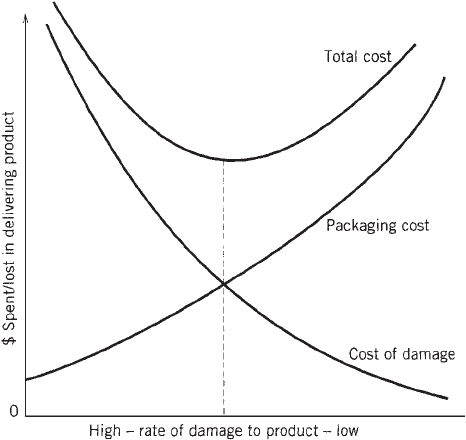
An inverse relationship exists between packaging cost
and maintaining product integrity with low damage rates,
as shown in Figure 1. Other factors being equal, an
increase in packaging will provide more protection to the
contents and therefore lower the potential for damage. Or,
conversely, cutting packaging costs without other im-
provements generally means less protection and higher
damage rates.
The real cost of getting the product safely to market is
the sum of packaging and damage. Optimizing the total is
the true goal of packaging design. As damages rise too
high on the left of the graph, both replacement–repair
costs and potential for loss of customer goodwill and
cancellation of orders increase. For companies where loss
of sales and customer satisfaction are more important
than costs, there is not much room for movement to the
left of the package–damage intersection.
No matter where packaging design takes place—in
engineering, in manufacturing, in shipping, or at the
supplier—all factors mentioned above must be considered,
costed, and involved in a total-system approach.
THE PROTECTIVE-PACKAGE CONCEPT
The equation presented earlier is used here to explain the
concept of protective packaging for distribution:
Product þpackage ¼ distribution environment
Figure 2 depicts this equation and the consequences of an
imbalance in the equation, which is what happens when a
product plus its package are not exactly what is needed to
survive in the distribution process.
Reading from left to right, here is an explanation of the
bar chart. Severity is the quantitative measure of the
environment, which can be any one or combination of
hazards in distribution. Here are examples of hazards
and their severity: The rough-handling hazard to a 20-lb
(9.1-kg) package is determined to be 30 in. (76-cm) of drop
on any of six package surfaces; or the compression (sto-
rage) hazard is determined to be 10 packages high in
warehousing; or the high-temperature hazard is 1401F.
Product represents the measured level of resistance to
damage of the product. In the rough-handling example,
the product has been tested and has shown the ability to
survive six drops from 15 in. (38 cm) with no damage,
while higher drops will cause product impairment.
The third bar depicts the equation whereby the pro-
duct’s measured level of damage resistance plus the
package’s measured abilities to protect the product are
exactly equal to the expected environmental hazard(s), an
optimum solution. For the example, a product with 15-in.
(38-cm) drop resistance is packaged in 15-in. (38-cm) drop
protection, which adds up to the 30 in. (76 cm) of drop
height the packaged product is expected to encounter in
the distribution environment.
When the package provides less protective capacity
than needed for the environment, as shown in the shaded
area of the fourth bar (Figure 2), this underpackaging will
result in damage in shipment. For example, the package
supplies only 9 in. (23 cm) of drop-height protection in-
stead of the required 15 in. (38 cm).
The next bar defines overpackaging. The package pro-
tection level is higher than the environment requires, and
the shaded area shows amount wasted. Instead of design-
ing
for 15 in.
of drop protection in our example, packaging
supplies 6 in. more than needed.
Figure 1. Cost of product protection is a tradeoff between packa-
ging and damage.
1242 TRANSPORT PACKAGING
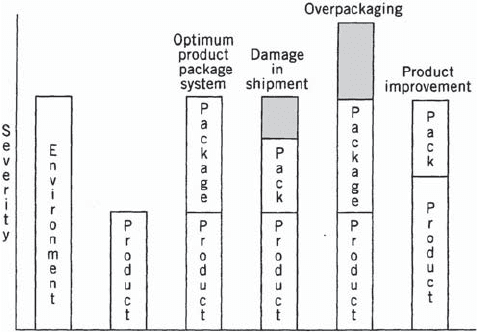
At times, product improvement is an alternative to
more packaging. Instead of accepting a certain level of
product ruggedness of a product, product engineers may
be able to raise the level as shown in the bar chart to the
far right. The result is a reduction in packaging needed.
Perhaps the product had a component that malfunctioned
above 15-in. (38-cm) drop heights, but a redesign improved
ruggedness to the 20-in. (51-cm) level. Now packaging
need only supply 10 in. (25 cm) of protection, a 33%
reduction from the original.
The most elusive part of the equation is the distribution
environment. The most difficult part of defining the
environment is not in identification of the types of ha-
zards, but what each hazard’s expected level is and its
probability of occurrence. Dedicated package designers
continually search for better methods of defining the
environment on the right side of the equation so they
can solve for the parameters of product and package on
the left side of the equation.
THE 10-STEP PROCESS OF TRANPORT PACKAGING
DESIGN
Here is a proven 10-step procedure that will ensure that a
transport package design will provide maximum perfor-
mance at least overall cost.
1. Identify the Physical Characteristics of the Product.
Product knowledge means more than knowing
simply its dimensions and weight. The package
designer must be aware of surface characteristics
and susceptibility to abrasion or corrosion, the
ability to hold a load in compression, internal
characteristics affected by vibration, and particu-
larly the product’s fragility. Guessing about any of
these factors will surely lead to potential problems.
2. Determine Marketing and Distribution Require-
ments. Package design must incorporate market-
ing and distribution requisites in addition to
product characteristics. One must know the num-
ber of units that will ship in a container, the
composition and attributes of the primary package,
the identity of customers and their handling and
storage requirements, the package disposal cri-
teria, total volume expected per shift per day per
year, expected life cycle, the planned modes of
transport, types of distribution channels, and so on.
3. Learn About the Environmental Hazards Your Pro-
ducts Encounter. It was emphasized earlier that
knowledge of the distribution environment is key
to designing an optimum package. Major hazards to
be expected in the environment are rough handling,
in-transit vibration and shock, compression in sto-
rage or in transit, high humidity and water, tem-
perature extremes, and puncturing forces. Learning
about them may include observation, reading
other’s research, or conducting measurements.
4. Consider Alternatives Available in Packaging and
Unitizing. Many alternatives are available for
shipping containers, interior packaging, and unit
loads. All should be considered and reviewed before
selecting the final types for further development.
Tradeoff analysis techniques such as make versus
buy often help. Rather than considering only ma-
terials that one has experience with, comparing
paper versus plastic versus wood vs metal is a good
exercise at times to ensure the best for the parti-
cular project. Once the basic materials have been
selected, detailed work on design can begin.
5. Design the Shipping Unit (Container, Interior
Packaging, and Unit Load). With basic materials
and information established in steps 1–4, the de-
signer can now scientifically engineer a transport
package, as well as unit load where appropriate.
Each component of the shipping unit (container–
interior–unit load) is analyzed for strength and
other required properties and compared to techni-
cal data available from suppliers. Some packaging
materials have good design data available, but
most do not. The designer frequently must rely on
experience to reach a successful solution; the no-
vice may find that lack of information makes it
difficult to arrive at an optimum solution. Trial and
error can be shortened for the novice, as well as the
experienced designer, by conducting engineering
tests in package development. Impact, vibration,
and compression testing in the lab not only identi-
fies shortcomings but helps to fine-tune to the
optimum solution.
6. Determine Quality of Protection Through Perfor-
mance Testing. After the shipping unit is designed,
perhaps with the aid of engineering development
tests, it should then be performance-tested. This
consists of subjecting the unit to a sequence of
anticipated hazards and/or tests in the laboratory
for the purpose of a pass/fail decision. Will the
shipping unit protect its contents all the way
through distribution? The performance test meth-
ods should be based on industry standards. Such
standards have considerable experience and his-
tory behind their development and use, and a
successful completion of the test sequence almost
Figure 2. Concept of a protective package.
TRANSPORT PACKAGING 1243
guarantees damage-free shipments. The most
widely used standard is the International Safe
Transit Association’s Project 1 and 1A, in use since
1948 (1). The 1982 approved ASTM D4169 (2)
provides a more complete array of distribution
possibilities and identified hazards with corre-
sponding test sequences, and it permits the user
some flexibility in selecting test intensities. For
users who can clearly define their distribution
cycles, but find them different from the standard
cycles in D4169, the ASTM standard also provides
a means of developing a unique sequence of tests,
resulting in performance tests that can more pre-
cisely simulate the actual conditions.
7. Redesign the Shipping Unit Until It Successfully
Passes All Tests. There is an old saying: One test is
worth 1000 expert opinions. Often performance test
results fool even the most experienced engineers,
and it is necessary to repeat an entire cycle of
redesign and retesting as many times as required
to reach a ‘‘pass’’ decision.
8. Redesign the Product Where Indicated and Feasi-
ble. Occasionally, testing reveals a product weak-
ness that can be compensated for by protective
packaging, but at excessive cost. If at all feasible,
the product should be redesigned to correct the
weakness rather than redesigning the package.
This is particularly important when the cost of
the redesigned product is less than that of the
increased packaging. It is usually difficult for pack-
age designers to bring about product redesign when
they are located organizationally in other than the
product engineering group. If this is the case, the
packaging designer should attempt to establish a
continuing line of communication with the product
engineers. Sometimes this means educating pro-
duct engineers in the hazards of distribution and
showing them how to correct product weaknesses.
9. Develop the Methods of Packing. An important part
of package design is packing of the product in the
shipping container and unitizing of containers.
Although this may be the responsibility of someone
else, (i.e., industrial engineering), the designer
must be aware of cost factors and the appropriate-
ness of mechanizing or automating all or part of the
operations. Sometimes a tradeoff in package design
must be implemented to achieve overall system
economics.
10. Document All Work. One step repeatedly over-
looked in the design process is documentation.
This includes documenting test results, specifica-
tions, drawings, and methods of packing. Drawings
should be in company-standard formats with ap-
propriate designations for reference in the corpo-
rate specification system. Relying on supplier
sketches or drawings as the reference document
is not a wise idea. They should be transferred to
company format so that purchasing, manufactur-
ing, and engineering can reference them. On any
package design project, follow these 10 steps and
check your work against the checklist below. Doing
so will significantly reduce potential of an unplea-
sant surprise when shipments begin.
Checklist for Each Package Design Project
1. Have you considered the solid-waste aspects of the
package and unit load, and their alternatives, to
minimize impact on the environment?
2. Have you pondered the use of returnable or reusa-
ble containers and dunnage?
3. Have you contemplated all cost factors in the
distribution cycle: handling, storage, and
transportation?
4. Have you checked cost of this package versus
company or plant average for similar products?
5. Have you considered all possible alternatives in
materials and methods?
6. Have you used industry standards for materials
and design criteria where possible?
7. Have you performance-tested the design against
accepted industry standards or regulatory
requirements?
8. Have you documented the design in company’s spec
system?
9. Have you checked damage and customer com-
plaints on this product line?
10. Have you satisfied all rules and regulations apply-
ing to this product for all distribution modes it is
expected to encounter?
THE COMPONENTS OF TRANSPORT PACKAGING
The components of transport packaging may be broadly
classified in the following categories:
Shipping containers
Interior protective packaging
Closure and securement materials
Unitized load shipping bases
Together these represent about one-third of the total U.S.
packaging costs.
By
far the largest
component of transport packaging is
shipping containers, representing an estimated 75% of the
total purchased. Corrugated boxes represent about 80% of
the total spent on shipping containers and probably close
to 90% of total units of shipping containers used. Other
types of containers include: paper and plastic shipping
sacks; wooden boxes and crates; metal and plastic return-
ables, drums and pails; and composites for textiles.
Interior packaging takes many forms, but the most
widely used for cushioning, positioning, or simply to fill
space are corrugated pads, die-cuts, partitions, foldups,
molded and fabricated expanded polystyrene forms,
molded and fabricated resilient foams, foam-in-place,
loose-fill, air-bubble and foam wraps, variations of paper
waddings, inflatable air bags, and a variety of specialty
1244 TRANSPORT PACKAGING
devices and forms. Barriers against water, water vapor,
and various gases and to prevent electrostatic damage are
another class of interior materials. Corrosion preventa-
tives are also in this category, such as preservatives,
volatile corrosion inhibitors, and desiccants.
Closure and securement includes (a) adhesives, tape,
and staples for corrugated box closure and (b) strapping,
stretch wrapping, and shrink bags for unitizing purposes.
Shipping bases include wood, corrugated, or plastic
pallets; corrugated, solid fiber, or plastic slip sheets; and
wood skids.
CONCLUSION
When products are shipped anywhere and by any mode of
transport, the packaging surrounding the product must
contain and protect it. Ensuring that the product arrives
at destination in undamaged condition is the primary
objective of transport packaging.
BIBLIOGRAPHY
1. Pre-shipment Test Procedures. International Safe Transit As-
sociation, East Lansing, MI, 2007.
2. Annual Book of ASTM Standards, Vol. 15.10, D4169, ASTM
International, West Conshohocken, PA, 2007.
TRANSPORTATION CODES
MARY ALICE O PFER
Fibre Box Association, Rolling
Meadows, Illinois
Two types of transportation codes are in use in the United
States with regard to packaging: federal regulations and
carrier rules. Carrier rules, such as Item 222 and Rule 41,
are the type that is more familiar to the packaging
community. They have been in effect the longest and
have changed the least over the past several years.
CARRIER RULES
Carrier packaging rules are found in the carriers’ tariffs
and must be followed if the shipper wants coverage by the
carrier for damage claims. Carriers reserve the right to
refuse articles they consider inadequately packaged, and
conformance to packaging rules is implicit in collection of
shipping rates as listed in the tariffs. The Airline Tariff
Publishing Company (air cargo) and Air Transport Asso-
ciation of America (airline) publish North American tar-
iffs, but these documents do not include detailed
packaging instructions except for special articles, such
as live animals, human remains, and seafood. Individual
carriers, United Parcel Service, Federal Express, and the
U.S. Postal Service, publish their own tariffs, which also
typically lack detailed packaging instructions.
The American Trucking Association and the National
Railroad Freight Committee publish the National Motor
Freight Classification (NMFC) and the Uniform Freight
Classification (UFC), respectively. These documents con-
tain detailed packaging rules as well as rates, which apply
to the participating individual carriers named in the
tariffs. The packaging rules mandate minimum quality
values for material of construction based on the total gross
weight and united dimensions (length+width+depth) of
the package and its contents.
Item 222. Item 222 is the rule for corrugated and
solidfiber packaging of articles transported in the less-
than-truckload (LTL) common-carrier mode. Most goods
transported in the United States today are transported by
this mode at some time in their distribution cycle. If the
NMFC specifies ‘‘in boxes’’ in the entry for the article to be
transported, then the outside of the box must carry a
circular box manufacturers certificate that precisely coin-
cides with the instructions in the rule and certifies com-
pliance with the manufacturing instructions in the rule, or
damage claims and rates may not be honored. If the entry
for the article specifies ‘‘in package numbery,’’ then
detailed instructions for that (those) numbered package(s)
are listed in the section ‘‘Specifications for Numbered
Packages,’’ which must be followed, and a rectangular
certificate is applied indicating the package number and
grade of board used. The numbered package certificate is
the only rectangular certificate that is recognized by
carriers for tariff compliance. All others are simply
advertisements.
Rule 41. Rule 41 is the corrugated and solid-fiber
packaging rule for articles shipped by rail. However,
piggyback shipments in trucks on railroad flatcars are
subject to truck rules. Rule 41 and Item 222 are very
similar, but not identical. The numbered packages can be
different. Rule 41 is the older of the two and is the model
on which Item 222 is based, but articles in boxes are
shipped most often by truck making Item 222 the rule to
be consulted.
Edge-Crush Test (ECT). In 1990, the corrugated industry
trade associations sponsored proposals to revise Item 222
and Rule 41. The primary thrust of the proposals was to
have the rules recognize edge crush test criteria as an
indicator of box-compression strength, and to allow its use
as an option to the traditional linerboard basis weight and
combined board-burst requirements. ECT is a character-
istic of the combined corrugated board that directly pre-
dicts compression strength of the corrugated packaging.
By providing alternative requirements in the carrier
rules, box manufacturers would have more latitude to
design and supply boxes that better meet the customer’s
performance requirements. This concept is supported by
organizations representing carriers, users, as well as
box and containerboard producers with the growing re-
cognition that box compression strength may be a more
important factor as unitized carrier loading and
TRANSPORTATION CODES 1245
warehousing has proliferated. Enhanced containerboard
materials achieving a guaranteed crush or compression
performance at lower basis weights had become available,
which provide potential environmental advantages and
improved quality through source-reduced packaging sys-
tems and increased recycled content.
Use as Standards. Over a long period, the terminology
and minimum requirements for corrugated packaging
used in the carrier rules became an assumed standard
for boxes. Using the carrier rules as standards is often
inappropriate, as the carrier rules were not developed to
address the box users’ warehousing and other distribution
needs. They were developed to delineate the carrier’s
liability. As the box-manufacturing industry and its cus-
tomers emphasize quality and efficiency, corrugated-box
standards should evolve to support the new emphasis.
FEDERAL REGULATIONS
Packaging itself is not typically of federal interest; how-
ever, certain specific issues are regulated by U.S. govern-
ment agencies. Consequently, packaging is sometimes
regulated by those agencies. Federal regulations that
affect packaging are found in the Code of Federal Regula-
tions (CFR) of the agency under whose jurisdiction the
issue resides. For example, the U.S. Department of Trans-
portation (DOT) regulates the transportation of hazardous
materials. Regulations for packaging hazardous materials
for transport are in the DOT’s CFR, Title 49. Packaging of
these materials is based on the capability of the packaging
to pass a battery of tests that are dictated by the degree of
hazard of the material, or its ‘‘packing group.’’ These
regulations were adopted by the DOT from the United
Nations (UN) Recommended Rules, which replaced the
former DOT specification packages such as the DOT 12B.
The DOT shares the regulation of packaging infectious
substances and regulated medical wastes with the Depart-
ment of Labor (29CFR) due to OSHA concerns over blood-
borne pathogens, and of packaging hazardous wastes and
pesticides with the Environmental Protection Agency
(EPA) (40 CFR) because of potential environmental im-
pact. The Food and Drug Administration (FDA, 21 CFR)
regulates direct contact packaging of fatty and aqueous
foods as indirect food additives. The Department of Agri-
culture (9 CFR) regulates the packaging of meats and
poultry under meat inspection and poultry inspection.
Labeling. The EPA assisted the Federal Trade Commis-
sion (FTC 16 CFR) in defining the voluntary ecolabel
statements that are allowed, such as recycled, recyclable,
and biodegradable. Aside from environmental claims,
package labeling issued are generally specific to the article
inside the package. With transport packaging often dou-
bling as consumer packaging, this process has become an
important concern. The FDA regulates the nutritional
labeling of packages with respect to food contents. Both
the FDA and FTC require metric as well as standard
measurement units displayed on the packages of many
consumer products. The DOT gives specific instructions
for labeling hazardous-materials packages, even specify-
ing the colors to be used. The EPA requires products
(including packages) that are manufactured using or
containing ozone-depleting substances to be specifically
labeled. Package labeling of regulated articles should be a
joint effort between package manufacturer and user.
BIBLIOGRAPHY
General References
Airline Tariff Publishing Company, Fairfax, VA.
Air Transport Association of America, Annapolis Junction, MD.
National Motor Freight Classification, American Trucking Asso-
ciations, Alexandria, VA.
Uniform Freight Classification, National Railroad Freight Com-
mittee, Atlanta, GA.
Code of Federal Regulations, Superintendent of Documents/U.S.
Government Printing Office, Washington, DC.
Fibre Box Handbook, Fibre Box Association, Rolling Meadows, IL.
TRAYS, FOAM
HUSTON KEITH
Keymark Associates,
Marietta, Georgia
These lightweight, inexpensive trays are made of ex-
panded polystyrene. The major packaging applications
are for packaging fresh meat, poultry, eggs, produce, and
other foods for retail sale or for packaging prepared foods
for imminent consumption. Other uses include industrial
protective packaging and disposable tableware (plates,
bowls, cups, trays, etc.). The primary process used for
making trays is extrusion of foamed polystyrene sheet
(Figure 1) and thermoforming the trays. A minor quantity
of trays are made from steam molding of precharged
beads—this process is used mostly for cups, industrial
packaging, and insulation. This article focuses on the
thermoformed trays as being of primary interest to packa-
ging, but it discusses the other applications briefly in
context of packaging use.
HISTORY
The process of making a polystyrene foam sheet for
thermoforming was developed in the late 1950s based on
technology first commercialized by Dow Chemical Com-
pany in 1943 for extruding foam board for insulation. It
was called the ‘‘direct-injection process,’’ because gas was
injected into the extruder and mixed with melted polymer,
as compared with the precharged bead process, where
resin beads are impregnated by the gas. Dow then started
a plant in Carteret, New Jersey to produce sheet and
1246 TRAYS, FOAM
trays. Because of Dow’s prominence in commercializing
these processes and continued dominance of the polystyr-
ene resin market, its trade name Styrofoam for foam
insulation board became associated with nearly any form
of expanded polystyrene. In fact, many people improperly
use the trade name Styrofoam for all polystyrene foam
products.
The initial application for this process for packaging
was for forming meat trays. By the mid-1960s, equipment
and techniques were developed for forming egg cartons.
Dow formed a joint venture with a major egg producer,
Olson Farms, to produce egg cartons. The venture,
Dolco Packaging, later became an independent company.
In the late 1960s, food-service containers and packaging
were developed. Foam trays began to replace pulp trays
for meat and egg packaging at an accelerated rate because
of lower cost and better durability. In addition, the
growth of the supermarket and especially the food-service
industry propelled rapid increases in the use of this
package.
The rapid growth of extruded-polystyrene foam packa-
ging continued as more users were found. Foam disposable
plates and bowls found acceptance, as did carry-out con-
tainers in an affluent society driven more and more by
convenience. The fast growth of polystyrene attracted
petrochemical giants Amoco and Mobil into the business.
In 1973, polystyrene foam containers were adopted by
McDonald’s as its primary hamburger package. Better
heat retention, enhanced produce protection, and con-
cerns for forest depletion and landfill stability were cited
as benefits. This led to over two decades of unprecedented
industry growth, from 15 million lb (6800 metric tons) in
1966 to 651 million lb in 1988 (295,900 metric tons) in the
United States alone. Costs were driven lower by more
efficient production, which made the replacement of sub-
stitutes (mostly paper) more and more compelling.
Under pressure from environmental groups, led by the
Environmental Defense Fund (EDF), McDonald’s first
placed a moratorium on chlorofluorocarbon (CFC) use in
its containers, then announced in November 1989 that it
would discontinue the use of polystyrene foam trays for
hamburger packaging; they would be replaced with a
paper-based wrap. Other fast-food suppliers followed
suit. This caused a loss of 90 million lb of demand in the
face of industry overcapacity. One supplier entered Chap-
ter 11 bankruptcy (since recovered), and at least two
plants were closed.
After a period of retrenchment, the industry began to
slowly recover. Although the fast-food packaging market
is moribund, the low cost and stiffness of foam relative to
alternatives has provided continued growth in disposable
tableware. The growth of the poultry market has also
pulled along foam tray consumption. Whereas the foam
tray may never visualize the usage in fast food as before, it
has proved to be an almost irreplaceable packaging con-
tainer for fresh meat and poultry.
MANUFACTURING PROCESS
As mentioned earlier, most foam trays are made by
extruding foam sheet and thermoforming it into trays.
Although this process is similar to the process used to
make solid plastic trays, it also differs in several signifi-
cant aspects. Two extruders are used instead of just one,
an annular die is used rather than a flat one, rolls must be
aged before forming, and matched metal dies are used for
forming. As a result, the capital costs are much higher
than for solid plastic. However, raw-material costs are
much lower as a percentage.
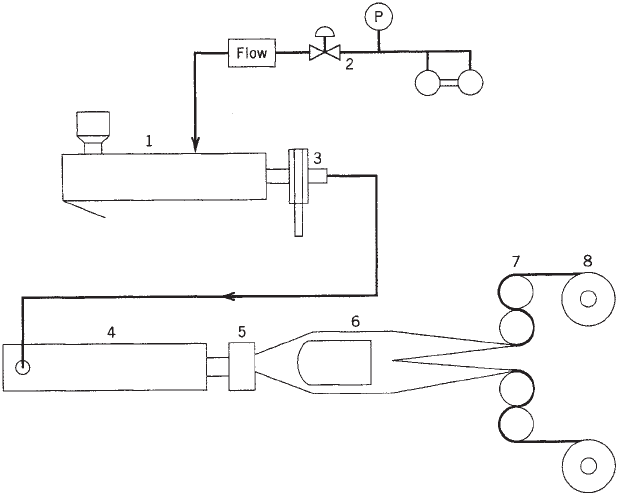
The typical tandem extrusion system includes a pri-
mary extruder for melting and mixing the polymer and a
Figure 1. A tandem extrusion process for the
manufacture of polystyrene foam sheet: 1: pri-
mary extruder, 2: blowing-agent addition system,
3: screen changer, 4: secondary extruder, 5: an-
nular die, 6: cooling mandrel, 7: S-wrap, 8:
winders.
TRAYS, FOAM 1247