
Yam, Kit L. (ed.). The Wiley encyclopedia of packaging technology
Подождите немного. Документ загружается.

10. R. J. Winne, ‘‘What Really Happens to Your Package in Trucks
and Trailers’’ in Proceedings of Western Regional Forum of the
Packaging Institute, USA, 1977.
11. R. D. Newton, Fragility Assessment Theory and Test Proce-
dure, Monterey Research Laboratory, Inc., Monterey, CA,
1968.
12. D. E. Young and S. R. Pierce, Development of a Product
Protection System, Shock and Vibration Bulletin, No. 42,
Office of the Secretary of Defense, Research and Engineering,
Washington, DC, 1972.
13. ASTM D3332-99, Standard Methods for Mechanical-Shock
Fragility of Products Using Shock Machines, American So-
ciety for Testing and Materials, 2004.
14. ASTM D3580-95, Standard Method of Vibration (Vertical
Sinusoidal Motion) Test of Products, American Society for
Testing and Materials, Philadelphia, PA, 2004.
15. J. P. Phillips, ‘‘Package Design Consideration for the Distri-
bution Environment,’’ Proceedings of the 1979 International
Packaging Week Assembly, Packaging Institute, October 1979.
16. J. F. Perry, A Brief Summary of Dynamic Test Methods for
Shipping Containers, Del Monte Corporation, Walnut Creek,
CA, March, 1982.
17. The 2008 ISTA Resosurce Book, International Safe Transit
Associon, 2008.
General References
C. M. Harris and A. G. Piersol, Harris’ Shock and Vibration
Handbook, 5th edition, McGraw-Hill, New York, 2002.
C. E. Crede, Vibration and Shock Isolation, John Wiley & Sons,
New York, 1951.
J. F. Perry, ‘‘Cost Reduction Through Dynamic Testing of Shipping
Containers,’’ Packaging Technology (June/July 1982).
W. Silver and E. Szymkowiak, ‘‘Recommended Shock and Vibra-
tion Test for Loose Cargo Transported by Trucks and Rail-
roads,’’ Proceedings of the Institute of Environmental Sciences,
1979.
ASTM D 5276-98, Drop Test for Shipping Containers, American
Society for Testing and Materials, Philadelphia, PA, 2004.
ASTM D 1596-97, Method of Testing for Dynamic Properties of
Package Cushioning Materials, American Society for Testing
and Materials, Philadelphia, PA, 2003.
ASTM D 999-07, Standard Methods for Vibration Testing of
Shipping Containers, American Society for Testing and Mate-
rials, Philadelphia, PA, 2007.
TESTING, SHIPPING CONTAINERS
ALFRED H. MCKINLAY
Consultant, Pattersonville,
New York
Shipping containers are tested in the laboratory to verify
their ability to survive hazards in the distribution envir-
onment. Tests may be conducted as a packaging develop-
ment tool for quantitative purposes, or as a qualitative
measure of performance. Objectives may be reduction of
damage, cost improvement, assurance of safe product
shipment, or other package-design reasons. Laboratory
preshipment tests, utilizing proven industry standards,
will provide a high level of assurance that a package
design will function properly and safely deliver its con-
tents, without cumbersome trial shipments. Such trials
require a large number of test packages and significant
time delay before an indication of success or failure. They
provide no fundamental data, are expensive to conduct,
and may severely delay introduction of new products to
the marketplace. While some trial shipments are a good
idea as a final check, prior laboratory testing is a much
quicker indicator of success or failure and can precisely
identify causes of inadequacy.
SOURCES OF TEST METHODS
The oldest and largest developer of packaging test meth-
ods, including those for shipping containers, is ASTM
International (American Society of Testing and Materi-
als). ASTM test methods, which are based on a balanced
consensus approval process, have worldwide acceptance.
Updated at least every 5 years, their standards for packa-
ging began development in 1914 and now include over 130
test methods, specifications, or practices, which are in-
cluded in the ASTM Annual Book of Standards, Volume
15.10 (1).
The International Safe Transit Association (ISTA) pub-
lishes several types of preshipment testing procedures.
These include: Series 1 Non-simulation Integrity Tests,
Series 2 Partial Simulation Tests, Series 3 General Simu-
lation Tests, Series 5 Focused Simulation Tests, and Series
7 Development Tests (2).
Internationally, the International Organization for
Standardization (ISO) develops and maintains test meth-
ods for shipping containers that are similar to, but not
exactly the same as, those of ASTM. ISO standards may be
obtained from the American National Standards Institute
(ANSI) in New York City.
ENVIRONMENTAL HAZARDS TO SHIPPING CONTAINERS
Shipping containers and interior protective packaging
serve the primary purpose of protecting products against
environmental hazards occurring in distribution. An early
definition of these hazards was set forth in a 1979 report
by the Forest Products Laboratory of the USDA (3), FPL
22, and still remains a source of many test methods and
levels of intensities. It identifies the following hazards as
the major causes of damage in distribution: rough hand-
ling, shock and vibration in transit, compressive forces,
and temperature and humidity extremes. Experience of
many shippers supports the contention that these hazards
are still the major culprits, with rough handling clearly
the most severe and frequent cause of damage. Since the
late 1980s, instrumentaion progress has made it possible
to measure shock, vibration, temperature, and humidity
much more accurately and easily. Packaging researchers
1218 TESTING, SHIPPING CONTAINERS
have used these instruments to update and enlarge the
database from FPL22 (3) since that time.
TEST METHODS FOR REPRODUCING SHIPPING
HAZARDS
Each of the major distribution hazards of handling, shock
and vibration in transit, and compression can be repro-
duced by one of several test methods, depending on the
type of container, test equipment availability, or purpose
of test. The following discussion covers the most widely
used ASTM methods.
Drop test
Accidental or purposeful dropping or striking of contain-
ers during handling, loading, and unloading is the prime
source of damage to most packages under 200 lb. ASTM
test method D5276, Drop Test of Loaded Containers by
Free Fall, describes the equipment and methodology for
conducting a laboratory simulation of this hazard. All
types of shipping containers may be tested, including
boxes, cylindrical containers, bags, and sacks. Accuracy
of the drop-test equipment is specified, including a re-
quirement for impact surface mass of at least 50 times
that of the heaviest container to be tested. The method
may be used to check the ability of the container to survive
free fall, evaluate the protective capability of container
and inner packing, compare performance of different
package designs, or permit observation of progressive
failure of a container and damage to its contents.
An alternative to free-fall drop is ASTM test method
D5487, Simulated Drop of Loaded Containers by Shock
Machine. This method provides more accurate package
positioning for impacts, particularly on flat impacts where
the shock transmitted to package contents is usually
greatest. While the shock machine method has been
shown to be quite accurate for most applications, rigid
package systems are not recommended for testing by this
method (where ‘‘rigid’’ means a natural frequency above
83 Hz for the system).
Incline Impact Test
For large shipping containers, an alternate method for
obtaining an impact is ASTM test method D880, Impact
Testing for Shipping Containers & Systems. A guided test
carriage, tilted at 101, is loaded with the test specimen on
the leading edge and pulled up the incline to a distance
sufficient to produce the desired impact velocity. The
carriage is then released and travels down the incline
until the container strikes the impact surface, also tilted
at 101. When the incline test equipment, dubbed the
‘‘Conbur test,’’ is constructed with impact surface at least
50 times the mass of the heaviest test specimen, it is
considered equivalent to a free-fall drop test for intensity
of shock. ASTM D880 also includes the use of pendulum
equipment as an alternative to the incline.
A popular test sequence and level of intensity for the
incline impact test is the ISTA 1B procedure for containers
and skidded or palletized items weighing over 150 lb. It
specifies an impact velocity of 5.75 ft/s with impacts on all
four sides, followed by a rotational bottom drop from 8 in.
high. The incline impact equipment may also be modified
such that it can reproduce shocks similar to railcar switch-
ing impacts. ASTM test method D5277, Performing Pro-
grammed Horizontal Impacts Using an Inclined Impact
Tester, describes the required carriage bulkhead, program-
ming material or device, and other modifications that are
necessary for simulating standard railcar draft-gear im-
pacts. The method is not appropriate for long-travel draft
gears or cushioned railcar underframes.
Horizontal Impact Test
A more accurate method of reproducing all types of railcar
impacts is described in ASTM test method D4003, Pro-
grammable Horizontal Impact Test for Shipping Contain-
ers and Systems. The test equipment specified is a
horizontal shock machine with precise control over impact
and rebound velocities. Dynamic compression of contain-
ers during railcar switching is great, due to backload of
other freight pressing against it; therefore, the test
method describes how such backload should be simulated
during testing. Proper instrumentation and calibration,
critical to the method’s accuracy, are specified in some
detail. ASTM D4003 may also be used for other types of
horizontal impact simulation, such as pallet marshaling.
Bridge Impact Test
Some handling systems place heavy stress on long
packages, particularly in small-parcel shipping. ASTM
test method D5265, Bridge Impact Testing, specifies
equipment and methodology for applying impacts to the
center of long packages. Two options are included; A, for
using a free-fall drop tester; or B, for using a SMITE
tester. In both methods, the package is supported on its
ends and an impacting device drops onto its center at a
specified impact velocity.
Concentrated Impact Test
Thin-walled
shipping containers and
plastic wrapped
items often incur damage to contents due to impacts
from other packages or handling devices. The impacts
typically do not cause a puncture but do impose severe
deflection of the container wall, resulting in damage to the
contents. ASTM test method D6804, Test Method for
Concentrated Impacts to Transport Packages, specifies
equipment and methods for applying concentrated im-
pacts to specific surfaces of the package.
Other Handling Tests
ASTM Standard D6179, Rough Handling of Unitized
Loads and Large Shipping Cases & Crates, contains a
number of test methods particularly suited to reproducing
handling hazards for either unitized loads or large con-
tainers or both. Included are the following:
Free-Fall Drop Test. This utilizes a quick-release hook
and sling for equipment to drop test on any con-
tainer surface.
TESTING, SHIPPING CONTAINERS 1219
Rotational Edge-Drop Test. One end of the specimen
is supported on a block while the opposite end is
raised to specified height and then dropped to the
floor.
Corner Drop Test. One bottom corner is supported on
a block while the diagonally opposite bottom corner
is raised to specified height and then dropped to the
floor.
Raised-Edge Drop Test. One end of the specimen is
raised to a specified height while the opposite end
rests on floor, and then the raised end is dropped to
floor.
Rolling Test. This determines the ability of a con-
tainer to withstand the effects of rolling.
Tip Test. This determines the ability of tall or top-
heavy containers to resist tipping over.
Tipover Test. This determines the protective ability of
loaded shipping containers when subjected to tip-
over impacts.
ASTM Standard D6055, Mechanical Handling of Uni-
tized Loads and Large Containers or Crates, provides
methods of testing handling capabilities using lift trucks,
grabhooks, or slings. A test course and methodology is
described for handling tests by four types of lift truck:
fork, spade, clamp, and push–pull.
VIBRATION TESTS
Although vibration-induced damage is not a frequent
problem for most packaged products, vibration does occur
with certainty on every shipment by any mode of trans-
port. It is therefore important to test all types of shipping
containers for vibration. Four methods of vibration testing
are available, depending on equipment and test objective.
ASTM test method D4728, Random Vibration Testing
of Shipping Containers, provides the closest simulation to
actual vibration received by containers in transit. Input
for the test may be generated from field measurements
made with accurate recording instruments or from use of
the sample vibration spectra for commercial transport
that is included in the standard. Test durations frequently
run as long as 3 h or more, depending on the packaged
product, distance shipped, and objective of the test. Re-
sonance buildups during random vibration are less in-
tense than by sinusoidal vibration methods, and
unrealistic fatigue damage is therefore minimized.
ASTM Standard D999, Vibration Testing of Shipping
Containers, actually contains four distinct test methods
and utilizes two entirely different types of vibration
equipment. Method A is a repetitive shock test, not really
vibration in the pure sense, and is divided into A1 for
rotary motion and A2 for vertical motion. Both tests are
conducted with the package free to bounce on the table,
which is running at a frequency causing the package to
just lift off during the upstroke of each vibration cycle
(known as 1G+). The operating frequency and table dis-
placement are constant throughout the test, which is
usually performed on a mechanical-type vibrator. Typical
test duration is about 1 h with smaller, nonskidded
containers tested one-third of the duration on each axis.
The two methods do not create the same type of motion;
therefore, they also do not cause the same types of
damage.
Methods B and C of D 999 are resonance search and
dwell tests, typically performed on electrohydraulic equip-
ment that easily performs at 3–200 Hz as required for
most packaging tests. The table displacement varies in-
versely with the frequency so as to maintain a constant
level of force, usually 0.25 G to 1 G. The purpose of the test
is to locate natural frequencies of the packaged product
and then dwell for a specified time at each natural
frequency while the package resonates. Procedures are
described for sweeping the vibration frequency up and
down to locate the natural frequency points. Method B is
conducted on single containers while Method C is con-
ducted on stacks of containers or unitized loads. Typical
dwell times at resonance for both methods is 5–15 min for
each point, although some users dwell for up to 1 h.
Compression Tests
The effects of stacking one container on another in storage
or transportation can be studied by means of the compres-
sion test. Two ASTM test methods are available: D642,
Determining Compressive Resistance of Shipping Contain-
ers, and D4577, Compression Resistance of a Container
Under Constant Load. The former requires a testing
machine that applies a steadily increasing force to the
container until it fails. A recording device notes applied
load and container deflection during testing that generally
requires r2
min for completion.
ASTM test method D4577
may use a similar machine, but more typically utilizes a
simple stationary apparatus that positions the test speci-
men under a fixed constant load for the desired time,
anywhere from 1 h to 1 year. Both methods may be used on
filled shipping containers or on empty ones, depending on
test objective.
Water-Vapor Transmission Test
To measure the resistance of shipping containers to water
vapor, ASTM D4279, Water Vapor Transmission of Ship-
ping containers, provides two test methods. The constant-
atmosphere method is conducted at 90% rh and 1001F. The
cycle method goes up and down, from 01F to 1001F., 90% rh
and back, for a number of specified cycles. Different
procedures are defined for reclosable and nonreclosable
containers.
Water-Resistance Test
ASTM test method D951, Water Resistance of Shipping
Containers by Spray Method, determines how well a filled
container will resist water spray such as produced by
heavy rains or waves over the deck of a ship. The test is
frequently conducted in a series with other tests such as
drop or incline impact.
CONDITIONING FOR TESTING
A requirement in all ASTM shipping container test meth-
ods is for testing at a specified condition of temperature
1220 TESTING, SHIPPING CONTAINERS

and humidity. A variety of atmospheric conditions are
described in D4332, Conditioning Containers, Packages,
or Packaging Components for Testing. This standard
practice provides special conditions that may be used to
simulate particular field conditions that a container may
encounter during distribution. The standard also de-
scribes procedures for preconditioning the containers to
ensure that they reach equilibrium in the atmosphere
before they are exposed to the final test conditions.
Following preconditioning, containers are placed in the
conditioning chamber for a specified time, ordinarily at
least 72 h, to reach equilibrium at test conditions. Most
testing is conducted at the U.S. standard conditioning
atmosphere of 731F and 50% rh, but other test atmo-
spheres may also be used, as listed in Table 1.
PERFORMANCE TESTING
The test methods described to this point may be used in
several ways by package designers. The most frequent use
is as an engineering development tool to ascertain how
well design and materials are doing their job of protecting
the product. But the same methods may also be utilized to
indicate whether the package will perform as expected for
the total distribution cycle. Whereas engineering develop-
ment testing often overstresses the package to determine
its limits when subjected to a particular hazard, the
performance use of the same methods is a pass/fail, go/
no-go situation with the same container going unopened
through the full set of tests. Development testing is a
quantitative measure, while performance testing is
qualitative.
ASTM D4169, Standard Practice for Performance Test-
ing of Shipping Containers and Systems, has received
wide acceptance as a national standard for measuring
expected shipping-container performance. It is essentially
a matrix of test methods, distribution modes, and levels of
test intensities. Putting them together in a sequence that
simulates a particular distribution environment produces
a ‘‘distribution cycle’’ (DC) containing certain hazards
(tests). If the shipping container and contents survive
the DC, then it can be assumed that they will also survive
in actual handling and shipping by the same method of
distribution (DC). ASTM D4169 also requires that the
criteria of acceptance (definition of success or failure) be
predetermined and documented prior to testing.
Each hazard in distribution is identified in D4169 with
a test method to reproduce it. Table 2 lists the nine hazard
elements recognized in the performance standard, along
with the corresponding test methods.
Presently, there are 18 distribution cycles in D4169,
each containing a sequence of hazards expected by that
particular distribution method. Table 3 is a listing of the
cycles with hazards noted by their code letters from Table 2.
For those packaging engineers with a good knowledge
of their distribution environment(s), DC 2 has become the
performance test plan of choice. It permits them to develop
a test plan that fits the often unique sequence of hazards
that their packages encounter in distribution.
Since 1997 ISTA has also developed several perfor-
mance or general simulation test procedures which are
somewhat different than ASTM’s. They are Procedure 3A
for Parcel Delivery System Shipments, 3E for Unitized
Loads of Same Product, 3F for Distribution Center to
Retail Outlet Shipments, and 3 H for Mechanically
Handled Bulk Transport Containers. There is also a
focused simulation Procedure 5B for Temperature Con-
trolled Transport Packages.
REGULATORY AGENCY USE OF CONTAINER TESTING
Shipping-container performance requirements, as a sub-
stitute for material or design specifications in regulatory
documents, has been slowly making progress. The U.S.
Department of Transportation (DOT) now requires that
many hazardous materials be packaged in conformance to
a brief set of performance-test specifications rather than
to cumbersome and complex material and design specifi-
cations previously required (4). The National Motor
Freight Classification in 1995 authorized an alternate
rule, Item 180, performance requirements for LTL ship-
ments, which can be utilized at the shipper’s discretion
Table 1. Special Atmospheres
Environment Temperature,
1F(1C)
Relative Humidity
(rh), %
Cryogenic 6776(5573)
Frozen-food storage 074 (–1872)
Refrigerated storage 4174(572) 8575
Temperate, high-humidity 6874 (2072) 9075
Tropical 10474 (4072) 9075
Desert 14074 (6072) 1572
Table 2. Hazard Elements and Corresponding Tests
Code Hazard Element Test Simulation of Hazard ASTM Designation
A Handling— manual and mechanical Drop, impact, stability D5276, D880, D4003, D6055, D6179
B Warehouse stacking Compression D642
C Vehicle stacking Compression D642
D Stacked or unitized vibration Random vibration D4728
E Vehicle vibration Random or sinusoidal vibration D4728, D999 Method B or C
F Loose-load vibration Vibration (aka repetitive shock) D999 Method A1 or A2
G Rail switching Longitudinal shock D4003, D5277
H Climate, atmospheric conditions Temperature, moisture humidity D4332
I Low Pressure Vacuum D6653
TESTING, SHIPPING CONTAINERS 1221

instead of other material- and design-based rules or
special package numbers (5).
BIBLIOGRAPHY
1. Annual Book of Standards, Volume 15.10, ASTM Interna-
tional, West Conshohocken, PA, 2007.
2. Pre-shipment Test Procedures, International Safe Transit
Association, East Lansing, MI, 2007.
3. F. E. Ostrem and W. D. Godshall, An Assessment of the
Common Carrier Shipping Environment, General Technical
Report FPL 22, U.S. Forest Products Laboratory, USDA,
Madison, WI, 1979.
4. Code of Federal Regulations Title 49, U.S. Department of
Transportation, Office of Hazardous Materials Safety,
Washington, DC, 2006.
5. National Motor Freight Classification, American Trucking
Association, Alexandria, VA, 2006.
THERMOFORM/FILL/SEAL
EDWIN HO
OSI Industries,
Lisle, Illinois
Thermoform/fill/seal equipment is used for a variety of
food and nonfood packaging applications. Thermoform/fill/
seal (TFFS) machines use two continuous webs or rolls of
film (see Figure 1). Typically, the lower web is formed into
a cup, pouch, tray, and so on, which is then filled with
product. The upper web becomes the lid or cover. Although
over 90% of all TFFS machines are run with formed
bottom webs and unformed lidstock, it should be men-
tioned that this is not always the case. Sometimes both
webs are formed; sometimes the top web is formed, and
the bottom one is not, depending on product presenata-
tion, marketing need, competitive packaging advantages,
and so on.
PACKAGING APPLICATIONS
TFFS machines were originally designed as vacuum-
packaging machines to package ham, bacon, or sausage.
From cured meats, their use spread to other sectors of the
meat industry (frozen steaks, certain fresh meats, cook-in-
package delicatessen meats), and then to cheese products,
baked goods, fresh pasta, and a variety of perishable food
products requiring extended shelf life.
Nonfood applications of TFFS evolved from the original
vacuum-packaging machines for sausage and meat pro-
ducts. These are primarily sterile-medical applications.
Typical medical items packed on TFFS equipment are
syringes, needles, catheters, kidney-dialysis filters, scrub
sponges, surgical drapes and clothing, operating-room
kits, and many other items. Although medical TFFS
machines are structurally and conceptually the same as
TFFS machines used in the food industry, the materials
Table 3. Performance Test Sequence by Distribution Cycle
DC Hazard Element
Distribution Cycle (DC) Number Sequence
General schedule—undefined distribution system 1 A, D, F, G, A
Specially defined distribution system, user-specified 2 User-specified from Table 3
Hazard Elements
Single-package environment, r100 lb 3 A, C, F, E, A
Motor freight
Single package >100 lb 4 A, C, F, E, A
Truckload, not unitized 5 A, D, E, A
Truckload or LTL, unitized 6 A, D, A, B
Rail, carload
Bulk loaded 7A,D,G,A
Unitized 8 A,D,G,A,B
Rail and motor freight
Not unitized 9 A,C,E,G,F,A
Unitized 10 A, D, G, A, B
Trailer-on-flatcar, container-on-flatcar 11 A, G, D, F, A
Air and motor freight
>100 lb 12 A, D, I, E, A
r100 lb 13 A, C, F, I, E, A
Warehousing (partial cycle to be added to other cycles as needed) 14 A, B
Export/import shipment
By intermodal container or roll on/roll off equipment (partial
cycle to be added to other cycles as needed)
15 A, C, A
For palletized cargo ship (partial cycle added as needed) 16 A, C, A
For breakbulk cargo ship (partial cycle added as needed) 17 A, C, A
Non-commercial Government shipments 18 A, B, C, A, H, F, A
1222 THERMOFORM/FILL/SEAL
tend to be more difficult to run and the quality standards
for cutting and thermoforming are more difficult to meet.
Among the TFFS applications that are not food or medical
are the following: hardware items, cigarette lighters,
cosmetics, and similar applications where packages
made on continuous-web machinery are replacing pre-
formed plastic ‘‘blisters’’ (see Carded packaging).
Food Packaging
In food applications, the packages are almost always
hermetically sealed, and the films have various degrees
of barrier properties. The primary application for vacuum
packaging is to improve shelf life of foods that are sensi-
tive to oxygen or susceptible to dehydration. Almost all
cured-meat products (ham, bacon, sausage, corn beef, beef
jerky, etc.) are vacuum-packaged, as are many cheeses. An
off-shoot of vacuum packaging is controlled atmosphere
packaging (see Modified atmosphere packaging). A mod-
ified atmosphere package produced on TFFS equipment is
a step beyond vacuum packaging. First, the unsealed
package is indexed automatically into a vacuum chamber.
Then all the air is removed from the package. Once the air
is removed, the desired gas mixture is injected into the
package, usually until the pressure of gas inside the
package reaches about one atmosphere. Table 1 lists
some commonly used gas mixtures and their application.
Vacuum and modified atmosphere packages are gener-
ally used to protect refrigerated perishable foods that
would otherwise spoil in less than a week. In a modified
atmosphere, they may stay fresh for 4–6 weeks or longer.
Many frozen foods are also packed on TFFS machinery,
and a modified atmosphere can sometimes replace freez-
ing (see Figure 2). Some nonperishable foods with shelf
life of over one year can be packaged on TFFS equipment.
In Europe, for example, shelf-stable heat-processed vege-
tables are marketed in retorted thermoformed packages.
Thermoforming machines can be modified to mechanically
cold-form aluminum foil for retort processing of various
meat and nonmeat dishes. The taste, texture, and nutri-
tional quality of food in retort-sterilized aluminum foil
pouches is generally higher than that of conventionally
canned foods (see Retortable flexible and semirigid
packages).
TFFS MACHINES
The essence of TFFS machines is their modularity. Within
any given machine designation, an almost infinite number
of configurations is possible. There are six basic operations
that make up the production of a package on TFFS
equipment: film advance, thermoforming, loading, sealing,
cutting, and labeling/printing (see Figure 3).
Film Advance
TFFS machines are built like miniature assembly lines
with separate stations for different operations. There are
several film-advance mechanisms for moving the webs
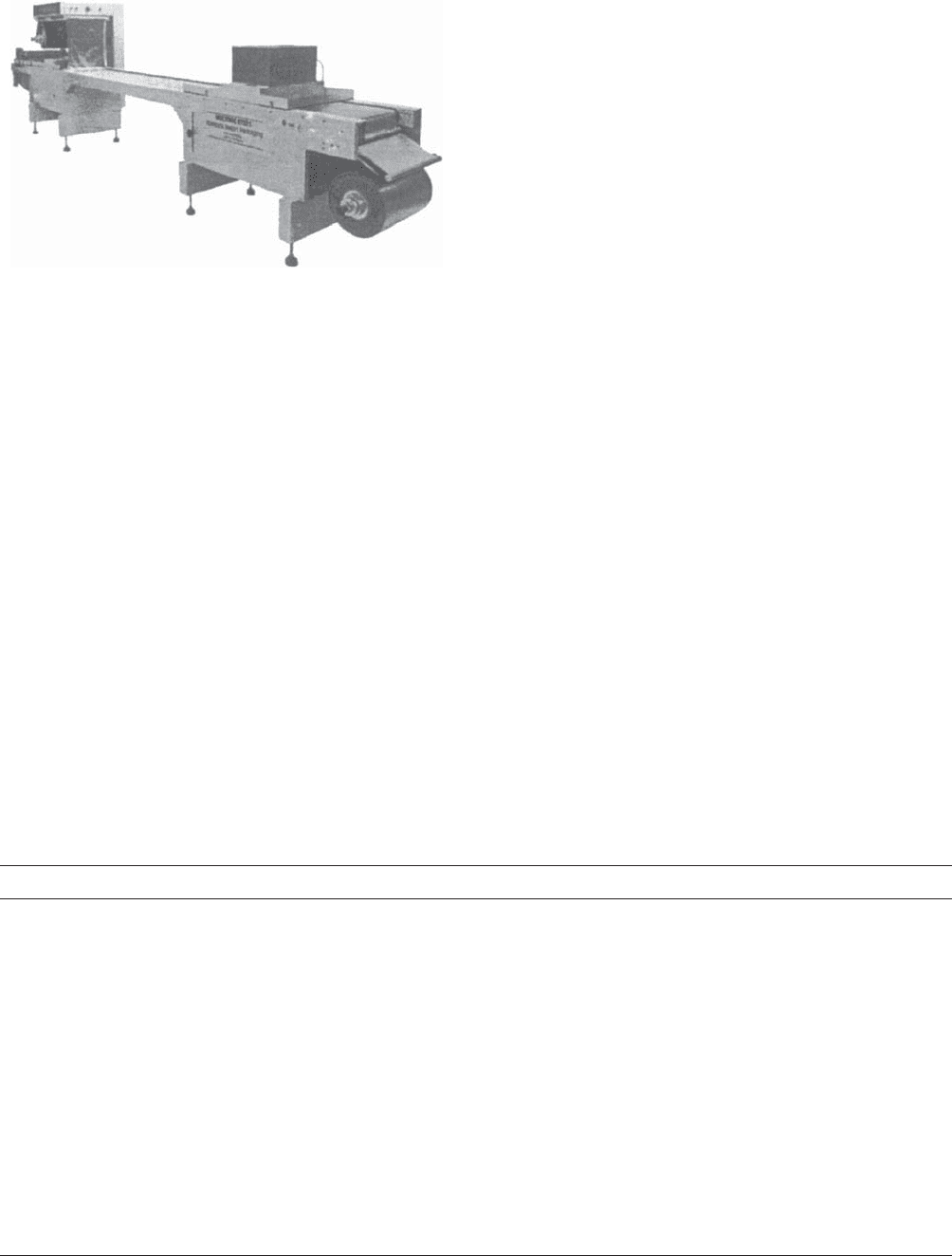
through these stations. The drive mechanism such as 2
Figure 1. Thermoform/fill/seal machine. Shown with lower web-
forming station in foreground. Note extensive product-loading
area.
Table 1. Gases Used in Packages Produced on TFFS Equipment
Gas Application
N
2
As a pressure-relief agent to prevent external atmosphere from crushing the product. N
2
is an inert gas. It does not react with
either the food substances or bacteria. Common applications include bulk-pack bacon and sausage, shredded and sliced
cheese, and beef jerky.
CO
2
Depending on the application, 25–100% CO
2
may be used. CO
2
lowers the pH of the food product and can exert a powerful
slowing effect on the growth of bacteria and molds. Primary application is for baked goods, cookies, cakes, and breads, as
well as dough and pasta products. CO
2
tends to be absorbed into the actual body of the food product itself. On one hand, CO
2
is frequently mixed with N
2
to prevent the package from clinging too tightly to the product. On the other hand, some
products that are not sensitive to strong pressure or tight cling, but that are susceptible to spoilage by mold growth, are
packed in an atmosphere of 100% CO
2
. An example of this is chunk cheese. Many CO
2
gas packages have the appearance of
a vacuum package, with much of the CO
2
absorbed into the product itself. In an extreme instance, container collapse in
shredded cheese can occur due to extended CO
2
absorption by cheese causing negative internal pressure if 100% CO
2
is
used. A mixture of 80%/20% of CO
2
/N
2
is recommended to prevent package collapse and is still able to prevent mold growth
in cheese.
O
2
The application using O
2
are primarily for red meat. The concept has been progressively used in the United States and
Europe for centrally packed retail cuts in the past decade. The O
2
is used as an oxygenating agent, at levels in the range of
40–80%, to form the bright-red, fresh-meat color called oxymyoglobin. When O
2
is used, it is usually mixed with CO
2
and
N
2
:CO
2
for its preservation effect, N
2
to provide a bulking agent. The O
2
tends to disappear inside the package. It can be
metabolized by the meat to CO
2
that is absorbed in the water phase of the meat as carbonic acid.
THERMOFORM/FILL/SEAL 1223
speed motor, frequency, servo driven, and so on (i.e., AC
Digital, DC Digital, Geneva, Elliptical Gear, Planetary
Gear, Emerson), differ as to accuracy of advance, accel-
eration curve, or suitability for print registration of
stretchable or nonstretchable materials.
Thermoforming
This is the first step in the formation of a package.
Thermoforming (see Thermoforming) may involve heating
in the forming die or preheating in a separate station.
There are two main ways to thermoform: positive (male)
and negative (female). Female forming involves using
compressed air or vacuum to pull the heated, softened
film into a mold. It is this mold or concave surface that is
the die that produces package shape and surface detail. A
mechanical plug (plug assist forming) may help to push
the film down into the cavity and provide more uniform
material distribution.
Positive (male) forming is the reverse. Positive forming
usually permits the production of a package with greater
surface detail and more-uniform wall thickness. A male
die part operated by a piston provides package shape and
surface detail. Air outside the film or vacuum on the
inside, or both air and vacuum, force the preheated film
to drape itself onto the exterior of the plug. Positive
forming requires a separate station or two separate sta-
tions to preheat the film. A typical package requires
thermoforming of only the lower web, but the machines
can also form both lower and upper webs. Usually each
product to be packaged requires its own separate forming
die. Major machine manufacturers have designed and
built thousands of different forming dies.
Loading
The lower web emerges from the forming station with the
pocket formed and ready to accept product. The loading
area must be long enough to accommodate the people
required for loading and inspecting, or automatic loading
equipment.
Sealing
Once the pockets on the web are loaded, the upper web is
indexed over them and the two webs are sealed (see
Sealing, heat). In food packaging, evacuation and, if
needed, gas injection (through nozzle or pin gas mechan-
ism) are performed at the sealing station. In order to
provide a more attractive package, sometimes all surfaces
of the top and bottom webs not in contact with the product
are sealed to each other. Sometimes, using a patented
process, steam is injected into the sealing die to shrink the
lower web (forming web) around the product to form an
attractive skin-tight package.
Cutting
Cutting systems range from the simple and inexpensive to
the complex and costly: paper-cutting-type knives (i.e.,
flying knives and high-speed rotary knives); shear cutting
(machine direction) with cross-direction strip removal by
means of matched male and female dies; shear cutting
(machine direction) and cross-direction cutting by means
of steel rule dies; and complete package cutting with
matched male and female dies (Table 2). Among them,
matched male and female dies are the most suitable for
cutting application on semirigid and rigid material, but
they are also the most expensive compared to other
cutting methods.
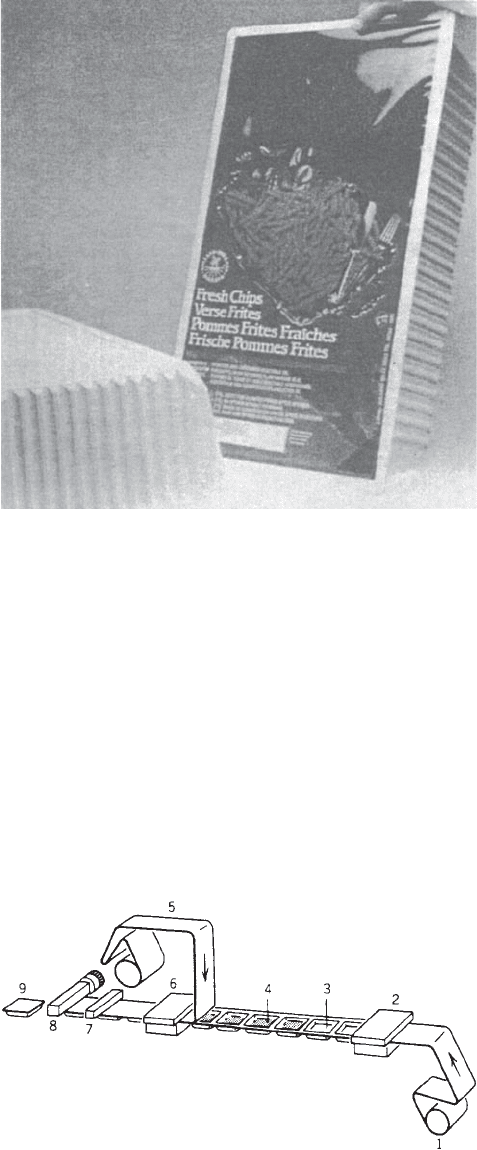
Figure 2. Modified atmosphere package for perishable foods.
Fresh (unfrozen), precooked French fries (10 kg) packed in N
2
atmosphere. Positive (male) formed PVC/PE bottom, polyester/PE
cover. Print registration of flexible upper web by means of
stretching with a brake.
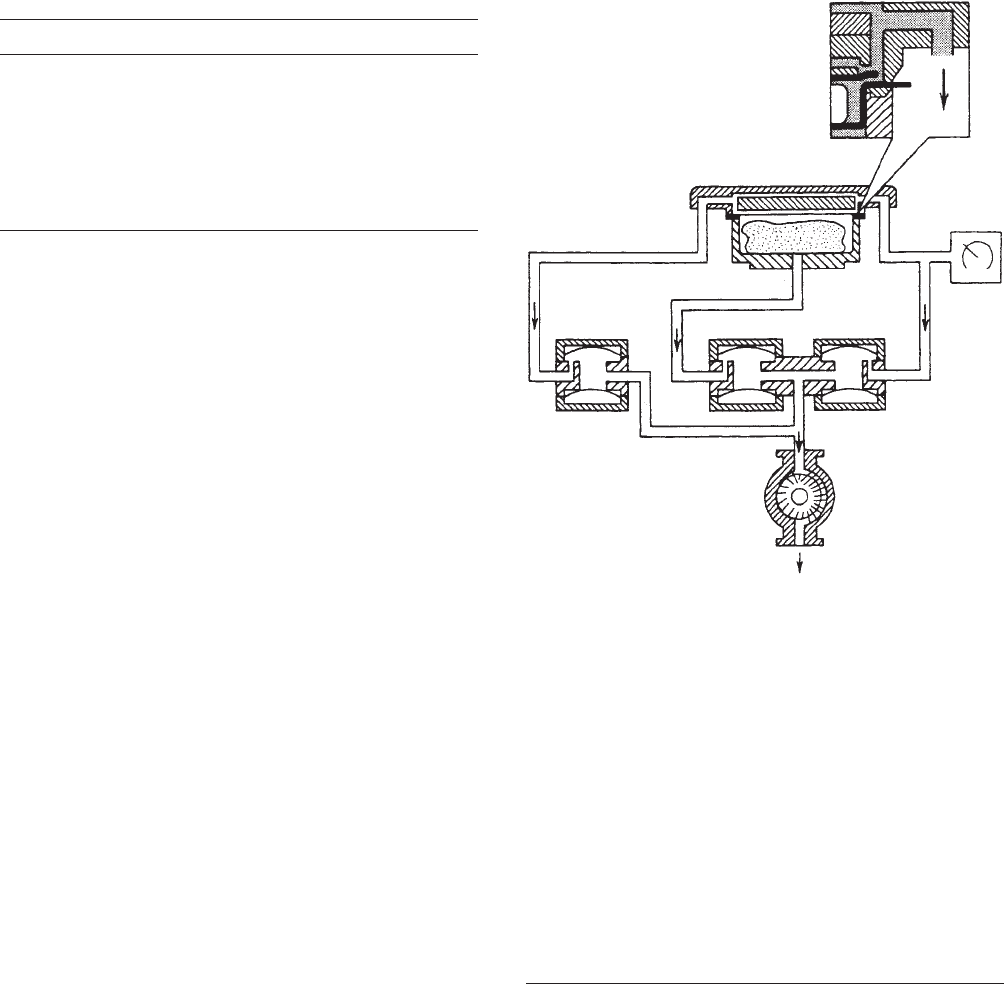
Figure 3. A schematic of the simplest and most basic configura-
tion of a TFFS machine as would be used for flexible, not
semirigid, upper and lower webs: 1, Lower or forming web; 2,
thermoforming die; 3, formed, unfilled pocket; 4, filled pocket; 5,
upper or lidding web; 6, vacuum/sealing die; 7, flying knife for
across-the-machine direction package cutoff; 8, high-speed rotary
knives for package cutoff in the machine direction; and 9, finished
package (rectangular).
1224 THERMOFORM/FILL/SEAL
Labeling and Printing
Online printing may consist of simply printing, or emboss-
ing, a code date or lot number (see Code marking and
imprinting) or may consist of printing an entire index,
actually ‘‘bleeding’’ finished package edges. Labels may be
applied to either surface of either web by appropriate top
or bottom web labeler.
VACUUM AND SEALING-DIE OPERATION
At this station the package is evacuated and the two webs
are sealed together. In order to understand how this die
operates, it helps to think of the die as consisting of two
nesting, concentric boxes that close in sequence. The outer
box closes first (see Figure 4). It mechanically seals off
that portion of the package represented by the lower web.
The upper web is narrower than the lower web and is not
sealed at this stage. Therefore, until the inner box closes,
atmosphere is free to enter or leave the package under the
lip of the upper web. The inner box is made up of the seal
mechanism. After the entire die chamber, including the
interior of the package, is evacuated, the inner box (the
seal mechanism) closes on both webs, first sealing them
mechanically, so no air can enter or leave the package, and
then applying a permanent heat-seal (see Figure 5). The
key operation, package evacuation, takes place when air
flows out of the package through the gap between the
narrow upper web and the outer wall of the die chamber.
This occurs during the interval after the outer box has
sealed off the lower web, but before the inner box has
closed off the package itself.
This is one of the most common methods of package
evacuation, also called the narrow web vacuum method. If
gas injection is required for modified atmosphere packa-
ging, the operation takes place in the sealing die using
nozzle or pin gas mechanism.
MATERIALS
The detailed design of a TFFS machine depends on the
packaging materials to be run. Therefore, any discussion
of how TFFS machines operate must refer to materials as
well. The two webs consist of a bottom web and a top web
on the type of equipment generally known as horizontal
thermoform/fill/seal machines. In the usual case, the
bottom web is thermoformable and is formed by heat
into a cup or cavity, which forms a receptacle for the
articles to be packaged. However, all variations are
possible:
Top Web
Nonformable
Nonformable
Formable
Formable
Bottom Web
Formable
Nonformable
Formable
Nonformable
When food products are packaged, the webs are usually
made of multilayer materials selected for their barrier and
strength properties. Typically, a barrier material protects
against transmission of water and oxygen into or out of
the package. In the medical industry, however, products
are typically sterilized by ETO (ethylene oxide) gas. In this
case, high gas transmission is desired. As a result, the
TFFS machines use an upper web (also called lidding
material) (see Lidding) selected for high-gas transmission
Table 2. Cutting Methods for Rigid Materials
In-the-Machine Direction Across-the-Machine Direction
Squeezing knives Steel rule dies with rounded
corners
Shear cut knives with or
without strip removal
Strip removal for rounded
corners by means of
matched male and female
dies
Complete 3601 cut by means of
matched male/female dies
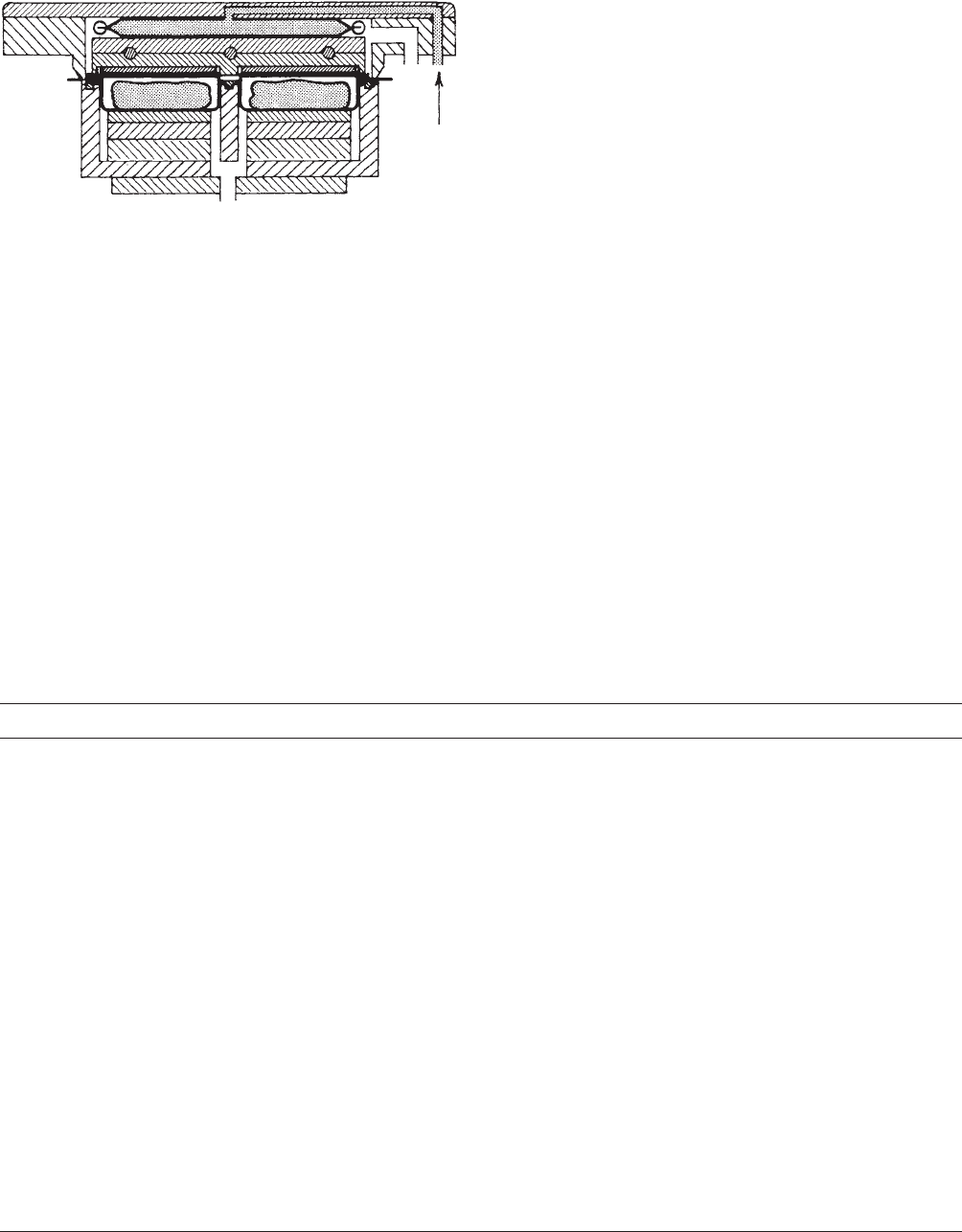
Figure 4. Evacuation. This shows the die after the first or outer
box has closed. Vacuum is drawn inside the die chamber. Because
vacuum is drawn on the outside of the package from both above
and below, air pressure inside the package forces the two webs to
separate, providing a large opening for air to flow out of the
package. During evacuation, the travel of air from the inside of
the package is through the gap between the narrow upper web
and the wide lower web. Package air exits along with air from
above the upper web. In this figure, the seal bar is in its upper, or
retracted, position so that air can leave the package.
THERMOFORM/FILL/SEAL 1225
properties as well as strength. Typical high-gas porosity
(lower gas barrier) materials include paper and Tyvek
(DuPont Company), a tough, spunbonded polyolefin. Ta-
bles 3 and 4 list some commonly used materials in TFFS
applications.
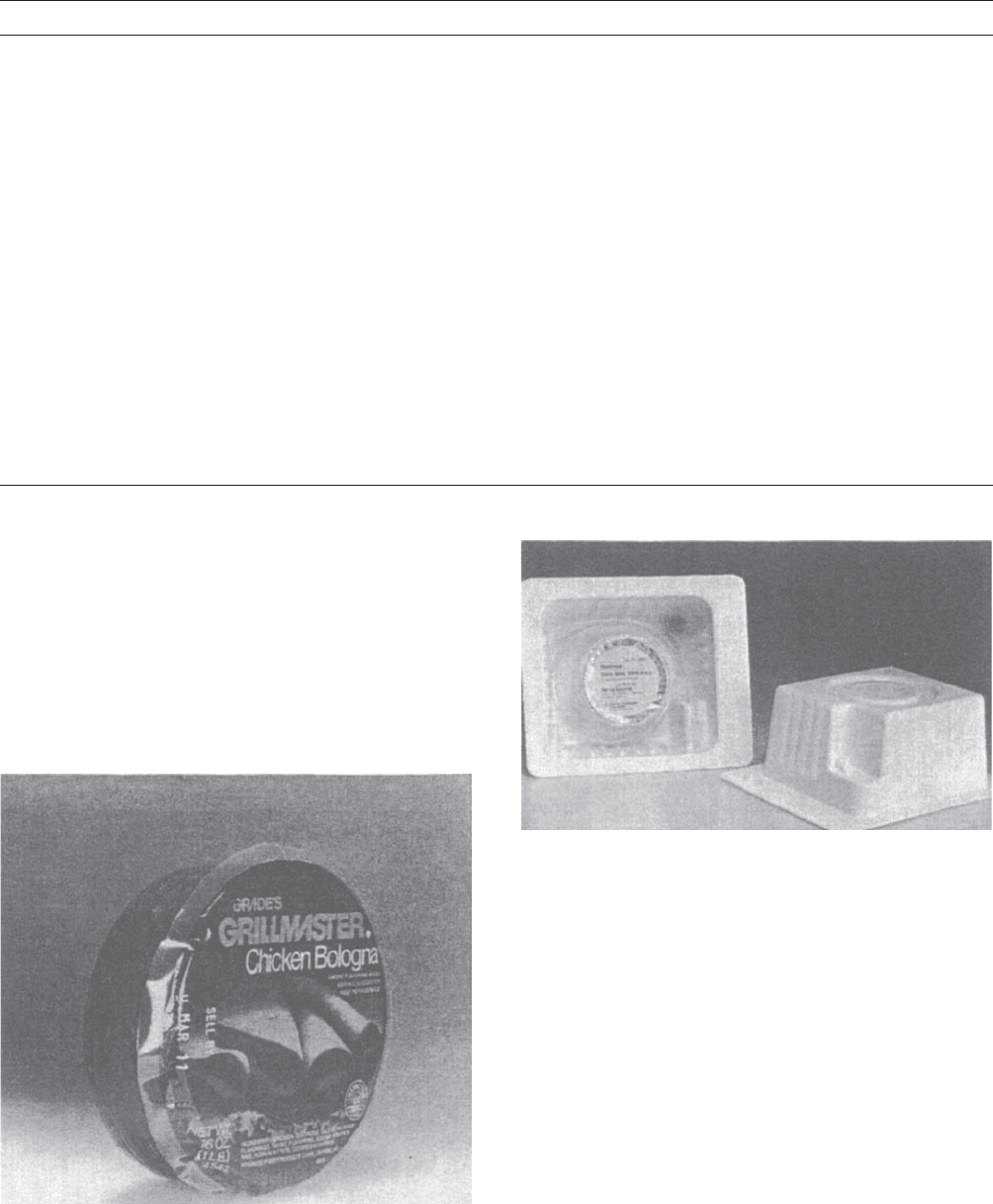
Flexible materials such as nylon (see Figure 6) can
usually be formed by heating and pressure-forming into a
female die part. Cutting is usually by means of a flying
knife in the cross-direction and high-speed rotary knives
in the machine direction. More severe draw ratios call for
a preheat station and plug assist. Nonrectangular shapes,
such as circles and ovals, can be cut with a flying knife
traveling on a cam or with punch cutter.
Rigid and semirigid materials (Figure 7) usually re-
quire higher cost and more-elaborate forming and cutting
methods. Rigid films usually call for one or more preheat
stations (single sandwich or double sandwich preheat) and
plug-assist forming in order to meet the package perfor-
mance and higher production speed requirement. If good
surface definition and uniform wall thickness is required,
positive (male-plug) forming is usually required.
In order to avoid sharp corners, rigid materials must be
cut by one of the methods shown in Table 2.
LATEST TTFS MACHINE DEVELOPMENT
Sanitary, easy-cleaning, easy-to-use design in TTFS ma-
chine development has been emphasized by the leading
suppliers in the past decades, especially for meat/food
packaging industry in which complete wash down at the
end of production prior to next production is required by
the USDA. Sanitary equipment design is needed to ensure
effective and easy cleaning to meet strict cleaning require-
ments. Aluminum frame machine has been completely
replaced by all stainless steel frame machine against
corrosion from caustic cleaning chemicals. In addition,
the latest TTFS machine has curved panel and tilted cover
to eliminate any possible harbors for bacteria growth that
may pose a food safety risk to consumers. An automatic
clean-in-place (CIP) feature is an option for the latest
machine manufactured by Multivac, a leading machine
supplier, if required. The interior of the machine can be
thoroughly cleaned under a predesigned programmable
automated cleaning protocol that includes four-stage
cleaning and sanitation sequence to rinse, clean with
Table 3. Common Food-Packaging Webs
a
Structure Comments
Nonforming Web
Polyester/polyethylene or polyester/ionomer Polyester is used for printability, strength, and general resistance
to moisture and abrasion. Normally it is reverse (capture)
printed (i.e., the polyester is printed on its inside surface for
protection of the printing). Printed polyester is normally stretch-
registered.
These structures may contain an intermediate layer of PVDC or
EVOH as oxygen barrier.
Forming Web
Flexible
Usually a nylon-base web is used for strength and formability,
combined with PE or ionomer as heat sealant and moisture
barrier, and, if needed, PVDC or EVOH as oxygen barrier.
Forming of flexible web by compressed air, vacuum, or compressed
air and vacuum possibly has a heated plug for severe draw ratios.
Cutting by means of flying knife in the cross-direction (XD), and
high-speed rotary knives in the machine direction (MD) for
rectangular packages. Circular, oval, or shape cutting by means
of flying knife following a pattern or cam or by punch cutter.
Rigid
Semirigid PVC, acrylonitrile, amorphous PET, PETG, or HIPS,
combined with PE or ionomer for moisture barrier and, if needed,
PVDC or EVOH as oxygen barrier.
Forming of rigid web by either negative (female) forming with plug
assist or positive (male) forming for more uniform forming and
surface definition.
Cutting by steel-rule die, or matched male and female die and strip
removal in XD with shear, cut strip removal in MD. Complete cut
by means of matched male and female dies shaped to the final
package size.
a
See Ionomers; Film, oriented polyester; Nylon; Nitrile polymers; Polyesters; thermoplastic; Polystyrene; Vinylidene chloride copolymers; Ethylene–vinyl
alcohol.
Figure 5. Heat sealing. After the package is evacuated, an air
bladder lowers the sealing bar and the package perimeter is
clamped shut and heat-sealed. In the next step, air is readmitted
into the die, the die opens, and the package is indexed out.
1226 THERMOFORM/FILL/SEAL
foaming detergent, rinse, and sanitize with alcohol-based
agent. Particularly the latest machine chain transport
redesign by Multivac, the first one offered the CIP feature
in the field, allows CIP features feasbile in their TTFS
machines. Side extraction tooling change feature in form-
ing and sealing stations is offered by leading TTFS
suppliers that minimizes downtime and negative ergo-
nomic impact from the tooling changeover process.
Some major TTFS equipment suppliers to the United
States market include Convenience Food Systems, Har-
pak, Multivac, Rapid-Pak and Ulma Packaging.
BIBLIOGRAPHY
E. Ho, ‘‘Thermoform/Fill/Seal’’ A. J. Brody and K. S. Marsh, eds.,
in The Wiley Encyclopedia of Packaging Technology, 2nd
edition, Wiley, New York, 1997, pp. 910–914.
Table 4. Common Medical-Packaging Webs
Structure Comments
Nonforming Web
Tyvek (spun-bonded polyolefin) or paper used for wet strength and
resistance to puncture, also exhibits minimal fiber generation
when cut. Paper is used for superior printability and lower cost.
Tyvek can be stretched registered (by means of photocell and
brake). Paper cannot be stretch-registered, so it needs to be
registered by controlling the advance with either an AC or DC
servo drive.
Stretch or advance registration.
Both Tyvek and paper are usually heat-seal coated. Used for ETO
gas sterilization because of their porosity. Polyester or polyester/
aluminum foil for gamma sterilization or gas or moisture barrier.
These materials are used in conjunction with appropriate heat-
seal coatings and laminating adhesives.
Forming Web
Flexible forming webs: polyolefin laminates or blends. Forming methods are similar to those used in flexible food
packaging. Shear cutting is normally used in both directions for
superior cleanliness of cut with paper or Tyvek upper webs.
Rigid forming webs: PVC or acrylic multipolymer or high-impact
polystyrene (HIPS) or copolyester.
Forming is typically with temperature controlled plug or positive
forming depending on draw ratio and degree of surface definition
required.
Cutting, typically, matched male–female in across-the-machine
direction. Shear cut in-the-machine direction. Or 100% matched
male–female cutting. These cutting systems provide relatively
particulate-free packages with radial corners.
Figure 6. Sliced luncheon-meat package. Nylon-ionomer flexible
forming web, OPET/ionomer top web. Circle cutting by means of
flying knife. Print registration by means of stretching film with a
brake.
Figure 7. Thermoformed medical-kit package. Typically, this
type of package would have a semirigid HIPS (high-impact
polystyrene) thermoformed bottom and a Tyvek or paper lid.
Forming would be positive (male-plug). Note both severe draw
ratio and enhanced surface detail. Print registration would be by
means of a dc drive since paper cannot be registered by stretch-
ing. Cutting could be a complete 3601 cut with matched male/
female dies, or shear cut (machine direction) with strip removal
by means of matched male/female dies (cross-direction). Package
is shown with lid removed.
THERMOFORM/FILL/SEAL 1227