
Yam, Kit L. (ed.). The Wiley encyclopedia of packaging technology
Подождите немного. Документ загружается.

General References
Modern Plastics Encyclopedia, McGraw Hill, New York, pub-
lished annually.
The Packaging Encyclopedia, Cahners Publishing, Denver, pub-
lished annually.
The PMMI Packaging Machinery Directory, The Package Machin-
ery Manufacturers Institute, Washington, DC, published
annually.
Food Master, equipment, supplies & services, Food Engineering
Network, Cahners, published annually.
J. M. Ramsbotton, ‘‘Packaging’’ in J. F. Price and B. S. Schweigert,
eds., The Science of Meat and Meat Products, 2nd edition,
Freeman, San Francisco, 1960, pp. 513–537.
THERMOFORMING
VIVEK CHOUGULE
MATT PIERCY
Printpack, Inc., Williamsburg,
Virginia
Thermoforming is a process of shaping thermoplastic
sheet into a product through the application of heat and
force. In most cases, the heat-softened plastic assumes the
shape by being forced against the mold until it cools and
sets up. Forming force may be developed by vacuum
(atmospheric pressure), positive air pressure, or mating
matched molds.
Thermoforming is an important thermoplastic fabrica-
tion process. Early developments involved thermoforming
of cellulose sheets. Industrial scale thermoforming began
in the early 1960s when containers and lids formed from
high-impact polystyrene (HIPS) were first used by the
dairy industry to package cottage cheese, sour cream,
yogurt, and other dairy foods. The word sheet as it relates
to thermoforming is used to describe flat extruded plastic
material that is generally relatively thick, in contrast to
comparatively thin plastic films. It is ambiguous, however,
in two ways: Thermoforming is also used to shape rela-
tively thin films, and the word sheet is also used to
distinguish between thermoforming machines that form
cut pieces (sheet-fed) rather than as extruded webs (web-
fed or roll-fed). The distinction between sheet-fed and
web-fed machines is similar to that between sheet-fed
and coil-fed equipment in the metal-can industry. The
exception is that in plastics forming, the wide sheet web
can come either from coiled stock or directly from the
extruder. When the thermoformer is fed directly by a sheet
coming from the extruder, it is called in-line thermoform-
ing. Sheet for thermoforming is commonly produced by
extrusion. Use of multilayered sheet structures is increas-
ing for a variety of applications. Multilayered sheet struc-
tures can be produced by coextrusion, coating, lamination,
or a combination of these processes. Roll-fed thermoform-
ing machinery is available that can produce beverage cups
at rates of 75,000–100,000 pieces/h while consuming plas-
tic sheet in excess of 1 ton/h (910 kg/h). Sheet consumption
for larger and heavier containers can exceed 2 tons/h (1.8
metric ton/h), but unit production rates may be lower
because fewer mold cavities can be mounted in the ma-
chines and more time is required to cool the thicker walls.
The ability to produce extruded HIPS foam sheet (see
Foam, extruded polystyrene) has provided additional
packaging markets for thermoforming. The first of these
was meat and produce trays, followed by egg cartons.
Other applications include fast-food carryout cartons,
institutional dinnerware medical trays and blisters, and
inserts for rigid boxes. Use of oxygen and moisture barrier
thermoformed containers is on the rise for variety of shelf
stable and refrigerated food packaging. Thermoformed
plastic containers have rapidly replaced other packaging
materials (metal, glass) in the last 20 years. Common
applications include containers for fruit, apple sauce,
puddings and baby food. One of the growing new applica-
tions is the use of high-barrier thermormed containers for
retorted shelf-stable foods. Retort applications require
special considerations for material selection, structure,
and shape of the container.
PROCESS STEPS
The thermoforming process is used to make products from
thermoplastic sheet by a sequence of heating, shaping,
cooling, and trimming. Trimming is not necessarily an
integral part of the forming cycle. Only a few applications
(e.g., pharmaceticul blisters) can use the formed web
without some kind of trimming.
Heating
Thermoplastic sheet is heated to a temperature range
adequate for forming, depending on the thermoplastic
material used. Temperature control is critical because of
plastic’s poor thermoconductivity and because tempera-
ture affects the forming characteristics (i.e., ductility) of
the materials: Too much heat causes the sheet to flow
without drawing; too little heat causes it to rupture early
in the forming process.
Heating time is governed by the heating process used,
materials used, sheet thickness, surface conditions of the
material, and the combination thereof. Any of the common
heat transfer processes such as convection, conduction, or
radiation can be used, but low thermoconductivity and
relatively high specific-heat capacity of thermoplastics
should be taken into consideration. Radiation heat could
be absorbed, transmitted, or reflected by thermoplastics,
depending on radiation wavelength and material proper-
ties. Most thermoplastics absorb infrared energy emitted
in the 3.0 to 3.5-mm wavelength range, which makes them
ideally suited to heating by radiation. Convection heating
would be ideal because the sheet could be soaked in hot air
at just the right temperature with the assurance that the
entire sheet would be uniformly heated. However, straight
convection systems are not practical because they are
relatively slow and they present materials-handling pro-
blems relative to transferring the sheet from the oven to
the forming station. Conduction heating requires contact
1228 THERMOFORMING
of a heated surface to the thermoplastic sheet. Although
conduction heating by contact is more efficient than con-
vection heating, it has unique challenges of material
handling such as thermoplastic sticking to heated surface.
Conduction heating is used in applications where thermo-
plastic requires relatively less heat to form or as prehea-
ters where contact surface temperatures are relatively
lower. Therefore, many thermoforming machines are
equipped with systems that take advantage of radiation,
convection, and conduction. Most of these ovens are
electrically heated, but there are also a large number of
cut-sheet machines using gas-fired ovens. Most are
capable of heating the sheet from two sides, which is
especially advantageous if the sheet is X40 mil
(X1 mm). The ovens should also be appropriately zoned
and temperature-regulated by instrumentation enabling
the operator to maintain good control over the heating
process.
Today, any number of electrically powered heating
systems can be specified, including the conventional tub-
ular steel rods, glass or ceramic panels, quartz lamps,
emitter-strip panels, and small ceramic modules. The
most common continues to be the calrod type, but use of
rectangular ceramic elements has been steadily increas-
ing. Their relatively small size permits them to be incor-
porated into elaborate microprocessor-control systems to
provide preferential heating in localized areas. Emitter
strip panels have been introduced as an alternative to
provide temperature uniformity with a less-complex in-
stallation. They are gaining popularity because they
provide a full-area heat source and can be mounted closer
to the sheet and are operated at lower temperatures,
thereby conserving energy.
Conduction or contact heating, sometimes called
trapped-sheet heating, has been used successfully with
easy-to-form materials such as polystyrene (PS) and PVC.
Here, the plastic sheet is trapped between the mold and the
temperature-controlled hot plate, which is perforated with
extremely small holes [i.e., B0.020-in. (0.5-mm) diameter].
The holes are drilled in a grid pattern on p1-in. (2.5-cm)
centers. After the sheet has been in contact with the heated
plate for a predetermined time, compressed air is injected
through the plate, forcing plastic off the heated platen and
into the mold. This system is generally reserved for mate-
rials p0.015 in. (0.38 mm) thick.
Solid-Phase and Conventional Thermoforming
Solid-phase pressure forming (SPPF) means forming
below the crystalline melting point—that is, generally
5–8% lower than melt-phase forming, depending on the
material. For example, homopolypropylene (hPP) is
formed in the melt phase at 310–3151F (154–1571C) but
at 285–2951F (141–1461C) in SPPF. SPPF does not require
special thermoforming equipment but demands much
tighter process control. A thermoforming machine
forms products within the thermoforming window, and
product-configuration requirements (i.e., stress, strength,
rigidity, flexibility) determine the proper temperature
range.
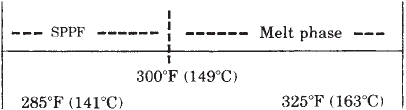
Figure 1 indicates that SPPF is done in a temperature
range within the window, as in melt-phase forming.
Compared with products formed in the meltphase, SPPF
can produce stiffer parts with lower part weight. Solid-
phase forming improves the sidewall strength of a con-
tainer and increases the stress factor. When forming cups,
trimming in the mold is recommended. Plug assist and
high form air pressures [i.e., 100 psi (689 kPa)] are re-
quired, and the plug design is more critical than in
conventional melt-phase forming.
Forming
There are two basic forming methods from which all
others are derived: (1) drape forming over a positive
(male) mold and (2) forming into a cavity (female) mold.
Product configuration, stress and strength requirements,
and material specifications all play a part in determining
the process technique. Generally, forming into a female
mold is used if the draw is relatively deep (e.g., cups).
Female molds generally provide better material distribu-
tion and faster cooling than do male molds. Malemold
forming is preferred for certain product configurations,
particularly if product tolerances on the inside of a part
are critical. Male-mold forming produces heavier bottom
strength; female-mold forming produces heavier lip or
perimeter strength. An advantage of straight forming
into a female mold is that parts with small sidewall angle
(near vertical) can be formed and extracted, stress-free,
from the molds because of the shrinkage that occurs as the
part cools.
In drape forming, when the hot plastic sheet touches
the mold as it is being drawn, it chills and start to set up.
To successfully drape-form, several variables must be
considered. One of the most significant is shrinkage. Since
all plastic materials have a high coefficient of thermal
expansion
and contraction (i.e.,
about 7–10 times that of
steel), care must be taken when designing the mold to
provide sufficient draft on the sidewalls so the part can be
extracted from the mold. It is not unusual for parts to
rupture on cooling on an improperly designed drape mold.
Another potential problem is that the part may become so
highly stressed during forming and cooling that it loses
most of the physical properties that the sheet would
otherwise provide. High stress in the part may also cause
shape distortion also known as warpage.
Natural-process evolution has combined the two sys-
tems to take advantage of the better parts of each method.
The plug-assist process, similar to matched-die forming,
involves a male mold (of plug) that ranges in size from
B60% to 90% of the volume of the cavity. By controlling
Figure 1. Thermoforming window.
THERMOFORMING 1229
the geometry and size of the plug and its rate and depth of
penetration, material distribution can be improved for a
broad range of products. The plug-assist technique is used
to manufacture cups, containers, and other deep-draw
products.
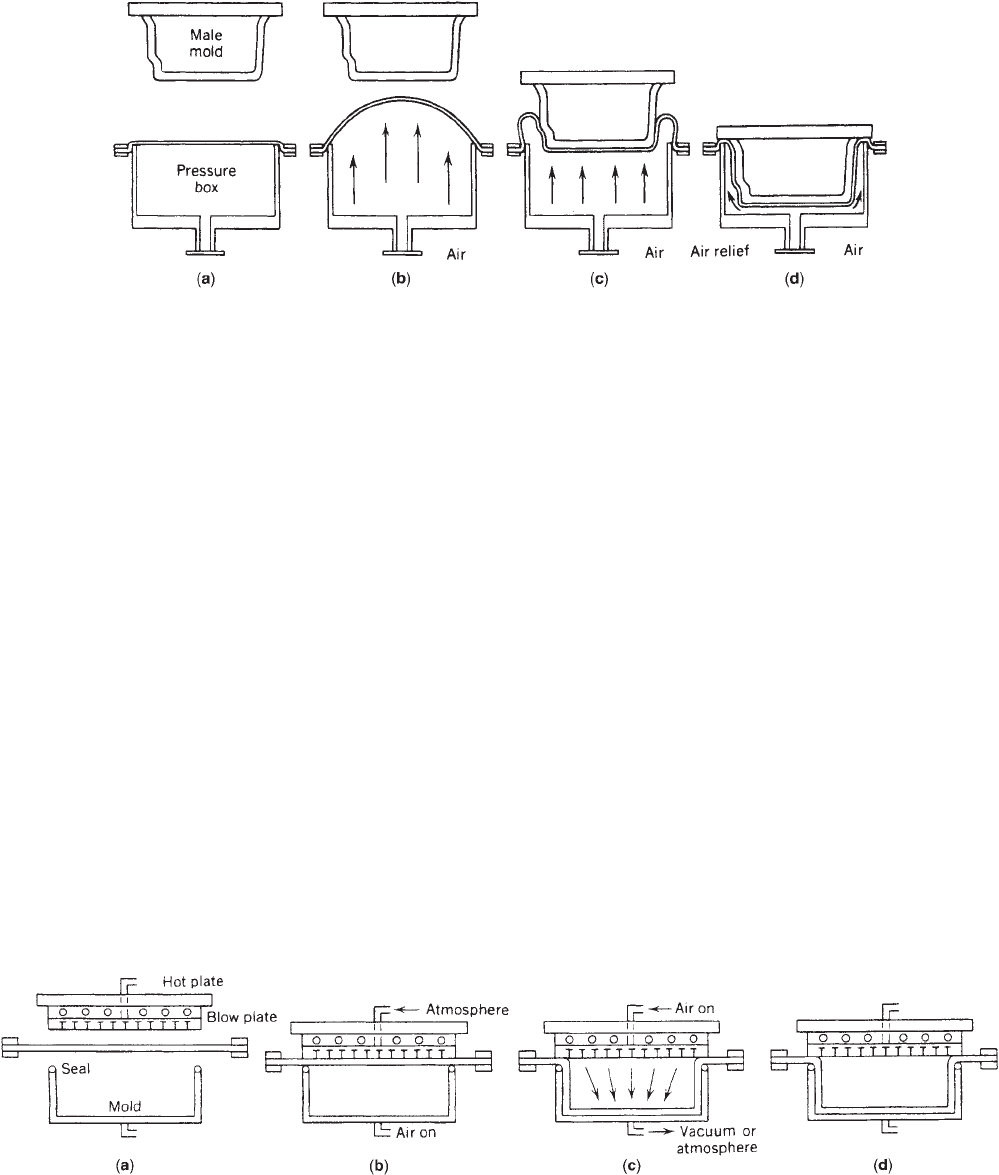
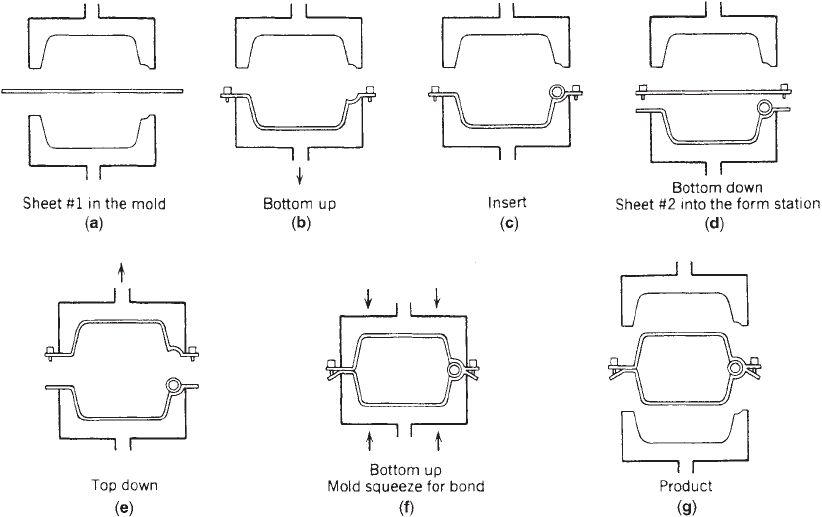
Many thermoforming techniques have been developed
to obtain better material distribution and broaden the
applicability of the process. Some of the more popular
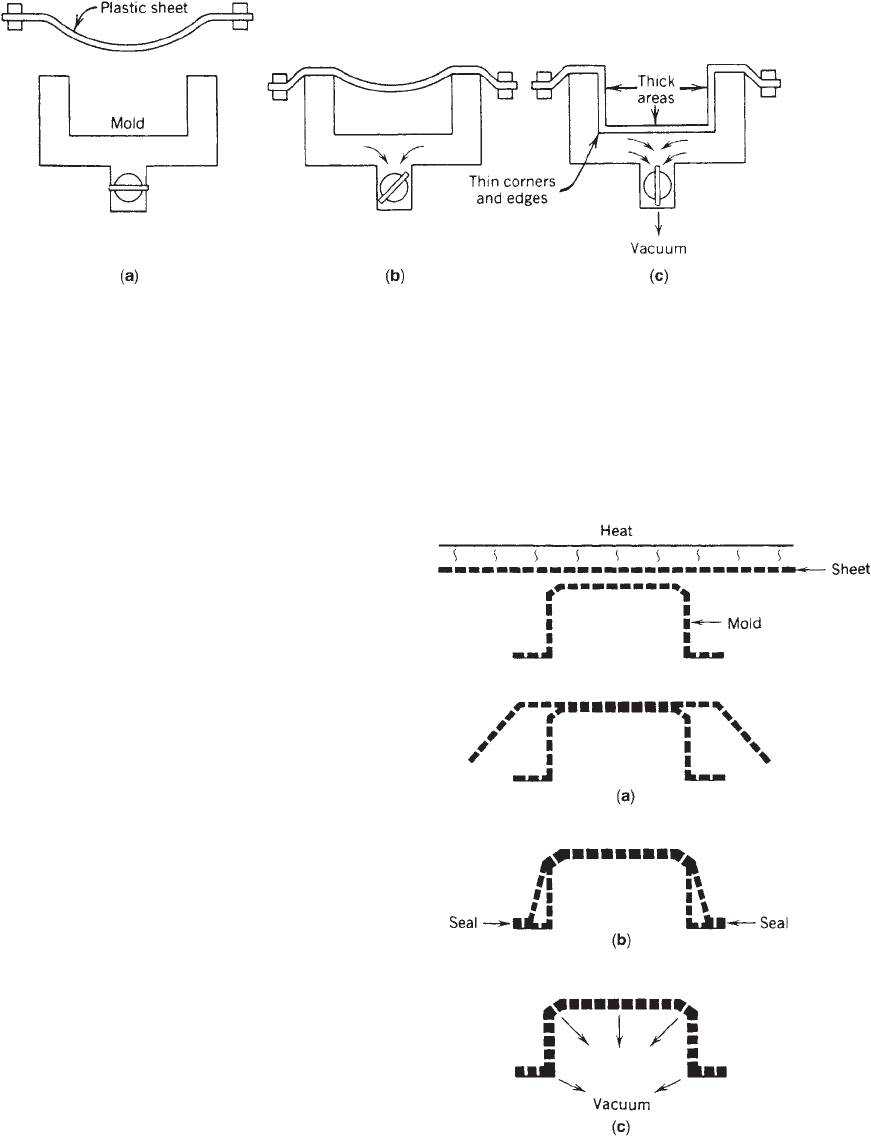
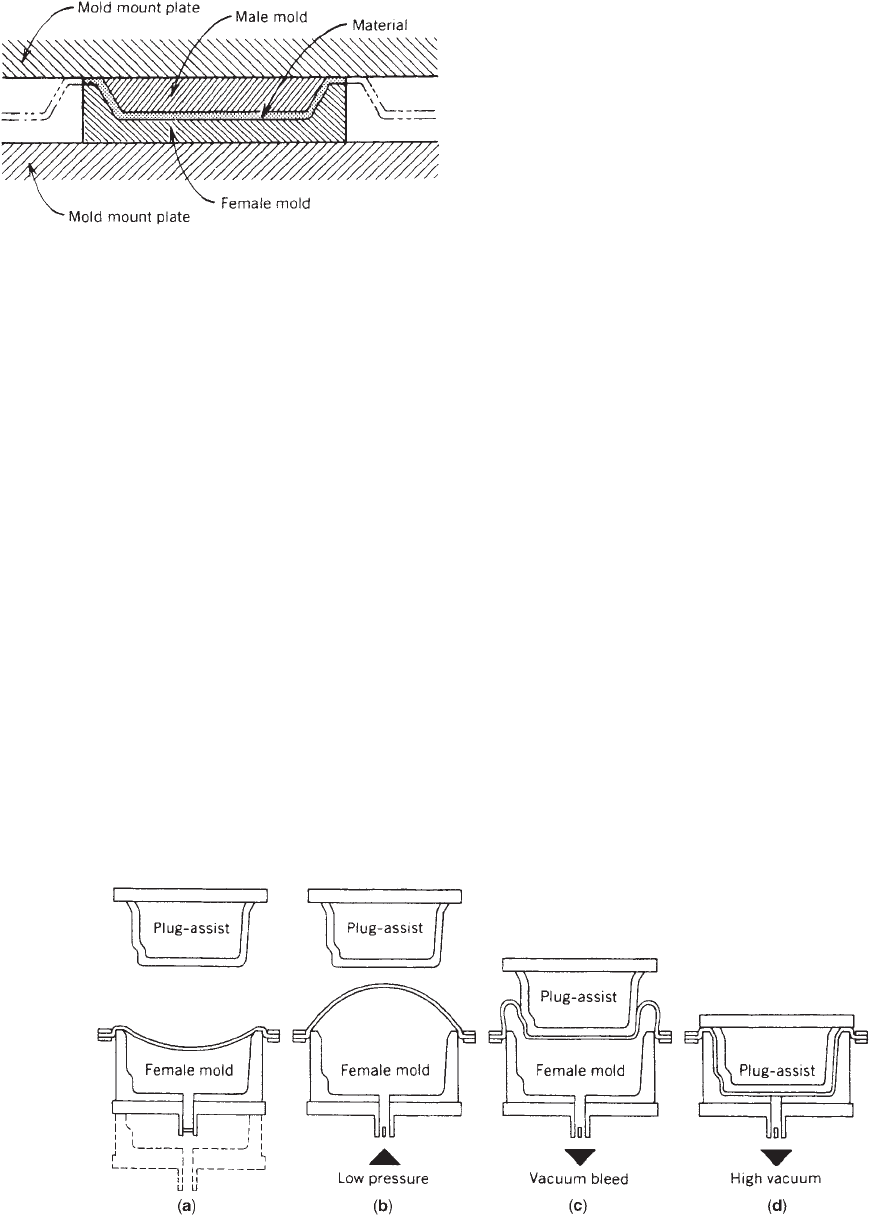
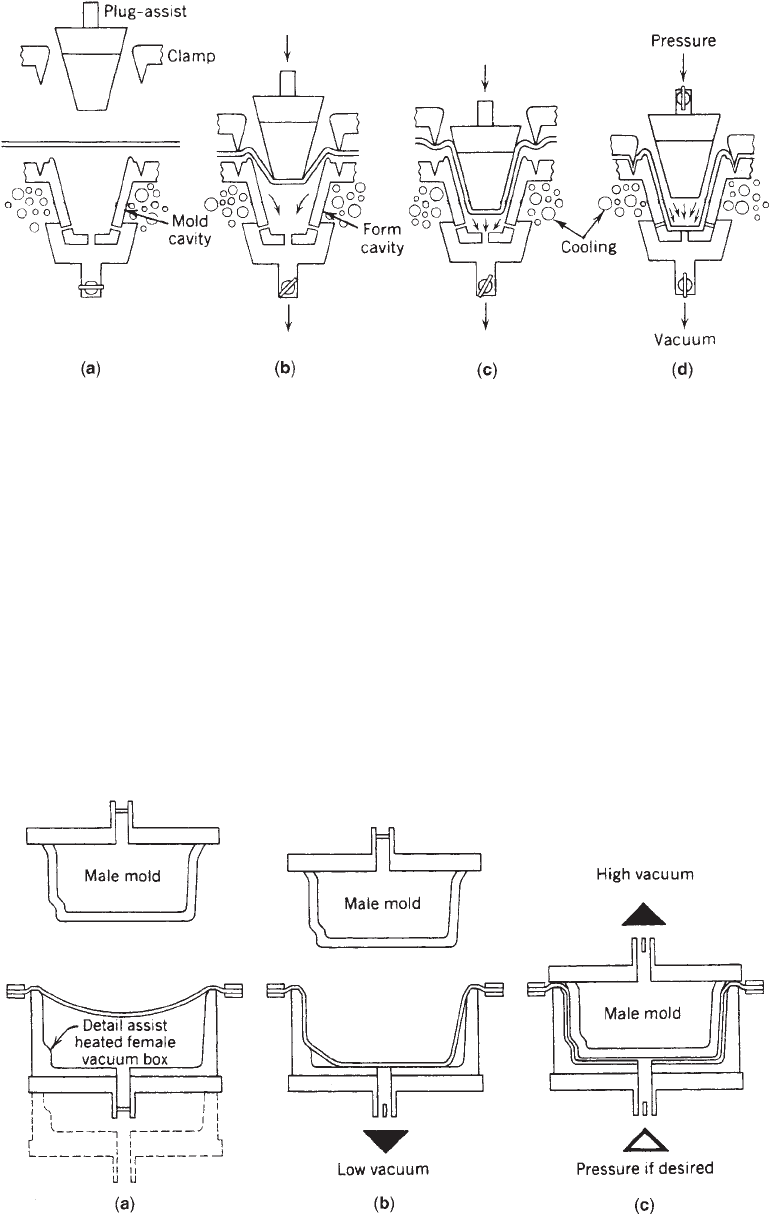
methods are illustrated and described in Figures 2–10.
Most of these techniques can employ vacuum, pressure, or
a combination to apply the force necessary to shape the
heat-softened plastic sheet.
Cooling
The time required to cool the heat-softened plastic below
its heat-deflection temperature while it is in contact with
the mold is often the key to determine the overall forming
cycle time. Cooling is accomplished by conductive heat loss
to the mold and convective heat loss to the surrounding
air. Cooling rate depends on the tooling, because in all
methods except matched mold, the plastic is in contact
with the mold on one side only. Time duration for which
the mold is closed after forming significantly affects cool-
ing. The opposite side of the thermoformed part is cooled
convectively by forced air or ambient air. Water sprays are
sometimes used but often pose as many problems (e.g.,
water spotting) as they solve. Pressure forming helps
minimize cooling time because the higher air pressure
keeps the sheet in more intimate contact with the mold
surface.
Trimming
A number of trimming methods are available, including
hand cutting, rough shearing of the web, punching parts
out from the web, or trimming around a periphery with a
steel rule or sharp-edged die used to penetrate the web.
The punch-and-die trim provides the greatest accuracy
and longest life, but at the highest cost. These dies are
usually designed with a hardened-steel punch and will
pass through a slightly softer steel die that can be peened
when it dulls. These trim dies are designed so the parts
are punched through the die successively and exit from
the trim station in a nested fashion. This simplifies the
material handling required to pack or prepare the parts
Figure 2. Shallow-draw forming, female-mold bottom. (a) The plastic sheet is clamped and heated to the required forming temperature;
(b) a vacuum is applied through the mold, causing the plastic sheet to be pushed down by atmospheric pressure—contact with the mold
cools the newly formed plastic part; (c) areas of the sheet reaching the mold first are the thickest. Applications: ice-chest lids, tub
enclosures, and so on.
Figure 3. Vacuum (drape) forming. (a) The plastic sheet is
clamped and heated to the required forming temperature; (b)
the sheet is sealed over the male mold; (c) vacuum from beneath
the mold is applied, forcing the sheet over the male mold and
forming the sheet. Material distribution is not uniform through-
out the part, because the portion of the sheet touching the mold
remains nearly the original thickness. The walls are formed from
the plastic sheet between the top edges of the mold and the
bottom-seal area at the base. Applications: trays, tubs, and so on.
1230 THERMOFORMING
for the next postforming operation (e.g., rim rolling or
printing).
Steel-rule dies are better suited for the lower-volume,
thin-sheet operations. Steel-rule trim dies are used pre-
dominantly in custom thermoforming operations, where
the run size does not justify the cost of matched shearing
dies. They are used almost exclusively in the manufacture
of blister packages and decorative packaging for the
cosmetics industry.
The trimming operation can be done inside or outside
the mold. The remote-trim configuration utilizes a sepa-
rate trim press, which punches out one or more rows of
parts at a time. The parts are discharged in nested stacks
ready for subsequent operations or for packing. Trimming
within the mold provides the most accurate alignment of
the trim cut to the formed part, but the close proximity of
the trimming to the mold body is a complex arrangement
that may limit cooling capacity near the cutting surface;
and after trimming, precise control of the part ceases.
Complex mechanisms are required to sort and nest these
parts downstream. Trimming is done by sawing or routing
in the production of low-volume odd-geometry industrial
parts (e.g., boat hulls, recreational vehicle bodies, bath-
tubs) but not in packaging.
Forming Machines
There are basically two types of thermoforming machines:
sheet-fed and web-fed (roll-fed). Sheet-fed machines oper-
ate from sheet cut into definite lengths and widths for
specific applications. The sheet is generally heavy [i.e.,
0.060–0.5 in. (1.5–13 mm)] and the products are industrial.
Packaging-related applications include dunnage trays and
pallets, large produce bins, shipping-case dividers, box
liners, crates, and carrying cases formed to the shape of
the product.
Packaging applications generally employ web-fed ma-
chines, which use either coil stock or a web that comes
directly (i.e., in-line) from a sheet extruder. The need to
form a coil limits the thickness of the web to B0.125 in.
(3.2 mm) due to sheet winding and reheating issues. Web
thickness can be increased by operating directly in line
with an extruder.
TOOLING
Among the plastic-fabricating processes, thermoforming
permits the use of the broadest range of mold-tooling
materials. Mold materials such as wood, epoxy, polyesters,
or combinations thereof can be used if the volume is
not sufficient to warrant the cost of advanced, tempera-
ture-controlled metal molds or for prototyping. For high-
volume applications (e.g., food packaging) molds are
normally manufactured from cast or machined aluminum,
sometimes with hard coats applied to the wearing surfaces
for longer service life. Molds are occasionally made from
beryllium copper or brass that is chrome-plated for ex-
tended service life.
Figure 4. Matched-mold forming. The plastic sheet is clamped
and heated to the required forming temperature. The heated
sheet can be positioned over the female die, or draped over the
male mold. The male and female halves of the mold are closed,
forming the sheet, and trapped air is evacuated by vents located
inside the mold. Material distribution varies with mold shape.
Detailed reproduction and dimensional accuracy are excellent.
Applications: foam products, egg cartons, meat trays, and so on.
Figure 5. Pressure-bubble/plug-assist vacuum forming. The plastic sheet is clamped and heated to the required forming temperature. (a)
The heated sheet is positioned over the female mold and sealed. (b) Prestretching is accomplished by applying controlled pressure through
the female mold, creating a bubble. (c) When the sheet is prestretched to the desired degree, the male plug is forced into the sheet. (d)
When the male plug is fully engaged, a vacuum is applied through the female mold to form the sheet. Pressure may be applied through the
plug to assist forming, depending on the material and forming requirements. Applications: refrigerator liners, bathtubs, and so on.
THERMOFORMING 1231
Vacuum and compressed air are the primary means
used to form the heated, thermoplastic sheet to the mold
configuration with rigid-type materials. For foam materi-
als, matched metal molds are frequently used to compress
the material to the desired thickness without compressed
air. Vacuum is transmitted through small holes that are
located to allow the sheet to come in intimate contact with
the mold surface. The diameter of these holes usually
ranges from B0.013 to 0.030 in. (B0.33 to 0.76 mm),
depending on the type of thermoplastic to be formed.
Other means of applying vacuum in the mold include
the incorporation of narrow grooves or slots, which often
are easier to incorporate than vacuum holes and allow
greater evacuation of the air in the tool. Polyolefin materi-
als require small vacuum holes and slots; PS materials,
which cool faster, can use larger holes. Final product
design and material selection determine the exact size of
the holes required.
In addition to vacuum holes and slots, molds can be
sandblasted to minimize the possibility of trapped air
between the sheet and the mold. Sandblasting molds
also results in mat surface finish and better cooling due
Figure 7. Vacuum snapback. ( a) The plastic sheet is heated and sealed over the female vacuum box; (b) when vacuum is applied to the
bottom of the vacuum box, the plastic sheet is prestretched into a concave shape; (c) after the plastic sheet is prestretched to the desired
degree, the male plug enters the sheet. A vacuum is applied through the male plug while the vacuum box is vented, creating the snapback.
Light air pressure may be optionally applied to the vacuum box, depending on the materials used and forming requirements. Applications:
deep-draw parts (e.g., luggage, auto parts), gun cases, cooler liners, and so on.
Figure 6. Plug-assist forming sequence: (a) The plastic sheet is clamped and heated to the required forming temperature—the sheet is
then sealed across the female-mold cavity; (b, c) the male plug is forced into the sheet—the depth and speed of penetration, as well as plug
size, are are the primary factors in material distribution; (d) when the plug is fully engaged, vacuum, pressure, or a combination are
applied to form the sheet. Applications: cups, food containers, and so on.
1232 THERMOFORMING
to higher surface area. Eliminating trapped air is impor-
tant because it prevents imperfections on the part surface
and aids in rapid transfer of heat out of the material by
providing close contact between the plastic and the cavity.
Molds for PS are normally not sandblasted because this
material is relatively rigid and sandblasting would make
part removal difficult. Vacuum is usually pulled through
the forming mold, male or female, and the compressed air
is introduced from the opposite side of the sheet material.
In foam-forming with matched metal molds, vacuum is
normally applied only through the female cavity.
Tooling for high-production applications is most often
aluminum because of its thermal conductivity, light
weight, and cost. Most crucial is thermal conductivity,
because in any thermoforming process the residual heat of
the plastic must be removed as rapidly as possible for
rapid cycling. The temperature control of the mold is
accomplished by water channels in the mold and design-
ing them to provide maximum heat removal from the
sheet. Ideally, all molds should provide a temperature
differential between inlet and exit water temperature of
no more than 51F(31C).
Many techniques are used to incorporate cooling in the
molds for improved cycle times. The most common meth-
ods are contact cooling and direct water cooling. Contact
cooling consists of coring a mold base and carefully
machining cavity inserts so that contact occurs when the
cavity insert expands from the heat of the plastic sheet
while the mold base contracts from the coolant circulating
through it. The most common method today for rigid HIPS
is to circulate water through hollow-shelled cavities. This
is more expensive but is the most effective way to cool the
plastic sheet rapidly.
Tooling for low-volume work (e.g., box inserts, blisters,
and other nonfood packaging) and prototyping can often
be simple and effective without any of the special cooling
features described above. This is because it normally takes
longer to heat the sheet than to cool it, and the work is
generally done on slow, low-production equipment that
does not require the rapid cycle rates. With these molds,
cooling is very often augmented by the use of fans to
increase the air circulation over the material after it is
formed. In such applications, low-cost, simple molds of
plastic, plaster, wood, or other materials are used
Figure 8. Pressure-bubble vacuum snapback. (a) The plastic sheet is clamped and sealed across the pressure box; (b) prestretching is
accomplished by applying controlled air pressure under the sheet, through the pressure box, creating a bubble; (c) when the sheet
is prestretched to the desired degree (i.e., 35–40%), the male plug is forced into the sheet while the air pressure beneath the sheet remains
constant; (d) after the male plug is fully engaged, the lower air pressure is increased. A vacuum is simultaneously applied through the
male plug, creating the snapback. Applications: intricate parts where material distribution is critical.
Figure 9. Trapped-sheet, contact-heat, pressure forming; the plastic sheet is clamped between the female-mold cavity and a hot blow
plate. (a) The hot, porous blow plate allows air or vacuum to be applied through its face; (b) the mold cavity seals the sheet against the hot
plate; (c) controlled air pressure, applied from the mold, blows the plastic sheet in contact with the hot plate to ensure complete contact
with the heating surface; (d) when the desired heating has been accomplished, air pressure is applied through the hot plate, forcing the
plastic sheet into the mold. Venting of the mold can be simultaneous, depending on materials and forming requirements. Steel knives may
be inserted in the mold for sealing and in-place trimming if additional closing pressure is available. Applications: OPS containers, covers,
and so on.
THERMOFORMING 1233
effectively. Mold dimensions must allow for the different
shrinkage rates of different types of thermoplastics. In the
manufacture of a family of products, it is sometimes
possible to utilize the same cooling base and interchange
only the molding inserts. Depending on the trim dimen-
sions of the products, the same cutting tool might be
suitable for more than one product; if not, they can be
designed to be easily interchanged from the trim die shoe.
CUT-SHEET THERMOFORMING
Cut sheet is processed on two types of thermoforming
machines: the shuttle style and the rotary, or carousel,
style. In single-station shuttle machines, the plastic sheet
is placed in a clamping frame that shuttles into the oven
for heating and back again for forming. Another very
popular shuttle machine is the double-ender, which has
a common oven with a form station at each end. This
arrangement provides 100% utilization of the oven be-
cause heating and forming can be done simultaneously.
Rotary or carousel thermoformers are most frequently
used for heavier-gauge materials—that is, starting at
B0.050 in. (1.3 mm). Most rotary machines have three
working stations: load/unload, heat, and form. In a typical
machine, the carousel frame rotates 1201 on a time-con-
trolled basis. Generally, the time cycle is dictated by the
period required for the plastic sheet to cool below its heat-
deflection temperature. When cooling time is faster than
the heating time, four-station rotary machines are often
used; these have two heating stations. Another type of
four-station machine has a separate load and unload for
automation and parts handling.
Most cut-sheet thermoformers are designed to operate
as vacuum formers, but rotary and single-station (shuttle-
type) machines are available with pressure-forming cap-
abilities and sustain forming pressures up to 50 psi
(345 kPa), depending on mold area. Most sheet-fed ma-
chines can be adapted for any of the standard thermo-
forming techniques. Cut-sheet machines have been built
to accept sheet 10 ft (3.05 m) wide and 20 ft (6.1 m) long
with the capability of making parts up to 4 ft (1.22 m) deep.
TWIN-SHEET THERMOFORMING
Twin-sheet thermoforming can produce hollow parts (e.g.,
pallets) from cut sheet. These parts can be produced from
both cut-sheet and roll-fed machinery. In sheet-fed machin-
ery, the material to be formed can be 0.050–0.500 in. (1.3–
13 mm) thick. Roll-fed machines are limited to materials
0.005–0.125 in. (1.3–3.2 mm) thick. With a typical web-fed,
twin-sheet system, two rolls of plastic materials are simul-
taneously fed, one above the other. The webs are trans-
ported through the oven on separate sheet-conveyor chains
and heated to a formable temperature. At the forming
station, a specially designed blow pin enters the space
between the two sheets before the mold closes. Air pressure
is introduced between the sheets through the blow pin,
and, at the same time, vaccum is applied to each mold half.
Figure 10. Twin-sheet forming. This technique utilizes a rotary-type machine with two heating stations and bottom-load clamp frames.
The first sheet (a) is heated and formed into the lower half of the mold (b, c) while the second sheet is being heated. After forming the first
sheet, the second sheet is indexed into the forming station (d) and vacuum is applied to the upper mold half to form the sheet (e). A bond is
simultaneously made between the parts by pressure applied to the mating surfaces (f). After cooling, the molds are removed to give the
product (g).
1234 THERMOFORMING
Twin-sheet forming is done by a slightly different method
on specially designed rotary thermoformers.
EQUIPMENT IMPROVEMENTS
Rapidly expanding markets for thermoformed products
are attributable to technological advancements in equip-
ment design. Most of the development is focused on
continuous roll-fed machines for packaging. New produc-
tivity enhancements such as bigger machines, faster
cycles, quicker changeover, and greater automation are
gaining in importance. Better process control has enabled
converters to increase productivity and improve product
quality. Use of microprocessor-control systems allows the
operator to enter data, examine existing values in the
program, or troubleshoot problems by viewing a monitor.
The conventional control panel includes a cathode-ray
tube (CRT) and keyboard, form-on and emergency stop
push buttons, and indicator lights to signal form or
automatic modes. Machine functions may be displayed
on the CRT upon request, and function control is obtained
by means of the simplified keyboard. The newer systems
use touch screen LCD panels.
The microprocessor-control systems feature control of
oven-temperature orientation in multiple zoned ovens,
interface speed between former and trim press, sheet-
index length, machinery functions and timing, and control
and graphic display of start end points of forming func-
tions, storage of production information, and diagnostic
capabilities. Use of the microprocessor results in tremen-
dous savings in labor, energy, and downtime. Many of
these systems are available as a retrofit to existing equip-
ment. Equipment has also been designed to monitor
several lines of similarly equipped machines from one
central location. Such data-management systems provide
comparative data, setup parameters, production rates,
maintenance schedules, alarms and safety signals, and
storage of reference information, resulting in a true on-
line management-information reporting system.
Design improvements that have contributed to im-
proved productivity include redesigned forming presses
that provide front and rear access to the forming station to
facilitate tooling installation and periodic maintenance;
access doors to oven heaters for quick cleaning; ovens that
eject automatically if the sheet overheats; and automatic
lubrication systems that increase component life substan-
tially and allow faster mechanical operation due to re-
duced friction.
Microprocessor heating control allows the operator to
control the temperature profile of the sheet from edge to
edge or to provide localized heating. Solid-state instru-
ments used in conjunction with mercury or semiconduc-
tor-controlled rectifier (SCR) relays have made it possible
to maintain extremely close heater temperature control.
Forming presses are now available with precision
guidance systems on the platens to permit critical opera-
tions to take place in the forming molds that formerly had
to be done on auxiliary equipment. An example is the
method of incorporating the latching slots that are cut in
the sidewalls of egg cartons, fast-food cartons, and trays.
Previously, these slots were punched in on a special press
located downstream from the forming station. Registra-
tion problems relative to the slot location were often
encountered because of variations in the index length by
the thermoformer web-conveyor system. These problems
were overcome by expensive drive systems. On machines
with precision-guidance systems, mating punches can be
incorporated in the forming molds that engage during the
last 5–10% of press closure and form a slot in the heat-
softened plastic that has reinforced edges similar to
button holes.
High-speed trim presses are available with supported
moving platens that carry up to 85% of the gross-platen
and trim-tool weight. The advantage of this system is that
it permits the press tie rods to function primarily as
guidance members rather than as both platen transpor-
ters and guides, in addition to serving as tie rods. The
system reduces trim-tool maintenance by up to 50%.
Significant improvements have been made in product-
handling systems, which can now automatically count,
stack, and package products at the trim-press discharge.
The design of these automated systems varies from rela-
tively simple systems using guide chutes or magazines
and transport conveyors to those employing robotics and
advanced packaging machinery.
Automation has been extended to the materials hand-
ling of large plastic sheets into sheet-fed machines. The
development of automatic sheet loaders provides auto-
matic loading systems that enable use of the entire
machine area. This results in a 20–30% increase in
productivity, achieved largely from savings in loading
time, since a manually loaded machine normally used
only one-quarter of the machine effectively.
IN-MOLD LABELING
Unlike injection molding for which in-mold labeling (IML)
is a very well established process, thermoforming process
has challenged IML to address several important limita-
tions in machinery and labeling technology that. Use of
IML for thermoformed products is on the rise in recent
years with development of automation and labeling tech-
nology. Even with the current improvements in output,
there still remains a gap between IML thermoforming
versus the productivity of conventional thermoforming.
For example, IML slows down the process reducing output
to 20 cycles/min versus 40 cycles/min for standard thermo-
forming of PP cups. Most of the current machines for IML
incorporate tilting-mold technology, which provides
greater accessibility and easier label placement. Another
new technology for IML uses a dual-mold configuration
instead of a tilting mold. The dual-mold system allows
removal of the finished part and placement of the label in
one mold while a part is being formed in the other mold.
In-mold labeling (IML) is a technique that typically
uses a heat-activated adhesive applied to the paper or film
label backing. The in-mold label is placed in a mold and
held in place by vacuum, electrostatic attraction, or other
means
. The mold
is then closed and the part is produced as
normal. The adhesive’s activation takes place during the
THERMOFORMING 1235
manufacture of the packaging itself via thermoforming.
The label becomes molded to the container wall. The
material used for in-mold labels is generally paper or
film. It must have sufficient temperature resistance and
stiffness to resist the rigors of the molding operation. The
adhesive that is utilized is generally heat-seal coating
adhesives. Depending on the packaging and labeling
materials, the in-mold label may not even require an
adhesive. The container resin itself will, in certain cases,
provide the adhesive material necessary to firmly and
permanently attach the label.
One of the advantages of IML is that the label appears
as part of the container compared to a label that is applied
by conventional (e.g., pressure sensitive adhesives) tech-
niques and appears above the surface of the container.
Thus, the in-mold label has greater consumer shelf appeal.
IML also eliminates the need, equipment, and labor
required of a separate labeling process. Other advantages
of IML include reduction in container weight (the IML
provides structural as well as decorative value, allowing
as much as 10–15% reduction in package weight) to
provide improved container sidewall strength and better
squeeze resistance.
High-density polyethylene (HDPE), polypropylene
(PP), polyester, and polyvinyl chloride are the most com-
mon container resins that are used with in-mold labeling.
Among the wide variety of consumer products packaged
with in-mold labels are laundry products, household clea-
ners, personal care products, automotive products, agri-
cultural and garden products, food, and beverages.
BIBLIOGRAPHY
V. A. Chougule and M. N. Piercy, ‘‘Thermoforming’’ in K. L. Yam,
ed., The Wiley Encyclopedia of Packaging Technology, 3rd
edition, John Wiley & Sons, Hoboken, NJ, 2009, pp. XYZ–XYZ.
L. McKinney, W. Kent, and R. Roe, ‘‘Thermoforming’’ in The Wiley
Encyclopedia of Packaging Technology, 1st edition, John Wiley
& Sons, New York, 19XX, pp. 668–675.
General Reference
‘‘Thermoforming Techniques’’ in J. Agranoff, ed., Modern Plastics
Encyclopedia, McGraw-Hill, New York, 1990.
TIME TEMPERATURE INDICATORS
R. PAUL SINGH
Department of Biological and
Agricultural Engineering,
University of California, Davis,
California
Temperature is one of the key environmental factors
influencing the storage stability of a food product. For
most foods, an increase in storage temperature causes a
reduction in their storage life. To determine the deleter-
ious effects of temperature, it is often necessary to know
for how long a food is exposed to that temperature. The
cumulative effects of temperature and time cause irrever-
sible changes in foods. In the commercial food-distribution
chain, specific guidelines for temperature management
have been developed. However, when these recommended
temperature guidelines are not met, food quality is ser-
iously impaired. Time-temperature indicators (TTIs) are
devices that provide useful information regarding the
temperature history experienced by a food during storage
and distribution.
A food material may undergo physical, chemical, or
microbiological change during storage. When these
changes accumulate to such an extent that they exceed
some predetermined criterion of acceptable quality, the
food is considered to have reached the end of its shelf life.
A variety of changes such as color, flavor, and texture may
lead to the end of a food’s shelf life. Similarly, the micro-
biological changes may render a product unsafe for human
consumption. In such cases, a monitoring system that
allows an early warning of the approaching undersirable
increase in the microbial level would be necessary. The
common practice in the modern food-distribution system
is to use some type of open dating that indicates the
expiration of the shelf life of a product. The open-dating
policy assumes that a product has been kept at the
recommended temperature. However, if the temperature
during storage and distribution exceeds the recommended
conditions, the open-dating policy fails. In these situa-
tions, TTIs are more suitable predictors of product’s shelf
life (see also Shelf life).
A TTI affixed to a food package undergoes a tempera-
ture history similar to that of food. The indicator response
is measured through some physical means, or a certain
property of an indicator may change, causing a visually
discernible response. The indicator response may be a
change in its color such as green to yellow or a change in
light reflectance measured with special instruments, or
there may be an advance of a boundary between two
different colors that is observed visually. When the change
in the property of an indicator is irreversible and cumu-
lative with time and temperature exposure, the indicators
are referred to as time-temperature integrators, full-his-
tory TTIs, or all-temperature TTIs. For certain applica-
tions, the indicators may be designed to respond only
when the food is exposed to temperatures above some
preselected threshold level, thus giving a partial history of
the storage period. These types of indicators are called
partial history TTIs or threshold-temperature TTIs. The
TTIs respond at a rapid rate when the temperature goes
up, and their response slows down as the temperature
decreases.
For a TTI to correctly predict the end of the shelf life of
a food, it must be able to accurately mimic the kinetics of
the product quality. Therefore, the first step in the selec-
tion of a TTI is to identify one or more quality attributes
of a food that are the key determinants of the shelf life
of a food. The next step is to quantitatively determine
their kinetics. For example, if a food material undergoes
an undersirable change in color due to storage at
1236 TIME TEMPERATURE INDICATORS
temperatures higher than ideal, and the off-color makes
the food unacceptable, then the kinetics of color change in
the food, as influenced by temperature, must be known (1).
The kinetics of quality change in a food material is
usually expressed by the rate constants. For example, if
the change in the attribute is described by a first-order
reaction, then the magnitude of the first-order rate con-
stant will indicate how rapidly the attribute may be
undergoing change at that temperature. The rate con-
stants are usually determined for at least three different
temperatures and then combined into the Arrhenius
equation to relate rate constants to temperature. Another
common way to express shelf-life kinetics is to use the
Arrhenius expression as follows:
t
s
¼ Ae
E
a
RT
where t
s
is the shelf life (days or months), A is a constant
with same units as t
s
, T is temperature (K or 1C + 273), R is
a constant (0.001987 kcal/(mole degrees), and E
a
is the
activation energy (kcal/mol). If the shelf life of one tem-
perature (T
1
) is known, the above equation may be used to
estimate the shelf life of the same product at a different
temperature (T
2
) as follows:
t
s2
¼ t
s1
e
E
a
RT
1
T
2
1
T
1
From the Arrhenius equation, one obtains the activa-
tion energy of a reaction or shelf life. The Arrhenius
equation is also used to predict the shelf life at any
unknown temperature. The shelf-life data and the activa-
tion energy are the key design parameters for a TTI. It is
absolutely essential that the activation energy of a TTI
match the activation energy of the quality attribute of
concern. This equality in kinetic parameters allows the
TTI to reach the same level of change as experienced by a
food material when exposed to identical storage time and
temperature.
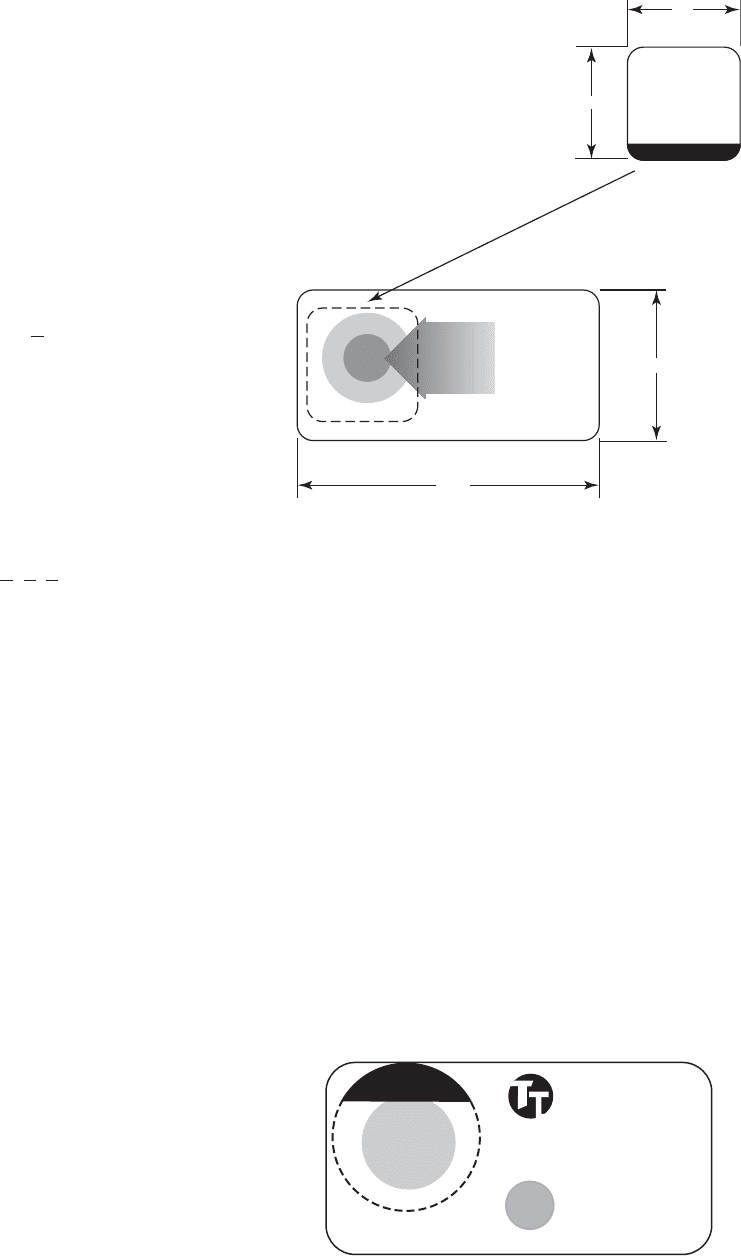
The commercially available TTIs use either a biochem-
ical reaction between an enzyme and a substrate (Figure 1),
a polymerization reaction in some material resulting in a
highly colored polymer (Figure 2), or diffusion of a dye
along a wick (Figure 3). In each case the reactions are
temperature-dependent and the rates of reactions are care-
fully controlled by controlling the concentration of the
indicator’s constituents. Some of the indicators are acti-
vated at the time of manufacture, requiring their storage at
ultralow temperature until they are affixed to a product
package. Other indicators are activable at any desired time,
such as when the TTI is fixed on a package at the start of
the distribution chain.
TTIs differ in how they display their response to time
and temperature. A TTI based on biochemical reactions
involves a pouch containing an enzyme and a substrate that
are initially kept separate by a thin seal. At the time of
activation, the seal separating the pouch contents is broken
and the contents are mixed. The pouch is made of a
transparent film and is placed inside a plastic sleeve with
a window. As the enzymatic reaction in the pouch proceeds
as a result of the combined effect of temperature and time,
the pH of the mix changes, resulting in a change in color.
The user observes the color of the pouch’s contents to
determine the time–temperature exposure. In another
type of TTI, the movement of a dye along a wick is
indicative of time and temperature exposure because the
diffusion process is temperature-dependent. A rectangular
wick is typically sandwiched inside an outer sleeve that
contains viewing holes and an appropriate scale. The
advance of the dye along the wick is visually observed
and related to the extent of the reaction. Another method
used to display the indicator response is the use of a bull’s-
eye concept. In this case an indicator is located at the inner
circle, while a surrounding ring is painted with a color that
is eventually reached by the indicator when the shelf life of
the product is deemed to have expired. In this type of a TTI,
a user compares the color of the indicator seen in the center
with the color of outside ring(s) as shown in Figures 1 and 2.
TTIs are useful in implementation of inventory man-
agement policies other than the commonly used first-in-
CheckPoint
®
III
Temperature
Label
www.vitsab.com
INACTIVE
2.00
< The word ACTIVE must appear here
C
h
e
c
k
P
o
i
n
t
®
DO Not Use
If Circle Is
PINK
1.00
ACTIVE
.75
.75
"Activator Label"
Figure 1. Check point III
s
temperature label (dimensions in
inches) (http://www.vitsab.com/Products2.htm).
Sensor
TM
If color of "ACTIVE" large circle
matches color of small circle,
TT Sensor
TM
is expired
= Expired
TT Sensor
TM
is a time temperature indicator
35-F
ACTIVE
Figure 2. Time–temperature indicator label (http://www.global-
spec.com/FeaturedProducts/Detail/TIPTemperatureProducts/
TimeTemperature_Indicator_Labels/32742/0).
TIME TEMPERATURE INDICATORS 1237