
Yam, Kit L. (ed.). The Wiley encyclopedia of packaging technology
Подождите немного. Документ загружается.

BOXES
Box styles. Wooden boxes are of either ‘‘nailed construc-
tion’’ or ‘‘lock-corner construction.’’ Of the eight basic box
styles shown in Figure 1 (3), Style 6 is the only lock-corner
construction. The others are nailed (cleated).
Wood. Specifications for wooden boxes refer to the
categories developed by the US Forest Products Labora-
tory, which relate to strength and nail-holding power (see
Table 1). Groups 1 and 2 are relatively soft; Groups 3 and 4
are relatively hard. For a given box of a given style, the
thickness of the wood and cleats depends on the type of
wood.
Fastenings. The strength and rigidity of crates and
boxes are highly dependent on the fastenings, which are as
follows: nails, staples, lag screws, and bolts. Nails are the
most common fastenings in the construction of boxes. The
size and spacing of the nails depends on the type of wood (5).
Loads. The type of load is determined by the weight
and size of the contents and its fragility, shape, and
capacity for support of, or damage to, the box. Load types
are classified as Type 1 (easy), Type 2 (average), or Type 3
(difficult). Descriptions and examples of each load type are
contained in Ref. 5.
CRATES
A wood crate is a structural framework of members
fastened together to form a rigid enclosure that will
protect the contents during shipping and storage. The
enclosure is usually rectangular and may, or may not, be
Table 1. Commercial Box Woods
a
Group 1 Group 2 Group 3 Group 4
Alpine Fir Lodgepole Pine Douglas Fir Black Ash Beech
Aspen Magnolia Hemlock Black Gum Birch
Balsam Fir Nobel Fir Larch Maple (soft or silver) Hackberry
Basswood Norway Pine North Carolina Pine Pumpkin Ash Hickory
Buckeye Redwood Southern Yellow Pine Red Gum Maple (hard)
Butternut Spruce Tamarack Sap Gum Oak
Cedar Sugar Pine Sycamore Rock Elm
Chestnut Western Yellow Pine Tupelo White Ash
Cottonwood White Fir White Elm
Cucumber White Pine
Cypress Willow
Jack Pine Yellow Poplar
a
Ref 4.
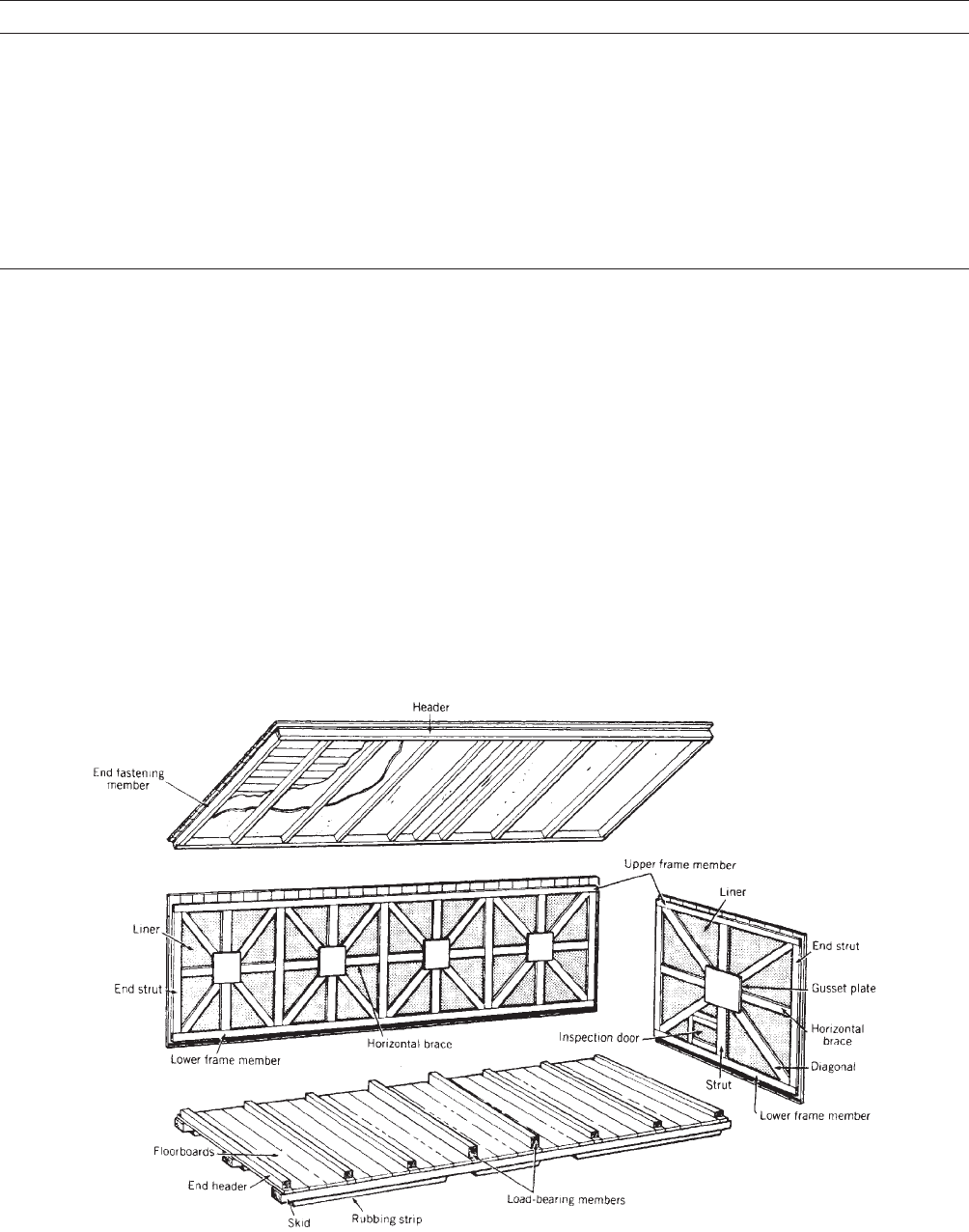
Figure 3. Plywood-sheathed crate.
178 BOXES, WOOD
sheathed (4). A crate differs from a nailed wood box in that
the framework of members in sides and ends must provide
the basic strength. For its strength, a box relies on the
boards of the sides, ends, top, and bottom. A crate gen-
erally contains a single item, and its dimensions are not
subject to standardization. The function of a crate is to
protect a product during handling and shipping at the
lowest possible cost. A simple enclosing framework is
shown in Figure 2 (4).
Some products and shipping conditions require greater
protection. The value of the contents or the likelihood of
top loading may dictate the use of a sheathed crate (6).
The sheathing can be lumber or plywood. A plywood-
sheathed crate is shown in Figure 3 (4).
BIBLIOGRAPHY
1. F. A. Paine, The Packaging Media, John Wiley & Sons, Inc.,
New York, 1977.
2. ASTM D-996: Standard Definitions of Terms Relating to
Packaging and Distribution Environments, ASTM,
Philadelphia.
3. National Wooden Box Association, Specifications for Nailed
Wooden and Lock Corner Boxes for Industrial Use, Washing-
ton, DC, 1958.
4. Wood Crate Design Manual, Agriculture Handbook No. 252,
U.S. Department of Agriculture, Forest Service, 1964.
5. Federal Specification PPP-B-621C, Oct. 5, 1973.
6. American Plywood Association, Plywood Design Manual: Crat-
ing, Tacoma, WA, 1969.
BULK PACKAGING
PETER HENNINGSEN
Minnetonka, Minnesota
Bulk packaging is an economical solution for the shipment
of many different types of product. Continuing advance-
ments in the materials applicable to constructing bulk
containers contribute to increasing acceptance in their
use. These factors, together with lower materials-hand-
ling and freight costs, combine to create an effective
shipping container system that meets the needs of the
product, the shipper, and the customers.
BULK PACKAGING CONSIDERATIONS
Almost all types of product present possibilities for use of
bulk containers. Successful applications include chemi-
cals, liquids, pastes, metallic powders, resins, food items,
automotive parts, and grains. Although metal, plastic, and
fiber drums are a form of bulk containers, these materials
are not included here as they are specifically covered in
other articles of this encyclopedia. Planning for use of bulk
containers should include the following analysis.
Product Needs. These needs include physical and che-
mical properties, such as sensitivity to moisture gain or
loss, flow characteristics, loading and unloading, compat-
ibility with packaging materials, vapor emissions, protec-
tion from oxygen, retention of various gases, physical
protection, and normal production volumes.
Product Weights. Depending on the product and the
container used, shipping weights of 2000 lb (907 kg) and
more are common, and some dry, flowable products that
weigh up to 8000 lb (3629 kg) are being sucessfully
shipped.
Container Costs. Weight and size of product, production
volumes, loading and unloading requirements, and meth-
ods of storage and transportation are all key elements in
the design process. It is essential to design for optimum
cube in storage and in the transportation vehicle to realize
the most benefits.
Lightweight products may reach vehicle weight limits
before cubing out. For heavy products, stacking strength
to use warehouse space effectively is a major point. Con-
tainer base dimensions must relate efficiently to both
storage and transport vehicle size and incorporate a
solid base for handling. Typical sizes are 48 in. 40 in.
(1219 mm 1016 mm) and 44 in. 35 in. (1118 mm 889
mm). Many other sizes are used, which depend on dis-
tribution requirements.
Container Types. Markets served and distribution
needs determine selection of the most cost-effective con-
tainer. Woven plastic films, corrugated containers, rigid
plastics, metal, and wood products are materials com-
monly used. Reusability reduces total costs, and the ease
of disposability at the end of container life is important.
The automotive industry makes great use of returnable
bulk containers for parts and assemblies feeding their
production lines. Ingredient packaging for food products is
another major use.
Customer requirements for use of the product are
important. Special features can be designed into contain-
ers to facilitate filling and emptying. All containers
must be equipped to accept applicable materials-handling
devices—forklifts, cranes, hoists, slings, pallet jacks, etc.—
used to load, store, move, and unload the containers at all
points in the distribution cycle.
MATERIALS USED FOR BULK CONTAINERS
The most commonly used materials are described below.
Table 1 shows a comparison of some attributes of various
container materials.
Corrugated. Widely used for bulk containers, corru-
gated containers can be designed to compensate for bulge
resistance, puncture resistance, and stacking strength as
needed. Variations in board construction that provide
necessary properties include one-piece liners, two-piece
inners, as well as three-ply and/or eight-sided (octagonal)
shapes. Board used can be single, double, triple wall, or
BULK PACKAGING 179

combinations thereof. Within supplier equipment limita-
tions [up to B180 in. (4572 mm) in perimeter and 55 in.
(1397 mm) in depth], many different sizes and shapes are
possible. Box liners are used as needed to ensure product
protection. Containers are easily disposed of and can be
designed for reuse. Container surfaces readily accept
graphics for product and company identification.
Bags. Many uses for bags are possible because of the
multitude of films and laminations available for fabrica-
tion. Woven polypropylene fabrics are most common. Use
of rubberized plastic films greatly increases bag strength.
If needed, then special extrusion coatings or additional
protective liners can be used for special product needs.
Most uses are for dry products. Bag handling is usually
accomplished through four corner lifting loop straps sewn
into bags at the top. Common bag sizes are usually up to
66 ft
3
(7.8 m
3
). However, recent designs that use rubber-
ized nylon and DuPont Kevlar provide the ultimate with
bags up to 9 ft (2.74 m) in diameter and 10 ft (3.05 m) high,
which hold up to 25 tons (2268 kg). Bags are collapsible
when empty, light in weight, and can be designed for
reusability (see Bags, plastic).
Rigid Plastics. Designs for rigid plastic containers can be
made to meet all expected requirements for bulk packa-
ging. They can be collapsible, lightweight, and usually up to
34 in. (864 mm) in depth. They are adapted to product
needs by selection of compatible plastic resins for molding
and/or addition of protective liners. These containers are
generally more costly than other types but can be justified
in a total system concept through recycling and reuse.
Plastic containers are resistant to normal environmental
hazards such as moisture and water. Temperature ex-
tremes—low or high—are addressed by specific material
selection. Some plastics may be adversely affected by
exposure to sunlight. Plastics often are used in captive
systems for handling and moving product between multiple
plants of a single parent company.
Metal. Metal containers in the form of drums were
among the first types of bulk container. The possibilities
for metals to meet many different product needs—high or
low temperatures, corrosion resistance, longevity, chemi-
cal compatibility, shipping weight and cube, etc.—are
significant. They can be closed-wall, cage-wall, collapsible,
and even expandable by adding tiers to a base container.
Metal returnables commonly are used for handling and
shipping automotive parts and assemblies from suppliers
to assembly plants. The quantities involved make dispos-
ing of packaging materials costly. Efficient container de-
sign, which includes internal components, provides for
reuse and physical protection. Metal containers are
usually heavier than other container types.
Wood. Wood is adaptable to the design of bulk contain-
ers to meet many different product demands. Styles
include open crates, cleated plywood, and wooden boxes.
Containers can be designed for knocked-down shipment
when empty to reduce space and freight costs. Reusable
fastening devices are available to close many types of box
construction. Box liners in various types are used to
satisfy special product needs. Wirebound boxes represent
a specially designed box or crate to reduce weight and
increase strength and are successfully used in bulk pro-
duct shipments.
CONTAINER TESTING
ASTMD-4169 provides for definition of test elements and
the applicable test procedures for shipping units to meet
specific distribution patterns. Performance can be mea-
sured against any one of three assurance levels as deter-
mined by the shipper. Preshipment testing is essential for
bulk container validation.
BIBLIOGRAPHY
General References
Fibre Box Handbook, Fibre Box Association, Rolling Meadows, IL,
1992.
G. G. Maltenfort, Corrugated Shipping Containers: An Engineer-
ing Approach, Jelmar Publishing Co. Plainview, NY, 1988.
Wood Crate Design Manual, Agricultural Handbook No. 252, U.S.
Department of Agriculture Forest Services, 1964.
Annual Book of Standards, Vol. 15.09, American Society for
Testing and Materials, Conshohocken, PA, 1996.
R. J. Kelsey, Packaging in Today’s Society, 3rd ed., St. Regis Paper
Company, New York, 1989.
Table 1. Comparative Attributes of Container Materials
General Material
Category Reuse Disposability
Tare
Weight Durability
Resistance to
Shipping
Environment
Container Cost
Advantage
Freight Cost
Advantage
Corrugated Good Best Best Good Good Best Best
Bags Better Good Best Better Better Better Best
Rigid plastic Best Good Better Better Best Good Better
Metal Best Best Good Best Best Good Good
Wood Better Better Good Better Better Better Better
180 BULK PACKAGING

C
CAN SEAMERS
OTTO L. HECK
RICHARD CABORI
Angelus Sanitary Can Machine
Company, Los Angeles,
California
Can seamers are machines that mechanically attach
component ends to can bodies in a reliable manner.
Around 1900, the sanitary can made its appearance in
Europe, where both top and bottom ends were double-
seamed to the can body. The term ‘‘sanitary’’ indicated
that solder was not used in the ends being double-seamed,
but only on the outside of the can body side seam (1). In
1910 Henry Louis Guenther, inventor and manufacturer,
introduced can seamers for double seaming that met the
requirements of modern food and beverage processing. His
products, which are sold under the trade name of ‘‘Ange-
lus,’’ were so well introduced that they are now used by the
largest food, beverage, and can manufacturing companies
in the United States as well as abroad (2). Basically, there
are two categories of can seamer: In can manufacturing
they are called can shop machines, which attach the first
end on a three-piece can, and in product filled cans they
are called closing machines, which attach the last end on
either a two-piece or three-piece can.
THE DOUBLE SEAM
The preservation of canned products requires hermeti-
cally sealed cans. The process of creating an airtight
closure by attaching the can end component to the can
body is called double seaming. This double seam is a
metal-to-metal joint formed by mechanically interlocking
five layers of metal together: three from the can end and
two from the can body (3). These layers are then com-
pressed and ironed tightly to form the hermetic seal (see
Figure 1). The can seamer sometimes referred to as a
double seamer requires two seaming operations to pro-
duce a quality seam formed by the machine’s seaming rolls
as the can body and can end are held together by a vertical
load applied between the lower lifter and the seaming
chuck as the can parts move through the machine. During
this seaming cycle the can end and can body meet, and the
first-operation seaming roll contacts the can end and
begins curling the can end around the can body flange. A
second-operation seaming roll follows, which tightens and
irons out the seam between the can body and can end
forming an airtight hermetic seal between the two parts
(see Figure 2).
The double seam is a critical can component for a
proper seal. Every angle, radius, and dimension must be
correct to ensure a hermetic seal (4). The double seam is
defined as follows: ‘‘The curl on the can end containing
sealing compound and the flange on the can body are
indexed and rolled flat, forming five folds of metal. Sealing
compound between folds gives an airtight seal (5).’’
METHOD OF SEAMING
There are two basic seamer designs: can spin and can
stand still. Practically all closing machines designed in the
early years were of the can stand still type incorporating
up to four seaming heads and operation at speeds ranging
from 25 to 275 cans per minute. The can-stand-still design
is still used extensively and in many cases is a necessity
due to the products being closed, such as shortening or
some fine powders. In this design the nonrotating can
body and can end are assembled between the knockout rod
pad and the lower lifter or base plate table. The knockout
rod pad keeps the can end firmly in place as the lower
lifter (which is synchronized with the knockout pad) raises
the can body and can end into the seaming position on the
seaming chuck. First operation seaming rolls, which
are diametrically opposite each other in a seaming head,
revolve around the stationary seaming chuck, and pres-
sure is applied through cam action to form the first
operation. After the first operation is completed to the
proper thickness, the second-operation seaming rolls,
which are diametrically opposite each other, iron out the
double seam to the proper thickness. After the seaming
operations are completed and the second-operation seam-
ing rolls have been released, the knockout rod follows the
seamed can away from the seaming chuck as it is being
lowered to the discharge position by the lower lifter (6).
As canning speed requirements increased, can spin or
rotating-can-type seamers were developed using a multi-
station design. Machines with 4 to 18 seaming stations are
in use, providing production speeds of 100–2300 cans per
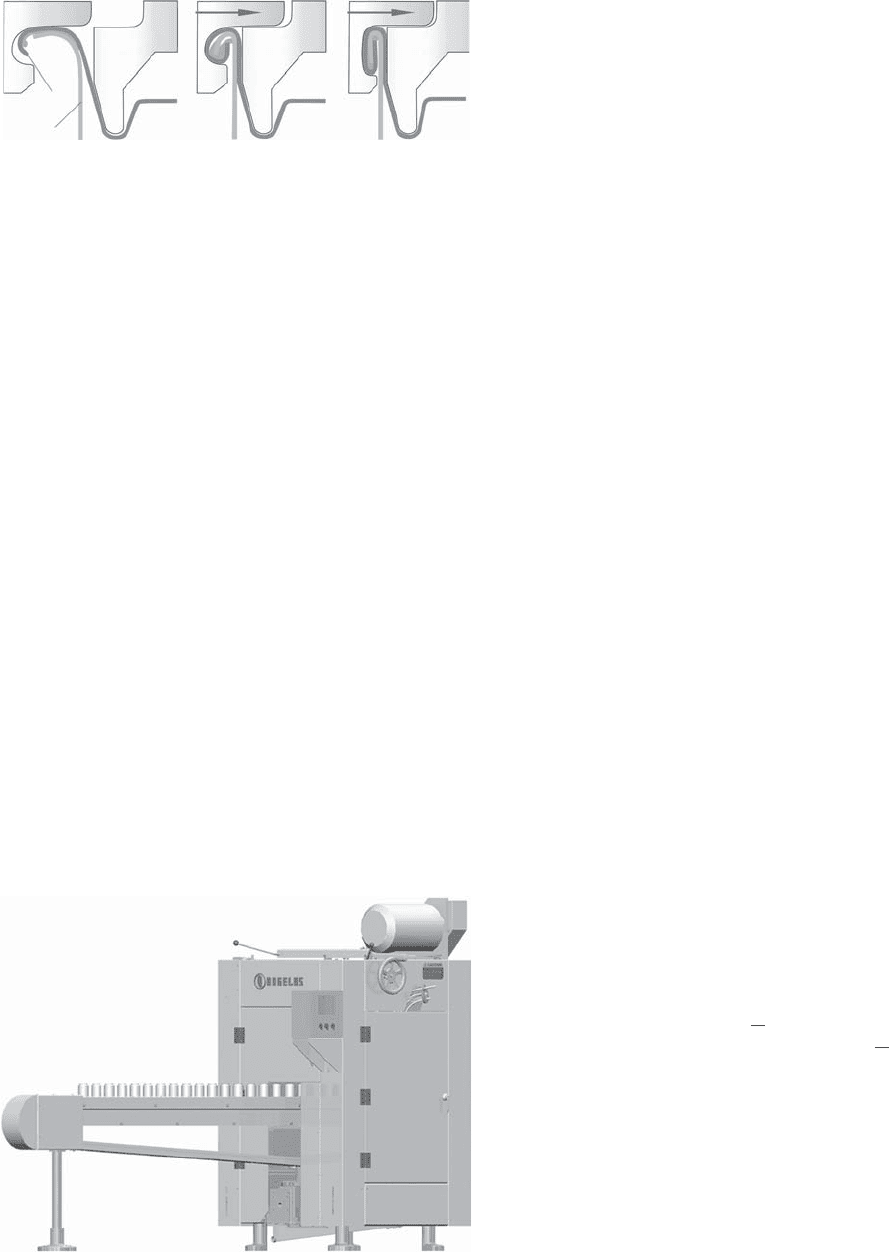
minute (see Figure 3). Can ends are automatically sepa-
rated and mated with the can bodies in the seaming
Body Wall
Thickness
Cover
Thickness
1
2 3 4 5
Figure 1. Double seam made of five layers compressed and
ironed tightly to form a hermetic seal.
181
position. The knockout rod pad contacts the can end while
the lower lifter, synchronized with the knockout rod pad,
lifts the can body and can end into position on the seaming
chuck. On thin-walled lightweight cans the machine de-
sign incorporates driven seaming chucks and driven lower
lifters to prevent can skid or can buckling. One first
operation seaming roll actuated by a cam forms the first
operation seam. After completion of the first operation
seam, the second operation seaming roll actuated by a
similar cam action irons out the seam to the proper
thickness.
MACHINE TYPE BY APPLICATION
Can seamers are typically manufactured in five machine
types for seaming can ends to can bodies: can shop, atmo-
spheric, mechanical vacuum, steam vacuum, and under-
cover gassing.
1. Can shop. For can manufacturing: this attaches the
first end on three-piece cans.
2. Atmospheric. For can closing products not requiring
removal of oxygen for preservation—that is, soaps,
petroleum products, frozen products, and hot
productsW1801F.
3. Mechanical vacuum. Evacuates oxygen from head-
space of can for preservation of product at slow
speeds—that is, vegetables, specialized powdered
products.
4. Steam vacuum. Evacuates oxygen from headspace of
can with steam for preservation of product at high
speeds—that is, fruits, vegetables, soups, fish, meat
products, and juices.
5. Under-cover gassing. Displaces oxygen in headspace
of can with a gas, such as carbon dioxide or nitrogen,
to extend shelf life and/or increase internal can
pressure for thin-walled aluminum cans—that is,
beer and soft drinks.
Generally, during the process of a modern automated
canning operation, cans are filled with a measured
amount of product, then transferred from the filler to
the can feed table of the seamer. This transfer from the
filler to the seamer is critical and must be timed in such a
manner to avoid can damage, product spill, or extreme
product agitation, thereby rendering a smooth flow of cans
and product into the seamer. As the cans move into the
seamer, they are sensed by a mechanical, electrical, or
optical device that triggers a signal to separate one can
end from a stack and feed it in a synchronized rotary
manner to an incoming can. Generally, the timing of
machine operations is mechanically controlled by cams
and there is a dwell period for steam vacuum and under-
cover gassing applications as stream or gas is injected
between the top of the open can and the can end prior to
their contact. Filling the headspace of cans with steam or
gas displaces the air, preserving the quality of the canned
product. After the can parts meet, they move through the
seaming cycle of the first and second seaming operations
and then the cans are discharged from the machine.
MACHINE SETUP
Can seaming machines are designed to double-seam a
given range of can diameters, can heights, and speeds.
Can diameters and can heights are expressed in both
inches and millimeters, but generally use an industry
nominal diameter, such as 200, 202, 206, 207.5, 209, 211,
300, 303, 307, 401, 404, 502, and 603. Industry nominal
diameters are defined as follows: The first digit equals
inches; the second and third digits equal 1/16 fraction of
an inch. For example, a can with a nominal 211 diameter
would be the equivalent of 2
11
16
in. and a can with a nominal
307 diameter would be the equivalent of 3
7
16
in.
It is very important that the machine be setup to the
correct specification for the type of can end and can body,
diameter of the can end and can body, and material
thickness of the end and can body. Important setup
procedures include the following:
1. Checking the fit of seaming chuck to can end.
2. Initially installing only the first operation seaming
rolls. Remove second-operation seaming rolls if in
place.
Figure 3. Can seamer.
Seaming RollSeaming Roll
Start
Seaming Roll
Seaming
Chuck
Seaming
Chuck
Seaming
Chuck
Can End
Can Body
First-operation
Seam
Second-operation
Seam
Finish
Figure 2. A schematic of the double-seam process.
182 CAN SEAMERS
3. Installing seaming chucks and checking that the
first operation seaming rolls do not interfere with
the seaming chucks when in the seaming position.
4. Setting lower lifter assemblies to correct height
relationship with can feed table.
5. Setting lower lifter spring pressure to proper load
with an appropriately calibrated instrument, such
as a Dillon force gauge or force cell gauge.
6. Setting pin height with an appropriately calibrated
instrument, such as a pin height gauge or planer
gauge.
7. Setting the first operation seaming rolls on each
station to a specified seam thickness using a wire
gauge of the proper diameter. Run samples of first-
operation seamed cans to verify quality of seam.
Visually inspect seam while measuring the seam
thickness, seam width, and countersink depth.
8. Installing and properly adjusting the second opera-
tion seaming rolls to the seaming chucks on all
stations to the specified seam thickness. Run sam-
ples of the finished second operation seam. Visually
inspect the seam while measuring the seam thick-
ness of the finished seam to given specifications
using a properly calibrated seam micrometer. Fi-
nally, tear down the second operation seam for
further inspection.
KEY FEATURES AND ATTACHMENTS
Depending on the application and production require-
ments, can seamers are equipped with features and
various attachments to meet the demands of industry
processors.
Automatic Stops. For safety reasons, machines are
equipped with mechanical, electrical, or optical sen-
sors that cut power to the motor, actuate the clutch
release unit, and apply the brake to stop the ma-
chine rapidly. These safety devices are located at
critical areas on the machine.
Filler Drive Seamer Safety Clutch. A safety overload
clutch is used to protect the can seaming machine in
case of a severe can jam or mechanical failure in the
filler.
In-Motion Timer. This is a timing attachment located
between the seamer and filler that synchronizes the
transfer of cans from the filler pockets to the seamer
feed chain fingers during machine operation.
Can Coding Markers. There are two types of mar-
kers—mechanical and ink-jet—used to place the
processor’s identification code on can ends. Mechan-
ical markers use type dies that are capable of
debossing and embossing identification characters
on can ends. Debossing is where the characters are
indented into the top of the can end, and embossing
is where the characters are raised on the top of the
can ends. Mechanical markers are driven by the
seamer and have speed limitations up to 1000 cans
per minute. They are used primarily on sanitary
food cans. Ink-jet markers are not driven by the
seamer and use a nozzle assembly device to print
droplets of ink to make up characters forming
alphanumeric or bar codes. Ink-jet markers apply
clear codes to virtually any surface at nearly any
production speed, using a programmable controller
and software to monitor the ink quality, size, font,
and lines of print.
Automatic Lubrication. Metered amounts of grease
and/or oil are automatically delivered by pumps
to designated machine areas requiring lubrication
while the machine is operating.
Automatic Oil Lubrication Recirculating and Filtration
System. This system continually filters water and
particles from the recirculating oil. The lubricating
oil is pumped and recirculated through the machine,
reducing the amount used and the environmental
concerns of discarding cycled oil.
Programmable Controller. This provides electrical
monitoring of seamer functions and operates auxili-
ary equipment.
Driven Lower Lifters. Also referred to as driven lower
chucks or driven baseplate tables. They accept in-
coming can bodies or product-filled cans from can
infeed devices before being raised by a cam action to
meet can ends to be seamed at the make up area.
They are gear-driven and rotating in a synchronized
design with the seaming chucks to provide stability
and enhance can control during the seaming cycle
process. Driven lower lifters use a preset spring
pressure, which is a vital component in the forma-
tion of a double seam.
SEAM TIGHTNESS EVALUATION
Generally, in order to stand the rigors of processing,
handling, damage by abuse, and distribution, as well as
to ensure product shelf-life, the tightness of the seam is
critical and should be evaluated carefully. During the
formation of a double seam the proper tightness assures
that the sealing compound will fill all the spaces not
occupied by metal.
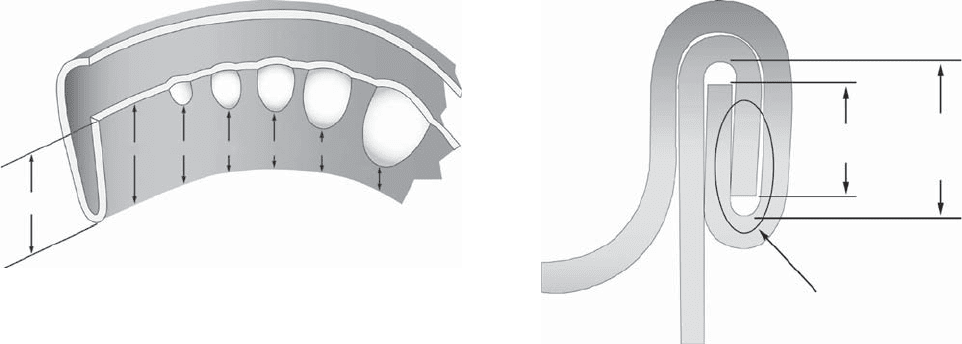
Seam tightness
is normally evaluated by the degree of
waviness or wrinkle found in the cover hook. This wrinkle
is formed by compression of the curled outer edge of the
can end as it is folded back under the body flange. By
increasing the pressure of the seaming rolls, the wrinkle
can be ironed out to a smooth strip; and by loosening
the rolls, the wrinkle is increased (7). Wrinkles may be
classified by a tightness (wrinkle) rating as shown in
Figure 4. A 70% wrinkle rating equates to a 30% wrinkle
in the cover hook or 70% of the cover hook is wrinkle-free.
Less than 70% tightness is considered too loose. There are
other numerical cover wrinkle rating systems used: The
Dewey and Almy wrinkle rating uses a 0–10 scale in which
absence of wrinkle rates as 0 and a full-width wrinkle
rates as 10: another uses a 0–3 rating system. The rating
for each end component is based on the worst or deepest
wrinkle, because it is at this point or area that the seam is
CAN SEAMERS 183
most vulnerable to abuse, leakage, and penetration by
bacteria.
In hemming a straight edge of metal, no wrinkles
are formed. On curved edges, wrinkling increases as the
radius of curvature decreases. For this reason, different
wrinkle ratings are specified for small-diameter cans as
compared to large-diameter cans (8). A 100% wrinkle
rating of a 211 diameter can indicates that the seam
may be too tight and should be watched for possible
defects such as cutovers, droops, and unhooking. A 100%
wrinkle of a 603 diameter can would not necessarily be too
tight. With most can seamers using standard seaming roll
profiles, the ideal seam almost invariably shows a slight
wrinkle, except on 603 diameter and other large-diameter
containers.
MEASUREMENT OF PERCENTAGE OVERLAP
The overlap of a double seam is expressed as a percentage
of the maximum possible overlap. A minimum percentage
of 55% is considered acceptable. The percentage overlap of
the seam is established by first measuring the internal
seam length, a measurement between the inside of the
cover hook and the inside of the body hook, and rating this
length as 100. The measured length of the actual overlap
is then a portion or percentage of that length calculated
(B/A 100 = percentage overlap) (see Figure 5).
PROFILES OF SEAMS
A properly formed first-operation and second-operation
double seam requires the correct adjustments of pressure
of the seaming rolls and lower lifter or base plate table. The
shape and conformity of the finished seam is determined by
the taper and fit of the seaming chuck to the top of the end
component and the contoured profile of the seaming rolls.
The seaming roll profile is a groove around the circumfer-
ence of the roll which varies with the diameter of the can to
accommodate variations in material, material thickness,
cover curl, body flanges, and seam specifications of the user.
For any given can diameter, there may be a number of roll
profiles, which will properly form the double seam. First-
operation and second-operation roll profiles are uniquely
different. As the first operation seaming roll profile contacts
the cover curl, the flange of the can bends over to form the
body hook and the edge of the cover tucks underneath to
form the cover hook. The second-operation seaming roll
profile completes the seam formation by compressing the
seam so that the hooks interlock tightly and any metal
voids or spaces are filled with the sealing compound.
BIBLIOGRAPHY
1. F. L. Church, Modern Metals, 28 (1991).
2. The National Cyclopedia of American Biography, Vol. XXXIII,
James T. White & Co., New York, 1947.
3. Pocket Guide to Evaluating Double Seams, Angelus Sanitary
Can Machine Company, Los Angeles, CA, 2001.
4. W. Soroka, Fundamentals of Packaging Technology, Institute of
Packaging Professionals, Herndon, Virginia, 1995.
5. CMI Can Standards Manual, Can Manufacturers Institute,
Washington, DC, 1992.
6. Canning Industry History, Terminology & Reference Manual,
Angelus Sanitary Can Machine Company, Los Angeles, CA,
1968.
7. Evaluating A Double Seam, W. R. Grace & Co., Cambridge, MA.
8. Top Double Seam Inspection & Evaluation, American Can
Company, Geneva, NY, 1966.
CAN, COMPOSITE, SELF-MANUFACTURED
Two basic types of self-manufactured composite cans are
produced in-house by packagers. One is the traditional
spiral-wound or convolute composite can, the familiar
form used for motor oil, orange juice, and cocoa-based
products (see Cans, composite). A more recent develop-
ment is the use of folding-carton material for the produc-
tion of self-manufactured paperboard cans that use
composite materials in the folding-carton base stock. A
newer innovation is a paperboard can that is hermetically
sealed and capable of holding a gas environment.
Overlap
“B
“
Internal
Length
“A
“
Primary
Seal Area
Figure 5. Overlap measurement.
50%
100%
80%
70%
60%
30%
Cover Hook
Figure 4. Wrinkles are rated by the percentage of tightness.
184 CAN, COMPOSITE, SELF-MANUFACTURED
Composite Cans. A typical example of self-manufacturing
of a traditional composite can is a system known as Sirpack.
This system, from Sireix (France), installed in the packager’s
manufacturing facility, produces composite cans that can be
round, square, rectangular, or oval. The cans are produced
from a continuous form-and-seal process from four reels of
material in a horizontal fashion. The materials are shaped
around a forming mandrel and sealed, generally by a
hot-melt adhesive (see Adhesives). The inside liner is
heat-sealed for excellent moisture and liquid tightness (see
Sealing, heat). The reels of material are slightly staggered to
each other so that the sealing lines on the four materials do
not superimpose. The inside materials that provide moisture
and liquid tightness are generally made from a plastic film
or aluminum foil (or both), according to the protection
needed for the product. The outside laminate can be printed
by web rotogravure, or web offset (see Printing).
The bottom is generally a metal end, but it can also be
made of a composite material matching that of the sidewall.
It also can be one of the many plastic closures available.
Generally, the top is a heavy injection-molded plastic that is
heat-sealed to the upper edges of the container. In most
cases, the cover incorporates an easy-open device that
allows a separation or opening of the lid and can be reclosed
after removing a portion of the product.
The main advantages of the in-plant Sirpack system are
that it permits the option of various sizes (material options)
and the ability to save the conversion cost normally paid to
the converter of the composite cans. Added to this benefit
are other savings, such as the savings in floor space and
warehousing of empty composite cans prior to use in the
filling and closing process. The machinery is relatively
compact and easy to maintain. It has been designed for
in-plant production with the average mechanic in mind.
Paperboard Cans. Several companies provide systems for
in-plant manufacture of paperboard cans. They include
folding-carton companies such as Westvaco (Printkan), In-
ternational Paper (CanShield ), and Sealright (Ultrakan) . All
of their packages are low-to-moderate barrier paperboard
cans that can be manufactured in the packager’s facilities.
Another paperboard can, Cekacan, offered in the United
States by Container Corporation of America, provides a
high-barrier, gastight supplement to the paperboard-can
list. All the paperboard cans are formed from a flat blank
and assem bled into either a straight-wall can or a tapered-
wall can. In some cases , e.g., CanShield, the use of paper-cup
technology has been employed to develop the vertical-wall
paperboard can.
A paperboard can is described as a semirigid container
with the body sidewall fabricated from a single sheet
of folding-carton-based material, wound once and sealed
to itself, with either or both ends closed by a rigid or
semirigid closure. The typical paperboard can has three
pieces, which are as follows: a single-sheet single-wound
body, a single sheet of base material fixed to one end, and a
closure. The system almost always is made in line with the
packager’s filling and closing operations, but it also is
possible to manufacture to storage. The can body can be
cylindrical, rectangular, or combinations thereof, but most
are cylindrical. Commercial or prototype paperboard cans
range in size from 2 to 10 in. (0.8–3.9 cm) high, and up to
6 in. (2.4 cm) in dia, but mostly are confined to a maximum
5.25-in. (2-cm) dia and 3–10-in. (1.2–3.9-cm) heights.
In the CanShield construction, the paperboard sidewall
is rolled into a cylindrical shape and the two edges are
overlapped and sealed. Continuous thermofusion along
the seal is effected by bringing the coating on one or two
edges of the blank to a molten state, i.e., by direct contact
with a heated plate, or more recently, by blowing hot
air onto the edge, bringing the two edges together, and
applying pressure. Usually a polyolefin, e.g., polyethylene,
is used on the surface of the board to provide the adhesive
factor. A disk of paperboard with a diameter approximat-
ing that of the cylinder is crimpfolded around its peri-
meter to form an inverted shallow cup. This base piece is
positioned in one end of the hollow cylinder so that the
bottom edge is about 1/4 in. (0.64 cm) below the edge of the
cylinder. The edge of the inner periphery is heated and
crimpfolded over to lock and seal the disk in place. In this
manner, the outer peripheral of the base is sealed to the
inner perimeter of the cylinder wall. The segment of the
outer wall extended beyond the inner disk then is heated
and folded over to come in contact with the inner side of
the disk. A spinning mandrel applies pressure to the base
of the cylinder to effect the final seal.
The result is a primary seal between the bottom disk
and the sidewall and a secondary seal, wherein the side-
wall is folded over, which captures the disk with an
additional seal. For the rectangular version, the base piece
is forced against the body wall under pressure using an
expanding mandrel to seal the base to the body. Here too,
the material for sealing is usually polyethylene, and hot
air is used to bring the material to a molten state to act as
a sealant. On the round containers, the top is usually
rolled out and the closure, e.g., a foil membrane, is
adhered to the top rolled edge after the product has been
placed into the paperboard can. On the rectangular ver-
sion, the top rolled edge is generally closed by a rim
closure that clamps onto the periphery of the opening
and is sealed into place by induction or by glue. The rim
then acts as a holder for a full panel closure.
The Ultrakan concept is similar to the CanShield in
that the body wall is wrapped around a mandrel and the
two edges are overlapped and heat-sealed to each other.
The bottom disk is inserted in the container, and the body
wall and bottom disk are heated and crimped or rolled
together. Thermoplastic hot-melt adhesive may be used
for
added security and
seal strength. The interior edge of
the sideseam can be skived to enhance WVTR or grease-
proofness of the container, or both. The top of the Ultrakan
container can be finished in a variety of ways that include
the following: rolled outward (to accept a membrane seal);
flared (for a variety of seamed metal ends); rolled inward
(for special thermoformed or injection-molded plastic clo-
sures); or gently flared (for insert rotor/dispenser style
closures). The Ultrakan system also provides the option of
customizing by special bottom techniques, which offer
dispensing features for granulated products, powders
and paste, or semiliquid sauces or condiments.
A high barrier paperboard can has been introduced from
Sweden (Cekacan). By incorporating the use of polyolefin
CAN, COMPOSITE, SELF-MANUFACTURED 185

laminates (see Laminating) along with foil and a special
means of sealing the package, a hermetic seal has been
demonstrated, which makes the package virtually im-
permeable to gas, liquid, fat, etc. (see Table 1). The Cekacan
system involves both a canforming operation and a can-
closing operation. In the forming operation, the sidewall is
wrapped around a mandrel and butt-seamed (not over-
lapped). Just prior to the wrapping operation, a foil-lami-
nated tape is induction-sealed to one edge of the blank.
With the seam butted, an induction sealer affixes the tape
to the interior of the can in such a way as to provide a
continuous hermetic seal along the longitudinal seam.
The package is transfered to an end-closing device,
wherein a top or bottom closure is affixed. In this case,
the closure is inserted into the can with the closure
sidewalls flanged to the vertical position. Through the
use of pressure and induction sealing, the disk is herme-
tically sealed into place. The package is then discharged
for filling and brought back to the second piece of equip-
ment, which inserts and hermetically seals the final
closure. Closures are available that provide easy opening
without compromising the gastight integrity of the pack-
age. Through the use of a butt seam, held together with
sealable tape, no discontinuous joints to bridge exist.
Ends are inserted, and fused by induction sealing, to
the smooth interior wall. During the induction-sealing
process, the fluid flow of the internal coating, usually
polyolefin, fills any short gaps that may occur. The equip-
ment is simple to operate and does not require special
expertise.
A special attribute of all the in-plant paperboard-can
packaging systems is the reduction of materials storage
and handling. Because the body walls are shipped flat
along with the bottom disk and top closures, a minimal
amount of storage space is necessary. The average space
needed to contain the paperboard can in its flat form
represents approximately 97% savings over a similar
number of composite or metal cans or glass jars. Addi-
tional savings are realized by the reduced cost of shipping
the container components to the plant and also in the
weight of the final product.
Materials. Basic paperboard-can-body structures are
made of laminations of paperboard, aluminum foil, and
polyolefins. End structures are analogs that might omit
the paperboard for some applications. The generalized
structure is paperboard/bonding, agents/aluminum, foil/
polyolefin (outside-to-inside). Engineering the components
to each other and the structure to the package has been a
significant advance. The material components must be
functional, economic, structurally sound, and compatible
with the contained product.
The paperboard component of the lamination is not
critical to the hermetic function of the Cekacan, but it is
essential to the commercial value of the system. The
exterior surface must be smooth and printable and the
interior surface must be sufficiently tied to ensure adhe-
sion to the adjacent layer. Because the paperboard-can
body is composed of a single-ply material (as opposed to
the multiple plies in composite cans), ranging from 0.016-
to 0.032-in. (406–813-mm) finished caliper, the appropriate
finished caliper must be chosen to meet the physical
stress. At the same time, the economics of the additional
caliper board must be weighted against the cost.
Structures can be engineered for each product’s specific
requirements. Interior polyolefins may be polyethylenes or
polypropylenes. They can be applied by extrusion, coextru-
sion, extrusion–lamination, or adhesion–lamination (see
Extrusion coating; Laminating). In the case of a gastight
container, a crucial variable is the bonding of the interior
polyolefin to the aluminum foil or paper substrates. This
adhesion must be maintained above preestablished mini-
mums in converting, body erecting, sealing, and operation.
This process is a demanding requirement.
REFERENCES
‘‘Cans, Composite Self-Manufactured’’ in J. M. Lavin, ed., The
Wiley Encyclopedia of Packaging, 1st edition, Wiley, New York,
Container Corporation of America, 1986, pp. 98–100.
CANNING, FOOD
JOSEPH H. HOTCHKISS
Cornell University,
Ithaca, New York
INTRODUCTION
Canning may be defined as the packaging of perishable
foods in hermetically sealed containers that are to be
stored at ambient temperatures for extended times
Table 1. Comparative Water-vapor Transmission
a
Rate of Moisture Pickup at 751F (241C) and 100%
rh, wt % per Week
Product Conventional Package Conventional Package Cekacan
Dehydrated sweetened beverage powder 26.5-oz (751-g) composite can 0.03 0.0075
Powdered soft-drink mix 34.0-oz (964-g) composite can 0.02 0.0025
Sweetened cereal product 12.0-oz (340-g) bag-in-box 0.2 0.04
Snack 7.5-oz (213-g) composite can 0.01 0.01
a
Courtesy of the Center for Packaging Engineering, Rutgers, The State University of New Jersey.
186 CANNING, FOOD
(months or years). The objective is to produce a ‘‘commer-
cially sterile’’ food product. Commercially sterile does not
mean that the food is free of micro-organisms, but rather
that the food does not contain viable organisms that might
be a public health risk or might multiply under normal
storage conditions and lead to spoilage. Canning processes
do not necessarily kill all micro-organisms present in a
food, and it may be possible to isolate viable organisms
from canned foods. The food product may be made com-
mercially sterile either before or after filling and sealing.
Three conditions must be met for canning safe and whole-
some food:
1. Sufficient heat must be applied to the food to render
it commercially sterile.
2. The container must prevent recontamination of the
product.
3. The filled and sealed container must be handled in a
manner that prevents loss of integrity.
Canning was invented as a means of food preservation
in 1810 in response to a prize offered by Napoleon. The
original containers were corked glass; handmade tin-
plate ‘‘canisters’’ (shortened to ‘‘cans’’) were introduced
shortly afterward. Cans used prior to 1990 were manu-
ally produced from a cylindrical body, an end unit or
disk, and a top ring. All seams were formed by dipping
in hot solder. The food was filled through the hole in the
top ring and a plate that contained a small hole was
soldered over the opening. Cans were heated to exhaust
the headspace so that a partial vacuum would be created
after sealing and cooling. A drop of solder was used to
seal the small hole, and the can was then thermally
processed.
Around the turn of the century, the process for manu-
facturing the three-piece open-top can became widely
available. This container used the same double-seamed
ends that are in use today. The second end was not put on
until the can was filled, which meant that food no longer
had to be forced through the hole in the ring.
Today the tin-plated steel double-seamed can is still the
predominant food canning package (see the Can seamers;
Cans, steel article in this encyclopedia). Glass is also used
for some products (see the Glass container design article
in this encyclopedia). Recently, flexible pouches (see the
Retortable flexible and semi rigid packages article), rigid
plastics (see the Cans, plastic article), and thin aluminum
(see the Cans, aluminum article) cans have been used to
can foods. Processes have also been developed in which the
food and container are commercially sterilized separately,
often by different methods, and the container is filled and
sealed without recontamination (see the Aseptic packa-
ging article).
Food canning accounts for just over 30% of U.S. metal
can shipments (1) and just under 30% of glass container
shipments. Approximately 1700 canning plants process
about 36 billion (10
9
) pounds (16.33 10
6
metric tons) of
food per year (2). The importance of canning in marketing
food products varies widely. Virtually all tuna is canned,
as is 90% of the tomato crop (2). Other foods rely less on
canning.
PROCESS DESCRIPTION
The processing of canned food must produce a commer-
cially sterile product and minimize degradation of the
food. The container must also withstand the process and
prevent recontamination of the product after processing
and up to the time of use, often months or years after
processing. The most common sequence of events in can-
ning is that the food product is prepared for canning, the
container is filled and hermetically sealed, and the sealed
container is thermally processed to achieve commercial
sterility. The thermal process necessary to commercially
sterilize a canned product depends on the acidity of the
food.
Role of pH. High-acid foods such as fruits and fruit
juices, pickled products, and products to which acid is
added in sufficient amounts to give a pH of 4.6 or lower
require considerably less heat treatment than low-acid
foods (pHW4.6). Low-acid foods include most vegetables,
meats, fish, poultry, dairy, and egg products. High-acid
foods may be processed at boiling water temperature
(2121F or 1001C) after sealing. High-acid liquid foods,
such as fruit juices, may also be sufficiently processed by
‘‘hot filling’’ the container with product near the boiling
point and allowing slow cooling after sealing. Low-acid
foods (pHW4.6) must be processed at temperatures above
the boiling point of water. Most often this is accomplished
in a pressurized vessel called a retort or autoclave, which
contains water or steam at 2501 F at 15 psi (1211Cat
103 kPa).
Time and Temperature Requirements. The process or
scheduled process refers to the specific combination of
temperature and time used to render the food commer-
cially sterile. Several factors affect this process, including
the nature of the product, shape and dimensions of the
container, temperature of the retort, the heat-transfer
coefficient of the heating medium, the number and type
of micro-organisms present, and the thermal-death resis-
tance of these micro-organisms.
The relationship among the heat destruction of specific
organisms, heating time, and temperature has been in-
tensely studied since the 1920s, and equations have been
derived for several organisms, the most important of
which is Clostridium botulinum (3). This spore-forming
organism is found in soil, is ubiquitous, and grows in
anaerobic environments such as canned foods; it produces
a deadly toxin. Its spores are also highly heat resistant.
When commercially sterilizing a canned product, it is the
temperature profile of the coldest spot in the container,
which must be known before the correct process can be
calculated. This is accomplished by placing a thermocou-
ple inside the can, usually at the geometric center for
products heated by conduction or in the lower portion of
the can for products heated by convection. The tempera-
ture is recorded during heat processing and used to
calculate the proper process time under the given
conditions of product, container size and geometry, and
retort temperature. This information coupled with the
thermal death characterstics of Cl. botulinum or a more
CANNING, FOOD 187