
Yam, Kit L. (ed.). The Wiley encyclopedia of packaging technology
Подождите немного. Документ загружается.


After the war, large quantities of aluminum foil became
available for commercial use. Its applications boomed with
the postwar economy. The first formed or semirigid con-
tainers appeared on the market in 1948. Large-scale
promotion and distribution of food service foil in 1949
quickly expanded the market. Aluminum foil’s compat-
ibility with foods and health products contributes greatly
to its utility as a packaging material.
Standard aluminum foil alloying elements are silicon,
iron, copper, manganese, magnesium, chromium, nickel,
zinc, and titanium (see Table 2). These elements constitute
only a small percent (in most cases, no more than 4%) of
aluminum-foil alloy composition.
PROPERTIES
Chemical Resistance
Resistance of aluminum foil to chemical attack depends on
the specific compound or agent. However, with most
compounds, foil has excellent to good compatibility.
Aluminum has high resistance to most fats, petroleum
greases, and organic solvents. Intermittent contact with
water generally has no visible effect on aluminum other-
wise exposed to clean air. Standing water in the presence
of certain salts and caustics can be corrosive.
Aluminum resists mildly acidic products better than it
does mildly alkaline compounds, such as soaps and deter-
gents. Use with stronger concentrations of mineral acids is
not recommended without proper protection because of
possible severe corrosion. Weak organic acids, such as
those found in foods, generally have little or no effect on
aluminum. A clear vinyl coating, however, is recom-
mended for use with tomato sauce and other acetic foods.
Temperature Resistance
Since aluminum foil is unaffected by heat and moisture,
it is easily sterilizable and is actually sterile when
heat-treated in production. Unlike many packaging ma-
terials, aluminum foil increases in strength and ductility
at lower temperatures. Its opacity protects products that
would otherwise deteriorate from exposure to light (see
Table 3).
Mechanical Properties
The addition of certain alloying elements strengthens
aluminum. The alloys produced from these compositions
can be further strengthened by mechanical and thermal
treatments of varying degree and combinations. For this
reason, the mechanical properties of aluminum foil are
significant to an understanding of its versatility.
The lowest, or basic, strength of aluminum and each of
its alloys is determined when the metal is in the annealed,
or soft, condition. Annealing consists of heating the metal
and slowly cooling it for a predetermined period of time.
Reroll-stock from which foil gauges are produced is an-
nealed (a process of heating and cooling) prior to the foil-
rolling operations to make it softer and less brittle.
All alloys are strain-hardened and strengthened when
cold-worked, as in foil rolling. When the product is wanted
in the soft condition, it is given a final anneal (1).
CONVERTING
Aluminum foil is converted into a multitude of shapes and
products (see Table 4). Processes involved may include
converting mill rolls of plain foil by rewinding into short
rolls, cutting into sheets, forming, laminating, coloring,
printing, coating, and the like (4) (see Slitting and rewind-
ing; Laminating; Printing; Coating equipment).
Packaging products account for about 75% of the
market for aluminum foil (5). Aluminum foil is also used
in households and institutions as a protective wrap, as
well as for decorative and construction purposes.
Among packaging end uses, aluminum foil is formed
into semirigid containers produced from unlaminated
metal for frozen and nonfrozen foods, as well as caps,
cap liners, and closures for beverages, milk, and other
liquid foods (see Closure liners; Closures). It is also formed
into composite containers with films and plastics to pack-
age powdered drinks, citrus and other juices, and motor oil
and other auto supplies (see Cans, composite).
Aluminum foil combined with other materials such as
paper or plastic film can be used to package a host of basic
nonfood products, including tobacco, soaps and detergents,
photographic films, drugs, and cosmetics (6).
When water-vapor or gas-barrier qualities are critical
to the success of a packaging material, aluminum foil is
usually considered. Aluminum-foil containers are odor-
less, moisture-proof, and stable in hot and cold tempera-
tures. They were originally developed to supply bakers
with cost-cutting disposable pie plates and bake pans.
A major reason for the wide use of aluminum foil in
packaging is its versatility. It is adaptable to practically all
converting processes and can be used plain or in combina-
tion with other materials. Aluminum foil can be laminated
to papers, paperboards, and plastic films. It can be cut by
Table 2. Principal Aluminum-Foil Alloys
Alloy and Temper
(Aluminum
Association
Number) Aluminum, %
Principal Other
Elements,
a
%
Non-Heat-Treatable
1100–H19 99.00 0.12 Cu
1145–H19 99.45
1235–H19 99.35
1350–H19 99.50
3003–H19 97.00 0.12 Cu, 1.2 Mn
5052–H19 96.00 2.5 Mg, 0.25 CR
5056–H19 93.6 0.12 Mn, 5.0 Mg,
0.12 Cr
5056–H39
Heat-Treatable
2024–T4 91.8 4.4 Cu, 0.6 Mn,
1.5 Mg
a
Nominal compositions.
528 FOIL, ALUMINUM

any method and can be wrapped and die-formed into
virtually any shape. Foil can be printed, embossed, etched,
or anodized.
Foil Lamination
In many laminations, light-gauge foil is the primary
barrier against water-vapor transfer. While creasing can
create pinholes or breaks in this barrier, problems can be
minimized by proper lamination (see Laminating
machinery).
Laminations of foil and waxed paper have been popular
as overwraps and liners for cereal packages for more than
40 years. Snack foods that once presented a problem
because of their high oil content are now wrapped by
specially formulated foil-paper and foil-film laminates.
Aluminum foil laminates have been designed to meet
exacting requirements of drugs used in transdermal med-
ication systems that deliver medication through the skin
at a constant rate over a specific period of time.
Peelable foil-laminated pouches protect transdermal
drugs. Space-shuttle astronauts wore a U.S.-quarter-sized
transdermal patch behind the ear to help prevent motion
sickness.
Printing
Either side of foil may be printed directly, or the foil may
be laminated to a reverse-printed clear film to provide
attractive designs with accents. Use of transparent inks
through which the foil can be seen produces pleasing
metallic colors with no loss in brightness or sparkle.
The same presses and the same types of processes used
for printing paper and plastic films are used for printing
on foil and foil-paper laminations. Processes include roto-
gravure, flexography, letterpress, lithography, and silk
screen (1) (see Printing; Decorating). Inks for all of these
processes are readily available in formulations expressly
made for printing on aluminum (see Inks).
To provide anchorage for the inks, prime or wash
coatings are nearly always used on foil to be printed.
The coatings also provide a barrier that prevents offset-
ting of undesirable materials from the paper to the foil
surface.
Embossing
In-line or out-of-line printing and embossing units allow
designs of limitless combinations of color and form. Any
embossing pattern in foil produces two basic visual effects,
namely, three-dimensional patterns or illustrations and
continual reflective contrasts.
Foil embossing often is performed in continuous roll
form by passing the web or sheet through a roll stand
equipped with one engraved steel roll and a soft matrix
roll of paper. The pressure for embossing may be obtained
by maintaining the paper roll with the axis in a fixed
position and using only the weight of the steel roll to
Table 3. Functional Properties of Aluminum Foil
Form Thickness Continuous rolls and sheets
0.00017–0.0059 in. (4.3–150 mm)
Hygienic Sterile when heat-treated in
production; smooth metallic surface
sheds most contaminants and
moisture of sterilization
Maximum width 68 in. (1.7 m) for pack-rolled lighter gauges;
72 in. (1.8 m) for gauges
Sterilizable Metal unaffected by heat and moisture
of sterilization (except for staining in
some cases)0.001 in. (25.4 mm) and heavier, single-web
rolled
Impermeability (WVTR)
a
0.001 in. (25.4 mm) and thicker is
impermeable; 0.00035 in. (8.9 mm) has a
WVTR of r0.02 g/100 in.
2
(0.065 m
2
);
24 h at 1001F (37.81C)/100th—WVTR
drops to practically zero when 0.00035-
in. (8.9-mm) foil is laminated to
appropriate film
Nontoxic Inert to or forms no harmful compounds
with most food, drug, cosmetic,
chemical, or other industrial products
Tasteless, odorless Imparts no detectable taste or odor to
products
Corrosion resistance Aluminum’s natural oxide shielding, which
is maintained in the presence of air,
renders it substantially corrosion
resistant
Opacity permanence Solid metal, transmits no light; highly
corrosion-resistant in most
environments
Compatibility with
food, drugs, and
cosmetics
Nontoxic; corrosion-resistant to many
compounds in solution
Sealability Excellent dead fold and adhesion to a
wide variety of compounds
Formability Dead fold Insignificantly
magnetic
Provides excellent electrical,
nonmagnetic shielding
Nonabsorptivity Proof against water and wide variety of
liquids
Nonsparking The leading metallic material for
applications with volatile, flammable
compounds
Greaseproof Nonabsorbent
a
WVTR = water-vapor transmission rate.
FOIL, ALUMINUM 529
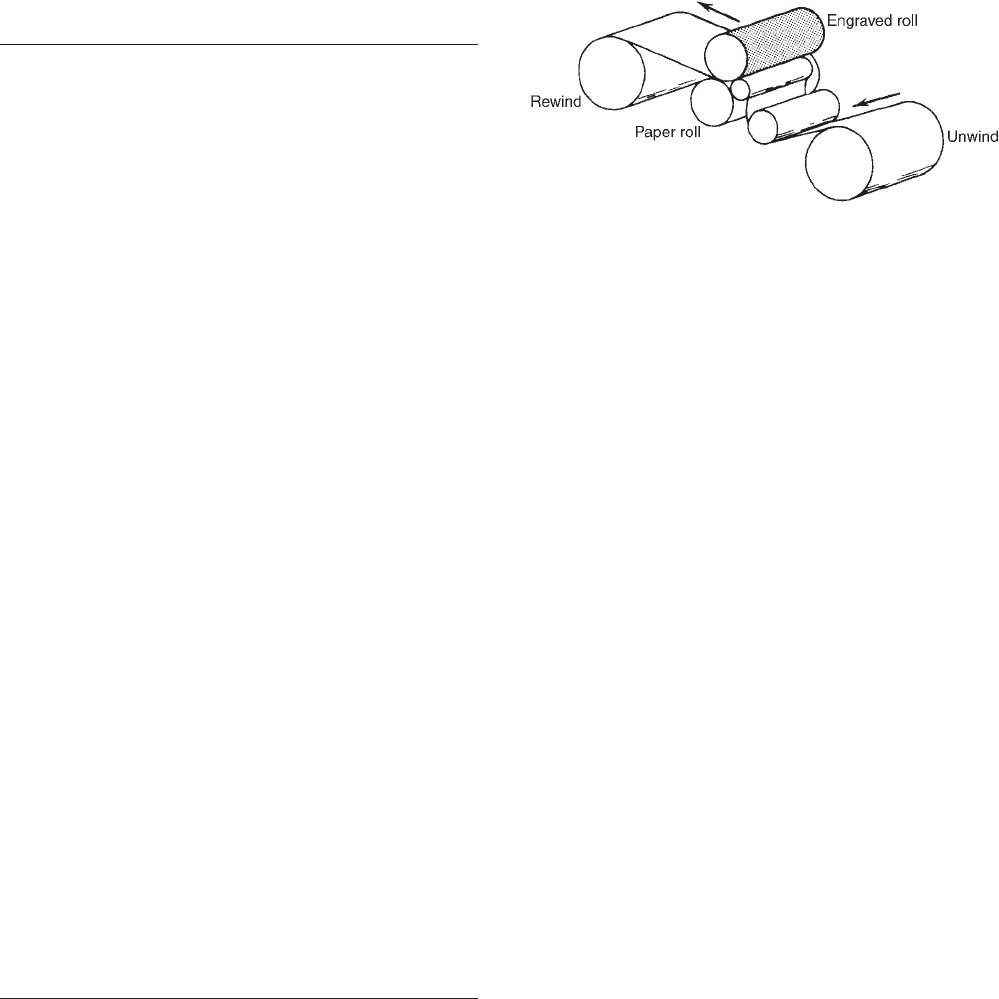
depress the negative pattern into the paper roll (see
Figure 1).
FLEXIBLE FOIL PACKAGES
Flexible foil-containing packages are extremely popular
for food packaging because they provide superior flavor
retention and longer shelf life than packages formed from
other flexible materials. Flexible foil packaging is imper-
vious to light, air, water, and most other gases and liquids.
The packages protect contents from harmful oxygen, sun-
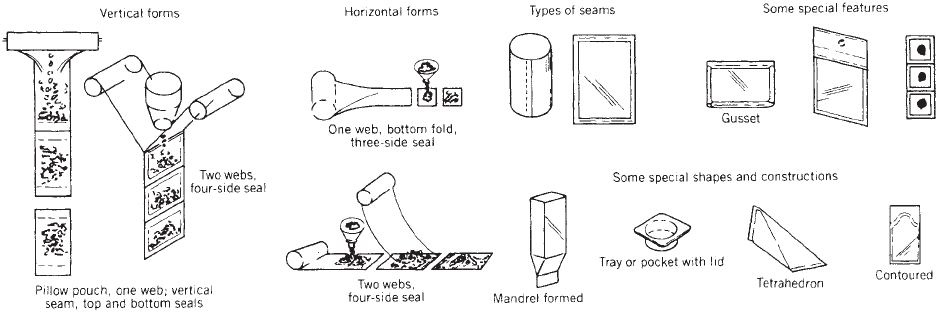
light, and bacteria (see Figure 2) (see Multilayer flexible
packaging).
One of the most important flexible-packaging applica-
tions of aluminum foil is the form/fill/seal pouch (1).
Pouches are formed continously from roll-fed laminated
material and are filled and sealed immediately as formed
(see Form/fill/seal, horizontal; Form/fill/seal, vertical;
Pouches). The pouch is one of the oldest automated-
package forms. The retort pouch, developed in the early
1950s, represented a significant advance in food packa-
ging. It is a flexible package made from a laminate of three
materials: an outer layer of polyester for strength; a
middle layer of aluminum foil as a moisture, light, and
gas barrier; and an inner layer of polypropylene as the
heat seal and food-contact material (7) (see Retortable
flexible and semirigid packages).
The Q-Pouch is a new foil-lined paperboard pouch that
can be turned into a drinking cup. A user of the package
simply rips the top edge along perforations and squeezes
the sides of the packet. Scored paperboard opens into a
hexagon-shaped cup.
Aluminum foil is also used to some extent for bag-in-
box liquid packaging (see Bag-in-box, liquid).
FOIL LIDDING
Another popular packaging application is the flexible
closure or flexible lid. The flexible closure got its start
with single-service dairy creamers, yogurt, and cheese
dips. It is also widely used in the healthcare industry,
especially in hospitals, where the trend is toward dispo-
sable packaging (see Healthcare packaging). Liquid med-
ications are also packaged in single-dosage containers,
which are convenient and provide easy evidence of tam-
pering (8) (see Pharmaceutical packaging; Tamper-evi-
dent packaging).
Flexible lids were introduced in 1966 when a U.S.
Health Service regulation required that the pouring lip
of dairy containers be covered during shipment and
storage. Besides covering the pouring lip of the container,
Table 4. Classifications for Converted and Nonconverted
Aluminum-Foil End Uses
a
Packaging End Uses
Semirigid foil containers (including formed foil lids) produced
from unlaminated metal for
Bakery goods
Frozen
Nonfrozen
Frozen foods, other than bakery
Caps, cap-liners, and packaging closures for
Beverages and milk
Foods
Composite cans and canisters (including labels and liners for
composite cans) for powdered drinks; auto supplies; food
snacks; citrus and other juices; refrigerated dough; other
refrigerated and frozen products
Flexible-packaging end uses (including labels, cartons,
overwraps, wrappers, capsules, bags, pouches, seal hoods and
overlays for semirigid foil containers)
Food products
Dairy products—cheese, butter, milk, milk powder, ice cream,
dried and dehydrated food products—fruit, vegetables, potato
products, soup mixes, yeast
Baked goods—bread, cookies, crackers
Cereals and baking mixes—cereals, rice, cake mixes, frosting
mixes, macaroni products
Powdered goods—coffee, tea, gelatins, dessert mixes, drink
powders, cocoa, dry concentrates, sugar, salt
Meat, poultry, and seafoods (fresh, frozen, irradiated, dried,
retorted)
Frozen prepared foods
Confections—candy, mints, chewing gum, chocolate bars
(converted foil only)
Dry snack foods—potato chips, popcorn, including coated popcorn
Beverages—soft drinks, beer, distilled liquors, wines
Food products, NEC
b
(including pet foods)
Nonfood products
Tobacco—cigars, cigarettes
Soaps and detergents
Photographic film and supplies
Drugs, pharmaceuticals, cosmetics, toiletries, kindred
products
Nonfood products, NEC
b
Military specification packaging
c
Selected Nonconverted Foil Products
d
Packaging end uses (unmounted, unconverted foil stock sold to
end-users for candy and gum wraps)
a
U.S. Department of Commerce.
b
Not elsewhere classified.
c
On direct government orders only.
d
Reported by foil producers (rollers) only.
Figure 1. Foil embossing unit. An engraved steel roll, usually
the top roll, carries the design, and a matching paper roll becomes
the matrix. This matrix roll is constructed of layers of paper
(wool-rag) rings compressed solidly into one continuous mass and
mounted on an appropriate core.
530 FOIL, ALUMINUM
a heat-sealed foil lid offered a more reliable seal, longer
shelf life, and greater protection than other lidding
materials.
The use of inductive heat-sealing equipment instead of
conductive heat sealing is broadening the applications for
foil lidding. Inductive sealing does not heat the lid by
direct contact. Heat is brought into the lidding stock by a
magnetic field through which the container and lid pass.
The magnetic field heats the foil in the lid, and an effective
hermetic seal forms between the lid and the container.
Flexible foil lidding can be used on glass, plastic, or
composite cans. This key development enables the alumi-
num foil industry to provide tamper-evident packaging
(see Tamper-evident packages).
REGULATED PACKAGES
Aluminum foil is an integral part of many tamper-evident
packages. Although the term came into prominence only
in the 1980s, this kind of packaging has been on the
market before then. As now defined by the Proprietary
Association, a tamper-evident package is ‘‘one which, if
breached or missing, can reasonably be expected to pro-
vide visible evidence to consumers that the package has
been tampered with or opened’’ (9).
Of 11 methods listed by the Proprietary Association
that conformed to the regulation when it was first pro-
nounced, six featured aluminum foil as part of the tamper-
evident system.
For a system to be tamper-evident, its package cannot
be removed and replaced without leaving evidence. It is
extremely difficult to mend or repair a foil-membrane seal
after it is broken or to return an aluminum rollon cap to its
original state once it has been removed.
One of the first major laws that required protective
packaging was the Poison Prevention Packaging Act of
1970, which essentially said that drugs and dangerous
substances must be packed in child-resistant packages.
This type of package includes blister packs of plastic–foil–
paper combinations; tape seals of paper or foil which
adhere to the cap or shoulder of a bottle; and pouches
that can be tighly sealed.
ASEPTIC PACKAGING
Most aseptic packages are laminations of paperboard,
plastic, and aluminum foil. In aseptic packaging, the
product is sterilized with high heat and then cooled. The
package is sterilized separately, and then the sterile
product and packaging are combined in a sterile chamber
(see Aseptic packaging).
Foil provides superior adhesion for the containers that,
in the main, hold highly acidic products. In almost all
methods of aseptic container manufacturing, aluminum
foil is used as a barrier to light and oxygen.
ALUMINUM AND MICROWAVE OVENS
In 1984, Underwriters Laboratories undertook a study on
the use of aluminum foil trays to reheat food in microwave
ovens. Using various models of microwave ovens and
standard types of aluminum trays containing frozen foods,
the study concluded that (10):
The power density of microwave radiation emissions
did not exceed maximum allowable limits.
There was no significant change in heat going into
various liquids and frozen foods in aluminum con-
tainers as compared to other containers.
The temperatures in the foods and liquids being tested
were generally comparable in the various
containers.
The foil trays containing different amounts of water
and empty trays produced no fire emissions of flam-
ing or molten metal.
The test trays used for heating frozen foods in accor-
dance with specific instructions did not increase the
risk of radiation, fire, or shock hazard.
Susceptors are a unique and successful innovation in food
packaging for microwave heating of a variety of foods such
as pizza and popcorn (11). They are microwave-absorbent
materials used in the microwave oven to generate surface
heating on the food to induce browning and crispness. A
susceptor is typically constructed of a metallized PET film
Figure 2. Features and constructions of pouches.
FOIL, ALUMINUM 531
(about 12 mm thick) laminated to a thin paperboard. The
paperboard provides dimensional stability, while the very
thin metal layer discontinuous layer of aluminum (usually
30–60 A
˚
) is responsible for generating localized resistance
heating when exposed to microwaves.
SEMIRIGID PACKAGING
Other classifications of aluminum packaging include
semirigid and rigid containers. Semirigid containers in-
clude those that are die-formed, folding cartons, and
collapsible tubes. Die-formed containers are one-way dis-
posable devices such as pie plates, loaf pans, and dinner
trays. Folding cartons come in many sizes and shapes and
hold such products as dry cereals, eggs, and milk or other
liquids (see Cartons, folding; Cartons, gable top). Collap-
sible tubes were first made of lead and used by artists
more than 100 years ago. In modern times, a proprietary
aluminum foil/film version of the collapsible tube holds
toothpaste and products of similar consistency, including
hair coloring and depilatories (1) (see Tubes, collapsible).
Aluminum foil provides the barrier to permeation of the
oils used in most products and compounds that go into the
tubes.
Aluminum tubes have the advantage of providing light
weight, high strength, flexibility, and good corrosion re-
sistance. Aluminum tubes also have low permeability and
offer quality appearance. Traditionally, aluminum collap-
sible tubes were impact-extruded, but a new process forms
the laminated rollstock into continuous tubing by use of
heat and pressure. The tubing is cut into individual
sleeves and is automatically headed by injection molding.
As opposed to flexible containers that conform to the
shape of the product, semirigid containers have a shape of
their own. They can be deformed from their original shape
either while they are emptied (as in the collapsible tooth-
paste tube), or before they are filled (as with the folding
carton).
Die-formed aluminum containers are among the most
versatile of all packages. They easily withstand all normal
extremes of handling and temperature variation. A pro-
duct in an aluminum container can be frozen, distributed,
stocked, purchased, prepared, and served without soiling
a single dish.
Bare foil is used for most formed aluminum-foil pro-
ducts, but protective coatings are used on the containers
for some foods and other products. Although the frozen-
food tray is the most common, the aluminum-formed
container is available in scores of shapes and sizes from
the half-ounce portion cup to full-size steam-table contain-
ers for institutional feeding. Closures for these containers
vary from laminated hooding to the hermetically sealed
closure according to the amount of protection needed for
the product.
Folding cartons offer protective and display character-
istics unique in packaging and have some of the advan-
tages of both the flexible and the rigid container. Before
use, when it is folded flat, the folding carton offers the
storage economy of the flexible bag. When it is filled, it
offers much of the protection of the setup box.
RIGID CONTAINERS
Composite cans and drums feature aluminum foil com-
bined with fiber. They are widely used for refrigerated
dough products, snack foods, pet foods, and powdered
drink mixes.
In some processes, a composite can is made up of
paper–polyethylene–aluminum foil–polyethylene lami-
nated stock with a foil-membrane closure. Cans are pro-
duced from preprinted gravure rolls of bottom aluminum
stock (see Cans, composite).
BIBLIOGRAPHY
Foil Division of the Aluminum Association, Inc., ‘‘Foil, Aluminum’’
in The Wiley Encyclopedia of Packaging Technology, 1st edi-
tion, John Wiley & Sons, New York, 1986, pp. 346–351; 2nd
edition, 1997, pp. 458-463.
Cited Publications
1. Aluminum Foil Manual, the Aluminum Association, Wa-
shington, DC, 2004.
2. The Story and Uses of Aluminum, the Aluminum Association,
Washington, DC, 1984.
3. G. Robertson, Food Packaging, Principles and Practise, 2nd
ed., Taylor and Francis, Boca Raton, FL, 2006.
4. Aluminum Foil Converted, U.S. Department of Commerce,
Washington, DC, 1981.
5. Aluminum Industry/Foil, the Aluminum Association, Wa-
shington, DC, www.aluminum.org., 2008.
6. M. J. Kirwan, Paper and Paperboard Packaging Technology,
Blackwell Publishers, London, 2005.
7. Food Technology, Institute of Food Technologists, June 1978.
8. Packaging Newsletter, the Aluminum Association, Fall 1983.
9. News release, the Proprietary Association, Washington, DC,
October 14, 1982.
10. Underwriters Laboratories, letter of July 23, 1984.
11. J. Osepchuk, ‘‘Microwave Technology’’ in Kirk–Othmer En-
cyclopedia of Chemical Technology, 5th edition, Vol. 16, John
Wiley & Sons, Hoboken, NJ, 2006.
FOOD PACKAGE DEVELOPMENT
KIT L. YAM
Department of Food Science,
Rutgers University,
New Brunswick, New Jersey
The food packaging development process requires many
considerations and activities. Below are some steps that
may be used as a reference to develop a food package.
Step 1: Determine Product/Package Requirements. The
first step usually involves optimizing the product formula-
tion; determining the stability of the product particularly
to light, O
2
, and H
2
O; evaluating the processing methods,
existing equipment, plant capability; working with
532 FOOD PACKAGE DEVELOPMENT
marketing to determine the desired shelf life, distribution
chain, cost constraints, launch timing, product position-
ing, package size. During this step, the marketing group
typically leads the discussion based upon consumer data,
while the technical group provides input on feasibility.
Step 2: Select Package Materials and Equipment. This
step usually involves working with suppliers of packaging
materials and machinery to identify options; determining
cost and availability; comparing stock versus custom
package; working closely with product development to
better understand ingredients and possible issues relating
to packaging; complying with regulations. Since timing is
critical to package design, it is important to identify
potential issues that may delay the timeline.
Step 3: Evaluate Prototype Packages. This step usually
involves conducting shelf-life testing to determine quality
retention at ambient and elevated temperatures, conduct-
ing distribution testing to determine robustness and
integrity of package, conducting product/package interac-
tion testing; evaluating feasibility of scale-up at final
production facility. Scale-up package at production facility
is important prior to initial run to identify potential
process issues.
Step 4: Test Packaging System in Market. This step
usually involves producing final food packages; confirming
that all major requirements are met; retrieving pack-
ages from market for evaluation and confirmation,
monitoring consumer feedback during test market or
national rollout; refining package/process design if neces-
sary. Final package is tested as part of a concept fulfill-
ment test to confirm consumer acceptance of product and
package.
FOOD PACKAGING FOR SPACE MISSIONS
M. H. PERCHONOK
Department of Food Science,
Rutgers University,
New Brunswick, New Jersey
T. OZIOMEK
Department of Food Science,
Rutgers University,
New Brunswick, New Jersey
S. J . FRENCH
Department of Food Science,
Rutgers University,
New Brunswick, New Jersey
INTRODUCTION
The approach to National Aeronautics and Space Admin-
istration (NASA) food provisioning has changed over the
last 45 years and will continue to change to accommodate
the different mission profiles and vehicle designs. The goal
of NASA’s food scientists is to provide the crew with a safe,
nutritious, and acceptable food system while efficiently
balancing appropriate vehicle resources such as mass,
volume, and crewtime. Because future NASA exploration
missions will range in duration from 2 weeks to 6 months
to an eventual 2.5-year mission to Mars, certain require-
ments for food packaging have been established. Similar
to food industry needs, the packaging materials will need
to act as a barrier that can interface with the crew/
consumer, facilitate use of existing or new processing
methods, prevent light transmission, and meet puncture
requirements. However, unique to NASA is the require-
ment not to release toxins into the closed environment of
the vehicle (off-gassing) and to insure seal strength to
withstand changes in g-forces and atmospheric pressure.
In particular, oxygen and water vapor transmission will
need to be adequately prevented to maintain sensory and
nutritional quality for the duration of the missions. These
missions can be as long as 3 years. Mission specific
proposed oxygen transmission and water vapor transmis-
sion values have been calculated using maximum allow-
able ingress or egress values for current products, various
mission lengths, and the areas of two current pouch
configurations.
This article will provide a historical and current
perspective to NASA’s packaged food system. In addition,
as NASA returns to the moon and goes on to Mars, the
food packaging requirements will change, and potential
food packaging recommended attributes are provided.
HISTORY OF PACKAGING FOR NASA FOOD SYSTEMS
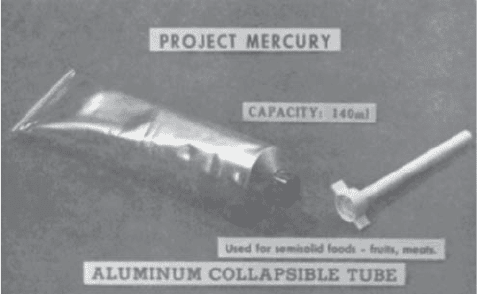
Mercury (1961–1963). Food packaging for space flight
has been in use since Mercury 6 where John Glenn
consumed 119.5 g of pureed applesauce from an aluminum
tube. Mercury flights used collapsible aluminum tubes
having Sunex 11-S lining that made use of a poly-
styrene extension tube called a ‘‘pontube’’ for consumption
(Figure 1). As flights progressed, bite-size (ready-to-eat
single serving shelf stable items) and up to four rehydra-
table foods made their way into the available menu
Figure 1. Aluminum collapsible tube with ‘‘pontube’’ used for
project Mercury.
FOOD PACKAGING FOR SPACE MISSIONS 533
selection. Plexiglass dispensers were used for some bite-
size items, whereas a three-ply laminate of clear plastic
was used for other bite-size items and rehydratables (1).
However, the progression to include more types of food
items led to packaging related issues that resulted in
decreased caloric intake. During Mercury 9, astronaut
Cooper only consumed 696 kcal of the 2369 kcal available
to him at launch because of problems with the food
container and water dispenser during flight (2).
Gemini (1965–1966). The Gemini food was packed in a
four-ply plastic laminate comprised of an inner and outer
layer of polyethylene and fluorohalocarbon with polyester
layers between. Overwrap material for these flights was a
polyolefin-aluminum foil-polyester laminate (3).
For Apollo missions, the primary packaging material
used for the rehydratable and bite-size foods was a four-
ply laminate of polyethylene-Mylar (biaxially oriented
polyethylene terephthalate) -Aclar
s
(polychlorotrifluor-
oethylene)-polyethylene. Rehydratable food packages
used a one-way spring valve at one end for water insertion
and a folded polyethylene tube for zero-g consumption at
the other end. These rehydratable packages also con-
tained a separate compartment for a germicidal tablet
(1 gram of 8-hydroxyquinoline sulfate) for stabilization of
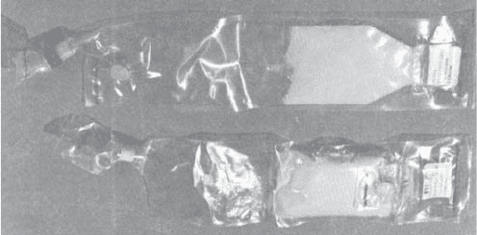
uneaten food residue. Figure 2 shows two examples of
rehydratable items used for Apollo missions.
Meal units, which were arranged by crewmember
nutrient requirements, mission timelines, and spacecraft
stowage-volume configurations, were overwrapped in a
four-ply aluminum foil/plastic laminate and evacuated to
a pressure of 29 inc. vacuum after a triple flush with
nitrogen. Overwrapped meals were labeled by mission
day, meal, crewman (by color-coded Velcro
s
patch), and
serial number. Meals were attached to each other using a
nylon lanyard to ensure ease of sequential retrieval in
flight (4).
Apollo (1968–1972). The Apollo missions increased in
duration resulting in a need to improve the food system.
During the Apollo missions, several improvements to the
food packaging were evaluated including an effort to use
nonflammable materials. Smith et al. (4) describe basic
design changes that were implemented, and results from
those changes are as follows:
. The meal overwrap material (four-ply aluminum
foil/plastic laminate) was replaced with polytrifluor-
ocloroethylene copolymer (Kel-F-82), which is a non-
flammable material. This new material was the
primary cause for an increase in food system weight
of approximately 0.25 lb/person/day or 14% of the
baseline weight. Material thickness was found to
vary from 4 to 8 mils, with corresponding variation
in flex strength. Relatively minor manipulations and
abrasion of the meal overwraps frequently resulted
in the formation of pinholes and loss of vacuum.
However, the Kel-F-82 manufacturer improved the
quality of the material through a process change
resulting in improved product strength and more
uniform thickness. The improved reliability of this
material resulted in a highly reliable food-package
material that was used with increasing frequency as
a primary food package for each succeeding Apollo
mission.
. The Bea-cloth lanyard used to attach sequential
meals was coated with Teflon
s
. Flaking of the
Teflon
s
coating presented a potential hazard of
inhalation of the resultant aerosol, even in one-g
conditions. As a result, Beta-cloth lanyards without
Teflon
s
coating were used.
During the second day of the Apollo 7 mission, the
crew reported a messy failure of a side seam of a
package of chocolate pudding (rehydratable). Ground
based operations were modified to ensure that heat
seals were at least 0.25 in. wide.
. Several water valves leaked food or water around the
outside the valve. A section of Teflon
s
shrink tubing
was used to form a leakproof friction fit of the water
valve to the package.
. For rehydratable foods, a frequent point of package
failure was caused by the attachment of a germicidal-
tablet pouch to the outside of the finished package
by a heat-seal process. The germicidal tablet was
used to prevent microbial growth and subsequent
odor development. The germicidal pouch was relo-
cated as a portion of the basic-package blank cutout.
The time and effort required for fabrication were
reduced.
. Inefficiencies were present for packaging material
usage and processing. The length of the package for
semisolid foods was reduced resulting in a weight
reduction of 2 g for each package and of approxi-
mately 1 lb for a mission set of food. This also
resulted in a reduction of exposed combustible sur-
face area by 7 in
2
. for each package and 1470 in
2
. for a
mission set of food. The length of the rehydratable-
beverage package was increased. This change en-
abled provisioning of 8-oz servings instead of 6-oz
servings increasing the amount of beverage per unit
weight and volume of packaging material. Auto-
mated package fabrication was instituted resulting
in a package production increase from approximately
12 to 100 packages per hour.
. Pressure stresses at the package shoulder when food
was squeezed from the package were higher than
Figure 2. Rehydratable items packaged in four-ply laminate for
Apollo missions.
534 FOOD PACKAGING FOR SPACE MISSIONS
necessary. The angle of the package shoulder was
lowered from 45 1 to 301.
. The texture and flavor quality of rehydratable foods
was lower as a result of the diameter of the mouth-
piece for rehydratable foods. The diameter for the
mouthpiece was increased form 0.75 in. to 1.25 in.
Skylab (1973–1974). The 1973 Skylab food system was
the most palatable and varied food system to be used in
space to date. All the planned food for the Skylab program
was launched with the first mission, making it over
2 years old when the last crew consumed it. Therefore,
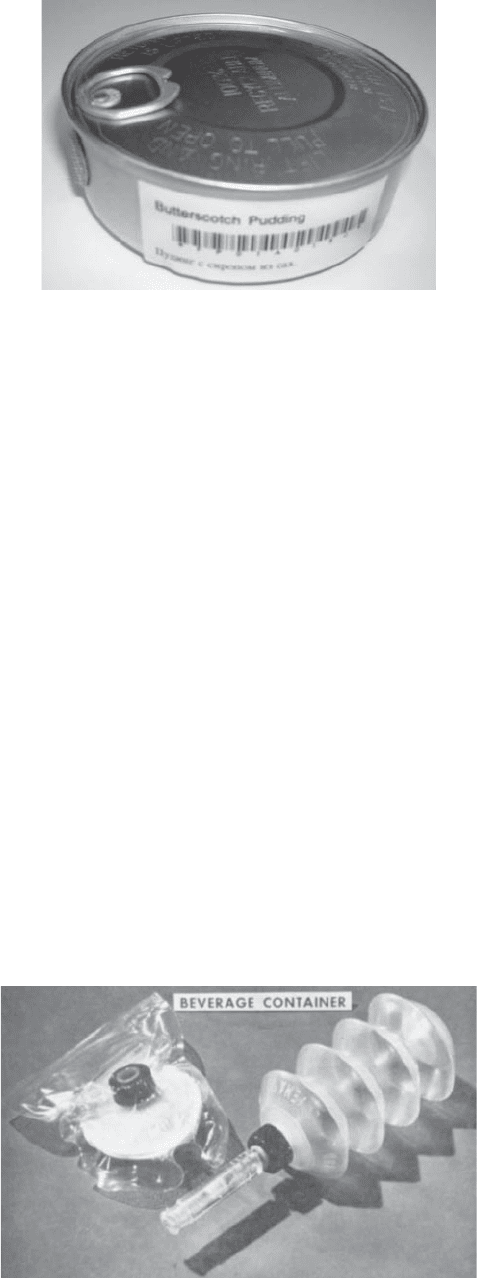
most of the food was packaged in aluminum cans to
maintain the 2-year shelf life. Frozen food, which required
heating, and some the thermostabilized items were pack-
aged in aluminum cans with a membrane under the lid to
prevent spilling while heating and to facilitate opening in
microgravity. All aluminum cans were sealed in canisters
designed to withstand the pressure changes from 14.7 to
5.0 psia between the ground and the spacecraft (Figure 3).
The primary package for beverages was a clear plastic
pouch with a reconstitution valve attached. Expandable
polymeric beverage containers were used (Figure 4).
CURRENT FOOD PACKAGING
The current state-of-the-art food packaging materials
employed for International Space Stations (ISS) (2000–
present) and Shuttle (1981–present) missions include
Smurfit Stone’s LCFLEX 70466 (LCF), Rollprint’s
RPP36-1080 (RPP), and Bayer’s Combitherm XX115
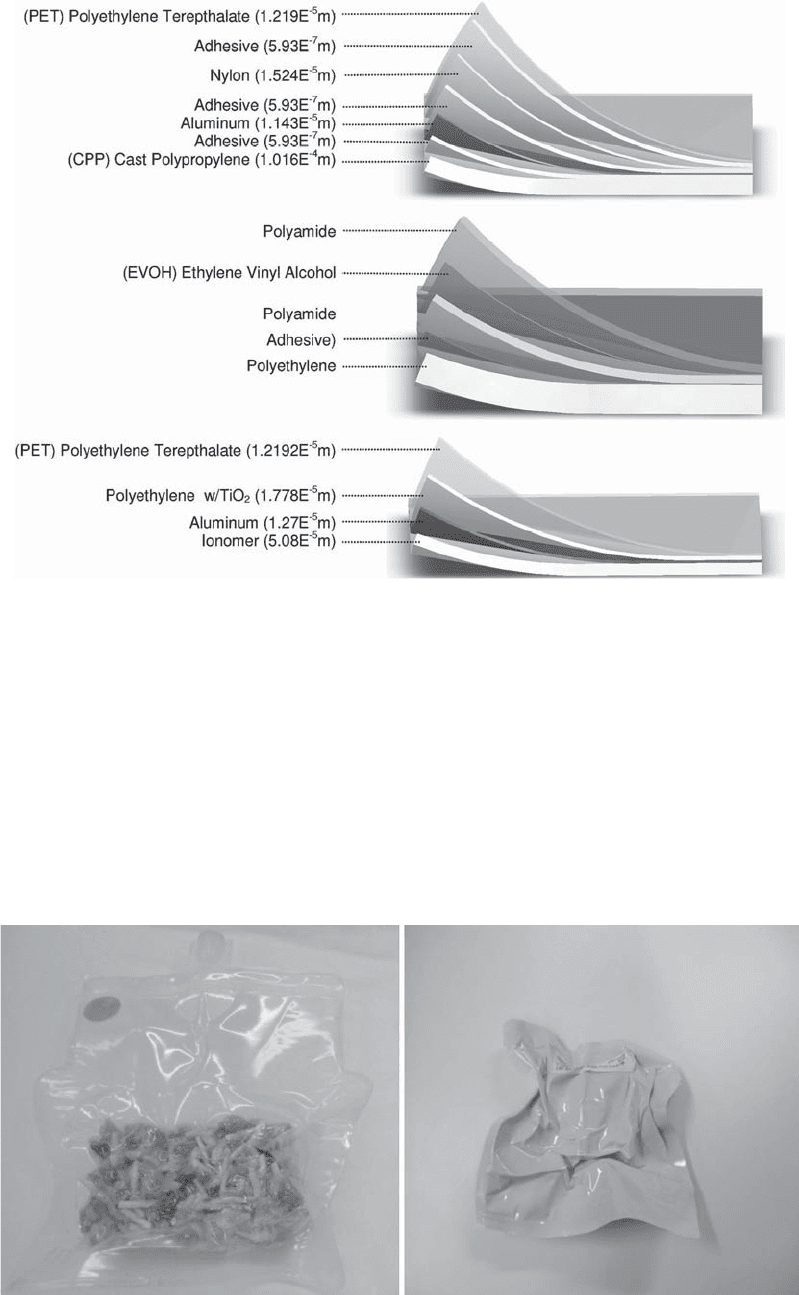
(COM115) and XX230 (COM230). Figure 5 illustrates
three of these materials.
LCF is a multilayer film that is ideal for current
missions because it is lightweight, flexible, and durable.
LCF includes an aluminum layer that allows the foods to
be processed after packaging without sacrificing its high
moisture and oxygen barrier properties. It is currently
used for packaging of thermostabilized (retorted) and
irradiated items. However, LCF cannot be thermoformed,
is opaque, and the aluminum layer presents a solid waste
issue for long duration missions.
COM115 and COM230 are clear polymers currently
used for packaging bitesize (COM115 only) and freeze-
dried items. COM230 is currently thermoformed into a
tray to hold freeze dried items, and COM115 is used as a
lid. Thermoforming COM230 results in areas with de-
creased thickness and thus reduced barrier capability.
Freeze-dried and bite-size items packaged with COM
materials are vacuum packed to 29 or 21 in. vacuum.
The COM only provides a 1-year shelf life, which is only
adequate for shuttle missions. Therefore, for ISS, menu
items packaged using COM materials are overwrapped
using RPP to provide additional barrier capability (Figure
6). Use of this additional packaging layer creates addi-
tional upmass and trash aboard the ISS, and crewmem-
bers have commented on the inconvenience of having to
open two separate packages for each food item.
NASA DESIGN REFERENCE MISSIONS (DRM)
NASA’s Exploration Systems Architecture Study (ESAS)
identified seven design reference missions (5). They in-
clude three DRMs for ISS-related missions, three for lunar
missions, and one for an 18-month surface mission to
Mars. The timelines relative to food packaging require-
ments associated with these DRMs vary from
7 days plus travel for Lunar Sortie missions, to 6 months
plus travel for ISS and Lunar Outpost missions, to
18 months plus travel for Mars Exploration missions.
These mission timelines can affect provisioning ap-
proach and influence the packaging material’s primary
requirement driver. For Mars Exploration missions, the
primary driver is shelf life longevity. For Lunar Sortie
missions, the primary driver may shift from shelf life
longevity to an ability to safely handle cabin depressur-
ization. However, for any mission, efficiency will always
play a role in material selection.
VEHICLE DESIGNS
Temperature, relative humidity, and pressure fluctuations
in the vehicle as well as exposure to radiation will
Figure 4. Expandable beverage container used for Skylab
missions.
Figure 3. Easy open can used for Skylab missions.
FOOD PACKAGING FOR SPACE MISSIONS 535
influence the effectiveness of any packaging material in
preserving food quality. A vehicle’s design can mitigate or
increase the affect of these conditions. A vehicle design can
also affect the required interface characteristics of the
package. For example, a vehicle may possess a hydration
interface, which will affect the design of packaging inter-
face (currently a septum for freeze-dried and beverage
items).
SHELF LIFE
Packaging materials are currently used to prevent ingress
and egress of mass. Of primary concern to NASA is the
ingress of oxygen and water vapor. Packaging materials
can decrease the oxygen available for chemical reactions
by slowing the transmission of oxygen to the food product.
If oxygen is not minimized, the resulting compounds from
Figure 5. Composition, order and thickness of layers within LCF (top), COM115 (Layer thicknesses are proprietary, therefore are not
provided), and RPP (bottom) packaging materials. COM230 is composed of the same materials as COM115, but the thickness of individual
layers is not relative to overall thickness.
Figure 6. Freeze-dried item in primary COM packaging (left) and with RPP overwrap (right).
536 FOOD PACKAGING FOR SPACE MISSIONS

autoxidation and lipid oxidation will impart a variety of
sensory notes that will likely be objectionable to the
consumer. This will generally result in lower acceptance
of the food product and hence influence shelf life.
To prevent unacceptable oxygen quality degradation
effects over a specified mission timeline, the required
oxygen transmission rate of a particular packaging mate-
rial must be defined. In some instances, certain assump-
tions must be made or at minimum, a range of values
should be provided. For example, the assumptions for
mission timelines may add 180 days for prepositioning of
food provisions. Or, the area of the packaging material
may change as packaging conformation changes.
Water vapor transmission through the packaging ma-
terial is also of concern to NASA as it affects the hydration
characteristics of dried food items, which can lead to
unacceptable texture characteristics. Packaging materials
can pose a safety concern if transmission rates are suffi-
ciently high enough to raise water activity (A
w
) above 0.65
(mold growth) or 0.86 (Staphylococcus aureus) (6) within
food items not undergoing a sterilization process.
NASA PACKAGING RECOMMENDED ATTRIBUTES
Several common attributes for food packaging materials
cross over between missions as well as ground-based
operations. Because water and oxygen transmission re-
commended rates are related to required shelf life of the
food, these attributes are listed under the specific missions.
Light Transmission. In many cases, the food packages
are stowed in an opaque container. Hence, light induced
reactions are minimized within the food product.
Offgas Properties. Because the vehicle is a closed en-
vironment, NASA has a unique off-gassing requirement
for all materials flown. The packaging material should not
produce volatiles that would prove harmful to crewmem-
bers. Off-gas levels for compounds will not exceed levels
set forth by the Toxicology Laboratory at NASA’s Johnson
Space Center.
Processing. No refrigerators or freezers for the food are
available onboard the NASA vehicles. Hence, the food
must be shelf stable. Packaging materials should accom-
modate the processing method used for microbial and
enzymatic stabilization. For example, a material may
need to be able to withstand the heat extremes present
in retort/thermostabilized processing without loss of in-
tegrity. Or, a material may need to allow microwaves to
pass.
Puncture Strength. Puncture strength is important for
the NASA food packaging materials. Damage to many food
packages on board the vehicle can result in a compromised
food system, which can compromise the crew health. To
measure the puncture strength of each material, a TA-
XTPlus (Texture Technologies, Scarsdale, NY) texture
analyzer is used. A TA-108 tortilla test rig is used to fix
the samples for testing. TA-52 (2-mm cylinder) and TA-55
(5-mm cylinder) probes are used to penetrate the samples.
A test speed of 2.0 mm/s is used to a distance of 25 mm.
In general, punctures from food contents can be identi-
fied during ground-based operations by loss of packaging
integrity. An in-to-out puncture strength of 2.5 kg is
required. An out-to-in puncture strength of 1.5 kg is
required.
Radiation. Packaging materials can potentially reduce
or mitigate the effects of radiation on food items. As
radiation effects on food require additional research and
the amounts and types of radiation will be mission specific
these requirements are still to be determined.
Seal Strength. Packaging materials should withstand
specified environmental and stowage conditions without
degrading or losing barrier integrity. Periods of reduced
or zero pressure will place additional strain on package
seals. Periods of increased pressure can also occur. To
withstand these conditions, a seal strength of 3 kgf/in. is
required.
To measure the tensile strength of seals a TA-XTPlus
(Texture Technologies, Scarsdale, NY) texture analyzer is
used. A TA-96 tensile test fixture is used to fix the samples
for testing. A test speed of 1.5 mm/s is used to a distance of
75 mm. Seal tensile strength is measured using a 1.25 in.
length by 1 in width attached on each side of the seal to the
clamp.
Material Transmission Rate Calculations. Current space
food products were grouped into two main categories:
freeze dried/natural form food items and thermostabilized
food items. The average mass was determined for each
category, and the worst case scenario for O
2
ingress and
H
2
O ingress/egress was used for calculating the required
material transmission rates. The transmission rates re-
quired to maintain the proper shelf life were determined
for various mission lengths.
The following formula was used to determine the
maximum allowable oxygen ingress for a specific product
using information obtained from Table 1 below.
V
O
2
¼
ProductmassðgÞMaxO
2
ðppmÞK
C
ð1Þ
K = 22 400 cc = 1 mole ideal gas at 1 atm and 201C
C = 32 g = Molar mass of O
2
Oxygen transmission rates (OTR) were calculated
using information from Table 1 and equations (1) and
(2). For example, the required oxygen transmission rate
for freeze-dried and natural form food items on lunar
sortie missions was calculated using the following infor-
mation: a VO
2
value of 0.0875 cc determined using a
maximum O
2
ingress value of 5 ppm (Table 1), a food
mass value of 25 g, which is the average mass of our
current products, a T value of 195 days, and an A of
0.0232 m
2
, which is the area of the current bite size pouch.
Values for determining rates on thermostabilized items
were modified to use a VO
2
value of 0.112 cc determined
using a maximum O
2
ingress value of 1 ppm (Table 1), a
food mass value of 160 g, which is the average mass of our
FOOD PACKAGING FOR SPACE MISSIONS 537