
Yam, Kit L. (ed.). The Wiley encyclopedia of packaging technology
Подождите немного. Документ загружается.


current products, a T value of 195 days, and an A value of
0.0387 m
2
, which is the area of the current 8-oz retort
pouch. Oxygen transmission rates for other missions were
determined using the same values above and mission
specific T values.
OTR
atm
¼
V
O
2
A T
ð2Þ
Water vapor transmission rates (WVTR) were calcu-
lated using information from Table 1 and equation (3).
Table 1 states that for freeze-dried and natural form food
items, the max allowable moisture ingress is 1% of the
product mass, which is 0.25 g for our products. For ther-
mostabilized food items, the max allowable egress is 3% of
the product mass, which is 4.8 g for our products.
WVTR
atm
¼
M
H
2
O
A T
ð3Þ
When films are converted into pouches, their transmis-
sion rates tend to increase because of abuse from processing
and other factors. Therefore, the rates in the following
sections are only a guideline and are the bare minimum
when evaluating materials. The rates were calculated using
assumptions that the atmosphere on each vehicle will be
20.9% O
2,
731F, and 50% RH (relative humidity). Also, they
are configured to be comparable with the standard testing
parameters of 100% O
2
at 731F for OTR and 100% RH at
1001F for WVTR. This was done by multiplying the re-
quired transmission rate by 100% O
2
divided by 20.9% O
2
for OTR and 100% RH divided by 50% RH for WVTR.
LUNAR SORTIE
Lunar sortie missions are nominally designed for 7 days
plus travel (8 days) plus a preflight positioning time of
180 days for food required for transit. The total mission
time then equates to 195 days, which is about 6 months.
Oxygen Transmission Rate. The oxygen transmission
rate for packaging materials used for freeze-dried and
natural form food items shall not exceed 0.0925 cc/m
2
day
or 0.0060 cc/100 in.
2
day. For thermostabilized items this
value shall not exceed 0.0710 cc/m
2
day or 0.0046 cc/
100 in.
2
day.
Water Vapor Transmission Rate. The water vapor trans-
mission rate for packaging materials used for freeze-dried
and natural form food items shall not exceed 0.1105
g/m
2
day or 0.0072 g/100 in.
2
day. For thermostabilized
items this value shall not exceed 1.2721 g/m
2
day or
0.0820 g/100 in.
2
day.
ISS AND LUNAR OUTPOST
ISS and lunar outpost missions are nominally designed for
180 days plus travel (8 days), plus a preflight positioning
time of 180 days. The total mission time then equates to
368 days, which is about 1 year.
Oxygen Transmission Rate. The oxygen transmission
rate for packaging materials used for freeze-dried and
natural form food items shall not exceed 0.0490 cc/m
2
day
or 0.0032 cc/100 in.
2
day. For thermostabilized items this
value shall not exceed 0.0376 cc/m
2
day or 0.0024 cc/
100 in.
2
day.
Water Vapor Transmission Rate. The water vapor trans-
mission rate for packaging materials used for freeze-dried
and natural form food items shall not exceed 0.0586
g/m
2
day or 0.0038 g/100 in.
2
day. For thermostabilized
items, this value shall not exceed 0.6741 g/m
2
day or
0.0434 g/100 in.
2
day.
MARS EXPLORATION
Mars exploration missions are designed nominally for
540 days plus travel (360 days), plus a preflight position-
ing time of 180 days. The total mission time then equates
to 1080 days, which is about 3 years.
Oxygen Transmission Rate. The oxygen transmission
rate for packaging materials used for freeze-dried and
natural form food items shall not exceed 0.0167 cc/m
2
day
or 0.0011 cc/100 in.
2
day. For thermostabilized items, this
value shall not exceed 0.0128 cc/m
2
day or 0.0008
cc/100 in.
2
day.
Water Vapor Transmission Rate. The water vapor trans-
mission rate for packaging materials used for freeze-dried
and natural form food items shall not exceed 0.0200
g/m
2
day or 0.0012 g/100 in.
2
day. For thermostabilized
items, this value shall not exceed 0.2297 g/m
2
day or
0.0148 g/100 in.
2
day.
Table 1. Maximum allowable ingress of O
2
loss or gain of moisture in shelf-stable products
Foods Max O
2
ingress, (ppm) Max H
2
O gain ( + ) or loss ()%
Canned milk, meats, fish, poultry, vegetables,
soups, spaghetti, catsup, sauces
1–5 3%
Canned fruit 5–15 3%
Dried foods 5–15 + 1%
Carbonated soft drinks, fruit juices 10–40 3%
Oils, shortenings, salad dressings, peanut butter 50–200 + 10%
Jams, jellies, syrups, pickles, olives, vinegar 50–200 3%
538 FOOD PACKAGING FOR SPACE MISSIONS
REFERENCES
1. E. A. Nebesky, G. L. Schulz, and F. J. Rubinate, ‘‘Packaging for
Space Flights,’’ Activities Report, 17, 32–36 (1965).
2. A. D. Catterson, E. P. McCutcheon, H. A. Minners, and R. A.
Pollard, ‘‘Aeromedical Observations, in Mercury Project Sum-
mary Including Results of the Fourth Manned Orbital Flight,’’
NASA SP-45, 315 (1963).
3. M. V. Klicka and M. C. Smith, ‘‘Food for U.S. Manned Space
Flight,’’ Technical Report NATICK/TR-82/019.
4. M. C. Smith, R. M. Rapp, C. S. Huber, P. C. Rambaut, and N. D.
Heidelbaugh, ‘‘Apollo Experience Report—Food Systems,’’
Technical Report NASA TN D-7720 (1974).
5. NASA’s Exploration Systems Architecture Study, Final
Report, 2005. NASA-TM-2005-214062. http://www.nasa.gov/
mission_pages/exploration/news/ESAS_report.html.
6. J. M. Jay, Modern Food Microbiology, 4th ed., Chapman and
Hall, New York, 1992, p. 34.
7. R. A. Armstrong, ‘‘Effects of Polymer Structure on Gas Barrier of
Ethylene Vinyl Alcohol (EVOH) and Considerations for Package
Development,’’ TAPPI 2002 PLACE Conference (2002).
FORENSIC PACKAGING
JACK L. ROSETTE
Forensic Packaging Concepts,
Inc., Del Rio, Tennessee
Forensic packaging is a legal term describing the science
of determining the cause of package function as intended.
Most people think of forensics as being associated with
criminal investigation (especially homicide), when in rea-
lity there are many areas of forensic specialization. For-
ensic medicine involves the cause of disease, forensic
pathology is related to the cause of death, forensic psy-
chiatry seeks the cause of mental disorders, forensic
engineering is used to determine the cause of accidents
such as train or automobile, forensic accounting identifies
procedures used to hide illegal accounting such as embez-
zlement, and forensics in law enforcement refers to scien-
tific physical evidence such as latent prints, ballistics,
handwriting, fiber analysis, and similar sciences.
Walter Stern, a packaging consultant in Wilmette,
Illinois, was the first person known to use the term
forensics in defining the science of determining the cause
of a package to fail to function that resulted in injury.
Forensic Packaging was recognized as a forensic science
by the American Academy of Forensic Sciences in 1997.
Determining the cause of package failure may be as
simple as discovering that liners are missing from a closure
or as complicated as duplicating actual environmental
factors such as (a) temperature and humidity present
during the time the package was in transport and storage
and (b) measuring the effect the conditions have on the
subject package. Determining the cause of package failure
may fall on the shoulders of any person involved in the sale,
manufacture, or use of the package. If the salesperson is
unable to readily identify the cause, production may be
asked to determine the cause. If production determines
that the package was produced in spec (specification), the
packaging engineer may analyze whether the spec was
sufficient to meet the objectives of the package under the
changing conditions. If the engineer is unable to determine
the cause, a specialist in forensic packaging may be needed
to identify all factors related to the package and conduct
extensive tests to determine the cause and recommend
solutions to the problem.
The concepts of forensic packaging are most useful in
identifying weaknesses in the package design, so that a
better package or component can be made and the possi-
bility of package failure can be reduced. Improvements
resulting from proper application of forensic packaging
concepts are not limited to materials or designs but may
also involve manufacturing processes.
The science of forensic packaging requires an objective
analytical process, where the results can be replicated by
others using the same procedure. Many of the procedures
used are found in ASTM 15.06, such as vibration, torque
retention, and drop tests. Others may have been developed
by various manufacturers, packaging schools, or indepen-
dent laboratories. The source of the procedure is not as
important as its relationship to the problem, reliability of
its results, and ability to be replicated by others.
Many improvements in packaging have been the result
of identifying the cause of a package failure such as new
media for corrugated cartons to increase stacking
strength, easier-to-open child-resistant closures, improved
lettering on labels, and better barrier properties in films.
Identifying and correcting any weakness in a package
before the package fails results in savings in tooling, fewer
claims of defective products, higher customer satisfaction,
and improved profits.
In today’s litigious atmosphere, forensic packaging
becomes most useful in legal actions. The science of
forensic packaging, when properly applied and explained,
can be used to objectively explain the process used in
developing a package so that it will function as intended,
that any weaknesses known would not affect package
performance, or that the cause of package failure was
not foreseeable and reasonable for the package to encoun-
ter. It is reasonable to expect that the package would
survive transport and storage in the high temperatures of
the summer, but is it reasonable to expect it to withstand
abuse by the consumer? The level of abuse the package
would withstand should be determined by testing, includ-
ing normal use and extreme abuse.
In some cases the package was designed with several
safeguards, functioned as intended, but the consumer
ignored indications of prior opening and died after consum-
ing an adulterated product that resulted in severe injury or
toxicity. Should the company have been liable for the failure
of the consumer, when the physical evidence of the package
remains indicated that it functioned properly?
A qualified forensic packaging consultant or scientist
can explain in either technical or lay terms the cause of
and solutions to any problem so that the problem can be
understood. The results of all tests performed by the
consultant or in-house scientist should be verifiable and
FORENSIC PACKAGING 539

replicable by others. While the consultant’s findings may
be based on experience, results based on objective scien-
tific reasoning may carry more weight. The consultant
should be capable of developing evidence for use in litiga-
tion and testifying in court if necessary.
In forensic engineering, it is possible to determine
whether a turn signal was on at the time of impact even
though the light is broken when examined. In forensic
packaging, similar results can be obtained by examining
the remaining components, duplicating environmental
and physical conditions, and conducting tests related to
the function of the package. Through the use of objective
test-duplicating the package components and conditions,
it is possible to determine the probability that a package
would or would not leak under similar circumstances. The
same analysis combined with variations of the package
can identify the cause of the package failure.
What is the value of forensic packaging to manage-
ment? Proper use of the principles of forensic packaging
can prevent the use of manufacture of a package that is
likely to fail to function and thereby result in injury to the
consumer. It can also ensure that the package is the most
effective for the specific application, provided that accu-
rate information on intended use and environmental
conditions are known.
BIBLIOGRAPHY
General References
Books
J. L. Rosette, Improving Tamper-Evident Packaging, Technomic
Publishing, Lancaster, PA, 1992.
J. L. Rosette, Product Tampering Detection, Forensic Packaging
Concepts, Inc., Atlanta, 1993.
W. Stern, Packaging Forensics; Package Failure in the Courts,
Lawyers & Judges Publishing Co., 2000.
Publications
American Society for Testing and Materials (ASTM) 15.06
Food & Drug Packaging, published monthly.
Articles and Technical Papers
‘‘Package Failure and the Courts,’’ W. Stern presentation to
Packaging Institute/International, Lisle, IL, September 1986.
J. Sneden, H. Lockhart, and M. Richmond, ‘‘Tamper-Resistant
Packaging,’’ Michigan State University, 1983.
FORM/FILL/SEAL, HORIZONTAL
R. F. BARDSLEY
Bard Associates
A variety of packages can be made on horizontal form/fill/
seal equipment. This article deals primarily with pouch
making, but similar concepts are applied to thermoform/
fill/seal (see the Thermoform/fill/seal article) and bag-in-
box packages (see the Bag-in-box, dry product article).
Pouch styles include the following: three-sided fin seal,
four-sided fin seal, single gusset, double gusset, pillow
pouch (lap seal/fin seal), and shaped seal. The package is
usually made from rolls of film (see the Films, plastic
article) or other ‘‘webs’’ (see the Multilayer flexible packa-
ging article). The sides are normally heat-sealed (see the
Sealing, heat article), but other methods such as ultra-
sonic, laser, or radiofrequency welding can be used to meet
specific requirements.
Filling can be done in many ways, depending on the
characteristics of the product. Fillers include liquid fillers
(see the Filling machinery, still liquid article), paste fillers,
augers, pocket fillers, vibratory, orifice-type, and gravi-
metric units (see the Filling machinery, dry product
article). Accessories can be provided with most form/fill/
seal equipment to provide registration (feed-to-the-mark
or stretch hardware); web splicing (‘‘flying splice’’ auto-
matic or manual equipment); in-line printing (see the
Printing article); coding (noncontact, hot-leaf stamping,
or printing units) (see the Code marking and imprinting
article); embossing; perforating; notching; vacuum or in-
ert-gas packaging (see the Controlled atmosphere packa-
ging article); aseptic packaging (see the Aseptic packaging
article); tear string; cartoning or bagging.
Some machines are small and relatively portable;
others are massive and fixed. Some versatile machines
can be readily changed over within limits. Other equip-
ment is dedicated to a given size, and any change requires
extensive and costly modifications. The cost of equipment
varies widely depending on the output required and the
extent of the system purchased, and on accessories speci-
fied and design requirements (e.g., sanitary criteria and
environmental considerations).
This discussion covers pouch, thermoform, and hori-
zontal bag/box machinery according to the outline shown
in Table 1. The equipment is classified by type and
functional sequence and is further subdivided by design
parameters. These are all horizontal form/fill/seal ma-
chines, even though the pouch may be horizontal or
Table 1. Horizontal Form/Fill/Seal Equipment
Pouch form/cut/fill/seal, pouch vertical
In-line equipment
Single-lane, intermittent, and continuous motion
Rotary equipment
Single-lane, intermittent motion
Pouch form/fill/seal/cut, pouch vertical
Single-lane, continuous motion
Multilane, continuous motion
Single-lane, intermittent motion
Pouch form/fill/seal/cut, pouch horizontal
Single-lane, intermittent, and continuous motion
Multilane, intermittent, and continuous motion
Thermoform/fill/seal equipment
Multilane, intermittent, and continuous motion
Horizontal form/fill/seal bag-in-box equipment
Single-lane, intermittent motion
540 FORM/FILL/SEAL, HORIZONTAL
vertical (see the Form/fill/seal, vertical article). It would be
impossible to mention all the machinery available. Repre-
sentative equipment is mentioned for clarity, not as
endorsement.
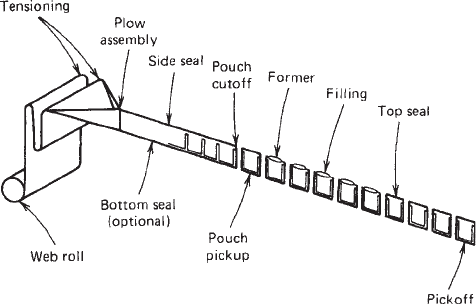
POUCH FORM/CUT/FILL/SEAL, POUCH VERTICAL
Inline, Single-Lane, Intermittent Motion. The basic
‘‘work-horse’’ of the pouch machinery group is the single-
lane, in-line vertical pouch form/cut/fill/seal intermittent
motion machine. It requires some web stiffness to transfer
from the cutoff knife to the bag clamps. Size changes,
within limits, can be accomplished by adjustments to the
machine. Its flexibility includes the ability to handle a
wide variety of pouch materials, including most self-
supported heat-sealable materials like polyesters, poly-
ethylenes, foils, cellophanes, and paper. Liquids, creams,
pastes, granular materials, pills, tablets, and small hard
goods, or a combination of these, may be packaged on this
type of equipment. Fillers include piston fillers; auger
fillers; and vibratory, volumetric, gravimetric, count, and
timed-cutoff units. A combination of fillers can be used to
permit formulation in the pouch. Gassing and sterilization
systems can be provided. The major factor in the selection
of this equipment is versatility.
Bartelt Machinery Division of Rexham builds equip-
ment of this type (see Figure 1). Pouch styles that can be
produced on this equipment are three- and four-sided fin
seal, bottom gusset pouches for greater volume, wrap-
around pouches, multiple compartment pouches, and die-
cut pouches as well as some combinations of these. Bartelt
has been a pioneer in the production of retort pouches, and
they can supply automated retort systems from rollstock
through cartoning.
Costs for equipment of this type vary widely. For
instance, N and W Packaging Systems of Kansas City,
MO makes a relatively simple unit that produces
55 packages per minute. Bartelt makes complete systems
that take packages from several machines with an
‘‘on-demand’’ feature and cartons them on high-speed
equipment.
Hassia, a division of IWK, Germany, builds a flat pouch
unit that operates at rates of up to 120 packages per
minute. Another German firm that produces inline inter-
mittent-motion pouch equipment is Hamac-Hoeller, a
division of the Bosch Packaging Group.
Inline, Single-Lane, Continuous Motion. The sequence of
form/cut/fill/seal on a continuous-motion machine entails
running a cut pouch into clips attached to a continuously
moving chain. Filling is usually accomplished by funnels
that move with the pouch to allow time for the fill cycle.
Sealing is done either with moving heat sealing bars (see
the Sealing, heat article) or band or contact heaters with
squeeze rolls at the discharge of the heater elements.
Continuous-motion equipment is more complex and ex-
pensive than intermittent-motion machines. They are
relatively fixed in the pouch size and do not provide the
flexibility of intermittent units, but they operate at sig-
nificantly higher rates.
Delamere and Williams, which is a subsidiary of Pneu-
matic Scale Corporation, builds a Packetron Pouch Maker
that will run at speeds of p500 pouches per minute. This
machine can package products like instant cocoa mix,
oatmeal, coffee, seasonings, dairy mix, powdered bev-
erages, and most free-flowing food products. Sealing
can be accomplished on three or four sides. A gusseted
bottom can be supplied to provide an increased pouch
volume.
Rotary Single-Lane, Intermittent Motion. In this design
concept, the pouch sides are sealed, then the pouch is cut
and transferred to an indexing wheel. Pouch opening,
filling, and top sealing take place at various stations
around the circumference of the indexing assembly.
Hamac-Hoeller manufactures a unit of this type called
the BMR-100. This machine can run up to 120 pouches per
minute and produce three- and four-sided fin seals, bottom
gusset, standup, and shaped seal pouches. The BMR-200
machine handles two pouches at a time. This unit has a
top rate of 200 packages per minute and makes the same
style pouches as the BMR-100 plus a twin pouch with a
central seal. These machines can be fitted with various
type fillers and auxiliaries to meet specific needs.
The Wrap-Ade Machine Company of Clifton, NJ, makes
a more economical model of a single-lane rotary pouch
machine. This unit produces pouches at a rate of 15–60
pouches per minute. It is a 12-station indexing system
with seven possible loading stations.
A somewhat related system is available from Jenco
(Germany). This machinery produces a standup bag of
relatively large volume. The system can be provided with
gas flushing, postpasteurization, or sterilization. Jenco
offers complete systems from bagmaking to cartoning.
System rates are up to 300 bags per minute.
The machines described above produce relatively small
pouches. Horizontal form/fill/seal intermittent motion
equipment to make and fill large bags is described
below.
Figure 1. Material-flow diagram of typical Bartelt intermittent
bottom horizontal form/fill/seal/machine. Filling of individual
pouches allows maximum versatility for multiple component fills
and easy pouch-size change. The machine primarily uses sup-
ported paper, foil, or laminated film structures.
FORM/FILL/SEAL, HORIZONTAL 541
POUCH FORM/FILL/SEAL/CUT, POUCH VERTICAL
This area of pouchmaking has advanced significantly. This
concept takes the web continuously from a roll, runs it
over a forming plough, makes the side seals on a rotary
drum (and bottom seal if required), then forms and fills
the pouch while it moves around a rotary filling hopper.
The top of the web is stretched, and the top seal is usually
accomplished by running the web through contact heaters
and squeeze rolls. A rotary knife is used to accomplish the
pouch cutoff. This type of machine can produce packages
at high rates, up to 1300 packages per minute on a single-
lane machine. It is an inflexible system and is normally
dedicated to one size.
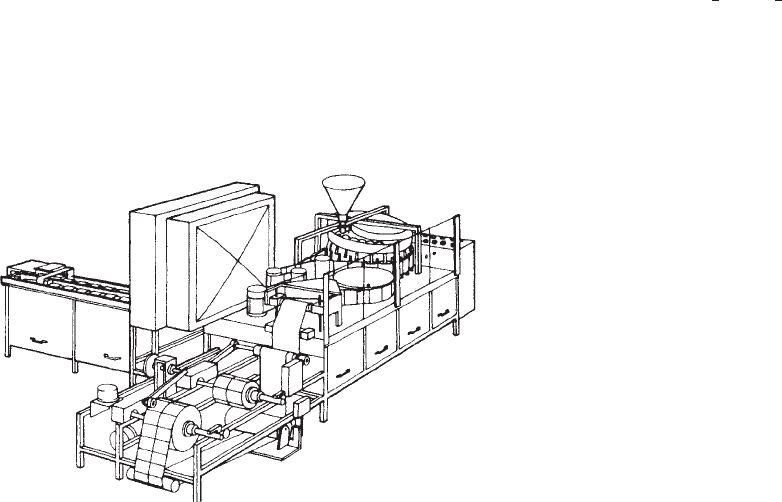
Single-Lane, Continuous Motion. R. A. Jones & Co., Inc.,
Cincinnati, OH, makes a machine of this type called a
Pouch King (see Figure 2). A Japanese firm, Showa Boeki
Company Ltd., makes a slower unit called the Toyo type
R-10.
The Jones unit was originally developed by the Cloud
Machinery Company of Chicago, IL for use on sugar
pouches with a paper–poly film (see the Multilayer flexible
packaging article). The current capability of the equip-
ment has been greatly expanded. The machine runs a
wide range of sizes and flexible heat-sealable structures.
These include glassine, cellophane, foil, polypropylene
film, and other materials with a variety of sealant
materials.
The original machine could fill only relatively small
product volumes relative to pouch size, but Jones has
developed a system called the ‘‘tucked-up-bottom’’ that
holds a significantly larger product volume.
Various types of volumetric fillers that handle free-
flowing products can be used on this equipment, including
augers, orifice metering, vibratory, and pocket fillers.
Jones now has six models that run a wide range of
products including salt, pepper, sugar, beverage mixes,
instant coffee, roasted coffee, cocoa mix, and many other
free-flowing products. The output is 750–1300 packages
per minute.
Multilane Continuous Motion. An example in this cate-
gory is the Matthews Industries (Decature, AL) ‘‘Ropak’’
machine. This equipment was also originally designed to
run sugar pouches at rates up to 2000 packages/min. This
rate is obtained by running two lanes at 1000 packages/
min per lane. Previously, the only structure run on this
unit was a paper-poly combination, but a paper—poly—
foil—poly web is now being successfully packaged. Ma-
chines are currently running sugar, pepper, and instant
coffee. Most of the product is bulk packed in drums or
cases for institutional use. The machine is equipped with a
predetermined counter-and-swing spout for bulk packing
by count.
Single-Lane, Intermittent Motion. Simplicity, economics,
versatility, and space saving were the criteria for this
approach to form/fill/seal pouches. Semirigid packaging
material is drawn from rollstock across a vertically
mounted tension control. It then passes over an adjustable
guide roller into a horizontal and flat position. At this
point, the packaging material is folded in half vertically by
passing through two round guide bars. In its horizontal
direction of travel, the package material passes the bottom
seal station (not required for a three-sided seal pouch). A
pouch-opening device separates the folded packaging ma-
terial for entry of the filling funnels before the side seals
are completed. After the product is filled, the packaging
material passes the top sealing station, followed by the
pouch-cutting device. The final station is the packaging
material transport station. The machine is adjustable to a
maximum pouch of 5
1
8
in: 5
1
8
in: (130 mm 130 mm) at
output speeds of r120 pouches/min (240 for duplex opera-
tions). The machine is manufactured by Kloeckner Wolko-
gon, a division of Otto Haensel (Germany).
POUCH FORM/FILL/SEAL/CUT, POUCH HORIZONTAL
In this wrapper-type equipment, the product is fed hor-
izontally into a web that is wrapped around it and sealed.
The product can be fed onto the moving web or the web can
be formed around the product being carried on an index-
ing conveyor. The web is longitudinally sealed to form a
tube around the product and the ends are sealed and cut
off. The machinery is normally single lane, but dual lanes
can be run on some equipment. Machines are available
that use automatic product feed, manual product feed, run
registered web, and they can be equipped for inert gas
packaging. A wide range of films and sizes can be run on
this equipment. Products such as cookies, candy bars,
cheese, and other rigid-type products can be packaged.
The pouch is basically a pillow pouch style with a lap- or
fin-longitudinal seal. Gussets can be added to handle
increased product volumes. Four-sided fin-seal packages
can also be produced on this equipment. Machinery can be
supplied that operates on either an intermittent or a
continuous basis. Speeds of p300 packages per minute
are available. The equipment is relatively flexible and
Figure 2. High-speed (700–1200 pouches per minute)—horizon-
tal/fill/seal machine is all-rotary motion to provide long filling and
sealing time. Pouches are automatically collated in the count and
pattern required. (Courtesy of R. A. Jones & Co., Inc.)
542 FORM/FILL/SEAL, HORIZONTAL
change overs are normally made by adjustments. An
interesting innovation offered by Weldotron Corporation
on its wrapper is a computer-controlled changeover sys-
tem. Simply by pressing a button, the machine will adjust
itself to any one of six preset sizes. This system was
developed by Omori Machine Co. of Tokyo and is distrib-
uted in the United States by Weldotron’s OMC Packaging
Division. Machinery of this type is supplied by Hayssen
Package Machinery, Sig, Bosch, Doboy and Oliver, to name
a few. Many of these companies specilize in wrapping a
given type of product.
Another category of horizontal form/fill/seal equipment
is the pouch strip-packaging unit. This machine is basi-
cally used to package low-profile products such as flat
candy bars, tablets, hardware, medical, and novelty items.
The machinery can run two different webs and can run
multiple rows of the same or different products.
THERMOFORM/FILL/SEAL EQUIPMENT
Thermoform equipment takes the horizontal-packaging
concept further. In this machine concept, a thermoplastic
web is heated and formed. The cavity is filled, lidded, and
cut from the web. In some machines, a pressure-forming
die can be substituted for the heat-form station to form a
soft aluminum tray (see the Thermoform/fill/seal article).
A wide variety of packages can be made on intermittent
and continuous motion machines of this type. Liquids,
solid foods, pharmaceuticals, medical devices, hardware,
and beauty aids can all be packaged on thermoform
machines. Packages can range from small blisterpacks to
deep drawn cups. The product can be gas, vacuum, or
aseptically packaged. Films are available today that pro-
vide excellent forming characteristics and barrier protec-
tion for sensitive food products.
A wide range of thermoforming machines is available.
The method of transporting the web through the machine
depends on the characteristics of the package and product
requirements. There are die machines where the film is
formed into a die and the die train moves through the
machine, supporting the web at every station. By far the
most prevalent is the dieless clip machine where the film
is carried on its sides by means of clips. Some machines do
not use clips but rely on the strength of the web to pull the
packages through the machine. The film is heated, prior to
forming, by contact or radiant heaters, then formed at the
same station or indexed to a separate forming station.
Accessories for film forming such as plug or pressure
assists can be supplied to obtain deep draws with a uni-
form wall thickness.
HORIZONTAL BAG-IN-BOX FORM/FILL/SEAL
EQUIPMENT
There are several types of equipment that produce this
type of package. One is a system that uses a rotary
indexing mandrel to form the inner and outer container.
The inner container is usually a flexible film with barrier
requirements to meet the needs of the product. The outer
packaging material is usually for package appearance or
structural requirements and can be either a printed web or
a box. Another system forms the box inline with the rest of
the system, then the inner liner is formed and inserted in
the box and the container is filled. A variation on this is
that the container is filled while the inner liner is being
inserted in the box (see the Bag-in-box, dry product article).
Some of the major manufacturers of this type of equip-
ment are Pneumatic Scale Corp., Hesser, and Sig Indus-
trial Company. Only Sig and Hesser provide a vacuum
system. They also provide a package with a valve system
that will allow a product such as coffee to outgas without
causing the package to rupture or balloon (see the Vacuum
coffee packaging article).
Hesser also makes a system that produces a container
similar to a composite can. This machine takes a laminate
from rollstock and forms a rectangular body. It then at-
taches one end, fills the container, and seals a lid to it. This
equipmenthasthecapabilitytomakeanasepticpackage.
Horizontal form/fill/seal is an extremely dynamic seg-
ment of the packaging industry; materials and equipment
are continually improving and presenting new opportu-
nities. New coextruded structures offer barrier and ma-
chining possibilities that are expanding the range of food
products that can be packaged in flexible film (see the
Coextrusions for flexible packaging article and the Coex-
trusions for semirigid packaging article). Aseptic packa-
ging is another growth area that will add new dimensions
to food packaging. In conjunction with the advance in
these technologies are equipment developments that will
provide a basis for expansion and cost reduction.
BIBLIOGRAPHY
R. F. Bardsley, ‘‘Form/Fill/Seal, Horizontal,’’ in The Wiley Ency-
clopedia of Packaging Technology, 1st ed., Bard Associates, pp.
364–367.
General References
Packaging Encyclopedia and Yearbook 1985. Cahners Publishing,
Boston, MA, 1985.
PMMI Packaging Machinery Directory, Annual, Packaging Ma-
chinery Manufacturers Institute, Washington, DC.
J. H. Briston, L. L. Katan, and G. Godwin. Plastics Films, Long-
man, New York, 1983.
F. A. Paine and H. Y. Paine, A Handbook of Food Packaging,
Blackie and Son Ltd., Glasgow, 1983.
FORM/FILL/SEAL, VERTICAL
EDWIN HO
OSI Industries, Lisle,
Illinois
The term form/fill/seal means producing a bag or pouch
from a flexible packaging material, inserting a measured
FORM/FILL/SEAL, VERTICAL 543
amount of product, and closing the bag top. Two distinct
principles are utilized for form/fill/seal packaging: hori-
zontal (HFFS) (see Form/fill/seal, horizontal) and vertical
(VFFS). Generally, the type of product dictates which
machine category applies. This article deals specifically
with VFFS equipment, which forms and fills vertically. It
is used to produce single-service pouches for condiments,
sugar, and so on, as well as bags for retail sale and
institutional use. The range of products and sizes is very
large.
PACKAGE STYLES
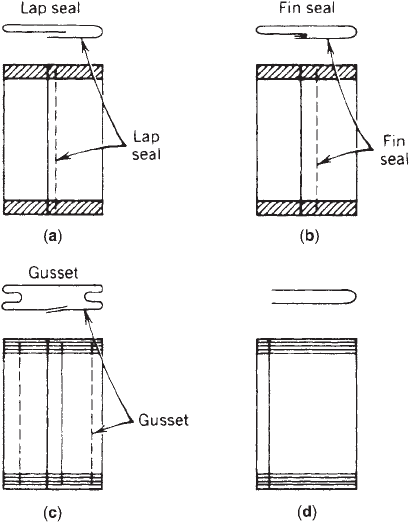
VFFS machines can make a number of different bag styles
(see Figure 1):
. A pillow-style bag with conventional seals on the top
and bottom and with a long (vertical) seal in the
center of the back panel from top to bottom. The long
seal can be a fin seal or a lap seal (see Figure 1a,b).
. A gusseted bag with tucks on both sides to make
more space for more product and maintain the gen-
erally rectangular shape of the filled bag (see Figure
1c). This style is used inside folding cartons for cereal
and other dry products (see Bag-in-box, dry product).
. A three- or four-sided seal package is similar to those
made on HFFS machinery (see Figure 1d).
. A standup bag (flat-bottom, gabletop) of the type that
used to be common for packaging coffee.
. Other special designs such as tetrahedrons, paralle-
lograms, and chubs (see Chub packaging).
A flat-bottom bag needs a relatively stiff material to
hold its desired shape, but any type of machinable mate-
rial can be used to make a pillow-style bag. Various
options are available, such as a hole punch for peg-board
display, header labels that are an extension of a standard
top of a bag, carry handles for large consumer-type
packages, and special sealing tools for hermetic seal
integrity.
MATERIALS
Two types of packaging materials are suitable for VFFS:
thermoplastic and ‘‘heat-sealable’’ materials. Polyethy-
lenes (thermoplastics) require a special bag-sealing tech-
nique. Polyethylene films must be melted under controlled
conditions until the areas to be attached to each other are
fused. The operation is analogous to welding metals. Heat
is applied to fuse the materials, and then a cooling process
allows the seal to set. The sequence for making good seals
requires careful control in order to get quality-seal integ-
rity. Impulse sealing is used to seal thermoplastics on
VFFS machines. A charge of electricity is put into a
Nichrome wire that heats to a preestablished temperature
(governed by material thickness) that will melt and fuse
the materials. Since thermoplastics become sticky when
melted, the Nichrome wire is covered by a Teflon (DuPont
Company) sheath. The principle of impulse sealing does
not require any specific tooling pressure.
Thermoplastic materials are generally used when a
high degree of product protection is not required and low
material cost is important. Polyethylene materials have
some porosity (low gas barrier such as O
2
,CO
2
) and are
not ideal for applications where hermetic seals are neces-
sary for good shelf life, product freshness, gas flushing,
and so on. They are used, for example, for frozen foods,
chemicals, confectionary items, fertilizers, and peat moss.
The class of ‘‘heat-sealable’’ materials or ‘‘resistance
seal films’’ includes paper and cellophane as well as some
coextrusions and laminations. Because these materials do
not melt at sealing temperatures, or do not melt at all,
they require a heat-seal layer that provides a seal with the
right combination of time, temperature, and pressure. The
sealant layer can be on one or two sides of the web,
depending on the desired package configuration (see
Multilayer flexible packaging).
A fin seal (see Figure 1) can be made of materials
with sealing properties on one side only, because the
‘‘heat-sealable’’ surface seals to itself. This seal is effective
for powder products that need the seal to eliminate sifting.
It is also a good seal if hermetic-seal integrity is impor-
tant, as in gas-flush packaging. A lap seal uses slightly
less material, but it requires sealing properties on both
sides because the lap is made by sealing the inner ply of
one edge to the outer ply of the other edge.
MACHINE OPERATION
A VFFS machine produces a flexible bag from flat roll-
stock. Material from a roll of a given web dimension is fed
Figure 1. Selected package styles on VFFS machinery: (a,b)
pillow style; (c) gusseted style; (d) three-sided seal.
544 FORM/FILL/SEAL, VERTICAL
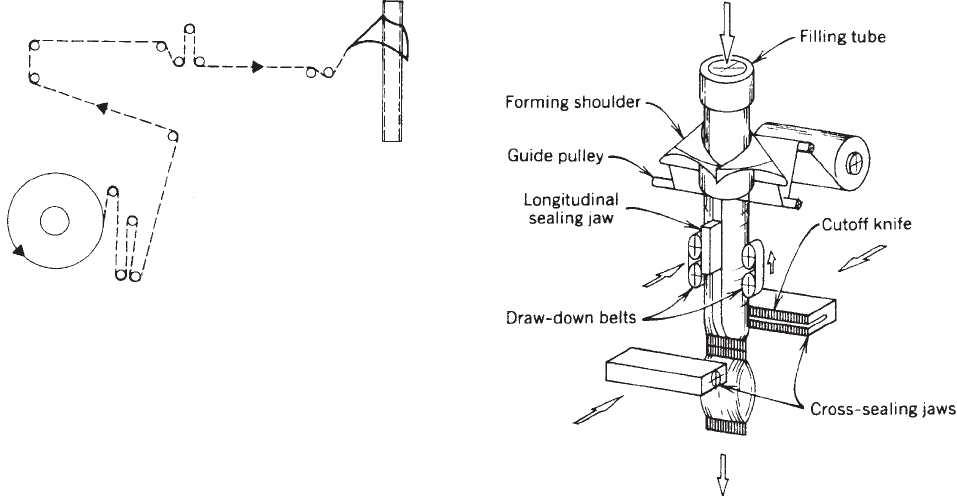
through a series of rollers to a bag-forming collar/tube,
where the finished bag is formed (see Figure 2). The roller
arrangement maintains minimum tension and controls
the material as it passes through the machine, preventing
overfeed or whipping action. The higher the linear speed
of the film, the more critical this handling capability
becomes.
The bag-forming collar is a precision-engineered com-
ponent that receives the film web from the rollers and
changes the film travel from a flat plane and shapes it
around a bag-forming tube. The design of the bag-forming
collar can be engineered to get the optimum efficiency
from metallized materials, heavy paper laminates, and
so on. As the wrapping material moves down around the
forming tube, the film is overlapped for either the fin
or lap seal. At this point, with the material wrapped
around the tube, the actual sealing functions start. The
overlapped material moving down (vertically) along
the bag-forming tube will be sealed. The packaging
material/film advances a predetermined distance that
equals the desired bag-length dimension. The bag length
is the extent of the material hanging down from the
bottom of the tube. The bag width is equal to half of the
outside circumference dimension of the tube. After the
film advance is completed, the bag-sealing and -filling
completes the remainder of one cycle (film advance/fill/
seal). There are two sets of tooling on the front of the
machine. One of the sealing tools, the vertical (long-
itudinal or back) seal bar, is mounted adjacent to the
face of the forming tube. Its function is to seal the fin- or
lap-longitudinal seal which makes the package material
into a tube.
The other set of tooling, the cross (end) seal, consists of
a front and rear cross-sealing jaw that combines top- and
bottom-sealing sections with a bag cutoff device in be-
tween. The top-sealing portion seals the bottom of an
empty bag suspended down from the tube, and the bottom
portion seals the top of a filled bag. The cutoff device,
which can be a knife or a hot wire, operates during the jaw
closing/sealing operation. This means that when the jaws
open, the filled bag is released from the machine. All
vertical bag machines utilize this principle to make a
bag (see Figure 3).
MACHINE VARIATIONS
Film Transport
Two distinct machine designs are used for transporting
the packaging material/film through the machine. The
traditional design clamps the material with the cross-seal
jaws and advances the material by moving the cross-seal
jaws down. This is called a ‘‘draw bar’’ (reciprocating up–
down cross-seal jaws). The other is a drive-belt principle
for film advance, which leaves the cross-seal bars in a fixed
horizontal position with only open–close motion. The belt-
drive film-advance principle has been shown to be the
most versatile design for high–speed packaging and sim-
plicity of operation, and a number of companies have
converted to this principle.
Power
There are several approaches to providing power for
material/film transport and the filling and sealing opera-
tions: all electromechanical; electromechanical/pneu-
matic; and electromechanical/pneumatic/vacuum.
The electromechanical vertical-bag machine incorpo-
rates a cam shaft with a series of cams to operate the
various functions. The package material/film drive motion
works off a motor/reducer/clutch/brake arrangement. The
long-seal and the cross-seal tooling are operated by cams.
This allows cycle-to-cycle repeatability of machine set-
tings. This is a very basic principle that has fixed timing
on all components and is generally accepted as a heavy-
duty, low-maintenance design.
The most common VFFS design incorporates electro-
mechanical power and pneumatics. This combination
Figure 2. Typical film feed path through a vertical form/fill/seal
machine.
Figure 3. Typical VFFS configuration.
FORM/FILL/SEAL, VERTICAL 545
offers a manufacturing cost advantage in a highly compe-
titive industry; but the tradeoff is the need to control air
supplies carefully in order to keep the performance of the
machine up to its top efficiency. The use of solenoid valves,
pneumatic valves, flow controls, and air lines increases
the maintenance requirements somewhat.
The electromechanical/pneumatic/vacuum principle is
quite unique. The design is similar to the types utilizing
air, with the addition of vacuum material/film transport
belts. This principle locks the film to perforated drive belts
by means of a vacuum pump. It works quite well, but
generally imposes limitations on speed and minimum bag-
width dimensions due to the design requirements for
utilizing vacuum draw-down belts. Also, the vacuum
pump adds another power requirement and noise factor.
BAG-FILLING FACTORS
The product being packaged is generally the limiting
factor regarding production rate capabilities on any of
the machine designs. Machine operation is affected by
product characteristics such as dust, fines, and stickiness,
as well as by piece size, piece weight, and product volume.
Some products create a piston effect when dropped down
inside a bag-forming tube, by pushing air down into the
sealed end of the packaging material. This air must escape
somewhere. There are various controls such as inner fill
tubes and snorkel tubes, to release air pressure before the
product drops down the tube. Some machine uses sponge
attached to seal jaw to push air out prior to sealing the
bag. The perforated or slitted film can be also used to
form the bag so that the release of air through the holes
helps to reduce bag puffiness prior to packing into corru-
gated case.
All of these factors affect the end result. Too often, cycle
capabilities of the bag machine and of the product mea-
suring system are calculated independently, without con-
sidering what happens when the product moves from the
measuring system down through the tube and into the
bag. Achievable production rates are based on the compat-
ibility of the three components: bag machine, filler, and
product(s). Users of VFFS machinery should supply com-
plete information concerning the products to be packaged
to the manufacturers of the equipment so that they can
factually evaluate the achievable speed, weight accuracy,
and efficiency capabilities.
PRODUCT FILLERS
There are several different choices of measuring/filling
equipment: net weigh scales, auger fillers, volumetric
fillers, counters, bucket elevators, and liquid fillers.
Net weight scales provide the most accurate means of
measuring products for packaging. The invention and
marketing of the multiple-head computer scale system in
the past few decades has literally revolutionized the
product-weighing industry. Package weight controls can
be held to 71 g regardless of the size of the piece or
particle being packaged.
Next in line for accuracy is the auger filler. This is
applicable to products that are powdery in form and can be
handled through a screw contained inside a tube. Most
chemicals, baking products, and other powdery forms
use an auger filler. The accuracy is dependent on bulk
density control of the product throughout the augering
system as well as the cycle repeatability of the chosen
auger filler.
A volumetric cup filler fills by volume and is generally
used for inexpensive products where high production
rates are desirable and product overweight giveaway is
unimportant. Counters (see Filling machinery, by count)
apply to applications such as hardware, confectionary
items, and other items that must be packaged by count.
The counter(s) can be mounted directly over the bag
machine, or they can work in conjunction with a bucket
elevator.
The bucket elevator can be an intermediate between
any of the other product fillers, but it should be utilized
only where space restraints or other impractical reasons
dictate needs. The shortest distance between two points is
the rule of thumb on VFFS systems, so mounting the filler
directly above the vertical bag machine is the best and
should be first choice where applicable.
A few major VFFS equipment suppliers to the United
States market are General Packaging Equipment Corpora-
tion Inc., Hayssen Manufacturing Company, Heat & Con-
trol Processing & Packaging Machinery Company, Ilapak
Packaging Machinery Company, Package Machinery Com-
pany, Pneumatic Scale Barry-Wehmiller Company, Ro-
vema Packaging Machines Inc., Triangle Package
Machinery Company, and The Woodman Company.
BIBLIOGRAPHY
George ‘‘Rocky’’ Moyer, ‘‘Form/Fill/Seal, Vertical’’ in A. J. Brody
and K. S. Marsh, eds., The Wiley Encyclopedia of Packagiing
Technology, 2nd edition, Wiley, New York, 1997, pp. 468–470.
General References
E. Dierking, F. Klien Schmidt, and J. Hesse, Packaging on Form,
Fill, and Seal Flexible Bag Machines, Massuers Wolff Wal-
sorde, Germany (formerly FRG), 1975; discusses the impor-
tance of the bag-forming collar with regard to package quality
as well as the relationship of material friction on machines
utilizing the belt-drive principle.
‘‘Extending the Shelf Life of Foodstuffs by Using the Aroma Perm
Protective Gas Flushing System for Flexible Bags,’’ Verpack.
Rundesch. 4, 412–414 (1979).
The PMMI Packaging Machinery Directory, The Package Machin-
ery Manufacturers Institute, Washington, DC, published
annually.
Food Master, equipment, supplies & services, Food Engineering
Network, Cahners, published annually.
546 FORM/FILL/SEAL, VERTICAL

G
GAS BARRIER PROPERTIES: EFFECTS OF SMALL
LEAKS
KIT L. YAM
Department of Food Science,
Rutgers University,
New Brunswick, New Jersey
How much do small leaks affect the barrier properties of a
package and the shelf life of the product it contains? This
question is frequently asked by companies concerned with
product quality and safety. Here are some real-life exam-
ples: A food company found significant weight gains in
their packages containing a dry food product, despite the
fact that the package was made with a high water barrier
material; another company found that the shelf life of
their food product was shortened by the onset of oxidative
rancidity, although a high-barrier metallized film pro-
tected the food product; a researcher abandoned the data
of a major experiment, because he found unexpected loss
of volatile compounds from the packaged samples used
in the experiment. In all of those cases, small leaks were
found in the packages.
Small leaks sometimes occur in packages because of the
mechanical abuses encountered during processing and
transport and the limited mechanical resistance of the
packages. The major concerns with the small leaks in
packages that contain sensitive food or pharmaceutical
products are (a) microbial penetration that can lead to
health risk; and (b) disruption of the gas barrier property
of the package, causing accelerated transfer of oxygen,
water vapor, and flavors through packages, which can
greatly shorten the shelf-life of the contained gas- or
flavor-sensitive products.
The two types of small leaks commonly found in
packages are pinholes and channel leaks (Figure 1). Pin-
holes are usually found in the package wall, and their
depths are approximately equal to the package thickness.
Pinholes may be caused by the package wall being acci-
dentally punctured by a sharp object. Channel leaks are
usually found in the seal area of the package, and their
depths are equal or slightly longer than the seal width.
Channel leaks may be caused by contaminants (such a
small food particle) or wrinkles in the seal area. It is
important to note that a channel leak typically has a
longer depth than pinhole; the longer depth poses a higher
resistance to microbial penetration and gas transport, and
thus a pinhole is usually more detrimental than a channel
leak of the same diameter. The diameters of pinholes and
channel leaks typically range from 50 to 300 mm.
GAS TRANSPORT THROUGH LEAKS VERSUS
PERMEATION
Besides going through leaks, a gas or vapor can also go
through a polymeric package wall through the mechanism
of permeation. As shown in Figure 2, gas permeation
through a polymeric package wall involves a three-step
process: adsorption of gas onto one surface of the package
wall, diffusion of gas through the package wall, and
desorption of gas from the other surface of the package
wall. In comparison, the transport of a gas through a
pinhole or channel leak (Figure 1) involves only the step of
diffusion, and the diffusion of the gas is through the air
column in the pinhole or channel leak, not through a solid
package wall as in the case of gas permeation.
PREDICTIVE EQUATION
Equation (1) has been developed to estimate the effects of
leaks on the barrier properties of packaging materials.
The equation assumes a polymeric packaging material
with a permeability P (cm
2
s
1
). A new parameter ‘‘effec-
tive permeability,’’ P
eff
(cm
2
s
1
), is introduced to include
the additional effects of leaks in the material. Hence, P
accounts for only gas permeation, whereas P
eff
accounts
for both gas permeation and gas transport through leaks.
P
eff
P
1 ¼ B
nd
2
l þk d
ð1Þ
Gas
molecules
Channel leak
Pinhole
Package wall
Seal area
Figure 1. Transport mechanism of gases or va-
pors through pinhole and channel leak in package.
547