
Yam, Kit L. (ed.). The Wiley encyclopedia of packaging technology
Подождите немного. Документ загружается.


Table 3. List of several common plastic additives
Antioxidants Octaethyl-3-(3,5-di-tert-butyl-4-hydroxyphenyl)propionate
t-Bu
t-Bu
OH
O
C
18
H
37
O
Phosphorous acid, tris(2,4-di-tert-butylphenyl)ester
t-Bu
O
t-Bu
P
3
Plasticiser Di-n-octylphthalate
O
O
O
O
C
8
C
17
C
8
C
17
UV absorbers 2-(2u-Hydroxy-5u-methylphenyl)benzotriazole
N
N
N
CH
3
HO
2-Hydroxy-4-n-octyloxybenzophenone
O
OH
O
C
8
H
17
Acidity regulator Stearoyl-2-lactylic acid, calcium salt
O
O
O
-
O
CH
3
O
CH
3
H
3
C(H
2
C)
16
O
2
Ca
2+
Lubricants/
Antistatics
Glycerol 1-monostearate
O
HO
OH
H
3
C(H
2
C)
16
O
N,N-Bis(2-hydroxyethyl)lauramide
N
H
3
C(H
2
C)
10
O
OH
OH
Behenamide
NH
2
H
3
C(H
2
C)
20
O
Antifogging agent Sorbitan, esters with acids, aliph., monocarbonic acids (more than
C5) (R)
O
HO OH
H
HO
R
Slip agent (Z)-13-Docosenamide (Erucamide)
NH
2
(CH
2
)
11
O
H
3
C(H
2
C)
7
768 MIGRATION FROM FOOD CONTACT MATERIALS
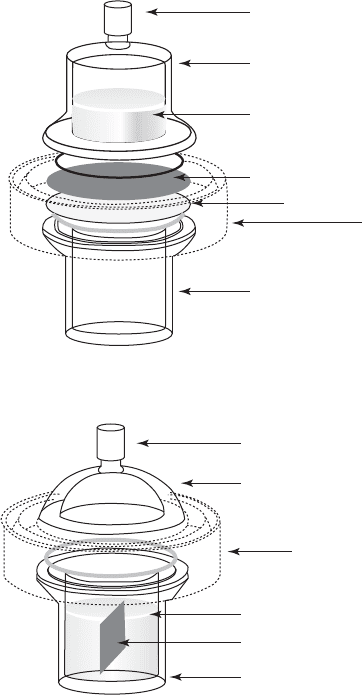
Usually the following procedures are used for detection
and quantification of migrants: Foils and boards are fixed
into a migration cell (see Figure 2(a)), covered with the
food or adequate food simulant and stored at specific time
and temperature conditions, which are laid down in
specific directives (see the section on ‘‘Regulation’’). As
food itself is too intricate to analyze, certain food simu-
lants are allowed to be used instead: simulant A (distilled
water) for aqueous foods, simulant B (acetic acid 3%) for
acidic foods (pHr4.5), simulant C (ethanol 10%) for alco-
holic foods, 50% ethanol for milky products, simulant D
(olive oil) for fatty foods, and the synthetic polymer Tenax
for dry foods. As olive oil presents analytical problems,
there are two alternative food simulants for fatty food-
stuffs, ethanol 95% and isooctane.
The migration solution is analyzed by means of gas or
liquid chromatograph coupled with certain spectrometers
and/or detectors. Another option is the complete immer-
sion of the package into the liquid (see Figure 2(b)).
Quantification is derived from using internal standards
(semiquantitative procedure) or by using calibration solu-
tions (quantitative procedure), and evaluation is done
depending on existing legislation requirements.
Sometimes it is more convenient to start not with
analytical determination of migration but with calcula-
tion. When the initial concentration of the migrant in the
polymer (c
P,0
) is known, it is common and legal practice in
verification of compliance with migration limits to assume
complete mass transfer of the migrant from the packaging
material into the food or food simulant. If the result is
below the specific migration limit, no more analytical
measurements are necessary regarding this specific
migrant.
As shown in the second section, mass transfer from
monolayer materials into food is a predictable physical
process, which can be quantified with appropriate math-
ematical algorithms. After European authorities com-
pleted the project ‘‘Evaluation of Migration Models to be
used under Directive 90/128/EEC’’ (10) in 2002, migration
modeling could now be used as an alternative method for
evaluation purposes and the use of migration modeling
was legalized in the ‘‘plastic directive’’ 2002/72/EC (Article
8, Section 4) (11). Details on which types of plastic
materials and foods are covered by this paragraph as
well as the basic mathematical algorithms that can be
used for the migration estimation are summarized in the
‘‘Practical Guide’’ and ‘‘Note for Guidance’’ (12, 13) for
‘‘Estimation of migration by generally recognized diffusion
models.’’ This document states a series of conditions that
should be considered when someone intends to use model-
ing to determine compliance of a certain packaging mate-
rial. Several software programmes have been developed
(e.g., (14) to aid in migration estimations.
It is stated above that many different types of materials
are used in multilayer packages and it is assumed that
there is no interaction between packaging and food
simulants.
However, migration processes are more complicated
and sometimes it is difficult to choose the correct simulant
that does not swell the material. For this reason, the use of
numerical models and algorithms are necessary to get
reliable migration results and/or a consistent interpreta-
tion of experimental data, and to get a deeper insight and
understanding on migration processes. Software pro-
grames like MIGRATEST
r
EXP (15–17) have been devel-
oped and adapted to deal with the increasing complexity of
multilayer food contact materials. Because of the huge
amount of different (food) contact materials and because
multilayer systems pose analytical problems, the use of
existing sophisticated migration modeling software
programs and their continued development will be
indispensable.
REGULATION IN THE EU AND USA
Conservation of the high quality of foodstuff is the most
important function of food packaging materials. As out-
lined in the previous sections, potentially harmful mi-
grants may diffuse out of the packaging into the foodstuff
and be consumed. Therefore, diffusion processes out of
packaging materials and the total amounts of migrants
in the food should be minimized and are regulated by
national and international authorities.
Food simulant
Lid
Sample
Beaker
Metal clamp
Metal plate
Screw cap
Food simulant
Sample
Metal clamp
Lid
Beaker
Screw cap
(a)
(b)
Figure 2.
MIGRATION FROM FOOD CONTACT MATERIALS 769

In the European Union, the European Food Safety
Authority (EFSA) is the keystone of EU risk assessment
regarding food and feed safety. EFSA produces scientific
opinions and advice providing basic information to the
European Commission, European Parliament, and EU
Member States as well as allowing them to make (legisla-
tive) decisions. Due to the lack of regulations in the food
packaging sector and as not all packaging materials are
yet covered by European legislation, national legislation
(and national recommendations, e.g., recommendations of
the German Bundesinstitut fu
¨
r Risikobewertung (BfR))
have to be taken into account.
In the framework regulation 1935/2004/EC of the Eur-
opean Parliament and of the council (18) on materials and
articles intended to come into contact with food, common
and superior guidelines regarding demands on food packa-
ging are laid down. Also a list of groups of materials and
articles (e.g., adhesives, ceramics, rubbers, plastics, paper
and board, inks, cellulose, etc.) is stipulated, which may be
covered by specific measures. Until now only specific
regulations exist for plastics (directive 2002/72/EC and
its five amendments) (11), ceramics (84/500/EEC and its
amendment) (19), and regenerated cellulose (2007/42/EC)
(20). Most important is the ‘‘plastic directive’’ where
several alternatives for verification of compliance of the
food packaging materials are given. Therein measuring of
the migration is possible by an adequate experimentation
(see directives 82/711/EEC, 85/572/EEC, 93/8/EEC, and
97/48/EEC) (21–24) and by application of generally recog-
nized mathematical diffusion models based on scientific
evidence. Furthermore, a positive list of authorized mono-
mers and additives with restrictions for certain sub-
stances (e.g., ‘‘specific migration limits’’ SMLs) was built
up at the community level. The SML values are generally
calculated based on ADI (acceptable daily intake) and TDI
(tolerable daily intake) values, laid down by the Scientific
Committee for Food (SCF). ADI and TDI values are
derived from toxicological studies.
Hence, for a positive evaluation of a certain packaging,
the migration results should meet the following limits:
. Global migration is less than 10-mg/dm
2
and 60-mg/
kg food, respectively.
. The amount of each detected additive (listed in the
positive list) is under its SML or the global migration
limit.
. The amount of each detected additive, which is not
listed in the positive list, is under 10 mg/kg food)
(2007/19/EC) (25) when no toxicological data exist.
In addition, the packaging shall be manufactured in
compliance with good manufacturing practice (GMP) and
the additional general requirements laid down under
article 3 of the directive 1935/2004/EC.
For evaluation and addition of a new substance to
national or European positive lists, a petition has to be
transmitted to the adequate authority, including identity
and proposed use of the new substance, migration, and
toxicological documents. As a general principle, the higher
the exposure through migration, the more toxicological
information is required (see Table 4).
Whereas EU authorities look at the identity and quan-
tity of chemical substances detected in the food or food
simulants, and list all substances, which are toxicologi-
cally evaluated and allowed to be used in all kinds of
packaging material, the U.S. Food and Drug Administra-
tion (FDA) established a food contact notification process,
whereby food additives are deemed to be safe for their
intended use. That means that in comparison with the EU,
substances evaluated by the FDA are only allowed to be
used in special applications and concentrations, which are
mentioned in their authorization processes (food contact
notification, FCN). For using these substances in other
applications, a new FCN has to be submitted to the FDA.
The law governing food packaging in the United States is
the Federal Food, Drug and Cosmetic Act of 1958 as
amended and the Fair Packaging and Labeling Act. Regu-
lated food contact substances can be found in title 21 of the
Code of Federal Regulations (CFR) (26). This title is
subdivided into parts covering specific regulatory areas
(e.g., indirect food additives: polymers; indirect food ad-
ditives: adjuvants, production aids and sanitizers, etc.).
Sometimes there are substances ‘‘generally recognized as
safe’’ (GRAS; e.g., ascorbic acid). Such substances are
allowed to be used in packaging materials, if a consensus
is reached by scientists that the substance is GRAS, and if
Table 4. Required toxicological information for evaluation by EFSA
Migration of substance Tests
o0.05 mg/kg food 3 mutagenicity tests . induction of gene mutations in bacteria
. induction of gene mutation in mammalian cells
in vitro
. induction of chromosomal aberrations in
mammalian cells in vitro
0.05–5 mg/kg food . 3 mutagenicity tests
. 90-day oral toxicity study
. data to demonstrate the absence of potential for
accumulation in human being
W5 mg/kg food . above mentioned tests
. further studies (e.g. on reproduction,
absorption, distribution)
770 MIGRATION FROM FOOD CONTACT MATERIALS
there are experimental data and published studies that
support this opinion.
In addition, if the estimated daily intake (EDI) from the
proposed use of the substance is less than or equal to
0.5 mg per kg food and 1.5 mg per person and day, respec-
tively (‘‘threshold of regulation’’ TOR), and if the sub-
stance has not been shown to be a carcinogen in humans
or animals and presents no other health or safety con-
cerns, an exemption from the notification process can be
granted by the FDA. If not, the petitioner has to send
roughly the same toxicological and migration data to the
FDA as to the EFSA. Whereas the European SMLs are
calculated from toxicological values that are compared
with migration data, the FDA calculates from migration
data the EDI, which is compared with the corresponding
ADI and TDI values. The EDI is calculated as the product
of the migrant concentration o M W in the total daily diet,
based on consumption factors (CF) and food type distribu-
tion factors (f
T
), and the factor 3, assuming that one
person consumes 3 kg of food (liquid and solid) per day:
EDI ¼ 3 kg food=person=day M
hi
CF ð8Þ
M
hi
¼ f
aqueous and acidic
ðM
10% Ethanol
Þþf
alcohol
ðM
50% Ethanol
Þ
þ f
fatty
ðM
fatty
Þ
CF describes the fraction of the daily diet expected to
contact specific packaging materials. It represents the
ratio of the weight of all food contacting a specific packa-
ging material to the weight of all food packed. These
values were derived using information on the types of
food consumed or the types of food contacting each packa-
ging surface. The factor f
T
considers the nature of food that
will likely contact the food contact material containing the
migrant. Both factors, CF and f
T
, are published in certain
guidances (e.g., (27)).
FUTURE TRENDS IN PACKAGING AND EVALUATION
The majority of the just off-the-shelf produced materials
and articles intended to come into contact with foodstuff
are passive materials mainly made out of plastics, (re-
cycled) paper, and metal. In the future there will be a shift
to the development and increased usage of active and
intelligent packaging materials. These active and intelli-
gent materials can, for example, indicate the edibility of
the food and prolong the freshness and the shelf life of
food. Also nanotechnology will be used in the food packa-
ging sector to increase the functionality of materials (e.g.,
protection and indication of freshness). The development
of more sustainable and environmentally friendly packa-
ging is an ongoing trend, and new sustainable and biode-
gradable packaging materials will be developed and used.
However, legislative authorities will still have to eval-
uate the impact of food safety of these new materials on
the health of the consumer. Authorities also still have to
evaluate the safety of ‘‘nonplastic’’-layers (e.g., coatings,
adhesives, etc.) in multilayer materials that have not been
taken into account yet.
As mentioned, the experimental measurement of mi-
gration is closely linked to certain directives, e.g., 85/572/
EEC (22). But some problems arose in this system as
implemented with the use of food simulants and not food-
stuffs to measure migration in a simple and reproducible
way. Therefore, the European Union and (industry) part-
ners have launched the project ‘‘Food Migrosure’’ to over-
come these weaknesses. The EU foresees that in order to
show compliance, the migration into foodstuffs and not
into food simulants is crucial and the exposure evaluation
has to be based on migration values in food. Migration
values are obtained by experiments and by modeling. In
addition, other (proposed) projects like FACET (‘‘flavours,
additives and food contact material exposure task’’) are
aimed at collecting deeper knowledge about both consumer
exposure by packaging components and the physical
properties of each layer of the multilayer packaging
materials.
BIBLIOGRAPHY
1. H. C. Langowski, ‘‘Permeation of Gases and Condensable
Substances Through Monolayer and Mulilayer Structures’’
in A. Baner, O. Piringer, eds., Plastic Packaging – Interactions
with Food and Pharmaceuticals, Wiley-VCH Verlag, Wein-
heim, 2008, pp. 297–348.
2. J. Brandrup, E. H. Immergut, and E. A. Grulke, eds., Polymer
Handbook, Wiley Interscience, New York, 1999.
3. H. S. Carslaw and J. C. Jaeger, Conduction of Heat in Solids,
Oxford University Press, Oxford, UK, 1959.
4. J. Crank, Mathematics of Diffusion, Oxford University Press,
Oxford, UK, 1975.
5. A. L. Baner and O.-G. Piringer, Plastic Packaging Materials
for Food, Wiley-VCH Verlag, Weinheim, 2000.
6. O. Piringer, Evaluation of Plastics for Food Packaging, Food
Add. Contam. 11, 221–230 (1994).
7. J. Brandsch, P. Mercea, and O. Piringer, ‘‘Modeling of Additive
Diffusion Coefficients in Polyolefines,’’ in S. J. Risch, ed., Food
Packaging—Test Methods and Applications, ACS Symposiun
Series 753, American Society, Washington, DC, 2000, pp. 27–
36.
8. W. Limm and H. C. Hollifield, Modeling of Additive Diffusion
in Polyolefines, Food Add. Contam. 13(8), 949–967 (1996).
9. A. Baner and O. Piringer, ‘‘Partition Coefficients’’ in A. Baner
and O. Piringer, eds., Plastic Packaging – Interactions with
Food and Pharmaceuticals, Wiley-VCH Verlag, Weinheim,
2008, pp. 89–121.
10. T. Begley, L. Castle, A. Feigenbaum, R. Franz, K. Hinrichs, T.
Lickly, P. Mercea, M. Milana, A. O’Brien, S. Rebre, R. Rijk,
and O. Piringer, Evaluation of Migration Models that Might
Be Used in Support of Regulations for Food-Contact Plastics,
Food Add. Contam. 22(1), 73–90 (2005).
11. Commission Directive 2002/72/EC relating to plastic materi-
als and articles intended to come into contact with foodstuffs
(6 August 2002).
12. European Commission, Practical Guide–A Practical Guide for
Users of European Directives, (updated on 15 April 2003).
13. European Food Safety Authority, Note for Guidance for Peti-
tioners Presenting an Application for the Assessment of a
Substance to be used in Food Contact Materials prior to its
Authorisation, (updated on June 2006).
MIGRATION FROM FOOD CONTACT MATERIALS 771
14. MIGRATEST Lite 2004, A software to estimate the migration
from polymeric packaging into foodstuffs and food simulants,
FABES Forschungs-GmbH, Schragenhofstrasse 35, D-80992
Munich, Germany.
15. SMEWISE, MULTITEMP, MULTIWISE, INRA-CPCB,
Moulinde de la Housse, B.P. 1039, F-51687 Reims Cedex 2,
France.
16. Prediction of Specific Migration from Packaging Material into
Food, Swiss Federal Office of Public Health, Division of Food
Science, Bern, Switzerland.
17. MIGRATEST
r
EXP 2008, FABES Forschungs-GmbH, Mu-
nich, Germany.
18. Regulation (EC) No 1935/2004 of the European Parliament
and of the Council on materials and articles intended to come
into contact with food and repealing Directives 80/590/EEC
and 89/109/EEC (27 October 2004).
19. Council Directive 84/500/EEC on the approximation of the
laws of the Member States relating to ceramic articles
intended to come into contact with foodstuffs (15 October
1984).
20. Commission Directive 2007/42/EC relating to materials and
articles made of regenerated cellulose film intended to come
into contact with foodstuffs (29 June 2007).
21. Council Directive 82/711/EEC laying down the basic rules
necessary for testing migration of the constituents of plastic
materials and articles intended to come into contact with
foodstuffs (18 October 1982).
22. Council Directive 85/572/EEC laying down the list of simu-
lants to be used for testing migration of constituents of plastic
materials and articles intended to come into contact with
foodstuffs (19 December 1985).
23. Commission Directive 93/8/EEC (15 March 1993).
24. Commission Directive 97/48/EEC amending for the second
time Council Directive 82/711/EEC laying down the basic
rules necessary for testing migration of the constituents of
plastic materials and articles intended to come into contact
with foodstuffs (29 July 1997).
25. Commission Directive 2007/19/EC amending Directive
2002/72/EC relating to plastic materials and articles intended
to come into contact with food and Council Directive 85/572/
EEC laying down the list of simulants to be used for test-
ing migration of constituents of plastic materials and
articles intended to come into contact with foodstuffs (2 April
2007).
26. Office of the Federal Register, National Archives and Records
Administration, Code of Federal Regulation: Foods and
Drugs, U.S. Government Printing Office, Washington, DC,
2008.
27. U.S. Food and Drug Administration – Center for Food Safety
& Applied Nutrition, Guidance for Industry, Preparation
of Food Contact Notification and Food Additive Petitions
for Food Contact Substances: Chemistry Recommendation,
2002.
General References
G. L. Robertson, Food Packaging – Principles and Practice, CRC
Press, Boca Raton, FL, 2006.
O. G. Piringer and A. L. Baner, eds., Plastic Packaging – Interac-
tions with Food and Pharmaceuticals, Wiley-VCH Verlag,
Weinheim, 2008.
K. A. Barnes, C. R. Sinclair, and D. H. Watson, eds., Chemical
Migration and Food Contact Materials, Woodhead Publishing
Limited and CRC Press LLC, Cambridge, UK, and Boca
Raton, FL, 2007.
H. Zweifel, ed., Plastics Additives Handbook, Carl Hanser Verlag,
Kempten, 2001.
EFSA, available at http://www.efsa.europa.eu/EFSA/efsa_locale-
1178620753812_home.htm.
BfR, available at http://www.bfr.bund.de/.
FDA, available at http://www.fda.gov/.
MILITARY FOOD PACKAGING
RAUNO LAMPI
Consultant,
Food Science, Engineering,
Food Service Systems,
Westborough,
Massachusetts
INTRODUCTION
The packaging requirements for military food service
range from: prevailing commercial practice for food pre-
pared and consumed on permanent state-wide stations,
stabilized foreign theater sites, and shipboard; to highly
durable concepts for mobile combat troop usage for both
groups and individuals. This review will emphasize those
packaging practices required for the initiation and con-
duct of a significant combat campaign. For the United
States, historically and currently, these have been over-
seas and have represented a wide range of package
challenging environments and food usage conditions.
Since hostilities may occur anywhere in the world and
it is impractical to design specific packaging for large
volume use for any defined geographic and/or climatic
region and it is propitious to pre-position selected rations
around the world for immediate local availability, military
food packaging must be basically selected and designed for
any and all climates or geographic regions. The packaging
must also provide long-term protection to make pre-
positioned war reserves feasible. Further general require-
ments include compatibility with the mode of use: feeding
in groups, singly, or during patrols. Specialized packets or
supplements are needed for emergency use or unusually
extreme climates. Organoleptic acceptability is essential,
and packaging plays the key role in assuring that this
desirable characteristic exists at time of food consumption.
Doctrinally, the practice is to use combat rations (as
individually packaged meals or packets) for an initial
period, say three weeks, followed by the introduction of
bulk shelf-stable foods (currently termed B rations) to be
prepared in company-sized mobile or temporary field
kitchens. As utilities become available and as operations
in the theater become stabilized, the master menu for
group feeding will include perishables—vegetables, frozen
meats, eggs, and so on (the A-ration). Of course, this
means that climate controlled storage and freezer storage
772 MILITARY FOOD PACKAGING
have become available. The type of packaging is parti-
ally changed to be less protective. For example, solid
fiberboard becomes replaced with weather-resistant
corrugated fiberboard and, for some items, standard com-
mercial packing. The rigors of transportation and hand-
ling have, accordingly, become less strenuous. Combat
rations for patrols and similar combat excursions and for
remote outposts remain an essential part of the subsis-
tence mix.
In actuality, based on informal yet direct feedback,
the doctrine is rarely followed. Combat rations are used
beyond the Surgeon General’s recommended time limit.
Standard mobile kitchens are underutilized. Much recent
operational theater food service has been contracted to
civilian concerns. So the packaging level, that is, the level
of protection prevalent, with the exception of combat
rations, varies.
THE REVOLUTIONARY WAR TO WORLD WAR II
Koehler (1) and Conference and Notes on Rations, QMS,
January 1949 (2) have presented comprehensive reviews
of military rations from the Revolutionary War era (1776)
to the World War II era (1945). Moody (3), also starting
with the Revolutionary War, has extended the review,
excellently, to status and development effort to the year
2000. Military packaging, up to 1936, was primarily
limited to common practices that defined commercial
quantities and some protection from weather elements
and dirt. Food preservation, with the exception of some
canned items, was the result of curing, salting, and/or
dehydration. There was minimal reliance on packaging to
preserve edibility. The military diet was supplemented by
live animal slaughter and foraging where possible.
In the early 1800s, Nicholas Appert established that
heating food in a hermetic container preserved the con-
tainer’s contents, an initial event where the package was
vital for high moisture food’s safe storage and retained
edibility. Canning was born; however, it was not evident in
military rations until the Civil War era (1860s on) when
some canned items were introduced, but with many
defects and complaints. The high level of spoilage of both
fresh and canned foods continued into the 1890s, accord-
ing to reports from the Spanish-American War.
Again following Koehler’s treatise, canned items finally
became standard ration components in World War I. At
this time, it was also recognized that rations needed to be
categorized according to their intended field usage. This
resulted in design of a menu for group feeding and an
organization of components for individual’s to carry and
consume in the field. These were (1):
1. Reserve ration: food allowance for one man for one
day consisting of
a. One 1-lb (usually cylindrical) can of meat
b. Two 8-oz cans of hard bread
c. 2.4 oz of sugar
d. 1.12 oz of ground coffee
e. 0.16 oz of salt
2. Trench ration: food for 25 men in the field for one
day consisting of
a. Sufficient canned meats (roast beef, corned beef,
salmon, and sardines) to feed, heated or cold, 25
men
b. Supplemental items that included salt, sugar,
soluble coffee, solidified alcohol, and cigarettes
All components were packed in large galvanized con-
tainers that protected the contents from poison gas.
3. Emergency ration: food to sustain a soldier when no
other sustenance was available consisting of
a. Three 3-oz cakes of a mixture of beef powder and
cooked wheat
b. Three 1-oz chocolate bars
4. Packaging consisted of an oval lacquered can to fit
into a soldier’s pocket. Ration categorization evolved
so that in the late 1920s, the American Army listed
four types of rations:
a. Garrison
b. Travel
c. Reserve (replacing the emergency ration)
d. Field (in essence, the first true emergency ration)
This categorization exercise surfaced the need and efficacy
of designing rations to fit the major modes of theater
of operations activities—personnel on attack, in garrison,
on patrols, and in unanticipated situations. These basic
definitions were the foundation of military food service
until the current categories of A, B, and combat rations
came into official use. Ensuing developments within
the categorization have been impacted by packaging
improvements integrated with innovative processes, reli-
able refrigeration, freeze-drying, irradiation, high-barrier
packaging materials, container ship and aircraft delivery,
an acceptance of flexible packaging in lieu of rigid cans for
shelf stable foods.
WORLD WAR II AND KOREAN CONFLICT
Although the need for organized ration development,
including significant packaging, packing, and unitization
improvements, was surfaced in World War I, no mean-
ingful action was taken until the advent of World War II
became obvious in the late 1930s. This peacetime lack of
urgency and support for military readiness is typical and
recurring. At this time, among the first steps forward were
the establishment of the Quartermaster Subsistence Re-
search and Development Laboratory and, later, to facil-
itate technical assistance from the commercial food sector
(then centered in the mid-west) and to accommodate the
needs of all service elements, the establishment of the
Food and Container Institute for the Armed Forces on
Pershing Avenue in Chicago, IL. Moody (3) covers the
evolution of the integration of commercially available
technology and food industry support as mutual benefits
surfaced. Frequently the military’s research and develop-
ment efforts provided industry with commercially viable
products.
MILITARY FOOD PACKAGING 773
As subsistence research and development intensified,
the Research and Development Associates (a technical
organization of industry and government technologists)
and various Technical Committees of the National Re-
search Council were used to recommend, to contribute,
and to analyze the military’s needs and technical perfor-
mance. Packaging and Packing interests were active
participants and contributors.
An initial output from this concerted ration develop-
ment was the D ration: three 4-ounce bars of chocolate,
sugar, dry milk, cacao fat, oat flour, and flavoring meant to
support a person for one day. Packaging, since there is no
specific discussion, was probably aluminum foil for indi-
vidual bars packed in Kraft board cartons for shipment
and handling. The D ration was convenient and termed
tenuously the first modern emergency ration.
The D ration had a short yet voluminous procurement
span, 600,000 rations in 1941 and 170 million through its
final procurement in 1944. Misuse as a combat food and its
non-provision of three full, familiar nutritionally balanced
meals per day found it being relegated to being a supple-
ment and an emergency ration.
The experience with the D ration, reinforced by the
evolving recognition of adequate nutrition and menu
variety in assuring ration acceptance and combatant
performance, resulted in the development and fielding,
predominantly for World War II, of the K and C rations.
Both were used throughout World War II.
There is some disparity as to when the C ration
assumed an identity. Basically, the components of the C
ration, in 12-oz, three-piece heavily tinned metal cans,
evolved from World War I individual items. In 1939, the
Adjutant General of the Army announced adoption of field
ration C to consist of three cans containing meat and
vegetable components and three cans, termed B units,
containing crackers, sugar, and soluble coffee. In early
1944, separate component specifications were consoli-
dated into a single document, ‘‘Ration, Type C, Assembly,
Packaging, and Packing’’ where three canned meat en-
trees and three B unit cans were supplemented with a
flexibly packaged accessory packet of sundries that
included a small folding can opener, essential to open
the durable, thick-tinned, three-piece double-seamed
cans. Ration components were packed in Kraft board
cartons, which in turn were packed six to a solid fiber-
board shipping case.
The C ration easily met the shelf-life requirement of
three years at 801F, as evidenced by reports of rations
issued far beyond their procurement dates. Organoleptic
acceptability and variety were lacking.
The K ration was developed to provide an individual,
easy-to-carry ration, initially requested by the U.S. Air
Force, and as its acceptance grew, it was, in 1942, adopted
for all service use, termed Field Ration, Type K. Per
Moody (3) it became the ration of choice in World War II
and for a while was quite popular. However, as noted by
Koehler (1), an improved C ration diminished the K’s
usefulness and popularity; it was declared obsolete in
1948.
The K ration went through seven revisions/improve-
ments, including packaging, before the final specifications
were published. Menus were divided into breakfast,
dinner, and supper units. Aside from minor variations,
each meal menu consisted of a can of meat or cheese,
two biscuits, and what would best be called an accessory
bag (fruit or chocolate bar, beverage powder, confections,
chewing gum, spoon, and key can opener). For each
meal assembly, cans were held in a chipboard sleeve-
type box; the remaining cans were held in a laminated
cellophane bag. These two units were assembled and
sealed in a waxed carton that was, in turn, enclosed in a
non-waxed outer carton suitably labeled with the K-ration
design and color. Twelve complete rations were packed
in a fiberboard box that was overpacked in a nailed wood
box (1).
DEVELOPMENTS LEADING TO CURRENT RATIONS
Because of (a) both actual and perceived deficiencies with
the C ration and its clone-like successor, the Meal, Com-
bat, Individual (weight, variable acceptability), (b) issue of
many of these rations to troops after the ration’s intended
shelf life had expired, (c) need to explore the applicability
of newer technologies in both food processing and in
packaging materials and designs, and (d) accommodation
to the military’s highly mobile combat tactics, in the late
1950s the Army issued a request (Qualitative Materiel
Development Objective) to improve combat rations. The
Army’s needs were supported by the U.S. Marine Corps
and acceded to by all DOD elements under the jurisdiction
of the Joint Formulation Board of the DOD Food Research,
Development, and Engineering Program.
The significance of a DOD-level program and funding
bears mention. It provides greater assurance that funding
support will not be siphoned off prior to its reaching the
working level and acknowledgment that all service per-
sonnel basically eat the same food. The implementation of
the program was assigned to the then-titled U.S. Army
Natick Research, Development, and Engineering Center,
Natick, Massachusetts (commonly referred to as Nlabs).
This progressive doctrinal and regulatory support was
steady and consistent as needed for aggressive, thorough,
and inevitably long-term (10–15 years) developments and
their implementation.
Among the desired improvements for combat rations
established
under the aegis
of the DOD Food Program and
further detailed in an Army Combat Development Objec-
tive Guide (CDOG) in 1956 were lighter weight, ease of
use and carrying by the individual, long shelf life, uni-
versal organoleptic acceptability, durability during trans-
port and use in any geographic area or climatic condition,
and adequate survivability on free-fall air drop.
During this time frame, mid-1950s to the late 1960s,
three food technological areas were identified that could
possibly be responsive to the military’s combat ration
needs. These were: freeze-dehydration, irradiation sterili-
zation, and substitution of flexible packaging for rigid
containers for both the preceding preservation techniques
and its application to thermoprocessed foods. All three
areas were amenable to the consideration of flexible
packaging in lieu of traditional rigid metal cans.
774 MILITARY FOOD PACKAGING
FREEZE-DRIED RATIONS
For the military, freeze-dried (lyophilized) foods had
obvious advantages: extremely light weight, excellent
retention of organoleptic characteristics, long shelf life
(if properly packaged to exclude oxygen), rapid rehydra-
tion, and suitability for flexible packaging in configura-
tions that could be carried in the combatant’s gear or
clothing.
During the Vietnam conflict (1960s and early 1970s), a
Packet, Long-Range Patrol (aka LRP) was fielded and
highly accepted by personnel, primarily during reconnais-
sance missions and combat excursions. Entrees were
‘‘ready-meals’’—a high-protein component, meat mostly,
combined integrally with starch and/or vegetables and a
sauce. Beef stew would represent such an item. Initially,
and for most of the Vietnam campaign, components were
individually freeze-dried and combined just prior to packa-
ging. It was established that pre-packaging combination
and cooking into partitionable servings improved accept-
ability, and later packets were so prepared and packaged.
During the active years of the Vietnam conflict, LRPs
remained popular and elicited much positive feedback on
quality and usage. Anecdotal comments, however, did
include (a) reluctance by combatants to use water that
they had to carry (canteen-full) in any way other than
direct consumption and (2) some reports that when, for
convenience, water was added to the packet at the start of
a patrol; that is, several hours before consumption, micro-
bial growth occurred and caused problems after entree
consumption.
As the Vietnam conflict neared its end, the use and
popularity of the LRP declined. High-quality entree com-
ponents became more difficult to procure and costs rose.
The LRP remained in the system at a low interest level.
Then, in the 1990s, improvements were re-energized by
the U.S. Marine Corps’ need for a ration for extreme cold
environments, and the U.S. Army Special Operational
Forces’ need for a long shelf life restricted calorie ration
(back to the original LRP concept) for initial assault,
special operations, and long-range reconnaissance mis-
sions. This reborn ration is now termed the Meal, Cold
Weather/Food Packet, Long-Range Patrol (MCW/LRP),
expanded as a meal to include crackers, spreads, cookies,
sports bars, nuts, candy, and powdered beverages, and
packed in a white (MCW) or a beige (LRP) outer poly-
ethylene meal bag. There are 12 meal menus. Sixteen
ounces of water (preferably heated) is required for all
meals except those with eggs, which require 8 ounces.
Another 12–24 oz of water are required for beverages.
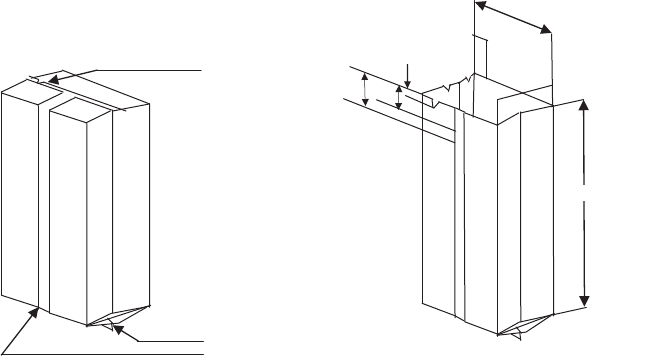
The package for the entree is brick-shaped (Figure 1)
when full and is designed for in-package rehydration and
food consumption. Beverages can be prepared in the
canteen cup; heat tablets are furnished.
Freeze-dried products require protection from water
vapor (products are strongly hygroscopic) and air (oxygen)
because of extensive exposed surface areas, and they also
require some protection of structural integrity (to some
degree, provided by immobilization in flexible, vacuu-
mized packages). From the user’s aspect, the ration pack-
age must provide a shelf life of a minimum of three years
at 801F and 6 months at 1001F. It must retain its form to
serve as an easily opened rehydration and consumption
container.
Two film structures are specified in Table 1.
Bonding of the sealant layer to the aluminum barrier
layer (film 1) is to be by lamination or by extrusion
coating. The barrier is in turn bonded to an outer layer
of biaxially oriented nylon layer with 10 pound per ream
low-density polyethylene. For film 2, the sealant ply is
laminated or extrusion-coated to a nylon ply, followed by
lamination to the foil that is bonded to an external
polyester (usually polyethylene terephthlate) ply. The
requirement for heat seals mentioned that the low-density
heat sealant layer shall be capable of forming a fusion seal
or shall be heat sealable and peelable. A peelable seal
would suffice for the outer polyethylene meal bag, but the
seals of the component brick-shaped pouch are more
critical and should be fusion seals. As summarized by
Lampi et al. (4), nonfusion seals can meet tensile and
CLOSURE
SEAL
BOTTOM SEAL
FIN SEAL
AFTER CLOSURE SEAL
1
/
32
MINIMUM NOTCH
1
5
/
8
BEFORE CLOSURE SEAL
2
9
/
16
+/-
1
/
8
I.D
3
3
/
8
+/-
1
/
8
3
/
4
1
10 +/-
1
/
8
I.D
Figure 1. MCW/LRP packages for entre
´
e.
MILITARY FOOD PACKAGING 775

burst test criteria at time of creation yet fail with time and
exposure to rough handling.
Pouch construction, filling, and final sealing follow
standard practice. Some major requirements are:
1. Minimum heat seal width: 0.25 in.
2. Fusion seal tensile strength: 7 lb per linear inch
3. Vacuum level, at which filled pouches are sealed: 23
in. of mercury
Defects and acceptance standards and criteria are given in
detail in the ‘‘Packaging Requirements and Quality As-
surance Provisions for Dehydrated Product in a Brickpack
Pouch.’’
IRRADIATED FOODS
During the gestation period of freeze-dried food develop-
ment and early feasibility probes into flexible packaging
for thermoprocessed foods, the preservation (i.e., to com-
mercial sterilization standards) of foods, including combat
ration entrees, by ionized radiation warranted explora-
tion. The anticipated advantages included very high
quality shelf-stable entrees with minimum destruction of
nutritive value, compatibility with a range of packaging
options from flexible pouches to rigid metal containers (in
other words, from combat rations to B, and possibly A
ration usage), and commercial viability to provide a basis
for reasonable costs during procurements.
For military rations, irradiation treatments (X ray,
gamma, and electron beam) were applied at high enough
levels to provide commercial sterility—that is, doses up to
60 kGy, the universal criterion for long shelf-life storage.
To assure achieving this long-term stability, multiple-ply
foil containing materials were used—not radically
different in composition and structure from those for
freeze-dried or thermoprocessed foods. Irradiation was
performed with packaged items.
Packaging materials for irradiation have some singular
requirements, namely:
1. In final filled package configuration, retention of
integrity when frozen to temperatures as low as
501F and held at those temperatures during the
irradiation step.
2. Minimal chemical changes and/or creation of unde-
sirable extractives in the packaging materials as
the result of irradiation. These changes might be
cross-linking, which could beneficially reduce migra-
tion; or, inversely, they might be degradation to
lower-molecular-weight elements (radiolysis pro-
ducts) with increased migration into the food.
3. Retention of package performance criteria—heat
seal integrity, absence of delamination, survivability
through the transportation and field-handling trail,
and retention of these properties over the desired
shelf-life time span.
The effect of high-dose irradiation on food, candidate
packaging films, and packaged irradiated foods (i.e., the
final product) has been extensively investigated and the
findings periodically scientifically and conscientiously re-
viewed. The first materials (5) approved for high-dose (up
to 60 kGy) packaging of irradiated foods in 1965 and 1967
were:
1. Vegetable parchments
2. Polyethylene film
3. Polyethylene terephthlate (PET) film
4. Nylon 6 film
5. Vinyl acetate–vinyl acetate copolymer film
Radiation-preserved packaged food items were technically
established as totally safe and nutritionally adequate, and
consumer-oriented taste testers found items acceptable.
However, the progression of high-dose irradiated foods
to either full-scale military or commercial usage is yet to
occur. Reasons implicated are: the existence (at least in
the United States) of an extensive established refrigerated
and frozen-food chain; the reluctance of investors to
establish costly manufacturing facilities without assur-
ance of a desirable, potentially flourishing market (the old
paradoxical question, What comes first, the chicken or the
egg?); significant consumer reluctance to believe that the
process is safe, in spite of the massive data proving it safe;
and limitation of the process to meat items.
Although irradiated foods are suitable for inclusion in
military rations, none, with the exception of South Africa,
are currently included. No adequately sized production
capability for the volumes that would be required exists.
However, the U.S. Army Soldier Systems Command
(Natick, Massachusetts) has been furnishing (in lots of
200 or so) irradiated meat entrees (beef, poultry, pork, and
lamb) to NASA for space applications. Earlier regulatory
agency approvals listed above, because of the development
of newer materials and material analysis techniques, are
no longer valid. Loveridge and Milch (6) reflect the current
status of packaging for NASA programs. They evaluated
five commercially available film structures, all without
current formal FDA approval for irradiated food entrees,
Table 1. Two Film Structures
Film 1 Film 2
Inner scalant layer 0.0035-in. linear low-density polyethylene 0.0035-in. linear low-density polyethylene
0.0006-in. biaxially oriented nylon
Barrier 0.00035-in. aluminum foil 0.00035-in. aluminum foil
Outer abrasion protection 0.006-in. biaxially oriented nylon 0.0005-in. polyester
776 MILITARY FOOD PACKAGING
but exempt for sole NASA usage and suitable for similar
food process applications. Of the five materials, the two
most readily commercially available were:
1. A new MRE pouch material (termed Quad since it
now had four plys) – fabricated from outer to inner
ply of polyester/nylon/aluminum foil/polypropylene.
2. The material used by South Africa – outer to inner
ply: nylon/aluminum foil/polyester/linear low den-
sity polyethylene.
Three other multi-ply film constructions were also eval-
uated; these had some potential for use with irradiation –
sterilized foods.
NASA-specific entrees were put through the entire
process: filling, vacuum evacuation, sealing, cartoning,
dry ice freezing and shipping, irradiation at 44 kGy,
thawing, and return shipment.
Testing included seal strength, leak tests, drop and
vibration tests, frozen pouch abuse, and internal pressure
resistance. Criteria were those of the now massively
produced Meal, Ready-to-Eat, combat ration. If high-
dose irradiation of foods, already proven safe, becomes
prevalent and costs are reasonable, packaging materials
for military entrees would require re-approval and would
likely be constructed with aluminum foil and the polymers
or their successors listed above. Bonding of plies would be
by coextrusion. A possible variant would be the inclusion
of sealable polyethylene terephthlate (PET) as the inner
layer. In short, flexible packaging for irradiated entrees
to enter the Meal, Ready-to-Eat matrix would in all like-
lihood be readily approved and available.
THERMOPROCESSED FOODS IN FLEXIBLE PACKAGES
While packaging (predominantly the use of multi-ply
flexible films) was being defined for freeze-dried and
irradiated foods that were intended for combat use,
studies were initiated with the aim of replacing the
traditional cylindrical metal cans for standard thermo-
processed combat ration entrees with high barrier flexible
polymeric films. The first probings to do this were prob-
ably in the late 1940s; however, the first formal publica-
tion of experiments with thermoprocessing common foods
in flexible films was by Hu in 1953. The military, noting
potential functional advantages (per their CDOG) for
combat rations furthered these studies, initially reported
by Keller in 1959 (cited in reference 3). After initial
positive indications, these studies grew into a major
development project culminating in the procurement of a
new combat ration, the Meal, Ready-to-Eat, Individual
(MRE) initially procured in 1979 (3). It is now the basic
U.S. combat ration.
Some initial decisions and considerations that drove
the direction that the development effort would take were
as follows:
1. An aseptic processing and packaging approach
would have alleviated the burden of performance
on the film and its formed package (specifically
resistance to process temperature as high as
2651F), but aseptic systems had no industry accep-
tance; and to undertake its technical development
(to include solids) and gain processor, regulator, and
consumer trust was felt to be prohibitive at that
time. The decision was to proceed with the tradi-
tional post-fill-and-seal thermoprocessing.
2. Although conceivably prematurely at that stage of
the state of the art, the manufacturing system was
visualized as a blend plus modification of equipment
already in use for forming, filling, and sealing for the
frozen food industry and thermoprocessing princi-
ples and equipment for ‘‘canned’’ foods; that is, the
need for radically new equipment was not antici-
pated. A need to tighten performance was accepted.
As a result, a new technology evolved.
3. The military could not replicate the technology
existing in the flexible film formulating and convert-
ing industries and would have to entice those
industries’ support by cooperatively revealing com-
mercial opportunities and/or providing monetary
support.
4. The package design would be a flat four-seal pouch—
no gusset or vertical center seam (pillow pack) de-
sign—that is, avoidance of unnecessary loci for leak-
age. If a horizontally drawn form–fill–seal package
concept were to evolve, it would be considered. It was
assumed that on-line pouch forming or the use of
preformed pouches would be suitable.
5. If successful, the replacement of the can with a
pouch (retort pouch) would offer significant advan-
tages; this provided a strong mission-oriented in-
centive to proceed. Briefly, these included:
a. lighter weight: 1.5 pounds per meal in the ship-
ping case
b. easy to open: side seam tear notch or two
c. improved palatability: flat thin shape precludes
overcooking the periphery to assure sterility of
the geometric cold spot
d. easy to carry: fits field clothing pockets; flat in the
rucksack
e. durable:
. during combat field movement
. for air drop
. all forms of transport
.
all climates
f.
storable: shelf life
suitable for war reserve mate-
riel usage
g. producible:
. materials
. form, fill, seal process
h. heatability: in water in canteen cup ( Note:A
flameless ration heater was later developed and
incorporated into each meal.)
From the earliest feasibility and field performance
tests, the packaging film producing and converting indus-
tries responded with proprietary film developments and
MILITARY FOOD PACKAGING 777