
Yao N. Focused Ion Beam Systems: Basics and Applications
Подождите немного. Документ загружается.

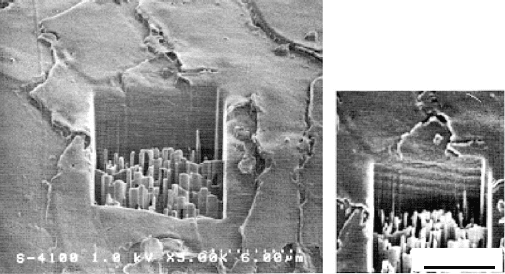
SIM and SEM images of FIB cross-sectioned human hair [5]. The SIM
image shows cuticles more clearly than the SEM image, suggesting that
SIM images are more sensitive to the surface than SEM images. The
opposite material-contrast between SIM and SEM images has been repor-
ted by others [1,6,7], but the origins of it have been discussed in only a few
papers [7,8]. Greater utilization of SIM images depends on understanding
the secondary electron (SE) properties under ion impact. In this chapter we
review the SE properties under ion impact using Monte Carlo (MC)
simulation, compare it with those under electron impact, and clarify the
origins of the essential differences in characteristics between the SIM and
SEM images.
C (12)
Pb (82)
Sn (50)
Cu (29)
(a) SEM
(c) SIM
Al (13)
W (74)
TiN
Al (13)
TiN
(b) SEM
(d) SIM
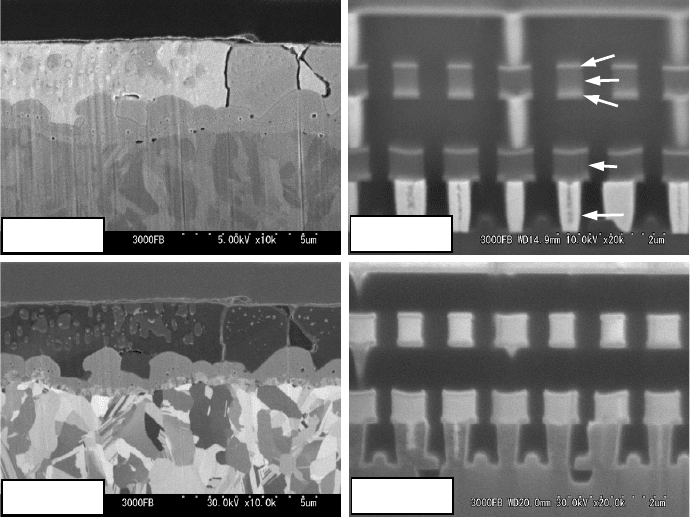
Figure 4.1 Comparison of image contrast between 30 keV Ga SIM and
5 or 10 keV SEM images of the FIB cross-sectioned samples (by the SEM/
FIB dua l beam system of Hitachi S-3000F B): (a,c) solder (Pb-Sn) on Cu
base and (b,d) Si device (static random access memory) [4]. The solder is
covered with a carbon (C) layer. In the SIM image (c), the Cu grains show
various contrasts depending on their crystal orientations, that is, grain
contrast or channeling contrast. Main elements are shown on the images
with their atomic numbers in parentheses.
Focused ion beam systems88
4.2 Background physics for imaging formation in SIM
4.2.1 Comparison in penetration behaviors between energetic
ions and electrons in solids
Before focusing on the SE properties, we will briefly describe the penetration
behaviors of energetic ions [9,10], compared with energetic electrons. How-
ever, only the basics of the electron penetration are described (refer to the
texts [11,12] for more discussion on the equivalence). Here, the beam char-
acteristics of the Ga-FIBs for SIM imaging and/or FIB milling of interest are
as follows: an energy of 10–40 keV, a current of 1 pA–30 nA (i.e., a difference
of over four orders of magnitude), a diameter of about 5 nm to 1 mm (i.e., a
difference of over two orders of magnitude), and a current density of 0.1 to
several tens A/cm
2
. For the SEM imaging, on the other hand, the primary
electron energy is mostly in the region of 1 to 30 keV for conventional SEM
systems and 100 to 200 keV for high-voltage (HV) SEM imaging in TEM/
STEM.
Interaction of energetic ions or electrons with solids
Interaction of energetic ions or electrons with solids is slightly complex.
Before ultimately losing their energies or escaping the sample, each incident
electron or ion may undergo a large number of scattering events, distributed
between elastic and inelastic processes. While elastic collisions result from
collisions of energetic electrons or ions with nuclei of the target atoms and
alter their undergoing directions, inelastic collisions result in transfer of their
energies to the target, leading to generation of SE, Auger electrons, photons,
electron hole pairs, and so forth. The MC method using a stepwise simulation
of various scattering events is useful to microscopically understand beam
5 m5 m
5 µm
(SEM)
(SIM)
Figure 4.2 Comparison of image contrast between 30 keV Ga SIM and
1 keV SEM images of the FI B cross-sectioned human hair [5].
Imaging using electrons and ion beams 89
interactions (refer to the special issue on electron beam/specimen interaction
modeling in Scanning 17, 4 and 5, 1995). MC programs also allow estimating
the various signals, yields, distributions, and so forth.
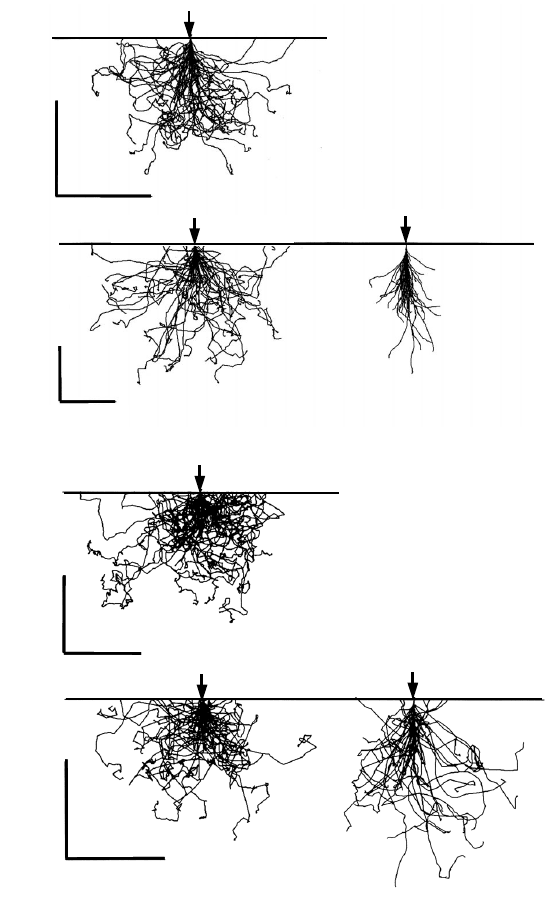
Electron and Ga ion trajectories are MC simulated so that their beam
interactions are visually understood. Figures 4.3(a) and (b) show their tra-
jectories in silicon (Si) and tungsten (W) targets, respectively, where beam
energies E
0
are 30 keV and 1.5 keV for electrons and 30 keV for Ga ions [9].
Here, Si and W are chosen as typical lighter and heavier atomic mass ele-
ments relative to Ga (i.e., atomic mass M ¼28.1, 69.7, and 183.5 amu for Si,
Ga, and W, respectively). A mass ratio of the strike to struck particles
governs the elastic scattering, as will be discussed later. The MC programs for
electrons and ions employed here are based on single scattering models
proposed by Joy [13] and Ishitani [14], respectively.
Range
The electron interaction volume indicates little dependency on E
0
and atomic
number of the target atoms (Z
2
) except for its scale magnification. The 30 keV
ranges R (defined as a maximum projected range) are about 6 and 0.6 mm for
Si and W, respectively, and the 1.5 keV R are about 0.05 and 0.01 mm for Si
and W, respectively. Although a factor of 10 exists in 30 keV R between Si
and W targets, there is only a slight difference between their reduced mass
ranges in mg/m
2
. It is known that an approximately Z
2
-independent mass
range is valid at E
0
¼10–100 keV [15]. On the other hand, the ranges R for
30 keV ions are as short as only about 0.04 and 0.02 mm for Si and W,
respectively, and are roughly equal to R for 1.5 keV electrons. In addition, a
Z
2
-independent mass range is no longer valid for ion R.
Backscattering
The larger the sample Z
2
, the higher the backscattering yield · for the electron
beam. On the other hand, · for an ion is rather low compared with that for an
electron. This is expected as Ga ions are never deflected backwards in Ga–Si
elastic two-body collisions because M
Si
/M
Ga
< 1 (see Elastic collision,p.92).
Total path length
As to total path length (defined as an accumulated path length along each
zigzag trajectory of the electrons or ions stopped in the sample), there is little
difference among the electrons. The reason is that electrons suffer negligible
energy loss in elastic two-body collisions because M
target-atom
/M
electron
1.
On the other hand, the larger the ion deflection angle, the larger the ion
energy loss (see the next subsection). Thus, the ion range after the large-angle
Focused ion beam systems90
scattering becomes short on average. If the energy transferred from the ion to
the target atom exceeds the sharp threshold energy, the target atom is dis-
placed and is added to the cascade with kinetic energy. This cascade brings
about lattice damage and sputtering.
5m
30 keV Electrons
0.02 m
1.5 keV Electrons
30 keV Ga ions
Si target
Si target
5 µm
30 keV Electrons
0.02 µm
1.5 keV Electrons
30 keV
Ga ions
Si target
Si target
1.5 keV Electrons
0.5 m
30 Electrons
0.01 m
30 keV Ga ions
W target
W target
1.5 keV Electrons
0.5 µm
30 keV Electrons
0.01 µm
30 keV Ga ions
W target
W target
(a)
(b)
Figure 4.3 Monte Carlo simu lations of 30 keV and 1.5 keV electron and
30 keV Ga
þ
ion trajectories in the targets: (a) Si target and (b) W target. The
number of trajectories drawn for each plot is 50 [9].
Imaging using electrons and ion beams 91

Elastic collision
It is appropriate both to describe interaction of two colliding particles as that
of a collision of two point masses (M
1
for the incident electron or ion, M
2
for
the struck particle) and to set up and solve the classical mechanical dynamic
equations of motion under a central force constraint. When the incident
particle is elastically scattered through an angle relative to the direction of
motion of the center of mass (CM), the incident particle with kinetic energy E
loses energy by
T ¼ E
4A
ð1 þ AÞ
2
!
sin
2
2
; ð4:1Þ
where A ¼M
2
/M
1
. This energy loss is equal to the post-collision energy of the
struck atom.
Only when T is larger than atom displacement energy ( 25 eV for metal) in
ion–atom collisions, target atoms are knocked out from their lattice posi-
tions. When struck atoms have sufficient kinetic energies to generate sec-
ondary collisions, they initiate a cascade of atomic collisions, causing
irradiation damage and sputtering. The center of mass scattering angle is
converted to the scattering angle 2 in the laboratory (Lab.) system using a
simple relation such as
cos 2 ¼
ð1 þ A cos Þ
ð1 þ 2A cos þ A
2
Þ
1=2
: ð4:2Þ
When ¼0, 2 ¼0, and when ¼, 2 ¼0or, depending upon whether A
< 1orA> 1, that is, the incident ion, which is heavier than the struck atom
(i.e., A < 1), is always scattered forward in the Lab. system (i.e., 0 2 /2).
On the other hand, collisions for A > 1 cover a full range of 0 2 so that
backward scattering (i.e., /2 < 2 ) can also occur.
Here, both collisions of the Ga ion–W target atom and electron–target
atom of interest correspond to the case A > 1. In the latter collision (at E < 100
keV), both 2 and T 0 are satisfied at any because A 1. In other words,
primary electrons can change their directions without losing their kinetic energies
through elastic collisions. No target atoms are knocked out from their lattice
positions by the electrons of inorganic substances such as metals, semi-
conductors, etc. On the other hand, organic substances (such as amino acids,
higher hydrocarbons, and aromatic compounds), which are little taken up in the
present study, are much more sensitive to radiation damage than inorganic
specimens.
Focused ion beam systems92

Inelastic collision
Regarding the approach to ion inelastic scattering, the continuous slow-down
approximation has been widely used. A schematic representation of the
stopping power combines two energy regimes. The stopping power increases
from zero, passes through a maximum when the incident velocity v is of the
order of the orbital velocities of lattice electrons ( Z
2
2/3
v
B
), and finally falls
off inversely as the first power of energy. Here, v
B
¼2.2 · 10
6
[m/s] is the
velocity of the Bohr electron in the hydrogen atom. In the lower velocity
region (i.e., v < Z
1
2/3
v
B
, Z
2
2/3
v
B
), a v-proportional stopping power is derived.
The velocity of v ¼Z
1
2/3
v
B
is converted to energy of E [keV] 25Z
1
4/3
M
1
[amu], which corresponds to 25 keV for the H ion and 170 MeV for the Ga
ion. Using dimensionless energy " and distance , v-proportional electronic
stopping power is given as (e.g., by Dearnaley et al.[16], Ryssel and Ruge
[17], and Orloff et al.[10])
d"
d
electronic
¼ "
1=2
: ð4:3Þ
The incident energy E
0
of several tens keV has too low a velocity for the Ga
ions to excite X-rays, in contrast to the case for electrons. The X-ray exci-
tation requires the incident’s velocity to be in the same order as that of the
target-atom shell-electrons in classical mechanics. The SE excitation of
interest is in the inelastic processes.
Stopping power
The stopping power of an energetic particle in a solid results from a sum of
two components (i.e., the nuclear and electronic stopping powers), which
may be taken in good approximation as independent of each other, and the
total stopping power given by
dE
dR
total
¼
dE
dR
nuclear
dE
dR
electronic
: ð4:4Þ
The nuclear stopping depends on the cumulative effect of statistically inde-
pendent elastic scattering of the incident particle and the target atom. The
stopping power is given by
dE
dR
i
¼
d"
d
i
ð=RÞ
ð"=EÞ
; ð4:5Þ
where i ¼nuclear, electronic, or total. Here, –(d "/d)
i
is the i-component
universal stopping power per atom. Values of "/E, /R,and for the
Imaging using electrons and ion beams 93
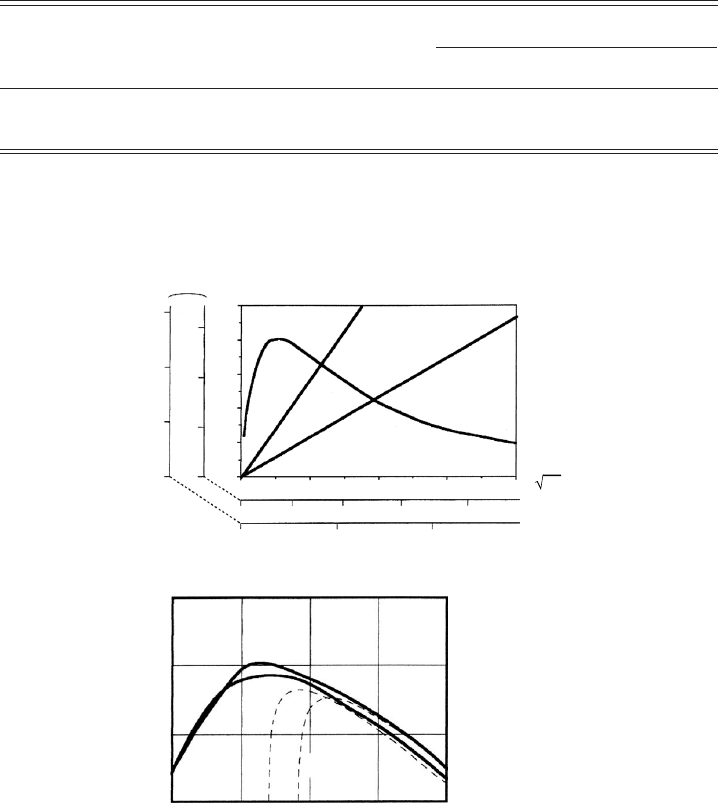
combination of Ga ions w ith S i and W targets are given in Table 4.1 .The
curves of S
n
( ")[ –( d" /d )
nuclear
]and S
e
( ")[ (d" /d )
electronic
] versus " are
showninFigure 4.4(a). The E and –(d E /dR ) axes, which are re du ce d for th e
combinations of GaionwithSiandWtargets,arealsogiveninthefigure.
Table 4.1. Variou s paramet ers in the beam –specimen interacti ons.
Target
elem ents
Atom ic
numb er
Z
Atom ic
mass M
[amu]
Density
[kg/m
3
] M /M
Ga
LSS parame ters
e / E [keV] / R[ mm]
Si 14 28.086 2.42 · 10
3
0.4 5.44 · 10
3
18.7 0.117
W 74 183.85 1.93 · 10
4
2.64 1.96 · 10
3
11.8 0.287
Ga: Z
Ga
¼ 31 M
Ga
¼ 69.72
3
2
1
0
1.5
1.0
0.5
0.0
0.5
0.4
0.3
0.2
0.1
0.0
0
0
0
1
100
400
1000 2000
2
3
4
1000
4000
E (keV) Ga in Si
E (keV) Ga in W
–dE/dR
(keV/nm)
S
n
()
S
e
() (Ga in W)
S
e
() (Ga in Si)
(a)
Au
Cu
Bethe
10
3
10
3
10
4
10
5
10
2
10
2
10
10
1
E-E
F
(eV)
–dE/dR [eV/nm]
(b)
S()
Figure 4.4 Comparis on of stopping power between ion an d electron; (a) ion
stopping powers for Si and W targets [9], and (b) electron stopping powers
for Au and Cu targets [18].
Focused ion beam systems94

It is f ound that S
n
( ") i s d omi nan t i n e ner gy l os s f or t he 30 ke V Ga io n
pe ne tra tio n i n S i a nd W tar ge ts. A s to th e e l ec tro n st op pin g po wer, th e
nucl ear t erm i n ( 4.5 ) is negl igible a s dis cussed before. The e lectron inelast ic
stopping powers for Au and Cu targets [18]areshowninFigure4.4(b). The
stopping power has a maximum plateau of 60–100 eV/nm in a range of
0.1 keV < E < 1 keV. The Bethe equation is valid only at sufficiently hig h
electron energies, i.e., E > 3keV [15]:
dE
dR
¼
2e
4
Z
2
N
E
ln
1:166E
I
av
: ð4:6Þ
It was found th at the el ect ron stopping powers at E
0
¼1–30 keV are smaller
by one to two orders of magnitude than those for Ga ions. This predicts
that Ga ion ranges are shorter by one to two orders of magnitude t han
electron ranges under the same incident energies.
4.2.2 Ion-induced secondary electron emission
Bombardment of a solid surface by an ion causes secondary electron (SE)
emission through many kinds of ion–solid interactions. Within the past few
decades considerable progress has been achieved in the research field of ion
induced SE emission from solid surfaces both experimental and theoretical
respects, as reviewed in [19 –25].
Ion-induced SE emission may proceed via two independent effects which
differ by the mechanism of the energy transfer from the incoming ion to the
electrons of the solid. If the potential energy of the ion is twice (or more) the
work function of the solid, SE emission may proceed via resonance neu-
tralization and subsequent Auger de-excitation or Auger neutralization. This
process, which proceeds in front of the solid surface and operates at low
(several keV) energies, is called potential emission. Its basic principles were
developed by Hagstrum [26,27]. As long as singly charged ions are concerned,
an empirical formula on the yield of SEs,
p
, was obtained by Baragiola et al.
[28] from a least-squares fit to experimental data on potential emission:
P
¼ 0:032ð0:78E
i
28Þ; ð4:7Þ
where E
i
and 8 are the ionization potential of the projectile ion and the work
function of the solid surface in eV. However, gallium (Ga) ion bombardment
will not lead to potential emission because of its low ionization potential
(6 eV). The 8 for normal metals is approximately 4–5 eV.
The second effect which covers all other sources of SE emission and which
shall be discussed here is called kinetic emission. In this case SEs are excited
Imaging using electrons and ion beams 95
within the solid by direct transfer of kinetic energy from the impinging ion.
The SEs that are excited near the surface may eventually be emitted if their
energy is high enough to overcome the surface barrier. The kinetic emission is
the major or only source of SEs at medium and high impact energies.
The kinetic emission is strikingly similar to electron-induced SE emission
which occurs for primary electron bombardment. The emission of SEs is
described by a three-stage process:
(1) production of SEs within a solid;
(2) migration of some of these SEs to the surface;
(3) escape through the surface.
The last two processes in kinetic emission are almost identical to those of
electron-induced SE emission. The important properties, i.e., characteristic of
the migration and escape, the energy-loss rate, the mean free path for elastic
scattering, and the magnitude and shape of the surface barrier, are common
for both primary particles. The difference between the SE emission induced
by the two types of primary particle is primarily in the production stage.
For electron bombardment the emitted electrons are conventionally divi-
ded into two groups: the ‘‘true’’ low-energy SEs with energies below 50 eV,
and the backscattered (or reflected) electrons (BSE) and high-energy SEs with
energies from 50 eV up to the primary energy. This division is formal, since
SEs from ionization events may also occur above 50 eV, and primary elec-
trons may have slowed down to be a few eV before ejection. The SEs induced
by ion bombardment are not expressed in a similar manner, because there is
no backscattered electron and only a minor fraction of the SEs have energies
above 50 eV.
There is a clear difference in the energy dependence of the SE yield between
electron and ion bombardments in the energies of tens of keV, because of a
large difference between electron and ion masses. At a given impact energy,
the initial velocity of a primary electron is two or three orders of magnitude
larger than that of an ion. This causes a large difference between the mean
free paths for excitation of an electron by primary electrons and by ions. In
general, therefore, the SE yield has a maximum for primary electron energies
below 1 keV, whereas the corresponding maximum is at the ion energies of
hundreds of keV. As a result, at the energies of tens of keV, the SE yield for
electron bombardment becomes small as the impact energy is increased,
whereas an opposite trend is found for ion bombardment. The general energy
dependence of the SE yield closely resembles that of the electronic stopping
power of the impinging fast, light ions [29,30]. It must be admitted that the
same simple relation does not hold for impact by slow, heavy ions.
Focused ion beam systems96

Excitation of secondary electrons in solids
Different excitat ion mechanisms are responsible for the SE emission
phenomena. The intera ction of the impingi ng parti cle ( v in velocity) with
the conduction electrons results, first, in the ionization of single conduc-
tion ele ctrons (commonly also called ‘‘excitation’’ of electrons from the
Fermi sea). Second, for impact energies above a projectile- and target-
dependent thresh old energ y the impinging part icle can create plas mons in
real metals. The dec ay of the se pla smons lead s to an excit ation of c on-
duction electrons. Third, the interact ion of the impinging protons with the
core electrons results in the direct exc itation of these elect rons. The inner-
shell vac ancies produced in this way are filled immediately by electrons
from oc cupie d higher states. At the same time an othe r electron would be
excited.
The maximum energy transfer in such a binary encounter to a conduction
electron with the Fermi velocity, v
F
,is
4E
max
¼ 2m
e
” þ
”
F
2
hi
2
; ð4:8Þ
where m
e
is the electron mass [31]. This equation applies equally well for
bound electrons with a kinetic energy determined from the orbit velocity.
This process is important mainly for incidence of light ions. This includes
electron production induced by the projectile ion or by secondary processes
(e.g., ionization by recoil target atoms or by energetic SEs); for proton
impact on metals the excitation of conduction electrons of the target is
generally assumed to be the major source of SEs.
The SE production processes at low-velocity ion impact (v < v
B
, where v
B
is
the Bohr velocity) are characterized by the fact that the target electrons are
much faster than the projectile ion; for 30 keV Ga ions, v ¼0.13v
B
. Instead of
regarding a fast ion that hits an electron at rest, one has to consider a slow
ion which is hit by a fast orbital or conduction electron. By such a collision
the energy transfer from the ion to the electrons may be adequate to eject it
from the atom excite it considerably above Fermi energy.
For l ow-velocity heavy ions electron promotion is the dominant process
[19]. If the collision between the ion and a target atom p roce eds slowly, a
temporary molecule can be formed. One or more electrons may be lifted up
to higher levels than before the collision and ejected from the atoms
immediately after the collision. Electron promotion can be efficient in
producing inner-shel l vacancies that may lead to electron emission vi a
Auger transitions [21].
Imaging using electrons and ion beams 97