
Yao N. Focused Ion Beam Systems: Basics and Applications
Подождите немного. Документ загружается.

field, or to create free standing structures for nanotechnology. To assist with
these processes, a reactive neutral gas is introduced to the sample through a
fine capillary tube at the milling site. The gas is able to enhance the etching
rate compared to straight sputtering of the material and also reduce the
amount of redeposited material from the sputtering of the sample. Other
benefits from the use of gas are the different etch rate enhancements obtained
for different materials that can allow for preferential etching of one material
in the presence of another. The use of gas can also result in structures
that cannot be formed by the use of the ion beam alone, such as high aspect
ratio vias.
3.2.1 Gas assisted focused ion beam etching – principles
Gas assistance of the FIB induced etching process relies on gases that react
with the sample to produce a volatile compound that is removed by the
vacuum system. Overall, there are many similarities in the steps used to
describe the deposition processes and those used to describe etching. For
example, deposition and etching gases can adsorb and desorb without
reacting (chemisorption) with the surface they are on. However, some
etching gases behave differently in that instead of just physisorbing on the
surface, the etching gas is able to chemisorb. For example, the use of
chlorine on a clean silicon surface results in a chlorosilyl layer being formed
on the silicon.
The steps in the gas assisted focused ion beam etching process are as
follows:
(1) A chemically neutral reactive gas is introd uced through a fine gas nozzle and is
adsorbed (or chemisorbed) on the sample surface.
(2) The gas reacts with the sample either spontaneously, as in silicon and fluorine, or
in the presence of the ion beam the gas decomposes and reacts with the sample,
as with water and carbon based polymers.
(3) The volatile products leave the surface (desorption).
Winters and Coburn [1] have investigated the spontaneous etching and
effect of ion enhanced spontaneous etching of silicon with fluorine-based
gases. These studies have shown that in the silicon-XeF
2
system the incoming
XeF
2
gas is able to spontaneously react with the silicon surface without the
interaction of the ion beam according to the following reaction:
XeF
2
(g) þSi(s) !‘‘SiF
2
’’(s) þXe(g), (3.1)
SiF
2
(s) þXeF
2
(g) !SiF
4
(g) þXe(g). (3.2)
Focused ion beam systems68

The symbols (g) and (s) indicate gas phase and solid phase respectively. The
SiF
2
, while stoichiometrically correct, is probably a mixture of SiF, SiF
2
, and
SiF
3
. The means by which the incoming ion from the FIB is able to enhance
the etch rate above the rate for the spontaneous process is by removing the
‘‘SiF
2
’’ layer through recombination to form SiF
4
(g):
2SiF
2
(s) þion ! SiF
4
(g) þSi(s), (3.3)
SiF(s) + SiF
3
(s) þion ! SiF
4
(g) þSi(s), (3.4)
through sputtering of SiF
2
:
SiF
2
(s) þion ! SiF
2
(g), (3.5)
or by increasing the desorption rate of SiF
4
. The main gaseous species
detected from the ion enhanced etching of silicon is SiF
4
and some SiF
2
.It
should be kept in mind that most of the material sputtered during ion beam
exposure originates from the first atomic layer and that the yield is inversely
proportional to the binding energy. Equations (3.1)–(3.5) result in the for-
mation of a volatile species with a low binding energy and hence can increase
the etching rate.
Equations (3.3), (3.4), and (3.5) will result in fresh silicon surfaces being
exposed to the reactive XeF
2
gas to form a fresh layer of SiF
2
as in (3.1). This
way more XeF
2
is able to react with silicon in the presence of the ion beam
than without, increasing the rate of removal of silicon.
The interaction of molecular chlorine on silicon is known to behave in a
similar fashion as the XeF
2
case with the exception of (3.2) which does not occur
with chlorine at room temperature. However, chlorine is still able to give a
significant boost to the etch rate of silicon in the presence of the ion beam as
shown in Table 3.1. The lack of spontaneous etching is more the preferred
situation with gas enhanced ion etching. Here the addition of the gas causes no
etching, even though in some cases the gas will chemisorb to the sample and the
Table 3.1 Selection of halide gases and their etch rate enhancements for semiconductor
materials using a 30 kV Ga
þ
ion beam.
Gas/sample Si SiO
2
Al W GaAs InP
XeF
2
[13] 7–12 7–10 1 7–10 NA NA
Cl
2
[13,14] 11 1 5–10 1 50 4
I
2
[15,16,17] 5–10 1–1.5 5–15 NA 10–15 11–13
Gas assisted ion beam etching and deposition 69
ion beam is required to drive the etching process. This provides greater control
of the etching process than is possible with the presence of spontaneous etching.
Gas assisted etching of metals
The use of halide etching gases on metals to increase the etching rate is widely
used in the semiconductor industry. In this case the halide helps to remove
the metal lines as a step to rewiring the circuit for failure analysis or para-
meter testing. Here the halide not only aids in the etching rate but is also able
to create an electrically isolated cut since any sputtered metal is oxidized by
the halide and rendered nonconducting. For applications requiring the
removal of aluminum metal the use of either chlorine or iodine is preferred
due to their ease of use, formation of volatile products, and excellent
enhancement rates. XeF
2
is not used here since the reaction product, AlF
3
,is
not volatile and there is no improvement in the etching rate.
The case with tungsten is the opposite of aluminum. In this case XeF
2
is the
preferred gas since the product of the reaction WF
6
is a gas and is thermo-
dynamically stable. Chlorine does not provide any enhancement over sput-
tering since the WCl
6
product is a solid with a low vapor pressure.
Gas assisted etching of SiO
2
Gas assisted etching of SiO
2
is achieved by the use of fluorine based gases.
XeF
2
is widely used because of the ease of handling this fluorine source.
There is no spontaneous component in the etching of SiO
2
. XeF
2
does not
chemisorb to the SiO
2
surface but only physisorbs in a low concentration
initially. This is due to the paucity of adsorption sites on the oxide surface
prior to milling with the ion beam. However, after a few passes of the ion
beam the damaged surface will readily adsorb up to ten times more fluorine,
which is about the same coverage as one monolayer [2 ,3]. Even when
damaged, the oxide surface does not spontaneously etch which is advanta-
geous and provides excellent control of the etching based solely on the ion
beam current. Studies using argon ions and XeF
2
have shown that the
majority of the desorbed product from the etching of SiO
2
is SiF
4
. This has
been shown to be independent of the energy and type of ion used to excite the
etching [4,5].
Etching of carbon based materials
The use of halide materials as etch enhancing agents provides solutions to
many materials issues. However, they are by no means universal etching
agents and are known to have limits with organic, carbon based materials.
Water has been found to be a very effective etch enhancing material for
Focused ion beam systems70

polymers and biological samples. The effect of water has been noted in the
SEM community for many years in papers and books [6]. This work was then
applied by Stark et al. [7] to focused ion beam systems with great success.
Table 3.2 shows a comparison of the etching enhancement of various gases
on poly(methyl methacrylate) (PMMA) and clearly shows the efficiency of
water over other gases including XeF
2
.
The products from the reaction of water on polymers have not been
determined but Stark et al. did speculate that CO
x
is formed and pumped
away. However, this would seem to be unlikely in light of the results reported
in the Si/XeF
2
system where the XeF
2
is able to chemisorb and attack the Si
surface prior to the ion beam arriving. In this system, the rate limiting step is
desorption since the gas reacts with the Si to form a saturated layer of
fluorosilanes. The ion interaction with the fluoridated surface results in the
maximum removal rate of Si of 25 atoms/ion [8]. These studies have also
shown the products of the etching reaction to be SiF
4
and SiF
2
. Comparing
this to the etching data of water, where no reaction occurs prior to the arrival
of the ion beam and the water is simply adsorbed to the surface, the authors
observed an etching rate of 100 atoms/ion striking the surface. The rate is
four times higher than that observed in the XeF
2
/Si system. It would seem
likely that the role of the water in the PMMA/water reaction is to cleave the
polymer chains and the volatile products are chunks of monomer or methyl
methacrylate fragments.
3.2.2 Inhibition of the etching process
The addition of gas is also able to inhibit ion beam sputtering of the sample.
In the previous discussion the focus was on gases that produced acceleration
in the etching rate of materials by the production of volatile products.
Table 3.2 Yield and etch rate enhancement for various gases on PMMA
with a 30 kV Ga
þ
ion beam [7].
Gas Yield ( mm
3
/nC) Enhancement
No gas 0.4 –
H
2
0.4 1
Iodine 0.8 2
XeF
2
1.7 4.2
Oxygen 1.8 4.5
CH
3
OH 4.2 10
Water 7.5 18
Gas assisted ion beam etching and deposition 71
In some cases there is no acceleration or even inhibition of the etching
process. The situations where the gas does not produce any enhancement can
be due to the gas not reacting with the substrate or the sputter rate of the
product is the same as for the substrate. For a reduction of the etching rate to
occur the gas and the sample must react to form nonvolatile products or
products with a high binding energy.
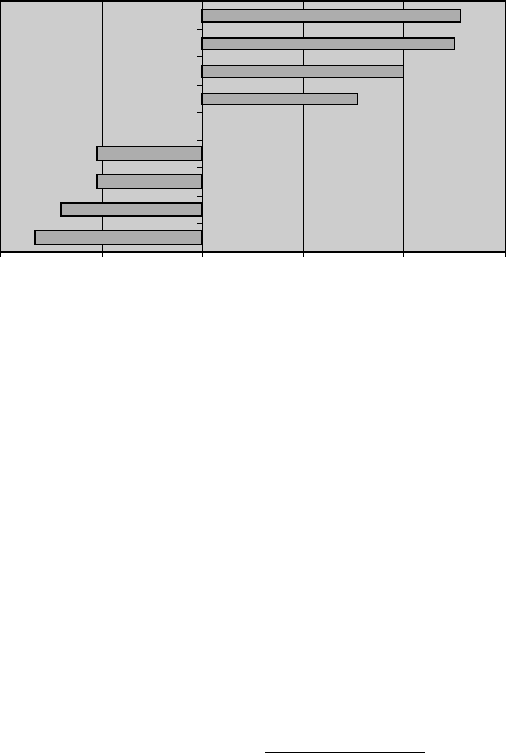
Water is a good example of a gas that is able to produce all three results;
enhancement, no change, and inhibition of etching. The chart below shows
the log of the enhancement factor versus different materials and clearly shows
enhancement, no affect, and inhibition. The enhancement factor is calculated
by dividing the yield (mm
3
/nC) with gas by the yield without gas:
enhancement factor ¼
yield with gas
yield without gas
· ð3:6Þ
It can be seen from Figure 3.1 that the etching rate of gold is unaffected by
the addition of water because it is inert and does not react. The etching rate
of aluminum or silicon is greatly reduced by the addition of water and is one-
sixth the normal sputtering rate of the material under a 30 kV Ga
þ
ion beam.
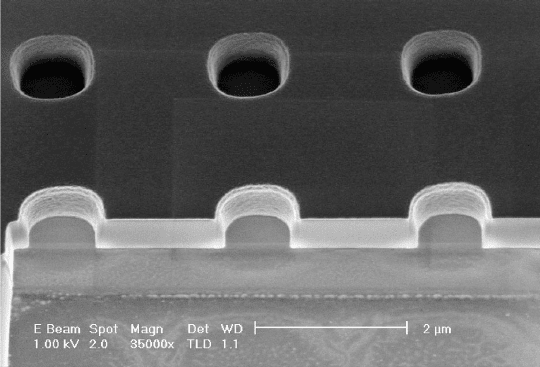
This is very advantageous and allows the user to preferentially etch polymers
from around aluminum lines in integrated circuits. The result of this etching
is seen in Figure 3.2, where the surface layer of resist with contact holes has
been removed to expose the profile of the contact. Note that the silicon
exposed to the ion beam at the bottom of the hole does not show any
apparent damage from the ion beam.
Water etch enhancements
–1 –0.5 0 0.5 1 1.5
Aluminum
Silicon
Silicon oxide
Silicon nitride
Gold
Teflon
Diamond
PMMA
Polyimide
Material
log (Enhancement factor)
Figure 3.1 Water etch enhancement and inhibition for various materials [7].
Focused ion beam systems72
The presence of a chemically active gas is able to influence the rate of
physical sputtering of a material by three factors:
(1) A modified surface is formed by the reaction of the gas with the material. For
silicon and XeF
2
this will be a saturated SiF
x
layer where x ¼1–3 and for water
the formation of SiO
2y
, y < 1.
(2) The binding energy of the surface atoms may increa se, as in the case of silicon
and water leading to inhibition of etchi ng, or decrease as with silicon and XeF
2
leading to enhancement of the etch rate.
(3) The number of atoms of the original element or material in the top surface layers
decreases.
For example, using water in the presence of aluminum and silicon creates a
surface where most of the atoms in the top layer are oxygen which originate
from the gas passed over the surface. As mentioned above since most of the
sputtered material originates from the surface layer the ion beam is mostly
removing the oxygen from the top oxide layer. These oxygen vacancies are
rapidly replaced by the gas leading to a net decrease in the rate of sputtering
of the aluminum or silicon in the sample.
The variation in the etching rate with different materials is very useful if
many materials are present in a cross section and the user needs to see where
they are. This is a common practice in the semiconductor industry where
engineers need to see the layers of a device during manufacturing to monitor
the FAB (fabrication plant for semiconductor materials) processes. This is
called delineation etching and utilizes the varying etch rates of materials
Figure 3.2 Water enhanced etching of Phot oresist. (Courtesy of FEI
Company.)
Gas assisted ion beam etching and deposition 73
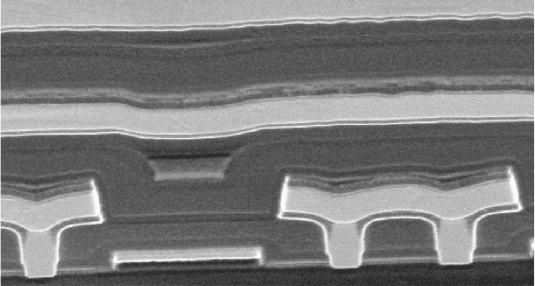
when exposed to a constant ion beam current and gas flow. Some gases are
designed to have a great variation in etching rate and an example is deli-
neation etch from FEI which is used to delineate the layers in semi-
conductor devices. The use of these gases can change a cross section from a
blank and uninformative view into a series of topographic features based on
the materials present. Figure 3.3 is an example of the end result of a deli-
neated semiconductor device.
3.2.3 Etching with other ion sources
Other ion sources apart from gallium will also produce similar results. Noble
gas ion sources have been used successfully to etch samples by sputtering and
with the addition of reactive gases. There are differences in the etching rates
achieved with the use of other ion sources due to the size and mass of the ion
produced. The interaction of an ion passing through a solid is explained in
depth in the book by Utlaut et al. [9]. The energy delivered to the sample is
via the nuclear losses of the collision cascade as the ion passes into the
substrate. The smaller and lighter the ion is the less energy it is able to deliver
to the sample and hence a lower sputter yield results.
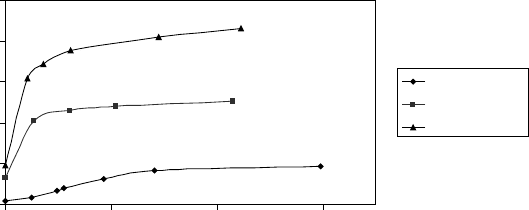
Coburn et al. [8] were able to demonstrate this clearly with various 1 kV
noble gas ions in a set of experiments with silicon and chlorine etching gas.
The heaviest gas used was argon and when used in conjunction with
chlorine a maximum yield of four silicon atoms ejected per argon ion was
observed. When helium was used instead of argon the yield dropped to less
than one silicon atom per helium ion. Figure 3.4 is a summary of these
results.
Figure 3.3 Results of delineation etching of a semiconductor device.
(Courtesy of FEI Company.)
Focused ion beam systems74
3.2.4 Sample damage
As with any physical process the ion beam will change the characteristics of
the top layers of a sample. With a 30 kV gallium ion beam the top 30 nm of
material is implanted with gallium and any atomic structure that was present
will be altered or destroyed depending on the dose the sample received. This
damage layer is very apparent in TEM samples obtained by FIB unless the
operator is careful to follow known damage minimizing procedures, which
can greatly reduced the thickness of the damaged layers.
Another effect of ion beam exposure is the movement of species within the
top most layers of the sample. Material from the surface can move into the
bulk and bulk material can move to the surface. This can be caused by recoil
implantation, cascade mixing, or radiation enhanced diffusion. Thus, etching
gases can be found implanted into the sample and not only on the top surface
of the material [1].
3.3 Gas assisted focused ion beam deposition
In terms of ion beam assisted deposition, FIB induced deposition and con-
ventional ion beam assisted deposition (IBAD) are similar. However, FIB
induced deposition with gas assistance significantly differs from the IBAD. In
general, ion beam assisted deposition is used in conjunction with other
sources such as evaporation, sputtering, pulsed laser, and molecular beam
epitaxy. The gas assisted FIB deposition is a direct deposition by using only
the focused ion beam itself along with a gas. In addition, FIB induced
deposition is also a deposition in a very local area only where the controlled
ion beam is scanning.
0
1
2
3
4
5
0 102030
Chlorine flow rate
Si atoms/ion
He etch rate
Ne etch rate
Ar etch rate
Figure 3.4 Yield of silicon atoms sputtered per 1 kV He
þ
,Ne
þ
, and Ar
þ
.
The chlorine flow rate is 10
15
molecules/s [8].
Gas assisted ion beam etching and deposition 75
The gas assisted FIB induced deposition process can be described by the
following steps:
(1) A gaseous compound precursor is introduced through fine gas nozzles inserted
close to the surface and adsorbs on the surface of the sample.
(2) The gas molecules adsorbed on the surface are decomposed into nonvolatile
products and volatile products by the incident energetic ion beam where the
focused ion beam is scanning. Simultaneously, the ion beam’s energy results in
sputtering of the sample surface.
(3) The nonvolatile products remain on the surface, producing deposition layers,
while the volatile components, such as oxygen and hydrogen, leave the surface.
Deposition conditions can be optimized by controllable system parameters
such as the properties of precursor gases, gas flux (needle location, the
heating temperature of gas), ion beam current, dwell time, beam overlap,
beam scanning area, and raster loop time.
Once the gas adsorbs to the surface of the sample, the precursor is required to
have sufficient sticking probability to remain on the surface long enough before
it is decomposed. Furthermore, the precursor on the surface must be easily
decomposed by the incident energetic ion beam for any deposition to occur.
The incident ion beam decomposes the precursor gas on the surface as well
as sputters or mills the materials on the surface. So the total deposition yield
(Y
dep
), the number of atoms deposited per incident ion, can be expressed as a
function of the decomposition yield (Y
decomp
) of the precursor gas and the
sputtering yield (Y
sputt
) on the surface:
Y
dep
¼ Y
decomp
Y
sputt
: ð3:7Þ
The decomposition yield is proportional to the number of adsorbed mole-
cules on the surface and the cross section for molecular dissociation. The
number of adsorbed molecules on the surface is known as a function of the
gas flux onto the substrate, the substrate temperature, and the gas/substrate
interaction on the deposited area [10].
For the success of deposition many beam parameters need to be adjusted
properly. In general the deposition rate is a combination of local gas flux or
local pressure, ion beam current, pattern size, dwell time per pixel, beam
overlap, and raster refresh time. The following sections introduce the type of
deposition precursor gases, and parameters to obtain good deposition.
3.3.1 Deposition precursor gases
In 1984, the first FIB induced deposition of Al was reported by Gamo et al. from
metal organic material, trimethyl aluminum (TMA) Al
2
(CH
3
)
3
precursor [11].
Focused ion beam systems76

So far there are dozens of different precursors that have been successfully
reported for FIB induced deposition of metal (aluminum, tungsten, tantalum,
platinum, gold, copper, palladium, and iron), insulator (silicon dioxide), and
carbon. The detail of precursor gases for the successful deposition is shown in
Table 3.3.
As one condition of a successful deposition in the focused ion beam system
the proper amount of gas precursor in a local area should be introduced by
the focused ion beam system. If the gas flux is too high the deposition rate
becomes slow at the same beam conditions. If the gas flux is too low all the
gases quickly get consumed resulting in the dominant sputtering of
the sample surface by the incident ion beam. The gas flux can be adjusted by
the nozzle location, e.g. the height from the surface and the distance from the
scanning ion beam, and the temperature of gas crucible. Figure 3.5 shows the
schematic diagram of the gas needle location in a focused ion beam system.
The gas flux or local pressure decreases as the height of the nozzle in the
system increases. However, the nozzle must be high enough to be able to
Table 3.3 Precursor gases for FIB induced deposition.
Deposition Material Precursor gas Reference
Aluminum Trimethyl aluminum (TMA) Al
2
(CH
3
)
3
[11]
Aluminum Trimethylamine alane (TMAA) [18]
Aluminum Triethylamine alane (TEAA) [18]
Aluminum Tri-isobutyl aluminum (TIBA), Al(C
4
H
9
)
3
[19]
Tungsten Tungsten hexafluoride WF
6
[20]
Tungsten Tungsten hexacarbonyl, W(CO)
6
[21]
Tungsten Tungsten hexafluoride, WF
6
[22]
Gold Dimethyl gold hexafluoro acetylacetonate
C
7
H
7
O
2
F
6
Au
[23, 24]
Platinum (methylcyclopentadienyl) trimethyl
platinum C
9
H
16
Pt
[25, 26]
Copper Cu(hfac)TMVS [27]
Tantalum PMTA, Ta(OC
2
H
5
)
5
[20]
Tantalum Pentaetoxy tantalum, Ta(OC
2
H
5
)
5
[20]
Iron Iron pentacarbonyl, Fe(CO)
5
[19]
Palladium Palladium acetate [Pd(O
2
CCH
3
)
2
]
3
[28]
Insulator (TEOS): (C
2
H
5
)
4
Si [29]
Silicon dioxide Si(OCH3)4 [30]
Silicon dioxide A combination of siloxane and
oxygen gases
[31]
Carbon – [32]
Carbon Naphthalene (C
10
H
8
)[33]
PMMA – [34]
Gas assisted ion beam etching and deposition 77