
Yao N. Focused Ion Beam Systems: Basics and Applications
Подождите немного. Документ загружается.

10
Micro-machining and mask repair
mark utlaut
University of Portland
10.1 Introduction
Transistors are, by far, the largest number of artificial objects made by human
technology. This device has caused and fueled the ‘‘Third Wave’’ of history.
As integration and miniaturization of devices continue to progress, auxiliary
techniques have been invented to aid in their development and failure analysis.
Focused ion beams (FIB) is one of those techniques without which such
progress would have been very slow or even impossible. The primary use of FIB
is in micro-machining, which is the programmed, controllable removal or
addition of material for fabrication, analysis, or repair on a sample at the sub-
micrometer scale. As modern small-scale fabrication and repair of structures
progresses, FIB has become an essential tool for work at the micro- and
nano-scales. An FIB system is capable of being used as a combined milling/
deposition machine and as a scanning ion microscope (with different modes of
contrast generation), so that as the milling/deposition work proceeds, it can be
inspected. In addition, the marriage of an FIB with an SEM (scanning electron
microscope) or an AFM (atomic force microscope), allows a natural integra-
tion of techniques so that metrology can be performed and the work can be
viewed using different imaging modes. The term ‘‘milling,’’ which is the sput-
tering of material, is borrowed in analogy with larger conventional machine
tools such as lathes which remove material by cutting. FIBs are the micro- and
nano-level lathes and milling machines used in modern small-scale technology
[1,2,3]. As the feature sizes of structures become smaller, FIB technology is
being pushed to the physical limits of operation. Some of these limits have been
addressed in other chapters in this book, and we reiterate some of them as
applied to micro-machining.
Focused Ion Beam Systems: Basics and Applications, ed. N. Yao.
Published by Cambridge University Press. ª Cambridge University Press 2007.
268
10.2 Scanning strategy
The basic structure and operation of an FIB system has been covered in
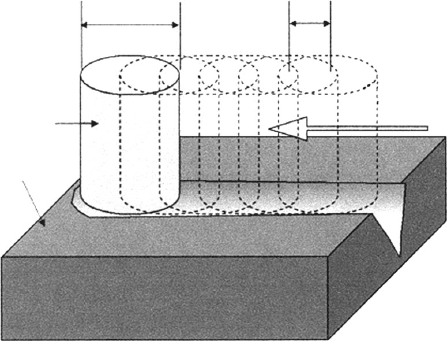
Chapter 2. In a typical FIB system, the beam is sequentially placed at adjacent
positions to form an area of quadrilateral or more general shape. The ‘‘beam
size,’’ typically determined by the beam current and system optical properties,
and the ‘‘beam overlap,’’ typically an adjustable parameter, both influence the
quality of the shape and quality of the milled region (Figure 10.1).
Most FIB systems employ digital scanning where the beam is stepped along
pixels to fill out a programmed shape. When imaging, the beam is rastered
across the sample and information generated in the sample in the form of
secondary electrons or ions are synchronously collected to form an image.
When milling or depositing material, the beam is rastered through the pattern
shape for a predetermined time. In order to mill a smooth pattern, the ion
dose delivered to the sample must be uniform. Since the ion beam has a
quasi-Gaussian profile, in order to achieve uniform dose there must be suf-
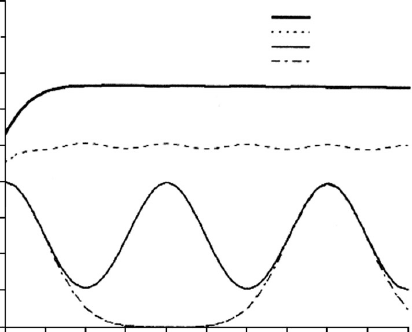
ficient overlap of the pixel spacing. The effect of beam overlap can be seen in
Figure 10.2, where the ion dose uniformity is shown as a function of spatial
distance for different amounts of beam overlap. Assuming the beam shape to
be a Gaussian distribution, with standard deviation , one performs a con-
volution of the beam shape with the pixel spacing, p
s
to calculate the ion dose
spatial variation. As can be seen in the figure, a uniform dose is achieved
when p
s
/ 1.5, although for some applications a p
s
/ 2 might be accep-
table. In most FIB machines the beam overlap is an adjustable parameter
Beam diameter
Pixel spacing
Direction of bea
m
advance
FIB beam
Substrate
Figure 10.1 The ion beam is moved sequentially from one site to another, with
the possibility of overlapping positions. (Courtesy of Ampere Tseng [4].)
Micro-machining and mask repair 269
that can be chosen as a ‘‘percentage of beam size’’ overlap. For a Gaussian,
the ‘‘beam diameter’’ d
b
¼2.35. For p
s
/ ¼1.5 this is equivalent to
p
s
/d
b
¼0.64, or 64% overlap. If the pixel spacing does not have sufficient
overlap, the resulting milled volume will have a bottom with divots, which for
most applications is unacceptable [2,3,4].
10.3 Sputtering
The sputtering process occurs when incident ions onto the sample transfer
sufficient momentum to surface and near-surface atoms to allow them to
escape through collisional cascades [3,5]. The number of sputtered atoms per
incident ion is called the sputter yield, Y . For ions incident perpendicular to
the surface, and without the introduction of reactive gases, such as Cl, I, or
XeF
2
, typically 0 < Y < 5 for energies of ions normally used (35 keV), but
for some materials it can be several times higher. If gases are introduced Y
can increase by as much as 20·.
Often it is useful to express the sputter yield in terms of the volume of
material removed per quantity of incident charge (cubic micrometers, mm
3
,
per nanocoulomb, nC). Typical values of sputter yields for 25 keV Ga
þ
incident ions lie in the range 0.05–0.7 mm
3
/ nC. The advantage of using these
units is the ease afforded in calculating the removal rate (volume removed
2.25
2.00
1.75
1.50
1.25
1.00
0.75
0.50
0.25
0.00
012345678910
Normalized coordinate (x/si
g
ma)
P
s
/sigma = 1.5
P
s
/sigma = 2.0
P
s
/sigma = 4.0
P
s
/sigma = 8.0
Normalized ion intensity
Figure 10.2 Convolution of the beam shape (assumed to be Gaussian) with
different pixel spacings (beam overlap). For a fixed dwell time per pixel, the
curves represent the spatial variation of the ion dose. For the case p
s
/ ¼1.5,
corresponding to a beam overlap of 64%. (Courtesy of Ampere Tseng [4].)
Focused ion beam systems270

per time) by forming the product of incident beam current and the sputter
yield. For example, the sputter yield of Si is 0.27 mm
3
/ nC so that if one were
using a beam current of 100 pA, the sputter rate would be 0.027 mm
3
/s. If a
10 mm square hole 3 mm deep were to be milled, then it would take roughly 3
hours to remove the 300 mm
3
. If, in this example, one were to use a beam
current of 10 nA, the milling time would be a much more reasonable 1.85
min. Table 10.1 gives some measured sputter rates and yields for common
materials of interest [6 ]. The sputter yield Y is calculated from the sputter rate
Y
r
by the relationship
Y ¼ 96:4
m
Y
r
;
where m is the mass (in amu) and is the density of the sample.
Numerous attempts have been made to calculate sputter yields from basic
theory. One model frequently used is that of Sigmund [7]. According to this
model, for ion energies E
0
, the total sputtering yield (integrated over a solid
angle) is given by:
Y
tot
ðE
0
Þ¼
4:2 · 10
14
fiS
n
U
s
½target atoms=primary ion;
where
fi ¼ 0:15 þ 0:13
M
target
M
ion
;
Table 10.1 Sputter yields for selected elements.
Element
Density
(g/cm
3
)
Sputter yield
(mm
3
/nC)
Sputter yield
(atoms/ion)
C (diamond) 3.57 0.18 2.73
Al 2.7 0.30 2.89
Si 2.33 0.27 2.08
Ti 4.5 0.37 3.35
Cr 7.19 0.09 1.20
Zn 7.13 0.34 3.57
Ge 5.32 0.22 1.55
Se 4.81 0.43 2.52
Mo 10.2 0.12 1.32
Ag 10.5 0.42 0.92
Sn 5.76 0.25 1.17
W 19.25 0.12 1.22
Pt 21.47 0.23 2.44
Micro-machining and mask repair 271
and
S
n
¼ 8:462s
n
ð"Þ
M
ion
M
ion
þ M
target
Z
ion
Z
target
ðZ
2=3
ion
þ Z
2=3
target
Þ
1=2
;
and U
s
is the surface potential. The ‘‘reduced energy’’ " and the ‘‘reduced
nuclear cross section’’ s
n
are given by
" ¼
aM
sample
E
Z
ion
Z
sample
e
2
ðM
ion
þ M
sample
Þ
½E in ergs;
and
S
n
ð"Þ¼
0:5lnð1 þ "Þ
" þ 0:14"
0:42
;
where a is the Thomas–Fermi radius (in angstroms), and a ¼ 0:468
ðZ
2=3
ion
þ Z
2=3
sample
Þ
1=2
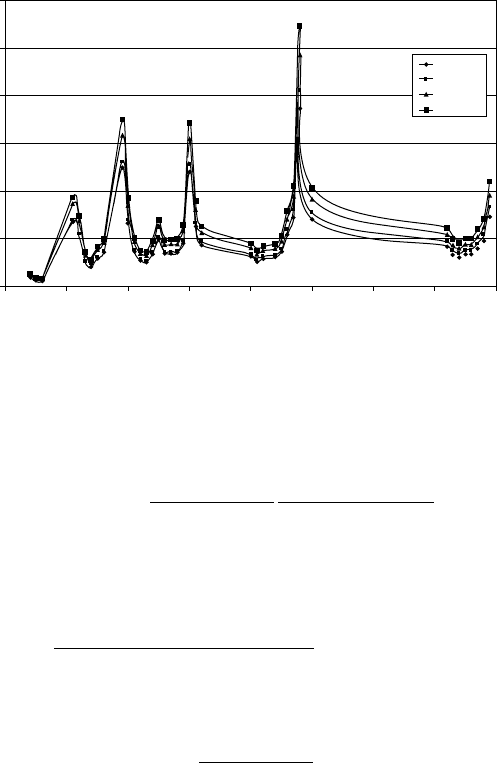
. Extensive tables [2] can be found for these quantities, and
an illustration of the dependence of sputtering on the incident energy and
sample composition is shown in Figure 10.3.
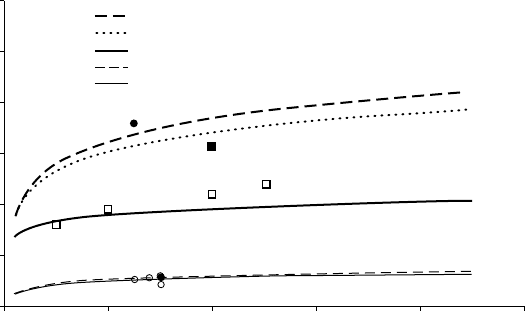
The dependence of sputter yield on incident energy is shown in one
example in Figure 10.4, where it can be seen that there is an increase in yield
with increasing energy that levels out somewhere near 40 keV [3,4]. This is
due to the deeper penetration depth of the ions, where the collisional cascades
are generated too deep to transfer sufficient energy to atoms to escape from
the surface.
60.0
50.0
40.0
30.0
20.0
10.0
0.0
0 1020304050607080
Atomic number of substrate
Sputter yields
Ga 30 kV
Ga 50 kV
In 30 kV
In 50 kV
Sputter yield
Figure 10.3 From the Sigmund model, calculated sputter yields for 30 keV
and 50 keV Ga and In impinging on solid mono-elemental substrates [2].
Focused ion beam systems272
The sputtering yield is also dependent upon the incident angle of the ion
beam to the surface. In the Sigmund model the angular sputter yield
dependence is
Yð2Þ¼Yð0Þcos
f
ð2Þ;
where f is a constant depending on the mass ratio M
sample
/M
ion
. Simulations
of this effect and experimental data are shown in Figure 10.5. This depen-
dency can be used to advantage when milling shapes near edges [2].
10.4 Redeposition
One deleterious complication to milling is the redeposition of sputtered
material into the volume that is being milled [3,4]. In conventional large-scale
machining, the swarf is carried away by liquid or air streams. In FIB milling,
the redeposition is very dependent on the milling strategy used. It has been
shown that for the same total dose incident onto a sample, that repeated
scans to mill a rectangular area cause less redeposition than a single slow
pass. In the case of a single slow scan, redeposited material is not removed,
while for many repeated scans some fraction of the redeposition is milled
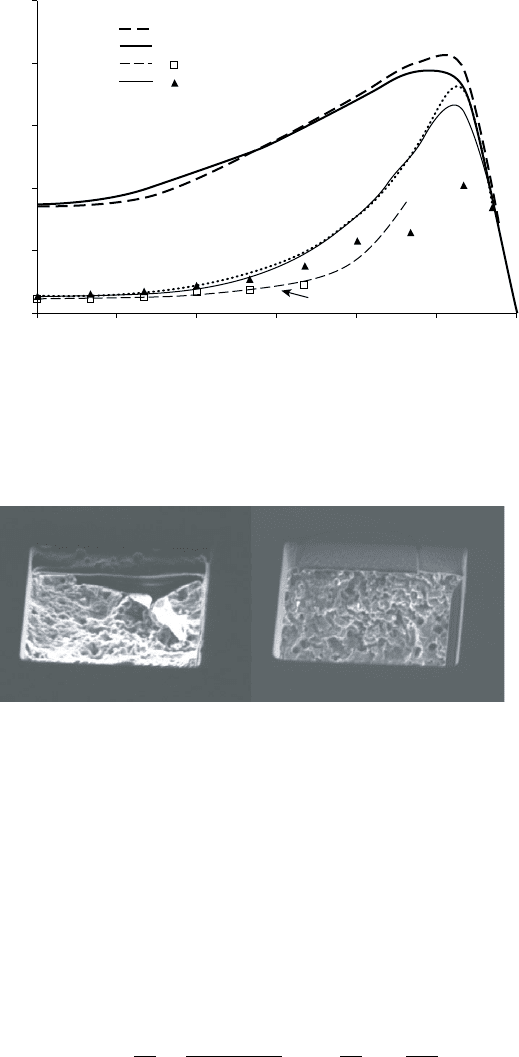
away by the primary beam. Figure 10.6 shows this effect.
These results can be understood partially by a simple geometrical analysis.
Consider milling a groove in one dimension of width d and height h,as
30
Sputtering yield (atoms/ion)
25
20
15
10
5
0
0 20 40 60 80 100
Ion ener
gy
(keV)
Ion/target TRIM Experiment
As/Au
a: [12]; b: [13]
c: [14]
d: [18]; e: [15]; f: [16]
g: [17]
a
b
c
d
f
g
e
Ga/Au
Ar/Au
As/Si
Ga/Si
Figure 10.4 Theoretical curves and experimental data points of sputtering
yield dependence on the energy of the incident ion for several ion/target
combinations. (Courtesy of Ampere Tseng [4].)
Micro-machining and mask repair 273
shown in cross section in Figure 10.7. Assuming that the sputtered efflux has
a cosine distribution, and falls off as 1/r, and that the sticking coefficient is
unity for the F
0
atoms/length emitted, then it can be shown that the flux
density of sputtered material from the bottom redeposited onto a sidewall at
a height h is
FhðÞ¼
F
0
2
Z
cos ’ cos
r
dx ¼
F
0
2
h
Z
d
0
xdx
r
3
;
(a) (b)
Figure 10.6 SEM photos of 5 mm · 5 mm milled boxes in Si by 30 keV Ga
þ
for the same total dose in each case. Box (a) was mil led with a single pass of
the ion beam, box (b) was milled with 50 passes. Both milled boxes are
viewed at 45
.
50
Sputtering yield (atoms/ion)
40
30
20
10
0
03015 45 60 75 90
Incident an
g
le (de
g
rees)
correlation: cos
–2
30 keV
θ
Ion/target TRIM Experiment
As/Au
[17]
[19]
Ga/Au
As/Si
Ga/Si
Figure 10.5 Angular dependence of sputtering yield of As and Ga ions onto
Si and Au. (Courtesy of Ampere Tseng [4].)
Focused ion beam systems274
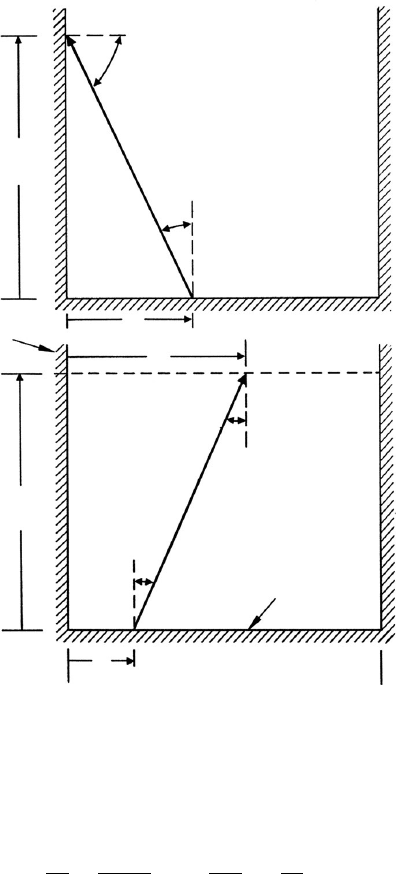
and the flux density of atoms that escape is
Fx
0
ðÞ¼
F
0
2
Z
cos
2
r
dx ¼
F
0
h
2
2
Z
d
0
dx
r
3
;
where x
0
is the distance from the sidewall. The total flux onto a sidewall and
the escaping flux are given by
Q
wall
¼
Z
h
0
FðhÞdh;
x = 0
x
x =
d
x = 0
x = d
x
θ
θ
θ
ϕ
x
(a) Wall flux
(b) Escaping flux
Au Substrate
Resist mask sidewall
r
r
h
h
Figure 10.7 Geometry used for calculation of redeposition effects.
Micro-machining and mask repair 275
and
Q
lost
¼
Z
h
0
FðxÞdx:
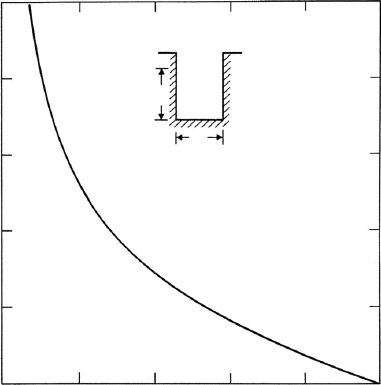
The redeposition for the case of two sidewalls forming a groove of aspect
ratio h/d is shown in Figure 10.8. Clearly the aspect ratio is an important
parameter to consider when milling a volume.
10.5 Channeling
Another effect that can cause complications when micro-machining is due to
channeling [3,5]. As discussed in Chapter 3, channeling occurs in crystalline
materials where ions can penetrate deep into low index directions, interacting
so deep that sputtering cannot happen. In polycrystalline materials, this
means that low index crystals will not sputter as rapidly as others, resulting in
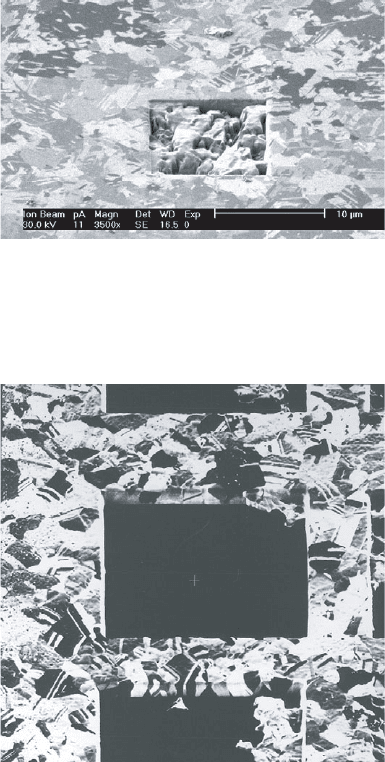
differential milling rates in mono-elemental samples. Figure 10.9 shows the
result of milling into polycrystalline Cu with 30 keV Ga
þ
.
The uneven bottom in the milled volume is due to differential sputtering
rates of the microcrystals, and not redeposition.
2.5
2.0
h
d
1.5
1.0
0.5
0
0.1 0.2 0.3 0.4 0.5
Normalized deposition rate, F/F
0
Normalized height, h/d
Figure 10.8 Normalized redeposition effect. Here F is the flux of sputtered
atoms that escape without striking the walls.
Focused ion beam systems276
There are remedies for reducing or nearly completely eliminating chan-
neling. One method is to introduce a gas near the sample surface. The
channeling axes are very sensitive to incident ion direction, and the intro-
duction of sufficient scattering centers on the surface can deflect incident ions
enough to eliminate channeling, thus reducing differential milling. This may
happen at the expense of reduced effective milling rate, but can yield good
results (Figure 10.10).
Figure 10.9 A 10 mm square milled in Cu. The uneven bottom is due to the
differential milling rate of the different microcrystals.
Figure 10.10 The same region of Cu milled in Figure 10.9, but with the
introduction of a gas, which uniformly clears the milled area by completely
disturbing the effects of channeling.
Micro-machining and mask repair 277