
Yao N. Focused Ion Beam Systems: Basics and Applications
Подождите немного. Документ загружается.


the interaction of ions with matter. On the basis of the binary-collision
approximation (BCA) Sigmund proposed a linear collision cascade model,
which has been successfully applied in a low-energy density collision [9].
Sigmund’s model is an analytical one. In order to include complex situations
depending on individual ion–solid combinations many researchers developed
simulation codes written by Monte Carlo method as listed in Table 2.1.
Those models were developed in the framework of BCA and resultantly it is
difficult to reproduce experimental phenomena appeared in a high-energy
density collision. In this situation, various molecular dynamics simulation
codes using sophisticated potentials can work well and are listed, too, in
Table 2.1 Monte Carlo (MC) and molecular dynamics (MD) simulation codes discussed
in this chapter.
Section, subsection Name of code
2.2 Basic processes and outline of
theoretical models,
2.2.5 Energy loss SRIM
2.3 Ion implantation and
defect formation,
2.3.2 Ion range and defect distributions
2.3.3 Ion implantation
2.3.4 Defect formation
SRIM, MARLOWE
DYN-TRIM
MD, MARLOWE DADOS
2.4 Sputtering,
2.4.2 Sputtering yield
General scope
Dose dependence of yield and
preferential sputtering
OKSANA, MD, MD & MC
(1) ‘‘Static’’ Monte Carlo (MC)
(a) Crystalline targets
MARLOWE, crystal-TRIM,
COSIPO, ACOCT
(b) Amorphous targets TRIM,
ACAT, SASAMAL,
(2) ‘‘Dynamic’’ Monte Carlo (MC)
TRIDYN, dynamic-SASAMAL
ACAT-DIFFUSE,
(3) MD, thermal spike model,
fluid dy namics
Mass distribution MD/MC-CEM
Incidental cluster-size dependence
of sputtering yield
MD
Sputtering of nonmetals MD(AIREBO)
2.5 Surface morphology stochastic nonlinear continuum
equation based on Sigmund theory
Focused ion beam systems38
Table 2.1. Results predicted by these models and their comparisons with
experimental findings are presented in the respective related subsections.
2.3 Ion implantation and defect formation
2.3.1 General remarks
Ion implantation is a fundamental technique in the fabrication of semi-
conductive devices and has been used for materials modification, too. Defect
formation following ion implantation plays, in general, unpleasant roles in
the above applications but sometimes can be used effectively. This section
presents recent experimental and theoretical findings on ion implantation and
defect formation.
For example, it was recently found that implanted atoms assemble by
themselves into nanoclusters and nanocrystals under thermal annealing and/
or radiation induced processes. The formation of these nanostructures is
closely related to the nanotechnology. In the high-density energy deposition
caused by very heavy ions and cluster ions, nonlinear effects on defect pro-
duction were found. To understand these experimental facts, a combined
code of Monte Carlo (MC), diffusion, and molecular dynamics (MD)
simulation codes were developed. In addition, it is necessary to localize
defects when one fabricates nanostructures with a focused ion beam. Diffu-
sion lengths were measured and an idea to localize the defects was presented.
This chapter includes the above experimental and theoretical results.
2.3.2 Ion range and defect distributions
An ion moving in matter loses its energy by the electronic and nuclear energy
losses and finally stops after the travel of a certain path. The total length of
the path is named as ‘‘range.’’ The atomic collision has a statistical nature
and, therefore, the range statistically distributes with a symmetric Gaussian
distribution around the mean value with a deviation called ‘‘range strag-
gling.’’ The range and the range straggling projected on the incident particle
direction are convenient for practical uses and the values are named ‘‘pro-
jected mean range’’ and ‘‘projected range straggling.’’ The moving ion recoils
one of the constituent atoms, which again strikes with and recoils another
constituent atom. Then, many atomic defects are generated along the passage
of the ion. This defect distribution is also important for the application of
energetic ions to material modifications.
For amorphous targets, the range and the range straggling can be calcu-
lated from the energy loss formulae given in Section 2.2.5. The more reliable
Interaction of ions with matter 39
values of the (projected) range, range and defect distributions can be
obtained by consulting the SRIM code developed by Ziegler et al.[5].
A Monte Carlo simulation code named MARLOWE, which was developed
by Robinson et al. on the basis of the binary collision approximation,
includes the time evolution of cascade collision and can treat the slowing
down both in crystalline and amorphous targets [10]. The code is opened for
researchers’ use and provides the calculation of sizes and shapes of dis-
placement cascades, sputtering, ion ranges, ion reflection, and so on.
In the case of crystalline targets, energy loss and range of an incoming ion
depend strongly on an incident angle against the crystal axis and plane. In a
channeling condition, that is, when the ion is incident along the crystal axis
or plane, the ion passes through the crystal with large impact parameters and
as a result the energy loss is very low compared with that for the amorphous
target of the same constituents. Then, the ion goes through deep inside the
crystal. Therefore, in order to avoid the trouble caused by the channeling
phenomena, ion implantation is usually carried out at an incident-angle
condition of off-axis or off-plane, or random incidence.
2.3.3 Ion implantation
The ion implantation technique has been a key element in the currently
established Si technologies and in the fields of materials modification because
of its well-known advantages, such as low-temperature processing, control of
distribution and concentration of dopants, overcoming solubility limits
which cannot be realized via conventional techniques. Ion implantation
induces mixing of constituent elements, alloy formation, and clusterization
and crystallization in nanometer size in matrix. These processes are very
complex and depend not only on ion-related parameters of species, dose, and
energy but on a high-temperature chemical reactivity between the implanted
and matrix elements.
Related to the nanotechnology, formation processes of nanoclusters and
nanocrystals are one of the most exciting and promising topics. These
nanostructures are evidently produced by thermal annealing and/or radiation
irradiation after ion implantation as schematically shown in Figure 2.1.In
special conditions implanted atoms assemble at interfaces of different
materials and form nanostructures by themselves. A comprehensive review
was made by F. Gonella et al. on several evidences of clusterization of metal
atoms implanted in glass matrices [11,12]. Figure 2.2 shows that the chemical
bond of element implanted into silica glass changes depending on its con-
centration. The introducing criterion of cluster formation of implants in SiO
2
Focused ion beam systems40
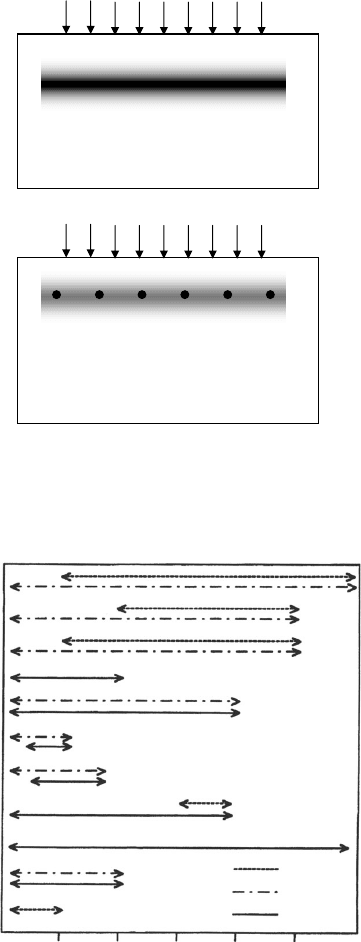
Self-assembling and
nanocluster formation
induced by thermal- and
radiation-induced diffusion
Ion implantation
Figure 2.1 Schematic view graphs of nanocluster/nanocrystal formation.
Ti
Cr
Mn
Co
Ni
Cu
Zn
Pd
Ag
W
Pt
5 10152025
Atomic fraction (%)
silicide
oxide
metal
Figure 2.2 Chemical bonds of the element implanted in silica glass as a
function of its concentration. (Reprinted with permi ssion from Nucl. Instr.
Meth. B, 166– 167 (2000), 831–9. Copyright 2000 Elsevier Science B.V.)
Interaction of ions with matter 41
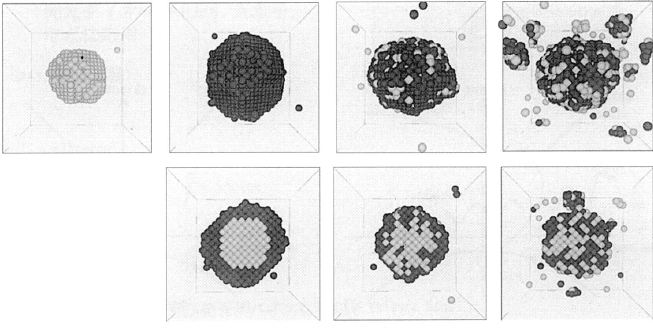
glasses, presented by Hosono, is that the elements which do not react with the
matrix (for example, Ag, Cu, Au, ...) are considered to directly form metallic
precipitates and those which tend to form bonds with O from the silica
network are expected to form clusters when the Gibbs energy for metal oxide
formation is greater than that of SiO
2
at an extrapolated effective tempera-
ture of 3000 K [13]. A more general approach is due to Hosono et al., who
pointed out the importance of the chemical interaction strength among atoms
coming into play in the creation of defects [14].
The preparation of ‘‘mixed’’ nanostructures of different metals, or nan-
ometer-scale core-shell structures, has also generated a worldwide concern
for the possibility of further fabrication of functional nanostructures. Strobel
et al. developed a kinetic 3D lattice Monte Carlo model applicable for
simulating the diffusion, precipitation, and interaction kinetics of sequen-
tially implanted elements X and Y in a chemically inactive matrix [15]. By
applying annealing procedure pre-implanted atoms X form nanocrystals.
Then, implantation of a different type of element Y induces collisional
mixing of atoms. The model predicts that in the case of the following con-
ditions, the elements X and Y form a core/shell structure, shown in Figure 2.3
without making a random distribution of X and Y: if (i) the solubility of Y
exceeds the solubility of X in the matrix, if (ii) the atomic mass of Y is small,
i.e. low collisional mixing, and (iii) for a rather low ion dose rate of Y and/or
(a)
(b)
(b')
(c')
(d')
(c)
(d)
Figure 2.3 Sequence of snapshots from KLMC simulations. (a) The X-type
‘‘core’’ NC. The microstructure of the compound NC after the deposition
of N
Y
¼2N
X
impurities is shown for (b) no mixing, (c) low intensity mixing,
and (d) high intensity mixing. The corresponding cuts through the NCs
(perpendicular to the plane of view) are shown in (b
0
), (c
0
), and (d
0
).
(Reprinted with permission from Nucl. Instr. Meth. B, 148 (1999), 104–9.
Copyright 1999 Elsevier Science B.V.)
Focused ion beam systems42
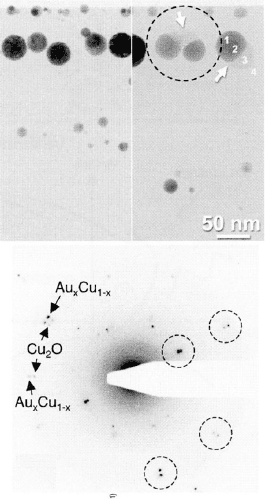
a high second implantation temperature, which favors a compensation of
displacements by thermodynamically driven atomic movements.
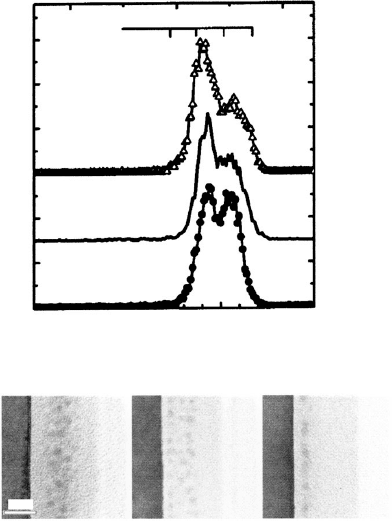
Mattei et al. sequentially implanted Au and Cu ions into silica glass and
annealed the sample in either oxygen or hydrogen atmosphere [16]. They
found that the sequential alloying directly forms alloyed Au-Cu colloids
caused by an enhanced diffusion of copper in small gold clusters during
implantation. Subsequent annealing in hydrogen drives copper atoms dis-
persed in the matrix toward the clusters, increases the Au/Cu concentration
toward the normal 1:1 ratio, and consequently induces the structural
ordering of the alloy. Annealing of the formed Au-Cu alloy nanoclusters in
oxygen atmosphere leads to separation of gold and copper by the possible
reason that Cu is extracted from the nanoclusters by chemical interaction
with the incoming oxygen (Figure 2.4). Another dealloying is caused by
irradiation with light ions, which forms vacancies in the nanocrystal and
(a)
(b)
(c)
Figure 2.4 Bright-field TEM cross-sectional micrograph of the sample
Au
3
Cu
3
H (annealed in H
2
(4%)-N
2
atmosphere at 1173 K for 1 h) (a) before
and (b) after a thermal annealing in air at 1173 K for 15 min. The arrows
indicate some of the two-fold clusters made of a Au-enriched alloy and
Cu
2
O: (c) SAED (selected area electron diffraction) diffraction pattern from
the circular region of part (b). (Reprinted with permission from Phys. Rev.
Lett., 90 (2002), 085502. Copyright 2003 The American Physical Society.)
Interaction of ions with matter 43
resultantly Au diffuses preferentially. A similar procedure of subsequent
implantation of two elements and post annealing was successfully applied by
White et al. for the formation of CdS and CdSe nanocrystals in SiO
2
and
Al
2
O
3
[17].
Klimenkov et al. reported that Ge nanoparticles fabricated by the ion
implantation technique in a SiO
2
thin film crystallize after irradiation with a
high-energy electron beam [18]. The crystallization process depends on
irradiation dose and dose rate. Irradiation with a dose above 3.7 · 10
22
/cm
2
results in cluster growth and above 2.5 · 10
23
/cm
2
in crystallization. An
irradiation with a dose rate below 150 A/cm
2
leads to the crystallization of
Ge nanoparticles in the form of single crystals. For an irradiation dose rate
above this value, the nanocrystals are fragmented into twinned and multiple
particles. Takeguchi et al. proposed a novel method of fabricating size-
and position-controlled Si nanocrystals by scanning an electron beam
intermittently, because the size of the Si nanocrystals depends on the beam
diameter [19].
Similar irradiation effects were found with ions and neutrons. Wang et al.
irradiated intermetallic and ceramic materials with 0.5 to 1.5 MeV Kr
þ
or
Xe
þ
ions [20]. As an example, when a U
3
Si target composed of large grains
tens of micrometers in size and large martensite plates is irradiated above a
critical temperature of 570 K for amorphization, martensite plates disappear
and small grains of < 20 nm in size appear below a dose of 2.7 · 10
15
Kr
þ
/cm
2
and increase in number with increasing dose keeping their sizes. At a dose of
1 · 10
20
Kr
þ
/cm
2
, the sample completely changes to polycrystalline materials
with grains of 20 nm in size. The mechanism of the radiation-induced
nanocrystallization is very complicated and needs a farseeing theoretical
understanding for its versatile application.
Formation of shallow bands of nanoclusters was observed for various
implanted species [e.g., Ge [21], Sn [22], Sb [23]] in the vicinity of a Si/SiO
2
interface. Heinig et al. explained the evolution of the near-interface
nanocluster band by a model taking into account collisional ion-beam mixing
and chemical reactions near the Si/SiO
2
interface [24]. That is, atomic dis-
placements during ion implantation and the action of the Si interface as a
sink for free oxygen result in a Si excess in the first few nanometers of SiO
2
parallel to the interface. Then the excess Si acts as nucleation centers for
diffusing metal, which results in the formation of the near-interface
nanocluster band. The model predicts two prerequisites of a damage rate of
about one displacement per atom at the Si/SiO
2
interface and the diffusion
capability of the implanted impurities for the near-interface nanocluster band
formation. On the other hand, a study of Ge implanted into a SiO
2
film
Focused ion beam systems44
revealed that annealing in hydrogen-containing atmosphere (7% H
2
þ93%
Ar) significantly accelerates the Ge mobility at elevated annealing tempera-
tures (T > 1173 K, t ¼60 min). This results in the formation of very large Ge
clusters (typical size of 30–40 nm) together with a remarkable Ge loss in the
oxide. Klimenkov et al. concluded that by appropriate choice of the post-
implantation treatment conditions, especially the application of two-step
annealing procedure involving low-temperature hydrogen preannealing, the
nanoclusters in the bulk SiO
2
layer can be suppressed (Figure 2.5)[21].
Ignatova et al. studied the sputtering of SiO
2
/Si interfaces with Ga ions by
using secondary neutral spectrometry and found an oscillation of ion-
implanted Ga concentration at SiO
2
/Si interface, that is, the Ga concentration
1200
1300
1400
600
500
400
300
200
100
0
650
700
750
800
Channel
RBS yield
Energy (keV)
Si SiO
2
glue Si SiO
2
glue Si SiO
2
glue
(a) 400 ˚C
(b) 500 ˚C
(c) 600 ˚C
After RTA treatment
with preannealing at
30 20 10 0
Depth
(nm)
(i) (ii) (iii)
10nm
(a)
(b)
Figure 2.5 (a) Ge depth distribution in SiO
2
films with a thickness of 20 nm
after rapid thermal annealing (RTA) treatment and preannealing in 7%H
2
-
Ar atmosphere. (b) The Ge nanocluster formation after three different RTA
steps at 1223 K in N
2
atmosphere is shown: for 30 s with the formation of a
bulk cluster band (i), for 4 min with the additional occurrence of an
interface-near cluster band (ii), and for 12 min with the single –-like cluster
band near the interface (iii). (Reprinted with permission from J. Appl. Phys.,
91 (2002), 10062–67. Copyright 2002 American Institute of Physics.)
Interaction of ions with matter 45
is depleted in a thin SiO
2
region close to the interface and is enhanced in a Si
thin region [25]. The phenomenon cannot be explained by a simple Monte
Carlo simulation based on a binary collision approximation but is explained
well by a dynamic DYN-TRIM simulation which includes additional defect
transport phenomena such as bombardment-induced segregation incorpo-
rated in an existing dynamic Monte Carlo computer code DYNTRIM.
Imanishi et al. studied hydrogen behavior in a Si-implanted SiO
2
sample at
several conditions of dose and annealing temperature for the Si implantation,
on which hydrogen trap sites depend [26]. At the condition of Si nanocrystal
formation, the implanted hydrogen moves to the interface of Si nanocrystal/
SiO
2
matrix through defects and is trapped at the interface passivating Si
dangling bonds.
2.3.4 Defect formation
The defect distribution in the linear cascade collision scheme is discussed in
Section 2.3.2 and can be accurately calculated with the SRIM code developed
by Ziegler et al. In the high-density energy deposition caused by very heavy
ions and cluster ions, the models based on the binary collision approximation
cannot reproduce experimental evidences of nonlinear effect on defect pro-
duction. The nonlinear effect is presently under exciting debate relating to the
nanotechnology, and, therefore, experimental evidences and theoretical
understanding of them are mainly treated in this subsection.
Canut et al. measured damage cross sections for silicon single crystals
irradiated with 200 keV/atom Au
n
þ
clusters and found that the cross section
varies roughly as n
2
[27]. Shen et al. found a similar dependence in the case of
Si irradiated with a fullerene ion [28]. These experimental results provide
evidence for the existence of nonlinear spike effects in high-density collision
cascades. The spike effect cannot be treated by the models based on BCA but
can be done by MD simulation. Molecular-dynamics computer simulation
study was made by Koster et al. for processes occurring in amorphous Si
after irradiation with a projectile with energy E < 500 eV focusing on the
effects of high and low deposited energy density by Au and Si impact [29].
They found that damage production (creation of over- and under-coordi-
nated Si atoms) and recoil implantation are strongly enhanced under Au
impact. The Au impact deposits high-energy density at a local point and
creates a strong collision spike. That is, its center is strongly under-dense – a
‘‘hole’’ appears – and consequently suffers strong tensile pressure, which
induces a compressive shock wave radiating outwards. The process occurs on
a time scale of 0.4 ps and produces abundant defects and relocation of atoms.
Focused ion beam systems46
Relaxation processes follow it, reducing the number of defects formed (of
under-coodinated atoms, in particular) and transporting relocated atoms
back into the vicinity of their original sites. The Si impact does not create
such a collision spike and leads to a low damage production.
A series of MD simulation studies done by Nordlund et al. predicts the
following general trends [30]: Low-mass ions (like Ne in Pt) tend to mostly
produce linear cascades with no large heat spikes. Likewise, cascades in
materials with a low mass or open crystal structure like silicon also do not
exhibit a large surface enhancement of damage production. For heavy ions in
dense, close-packed materials like Ni, Cu, W, Pt, and Au, on the other hand,
a liquid-like state caused by a large heat spike is produced, and the ther-
modynamic and mechanical aspects of materials become important. In this
case, the presence of a surface can strongly affect the behavior of cascades by
hot liquid flow to the surface, microexplosion of the hot liquid zone moved
out to the surface by the inside pressure wave, and coherent displacement. In
addition, a comparison of cascades in pairs of materials (Pt and Au, Ni and
Cu) expected to behave similarly in a ballistic collision revealed that melting
point and elastic hardness of a material are important parameters in deter-
mining the behavior of cascades. Because in all these materials the liquid has
a lower density than the solid, the heat spike formed by local high-energy
deposition leads to the subsequent liquid flow and microexplosion processes.
Then, for similar irradiations, Pt and Ni with relatively high melting points
suffer smaller defects than Au and Cu with low melting points. On the other
hand, semiconductors have open crystal structures, which lead to medium-
energy recoils traveling further than in face centered cubic (fcc) lattices and
thus diminishing the energy density in the heat spike. In addition, since the
density of liquid phase is high compared with that of solid in these materials
and the heat spike tends to relax inwards rather than outwards, making the
‘‘thermodynamic’’ surface mechanisms unlikely to occur. Thus, heavy ions
produce a liquid-like state in dense, close-packed materials and its flow onto
the surface results in a nonlinear sputtering regime and crater formation on
the surface.
Accumulation of defects in a crystal leads to the formation of a local
amorphous zone. Pelaz et al. studied the effects of dose, dose rate, and
implant and annealing temperatures on amorphization resulting from ion
implantation in Si by simulating with a combined code of MARLOWE and
DADOS [31]. They first obtained coordinates of the displaced atoms in the
lattice with MARLOWE [10] which uses the binary collision approximation.
Then, the coordinates were continued in DADOS [32], which is the three-
dimensional kinetic Monte Carlo diffusion code and was improved to include
Interaction of ions with matter 47