
Yao N. Focused Ion Beam Systems: Basics and Applications
Подождите немного. Документ загружается.

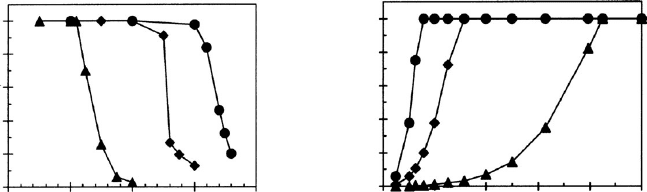
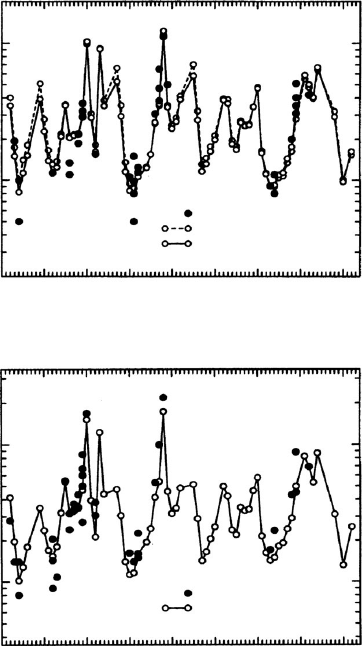
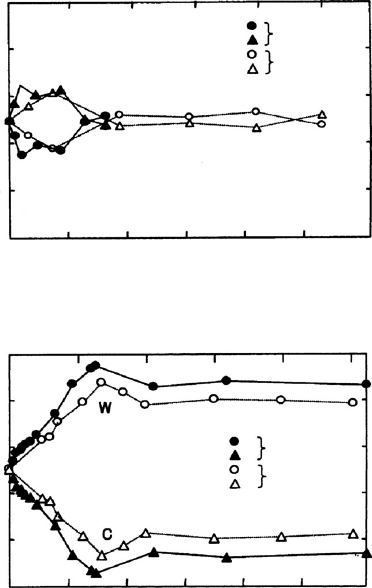
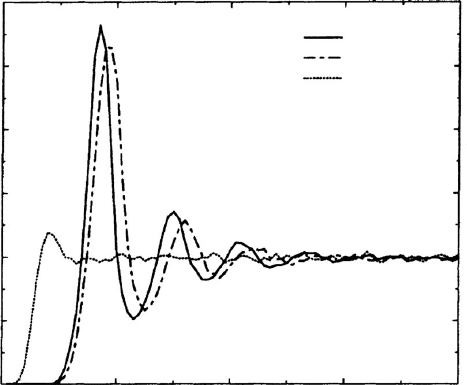
damage ranging from individual defects to continuous amorphous pockets
and layers. Calculated results are shown in Figure 2.6 for a critical transition
temperature where the rate of defect production and annihilation are com-
parable. Here, peak concentration of interstitial–vacancy (I–V) complex is
plotted as a function of implantation temperature and implantation dose. It
reproduces and explains features of the crystalline-to-amorphous transition.
When implantation cascades are annealed independently, many interstitials
escape recombination for a long enough period to contribute significantly to
transient enhanced diffusion (TED). This situation happens at low doses,
high implant temperatures, and low dose rates. At high doses, low tem-
peratures, and high dose rates, the damage is accumulated during ion
implantation. During a high-temperature post-implant anneal, recombina-
tion of Frenkel pairs is efficient and only the extra interstitial generated by
the implanted ion controls TED [33].
It is necessary to localize defects especially for a nanostructure fabrication
with a focused ion beam. Vieu et al. measured the diffusion length of defects
in GaAs/Ga
0.67
Al
0.33
As multi quantum-well layers implanted with Ga
þ
ions
to a dose of 1 · 10
15
ions/cm
2
by means of a photoluminescence (PL)
technique [34]. Obtained values are 65 and 270 nm for the depth and lateral
directions, respectively, at room-temperature implantation. That is, defect
diffusion in the III–V heterostructures occurs much more efficiently in the
lateral direction than in depth. Nonradiative recombination of electron–hole
pairs formed in the GaAlAs barrier layers by the irradiation possibly
enhances the defect diffusion. The fast diffusion of nonequilibrium defects is
drastically reduced, for a liquid nitrogen temperature (LNT) irradiation, to
1.0
0.8
0.4
0.2
0.0
0.6
1.0
0.8
0.4
0.2
0.0
0.6
200 300
400
500
600
Temperature (K)
Peak concentration
(5×10
22
cm
–3
)
Peak concentration
(5×10
22
cm
–3
)
50 ˚C 180 ˚C 250 ˚C
Si
Ge Sn
0246810
Dose (10
14
cm
–2
)
Sn
Ge
Si
(b)
(a)
Figure 2.6 Peak concentration of the I–V complexes for 80 keV, 10
12
cm
2
s
1
implants for Si, Ge, Sn ions. (a) Amorphization is not possible above the
transition temperature at a 10
15
cm
2
dose. (b) A superlinear depend ence is
observed near the amorphizing dose. (Reprinted with permission from Comp
Mater. Sci., 27 (2003), 1–5. Copyright 2002 Elsevier Science B.V.)
Focused ion beam systems48
values of 36 and 70 nm for the depth and lateral directions, respectively. The
low-temperature implantation is inevitable for localizing the implantation-
caused damages in the advanced nanostructure fabrication.
2.4 Sputtering
2.4.1 General remarks
In a low energy region where the nuclear collision process is dominant over
the electronic one, an incident ion makes a kinetic collision with an atom in a
solid and transfers a part of kinetic energy to the atom. The recoiled atom
successively collides with another atom and induces a cascade collision
process. During the process some of the recoiled atoms are ejected from the
solid surface as mostly neutral particles and partly positively or negatively
charged ions. Sigmund developed an analytical formula called the linear
collision cascade model which successfully describes the sputtering process
[9]. In a high-deposit energy condition, the recoiled atoms collide with not
only stationary atoms but moving atoms, and as a result the colliding local
region attains a thermal equilibrium. A thermal spike and a shock wave
model were proposed to describe the process in the condition that the atoms
behave collectively and the linear cascade collision process cannot be applied
anymore. Recently, several simulation codes have been developed using
Monte Carlo treatment, dynamic Monte Carlo treatment, molecular
dynamics, combined treatment of Monte Carlo and molecular dynamics, rate
equation, and so on. These models successfully reproduce the experimental
results on yields, emission energies, and angular distributions sputtered from
metal targets. Some of them cover mass spectra and yields of sputtered
neutral and ionized clusters.
On the other hand, in the cases of semiconductive and insulating materials,
even in the nuclear-collision-dominant low energy region, the electronic
collision process contributes to the sputtering process in a complex way and
the sputtering mechanism is material dependent and different from that
applied for the metals. In spite of the importance of such materials as
semiconductor, insulator, and organic- and bio-molecules, reliable models
are, therefore, very few.
Many excellent publications reviewed the experimental results and the
mechanisms of the sputtering process in the case of metal targets [35–38].
However, descriptions have been scarcely devoted space on dose and dose
rate dependences, an incident cluster effect, chemical and deposition effects,
and incident particle broadening (dispersion) that will become important for
Interaction of ions with matter 49

the focused ion beam process. This section is focusing on the experimental
and theoretical details of the above mentioned various effects on sputtering.
2.4.2 Sputtering yield
General scope
The sputtering yield, Y, is defined as the average number of atoms removed
from a solid surface per incident particle, and is given by Y ¼
P
Y
i
for multi-
elemental materials, where Y
i
is a partial sputtering yield for the element i.
Energy and angular distributions of sputtered particles are given by
@
3
Y=@K@˜
2
with an emission energy K and a solid angle ˜. The sputtering yield
depends on the following various parameters: incident ion (mass, energy, dose
rate, angle of incidence, and clustering), target materials (masses and fractions
of atoms, crystallinity, crystal orientation, surface binding energies, con-
ductivity, surface curvature), and so on. A threshold energy is about 20–40 eV
for normally incident ions and the yield generally increases with incident energy
having a broad maximum in the energy region of 5–50 keV. Sigmund developed
an analytical theory describing the linear collision cascade [9]. According to the
theory, the sputtering yield is given by the simple formula
YðE; ; dÞ¼
0:042F
D
ðE; ; dÞ
NU
0
; ð2:27Þ
where F
D
is the deposited-energy depth distribution, d the depth of the sput-
tering surface from the entrance point of the projectile, E the projectile energy,
the angle of incidence to the surface, N the density of the target material, and U
0
the average surface-binding energy. For backward sputtering at perpendicular
incidence, the formula is simplified into
Y ¼
0:042fi M
2
=M
1
ðÞS
n
ðE; Z
1
; Z
2
Þ
NU
0
; ð2:28Þ
where S
n
is the nuclear stopping power and fi is a function depending on the
mass ratio between the target (M
2
) and projectile (M
1
) atoms.
The linear collision cascade theory predicts the yields very well for light
targets, but for heavier targets, in particular in combination with heavier
projectiles, the yield increases substantially faster with Z
1
than that predicted
by the theory. The density and binding effects in sputtering by ions of Ne, Ar,
and Xe were studied by Shulga using the code OKSANA which is based on
the binary collision approximation and takes into account weak simulta-
neous collisions at larger distances [39]. The ion energy and target cover
ranges from 100 eV to 100 keV and from Mg to U, respectively. The linear
Focused ion beam systems50

cascade theory describes correctly the binding and mass effects at an incident
energy higher than 1 keV but fails to include the density effect. To study the
binding and density effects the following fitting functions are applied:
Y ¼ A
N
p
U
q
0
ðS
L
U
0
Þ; ð2:29Þ
and
Y ¼ A
N
p
U
q
0
ðS
H
U
0
Þ; ð2:30Þ
where S
L
¼ð3=4
2
Þðfi M
2
=M
1
ðÞK
m
=U
0
Þ; (applied at the incident energy less
than 1 keV) and S
H
¼ 0:042fi M
2
=M
1
ðÞS
n
ðE; Z
1
; Z
2
Þ=NU
0
; A, p, and q are fitting
parameters; and K
m
is the maximum transferred energy in the binary colli-
sion. The sputtering yield is shown in Figure 2.7 as a function of target
atomic number. The calculated data are obtained by applying the effects to
the Sigmund’s linear cascade theory.
For ion bombardment at an oblique angle of incidence the sputtering yield
increases monotonically with increasing angle of incidence up to a maximum
near 60–80
. A dependence on the angle of incidence is expected to be given
by Yð Þ=Yð0Þ¼1= cos
fl
, where is measured from the surface normal. But
surface morphology influences the reproducibility of the experimental data
and the dependence is not clear. For single crystals the sputtering yields
depend also on the direction of particle incidence relative to the crystal
orientation.
Particles sputtered from a solid surface during particle bombardment are
mostly neutral atoms emitted with a cosine like angular distribution and with
a broad energy distribution that peaks at a few eV, about half the surface
binding energy. A small fraction of the sputtered particles are clusters con-
taining up to some 100 atoms. A very good review was presented by Betz
and Wien on the energy and angular distributions of atomic, molecular, and
cluster particles sputtered from solid surfaces under ion bombardment [38].
Experimental data are often compared with the Sigmund–Thompson
distribution as described by [9]
d
3
Y
dKd
2
˜
/
K
K þ U
0
ðÞ
32m
cos 2; ð2:31Þ
where 2 is the polar angle of the emitted particles with respect to the surface
normal and m is an adjustable parameter close to 0.
Interaction of ions with matter 51
In the case of single crystalline targets, the angular distribution is strongly
affected by the surface structure. Rosencrance et al. measured energy-
resolved angular distributions for Ni and Rh atoms desorbed from Ni and
Rh fcc{001} single crystals bombarded by keV Ar
þ
ion and found that the
experimental spectra for the two elements are almost identical, implying that
the crystal and surface structures dominate the ejection process [40]. From
the comparison between the experimental results and the MD calculations
which are based on the molecular-dynamics/Monte Carlo corrected effective-
medium interaction potential, it was found that about 90% of the ejected
10
1
10 20 30 40 50 60 70 80 90
Target atomic number
10 20 30 40 50 60 70 80 90
Tar
g
et atomic number
10 keV Ar → different targets, normal incidence
polycrystalline & amorphous
S (atoms/ion)
10
1
S (atoms/ion)
1 keV Ar → different targets, normal incidence
polycrystalline & amorphous
experiment
experiment
Eq. (2.30)
Eq. (2.29)
Eq. (2.30)
(a)
(b)
Figure 2.7 The experimental yield data for (a) 1 keV and (b) 10 keV Ar and
their fits by (2.29) and (2.30). (Reprinted with permission from Nucl. Instr.
Meth. B, 195 (2002), 291–301. Copyright 2002 Elsevier Science B.V.)
Focused ion beam systems52
atoms originate from the first top layer and at least three major ejection
mechanisms exist for the surface depending on the sequential collisions
between atoms on (i) the first top layer, (ii) on the first and second layers, and
(iii) on the first and third layers. The dominant mechanism of ejection is the
above second case.
As described thus far, the main parts of the sputtering phenomena can be
physically understood by the analytical linear cascade models and by the
associated computer simulation schemes of binary-collision approximation
and Monte Carlo treatments. That is, these models can represent well the
experimental results as far as the energy deposit to the target is small enough
to be treated in the linear cascade regime and the contribution of the elec-
tronic excitation is small. In the case of high-energy deposition, various
phenomena have been observed as spikes, large cluster emission, chemical
effects, and so on, which cannot be explained in the linear cascade regime.
Therefore, the further understanding of these sputtering phenomena needs
the molecular dynamic treatment, because these phenomena contain many-
body interactions, electron–phonon coupling, and internal excitation of the
limited region. In addition, some of the MD calculations were applied to the
problems of bulk-binding energy and single-crystal sputtering, and further to
the understanding of preferential sputtering and electronic sputtering. These
will be discussed at each subsection described below.
Dose dependence of yield and preferential sputtering
Various BCA codes have been developed on the basis of the linear collision
cascade theory for crystalline targets (named MARLOWE [10], COSIPO
[41], ACOCT [42], crystal-TRIM [43], etc.) and for amorphous targets
(named TRIM [5], ACAT [44], SASAMAL [45,46], etc.). These codes do not
take into account compositional changes caused by the collision cascades and
are called ‘‘static’’ Monte Carlo (MC) code. The ‘‘dynamic’’ codes (named
TRIDYN [47], ACAT-DIFFUSE [44], dynamic-SASAMAL [45,46], etc.) are
improved to treat the compositional changes during the ion bombardment
and can reproduce the dose dependence of depth profiles of implanted ion
and preferential sputtering. An example of calculations by the dynamic-
SASAMAL code for Ar ion incidence, as shown in Figure 2.8, is the effect of
mass ratio of two components on the preferential sputtering [45,46]. The
TRIDYN code predicts that implantation of heavy ions into light materials
(low atomic number) leads to oscillations in partial sputtering yields as a
function of incident dose [47], as shown in Figure 2.9. In the BCA regime, the
kinetic energy is effectively transferred to atoms with similar mass as the incom-
ing particle. In addition, lower-mass atoms have larger ranges in the solid than
Interaction of ions with matter 53
heavier atoms, so that lighter atoms are depleted in the solid at the depth of
maximum energy deposition. As a result the lighter atoms are in general
preferentially sputtered at the surface.
Besides those reasons based on the BCA regime, factors influencing pre-
ferential sputtering are different binding energies of different atoms at the
surface, segregation of one element at the surface, and diffusion in the
implanted layers of the solid. These preferential sputtering have been studied
in more detail with various simulation codes such as molecular dynamic
treatment, thermal spike model, and fluid dynamics calculation [48–52]. An
example of sputter preferentiality and partial sputter yields calculated by
molecular dynamics simulation [49] is presented in Table 2.2. The results
100
80
60
40
20
0
0
50 100
150
200 250
300
Sp. loss (Å)
S
p
. loss (Å)
Concentration (at.%)
01020304050
01020304050
Dose (× 10
16
cm
–2
) for 3 keV Ar
Dose (× 10
16
cm
–2
) for 3 keV Ar
1 keV Ar
3 keV Ar
1 keV Ar
3 keV Ar
100
80
60
40
20
0
0
20
40
60
80
100
120
Concentration (at.%)
(a)
(b)
Si
C
Figure 2.8 Change of surface atomic concentration in SiC (a) and WC (b)
during 1 and 3 keV Ar sputtering. (Reprinted with permission from Nucl.
Instr. Meth. B , 190 (2002), 256–60. Copyright 2002 Elsevier Science B.V.)
Focused ion beam systems54
show that the sputter preferentiality in the Cu-Au alloy is mainly caused by a
mass difference rather than a binding energy and furthermore an enhanced
sputter preferentiality of Cu atoms for an ordered Cu
3
Au alloy compared to
a disordered alloy demonstrates a strong influence of local ordering on
sputtering emission.
Mass distribution
Mass distributions of emitted neutral large clusters have been systematically
measured by Wucher group using a post ionization method with a laser
induced single ionization technique [53,54]. Obtained cluster yields are very
large and have power law dependences n
–
on the cluster size n. The exponent
– depends on wavelength of ultraviolet, and the respective values for 193 nm
and 157 nm of ArF and F
2
lasers are Al (8.6, 7.7), Ag (6.0, 5.3), Nb
(—, 8.1), and Ta (—, 8.5). Further, the exponent depends on the total
sputtering, as shown in Figure 2.10. Start and Wucher carefully corrected the
apparent cluster yields on size dependent detection efficiency, and found that
a power-law yield distribution for In clusters by 15-keV Xe incidence has two
3
2.5
2
1.5
1
0.5
0
010203040
Dose (× 10
16
W cm
–2
)
Y
w
, W partial sputtering yield
W → Be
W → C
W → Si
10 keV W → Be, C, Si
normal incidence
Figure 2.9 Dose dependence of partial sputtering yield of W. Be, C, and Si
are bombarded with 10 keV W at normal incide nce. (Reprinted with
permission from Nucl. Instr. Meth. B, 171 (2002), 435–42. Copyright 2000
Elsevier Science B.V.)
Interaction of ions with matter 55
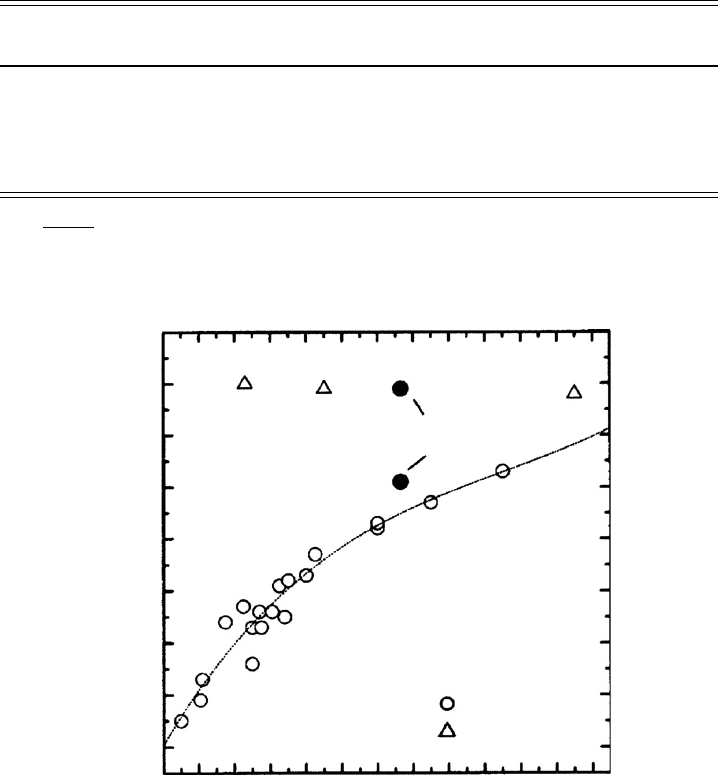
Table 2.2 Sputter preferentiality – calculated by a molecular dynamics simulation.
(Reprinted with permission from Nucl. Instr. Meth. B, 1999, 152, 459–471. Copyright
1999 Elsevier Science B.V.)
Ordered- Disordered- Disordered- Disordered-
Cu Au Cu
3
Au Cu
3
Au Cu
3
Au
0
b
CuAu
3
Y
Cu
5.12 – 3.31 3.65 3.61 1.24
Y
Au
– 4.44 1.20 0.85 1.23 3.31
Y
tot
5.12 4.44 4.51 4.50 4.84 4.55
Y
Cu
/Y
Au
– – 2.76 4.30 2.94 0.38
–(%)
a
– – 176.4 43.3 2.0 12.7
a
¼
Y
Cu
C
s
Au
Y
Au
C
s
Au
1;c
s
i
: atomic concentration at surface.
b
Au
0
: an artificial light mass of Au.
1
2
3
4
5
6
7
8
9
024
6
8
10
12
14 16
18
20
22
24
Total sputter yield Y
tot
Our group
Rehn et al.
Exponent δ
In
Figure 2.10 Compilation of power-law exponents extracted from cluster
yield distributions versus total sputtering yield Y
tot
. The In data (solid
symbols) have been determined by correcting the cluster-size-dependent
detection probability: the remaining exponents (open symbols) are non-
corrected values for Ag, Cu, Al, Ge, Nb, and Ta. For comparison, the Au
data of Rehn et al.[55] have been included. (Reprinted with permission from
Phys. Rev. B, 66 (2002), 075419. Copyright 2002 The American Physical
Society.)
Focused ion beam systems56
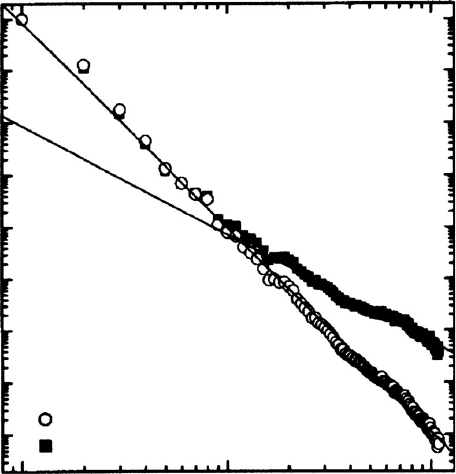
decay components of 3.9 for small (n 20) and 2.1 for large (20 n
100) clusters (Figure 2.11)[54]. On the other hand, Rehn et al. measured size
distributions of very large clusters (n 500) by a transmission electron
microscope (TEM) and obtained a power law dependence of cluster yield
with a rather low value of exponent of 2, which is independent of total
sputtering yield as shown in Figures 2.10 and 2.12 [55]. These results are
explained in the following way: the inverse-square dependence reveals that
the very large clusters are produced when shock waves, generated by sub-
surface displacement cascades, impact and then they ablate the surfaces
[56,57]. Many smaller clusters detected with the post ionization method can
result from the break up of larger ones, which provides a plausible expla-
nation for the large negative exponents. This idea was simulated by Wucher
et al. with so-called ‘‘molecular dynamics and Monte Carlo-corrected effec-
tive medium potential (MD/MC-CEM).’’ That is, first, the formation of
so-called very large highly excited nascent clusters, is calculated by the MD
1
10
100
Cluster size n
Relative yield
w/o detection prob. correction
with detection prob. correction
In
n
∝n
–3.9
∝n
–2.1
10
0
10
–1
10
–2
10
–3
10
–4
10
–5
10
–6
10
–7
10
–8
Figure 2.11 Relative yields of In
n
clusters sputtered from a pure,
polycrystalline indium surface under bombardment with 15 keV Xe
þ
ions.
The data have been normalized to the partial yield of In atoms. (Reprinted
with permission from Phys. Rev. B, 66 (2002), 075419. Copyright 2002 The
American Physical Society.)
Interaction of ions with matter 57