
Zhang K., Li D. Electromagnetic Theory for Microwaves and Optoelectronics
Подождите немного. Документ загружается.


3.5 Introduction to Network Theory 141
connected at the port j and the other ports are matched, which is the matched
transmission coefficient of the jth port to the ith port of the network:
S
ij
=
b
i
a
j
¯
¯
¯
¯
matched ports
. (3.92)
When the reference plane is moved along the waveguide of a port, the
amplitudes of the inward and outward waves do not change, only the phase
difference of the two waves changes. So the magnitude of the scattering
parameter is independent of the position of the reference plane, and the
angle of the scattering parameter is dependent on the position of the reference
plane.
The scattering matrix and scattering parameters are suitable for the net-
work in the high-frequency, microwave, and light-wave band, in which the
magnitude and angle of the reflection coefficient rather than the voltage and
current are more easy to obtain by means of measurement.
(4) The Relations Among Scattering, Impedance, and Admittance
Matrices.
The ratio of the voltage to the current of the inward wave is the character-
istic impedance, then the ratio of the voltage to the current of the outward
wave must be the negative of the characteristic impedance. The normalized
characteristic impedance is 1. So the ratio of the normalized voltage to the
normalized current of the inward wave is +1, and the ratio of the normal-
ized voltage to the normalized current of the outward wave is −1. Thus the
normalized voltage and the normalized current at the ith port are given by
u
i
= a
i
+ b
i
, i
i
= a
i
− b
i
.
The matrix notation of the above equations are
(u) = (a) + (b), (i) = (a) − (b). (3.93)
Substituting (3.90) into the above equations, yields
(u) = [(I) + (S)](a), (i) = [(I) − (S)](a). (3.94)
Substituting the above equations into (3.82) gives
[(I) + (S)](a) = (z)[(I) − (S)](a).
Right multiplying the both sides of the above equation by (a)
−1
then by
[(I) − (S)]
−1
yields
(z) = [(I) + (S)][(I) − (S)]
−1
.

142 3. Transmission-Line and Network Theory for Electromagnetic Waves
Since
[(I) − (S)][(I) + (S)] = [(I) + (S)][(I) − (S)] = (I) − (S)(S),
then right multiplying and left multiplying the above equation by [(I) −
(S)]
−1
, we have
(z) = [(I) + (S)][(I) − (S)]
−1
= [(I) − (S)]
−1
[(I) + (S)]. (3.95)
Similarly, we have
(y) = [(I) − (S)][(I) + (S)]
−1
= [(I) + (S)]
−1
[(I) − (S)]. (3.96)
(S) = [(z) − (I)][(z) + (I)]
−1
= [(z) + (I)]
−1
[(z) − (I)]. (3.97)
(S) = [(I) − (y)][(I) + (y)]
−1
= [(I) + (y)]
−1
[(I) − (y)]. (3.98)
Equations (3.95)–(3.98) are similar to the relations between the reflection co-
efficient and the impedance or admittance in transmission-line theory, (3.46)
and (3.47). In transmission-line theory, they are complex equations, whereas
in network theory, they become matrix equations. If N = 1, (3.95)–(3.98)
reduce to (3.46) and (3.47). So, a loaded transmission line can be seen as a
single-port network.
The relations among (z), (y), and (S) matrices for multi-port networks
are shown in Table 3.1.
Table 3.1 Relations among (z), (y), and (S) matrices
[(I) + (S)][(I) − (S)]
−1
(z) (z) (y)
−1
or
[(I) − (S)]
−1
[(I) + (S)]
[(I) − (S)][(I) + (S)]
−1
(y) (z)
−1
(y) or
[(I) + (S)]
−1
[(I) − (S)]
[(z) − (I)][(z) + (I)]
−1
[(I) − (y)][(I) + (y)]
−1
(S) or or (S)
[(z) + (I)]
−1
[(z) − (I)] [(I) + (y)]
−1
[(I) − (y)]
3.5.2 The Network Matrices of the Reciprocal, Lossless,
Source-Free Multi-Port Networks
(1) The Reciprocal Network
When the considered region is filled with recipro cal media, including isotropic
media and reciprocal anisotropic media, the equivalent network is a reciprocal
3.5 Introduction to Network Theory 143
network. The matrix of the reciprocal network is a symmetrical matrix, i.e.,
the transposed matrix is equal to the original matrix. This can be proven by
the Lorentz reciprocity theorem of the electromagnetic fields as follows.
In a source-free region V bounded by closed surface S filled with reciprocal
media, the fields on the boundary of the region satisfy the following equation
of the Lorentz reciprocity theorem, refer to Section 1.8:
I
S
(E
1
× H
2
− E
2
× H
1
) · dS = 0, (3.99)
where E
1
, H
1
and E
2
, H
2
denote two sets of fields in the region.
Suppose the ports other than the ith and jth ports of a multi-port net-
work are closed by short-circuit surfaces. In the first case, the transverse
components of the electric and magnetic fields in the ith and jth ports are
E
i1
, H
i1
and E
j1
, H
j1
, resp ectively. In the second case, these are E
i2
, H
i2
and E
j2
, H
j2
, respectively. The equation (3.99) then becomes
Z
S
i
(E
i1
×H
i2
−E
i2
×H
i1
)·dS+
Z
S
j
(E
j1
×H
j2
−E
j2
×H
j1
)·dS = 0. (3.100)
The transverse components of the electric and magnetic fields at the ports
can be written in the form of the product of the normalized voltage or current
and the normalized vectors shown in (3.74) as follows:
E
i1
= e
iT
u
i1
, H
i1
= h
iT
i
i1
, E
i2
= e
iT
u
i2
, H
i2
= h
iT
i
i2
,
E
j1
= e
jT
u
j1
, H
j1
= h
jT
i
j1
, E
j2
= e
jT
u
j2
, H
j2
= h
jT
i
j2
.
Then (3.100) becomes
(u
i1
i
i2
−u
i2
i
i1
)
Z
S
i
(e
iT
×h
iT
)·dS + (u
j1
i
j2
−u
j2
i
j1
)
Z
S
j
(e
jT
×h
jT
)·dS = 0.
(3.101)
Applying the normalization condition of the normalized vectors (3.75), yields
Z
S
i
(e
iT
× h
iT
) · dS = 1,
Z
S
j
(e
jT
× h
jT
) · dS = 1.
Then we have
u
i1
i
i2
− u
i2
i
i1
+ u
ij1
i
j2
− u
j2
i
j1
= 0. (3.102)
According to the impedance matrix equation (3.81),
u
i1
= z
ii
i
i1
+ z
ij
i
j1
, u
i2
= z
ii
i
i2
+ z
ij
i
j2
,
u
j1
= z
ji
i
i1
+ z
jj
i
j1
, u
j2
= z
ji
i
i2
+ z
jj
i
j2
.
Substituting the above relations into (3.102) and simplifying, yields
(i
i2
i
j1
− i
i1
i
j2
)(z
ij
− z
ji
) = 0. (3.103)
144 3. Transmission-Line and Network Theory for Electromagnetic Waves
Since case 1 and case 2 are arbitrary states, the first factor in the above
equation cannot always be zero, so the second factor must be zero, yields
z
ij
= z
ji
, i.e., (z)
T
= (z), (3.104)
where (z)
T
denotes the transposed matrix of (z). We come to a conclusion
that the impedance matrix of a reciprocal network is a symmetrical matrix.
The inverse matrix of a symmetrical matrix is also a symmetrical matrix, so
the admittance matrix is a symmetrical matrix too, and we have
y
ij
= y
ji
, i.e., (y)
T
= (y). (3.105)
The scattering matrix may be expressed as (3.97),
(S) = [(z) + (I)]
−1
[(z) − (I)].
Since [(A)(B)]
T
= (B)
T
(A)
T
, we have
(S)
T
= [(z) − (I)]
T
©
[(z) + (I)]
−1
ª
T
=
£
(z)
T
− (I)
T
¤£
(z)
T
+ (I)
T
¤
−1
.
The unit matrix is a symmetrical matrix, (I)
T
= (I), and (z)
T
= (z). Thus
we have
(S)
T
= (S), i.e., S
ij
= S
ji
. (3.106)
Finally, we come to the conclusion that, when the structure is filled with
reciprocal media, the equivalent network of the structure is a reciprocal net-
work, then the impedance matrix, the admittance matrix, and the scattering
matrix are all symmetrical matrices.
(2) Lossless Source-Free Network
When the considered region is filled with lossless media and is without a
source in it, the equivalent network is a lossless source-free network and must
be composed by reactance or susceptance only. The nature of matrices of a
lossless source-free network is given as follows.
(a) The scattering matrix of a lossless source-free network is a unitary ma-
trix or U matrix, which satisfies the unitary condition or U condition, i.e.,
the transposed conjugate matrix and its original matrix are inverse matrices
with each other:
(S)
†
(S) = (I), (3.107)
where (S)
†
= (S)
∗T
denotes the transposed conjugate matrix of (S).
Proof. Since the normalized characteristic impedance of each port is
1, both the voltage and the current for the inward wave at the ith port are

3.5 Introduction to Network Theory 145
a
i
, and those for the outward wave are b
i
. The total input power and the
total output power of the network are given by
P
in
=
1
2
N
X
i=1
a
∗
i
a
i
=
1
2
(a)
†
(a) and P
out
=
1
2
N
X
i=1
b
∗
i
b
i
=
1
2
(b)
†
(b).
For a lossless, source-free network, the input power must be equal to the
output power, P
in
= P
out
, which gives
(a)
†
(a) = (b)
†
(b). (3.108)
According to (3.90), we have
(b)
∗T
= [(S)
∗
(a)
∗
]
T
= (a)
∗T
(S)
∗T
, i.e., (b)
†
= (a)
†
(S)
†
.
Substituting it into (3.108) and applying (3.90) yields
(a)
†
(a) = (a)
†
(S)
†
(S)(a), i.e., (a)
†
[(I) − (S)
†
(S)](a) = 0.
This equation must be satisfied for an arbitrary inward wave, i.e., (a) is an
arbitrary column matrix, therefore,
(S)
†
(S) = (I).
The U condition of the scattering matrix for a lossless source-free network
(3.107) is proven.
(b) For a reciprocal network, (S)
T
= (S), so we have
(S)
†
= (S)
∗T
= (S)
T∗
= (S)
∗
.
Then for a reciprocal lossless source-free network, (3.107) becomes
(S)
∗
(S) = (I). (3.109)
We come to the conclusion that for a reciprocal lossless source-free network,
the conjugate matrix and its original matrix are inverse matrices with each
other.
(c) The normalized impedance and admittance matrix of a lossless source-
free network are inverse Hermitain matrices,
(z)
†
= −(z), (y)
†
= −(y). (3.110)
proof. Taking the conjugate and the transposition of (3.97), yields
(S)
†
= {[(z) + (I)]
−1
}
†
[(z) − (I)]
†
= [(z)
†
+ (I)]
−1
[(z)
†
− (I)].
146 3. Transmission-Line and Network Theory for Electromagnetic Waves
Substituting it and (3.97) into (3.107), gives
[(z)
†
+ (I)]
−1
[(z)
†
− (I)][(z) − (I)][(z) + (I)]
−1
= (I).
Left multiplying the above equation by [(z)
†
+ (I)] and right multiplying it
by [(z) + (I)], yields
[(z)
†
− (I)][(z) − (I)] = [(z)
†
+ (I)][(z) + (I)].
Expanding this equation, we have
(z)
†
= −(z).
The first equation of (3.110) for (z) is proven, and similarly, the second
equation for (y) can also be proven.
The diagonal elements of an inverse Hermitain matrix are imaginary.
Hence the diagonal elements of (z) and (y), i.e., all of z
ii
and y
ii
are imagi-
nary.
(d) For a reciprocal lossless source-free network, the impedance matrix and
the admittance matrix are symmetrical,
(z)
†
= (z)
∗T
= (z)
T∗
= (z)
∗
, (y)
†
= (y)
∗T
= (y)
T∗
= (y)
∗
.
Then (3.110) reduces to
(z)
∗
= −(z), (y)
∗
= −(y). (3.111)
All the elements of a matrix satisfying the above condition are imaginary.
Hence, all the impedance and admittance parameters of a reciprocal lossless
source-free network are imaginary.
3.6 Two-Port Networks
The simplest and most useful multi-port network is the two-port network
or simply two-port, which has an input port and an output port. In the
equivalent circuit of a two-port network, there are four terminals or two
terminal pairs connected to the outside, so the two-p ort network is also known
as a four-terminal network. A lot of devices are two-port networks, such as
adapters, impedance transducers, filters, amplifiers, attenuators, equalizers,
phase shifters, and so on.
3.6.1 The Network Matrices and the Parameters
of Two-Port Networks
Let N = 2. The impedance matrix, admittance matrix, and scattering matrix
of a two-port are given as follows
·
u
1
u
2
¸
=
·
z
11
z
12
z
21
z
22
¸·
i
1
i
2
¸
, (z) =
·
z
11
z
12
z
21
z
22
¸
, (3.112)
3.6 Two-Port Networks 147
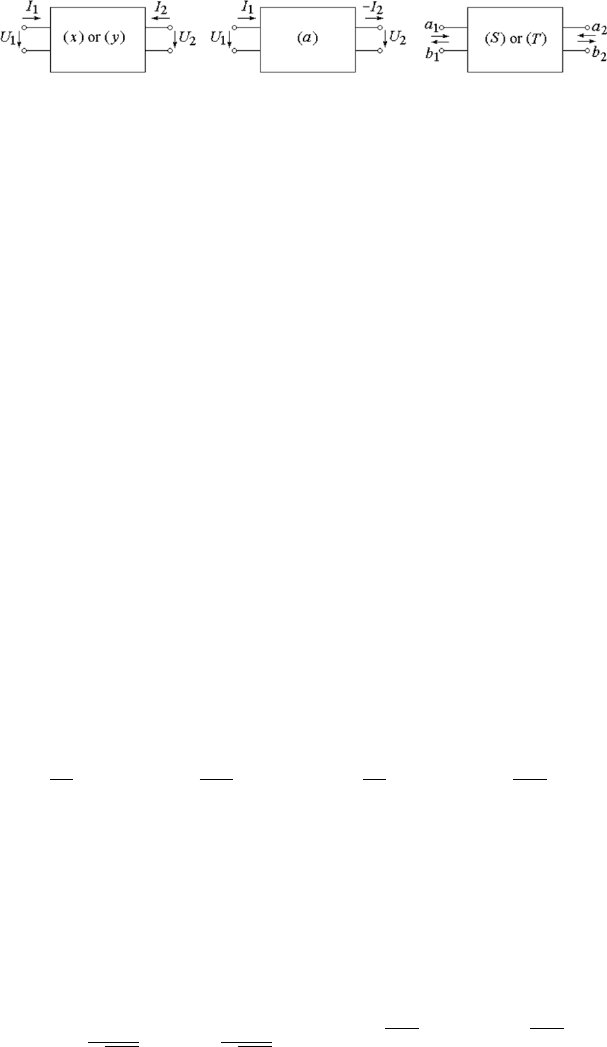
Figure 3.13: Matrices of a two-port network.
·
i
1
i
2
¸
=
·
y
11
y
12
y
21
y
22
¸·
u
1
u
2
¸
, (y) =
·
y
11
y
12
y
21
y
22
¸
, (3.113)
·
b
1
b
2
¸
=
·
S
11
S
12
S
21
S
22
¸·
a
1
a
2
¸
, (S) =
·
S
11
S
12
S
21
S
22
¸
. (3.114)
There are two other network matrices for two-port networks only. They
are the transfer matrix and the transmission matrix.
(1) The Transfer Matrix.
For a two-port network, the voltage and the current at the input port, U
1
, I
1
can be expressed in terms of the voltage and the current at the output port
U
2
, −I
2
as follows:
·
U
1
I
1
¸
=
·
A B
C D
¸·
U
2
−I
2
¸
, (A) =
·
A B
C D
¸
, (3.115)
where the output current −I is chosen instead of I for the convenience of
cascade connection. See Figure 3.13.
The matrix (A) denotes the transfer matrix of a two-port, it is also known
as the ABCD matrix or simply A matrix. The definitions of the transfer
parameters are as follows:
A =
U
1
U
2
¯
¯
¯
¯
I
2
=0
, B =
U
1
−I
2
¯
¯
¯
¯
U
2
=0
, C =
I
1
U
2
¯
¯
¯
¯
I
2
=0
, D =
I
1
−I
2
¯
¯
¯
¯
U
2
=0
,
(3.116)
where A denotes the inverse of the open-circuit voltage amplification factor,
B denotes the inverse of the short-circuit transadmittance, C denotes the
inverse of the open-circuit transimpedance, and D denotes the inverse of
the short-circuit current amplification factor. A and D are dimensionless
quantities, B is in the dimension of impedance, and C is in the dimension of
admittance.
For the normalized voltage and current,
u
1
=
U
1
√
Z
C1
, u
2
=
U
2
√
Z
C2
, i
1
= I
1
p
Z
C1
, i
2
= I
2
p
Z
C2
.
148 3. Transmission-Line and Network Theory for Electromagnetic Waves
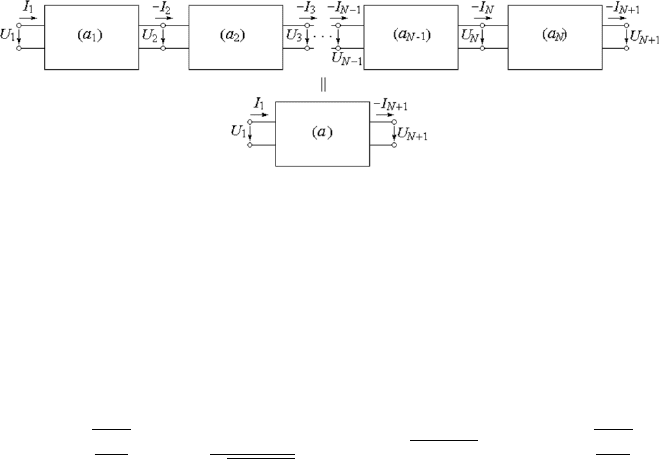
Figure 3.14: Cascade-connected network.
Equation (3.115) becomes
·
u
1
i
1
¸
=
·
a b
c d
¸·
u
2
−i
2
¸
, (a) =
·
a b
c d
¸
, (3.117)
where
a = A
r
Z
C2
Z
C1
, b =
B
√
Z
C1
Z
C2
, c = C
p
Z
C1
Z
C2
, d = D
r
Z
C1
Z
C2
,
and all of them are dimensionless quantities. Matrix (a) denotes the normal-
ized transfer matrix, which is known as the abcd matrix.
The transfer matrix of a two-port network consists of N cascade-connected
networks and is given as
·
u
1
i
1
¸
= (a
1
)
·
u
2
−i
2
¸
= (a
1
)(a
2
)
·
u
3
−i
3
¸
= ······
= (a
1
)(a
2
) ···(a
N
)
·
u
N+1
−i
N+1
¸
= (a)
·
u
N+1
−i
N+1
¸
.
So we have
(a) = (a
1
)(a
2
) ···(a
N
). (3.118)
The transfer matrix of a two-port network consists of N cascade-connected
networks is equal to the product of the transfer matrices of all the elementary
networks, refer to Fig. 3.14.
(2) The Transmission Matrix.
For two-port networks, we may express the inward and outward waves at the
output port in terms of those at the input port as follows:
·
b
2
a
2
¸
=
·
T
11
T
12
T
21
T
22
¸·
a
1
b
1
¸
, (T ) =
·
T
11
T
12
T
21
T
22
¸
, (3.119)

3.6 Two-Port Networks 149
where (T ) is known as the transmission matrix. The order of the left-hand
side is chosen for the convenience of cascade connection. For a cascade-
connected network, the transmission matrix of the network is equal to the
product of the transmission matrices of all the elementary networks:
(T ) = (T
1
)(T
2
) ···(T
N
). (3.120)
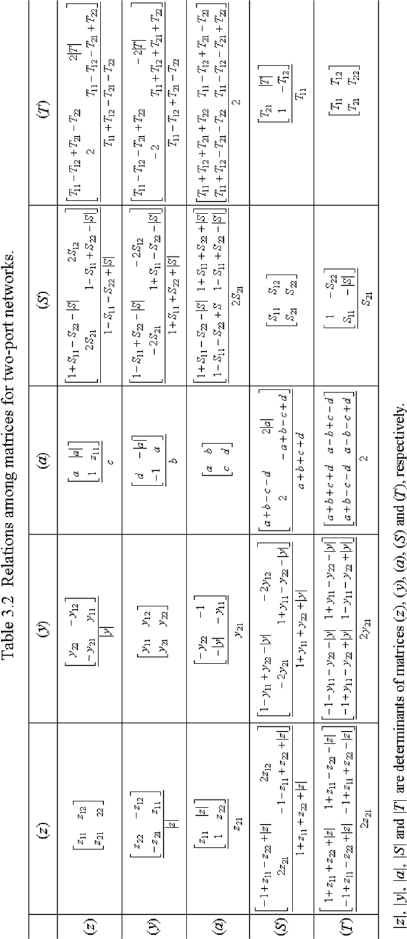
The relations among the above-mentioned five matrices for two-port net-
works are shown in Table 3.2.
3.6.2 The Network Matrices of the Reciprocal, Lossless,
Source-Free and Symmetrical Two-Port Networks
The general features of multi-port networks given in Section 3.5.2 are also
suitable for two-port networks. In addition, some useful features for two-port
networks only are as follows.
(1) The Transfer Matrix of Reciprocal, Lossless and Source-Free
Two-Port Networks.
The relation between (z) and (a) is given as
·
z
11
z
12
z
21
z
22
¸
=
·
a/c ad/c − b
1/c d/c
¸
.
According to (3.111), the impedance matrix of a reciprocal, lossless and
source-free network satisfies
(z)
∗
= −(z).
Hence we have
1
c
∗
= −
1
c
, c
∗
= −c;
d
∗
c
∗
= −
d
c
, d
∗
= d;
a
∗
c
∗
= −
a
c
, a
∗
= a;
a
∗
d
∗
c
∗
− b
∗
= −
ad
c
+ b, b
∗
= −b.
So a and d are real, b and c are imaginary.
(2) The Transmission Matrix of Reciprocal, Lossless and Source-
Free Two-Port Networks.
The relation between (T ) and (a) is given as
·
T
11
T
12
T
21
T
22
¸
=
1
2
·
(a + d) + (b + c) (a − d) − (b − c)
(a − d) + (b −c) (a + d) − (b + c)
¸
.
It shows that all of T parameters are complex, and gives
T
11
= T
∗
22
, T
12
= T
∗
21
. (3.121)
150 3. Transmission-Line and Network Theory for Electromagnetic Waves