
Zhang K., Li D. Electromagnetic Theory for Microwaves and Optoelectronics
Подождите немного. Документ загружается.

4.1 Uniqueness Theorem 181
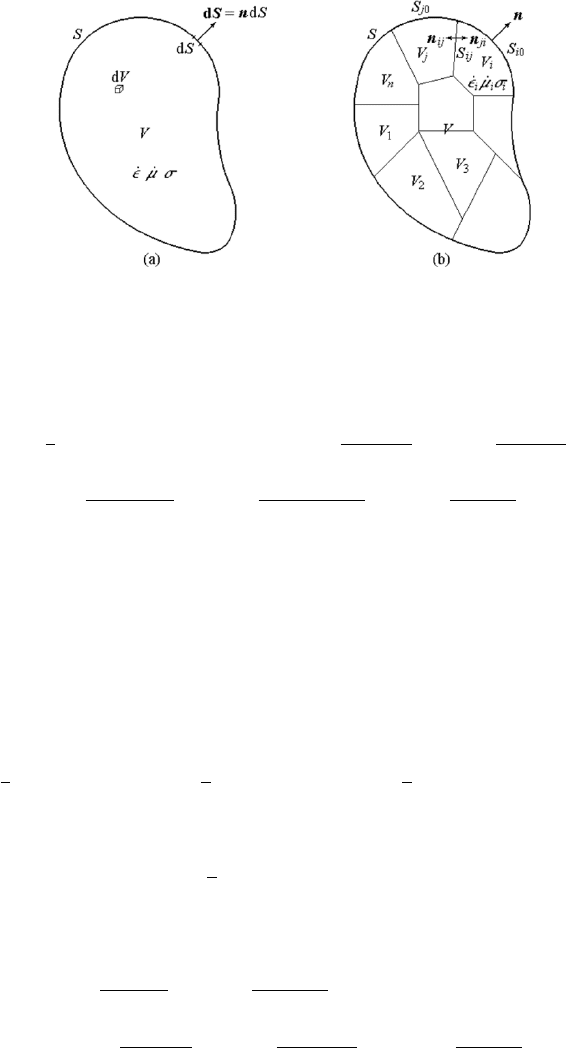
Figure 4.1: (a) Volume of interest, (b) subregions.
from the complex Maxwell equations.
−
I
S
µ
1
2
∆E × ∆H
∗

· ndS = −jω
µ
Z
V
˙²
∗
|∆E|
2
2
dV −
Z
V
˙µ|∆H|
2
2
dV

+
Z
V
∆E · ∆J
∗
2
dV +
Z
V
∆H
∗
· ∆J
m
2
dV +
Z
V
σ|∆E|
2
2
dV. (4.1)
In this equation, ∆J = 0 and ∆J
m
= 0, because the distribution of the
sources in the volume V is given, and
n × ∆E|
S
= 0, or n × ∆H|
S
= 0,
because the tangential component of the electric field or the tangential com-
ponent of the magnetic field on the boundary is given. For any one of the
above two cases, we have
µ
1
2
∆E × ∆H
∗

· n
¯
¯
¯
¯
S
=
1
2
∆H
∗
· (n × ∆E)
¯
¯
¯
¯
S
=
1
2
∆E · (∆H
∗
× n)
¯
¯
¯
¯
S
= 0.
Hence we have
I
S
µ
1
2
∆E × ∆H
∗

· ndS = 0. (4.2)
Then (4.1) becomes
−j ω
µ
Z
V
²
0
|∆E|
2
2
dV −
Z
V
µ
0
|∆H|
2
2
dV

+ ω
µ
Z
V
²
00
|∆E|
2
2
dV +
Z
V
µ
00
|∆H|
2
2
dV

+
Z
V
σ|∆E|
2
2
dV = 0.

182 4. Time-Varying Boundary-Value Problems
The real part and the imaginary part of the left-hand side of the above
equation must be equal to zero separately, which gives
Z
V
ω²
00
|∆E|
2
2
dV +
Z
V
ωµ
00
|∆H|
2
2
dV +
Z
V
σ|∆E|
2
2
dV = 0, (4.3)
Z
V
ω²
0
|∆E|
2
2
dV −
Z
V
ωµ
0
|∆H|
2
2
dV = 0. (4.4)
In this equation, ω, ²
0
and µ
0
cannot be zero, but σ, ²
00
, and µ
00
can be zero in
non-dissipative media. If we suppose some dissipation, however slight, exists
everywhere in the volume V , then at least one of them is positive, and (4.3)
and (4.4) are satisfied only if ∆E = 0 and ∆H = 0 everywhere in the volume
within S. Finally we have
E
1
= E
2
and H
1
= H
2
.
The uniqueness theorem is proved.
The condition, that at least one of σ, ²
00
, or µ
00
is not zero, means that
there must be some dissipation in the volume, no matter how slight, such that
the influence of the initial condition becomes negligible after a long enough
time period, and the steady state can be achieved.
For a lossless region, we consider the fields to be the limit of the corre-
sponding fields in the lossy region as the loss becomes negligible.
We come to the conclusion that a steady-state sinusoidal field in a region
is uniquely specified by the sources within the region plus the tangential
component of E or the tangential component of H over the boundary of the
region. It is also valid if the former over part of the boundary and the latter
over the rest of the boundary.
4.1.2 Uniqueness Theorem for the Boundary-Value
Problems with Complicated Boundaries
Sometimes, it is difficult to write the unified solution when the boundary of
the region is complicated, i.e., the Complicate boundary-condition problem.
In this case, we may divide the whole region into a number of subregions. In
each subregion, the problem becomes a simple boundary-condition problem.
Consider a region of volume V enclosed by the boundary S. The whole
region is divided into subregions V
i
, i = 1 to n. The medium in the subregion
is uniform and its parameters are ˙²
i
, ˙µ
i
, σ
i
. The subregion V
i
is enclosed by
the surface S
i
, which consists of two sorts of surfaces, the outer boundary
of the whole region V denoted by S
i0
, which is a part of S, and the inner
boundary or boundary between subregion V
i
and the adjacent subregion V
j
,
denoted by S
ij
, see Fig. 4.1(b).

4.1 Uniqueness Theorem 183
Theorem
In the steady sinusoidal time-varying state, if the following conditions are
satisfied, the solution of the complex Maxwell equations or Helmholtz’s equa-
tions in a complicated region divided into a number of subregions is unique.
1. The sources, J
i
and J
mi
must b e given everywhere in all the subregions
V
i
.
2. The tangential component of the electric field n×E|
S
or the tangential
component of the magnetic n×H|
S
must be given everywhere over the
outer boundary S =
P
S
i0
.
3. The tangential components of the electric field and the tangential com-
ponents of the magnetic field must both be continuous over the bound-
ary S
ij
, which is known as the field matching condition. i.e.,
n × E
i
|
S
ij
= n × E
j
|
S
ij
and n ×H
i
|
S
ij
= n × H
j
|
S
ij
. (4.5)
Proof
Suppose that both of the two sets of complex vector functions, E
i1
, H
i1
and
E
i2
, H
i2
are solutions of the given boundary-value problem in the subregion
V
i
bounded by a closed surface S
i
. Then the difference functions
∆E
i
= E
i1
− E
i2
, ∆H
i
= H
i1
− H
i2
must satisfy the complex Maxwell equations and are sure to satisfy the com-
plex Poynting theorem.
−
I
S
i
µ
1
2
∆E
i
× ∆H
∗
i

· ndS =−jω
µ
Z
V
i
˙²
i
|∆E
i
|
2
2
dV −
Z
V
i
˙µ
i
|∆H
i
|
2
2
dV

+
Z
V
i
∆E
i
· ∆J
∗
i
2
dV +
Z
V
i
∆H
∗
i
· ∆J
mi
2
dV +
Z
V
i
σ
i
|∆E
i
|
2
2
dV. (4.6)
In this equation, ∆J
i
= 0 and ∆J
mi
= 0, because the distribution of the
sources in the subregion V
i
is given. The equation becomes
−
I
S
i
µ
1
2
∆E
i
× ∆H
∗
i

· ndS = −jω
µ
Z
V
i
˙²
i
|∆E
i
|
2
2
d−
Z
V
i
˙µ
i
|∆H
i
|
2
2
dV

+
Z
V
i
σ
i
|∆E
i
|
2
2
dV. (4.7)
Taking the sum of (4.7) for all the subregions in the volume V , we have
−
n
X
i=1
I
S
i
µ
1
2
∆E
i
× ∆H
∗
i

· n
i
dS =
n
X
i=1
Z
V
i
σ
i
|∆E
i
|
2
2
dV
−jω
Ã
n
X
i=1
Z
V
i
˙²
i
|∆E
i
|
2
2
dV −
n
X
i=1
Z
V
i
˙µ
i
|∆H
i
|
2
2
dV
!
. (4.8)

184 4. Time-Varying Boundary-Value Problems
The closed surface S
i
consists of S
i0
and S
ij
, where S
i0
belongs to V
i
alone,
but S
ij
is shared by V
i
and V
j
. So there are two surface integrals over S
ij
in the summation of the left-hand side, one for V
i
and the other for V
j
. The
positive normal of S
ij
is set as the outward direction of the subregion, so
n
ij
= −n
ji
, and the left-hand side of (4.8) becomes
n
X
i=1
I
S
i
µ
1
2
∆E
i
× ∆H
∗
i

· n
i
dS = −
n
X
i=1
Z
S
i0
µ
1
2
∆E
i
× ∆H
∗
i

· n
i0
dS
+
X
i,j
Z
S
ij
1
2
[∆E
i
× ∆H
∗
i
− ∆E
j
× ∆H
∗
j
] · n
ij
dS. (4.9)
In this equation,
n × ∆E
i
|
S
i0
= 0 or n × ∆H
i
|
S
i0
= 0,
because the tangential component of the electric field or the tangential com-
ponent of the magnetic field is given on the outer boundary S
i0
. For any one
of the above two cases we have
n
X
i=1
Z
S
i0
µ
1
2
∆E
i
× ∆H
∗
i

· n
i0
dS = 0.
According to the conditions given in the theorem,
n × E
i1
|
S
ij
= n × E
j1
|
S
ij
, n × E
i2
|
S
ij
= n × E
j2
|
S
ij
,
n × H
i1
|
S
ij
= n × H
j1
|
S
ij
, n × H
i2
|
S
ij
= n × H
j2
|
S
ij
.
Hence we have
n × ∆E
i
|
S
ij
= n × ∆E
j
|
S
ij
, n × ∆H
i
|
S
ij
= n × ∆H
j
|
S
ij
.
All the above conditions lead to the sum of the surface integral over S
ij
being
equal zero:
X
i,j
Z
S
ij
1
2
[(∆E
i
× ∆H
∗
i
) − (∆E
j
× ∆H
∗
j
)] · n
ij
dS = 0.
So the left-hand side of (4.8) must be zero,
n
X
i=1
I
S
i
µ
1
2
∆E
i
× ∆H
∗
i

· n
i
dS = 0,
and then, the right-hand side of (4.8) must be zero too,
−jω
Ã
n
X
i=1
Z
V
i
˙²
i
|∆E
i
|
2
2
dV −
n
X
i=1
Z
V
i
˙µ
i
|∆H
i
|
2
2
dV
!
+
n
X
i=1
Z
V
i
σ
i
|∆E
i
|
2
2
dV = 0.

4.2 Orthogonal Curvilinear Coordinate Systems 185
The real part and the imaginary part of the left-hand side of the above
equation must be equal to zero separately, which yields
n
X
i=1
Z
V
i
ω²
00
i
|∆E
i
|
2
2
dV +
n
X
i=1
Z
V
i
ωµ
00
i
|∆H
i
|
2
2
dV +
n
X
i=1
Z
V
i
σ
i
|∆E
i
|
2
2
dV = 0, (4.10)
n
X
i=1
Z
V
i
ω²
0
i
|∆E
i
|
2
2
dV −
n
X
i=1
Z
V
i
ωµ
0
i
|∆H
i
|
2
2
dV = 0. (4.11)
These two equations are the same as (4.3) and (4.4), so we have ∆E
i
= 0
and ∆H
i
= 0 everywhere in V
i
, and
E
i1
= E
i2
and H
i1
= H
i2
.
The conclusion is that, if we suppose some dissipation everywhere in the
volume V , no matter how slight. The uniqueness theorem is proved.
4.2 Orthogonal Curvilinear
Coordinate Systems
The solution of a partial differential equation strongly depends on the choice
of coordinate system.
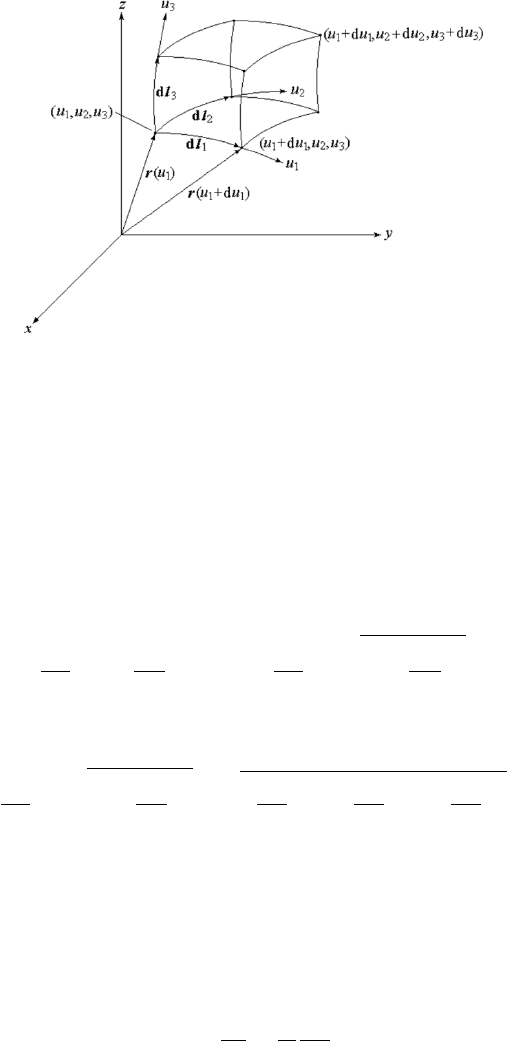
The orthogonal curvilinear coordinate system is a three-dimensional space
coordinate system that consists of three sets of mutually orthogonal curved
surfaces. See Fig. 4.2
A family of curved surfaces in space is defined by
f(x, y, z) = u,
in which u is a set of constants. Consider three families of curved surfaces
that are mutually orthogonal, defined by the following equations:
f
1
(x, y, z) = u
1
, f
2
(x, y, z) = u
2
, f
3
(x, y, z) = u
3
.
The intersection of three of these surfaces, one from each family, defines a
point in space, which may be described by means of u
1
, u
2
, u
3
. Then the u
i
,
i = 1, 2, 3, are defined as the orthogonal curvilinear coordinates of that point.
Note that the u
i
are not necessarily line coordinates.
The direction perpendicular to a constant u
i
surface denotes the curvi-
linear coordinate axis. When the coordinate variable increases from u
i
to
u
i
+ du
i
along the coordinate axis, the corresponding line element vector dl
i
is
dl
i
= r(u
i
+ du
i
) − r(u
i
) =
∂r
∂u
i
du
i
, dl
i
= |dl
i
| =
¯
¯
¯
¯
∂r
∂u
i
¯
¯
¯
¯
du
i
,
186 4. Time-Varying Boundary Value Problems
Figure 4.2: Orthogonal curvilinear coordinate system.
where r is the coordinate vector of the point,
r =
X
j=1,2,3
ˆ
x
j
x
j
=
ˆ
xx +
ˆ
yy +
ˆ
zz,
and x
j
(j = 1, 2, 3) represents the rectangular coordinate variables x, y, and
z, then we have
∂r
∂u
i
=
3
X
j=1
∂x
j
∂u
i
ˆ
x
j
,
¯
¯
¯
¯
∂r
∂u
i
¯
¯
¯
¯
=
v
u
u
t
3
X
j=1
µ
∂x
j
∂u
i

2
.
Let
h
i
=
¯
¯
¯
¯
∂r
∂u
i
¯
¯
¯
¯
=
v
u
u
t
3
X
j=1
µ
∂x
j
∂u
i

2
=
s
µ
∂x
∂u
i

2
+
µ
∂y
∂u
i

2
+
µ
∂z
∂u
i

2
, (4.12)
where h
i
, i = 1, 2, 3, are known as the Lame coefficients or scale factors. The
line-element vector and its magnitude become
dl
i
=
ˆ
u
i
h
i
du
i
, dl
i
= h
i
du
i
. (4.13)
The unit vector of coordinate u
i
is
ˆ
u
i
=
dl
i
dl
i
=
1
h
i
∂r
∂u
i
. (4.14)

4.2 Orthogonal Curvilinear Coordinate Systems 187
The condition of orthogonality of the coordinates is
ˆ
u
i
·
ˆ
u
j
= 0 or
∂r
∂u
i
·
∂r
∂u
j
= 0.
The surface-element vector dS
i
and its magnitude dS in the curvilinear or-
thogonal coordinates are
dS
i
= dl
j
× dl
k
=
ˆ
u
i
h
j
h
k
du
j
du
k
, dS
i
= h
j
h
k
du
j
du
k
, (4.15)
where
ˆ
u
i
=
ˆ
u
j
×
ˆ
u
k
. The volume element dV is
dV = dl
i
· dl
j
× dl
k
= h
i
h
j
h
k
du
i
du
j
du
k
,
where
ˆ
u
i
·
ˆ
u
j
×
ˆ
u
k
= 1. Let
g = h
2
i
h
2
j
h
2
k
= h
2
1
h
2
2
h
2
3
,
we have
dV =
√
g du
1
du
2
du
3
. (4.16)
The vector differential operations in an arbitrary orthogonal curvilinear
coordinate system are obtained similar to those in rectangular coordinate
system by using the above expressions for the line element, surface element,
and volume element.
∇ϕ =
3
X
i=1
ˆ
u
i
1
h
i
∂ ϕ
∂ u
i
(4.17)
∇ · A =
1
h
1
h
2
h
3
3
X
i=1
∂
∂ u
i
(h
j
h
k
A
i
) (4.18)
∇ × A =
¯
¯
¯
¯
¯
¯
¯
¯
¯
¯
¯
¯
ˆ
u
1
h
2
h
3
ˆ
u
2
h
3
h
1
ˆ
u
3
h
1
h
2
∂
∂u
1
∂
∂u
2
∂
∂u
3
h
1
A
1
h
2
A
2
h
3
A
3
¯
¯
¯
¯
¯
¯
¯
¯
¯
¯
¯
¯
=
3
X
i=1
ˆ
u
i
1
h
j
h
k
·
∂
∂ u
j
(h
k
A
k
) −
∂
∂ u
k
(h
j
A
j
)
¸
(4.19)
∇
2
ϕ =
1
h
1
h
2
h
3
3
X
i=1
∂
∂ u
i
³
h
j
h
k
h
i
∂ ϕ
∂ u
i
´
(4.20)
The vector differential operator ∇ is known as nabla op erator, the nabla
operation in some commonly used orthogonal curvilinear coordinate systems
are listed in Appendix B.1.

188 4. Time-Varying Boundary Value Problems
4.3 Solution of Vector Helmholtz Equations in
Orthogonal Curvilinear Coordinates
Rewrite the vector Helmholtz equations,
∇
2
E + k
2
E = 0, (4.21)
∇
2
H + k
2
H = 0, (4.22)
where
k
2
= ω
2
˙µ ˙² − jωµσ. (4.23)
In low-loss media and for a high frequency, σ ¿ ω², i.e., σ ≈ 0, ² and µ are
real,
k = ω
√
µ². (4.24)
According to the expansion of the vector Laplacian operator in a gen-
eral orthogonal curvilinear coordinate system given in Appendix B.1, we can
see that, only in the rectangular coordinate system, the three-dimensional
vector Helmholtz equation will reduce to three scalar Helmholtz equations,
and the three components of the field can be separated in these three equa-
tions. Otherwise, in all other coordinate systems, the three-dimensional vec-
tor Helmholtz equation will reduce to three complicated scalar partial differ-
ential equations, and the three components of the field cannot be separated
in these three equations. Therefore, solving the vector Helmholtz equations
directly and generally will be difficult.
For this purpose, some methods for reducing the three-dimensional vector
Helmholtz equations into scalar Helmholtz equations under certain conditions
are developed. They are the method of Borgnis’ potentials [14, 18, 103], the
method of Hertz’s vector potentials [103], and the method of longitudinal
components [84, 60]. All the methods depend upon the choice of the coordi-
nate system in which the equations are to be solved.
4.3.1 Method of Borgnis’ Potentials [14, 18, 103]
In a source-free region, for the high-frequency and low-loss problems, the
Maxwell curl equations are given by:
∇ × E = −jωµH, (4.25)
∇ × H = jω²E. (4.26)
The equations may be decomposed into component equations in a specific
orthogonal curvilinear coordinates u
1
, u
2
, u
3
. The unit vectors are ˆu
1
, ˆu
2
, ˆu
3
and the Lame coefficients are h
1
, h
2
, h
3
. In this coordinate system the field
vectors are expressed by their component expressions as follows:
E = ˆu
1
E
1
+ ˆu
2
E
2
+ ˆu
3
E
3
, H = ˆu
1
H
1
+ ˆu
2
H
2
+ ˆu
3
H
3
.
4.3 Solution of Vector Helmholtz Equations 189
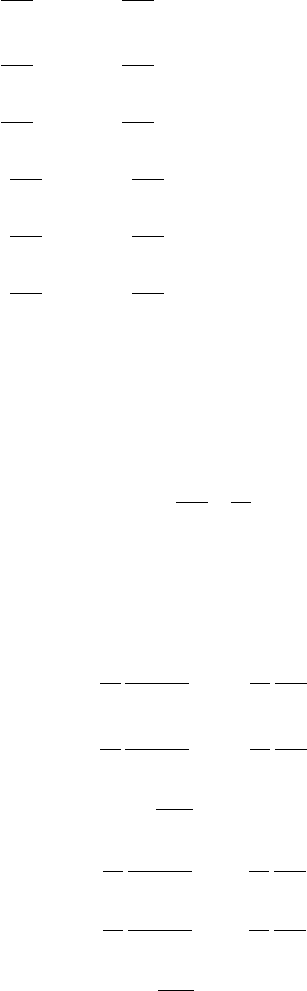
The Maxwell equations (4.25), (4.26) become six component equations,
∂
∂u
2
(h
3
E
3
) −
∂
∂u
3
(h
2
E
2
) = −jωµ h
2
h
3
H
1
, (4.27)
∂
∂u
3
(h
1
E
1
) −
∂
∂u
1
(h
3
E
3
) = −jωµ h
3
h
1
H
2
, (4.28)
∂
∂u
1
(h
2
E
2
) −
∂
∂u
2
(h
1
E
1
) = −jωµ h
1
h
2
H
3
, (4.29)
∂
∂u
2
(h
3
H
3
) −
∂
∂u
3
(h
2
H
2
) = jω² h
2
h
3
E
1
, (4.30)
∂
∂u
3
(h
1
H
1
) −
∂
∂u
1
(h
3
H
3
) = jω² h
3
h
1
E
2
, (4.31)
∂
∂u
1
(h
2
H
2
) −
∂
∂u
2
(h
1
H
1
) = jω² h
1
h
2
E
3
. (4.32)
The principles of Borgnis’ potentials consists of two theorems.
Theorem 1
If an orthogonal coordinate system u
1
, u
2
, u
3
, with lame coefficients h
1
, h
2
,
h
3
, satisfies the conditions
h
3
= 1,
∂
∂u
3
µ
h
1
h
2

= 0, (4.33)
then two scalar functions, U (x) and V (x), known as Borgnis’ potentials or
Borgnis’ functions [14], can be found such that E
3
is a function of U only
and H
3
is a function of V only, and all the components of the fields can be
expressed as follows:
E
1
=
1
h
1
∂
2
U
∂u
3
∂u
1
− jωµ
1
h
2
∂V
∂u
2
, (4.34)
E
2
=
1
h
2
∂
2
U
∂u
2
∂u
3
+ jωµ
1
h
1
∂V
∂u
1
, (4.35)
E
3
=
∂
2
U
∂u
2
3
+ k
2
U, (4.36)
H
1
=
1
h
1
∂
2
V
∂u
3
∂u
1
+ jω²
1
h
2
∂U
∂u
2
, (4.37)
H
2
=
1
h
2
∂
2
V
∂u
2
∂u
3
− jω²
1
h
1
∂U
∂u
1
, (4.38)
H
3
=
∂
2
V
∂u
2
3
+ k
2
V. (4.39)
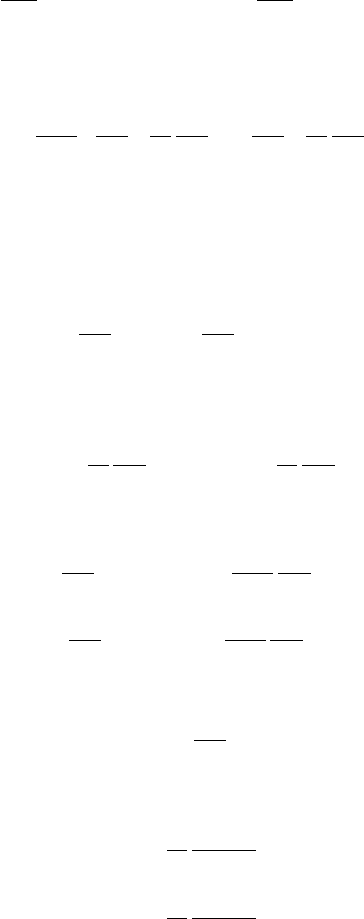
190 4. Time-Varying Boundary Value Problems
Here and afterwards we use V for the Borgnis’ function of the second kind,
and reader should distinguish it from the volume. Functions U(x) and V (x)
are also known as scalar wave functions, which satisfy the following second-
order scalar partial differential equations:
∇
2
T
U +
∂
2
U
∂u
2
3
+ k
2
U = 0, ∇
2
T
V +
∂
2
V
∂u
2
3
+ k
2
V = 0, (4.40)
where ∇
2
T
denotes the two-dimensional Laplacian operator with respect to
u
1
and u
2
,
∇
2
T
=
1
h
1
h
2
·
∂
∂u
1
µ
h
2
h
1
∂
∂u
1

+
∂
∂u
2
µ
h
1
h
2
∂
∂u
2
¶¸
. (4.41)
Note that, (4.40) are not necessarily scalar Helmholtz equations.
Proof
(1) If H
3
= 0 and E
3
6= 0, according to (4.29) we have
∂
∂u
1
(h
2
E
2
) =
∂
∂u
2
(h
1
E
1
). (4.42)
Equation (4.42) is satisfied by introducing an auxiliary scalar function U
0
(x),
related to E
1
and E
2
via
E
1
=
1
h
1
∂U
0
∂u
1
, E
2
=
1
h
2
∂U
0
∂u
2
. (4.43)
Substituting (4.43) into (4.30) and (4.31) yields
∂
∂u
3
(h
2
H
2
) = −jω²
h
2
h
3
h
1
∂U
0
∂u
1
, (4.44)
∂
∂u
3
(h
1
H
1
) = jω²
h
3
h
1
h
2
∂U
0
∂u
2
. (4.45)
Make another auxiliary scalar function U(x), and let
U
0
=
∂U
∂u
3
. (4.46)
Substituting (4.46) into (4.43) we have
E
1
=
1
h
1
∂
2
U
∂u
3
∂u
1
, (4.47)
E
2
=
1
h
2
∂
2
U
∂u
2
∂u
3
, (4.48)