
Zhang K., Li D. Electromagnetic Theory for Microwaves and Optoelectronics
Подождите немного. Документ загружается.


4.8 Solutions in Circular Cylindrical Coordinates 211
When ν is not an integer, the two independent solutions of the Bessel equation
are the Bessel functions [44] or Bessel functions of the first kind with positive
and negative order:
J
ν
(x) =
∞
X
m=0
(−1)
m
m!Γ (ν + m + 1)
³
x
2
´
ν+2m
, (4.176)
J
−ν
(x) =
∞
X
m=0
(−1)
m
m!Γ (−ν + m + 1)
³
x
2
´
−ν+2m
. (4.177)
The other possible solutions are the Bessel functions of the second kind or
the Neumann functions which are defined as
N
ν
(x) =
J
ν
(x) cos νπ − J
−ν
(x)
sin νπ
. (4.178)
When ν is an integer or zero, ν = n, functions J
n
(x) and J
−n
(x) are not
linearly independent,
Γ (n + m + 1) = (n + m)! and J
−n
(x) = (−1)
n
J
n
(x).
In this case the two independent solutions of the Bessel equation become the
Bessel functions and the Neumann functions with integer order:
J
n
(x) =
∞
X
m=0
(−1)
m
m!(n + m)!
³
x
2
´
n+2m
, (4.179)
N
n
(x) = lim
ν→n
N
ν
(x) = lim
ν→n
J
ν
(x) cos νπ − J
−ν
(x)
sin νπ
= =
1
π
·
∂
∂ν
J
ν
(x) − (−1)
n
∂
∂ν
J
−ν
(x)
¸
ν=n
(4.180)
Finally, we have the solution of (4.171):
R(ρ) = a
ν
J
ν
(T ρ)+b
ν
J
−ν
(T ρ), or R(ρ) = A
ν
J
ν
(T ρ)+B
ν
N
ν
(T ρ), (4.181)
when ν is not an integer, and
R(ρ) = A
n
J
n
(T ρ) + B
n
N
n
(T ρ), (4.182)
when ν is an integer, ν = n.
The following linear combinations of J
ν
(x) and N
ν
(x) are solutions of the
Bessel equation too,
H
(1)
ν
(x) = J
ν
(x) + jN
ν
(x), H
(2)
ν
(x) = J
ν
(x) − jN
ν
(x). (4.183)
Functions H
(1)
ν
(x) and H
(2)
ν
(x) are Hankel functions of the first kind and the
second kind, respectively. Hence the solution of the Bessel equation can also
be the linear combinations of them,
R(ρ) = A
ν
H
(1)
ν
(T ρ) + B
ν
H
(2)
ν
(T ρ). (4.184)

212 4. Time-Varying Boundary Value Problems
In fact, any two of the functions J
ν
(x), N
ν
(x), H
(1)
ν
(x), and H
(2)
ν
(x) are
linearly independent, hence the linear combination of any two of them is the
complete solution of the Bessel equation. When ν is not an integer, J
−ν
(x)
is also independent.
If T
2
is negative, we replace T by jτ and x by jx, then equations (4.171)
and (4.175) become the modified Bessel equations
ρ
d
dρ
µ
ρ
dR
dρ

−
¡
τ
2
ρ
2
+ ν
2
¢
R = 0, (4.185)
x
d
dx
·
x
dR(x)
dx
¸
−
¡
x
2
+ ν
2
¢
R(x) = 0. (4.186)
The solution of (4.186 ) must be J
ν
(jx) and N
ν
(jx), but these two func-
tions are usually complex or imaginary. Construct the following two linearly
independent functions:
I
ν
(x) = j
−ν
J
ν
(jx), (4.187)
K
ν
(x) = j
−ν+1
π
2
H
(1)
ν
(jx) = j
−ν+1
π
2
[J
ν
(jx) + jN
ν
(jx)]. (4.188)
Both I
ν
(x) and K
ν
(x) are real functions and are known as the modified Bessel
functions of the first and the second kind, respectively. Hence the solution
of (4.185) is
R(ρ) = A
ν
I
ν
(τρ) + B
ν
K
ν
(τρ). (4.189)
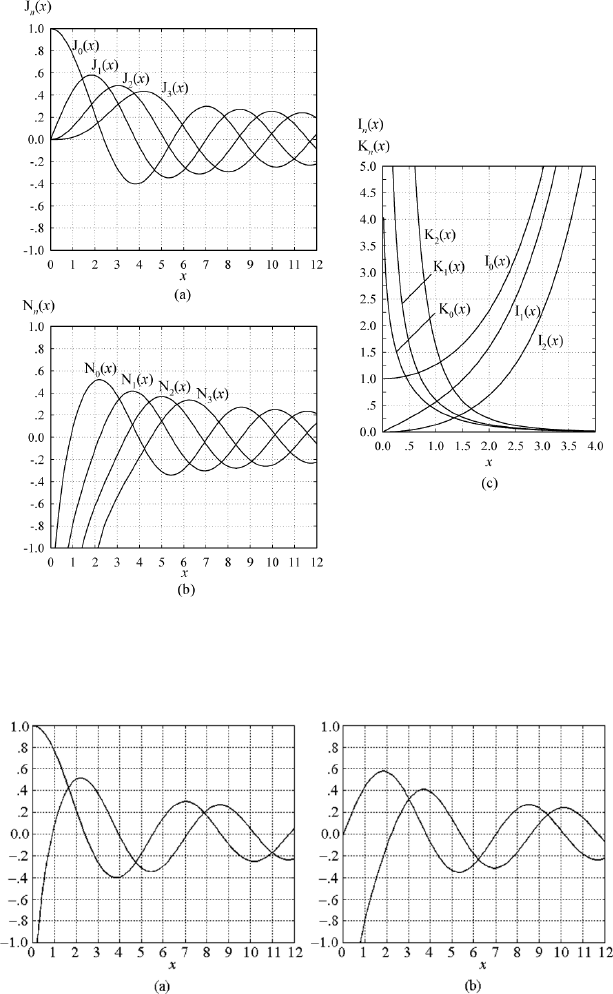
The Bessel functions, Neumann functions, Hankel functions and modified
Bessel functions are cylindrical harmonics. Bessel functions and Neumann
functions are quasi-periodic functions with multiple zeros, see Fig. 4.5(a) and
(b). The modified Bessel functions are monotonic increasing or decreasing
functions, see Fig. 4.5(c). The Hankel functions are generally complex.
Comparing these plots with the plots of rectangular harmonics, we find
that Bessel and Neumann functions are similar to sine and cosine functions,
which represent standing waves. See Fig. 4.6. The modified Bessel functions
are similar to hyperbolic functions and exponential functions with real ar-
guments, so the modified Bessel functions are also called hyperbolic Bessel
functions, which describe the decaying fields. The position of Hankel func-
tions in circular-cylinder coordinates is the same as that of the exponential
functions with imaginary arguments in the rectangular coordinates, which
describe the traveling waves.
For large arguments, the leading terms of the asymptotic series of cylin-
drical harmonics are listed in Appendix C, (C.10)–(C.12). We find that the
asymptotic approximations of the Bessel functions and Neumann functions
are cosine and sine functions, the asymptotic approximations of the modi-
fied Bessel functions are exponential functions with real arguments and the
asymptotic approximations of the Hankel functions are exponential functions
with imaginary arguments.
The solution of the function V is the same as that of the function U.
4.8 Solutions in Circular Cylindrical Coordinates 213
Figure 4.5: Bessel functions (a), Neumann functions (b) and modified Bessel
functions (c).
Figure 4.6: Bessel functions and Neumann functions.

214 4. Time-Varying Boundary Value Problems
In circular cylindrical coordinates, the field components may be expressed
in terms of U and V by (4.34)–(4.39) as follows:
E
ρ
=
∂
2
U
∂ρ ∂z
−
jωµ
ρ
∂V
∂φ
, (4.190)
E
φ
=
1
ρ
∂
2
U
∂φ ∂z
+ jωµ
∂V
∂ρ
, (4.191)
E
z
=
∂
2
U
∂z
2
+ k
2
U =
¡
k
2
− β
2
¢
U = T
2
U = −τ
2
U, (4.192)
H
ρ
=
∂
2
V
∂ρ ∂z
+
jω²
ρ
∂U
∂φ
, (4.193)
H
φ
=
1
ρ
∂
2
V
∂φ ∂z
− jω²
∂U
∂ρ
, (4.194)
H
z
=
∂
2
V
∂z
2
+ k
2
V =
¡
k
2
− β
2
¢
V = T
2
V = −τ
2
V. (4.195)
If we are interested in the wave along the positive direction of the axis
+z only, ∂/∂z = −jβ, and according to (4.63)–(4.68) the field components
become:
E
ρ
= −jβ
∂U
∂ρ
−
jωµ
ρ
∂V
∂φ
, (4.196)
E
φ
= −
jβ
ρ
∂U
∂φ
+ jωµ
∂V
∂ρ
, (4.197)
E
z
=
¡
k
2
− β
2
¢
U = T
2
U = −τ
2
U, (4.198)
H
ρ
= −jβ
∂V
∂ρ
+
jω²
ρ
∂U
∂φ
, (4.199)
H
φ
= −
jβ
ρ
∂V
∂φ
− jω²
∂U
∂ρ
, (4.200)
H
z
=
¡
k
2
− β
2
¢
V = T
2
V = −τ
2
V. (4.201)
4.9 Solution of Helmholtz’s Equations in
Spherical Coordinates
For spherical coordinates,
u
1
= θ, u
2
= φ, u
3
= r, h
1
= r, h
2
= r sin θ, h
3
= 1.
The conditions of the Borgnis’ Theorem 1 are satisfied but the conditions of
Theorem 2 are not satisfied in the spherical coordinates. So the equations
for functions U and V (4.40) are not scalar Helmholtz equations.

4.9 Solutions in Spherical Coordinates 215
In spherical coordinates the two-dimensional Laplacian operator (4.41)
becomes
∇
2
T
=
1
r
2
sin θ
∂
∂θ
µ
sin θ
∂
∂θ

+
1
r
2
sin
2
θ
∂
2
∂φ
2
.
Then, (4.40) for U (and similarly V ) becomes
1
r
2
sin θ
∂
∂θ
µ
sin θ
∂U
∂θ

+
1
r
2
sin
2
θ
∂
2
U
∂φ
2
+
∂
2
U
∂r
2
+ k
2
U = 0. (4.202)
Equation (4.202) is not a scalar Helmholtz equation. The difference between
(4.202) and the scalar Helmholtz equation is that the term ∂
2
/∂r
2
in (4.202)
must be replaced by (1/r
2
)∂/∂r(r
2
∂/∂r) in the scalar Helmholtz equation.
Making the function substitution
U = rF or V = rF, (4.203)
substituting (4.203) into (4.202), and dividing it by r, we find the equation
for F becomes a scalar Helmholtz equation in spherical coordinates:
1
r
2
sin θ
∂
∂θ
µ
sin θ
∂F
∂θ

+
1
r
2
sin
2
θ
∂
2
F
∂φ
2
+
1
r
2
∂
∂r
µ
r
2
∂F
∂r

+ k
2
F = 0. (4.204)
Applying the method of separation of variables, let
F (r, θ, φ) = R(r)Θ(θ)Φ(φ). (4.205)
Substituting it into (4.204) and being multiplying by r
2
sin
2
θ/RΘΦ, we have
sin θ
Θ
d
dθ
µ
sin θ
dΘ
dθ

+
1
Φ
d
2
Φ
dφ
2
+
sin
2
θ
R
d
dr
µ
r
2
dR
dr

+ k
2
r
2
sin
2
θ = 0. (4.206)
The left-hand side of the equation includes two parts, the first part is the
second term, which is a function of φ only and the second part is the sum of
the rest of the terms, which are functions of r and θ. To satisfy the equation,
each part must be equal to a constant and the sum of the two constants must
be zero. Suppose the two constants are −m
2
and m
2
, respectively, we have
d
2
Φ
dφ
2
= −m
2
Φ, (4.207)
sin θ
Θ
d
dθ
µ
sin θ
dΘ
dθ

−m
2
+
sin
2
θ
R
d
dr
µ
r
2
dR
dr

+ k
2
r
2
sin
2
θ = 0. (4.208)
Dividing (4.208) by sin
2
θ, yields
1
Θ sin θ
d
dθ
µ
sin θ
dΘ
dθ

−
m
2
sin
2
θ
+
1
R
d
dr
µ
r
2
dR
dr

+ k
2
r
2
= 0. (4.209)

216 4. Time-Varying Boundary Value Problems
The first and the second terms are function of θ only, and the third and
the fourth terms are functions of r only. They must be equal to constants
separately, and the sum of the two constants must be zero. Suppose they are
−χ
2
and χ
2
, respectively. This yields
1
sin θ
d
dθ
µ
sin θ
dΘ
dθ

+
µ
χ
2
−
m
2
sin
2
θ

Θ = 0 (4.210)
d
dr
µ
r
2
dR
dr

+ (k
2
r
2
− χ
2
)R = 0 (4.211)
The partial differential equation (4.204) is reduced to three ordinary differ-
ential equations (4.207), (4.210), and (4.211).
Equation (4.207) is the same as that for the cylindrical coordinates
(4.170), so the solutions of it are the same as (4.174):
Φ(φ) = F
m
cos mφ + G
m
sin mφ = f
m
e
jmφ
+ g
m
e
−jmφ
. (4.212)
Equation (4.210) belongs to a special kind of equations in spherical coor-
dinates. The solutions of it are generally power series, which become infinite
when either θ = 0 or θ = π. These solutions would not be suitable for the
physical problems that include the positive and negative polar axes. For the
sake of avoiding this difficulty, let
χ
2
= n(n + 1), n is an integer or zero, (4.213)
then equation (4.210) becomes
1
sin θ
d
dθ
µ
sin θ
dΘ
dθ

+
·
n(n + 1) −
m
2
sin
2
θ
¸
Θ = 0. (4.214)
Let
x = cos θ,
the equation becomes
d
dx
·
(1 − x
2
)
dΘ
dx
¸
+
·
n(n + 1) −
m
2
1 − x
2
¸
Θ = 0. (4.215)
This is the associate Legendre equation. If m = 0, the function is independent
of the azimuth angle φ, the above equation becomes
d
dx
·
(1 − x
2
)
dΘ
dx
¸
+ n(n + 1)Θ = 0. (4.216)
This is the standard Legendre equation.
When n is an integer or zero, the solutions of the Legendre equation
(4.216) are two sets of polynomials called Legendre functions or Legendre
polynomials [44]:
Θ = C
n
P
n
(x) + D
n
Q
n
(x) = C
n
P
n
(cos θ) + D
n
Q
n
(cos θ), (4.217)

4.9 Solutions in Spherical Coordinates 217
where
P
n
(x) =
1
2
n
n!
d
n
dx
n
¡
x
2
− 1
¢
n
, (4.218)
Q
n
(x) =
1
2
P
n
(x) ln
1 + x
1 − x
−
n
X
l=1
1
l
P
l−1
(x)Pn − 1(x). (4.219)
Function P
n
(x) denotes the Legendre polynomial of the first kind and Q
n
(x)
denotes the Legendre polynomial of the second kind, where n is the degree of
the functions, n is an arbitrary integer or zero. Equation (4.218) is the basic
expression of the Legendre function and is called Rodrigue’s formula.
The solutions of the associate Legendre equation (4.215) are also two
sets of polynomials called associate Legendre functions or associate Legendre
polynomials [44]:
Θ = C
nm
P
m
n
(x) + D
nm
Q
m
n
(x) = C
nm
P
m
n
(cos θ) + D
nm
Q
m
n
(cos θ), (4.220)
where
P
m
n
(x)=
¡
x
2
− 1
¢
m/2
d
m
dx
m
P
n
(x)=
1
2
n
n!
¡
x
2
− 1
¢
m/2
d
n+m
dx
n+m
¡
x
2
− 1
¢
n
, (4.221)
and
Q
m
n
(x) =
¡
x
2
− 1
¢
m/2
d
m
dx
m
Q
n
(x). (4.222)
Function P
m
n
(x) is the associate Legendre polynomial of the first kind, and
Q
m
n
(x) is the associate Legendre polynomial of the second kind, where n is
the degree and m is the order of the functions. The order m is an integer
between 1 and n. Functions P
m
n
(x) and Q
m
n
(x) are spherical harmonics.
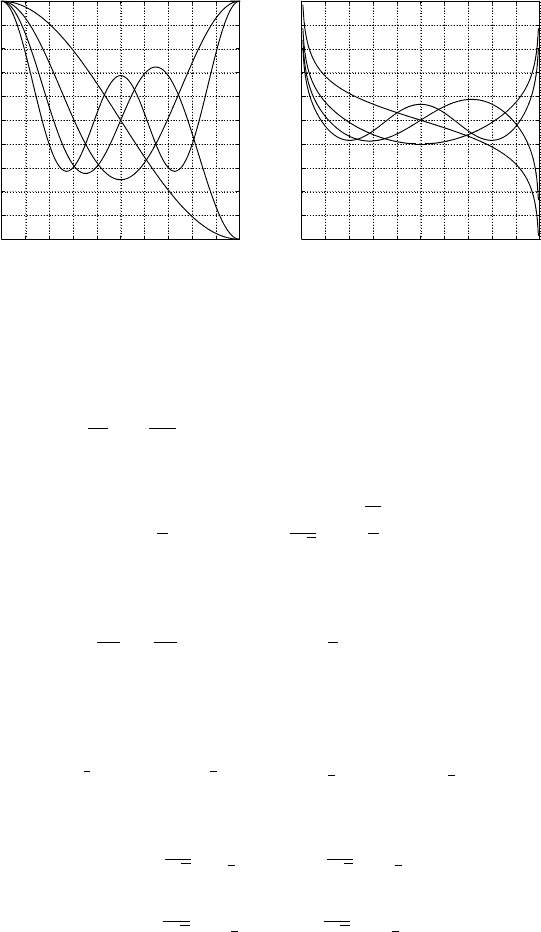
The plots of the Legendre polynomials are shown in Figure 4.7. We see
that on the polar axes θ = 0 and θ = π,
Q
n
(cos θ) → ∞, and Q
m
n
(cos θ) → ∞.
So, for the problem that involves positive and negative polar axes, the co-
efficient of Q
m
n
(cos θ) must be zero, and function P
m
n
(cos θ) is the suitable
solution.
If n + m is not an integer, we rewrite n and m as ν and ω, respectively.
Then the two independent solutions of Legendre’s equation are P
ω
ν
(cos θ) and
P
ω
ν
(−cos θ).
Θ = C
νω
P
ω
ν
(cos θ) + D
νω
P
ω
ν
(−cos θ), (4.223)
and when ω = 0, n is not an integer,
Θ = C
ν
P
ν
(cos θ) + D
ν
P
ν
(−cos θ), (4.224)
When ν+ω ia an integer, n+m, P
m
n
(cos θ) and Q
m
n
(cos θ) are the two inde-
pendent solutions, and when ν + ω is not an integer, any two from P
ω
ν
(cos θ),
P
ω
ν
(−cos θ) and Q
ω
ν
(cos θ) can be the two independent solutions.
218 4. Time-Varying Boundary Value Problems
0.0 .1 .2 .3 .4 .5 .6 .7 .8 .9 1.0
-5
-4
-3
-2
-1
0
1
2
3
4
5
n = 0
0.0 .1 .2 .3 .4 .5 .6 .7 .8 .9 1.0
-1.0
-.8
-.6
-.4
-.2
0.0
.2
.4
.6
.8
1.0
n = 0
P
n
(cos
T
)
Q
n
(cos
T
)
1
1
2
2
3
3
4
T
S
T
S
Figure 4.7: Legendre functions of the first kind (a) and the second kind (b).
Substituting (4.213) into (4.211), we have the equation for R as
d
dr
µ
r
2
dR
dr

+
£
k
2
r
2
− n(n + 1)
¤
R = 0. (4.225)
With the substitution,
r =
u
k
, R =
f
√
r
=
r
k
u
f, (4.226)
(4.225) becomes
u
d
du
µ
u
df
du

+
"
u
2
−
µ
n +
1
2

2
#
f = 0. (4.227)
This is a Bessel equation, and the solutions are Bessel functions of order
n + 1/2,
f(u) = A
n
J
n+
1
2
(u) + B
n
N
n+
1
2
(u)=a
n
H
(1)
n+
1
2
(u) + b
n
H
(2)
n+
1
2
(u). (4.228)
Considering (4.226), we have
R(r) = A
n
1
√
r
J
n+
1
2
(kr) + B
n
1
√
r
N
n+
1
2
(kr), (4.229)
R(r) = a
n
1
√
r
H
(1)
n+
1
2
(kr) + b
n
1
√
r
H
(2)
n+
1
2
(kr). (4.230)
If n is an integer, these Bessel functions of order n + 1/2 reduce to alge-
braic combinations of sinusoids, see Appendix C.5.1, which represent spheri-
cal waves and explain the wave nature of the solutions of Helmholtz’s equa-
tions in spherical coordinates.

4.10 Vector Eigenfunctions and Normal Modes 219
In different literatures, a sets of spherical Bessel functions [37, 96]
j
n
(x), n
n
(x), h
(1)
n
(x), h
(2)
n
(x);
and a set of spherical Bessel functions defined by S. A. Schelkunoff [86]
ˆ
J
n
(x),
ˆ
N
n
(x),
ˆ
H
(1)
n
(x),
ˆ
H
(2)
n
(x)
are introduced, refer to Appendix C.5.2 and C.5.3.
Finally, we have the 3-D solutions in spherical coordinates
U (or V ) = rF = rR ΘΦ =
h
a
n
√
rJ
n+
1
2
(kr) + b
n
√
rN
n+
1
2
(kr)
i
·[C
nm
P
m
n
(cos θ)+D
nm
Q
m
n
(cos θ)]
·[F
m
cos mφ + G
m
sin mφ] , (4.231)
U (or V ) = rF = rR ΘΦ =
h
A
n
√
rH
(1)
n+
1
2
(kr) + B
n
√
rH
(2)
n+
1
2
(kr)
i
·[C
nm
P
m
n
(cos θ)+D
nm
Q
m
n
(cos θ)]
·[F
m
cos mφ + G
m
sin mφ] . (4.232)
In spherical coordinates, the field components may be expressed in terms
of U and V by (4.34)–(4.39) as follows:
E
θ
=
1
r
∂
2
U
∂θ ∂r
−
jωµ
r sin θ
∂V
∂φ
, (4.233)
E
φ
=
1
r sin θ
∂
2
U
∂φ ∂r
+
jωµ
r
∂V
∂θ
, (4.234)
E
r
=
∂
2
U
∂r
2
+ k
2
U, (4.235)
H
θ
=
1
r
∂
2
V
∂θ ∂r
+
jω²
r sin θ
∂U
∂φ
, (4.236)
E
φ
=
1
r sin θ
∂
2
V
∂φ ∂r
−
jω²
r
∂U
∂θ
, (4.237)
H
r
=
∂
2
V
∂r
2
+ k
2
V. (4.238)
In most cases, the waves in spherical coordinates may also be classified as
a mode with U = 0 and E
r
= 0 and a mode with V = 0 and H
r
= 0. They
are spherical TE and spherical TM modes, respectively
4.10 Vector Eigenfunctions and
Normal Modes
In the previous sections, the vector Helmholtz equation is separated into
three ordinary differential equations. The problems of solving these equations
with given boundary conditions are eigenvalue problem or so-called Sturm–
Liouville problems.

220 4. Time-Varying Boundary Value Problems
4.10.1 Eigenvalue Problems and Orthogonal Expansions
(1) Sturm–Liouville Problems
By separation of variables in an appropriate coordinate system, the Laplace
equation or Helmholtz equation reduces to ordinary differential equations in
the following general form
d
dx
·
p(x)
dy(x)
dx
¸
− [q(x) − λρ(x)] y(x) = 0. (4.239)
This equation is known as the Sturm–Liouville equation. The function y(x)
satisfies the constant boundary conditions of the first or the second kind at
x = a and x = b,
y(x)|
x=a
= C
1
, y(x)|
x=b
= C
2
, or
dy(x)
dx
¯
¯
¯
¯
x=a
= C
1
,
dy(x)
dx
¯
¯
¯
¯
x=b
= C
2
,
or the more general mixed boundary conditions:
·
α
dy(x)
dx
− βy(x)
¸
x=a, x=b
= C
1, 2
, (4.240)
where α and β are two constants, including α = 0 for the boundary condition
of the first kind and β = 0 for that of the second kind.
The problem of solving Sturm–Liouville equation (4.239) with the bound-
ary conditions (4.240) is known as the Sturm–Liouville problem or eigenvalue
problem. The following are four basic theorems about the Sturm–Liouville
problems.
Theorem 1 Only specific or discrete real values of λ are allowed for a
nontrivial solution of the Sturm–Liouville equation satisfying the specific set
of boundary conditions. These allowed λ values are called eigenvalues. The
eigenvalues, ordered with respect to magnitude form a denumerable sequence
λ
1
, λ
2
, λ
3
, ···, λ
i
, ···.
For each specific eigenvalue λ
i
, there is a corresponding function y
i
(x) that
satisfies the differential equation (4.239) and the boundary conditions (4.240).
These functions y
i
(x) are called the eigenfunctions of the problem. The
complete set of eigenfunctions is
y
1
(x), y
2
(x), y
3
(x), ···, y
i
(x), ···.
Each eigenvalue corresponds to one eigenfunction or a number of linearly
independent eigenfunctions. If more than one eigenfunction is allowed for a
particular eigenvalue the problem is said to be degenerate.