
Zhang K., Li D. Electromagnetic Theory for Microwaves and Optoelectronics
Подождите немного. Документ загружается.


4.6 Electromagnetic Waves in Cylindrical Systems 201
General
9. Conical coordinates: Consists of a set of concentric spheres and
two sets of mutual orthogonal elliptic cones.
10. Ellipsoidal coordinates: Consists of a set of ellipsoids, a set of
hyperboloids of one sheet, and a set of hyperboloids of two sheets.
11. Paraboloidal coordinates: Consists of two sets of mutually or-
thogonal elliptic paraboloids, and a set of hyperbolic paraboloid.
For the details of separation of variables in the eleven coordinate systems,
please refer to [70, 71, 72, 114].
4.6 Electromagnetic Waves in
Cylindrical Systems
In an arbitrary cylindrical coordinate system, u
1
, u
2
, z, all of the functions
U, V , Π
ez
, Π
mz
, E
z
, H
z
satisfy the same scalar Helmholtz equation:
∇
2
T
U +
∂
2
U
∂z
2
+ k
2
U = 0. (4.109)
Applying the method of separation of variables, let
U(u
1
, u
2
, z) = U
T
(u
1
, u
2
)Z(z), (4.110)
where U
T
denotes the transverse function and Z denotes the longitudinal
function. Substituting it into (4.109) and dividing by U yields
∇
2
T
U
T
U
T
+
d
2
Z/dz
2
Z
= −k
2
. (4.111)
The first term is a function of u
1
and u
2
only and the second term is a
function of z only. Each of them must be equal to a constant so that the sum
of them can be a constant −k
2
. Let
d
2
Z/dz
2
Z
= −β
2
,
∇
2
T
U
T
U
T
= −T
2
and
β
2
+ T
2
= k
2
, β =
p
k
2
− T
2
. (4.112)
Then we have
d
2
Z
dz
2
+ β
2
Z = 0. (4.113)
∇
2
T
U
T
+ T
2
U
T
= 0. (4.114)

202 4. Time-Varying Boundary Value Problems
The first equation (4.113) is a one-dimensional homogeneous scalar Helmholtz
equation and we have seen it in Sections 2.1 and 3.1, the latter is known as
the telegraph equation.
The solutions of (4.113) are two traveling waves propagating along +z
and −z, known as guided waves,
Z(z) = Z
1
e
−jβz
+ Z
2
e
jβz
, (4.115)
where β is the longitudinal phase coefficient which is determined by k = ω
√
µ²
and T in (4.112).
The second equation (4.114) is a two-dimensional scalar Helmholtz equa-
tion which is known as the transverse wave equation and T
2
is the transverse
eigenvalue which is determined by the boundary conditions of the system.
The guided waves in a bounded cylindrical system are classified as follow-
ings according to the transverse eigenvalue T
2
.
(1) The TEM Mode
When T
2
= 0, then β = k = ω
√
µ² and v
p
= 1/
√
µ². This is a wave with
a velocity equal to the velocity of a plane wave in the unbounded medium,
and ∂
2
/∂z
2
= −k
2
. According to (4.36) and (4.39), this must be a wave with
neither electric nor magnetic field in the direction of propagation, E
z
= 0,
H
z
= 0. It is known as a transverse electromagnetic wave and is denoted by
the TEM mode.
In the case of T
2
= 0, The equation for U
T
, (4.114), and the similar
equation for V
T
become
∇
2
T
U
T
= 0, ∇
2
T
V
T
= 0. (4.116)
So the Borgnis’ functions U and V satisfy the transverse two-dimensional
scalar Laplace equations.
Under the conditions E
z
= 0, H
z
= 0 and E = E
T
, H = H
T
, the
equations of the transverse fields (4.88) and (4.90) become
∇
T
× E = 0, ∇
T
× H = 0. (4.117)
The transverse fields are irrotational vector functions in the transverse cross-
section, and may be explained in terms of the two-dimensional gradient of
scalar potentials ϕ(u
1
, u
2
) and ψ(u
1
, u
2
) as follows:
E(u
1
, u
2
) = ∇
T
ϕ(u
1
, u
2
), H(u
1
, u
2
) = ∇
T
ψ(u
1
, u
2
). (4.118)
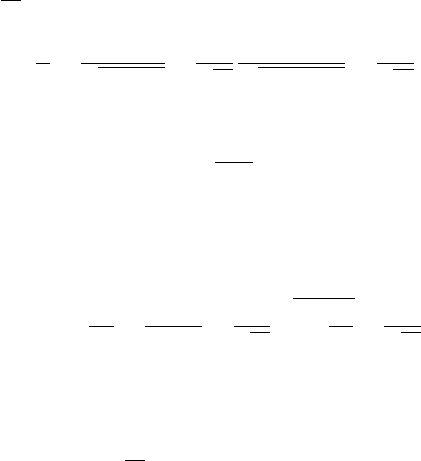
It has been shown in Maxwell’s equations that in source-free problems, the
fields are solenoidal vector functions, so that
∇
T
· E = 0, ∇
T
· H = 0. (4.119)
4.6 Electromagnetic Waves in Cylindrical Systems 203
Hence we have
∇
2
T
ϕ(u
1
, u
2
) = 0, ∇
2
T
ψ(u
1
, u
2
) = 0. (4.120)
It is shown that the scalar potentials of the TEM mode satisfy the two-
dimensional Laplace equations. The transverse distribution of the electric
and magnetic fields in a TEM wave are the same as those in static fields.
We come to the conclusion that the TEM mode can exist only in a system
that can support static fields. This means that the TEM mode can not be
supported by a single conductor or insulator, no matter what the configura-
tion is, and only the system composed of at least two conductors insulated
from each other can support TEM waves. This kind of system is known as
a transmission line and can be analyzed by means of the circuit approach as
well as the field approach, refer to Chapters 3 and 5, respectively.
(2) Fast Wave modes
Here T
2
> 0, T is real. The fields in the system depend on the relation
between T
2
and k
2
as follows:
(a) T
2
< k
2
, β
2
= k
2
− T
2
> 0, β is real and β < k. Since v
p
= ω/β and
ω/k = 1/
√
µ², we have
v
p
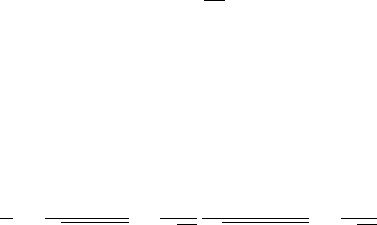
=
ω
β
=
ω
√
k
2
− T
2
=
1
√
µ²
1
p
1 − T
2
/k
2
>
1
√
µ²
. (4.121)
This is a traveling wave along z, and the phase velocity is larger than the
phase velocity of a plane wave in the unbounded media. So it is a fast wave
mode. In vacuum, v
p
> c = 1/
√
µ
0
²
0
. The fact that the phase velocity
is larger than the velocity of light in vacuum does not violate the special
theory of relativity of Einstein , because the phase velocity does not bring
any matter, energy, or signal with it.
Since T
2
is a constant, the group velocity becomes
v
g
=
dω
dβ
=
1
dω/dβ
=
1
√
µ²
r
1 −
T
2
k
2
<
1
√
µ²
. (4.122)
So the group velocity is less then the velocity of a plane wave in the un-
bounded medium, and
v
p
v
g
=
1
µ²
, in vacuum v
p
v
g
= c
2
. (4.123)
This is the propagation state of a fast wave mode in common metallic
waveguides, refer to Chapter 5. The modes in propagation state are called
propagating modes or guided modes.
204 4. Time-Varying Boundary Value Problems
(b) T
2
> k
2
, β
2
= k
2
− T
2
< 0, β is imaginary. The field is not a traveling
wave but a damping or decaying field along z. This is the cutoff state of
a waveguide mode. The modes in cutoff state are called cutoff modes or
evanescent modes.
(c) T
2
= k
2
, β
2
= k
2
− T
2
= 0. This is the critical state of a waveguide
mode. Hence the transverse eigenvalue T is also known as the critical angular
wave number or cutoff angular wave number,
k
c
= ω
c
√
µ² = T, (4.124)
where ω
c
denotes the cutoff angular frequency of the waveguide.
(3) Slow Waves
When T
2
< 0, then T is imaginary, and β
2
= k
2
− T
2
> k
2
, β is real and
β > k. So
v
p
=
ω
β
=
ω
√
k
2
− T
2
=
1
√
µ²
1
p
1 − T
2
/k
2
<
1
√
µ²
(4.125)
and the phase velocity along z is less then the phase velocity of a plane wave
in the unbounded medium. So it is known as a slow wave, refer to Chapters
6 and 7).
In fast-wave and TEM-wave systems, T
2
≥ 0, which is consistent with the
condition given in Theorem 2 for the Sturm–Liouville problems which will be
shown in Section 4.10.1. The theorem indicates that in the system with ho-
mogeneous boundary conditions, the eigenvalue of the Sturm–Liouville prob-
lem must not be negative. So fast-wave or TEM-wave systems must be
surrounded by short-circuit or open-circuit boundaries, generally conducting
walls.
On the contrary, in slow wave systems, T
2
< 0, which cannot be the eigen-
value of Sturm–Liouville problems with homogeneous boundary conditions.
So a system surrounded by smooth short-circuit or open-circuit boundaries
cannot support slow waves. The slow wave systems are constructed by means
of dielectric boundaries or corrugated metallic boundaries.
For a slow wave, the eigenvalue T
2
is no longer constant, so (4.122) and
(4.123) are no longer valid. The group velocity of a slow wave is still less then
or equal to the velocity of light in space. In some systems, two or even three
sorts of waves can be supp orted simultaneously. In most cases, the fields
related to U or the fields related to V can satisfy the boundary conditions
independently, and the waves may be classified as the following two kinds of
mode:
1. Transverse electric mode, denoted as the TE mode or H mode, with
U = 0, Π
ez
= 0, and E
z
= 0. There are only a transverse electric

4.7 Solutions in Rectangular Coordinates 205
field component and both the transverse and longitudinal magnetic
components in the TE mode.
2. Transverse magnetic mode, denoted as the TM mode or E mode, with
V = 0, Π
mz
= 0, and H
z
= 0. There are only a transverse mag-
netic field component and both the transverse and longitudinal electric
components in the TM mode.
In some cases, the fields of the TE or TM mode alone cannot satisfy the
boundary conditions, and the only possible mode is the hybrid electric and
magnetic mode denoted by HEM mode. See Chapters 6 and 7 for details.
4.7 Solution of Helmholtz’s Equations in
Rectangular Coordinates
The three axes x, y, z in a rectangular coordinate system are all Cartesian
coordinates, h
1
= 1, h
2
= 1, h
3
= 1. So we may choose any one of them as
the special coordinate u
3
and the vector Helmholtz equations may be solved
by means of any one of the methods given in Section 4.3.
4.7.1 Set z as u
3
In rectangular coordinates, if we choose x = u
1
, y = u
2
, z = u
3
, then
h
1
= h
2
= h
3
= 1, and equation (4.114) becomes
∂
2
U
T
∂x
2
+
∂
2
U
T
∂y
2
+ T
2
U
T
= 0. (4.126)
Applying the method of separation of variables, let
U
T
(x, y) = X(x)Y (y), U(x, y, z) = X(x)Y (y)Z(z). (4.127)
Substituting this into (4.126) and subtracting U
T
yields
d
2
X/dx
2
X
+
d
2
Y/dy
2
Y
= −T
2
. (4.128)
The first term is a function of x only and the second term is a function of y
only. Each of them must be equal to a constant and the sum of them must
be equal to the constant −T
2
. As in the last section, we have
d
2
X
dx
2
+ k
2
x
X = 0,
d
2
Y
dy
2
+ k
2
y
Y = 0, (4.129)
where
k
2
x
+ k
2
y
= T
2
. (4.130)

206 4. Time-Varying Boundary Value Problems
In the last section, we had the differential equation of Z (4.113):
d
2
Z
dz
2
+ β
2
Z = 0, and β = k
z
, k
2
x
+ k
2
y
+ β
2
= k
2
. (4.131)
Equations (4.129) and (4.131) are one-dimensional homogeneous scalar
Helmholtz equations or the telegraph equations, which are the same as the
equation for a plane wave and a transmission line given in Chapter 2. Their
solutions are as follows.
If k
x
, k
y
, and β are real,
X(x) = Ae
jk
x
x
+ Be
−jk
x
x
=a sin k
x
x + b cos k
x
x =X
0
sin(k
x
x + φ
x
), (4.132)
Y (y) = Ce
jk
y
y
+ De
−jk
y
y
=c sin k
y
y + d cos k
y
y =Y
0
sin(k
y
y + φ
y
), (4.133)
Z(z)=F e
jβz
+ Ge
−jβz
=f sin βz + g cos βz = Z
0
sin(βz + φ
z
). (4.134)
If k
x
, k
y
, and β are imaginary, let
k
x
= jK
x
, k
y
= jK
y
, β = jK
z
, (4.135)
and
K
2
x
+ K
2
y
= τ
2
, K
2
z
+ τ
2
= −k
2
. (4.136)
Then (4.129) and (4.131) become
d
2
X
dx
2
− K
2
x
X = 0,
d
2
Y
dy
2
− K
2
y
Y = 0,
d
2
Z
dz
2
− K
2
z
Z = 0. (4.137)
The solutions become
X(x) = Ae
K
x
x
+ Be
−K
x
x
=a sinh K
x
x + b cosh K
x
x =X
0
sinh(K
x
x + ψ
x
),
(4.138)
Y (y) = Ce
K
y
y
+ De
−K
y
y
=c sinh K
y
y + d cosh K
y
y =Y
0
sinh(K
y
y + ψ
y
),
(4.139)
Z(z)=F e
K
z
z
+ Ge
−K
z
z
=f sinh K
z
z + g cosh K
z
z =Z
0
sinh(K
z
z + ψ
z
).
(4.140)
The above sets of functions are the eigenfunctions of the Laplace equation
as well as the Helmholtz equation in rectangular coordinates. They are called
the rectangular harmonics. They are all orthogonal and complete function
sets. k
2
x
= −K
2
x
, k
2
y
= −K
2
y
, β
2
= −K
2
z
are the corresponding eigenvalues,
which must be specific discrete real values for the specific boundary condi-
tions.
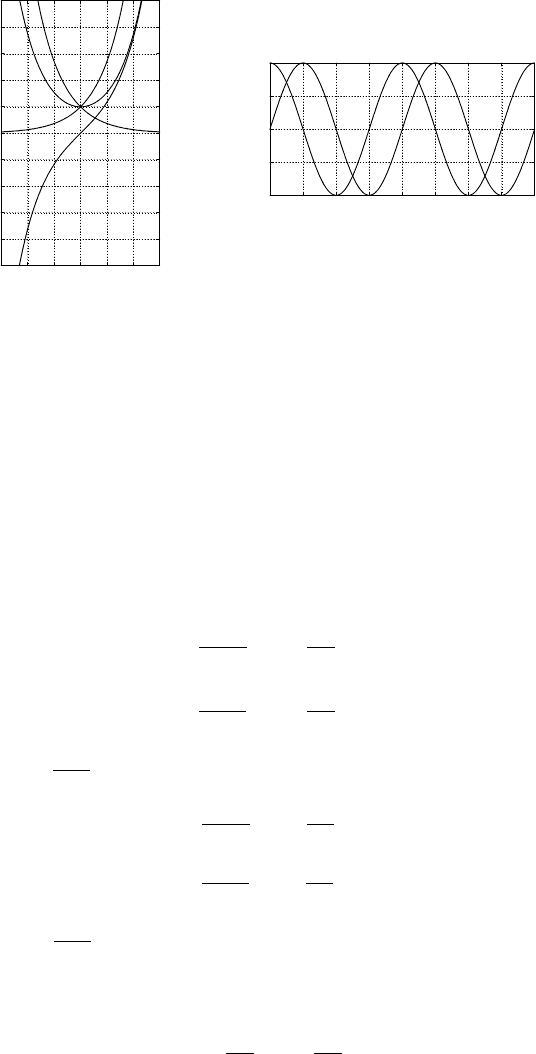
The exponential functions with real arguments and the hyperbolic func-
tions are monotonic increasing or decreasing functions or at most the hyper-
bolic cosine function with one minimum and the hyperbolic sine with one
zero, see Fig. 4.4(a). On the contrary, the sine and cosine functions are p eri-
odic functions with multiple zeros, see Fig. 4.4(b). The exponential functions
with imaginary arguments are generally complex.
4.7 Solutions in Rectangular Coordinates 207
-1.0
-.5
0.0
.5
1.0
0
sin x
cos x
x
S
S
S
S
-3 -2 -1 0 1 2 3
-5
-4
-3
-2
-1
0
1
2
3
4
5
cosh x
sinh x
e
x
e
-x
S
S
S
S
(a)
(b)
x
sin x
cos x
e
x
e
-x
sinhx
coshx
Figure 4.4: Rectangular harmonics.
A single term of a harmonic function cannot certainly satisfy the specific
boundary conditions. According to the expansion theorem of the eigenvalue
problems, the solution can be expanded into series in terms of the rectangular
harmonics with initially arbitrary coefficients to be chosen to satisfy the final
boundary conditions.
The form of the solution of the function V is the same as that of the
function U . The field components may then be obtained in terms of U and
V by (4.34)–(4.39) as follows:
E
x
=
∂
2
U
∂x ∂z
− jωµ
∂V
∂y
, (4.141)
E
y
=
∂
2
U
∂y ∂z
+ jωµ
∂V
∂x
, (4.142)
E
z
=
∂
2
U
∂z
2
+ k
2
U =
¡
k
2
− k
2
z
¢
U = T
2
U = −τ
2
U, (4.143)
H
x
=
∂
2
V
∂x ∂z
+ jω²
∂U
∂y
, (4.144)
H
y
=
∂
2
V
∂y ∂z
− jω²
∂U
∂x
, (4.145)
H
z
=
∂
2
V
∂z
2
+ k
2
V =
¡
k
2
− k
2
z
¢
V = T
2
V = −τ
2
V. (4.146)
If we are interested in the wave along the positive direction of the axis +z
only, according to (4.63)–(4.68), the field components become:
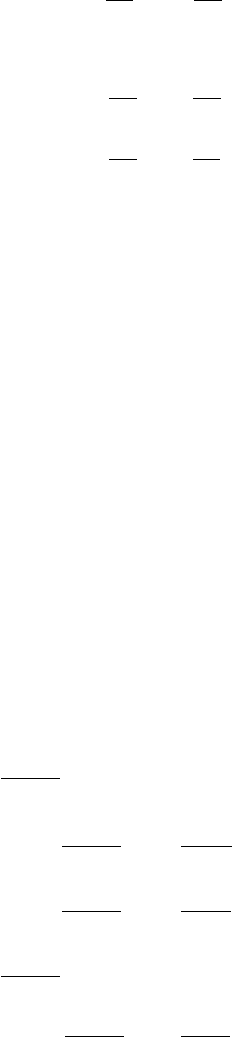
E
x
= −jβ
∂U
∂x
− jωµ
∂V
∂y
, (4.147)
208 4. Time-Varying Boundary Value Problems
E
y
= −jβ
∂U
∂y
+ jωµ
∂V
∂x
, (4.148)
E
z
= T
2
U = τ
2
U, (4.149)
H
x
= −jβ
∂V
∂x
+ jω²
∂U
∂y
, (4.150)
H
y
= −jβ
∂V
∂y
− jω²
∂U
∂x
, (4.151)
H
z
= T
2
V = τ
2
V. (4.152)
Note that the general forms of the solutions of U and V are the same but
their boundary conditions are different, so the final expressions for U and V
must be different.
4.7.2 Set x or y as u
3
All the three axes x, y, z in a rectangular coordinate system are Cartesian
coordinates. So we may also choose x or y as the special coordinate u
3
and the field components can be explained by means of the corresponding
Borgnis’ potentials. Let U
(x)
and V
(x)
denote the Borgnis’ potentials when
x is chosen as u
3
, and let U
(y )
and V
(y )
denote the Borgnis’ potentials when
y is chosen as u
3
. All of the functions U
(x)
, V
(x)
, U
(y )
and V
(y )
satisfy the
same scalar Helmholtz equation for the functions U and V in Section 4.3.1.
So the forms of the solutions of U
(x)
, V
(x)
, U
(y )
and V
(y )
are the same as
those for U and V , (4.132)–(4.134) and (4.138)–(4.140). We must give only
the relations between the field components and the Borgnis’ potentials U
(x)
,
V
(x)
or U
(y )
, V
(y )
.
(1) Set x as u
3
, y as u
1
, and z as u
2
The expressions of the field components (4.34)–(4.39) become
E
x
=
∂
2
U
(x)
∂x
2
+ k
2
U
(x)
=
¡
k
2
− k
2
x
¢
U
(x)
, (4.153)
E
y
=
∂
2
U
(x)
∂y ∂x
− jωµ
∂V
(x)
∂z
, (4.154)
E
z
=
∂
2
U
(x)
∂z ∂x
+ jωµ
∂V
(x)
∂y
, (4.155)
H
x
=
∂
2
V
(x)
∂x
2
+ k
2
V
(x)
=
¡
k
2
− k
2
x
¢
V
(x)
, (4.156)
H
y
=
∂
2
V
(x)
∂y ∂x
+ jω²
∂U
(x)
∂z
, (4.157)

4.8 Solutions in Circular Cylindrical Coordinates 209
H
z
=
∂
2
V
(x)
∂z ∂x
− jω²
∂U
(x)
∂y
. (4.158)
The mode in which V
(x)
= 0 and U
(x)
6= 0 is called the TM
(x)
or the E
(x)
mode, which is also known as the LSM
(x)
mode, where all the magnetic field
components are in a longitudinal section, the x–z plane. On the contrary,
The mode in which U
(x)
= 0 and V
(x)
6= 0 is called the TE
(x)
or the H
(x)
mode, which is also known as the LSE
(x)
mode, where all the electric field
components are in the x–z plane.
(2) Set y as u
3
, z as u
1
, and x as u
2
The expressions of the field components (4.34)–(4.39) become
E
x
=
∂
2
U
(y )
∂x ∂y
+ jωµ
∂V
(y )
∂z
, (4.159)
E
y
=
∂
2
U
(y )
∂y
2
+ k
2
U
(y )
=
¡
k
2
− k
2
y
¢
U
(y )
, (4.160)
E
z
=
∂
2
U
(y )
∂z ∂y
− jωµ
∂V
(y )
∂x
, (4.161)
H
x
=
∂
2
V
(y )
∂x ∂y
− jω²
∂U
(y )
∂z
, (4.162)
H
y
=
∂
2
V
(y )
∂y
2
+ k
2
V
(y )
=
¡
k
2
− k
2
y
¢
V
(y )
, (4.163)
H
z
=
∂
2
V
(y )
∂z ∂y
+ jω²
∂U
(y )
∂x
. (4.164)
The mode in which V
(x)
= 0 and U
(x)
6= 0 is called the TM
(x)
or LSM
(x)
mode and the mode in which U
(y )
= 0 and V
(y )
6= 0 is called the TE
(y )
or
LSE
(y )
mode. LSM
(x)
mode and LSE
(y )
mode are two kind of hybrid (HEM)
modes. See Chapters 5 and 6. The common TE and TM modes, where z is
set as u
3
, are exactly TE
(z)
and TM
(z)
modes.
4.8 Solution of Helmholtz’s Equations in
Circular Cylindrical Coordinates
For circular cylindrical coordinates,
u
1
= ρ, u
2
= φ, u
3
= z, h
1
= h
3
= 1, h
2
= ρ,
the equations for U (and V , the same) are scalar Helmholtz equations,
1
ρ
∂
∂ρ
µ
ρ
∂U
∂ρ

+
1
ρ
2
∂
2
U
∂φ
2
+
∂
2
U
∂z
2
+ k
2
U = 0. (4.165)

210 4. Time-Varying Boundary Value Problems
This equation can be separated into two equations, the equation for the
longitudinal function Z is (4.113), as follows:
d
2
Z
dz
2
= −β
2
Z, (4.166)
where
T
2
+ β
2
= k
2
,
and the equation for the transverse function U
T
(ρ, φ), (4.114), becomes
1
ρ
∂
∂ρ
µ
ρ
∂U
T
∂ρ

+
1
ρ
2
∂
2
U
T
∂φ
2
+ T
2
U
T
= 0. (4.167)
Let
U(ρ, φ, z) = R(ρ)Φ(φ)Z(z), (4.168)
i.e.,
U
T
(ρ, φ) = R(ρ)Φ(φ). (4.169)
Substituting this into (4.167), and multiplying by ρ
2
/U, we have
ρ d(ρ dR/dρ)/dρ
R
+
d
2
Φ/dφ
2
Φ
= −T
2
ρ
2
.
This equation may be separated into the following two equations:
d
2
Φ
dφ
2
= −ν
2
Φ, (4.170)
ρ
d
dρ
µ
ρ
dR
dρ

+
¡
T
2
ρ
2
− ν
2
¢
R = 0. (4.171)
The equations (4.166) and (4.170) are the same as those for rectangular
coordinates, (4.129) and (4.131). The solution of (4.166) has been given as
follows,
Z(z) = F e
jβz
+ Ge
−jβz
= f sin βz + g cos βz = sin(βz + ψ
z
) (4.172)
for a propagation state or
Z(z) = F e
K
z
z
+ Ge
−K
z
z
= f sinh K
z
z + g cosh K
z
z (4.173)
for a cutoff state, where β = jK
z
.
The solution of (4.170) is given by
Φ(φ) = C
ν
cos νφ + D
ν
sin νφ = c
ν
e
jνφ
+ d
ν
e
−jνφ
, (4.174)
In (4.171), let x = T ρ, then (4.171) becomes the standard form of the
Bessel equation:
x
d
dx
·
x
dR(x)
dx
¸
+
¡
x
2
− ν
2
¢
R(x) = 0. (4.175)