
Zhang K., Li D. Electromagnetic Theory for Microwaves and Optoelectronics
Подождите немного. Документ загружается.

4.3 Solution of Vector Helmholtz Equations 191
By applying the conditions of (4.33), h
3
= 1 and (∂/∂u
3
)(h
1
/h
2
) = 0, in
(4.44) and (4.45), gives
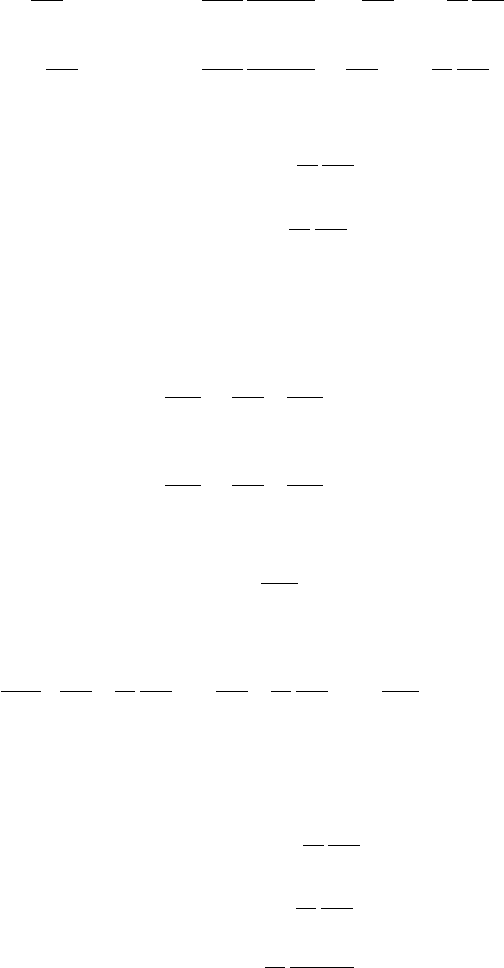
∂
∂u
3
(h
2
H
2
) = −jω²
h
2
h
3
h
1
∂
2
U
∂u
3
∂u
1
= −
∂
∂u
3
µ
jω²
h
2
h
1
∂
∂u
1

U,
∂
∂u
3
(h
1
H
1
) = jω²
h
3
h
1
h
2
∂
2
U
∂u
2
∂u
3
=
∂
∂u
3
µ
jω²
h
1
h
2
∂
∂u
2

U.
Integrating the two equations yields
H
2
= −jω²
1
h
1
∂
∂u
1
U, (4.49)
H
1
= jω²
1
h
2
∂
∂u
2
U. (4.50)
The integration constants provide solutions independent of u
3
, which are
included in the above solutions.
Substituting E
1
from (4.47) and H
2
from (4.49) into (4.28), and consid-
ering h
3
= 1 and k
2
= ω
2
µ², we have
∂E
3
∂u
1
=
∂
∂u
1
µ
∂
2
U
∂u
2
3
+ k
2
U

.
Similarly,
∂E
3
∂u
2
=
∂
∂u
2
µ
∂
2
U
∂u
2
3
+ k
2
U

.
We do not consider the constant field along both u
1
and u
2
; hence we have
E
3
=
∂
2
U
∂u
2
3
+ k
2
U. (4.51)
Substituting (4.49), (4.50) and (4.51) into (4.32) yields
1
h
1
h
2
·
∂
∂u
1
µ
h
2
h
1
∂U
∂u
1

+
∂
∂u
2
µ
h
1
h
2
∂U
∂u
2
¶¸
+
∂
2
U
∂u
2
3
+ k
2
U = 0. (4.52)
This is just the equation (4.40).
(2) If E
3
= 0 and H
3
6= 0, when we apply a similar procedure, making an
auxiliary function V (x), we have
E
1
= −jωµ
1
h
2
∂V
∂u
2
, (4.53)
E
2
= jωµ
1
h
1
∂V
∂u
1
, (4.54)
H
1
=
1
h
1
∂
2
V
∂u
3
∂u
1
, (4.55)

192 4. Time-Varying Boundary Value Problems
H
2
=
1
h
2
∂
2
V
∂u
2
∂u
3
, (4.56)
and
H
3
=
∂
2
V
∂u
2
3
+ k
2
V. (4.57)
Function V satisfies the same equation (4.40).
According to the theorem of superposition, if E
3
6= 0 and H
3
6= 0, then
the sums of (4.47)–(4.51) and (4.53)–(4.57) are just expressions (4.34)–(4.39).
In this theorem, the condition h
1
= 1 means that at least one di-
rection of the coordinate system is a linear coordinate, and the condition
(∂/∂u
3
)(h
1
/h
2
) = 0 means that the forms of functions h
1
and h
2
with re-
spect to u
3
are the same, so that their ratio is independent of u
3
.
The coordinate systems that satisfy the conditions of Theorem 1 include
all cylindrical coordinate systems and spherical coordinate systems.
Theorem 2
If the orthogonal coordinate system satisfies not only the conditions in The-
orem 1, (4.33), but also
∂
∂u
3
(h
1
h
2
) = 0, (4.58)
then the Borgnis’ functions U and V satisfy the homogeneous scalar
Helmholtz equations:
∇
2
U + k
2
U = 0, ∇
2
V + k
2
V = 0. (4.59)
Proof
The expansion of the scalar Helmholtz equation (4.59) in an arbitrary or-
thogonal coordinate system is given by
1
h
1
h
2
h
3
·
∂
∂u
1
µ
h
2
h
3
h
1
∂U
∂u
1

+
∂
∂u
2
µ
h
3
h
1
h
2
∂U
∂u
2

+
∂
∂u
3
µ
h
1
h
2
h
3
∂U
∂u
3
¶¸
+ k
2
U =0.
(4.60)
If the conditions h
3
= 1 and (∂/∂u
3
)(h
1
h
2
) = 0 are satisfied, the scalar
Helmholtz equation (4.60) becomes
1
h
1
h
2
·
∂
∂u
1
µ
h
2
h
1
∂U
∂u
1

+
∂
∂u
2
µ
h
1
h
2
∂U
∂u
2
¶¸
+
µ
∂
2
U
∂u
2
3

+ k
2
U =0. (4.61)
The scalar Helmholtz equation (4.60) is the same as (4.40). So is the equation
for V .
The conditions of Theorem 2 mean that
h
3
= 1,
∂h
1
∂u
3
= 0,
∂h
2
∂u
3
= 0.
4.3 Solution of Vector Helmholtz Equations 193
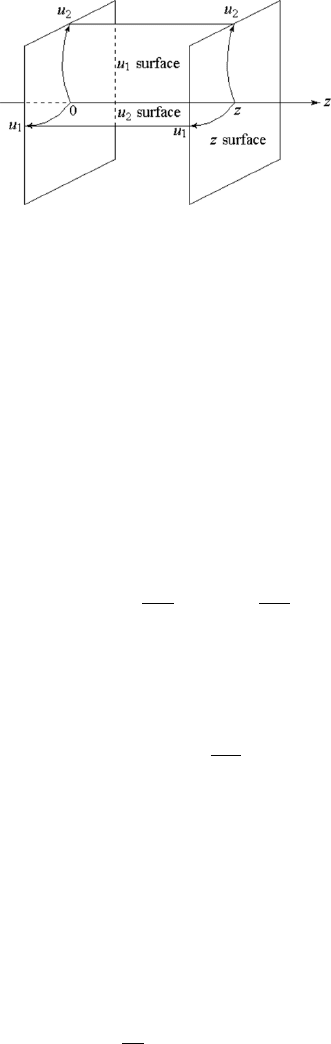
Figure 4.3: Cylindrical coordinate system.
The Lame coefficients h
1
and h
2
for two coordinates u
1
and u
2
are inde-
pendent of the third coordinate u
3
. The coordinate systems that satisfy the
conditions of Theorem 2 are cylindrical coordinate systems.
In an arbitrary cylindrical coordinate system, at least one axis is Cartesian
coordinates, which is recognized as the longitudinal axis, denoted by z. Let
z = u
3
, then h
z
= h
3
= 1, and the equal-z surfaces are parallel planes
perpendicular to the z axis. The other two coordinates are two-dimensional
orthogonal curve sets on the equal-z plane and are denoted by u
1
and u
2
, see
Fig. 4.3. This is just the equation (4.40).
Let u
3
= z, Laplacian operator ∇
2
may be expressed as
∇
2
= ∇
2
T
+
∂
2
∂u
2
3
= ∇
2
T
+
∂
2
∂z
2
, (4.62)
In cylindrical systems, when sinusoidal traveling waves propagate along
two opposite directions of the longitudinal axis z, the function of the field
with respect to t and z is given as follows:
e
j(ωt∓βz)
and
∂
2
∂z
2
= −β
2
,
where β = k
z
denotes the longitudinal phase coefficient. The expressions for
the longitudinal components of the fields (4.36) and (4.39) become:
E
z
=
¡
k
2
− β
2
¢
U = T
2
U, (4.63)
H
z
=
¡
k
2
− β
2
¢
V = T
2
V, (4.64)
where T
2
= k
2
− β
2
= k
2
+ (∂
2
/∂z
2
) denotes the transverse angular wave
number. If we are interested in the wave along the positive direction of the
axis +z, the function of the field becomes e
−jβz
, and we have
∂
∂z
= −jβ.

194 4. Time-Varying Boundary Value Problems
The expressions for the field comp onents (4.34), (4.35), (4.37), (4.38) become
E
1
= −
jβ
h
1
∂U
∂u
1
−
jωµ
h
2
∂V
∂u
2
, (4.65)
E
2
= −
jβ
h
2
∂U
∂u
2
+
jωµ
h
1
∂V
∂u
1
, (4.66)
H
1
= −
jβ
h
1
∂V
∂u
1
+
jω²
h
2
∂U
∂u
2
, (4.67)
H
2
= −
jβ
h
2
∂V
∂u
2
−
jω²
h
1
∂U
∂u
1
. (4.68)
4.3.2 Method of Hertz Vectors [103]
The time-dependent electromagnetic fields can be formulated by means of
Hertz vector potentials as shown in Section 1.6, Chapter 1. For the source-
free problem the electric Hertz vector Π
e
and magnetic Hertz vector Π
m
satisfy the vector Helmholtz equations (1.280) and (1.281):
∇
2
Π
e
+ k
2
Π
e
= 0, (4.69)
∇
2
Π
m
+ k
2
Π
m
= 0. (4.70)
The Hertz vectors may be used to solve the time-dependent field problems
in cylindrical coordinates.
Assume that only the longitudinal component of the electric Hertz vector
exists in a cylindrical coordinates,
Π
e
= ˆzΠ
ez
. (4.71)
According to the expansions (B.10), the vector Helmholtz equation (4.69) for
Π
e
is reduced to the scalar Helmholtz equation
∇
2
Π
ez
+ k
2
Π
ez
= 0. (4.72)
If only the longitudinal component of the magnetic Hertz vector exists in
a cylindrical coordinates,
Π
m
= ˆzΠ
mz
, (4.73)
the vector Helmholtz equation (4.70) for Π
m
is also reduced to a scalar
Helmholtz equation:
∇
2
Π
mz
+ k
2
Π
mz
= 0. (4.74)
We come to the conclusion that both longitudinal components of Hertz
vectors satisfy the scalar Helmholtz equations. Hence the solution of the vec-
tor Helmholtz equations of time-varying-field problems can be reduced to the
solution of the scalar Helmholtz’s equations of the longitudinal components
of Hertz vectors.
4.3 Solution of Vector Helmholtz Equations 195
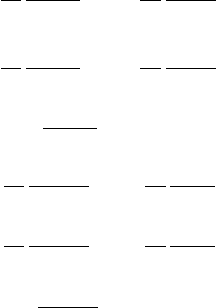
According to the principle of superposition, substituting Π
e
= ˆzΠ
ez
and
Π
m
= ˆzΠ
mz
into (1.284) and (1.285) yields
E
1
=
1
h
1
∂
2
Π
ez
∂z∂u
1
− jωµ
1
h
2
∂Π
mz
∂u
2
, (4.75)
E
2
=
1
h
2
∂
2
Π
ez
∂u
2
∂z
+ jωµ
1
h
1
∂Π
mz
∂u
1
, (4.76)
E
z
=
∂
2
Π
ez
∂z
2
+ k
2
Π
ez
, (4.77)
H
1
=
1
h
1
∂
2
Π
mz
∂z∂u
1
+ jω²
1
h
2
∂Π
ez
∂u
2
, (4.78)
H
2
=
1
h
2
∂
2
Π
mz
∂u
2
∂z
− jω²
1
h
1
∂Π
ez
∂u
1
, (4.79)
H
z
=
∂
2
Π
mz
∂z
2
+ k
2
Π
mz
. (4.80)
Comparing the above six expressions with respect to Π
ez
and Π
mz
and those
with respect to U and V , (4.34) to (4.39), we find that in the cylindrical
coordinates, Π
ez
and Π
mz
are identical to U and V , respectively,
Π
ez
= U, Π
mz
= V.
4.3.3 Method of Longitudinal Components [84, 60]
In the cylindrical coordinate systems, the longitudinal components of the elec-
tric and magnetic fields satisfy the scalar Helmholtz equations. The vector
Helmholtz equations can be solved by starting with the longitudinal comp o-
nents, which is known as the longitudinal component method.
An arbitrary 3-dimensional vector function may be decomposed into a
transverse two-dimensional vector function and a longitudinal scalar function.
So the electric and magnetic field vectors are expressed as follows:
E = E
T
+ ˆzE
z
, H = H
T
+ ˆzH
z
. (4.81)
According to (B.10), the expansion of the vector Laplacian operator in
any cylindrical coordinate system is given by
∇
2
A = ∇
2
A
T
+ ˆz∇
2
A
z
. (4.82)
Hence, the vector Helmholtz equations (4.21), (4.22) for E and H are de-
composed into the following two vector Helmholtz equations and two scalar
Helmholtz equations:
∇
2
E
T
+ k
2
E
T
= 0, ∇
2
H
T
+ k
2
H
T
= 0, (4.83)
196 4. Time-Varying Boundary Value Problems
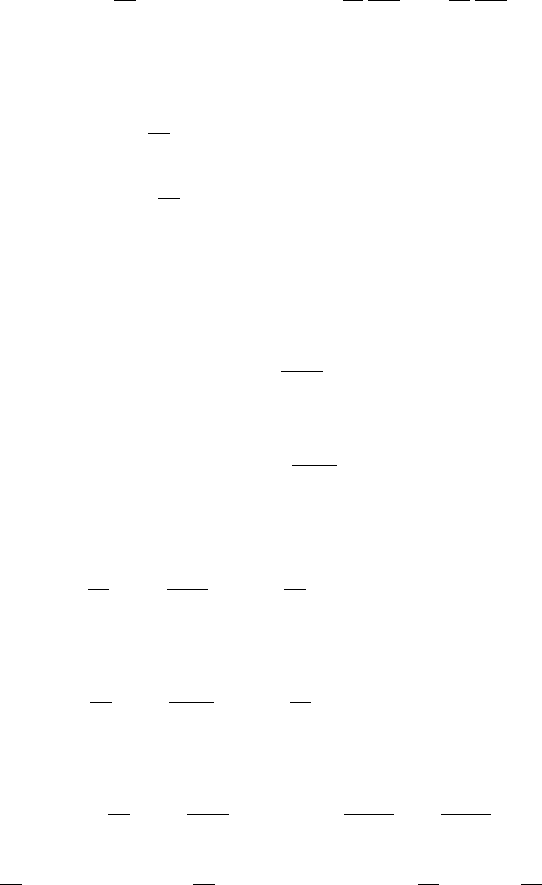
∇
2
E
z
+ k
2
E
z
= 0, ∇
2
H
z
+ k
2
H
z
= 0. (4.84)
The equations for the longitudinal components are scalar Helmholtz equa-
tions. We can solve them first and then find the transverse components with
respect to the longitudinal components by means of Maxwell’s equations.
The nabla operator in cylindrical coordinates is expressed by
∇ = ∇
T
+ ˆz
∂
∂z
, where ∇
T
= ˆu
1
1
h
1
∂
∂u
1
+ ˆu
2
1
h
2
∂
∂u
2
. (4.85)
∇
T
denotes the transverse two-dimensional nabla operator.
Applying (4.81) and (4.85) in Maxwell’s equations (4.25) and (4.26), we
have
µ
∇
T
+ ˆz
∂
∂z

× (E
T
+ ˆzE
z
) = −jωµ(H
T
+ ˆzH
z
), (4.86)
µ
∇
T
+ ˆz
∂
∂z

× (H
T
+ ˆzH
z
) = jω²(E
T
+ ˆzE
z
). (4.87)
The transverse vector and the longitudinal component must satisfy the fol-
lowing equations separately,
∇
T
× E
T
= −jωµH
z
ˆz, (4.88)
∇
T
× ˆzE
z
+ ˆz ×
∂E
T
∂z
= −jωµH
T
, (4.89)
∇
T
× H
T
= jω²E
z
ˆz, (4.90)
∇
T
× ˆzH
z
+ ˆz ×
∂H
T
∂z
= jω²E
T
. (4.91)
Applying the operator ˆz × (∂/∂z) to (4.89) and multiplying (4.91) by
−jωµ, then adding up them and canceling H
T
, we have
ω
2
µ²E
T
−ˆz ×
∂
∂z
µ
ˆz ×
∂E
T
∂z

= ˆz ×
∂
∂z
(∇
T
× ˆzE
z
)−jωµ∇
T
׈zH
z
. (4.92)
Similarly, canceling E
T
from (4.91) and (4.89), we have
ω
2
µ²H
T
−ˆz ×
∂
∂z
µ
ˆz ×
∂H
T
∂z

= ˆz×
∂
∂z
(∇
T
× ˆzH
z
)+jω²∇
T
׈zE
z
. (4.93)
Applying the following vector formulas,
ˆz ×
∂
∂z
µ
ˆz ×
∂A
T
∂z

= ˆz × ˆz ×
∂
2
A
T
∂z
2
= −
∂
2
A
T
∂z
2
,
ˆz ×
∂
∂z
(∇
T
× ˆzA
z
)=−ˆz ×
∂
∂z
(ˆz ×∇
T
A
z
)=−ˆz × ˆz ×
∂
∂z
∇
T
A
z
=
∂
∂z
∇
T
A
z
,

4.3 Solution of Vector Helmholtz Equations 197
(4.92) and (4.93) become
µ
k
2
+
∂
2
∂z
2

E
T
=
∂
∂z
∇
T
E
z
+ jωµˆz × ∇
T
H
z
, (4.94)
µ
k
2
+
∂
2
∂z
2

H
T
=
∂
∂z
∇
T
H
z
− jω²ˆz × ∇
T
E
z
. (4.95)
These are the expressions of the transverse components of the fields in terms
of the longitudinal components.
For sinusoidal traveling waves propagating in two opposite directions
along the longitudinal axis z,
e
∓jβz
,
∂
2
∂z
2
= −β
2
, and T
2
= k
2
− β
2
= k
2
+
∂
2
∂z
2
.
With this notation and the notation of the transverse Laplacian operator
(4.62), the equations of the transverse field vectors (4.83) become
∇
2
T
E
T
+ T
2
E
T
= 0, ∇
2
T
H
T
+ T
2
H
T
= 0. (4.96)
The expressions for E
T
, H
T
, (4.94) and (4.95) become:
E
T
=
1
T
2
µ
∂
∂z
∇
T
E
z
− jωµˆz × ∇
T
H
z

, (4.97)
H
T
=
1
T
2
µ
∂
∂z
∇
T
H
z
− jω²ˆz × ∇
T
E
z

. (4.98)
Each of the transverse vectors may be decomposed into two components:
E
T
= ˆu
1
E
1
+ ˆu
2
E
2
, H
T
= ˆu
1
H
1
+ ˆu
2
H
2
. (4.99)
Applying the expansions of ∇
T
in two-dimensional coordinates u
1
, u
2
, (4.85),
we have
E
1
=
1
T
2
µ
1
h
1
∂
2
E
z
∂u
1
∂z
− jωµ
1
h
2
∂H
z
∂u
2

, (4.100)
E
2
=
1
T
2
µ
1
h
2
∂
2
E
z
∂u
2
∂z
+ jωµ
1
h
1
∂H
z
∂u
1

, (4.101)
H
1
=
1
T
2
µ
1
h
1
∂
2
H
z
∂u
1
∂z
+ jω²
1
h
2
∂E
z
∂u
2

, (4.102)
H
2
=
1
T
2
µ
1
h
2
∂
2
H
z
∂u
2
∂z
− jω²
1
h
1
∂E
z
∂u
1

. (4.103)
Comparing these expressions with the expressions with respect to U, V ,
(4.34), (4.35), (4.37), and (4.38) and the expressions with respect to Π
ez
,
Π
mz
, (4.75), (4.76), (4.78), and (4.79), we see that
E
z
= T
2
U = T
2
Π
ez
, H
z
= T
2
V = T
2
Π
mz
. (4.104)

198 4. Time-Varying Boundary Value Problems
These two expressions are the same as (4.36), (4.39) and (4.77), (4.80), re-
spectively.
We come to the conclusion that the Borgnis’ potentials are identical to the
longitudinal components of the Hertzian vectors and the difference between
them and the longitudinal field components are a multiplying factor T
2
only.
4.4 Boundary Conditions of
Helmholtz’s Equations
The general boundary conditions of time-dependent fields are given in Sec-
tion 1.2. Now, the boundary conditions of the Borgnis’ potentials U , V , the
longitudinal components of the Hertzian vectors Π
ez
, Π
mz
, and the longitu-
dinal field components E
z
, H
z
are to be investigated.
In arbitrary orthogonal curvilinear coordinates, the boundaries are differ-
entiated into two sorts, the boundary p erpendicular to u
3
and the boundaries
parallel to u
3
, The former is the u
3
surface or transverse cross section and
the later are the u
1
and u
2
surfaces or longitudinal boundary surfaces.
We now look into the short-circuit boundaries. At the longitudinal short-
circuit boundary surfaces u
1
= a, denoted by S
1
, the tangential components
of the electric field must be zero, i.e.,
E
3
|
S
1
= 0 and E
2
|
S
1
= 0.
In cylindrical or spherical coordinates, according to (4.36) and (4.35), the
conditions are satisfied when
U|
S
1
= 0 and
∂V
∂u
1
¯
¯
¯
¯
S
1
= 0.
In cylindrical coordinates, according to (4.77) and (4.76), or (4.101), the
conditions are satisfied when
Π
ez
|
S
1
= 0 and
∂Π
mz
∂u
1
¯
¯
¯
¯
S
1
= 0 or E
z
|
S
1
= 0 and
∂H
z
∂u
1
¯
¯
¯
¯
S
1
= 0.
Similarly, At the longitudinal short-circuit boundary surfaces u
2
= b, denoted
by S
2
, the tangential components of the electric field must also be zero, i.e.,
E
3
|
S
2
= 0 and E
1
|
S
2
= 0.
According to (4.36) and (4.34), the conditions are satisfied when
U|
S
2
= 0 and
∂V
∂u
2
¯
¯
¯
¯
S
2
= 0.
According to (4.77) and (4.75), or (4.100), the conditions are satisfied when
Π
ez
|
S
2
= 0 and
∂Π
mz
∂u
2
¯
¯
¯
¯
S
2
= 0 or E
z
|
S
2
= 0 and
∂H
z
∂u
2
¯
¯
¯
¯
S
2
= 0.

4.5 Separation of Variables 199
The above conditions can be summarized as follows:
U|
S
1,2
= 0 or Π
ez
|
S
1,2
= 0 or E
z
|
S
1,2
= 0, (4.105)
and
∂V
∂n
¯
¯
¯
¯
S
1,2
= 0 or
∂Π
mz
∂n
¯
¯
¯
¯
S
1,2
= 0 or
∂H
z
∂n
¯
¯
¯
¯
S
1,2
= 0, (4.106)
where n denotes the normal of the boundary surface. The conclusion is that
the functions U , Π
ez
, and E
z
are equal to zero and the normal derivatives of
V , Π
mz
, and H
z
are equal to zero at the longitudinal short-circuit boundaries.
At the transverse cross-section short-circuit boundaries, u
3
= c, denoted
by S
3
, the tangential components of the electric field are E
1
and E
2
, and we
have
E
1
|
S
3
= 0 and E
2
|
S
3
= 0.
According to (4.34), (4.35), (4.75), (4.76), (4.100), and (4.101), the boundary
conditions of U, V , Π
ez
, Π
mz
, E
z
, and H
z
become
V |
S
3
= 0 or Π
mz
|
S
3
= 0 or H
z
|
S
3
= 0, (4.107)
and
∂U
∂n
¯
¯
¯
¯
S
3
= 0 or
∂Π
ez
∂n
¯
¯
¯
¯
S
3
= 0 or
∂E
z
∂n
¯
¯
¯
¯
S
3
= 0. (4.108)
Functions V , Π
mz
, and H
z
are equal to zero and the normal derivatives of
U, Π
ez
, and E
z
are equal to zero at the transverse cross-section short circuit
boundaries.
For the open-circuit boundaries, the conditions are dual to those for the
short-circuit boundaries.
4.5 Separation of Variables
Using the methods given in the previous two sections, the boundary-value
problems of vector Helmholtz equations may reduce to the problems of solving
the scalar Helmholtz equation
∇
2
U + k
2
U = 0
with certain boundary conditions,
U|
S
= 0 or
∂U
∂n
¯
¯
¯
¯
S
= 0,
where U can also be one of V , Π
ez
, Π
mz
, E
z
, and H
z
.
200 4. Time-Varying Boundary Value Problems
The method of separation of variables is an important and convenient
way to solve scalar partial differential equations in mathematical physics. By
choosing an appropriate orthogonal coordinate system, we can represent the
solution by a product of three functions, one for each coordinate, and the
three-dimensional partial differential equation is reduced to three ordinary
differential equations. The functions that satisfy these ordinary differential
equations are orthogonal function sets called harmonics. The solution of the
differential equation with specific boundary conditions is usually a series of
the specific harmonics set.
Equations involving the three-dimensional Laplacian operator, for exam-
ple Laplace’s equation and Helmholtz’s equation, are known to be separable
in eleven different orthogonal coordinate systems, included in the following
three groups:
Cylindrical
1. Rectangular coordinates: Consists of three sets of mutual or-
thogonal parallel planes.
2. Circular-cylinder coordinates: Consists of a set of coaxial circu-
lar cylinders, a set of half planes rotated around the axis, and a set
of parallel planes perpendicular to the axis. The circular-cylinder
coordinate system is also a rotational coordinate system.
3. Elliptic-cylinder coordinates: Consists of a set of confo cal ellip-
tic cylinders, a set of confocal hyperbolic cylinders perpendicular
to the elliptic cylinders, and a set of parallel planes perpendicular
to the axis.
4. Parabolic-cylinder coordinates: Consists of two sets of mutual
orthogonal parabolic cylinders and a set of parallel planes perpen-
dicular to the axis.
Rotational
5. Spherical coordinates: Consists of a set of concentric spheres, a
set of cones perpendicular to the spheres, and a set of half planes
rotated around the polar axis.
6. Prolate spheroidal coordinates: Consists of a set of confocal
prolate spheroids, a set of confocal hyperboloids of two sheets,
and a set of half planes rotated around the polar axis.
7. Oblate spheroidal coordinates: Consists of a set of confocal
oblate spheroids, a set of confocal hyperboloids of one sheet and
a set of half planes rotated around the polar axis.
8. Parabolic coordinates: Consists of two sets of mutual orthogonal
circular paraboloids and a set of half planes rotated around the
polar axis.