
Zhang K., Li D. Electromagnetic Theory for Microwaves and Optoelectronics
Подождите немного. Документ загружается.

Chapter 1
Basic Electromagnetic
Theory
The foundation of this book is macroscopic electromagnetic theory. In the
beginning, a brief survey of the basic laws and theorems of electromagnetic
theory is necessary. These subjects are included in undergraduate texts on
electrodynamics or electromagnetic theory. Therefore, this chapter may be
read as a review. The contents of this chapter include:
Maxwell’s equations in vacuum and in continuous media;
Characteristics of material media;
Boundary conditions, Maxwell’s equations on the boundary of media;
Wave equations and Helmholtz’s equations;
Energy and power flow in electromagnetic fields, Poynting’s theorem;
Potential functions and d’Alembert’s equations;
Hertzian vector potentials;
Duality and reciprocity.
1.1 Maxwell’s Equations
James Clark Maxwell (1831–1879) reviewed and grouped the most important
experimental laws on electric and magnetic phenomena, developed by previ-
ous scientists over more than one hundred years. He also developed Faraday’s
concept of field, introduced the displacement current into Amp`ere’s circuital
law, and finally, in 1863, formulated a complete set of equations governing
the behavior of the macroscopic electromagnetic phenomenon [68]. In fact, it
was Oliver Heaviside (1850-1925) who first expressed them in the form that
we know today, but J.C. Maxwell was the first to state them clearly and to
recognize their significance. This set of equations is usually and justly known
as Maxwell’s equations.
2 1. Basic Electromagnetic Theory
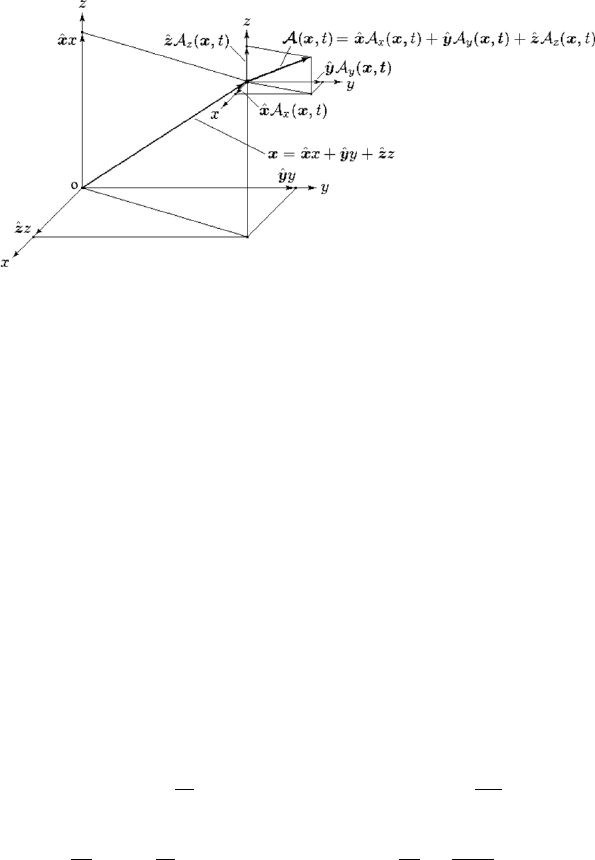
Figure 1.1: Position vector x and vector function A(x, t).
1.1.1 Basic Maxwell Equations
Instantaneous, or so-called time-domain, Maxwell equations in vacuum are
the basic Maxwell equations. The vectors and scalars in the equations are
functions of position x (vector) and time t (scalar). In rectangular coordi-
nates, x =
ˆ
xx+
ˆ
yy +
ˆ
zz, where
ˆ
x,
ˆ
y and
ˆ
z are the unit vectors along the x, y
and z directions, respectively, refer to Fig. 1.1. An arbitrary vector function
A = A(x, t) is explained as follows:
A(x, t) =
ˆ
xA
x
(x, t) +
ˆ
yA
y
(x, t) +
ˆ
zA
z
(x, t), (1.1)
where scalar functions A
x
, A
y
and A
z
are the comp onents of the vector
function A. This kind of vector functions and scalar functions with respect
to time t are known as instantaneous functions or instantaneous values.
The basic Maxwell equations in integral form and derivative form are
given as
I
l
E · dl = −
d
dt
Z
S
B · dS, ∇ × E = −
∂B
∂t
, (1.2)
I
l
B
µ
0
· dl =
d
dt
Z
S
²
0
E · dS + I, ∇ ×
B
µ
0
=
∂²
0
E
∂t
+ J , (1.3)
I
S
²
0
E · dS = q, ∇ · ²
0
E = %, (1.4)
I
S
B · dS = 0, ∇ · B = 0, (1.5)
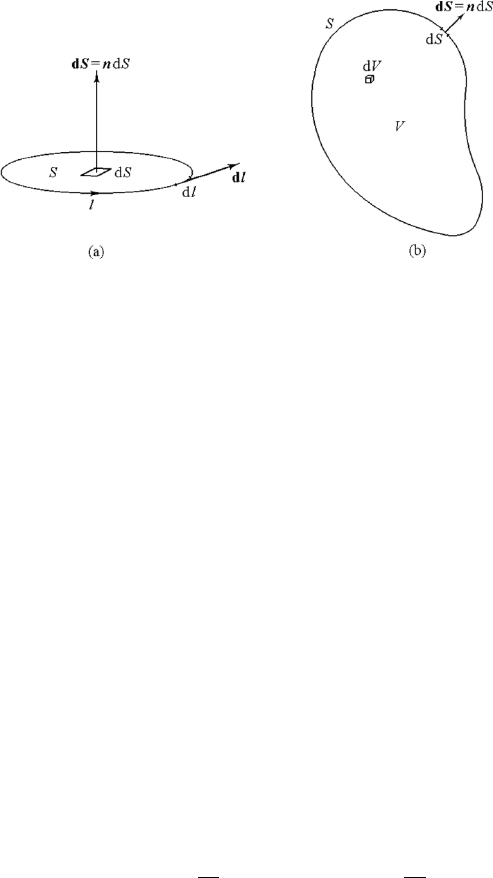
where l is a closed contour surrounding an open surface S and a volume V
is bounded by the closed surface S. See Fig. 1.2.
1.1 Maxwell’s Equations 3
Figure 1.2: An open surface S surrounded by a closed contour l (a) and a
volume V bounded by a closed surface S (b).
Maxwell’s equations in derivative form are applicable in continuous
medium only. These constitute a set of simultaneous partial differential equa-
tions with respect to space and time. Equation (1.2) is the curl equation for
the electric field, originating from Faraday’s law of induction; (1.3) is the curl
equation for the magnetic field, originating from Amp`ere’s circuital law and
Maxwell’s hypothesis of displacement current; (1.4) is the divergence equa-
tion for the electric field, originating from Gauss’s law; and finally, (1.5) is
the divergence equation for the magnetic field, originating from the law of
continuity of magnetic flux. The experimental foundation of Gauss’s law for
the electric field is Coulomb’s law; the experimental foundation of Amp`ere’s
circuital law is the Biot–Savart law and Amp`ere’s law of force; and finally,
the experimental foundation of the law of continuity of magnetic flux is that
there is no experimental evidence to prove the existence of magnetic charges
or so-called monopoles (until now).
In the above equations, % = %(x, t) is the electric charge density, a scalar
function in units of coulombs per cubic meter (C/m
3
); J = J (x, t) is
the electric current density, a vector function in amperes per square meter
(A/m
2
). The relation between them is the equation of continuity,
I
S
J · dS = −
dq
dt
, ∇ · J = −
∂%
∂t
, (1.6)
where q is the total electric charge in the volume V bounded by the closed
surface S, and we have
q =
Z
V
% dV, (1.7)
and I is the total current flowing across the cross section S surrounded by

4 1. Basic Electromagnetic Theory
closed contour l, and we have
I =
Z
S
J · dS. (1.8)
The equation of continuity (1.6) is not independent, it can be derived from
the curl equation (1.3) and the divergence equation (1.4). Alternatively, we
may recognize the equation of continuity (1.6) as a basic law, and then the
divergence equation (1.4) can be derived from (1.6) and the curl equation
of the magnetic field (1.3). Similarly, the divergence equation of magnetic
field (1.5) is also not independent, it can be derived directly from the curl
equation of the electric field (1.2).
In (1.2)–(1.5), E = E(x, t) is the vector function of electric field strength,
the unit of E is volts per meter (V/m). The definition of electric field strength
is the electric force exerted on a unit test point charge:
F = qE. (1.9)
The direction of the electric force is the same as that of the electric field.
The vector function B = B (x, t) is the magnetic induction or magnetic
flux density, in tesla (T) or weber per square meter (Wb/m
2
). The definition
of magnetic induction is based on the magnetic force exerted on a unit test
current element, i.e., the Amp`ere force, or the magnetic force exerted on a
moving point charge with velocity v, i.e., the Lorentz force. The direction
of the magnetic force is perpendicular to both the current element or the
velocity of the charge and the magnetic induction. The Amp`ere force and
the Lorentz force are given as
F = Idl × B, F = qv × B. (1.10)
In Maxwell’s equations, ²
0
and µ
0
are two constants, the permittivity and
the permeability of vacuum, respectively. The relation among ²
0
, µ
0
and the
speed of light in vacuum, c, is
c
2
= 1/µ
0
²
0
, c = 2.99792458 ×10
8
m/s ≈ 3 × 10
8
m/s.
In the international system of units (SI), the value of µ
0
has b een chosen to
be
µ
0
= 4π × 10
−7
H/m,
which gives
²
0
= 8.85418782 × 10
−12
F/m ≈ (1/36π) × 10
−9
F/m.
The term
∂²
0
E
∂t
in equation (1.3) was originally introduced into the curl
equation for magnetic field by Maxwell and is called the displacement current
density. Note that, displacement current density is not connected with the

1.1 Maxwell’s Equations 5
movement of electric charge but just the variation of electric field with respect
to time, which has the same dimension of current density and has the same
effect in the curl equation of magnetic field. During the time of Maxwell, no
experimental verification was made for this hypothesis.
Maxwell’s equations are the general description of macroscopic electro-
magnetic phenomenon. From this point of view, Coulomb’s law, the Biot–
Savart law, Amp`ere’s law and Faraday’s law are all particular examples. The
most important equations are the two curl equations including Faraday’s law
of induction and Maxwell’s hypothesis of displacement current. The interac-
tions between an electric field and a magnetic field in a time-varying state
were described by J.C. Maxwell, as were the wave behavior of electromag-
netic fields. Furthermore, the speed of an electromagnetic wave was obtained
theoretically from these equations and agrees with the experimental value for
the speed of light, within a small experimental error. J.C. Maxwell predicted
that time-varying electromagnetic fields exist in the form of waves and light
is an electromagnetic wave phenomenon in a special frequency band. 25 years
after this prediction, 9 years after the death of J.C. Maxwell, the electromag-
netic wave was generated and detected for the first time in electromagnetic
experiments by Henrich R. Hertz in 1888, by which Maxwell’s hypothesis
of displacement current was experimentally proved. In 1895, the year after
the death of H.R. Hertz, experiments into the application of electromagnetic
waves in communications were realized by G. Marconi of Italy and A. Popov
of Russia independently and almost simultaneously. Unfortunately, the two
great prophets and forerunners, J.C. Maxwell and H.R. Hertz, didn’t see the
glorious result of their pioneering work.
In material media, Maxwell’s equations in vacuum (1.2)–(1.5) are still
correct, but all kinds of charges and currents must be included in % and J in
the equations. Both the free charge density %
f
and the bound charge density
%
p
produced by the polarization of media are included in the total electric
charge density %. All of the true (or free) current density, J
f
, including the
conduction current density and the convection current density, the polariza-
tion current density J
p
produced by the time-varying polarization of the
media and the molecular current density J
M
produced by the magnetization
of the media are included in the current density J . Thus the basic Maxwell
equations can be rewritten as
∇ × E = −
∂B
∂t
, (1.11)
∇ ×
B
µ
0
=
∂²
0
E
∂t
+ J
f
+ J
p
+ J
M
, (1.12)
∇ · ²
0
E = %
f
+ %
p
, (1.13)
∇ · B = 0. (1.14)
6 1. Basic Electromagnetic Theory
1.1.2 Maxwell’s Equations in Material Media
When an electromagnetic field is applied to material media, the phenomena
of conduction, polarization, and magnetization occur.
For conductive media, the conduction current flowing as a result of the
existence of an electric field is directly proportional to E,
J = σE, (1.15)
where σ is the conductivity of the material, in siemens per meter (S/m). This
is the differential form of Ohm’s law.
Polarization causes the appearance of aligned electric dipole moments or a
bound charge density %
p
. In addition, a time-varying polarization causes the
appearance of the polarization current density J
p
, which is the result of the
oscillation of bound charges. The result of magnetization is the appearance
of aligned magnetic dipole moments or a molecular current density J
M
. Two
new vector functions, the polarization vector P and the magnetization vector
M are introduced, where P is the vector sum of the electric dipole moments
per unit volume, i.e., the volume density of electric dipole moment and M
is the vector sum of the magnetic dipole moments per unit volume, i.e., the
volume density of magnetic dipole moment. The relation between P and %
p
is
∇ · P = −%
p
, (1.16)
and the relation between M and J
M
is
∇ × M = J
M
. (1.17)
From the equation of continuity (1.6), we have
∇ · J
p
= −
∂%
p
∂t
.
Substituting (1.16) into it, we obtain
J
p
=
∂P
∂t
. (1.18)
Substituting (1.16), (1.17) and (1.18) into Maxwell’s equations (1.11)–
(1.14) yields
∇ × E = −
∂B
∂t
, (1.19)
∇ ×
B
µ
0
− ∇ × M =
∂²
0
E
∂t
+
∂P
∂t
+ J
f
, (1.20)
∇ · ²
0
E + ∇ · P = %
f
, (1.21)
∇ · B = 0. (1.22)

1.1 Maxwell’s Equations 7
The bound charge, the polarization current, and the molecular current dis-
appear in this set of equations, which are replaced by −∇ · P, ∂P/∂t and
∇ × M, respectively.
Introduce two new vector functions D and H. Their definitions are
D = ²
0
E + P, (1.23)
H =
B
µ
0
− M, or B = µ
0
(H + M). (1.24)
D denotes the electric induction vector, and is also known as the electric
displacement vector or electric flux density, the unit of D is coulombs per
square meter (C/m
2
). H denotes the magnetic strength vector, its unit is
amperes per meter (A/m).
For understanding the relations (1.16), (1.17), (1.18), equations (1.19) to
(1.22) and relations (1.23), (1.24), please refer to an undergraduate text on
electromagnetism.
Substituting (1.23) and (1.24) into equations (1.19) to (1.22) , and neglect-
ing the subscript ‘f ’ in %
f
and J
f
, we have the following Maxwell equations
and their integral form counterparts
I
l
E · dl = −
d
dt
Z
S
B · dS, ∇ × E = −
∂B
∂t
(1.25)
I
l
H · dl =
d
dt
Z
S
D · dS + I, ∇ × H =
∂D
∂t
+ J , (1.26)
I
S
D · dS = q, ∇·D = %, (1.27)
I
S
B · dS = 0, ∇ · B = 0. (1.28)
These equations are Maxwell’s equations in material media or, exactly,
Maxwell’s equations taking account of the effect of polarization and magne-
tization of media. They are valid in material media as well as in vacuum.
In vacuum, we have P = 0 and M = 0, or D = ²
0
E and B = µ
0
H. Note
that only free charges and free (or true) currents are included in the charge
density and the current density terms in Maxwell’s equations in material me-
dia (1.25)–(1.28), but in the basic Maxwell’s equations or so called Maxwell’s
equations in vacuum (1.2)–(1.5), all kinds of charge and currents must be
included.
The term J
d
=
∂D
∂t
=
∂²
0
E
∂t
+
∂P
∂t
in equation (1.26) denotes the displace-
ment current density in material media, includes the variation of electric field
and the variation of electric polarization with respect to time. The later rep-
resents the oscillation of bound charges. Equation of the curl of magnetic
field (1.26) then becomes
∇ × H = J
d
+ J
f
.
8 1. Basic Electromagnetic Theory
It leads to the law of continuity of total current,
I
S
(J
d
+ J
f
) · dS = 0.
We leave the proof of this law as an exercise, see Problem 1.4.
Equations (1.23)–(1.28) are universally applicable for any medium. But
when we deal with the relation between P and E, or the relation between M
and H, which are usually called the constitutive relations, the performances
of different kinds of media are quite different from each other.
(1) Simple Media
The non-dispersive, linear and isotropic media are called simple media. In
simple media, vector P is parallel to and proportional to vector E and vector
M is parallel to and proportional to vector B. The relationships can be
expressed as follows:
P = ²
0
χ
e
E, (1.29)
M = χ
m
H, (1.30)
where χ
e
is the electric susceptibility and χ
m
is the magnetic susceptibility
of the medium, both of which are dimensionless quantities.
Substituting (1.29) and (1.30) into (1.23) and (1.24), respectively, we have
D = ²
0
(1 + χ
e
)E = ²
0
²
r
E, or D = ²E, (1.31)
B = µ
0
(1 + χ
m
)H = µ
0
µ
r
H, or B = µH. (1.32)
In the above equations,
²
r
= 1 + χ
e
, ² = ²
0
²
r
= ²
0
(1 + χ
e
), (1.33)
µ
r
= 1 + χ
m
, µ = µ
0
µ
r
= µ
0
(1 + χ
m
), (1.34)
where ² is the permittivity, µ is the permeability of the medium, and ²
r
and
µ
r
are the relative permittivity and relative permeability, respectively. The
unit of ² is the same as that of ²
0
and the unit of µ is the same as that of
µ
0
. ²
r
and µ
r
are dimensionless quantities. Equations (1.31) and (1.32) are
constitutive equations or constitutive relations of the simple media, in which
² and µ are constitutive parameters.
In isotropic medium, the electric field vector and the polarization vector
are in the same direction, and the susceptibilities in all directions are equal,
so are the magnetic field and the magnetization vectors. In isotropic media,
² and µ are scalars. Hence in simple media, both the permittivity ² and the
permeability µ are constant scalars.

1.1 Maxwell’s Equations 9
Substituting (1.31) and (1.32) into (1.25)–(1.28), yields Maxwell’s equa-
tions for stable, uniform simple media:
∇ × E = −µ
∂H
∂t
, (1.35)
∇ × H = ²
∂E
∂t
+ σE + J , (1.36)
∇ · E =
%
²
, (1.37)
∇ · H = 0. (1.38)
True (or free) current J in equation (1.26) is divided into two terms in
(1.36). The one is conduction current, which comply with Ohm’s law and is
directly proportional to electric field strength, J
c
= σE. It is considered as
a field term. The second term is the current other than the conduction cur-
rent, and is not proportional to the electric field, for example, the convection
current caused by the motion of charged particles in vacuum or plasma, and
the source current independent of the field or so called impressed current. It
is considered as the source term J
s
or simply J in (1.36).
(2) Dispersive Media
In dispersive media, the responses of polarization and magnetization are not
instant. The D depends upon not only the present value of E but also
the time derivatives of all orders of E. So does B and H. For isotropic,
linear dispersive media, the constitutive relations become the following linear
differential equations [37]:
D = ²E + ²
1
∂E
∂t
+ ²
2
∂
2
E
∂t
2
+ ²
3
∂
3
E
∂t
3
+ ···, (1.39)
B = µH + µ
1
∂H
∂t
+ µ
2
∂
2
H
∂t
2
+ µ
3
∂
3
H
∂t
3
+ ···. (1.40)
Equations (1.39) and (1.40) reduce to (1.31) and (1.32), respectively, when
the coefficients of the derivative terms become sufficiently small, and the
medium can be treated as a non-dispersive medium.
Later, in section 1.1.4, we can see that, not only the dispersion but also
the polarization dissipation and magnetization dissipation are described in
the constitutive relations (1.39) and (1.40).
Detailed discussions of the dispersion of media and the electromagnetic
waves in dispersive media are given in Chapter 8.
10 1. Basic Electromagnetic Theory
(3) Nonlinear Media
In nonlinear media, the relation between D and E and the relation between
B and H are nonlinear. This means that the constitutive parameters ² and
µ depend upon the field strengths. In this case, we must return to (1.23) and
(1.24). In practice, the experimental curves of D versus E and B versus H
are established in the following manner
D = f
1
(E), B = f
2
(H). (1.41)
An important phenomenon of nonlinear media is the hysteresis of ferro-
magnetic materials [82]. The investigation of nonlinear effects of media in
the optical band, i.e., nonlinear optics, has been highly developed in recent
years [38, 116]. These subjects are not included in this book, refer to [16, 89].
(4) Anisotropic Media
If the electric field induces polarization in a direction other than that of the
electric field, and the susceptibilities are different in different directions, the
medium is known as an electric anisotropic medium. Similar behavior in
magnetization is called magnetic anisotropic medium. In anisotropic media,
the electric and/or magnetic susceptibilities are no longer scalars but tensors
of rank 2 or matrices [11, 53, 84].
For the electric anisotropic media, the electric susceptibility becomes a
tensor,
P = ²
0
χ
e
· E, χ
e
=
χ
exx
χ
exy
χ
exz
χ
eyx
χ
eyy
χ
eyz
χ
ezx
χ
ezy
χ
ezz
. (1.42)
For the magnetic anisotropic media, the magnetic susceptibility becomes a
tensor,
M = χ
m
· H, χ
m
=
χ
mxx
χ
mxy
χ
mxz
χ
myx
χ
myy
χ
myz
χ
mzx
χ
mzy
χ
mzz
. (1.43)
Substituting (1.42) and (1.43) into (1.23) and (1.24), respectively, we have
D = ²
0
E + ²
0
χ
e
· E = ²
0
(I + χ
e
) · E, (1.44)
B = µ
0
H + µ
0
χ
m
· H = µ
0
(I + χ
m
) · H, (1.45)
where I is the unit tensor,
I =
1 0 0
0 1 0
0 0 1
. (1.46)