
Zhang K., Li D. Electromagnetic Theory for Microwaves and Optoelectronics
Подождите немного. Документ загружается.

1.8 Reciprocity 51
1.8 Reciprocity
The Lorentz reciprocity theorem is one of the most important theorems in
electromagnetic theory [24, 25, 37]. It is suitable for the fields and waves in
reciprocal media, in which the permittivity ² and permeability µ are symmet-
rical tensors of rank two for anisotropic media, and are scalars for isotropic
media.
Let E
1
, H
1
be the fields generated, in the volume V bounded by a closed
surface S, by a volume distribution of electric current J
1
and equivalent
magnetic current J
m1
. Let E
2
, H
2
be the fields generated, in the same
volume, by a volume distribution of sources J
2
and J
m2
. The two sets of
fields and sources both satisfy Maxwell’s equations
∇ × E
1
= −jωµ · H
1
− J
m1
, ∇× H
1
= jω² · E
1
+ J
1
,
∇ × E
2
= −jωµ · H
2
− J
m2
, ∇× H
2
= jω² · E
2
+ J
2
.
Expanding ∇·(E
1
×H
2
−E
2
×H
1
) and using the vector identity (B.38),
∇ · (A × B) = B · ∇ × A − A · ∇ × B,
we obtain
∇ · (E
1
× H
2
− E
2
× H
1
) = H
2
· ∇ × E
1
− E
1
· ∇ × H
2
+H
1
· ∇ × E
2
− E
2
· ∇ × H
1
.
Substituting the curl of the field vectors from Maxwell’s equations and noting
that
² · E = E · ², µ · H = H · µ,
because of the symmetry of the tensors ² and µ in reciprocal media, we have
∇·(E
1
×H
2
−E
2
×H
1
) = E
2
·J
1
−E
1
·J
2
−H
2
·J
m1
+H
1
·J
m2
. (1.286)
Integrating (1.286) over the volume V and using Gauss’s theorem (B.47) to
convert the volume integral of the divergence to a surface integral, give
I
S
(E
1
×H
2
−E
2
×H
1
)·dS =
Z
V
(E
2
·J
1
−E
1
·J
2
−H
2
·J
m1
+H
1
·J
m2
)dV.
(1.287)
Equations (1.286) and (1.287) are the general form of the Lorentz reciprocity
theorem in derivative form and integral form, respectively. The follows are
some special cases
1. At a point without a source,
∇ · (E
1
× H
2
− E
2
× H
1
) = 0. (1.288)
In a source-free volume V ,
I
S
(E
1
× H
2
− E
2
× H
1
) · dS = 0. (1.289)

52 1. Basic Electromagnetic Theory
2. In an adiabatic volume V , surrounded by a short-circuit surface, i.e.,
an electric wall or by an open-circuit surface, i.e., a magnetic wall,
I
S
(E
1
× H
2
− E
2
× H
1
) · dS = 0.
If there are sources in the volume V , we have
Z
V
(E
1
· J
2
− H
1
· J
m2
)dV =
Z
V
(E
2
· J
1
− H
2
· J
m1
)dV. (1.290)
This means that in an adiabatic volume, the reaction of field 1 on source
2 is equal to the reaction of field 2 on source 1. The unbounded infinite
space is also an adiabatic volume if all sources are of finite extent.
Using the reciprocity theorem, it can be proven that the receiving pattern
of any antenna constructed by reciprocal material is identical to its transmit-
ting pattern; and the characteristics of a probe in a reciprocal waveguide or
resonator as a receiving element is identical to that of an exciting element.
Note that, the reciprocity theorem is not suitable for the fields and waves
in non-reciprocal media, such as magnetized plasma and saturated magne-
tized ferrite. See Section 8.9 and 8.10.
The reciprocity in network theory may be derived from the reciprocity
theorem for fields, see Section 3.5.2.
Problems
1.1 Show that the equation of continuity may be derived from Maxwell’s
equations.
1.2 (1) Show that the volume charge density in a conducting medium with
conductivity σ and permittivity ² satisfies the following equation:
σ
²
+
∂%
∂t
= 0.
(2) Show that any existing charge density within a conductor will be
damped exponentially and find the relaxation time, i.e., the time re-
quired for it to be reduced to 1/e of its initial value.
(3) Find the relaxation times for copp er and glass. The conductivity
and relative permittivity of copper are 5.8 ×10
7
S/m and 1, and those
of a typical glass are 10
−12
S/m and 5, respectively.

Problems 53
1.3 For a coaxial cylindrical capacitor of radii a and b (b < a), calculate
the displacement current per unit length across a cylindrical surface of
radius r between the inner and outer conductors (b < r < a). The end
effect can be neglected for the capacitor is long enough. Suppose the
voltage variation is sinusoidal in time and the frequency is low enough
so that the electric field distribution is approximately the same as that
for static state. Show that the displacement current is independent of
r and equal to the conductive current for charging the capacitor.
1.4 Starting from Maxwell’s equation (1.26), prove that the total current is
continuous everywhere, i.e., for a closed surface
I
S
(J
d
+ J
f
) · dS = 0,
where J
d
denotes the displacement current density and J
f
, the free
current density, including the conduction current density and the con-
vection current density.
1.5 Suppose we have the following expressions for the electric fields in a
source-free nonconducting region:
(a) E = ˆxE
0
cos(ωt − kz),
(b) E = ˆzE
0
cos(ωt − kz),
(c) E = ˆxE
0
sinkzcos ωt,
(d) E = ˆxE
0
sink
y
y e
j(ωt−k
z
z)
,
(e) E = (ˆx + jˆy)E
0
cos(ωt − kz),
(f) E = (ˆx + ˆz)E
0
cos(ωt − k|x − z|/
√
2).
(1) Which expressions satisfy the homogeneous wave equation? Which
ones do not?
(2) For the expressions that satisfy the homogeneous wave equation,
derive the expressions for the magnetic fields using Maxwell’s equa-
tions, and show the relations among the directions of the electric field,
magnetic field, and propagation.
1.6 The breakdown field strength of air is approximately 3 ×10
6
V/m. Cal-
culate the maximum power flow density in W/m
2
of a laser beam prop-
agating through air without breakdown.
1.7 Sunlight brings in average power flow of 1376 W/m
2
approximately to
the earth. Assuming a plane polarized wave brings the same power flow
density, find the peak values of E and H in such a wave.
1.8 Given a cylindrical resistor carrying a current, find the value of E and H
on the surface of the resistor, compute the Poynting vector, and show
that the amount of power flowing into the resistor is just enough to
supply the Joule loss that appears as heat in the resistor.

54 1. Basic Electromagnetic Theory
1.9 Show that the instantaneous value of the Poynting vector for sinusoidal
fields may be found as follows:
S = <
µ
˙
S ±
1
2
E × He
j2ωt

.
Note:
<(A) =
1
2
(A + A
∗
), =(A) =
1
2j
(A − A
∗
).
1.10 Assume an infinitely long conducting wire along the
ˆ
z axis. A current
I is suddenly applied to it at the time t = 0. Show that the vector
potential at a point perpendicular to the wire and at a distance r is
A(x, t) =
ˆ
z(µ
0
I/2π) cosh
−1
(tc/r), t ≥ r/c,
A(x, t) = 0, t ≤ r/c.
Derive the electric and magnetic fields for t ≥ r/c , and show that the
Poynting vector is
S =
ˆ
r
µ
0
I
2
c
2
t
4π
2
r(c
2
t
2
− r
2
)
.
1.11 In a nonuniform medium the permittivity and permeability are func-
tions of coordinates ²(x) and µ(x). Derive the wave equations for E
and H in a source-free, nonconducting, nonuniform medium.
1.12 Derive the relationship between ϕ and A in the Coulomb gauge and
those in the Lorentz gauge.
1.13 Show that in a source-free region, ∇ · E = 0, the electric field and
the magnetic field may be expressed by means of the electric vector
potential A
e
as follows,
E = ∇ × A
e
,
H = jωA
e
−
∇∇ · A
e
j ωµ
,
and that A
e
satisfies the following Helmholtz’s equation
∇
2
A
e
+ ω
2
µ²A
e
= 0.
1.14 Prove that, in nonreciprocal anisotropic media, the Lorentz reciprocity
theorem is no longer satisfied.
Chapter 2
Introduction to Waves
J.C. Maxwell predicted that time-varying electromagnetic fields would exist
in the form of a wave propagating with the velocity of light. In Section 1.3.2,
the time-domain solution of the wave equation was given and the concept of
a uniform plane wave in unbounded space, the simplest form of waves, was
introduced.
In practice, a large variety of electromagnetic waves may exist. The form
of a wave in a specific system depends upon the nature of the media and the
boundary conditions. In the remainder of this book, waves in different forms
will be discussed in detail.
In this chapter, the propagation, dissipation, polarization, reflection, and
refraction of sinusoidal uniform plane waves are presented.
2.1 Sinusoidal Uniform Plane Waves
The most fundamental and simplest electromagnetic waves in unbounded
homogeneous simple media are uniform plane waves. In a plane wave, the
fields propagate in a specific direction; the plane perpendicular to the direc-
tion of propagation is an equiphase plane or wave front. In a uniform plane
wave, the equiphase plane is also an equiamplitude plane. This means that
the field strength is constant in the plane perpendicular to the direction of
propagation.
Strictly speaking, plane waves can be generated only by infinite uniform
plane sources. In fact, waves at large distances from an arbitrary source have
negligible curvature, and are well represented by plane waves when observed
over a limited area. For example, solar light is a spherical wave, but when
we observe it on the earth, it can be identified as a plane wave.
56 2. Introduction to Waves
2.1.1 Uniform Plane Waves in Lossless Simple Media
Rewrite the Helmholtz’s equations in a lossless homogeneous simple medium
(1.156), (1.157),
∇
2
E + k
2
E = 0, (2.1)
∇
2
H + k
2
H = 0. (2.2)
and the corresponding source-free complex Maxwell equations (1.75)–(1.78),
∇ × E = −j ωµH, (2.3)
∇ × H = j ω²E, (2.4)
∇ · E = 0, (2.5)
∇ · H = 0. (2.6)
For Uniform plane waves propagating along z, E and H are functions of
z only and are independent of x and y, which determined the equiphase and
equiamplitude plane,
∂
∂x
= 0,
∂
∂y
= 0,
∂
∂z
6= 0.
Under the above conditions for uniform plane waves, the component equa-
tions of Maxwell’s equations (2.3) and (2.4) reduce to
dE
y
dz
= −jωµH
x
, (2.7)
dE
x
dz
= −jωµH
y
, (2.8)
0 = −jωµH
z
, (2.9)
dH
y
dz
= −jω²E
x
, (2.10)
dH
x
dz
= −jω²E
y
, (2.11)
0 = −jω²E
z
. (2.12)
We see from (2.9) and (2.12) that the longitudinal components of the
fields vanish,
E
z
= 0, H
z
= 0, (2.13)
and both the electric field and the magnetic field have only transverse compo-
nents perpendicular to the direction of propagation z. So the uniform plane
wave must be a transverse wave or so-called TEM wave.
The equations for transverse components become two independent sets,
the equations containing E
x
, H
y
, (2.8), (2.10) and the equations containing
E
x
, H
y
, (2.7), (2.11). The two sets of equations have the same form, so we
2.1 Sinusoidal Uniform Plane Waves 57
may deal with whichever set. Firstly, we deal with the equations containing
E
x
and H
y
.
For E
x
and H
y
, from maxwell’s equations (2.8) and (2.10) the one dimen-
sional scalar Helmholtz’s equations are derived,
d
2
E
x
dz
2
= −ω
2
µ²E
x
, (2.14)
d
2
H
y
dz
2
= −ω
2
µ²H
y
. (2.15)
Equations (2.8), (2.10), (2.14) and (2.15) are the complex forms of the corre-
sponding instantaneous equations (1.135), (1.137), (1.141) and (1.142) given
in Section 1.3.2.
In Section 1.3.2, with an arbitrary time dependence f(t), the time-domain
solution of the one-dimensional instantaneous wave equation in vacuum or
lossless media, (1.141) and (1.142), was given as follows, refer to (1.149) and
(1.150),
E
x
(z, t) = E
+
f
³
t −
z
v
p
´
+ E
−
f
³
t +
z
v
p
´
, (2.16)
H
y
(z, t) =
E
+
η
f
³
t −
z
v
p
´
−
E
−
η
f
³
t +
z
v
p
´
. (2.17)
This ia a linear polarized uniform plane wave with the electric field in the
x direction, propagating along +z and −z, where v
p
= 1/
√
µ² denotes the
phase velocity, and η =
p
µ/² denotes the wave impedance.
For sinusoidal fields, the time dependence of the fields is explained by
f(t) = sin ωt, and the solutions (2.16) and (2.17) become
E
x
(z, t) = =E
x
(z, t) = E
+
sin ω (t − z/v
p
) + E
−
sin ω (t + z/v
p
)
= E
+
sin(ωt − kz) + E
−
sin(ωt + kz),
H
y
(z, t) = =H
y
(z, t) =
E
+
η
sin ω (t − z/v
p
) −
E
−
η
sin ω (t + z/v
p
)
=
E
+
η
sin(ωt − kz) −
E
−
η
sin(ωt + kz),
where k = ω/v
p
= ω
√
µ² (m
−1
), is the change in phase per unit length at
a particular frequency, which denotes the phase coefficient or angular wave
number of uniform plane wave propagates in unbounded medium.
The complex amplitudes E
x
(z, t) and H
y
(z, t) are given by
E
x
(z, t) = E
+
e
j(ωt−kz)
+ E
−
e
j(ωt+kz)
, (2.18)
H
y
(z, t) =
E
+
η
e
j(ωt−kz)
−
E
−
η
e
j(ωt+kz)
. (2.19)
58 2. Introduction to Waves
Figure 2.1: Fields of a linear polarized uniform plane wave.
Solutions (2.18) and (2.19) can be explained as follows. Equations (2.14)
and (2.15) are second-order ordinary differential equations, so the solutions
of which must be the linear combination of two independent functions. The
functions that satisfy the differential equations (2.14) and (2.15) must have
the feature that their second-order derivative is the same function times a
constant −k
2
= −ω
2
µ². The only functions with this feature are exponential
functions and their linear combinations, sinusoidal and hyperbolic sinusoidal
functions. For positive k
2
, the solutions must be exponential functions with
imaginary arguments or sinusoidal functions. The solutions are obtained
precisely by solving equations (2.14) and (2.15) by means of the method of
infinite series.
The two terms of the solutions (2.18) and (2.19) represent persistent
waves traveling along +z and −z directions, respectively. The x-y plane,
perpendicular to the direction of propagation, is the equiphase as well as the
equiamplitude plane.
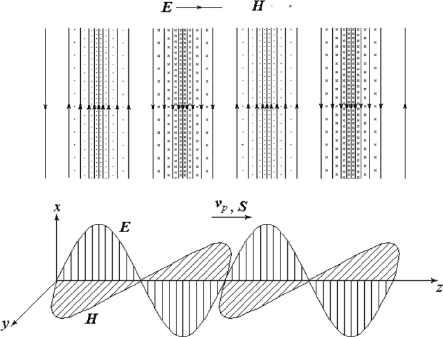
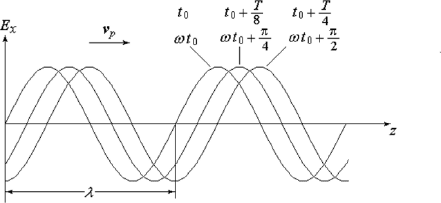
The field patterns of a linearly polarized uniform plane wave are shown
in Fig. 2.1 and a persistent traveling wave along +z is shown in Fig. 2.2.
Fields (2.18) and (2.19) are solutions of the equations (2.8) and (2.10)
containing E
x
, H
y
. This is a linear polarized uniform plane wave with the
electric field in the x direction, called a x-polarized wave. Dealing with
equations (2.7) and (2.11), we can have another linear polarized uniform
plane wave containing E
y
, H
x
. This is a linear polarized uniform plane wave
with the electric field in the y direction, called the y-polarized wave.
Note that, some authors, especially on optics, recognize the direction of
the magnetic field instead of the electric field as the direction of polarization.
2.1 Sinusoidal Uniform Plane Waves 59
Figure 2.2: Persistent traveling wave propagating along +z.
2.1.2 Uniform Plane Waves with an Arbitrary Direction
of Propagation
In the last section, we deal with the plane wave propagating along a specific
coordinate axis z. In isotropic media, the nature of a uniform plane wave is
independent of the orientation of coordinates. We would now like to reformu-
late the characteristics of a uniform plane wave with an arbitrary direction
of propagation.
Define k as the wave vector, the magnitude of which is the phase coeffi-
cient k, and the direction of which coincides with the direction of propagation
n perpendicular to the wave front:
k = kn =
ˆ
xk
x
+
ˆ
yk
y
+
ˆ
zk
z
, (2.20)
k
2
= k
2
x
+ k
2
y
+ k
2
z
. (2.21)
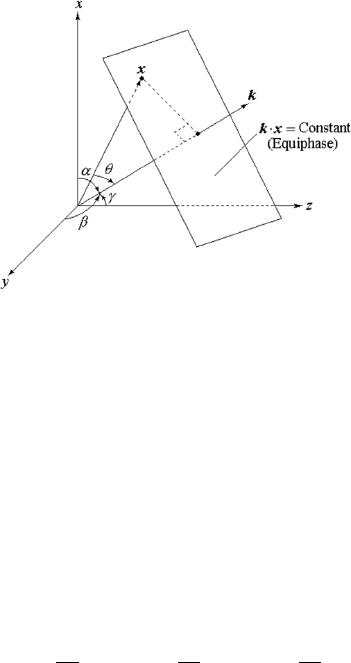
For an arbitrary point x, the equiphase plane must be the plane perpen-
dicular to k that has point x lying on it, see Fig. 2.3. The equation for the
equiphase plane is given by
ωt − k · x = ωt − k|x|cos θ = constant. (2.22)
The phase of the wave at point x can then be expressed as
k · x = k
x
x + k
y
y + k
z
z. (2.23)
The complex electric and magnetic fields of the plane wave propagating
in the +k direction can be written as
E
+
(x, t) = E
+
e
j(ωt−k·x)
, E
+
(x) = E
+
e
−jk·x
, (2.24)
H
+
(x, t) = H
+
e
j(ωt−k·x)
, H
+
(x) = H
+
e
−jk·x
, (2.25)
60 2. Introduction to Waves
Figure 2.3: Plane wave with an arbitrary direction of propagation.
where E
+
and H
+
are constant vectors in time and space, and
e
−jk·x
= e
−jk
x
x
e
−jk
y
y
e
−jk
z
z
. (2.26)
For a scalar functions ϕ = ϕ
0
e
−jk·x
, where ϕ
0
is a constant scalar, ∇ϕ
0
=
0, the operator ∇ takes the following form:
∇ϕ = ϕ
0
∇e
−jk·x
.
Applying (2.26) yields
∇e
−jk·x
=
ˆ
x
∂
∂x
e
−jk·x
+
ˆ
y
∂
∂y
e
−jk·x
+
ˆ
z
∂
∂z
e
−jk·x
= −(
ˆ
xjk
x
+
ˆ
yjk
y
+
ˆ
zjk
z
)e
−jk·x
= −jke
−jk·x
.
So we have
∇ϕ = ϕ
0
∇e
−jk·x
= −jkϕ
0
e
−jk·x
= −jkϕ. (2.27)
For a vector functions A = A
0
e
−jk·x
, where A
0
is a constant vector,
∇ · A
0
= 0, and ∇ × A
0
= 0, using (B.37) and (B.40),
∇ · A = ∇ ·
³
A
0
e
−jk·x
´
= A
0
· ∇e
−jk·x
= −jk · A. (2.28)
∇ × A = ∇ ×
³
A
0
e
−jk·x
´
= ∇e
−jk·x
× A
0
= −jk × A. (2.29)
We have just seen that for a uniform plane wave, the complex form of a
sinusoidal function is e
−jk·x
, and the nabla operator becomes
∇ = −jk. (2.30)