
Zhang K., Li D. Electromagnetic Theory for Microwaves and Optoelectronics
Подождите немного. Документ загружается.


1.4 Poynting’s Theorem 31
In conclusion, for linear, non-dispersive reciprocal media, including recip-
rocal anisotropic media and isotropic media (isotropic media are certainly
reciprocal),
E ·
∂D
∂t
=
∂
∂t
E · D
2
, (1.165)
H ·
∂B
∂t
=
∂
∂t
H · B
2
. (1.166)
Equations (1.161) and (1.162) then become
−∇ · (E × H) =
∂
∂t
E · D
2
+
∂
∂t
H · B
2
+ σE
2
+ E · J + H · J
m
, (1.167)
−
I
S
(E×H)·dS =
Z
V
µ
∂
∂t
E ·D
2
+
∂
∂t
H·B
2
+ σE
2
+ E ·J +H·J
m

dV. (1.168)
In the above two equations, at first, we are familiar with the third term
in the right-hand side, which represents the volume density of Joule’s power
loss or conducting dissipation, caused by the conduction electric current,
p
d
= σE
2
. (1.169)
This is just the joule’s Law in derivative form, which can be derived from the
circuit theory.
The fourth and the fifth terms
p
s
= E · J , p
sm
= H · J
m
(1.170)
are the volume densities of power dissipation caused by the electric current
other than conduction current and the equivalent magnetic current, respec-
tively, for positive values. Their negative values represent the volume densi-
ties of energy produced by the currents, which means the J and E or J
m
and H have the components in the opposite direction, i.e., the angle between
vectors J and E or J
m
and H is larger than π/2. The effect of such a
current represents a power source.
For isotropic, non-dispersive media, D = ²E, B = µH, the factors in
expressions (1.165) and (1.166) become
w
e
=
E · D
2
=
²E
2
2
, w
m
=
H · B
2
=
µH
2
2
. (1.171)
They represent the instantaneous volume densities of energy stored in the
electric and the magnetic fields, respectively, which are the same as the ex-
pressions for the density of energy stored in a static electric field and in a
stationary magnetic field, respectively.
For reciprocal anisotropic media, the instantaneous volume densities of
stored energy remain in the earlier form:

32 1. Basic Electromagnetic Theory
w
e
=
E · D
2
, w
m
=
H · B
2
. (1.172)
Investigating Poynting’s equation (1.168), we see that its right-hand side
represents the power dissipation and the rate of increase of the energy stored
in the volume. According to the law of conservation of energy, there must be
net energy flowing into the volume through the closed surface S. The left-
hand side of (1.168) must then represent this power flow. We interpret the
vector E ×H as the surface density of the power flow of the electromagnetic
fields,
S = E × H. (1.173)
Vector S gives the magnitude and direction of the power flow per unit area
at any point in space and is called the Poynting vector. Nevertheless, this
interpretation is a matter of convenience and does not follow directly from
Poynting’s theorem, which gives only the total power flow throughout the
whole closed surface. However, we never get results that disagree with ex-
periments if we assume that the Poynting vector S is the surface density of
the power flow at a point.
Then equations (1.167) and (1.168), i.e., the law of energy conservation
for electromagnetic fields, may be rewritten as follows:
−∇ · S =
∂w
e
∂t
+
∂w
m
∂t
+ p
d
+ p
s
+ p
sm
, (1.174)
−
I
S
S · dS =
Z
V
µ
∂w
e
∂t
+
∂w
m
∂t
+ p
d
+ p
s
+ p
sm

dV. (1.175)
1.4.2 Frequency-Domain Poynting Theorem
For steady-state sinusoidal time-varying fields, Poynting’s theorem in com-
plex form, or the so-called frequency-domain Poynting theorem, may be de-
rived from Maxwell’s equations in complex form, (1.111)–(1.114).
In circuit theory, for sinusoidal time-varying state, the time average power
delivered to a circuit element with a voltage v(t) = =(
√
2V e
jωt
) across its
terminals and a current i(t) = =(
√
2Ie
jωt
) into the terminals is
P = v(t)i(t)=
1
T
Z
T
0
v(t)i(t)dt =
1
T
Z
T
0
=(
√
2V e
jωt
)=(
√
2Ie
jωt
)dt.
Using the formulas for complex functions
<(A) =
1
2
(A + A
∗
), =(A) =
1
2j
(A − A
∗
),
the time average power becomes
P =
2
T
Z
T
0
1
2j
(V e
jωt
− V
∗
e
−jωt
)
1
2j
(Ie
jωt
− I
∗
e
−jωt
))dt

1.4 Poynting’s Theorem 33
=
2
T
Z
T
0
1
4
(V I
∗
+ V
∗
I)dt −
2
T
Z
T
0
1
4
(V Ie
j2ωt
+ V
∗
I
∗
e
−j2ωt
)dt
=
1
2
(V I
∗
+ V
∗
I) − 0 =
1
2
[V I
∗
+ (V I
∗
)
∗
] = <[V I
∗
],
where V and I are the complex effective value of the voltage and the current,
respectively, and I
∗
is the complex conjugate of I.
If we use complex amplitude value V
m
=
√
2V and I
m
=
√
2I instead of
effective value V and I, the time average p ower becomes
P = v(t)i(t) = <
·
1
2
V
m
I
∗
m
¸
, where
˙
P = V I
∗
=
1
2
V
m
I
∗
m
= P + jQ
denotes the complex p ower,
P is the time average power or active power and
Q denotes the reactive power.
Similar to the definition of complex power in circuit theory, define a com-
plex power flow density, i.e., complex Poynting vector:
˙
S =
1
2
E × H
∗
= S + j q, (1.176)
where E and H are complex vectors in amplitude value (but not effect value
as usually used in circuit theory), H
∗
is the complex conjugate of H. The
real part of the complex Poynting vector
S denotes the time-average power
flow density or the active component of the complex power flow density, and
the imaginary part
q denotes the reactive component of the complex power
flow density.
Rewrite the complex Maxwell equation (1.111) and write the complex
conjugate of (1.112):
∇ × E = −j ωB − J
m
, (1.177)
∇ × H
∗
= −j ωD
∗
+ σE
∗
+ J
∗
. (1.178)
Substituting them into the vector identity (B.38), we obtain
−∇·
˙
S = −∇ ·
³
1
2
E × H
∗
´
=
1
2
H
∗
· (∇ × E) −
1
2
E · (∇ × H
∗
)
= j2ω
µ
H
∗
·B
4
−
E·D
∗
4

+ σ
E·E
∗
2
+
E·J
∗
2
+
H
∗
·J
m
2
. (1.179)
Integrating the above expression over the volume V and applying the diver-
gence theorem gives
−
I
S
˙
S·dS = −
I
S
³
1
2
E × H
∗
´
· dS
=
Z
V
·
j2ω
µ
H
∗
·B
4
−
E·D
∗
4

+ σ
E·E
∗
2
+
E·J
∗
2
+
H
∗
·J
m
2
¸
dV. (1.180)
34 1. Basic Electromagnetic Theory
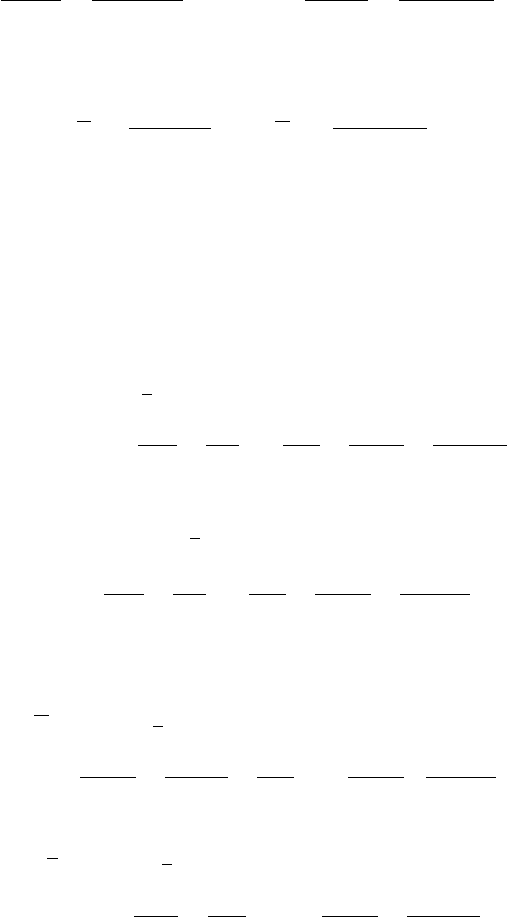
This is the frequency-domain or complex Poynting theorem for non-
dispersive isotropic and anisotropic media. In this equation, 2ω is the angular
frequency of the alternative energy. The complex energy densities stored in
the electric and magnetic fields are identified as
˙w
e
=
E · D
∗
4
=
E ·
˙
²
∗
· E
∗
4
, ˙w
m
=
H
∗
· B
4
=
H
∗
·
˙
µ · H
4
(1.181)
where
˙
² and
˙
µ are complex tensors independent of frequency. For lossless
media, ² and µ become real tensors and (1.181) become average energy den-
sities:
w
e
=
E · ² · E
∗
4
,
w
m
=
H
∗
· µ · H
4
(1.182)
For isotropic, non-dispersive medium, the permittivity and permeability
become complex scalars:
D = ˙²E, D
∗
= ˙²
∗
E
∗
, B = ˙µH,
˙² = ²
0
− j ²
00
, ˙²
∗
= ²
0
+ j ²
00
, ˙µ = µ
0
− j µ
00
.
For non-dispersive media, ²
0
, ²
00
, µ
0
, and µ
00
are constants with respect to the
frequency ω. Then (1.179) and (1.180) become
−∇ ·
˙
S = −∇ ·
³
1
2
E × H
∗
´
= j 2 ω
µ
˙µH
2
4
−
˙²E
2
4

+
σE
2
2
+
E · J
∗
2
+
H
∗
· J
m
2
, (1.183)
−
I
S
˙
S · dS = −
I
S
³
1
2
E × H
∗
´
· dS
=
Z
V
·
j2ω
µ
˙µH
2
4
−
˙²E
2
4

+
σE
2
2
+
E · J
∗
2
+
H
∗
· J
m
2
¸
dV. (1.184)
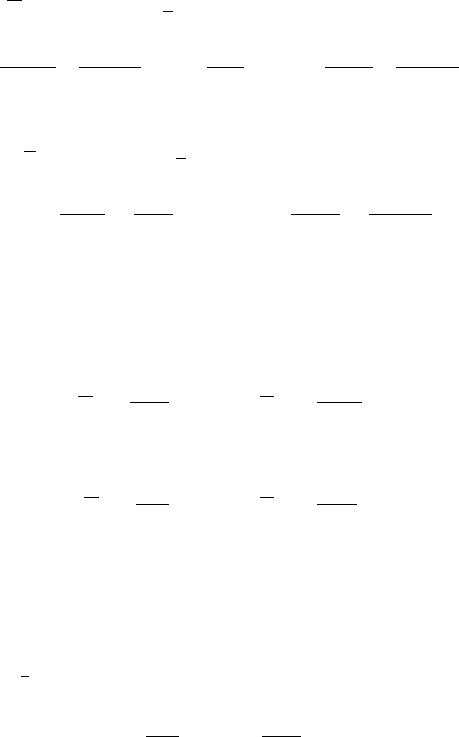
Equations (1.183) and (1.184) may be separated into real and imaginary
parts:
−∇ ·
S = −∇ · <
³
1
2
E × H
∗
´
=
ω²
00
E
2
2
+
ωµ
00
H
2
2
+
σE
2
2
+ <
µ
E · J
∗
2
+
H
∗
· J
m
2

, (1.185)
−∇ ·
q = −∇ · =
³
1
2
E × H
∗
´
= 2 ω
µ
µ
0
H
2
4
−
²
0
E
2
4

+ =
µ
E · J
∗
2
+
H
∗
· J
m
2

, (1.186)
1.4 Poynting’s Theorem 35
−
I
S
S · dS = −
I
S
<
³
1
2
E × H
∗
´
· dS
=
Z
V
µ
ω²
00
E
2
2
+
ωµ
00
H
2
2

dV+
Z
V
σE
2
2
dV+<
Z
V
µ
E·J
∗
2
+
H
∗
·J
m
2

dV,(1.187)
−
I
S
q · dS = −
I
S
=
³
1
2
E × H
∗
´
· dS
= 2ω
Z
V
µ
µ
0
H
2
4
−
²
0
E
2
4

dV + =
Z
V
µ
E·J
∗
2
+
H
∗
·J
m
2

dV, (1.188)
where σE
2
/2 is the Joule power loss density, ω²
00
E
2
/2 is the polarization
damping loss density, and ωµ
00
H
2
/2 is the magnetization damping loss den-
sity. All of them are time-average values.
The time-average energy densities stored in the electric and magnetic
fields are
w
e
=
²
0
E
2
4
,
w
m
=
µ
0
H
2
4
. (1.189)
For lossless media, ²
00
= 0, µ
00
= 0, and ² = ²
0
, µ = µ
0
, then we have
w
e
=
²E
2
4
,
w
m
=
µH
2
4
. (1.190)
Equations (1.187) and (1.188) describe the power equilibrium conditions
in sinusoidal time-varying electromagnetic fields. We investigate the exam-
ple of an existing electromagnetic field in a source-free volume filled with a
lossless medium and bounded by a perfectly conducting wall. We know that
J = 0, J
m
= 0, σ = 0, ²
00
= 0 and µ
00
= 0, and on the boundary, E
t
|
S
= 0,
so that
˙
S|
S
=
1
2
E × H
∗
|
S
= 0. Equations (1.187) and (1.188) become
Z
V
²E
2
4
dV =
Z
V
µH
2
4
dV.
The time-average energy stored in the electric field is equal to that stored
in the magnetic field within a closed adiabatic volume. This is the natural
oscillating condition of a resonator. So any closed adiabatic volume forms an
electromagnetic cavity resonator.
1.4.3 Poynting’s Theorem for Dispersive Media
Poynting’s theorem as derived in the previous subsection is suitable for non-
dispersive media only, where constitutional parameters are scalars or tensors,
independent of frequency. In this subsection, expressions for the energy den-
sities for dispersive, isotropic media and for dispersive, reciprocal, anisotropic
media will be given.

36 1. Basic Electromagnetic Theory
(1) Energy Densities in Lossless, Dispersive, Isotropic Media
The average energy density stored in the fields in dispersive media is obtained
as follows [78]. It has been shown in Sects. 1.1.2 that for dispersive media the
constitutive parameters depend upon not only the instantaneous values but
also the derivatives of fields with respect to time. For time-harmonic fields,
the constitutive parameters are functions of frequency . In dispersive media,
relations (1.165) and (1.166) and the expressions for the energy densities
(1.171), (1.181), (1.189) and( 1.190) are no longer valid. We must go back to
(1.161) and (1.162), in which
∂w
e
∂t
= E ·
∂D
∂t
,
∂w
m
∂t
= H ·
∂B
∂t
. (1.191)
We see that, in general, the rate of change of the electric energy density is
equal to the scalar product of the electric field and the displacement current
density and the rate of change of the magnetic energy density is equal to the
scalar product of the magnetic field and the displacement magnetic current
density. The energy densities become
w
e
(t) =
Z
E ·
∂D
∂t
dt + C
e
, w
m
(t) =
Z
H ·
∂B
∂t
dt + C
m
, (1.192)
where C
e
and C
m
are integration constants whose values depend on how the
fields are established. This means that the instantaneous energy density in
a dispersive medium are not fully determined by means of the instantaneous
value of the field. We assume that the wave is quasi-monochromatic, then for
t → −∞ we have E(−∞) = 0, w
e
(−∞) = 0, and hence C
e
= 0. In a similar
way the integration constant for magnetic energy is also shown to be zero.
That is, for a quasi-monochromatic wave that starts with a value of zero in
the remote past and builds up gradually, the integration constants are zero
and w
e
(t) and w
m
(t) are fully determined.
First we deal with the electric energy in a lossless, electric-dispersive
medium, and assume that the time dependence of the electric field has the
form of a slowly modulated high-frequency function of time:
E(t) = E sin ∆ωt sin ωt =
1
2
E[cos(ω − ∆ω)t − cos(ω + ∆ω)t], (1.193)
where E is a constant vector that denotes the peak value of the modulated
wave, and the modulation frequency ∆ω is sufficiently small compared to the
carrier frequency ω. Thus E(t) has the form of a high-frequency carrier sin ωt
whose modulation envelope sin ∆ωt varies slowly with time. The electric
induction or electric displacement vector is then given by
D(t) = ²(ω)E(t)
=
1
2
E[²
(ω −∆ω)
cos(ω − ∆ω)t − ²
(ω +∆ω)
cos(ω + ∆ω)t], (1.194)

1.4 Poynting’s Theorem 37
and the resulting displacement current density is
∂D(t)
∂t
= −
1
2
E[(ω − ∆ω)²
(ω −∆ω)
sin(ω − ∆ω)t
− (ω + ∆ω)²
(ω +∆ω)
sin(ω + ∆ω)t]. (1.195)
In the above expression, we suppose that the permittivity is a constant or
slow-varying function with respect to time, so that the derivative of the per-
mittivity with respect to time can be neglected.
The Taylor series expansion of function f(ω ± ∆ω) at ω is given by
f(ω ± ∆ω) = f(ω) ±
df(ω)
dω
∆ω ∓ ···.
Then we get the approximate expressions
(ω + ∆ω) ²
(ω +∆ω)
≈ ω² +
∂ω²
∂ω
∆ω, (1.196)
(ω − ∆ω) ²
(ω −∆ω)
≈ ω² −
∂ω²
∂ω
∆ω. (1.197)
Substituting them into (1.195), we have
∂D(t)
∂t
= E
·
ω² sin(∆ωt) cos(ωt) +
∂ω²
∂ω
∆ω cos(∆ωt) sin(ωt)
¸
. (1.198)
According to (1.192), the energy density gained during the time interval
from t
0
to t is given by
w
e
(t) − w
e
(t
0
) =
Z
t
t
0
E(t) ·
∂D(t)
∂t
dt.
From (1.193) it is evident that E(0) = 0, and the time required for E(t) to
build up from zero to its maximum value is ∆ωt = π/2 or t = π/2∆ω. The
energy density gained during the time interval from t
0
= 0 to t = π/2∆ω is
given by
w
e
=
Z
π/ 2∆ ω
0
E(t) ·
∂D(t)
∂t
dt. (1.199)
Substituting (1.193) and (1.198) into (1.199), we have
w
e
= E ·E ω²
Z
π/ 2∆ ω
0
sin
2
(∆ωt) sin(ωt) cos(ωt)dt
+ E · E ∆ω
∂ω²
∂ω
Z
π/ 2∆ ω
0
sin
2
(ωt) sin(∆ωt) cos(∆ωt)dt. (1.200)
38 1. Basic Electromagnetic Theory
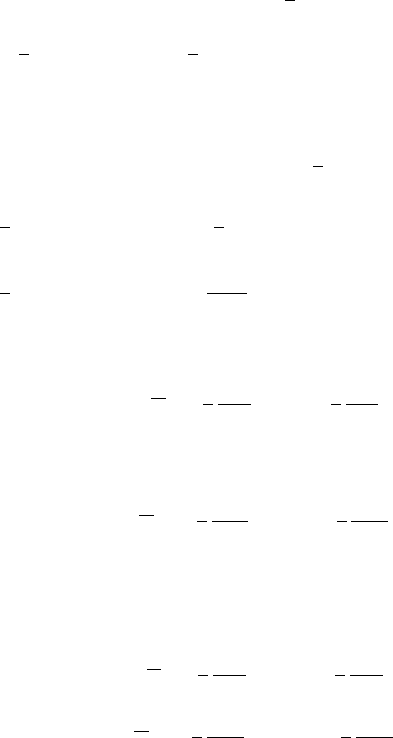
Under the condition that ∆ω ¿ ω, the first integral on the right-hand side
is negligibly small,
Z
sin
2
(∆ωt) sin(ωt) cos(ωt)dt =
1
4
Z
sin(2ωt)(1 − cos 2∆ωt) dt
=
1
4
½
Z
sin 2 (ωt) dt−
1
2
Z
[sin 2 (ω+∆ω)t+sin 2 (ω−∆ω)t] dt
¾
≈ 0,
and the second integral may approximately be
Z
π/ 2∆ ω
0
sin
2
(ωt) sin(∆ωt) cos(∆ωt) dt =
1
4
Z
π/ 2∆ ω
0
sin(2∆ωt) (1−cos 2ωt) dt
=
1
4
(
Z
π/ 2∆ ω
0
sin(2∆ωt) dt−
1
2
Z
π/ 2∆ ω
0
[sin 2 (ω+∆ω)t−sin 2 (ω−∆ω)t] dt
)
≈
1
4
Z
π/ 2∆ ω
0
sin(2∆ωt) dt =
1
4∆ω
.
Substituting them into (1.200) we have the time-average electric energy den-
sity
w
e
=
1
4
∂ω²
∂ω
E · E =
1
4
∂ω²
∂ω
E
2
. (1.201)
Similarly, the time-average magnetic energy density in lossless, magnetic-
dispersive medium is given by
w
m
=
1
4
∂ωµ
∂ω
H · H =
1
4
∂ωµ
∂ω
H
2
. (1.202)
If we take the complex forms of the fields E(t) = =[
˙
E sin ∆ωt e
jωt
], H(t) =
=[
˙
H sin ∆ωt e
jωt
] instead of (1.193), then the time-average electric energy
density and magnetic energy density in lossless, dispersive media becomes
w
e
=
1
4
∂ω²
∂ω
˙
E ·
˙
E
∗
=
1
4
∂ω²
∂ω
E
2
, (1.203)
w
m
=
1
4
∂ωµ
∂ω
˙
H ·
˙
H
∗
=
1
4
∂ωµ
∂ω
H
2
. (1.204)
(2) Energy Densities in Lossless, Dispersive, Reciprocal,
Anisotropic Media
In dispersive, anisotropic media the permittivity or permeability becomes a
frequency-dependent tensor. We investigate the relation between the energy
and field with a small perturbation in frequency and try to find the pertur-
bation formulation of Poynting’s theorem [38, 78].
We deal with a nonconducting, dispersive, reciprocal, anisotropic medium
with negligibly small p olarization and magnetization loss, which means ²(ω)

1.4 Poynting’s Theorem 39
and µ(ω) are real symmetrical tensors. Suppose there is a small current drive
δJ introduced into an originally source-free field E, H. The current drive
corresponds to perturbations in the field, δE, δH, with complex frequency
deviation
˙
δω. The perturbation formulation of Poynting’s theorem is given
by
− ∇ ·
1
2
(E
∗
× δH + δE × H
∗
)
=
1
2
[E
∗
·(∇×δH)−δH·(∇×E
∗
)−H
∗
·(∇×δE)+δE·(∇×H
∗
)]. (1.205)
The original fields E and H satisfy the source-free Maxwell equations
because J = 0:
∇ × E = −j ωµ · H, ∇ × H = j ω² · E, (1.206)
∇ × E
∗
= j ωµ · H
∗
, ∇×H
∗
= −j ω² · E
∗
, (1.207)
where ² and µ are functions of frequency, i.e., ²(ω) and µ(ω).
The above equations are perturbed with δJ at a frequency ω +
˙
δω, where
˙
δω is complex, so that the time dependence of the field becomes
exp[j (ω +
˙
δω)t] = exp[−(=δω)t] exp[j (ω + <δω)t], (1.208)
corresponding to a rate of exponential build up of the field. The equations
(1.206) perturbed to the first order (E → E + δE, H → H + δH) are
∇ × δE = δ(∇×E) = −jδ(ωµ · H) = −jωµ · δH − jδ(ωµ) · H, (1.209)
∇×δH = δ(∇×H) = jδ(ω² ·E) + δJ = jω² ·δE + jδ(ω²) ·E + δJ. (1.210)
Substituting (1.207), (1.209), and (1.210) into (1.205), yields
−∇ ·
1
2
(E
∗
× δH + δE ×H
∗
)=
1
2
[E
∗
·jω² · δE + E
∗
·jδ(ω²) · E + E
∗
·δJ
−δH·j ωµ · H
∗
+H
∗
·jωµ · δH +H
∗
·jδ(ωµ) · H − δE ·j ω² · E
∗
].
Using the tensor identities (E.44)
A · a · B = B · a
T
· A,
and noting that for lossless reciprocal anisotropic media the constitutional
tensors are real symmetrical matrices and the transposed matrices are equal
to the original matrices, we have
−∇ ·
1
2
(E
∗
× δH + δE × H
∗
)
= j
1
2
[E
∗
· δ(ω²) · E + H
∗
· δ(ωµ) · H] +
E
∗
· δJ
2
. (1.211)

40 1. Basic Electromagnetic Theory
The deviations δ(ω²) and δ(ωµ) are
δ(ω²) = δω
∂(ω²)
∂ω
, δ(ωµ) = δω
∂(ωµ)
∂ω
.
Equation (1.211) becomes
−∇ ·
1
2
(E
∗
× δH + δE × H
∗
)
= j (2δω)
·
1
4
E
∗
·
∂(ω²)
∂ω
· E +
1
4
H
∗
·
∂(ωµ)
∂ω
· H
¸
+
E
∗
· δJ
2
. (1.212)
In the above expression
E
∗
· δJ
2
is the power per unit volume dissipated or supplied by the current perturba-
tion δJ, and
1
2
(E
∗
× δH + δE × H
∗
)
is identified as the perturbation of the Poynting vector caused by δJ .
The energy is quadratic in the field amplitudes, so, for the time-
dependence of field, exp[ −=(δω)t ], the growth of the energy must be with
the time dep endence exp[ −2=(δω)t ]. The growth rate of the energy is equiv-
alent to multiplication by =(2δω). Hence, the remaining term in (1.212) is
identified as the time-average energy density stored in the field,
w =
·
1
4
E
∗
·
∂(ω²)
∂ω
· E +
1
4
H
∗
·
∂(ωµ)
∂ω
· H
¸
,
and we have the average electric and magnetic energy densities in lossless
dispersive reciprocal anisotropic media:
w
e
=
1
4
E
∗
·
∂(ω²)
∂ω
· E, w
m
=
1
4
H
∗
·
∂(ωµ)
∂ω
· H, (1.213)
where ²(ω) and µ(ω) are real symmetrical tensor functions of ω.
For dispersive isotropic media, tensor functions ²(ω) and µ(ω) reduce to
scalar functions ²(ω) and µ(ω), and (1.213) reduces to (1.203) and (1.204),
w
e
=
1
4
∂ω²
∂ω
E
2
, w
m
=
1
4
∂ωµ
∂ω
H
2
.
For non-dispersive anisotropic media, tensors ² and µ are independent of
frequency, so that (1.213) reduces to (1.182),
w
e
=
E · ² · E
∗
4
,
w
m
=
H
∗
· µ · H
4
.
Finally, for non-dispersive isotropic media, tensors ² and µ become scalars ²
and µ, then (1.213) and (1.203), (1.204) reduces to (1.190),
w
e
=
²E
2
4
,
w
m
=
µH
2
4
.