
Zhang K., Li D. Electromagnetic Theory for Microwaves and Optoelectronics
Подождите немного. Документ загружается.

1.5 Scalar and Vector Potentials 41
1.5 Scalar and Vector Potentials
Since the current density vector and charge density enter into the inhomo-
geneous wave equations in a rather complicated way, it is difficult to solve
the inhomogeneous vector wave equations (1.128) and (1.129) directly. For
this purpose, the integration of these equations is usually performed by the
introduction of auxiliary potential functions that serve to simplify the math-
ematical analysis. The first auxiliary potential functions we will consider are
the scalar and vector potentials or the so-called retarding potentials.
1.5.1 Retarding Potentials, d’Alembert’s Equations
We mention that the magnetic induction B is a solenoidal vector function,
∇ · B = 0 everywhere. In vector analysis, we know that the vector function
formed by the curl of a vector function is a solenoidal vector function, ∇ ·
∇ × A = 0, and hence we may take
B = ∇ × A. (1.214)
Substituting (1.214) into the curl equation for the electric field, (1.25), we
obtain
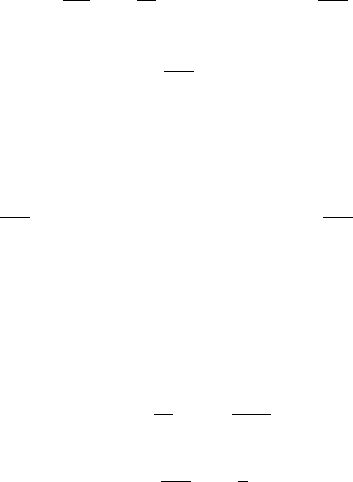
∇ × E = −
∂B
∂t
= −
∂
∂t
(∇ × A) = −∇ ×
∂A
∂t
, (1.215)
and hence
∇ ×
µ
E +
∂A
∂t

= 0. (1.216)
We see that the function E + ∂A/∂t is an irrotational vector function, and
we know that a vector function formed by the gradient of a scalar function
is an irrotational vector function, ∇ × ∇ϕ = 0, and hence we may take
E +
∂A
∂t
= −∇ϕ, or E = −∇ϕ −
∂A
∂t
, (1.217)
where A(x, t) denotes the vector potential function and ϕ(x, t) denotes the
scalar potential function.
Substituting (1.214) and (1.217) into Maxwell’s equations, (1.36) and
(1.37), and assuming σ = 0, we obtain the differential equations for A and
ϕ in vacuum or nonconducting simple media:
∇ × ∇ × A = −µ²
µ
∂
∂t
∇ϕ +
∂
2
A
∂t
2

+ µJ , (1.218)
∇
2
ϕ + ∇ ·
∂A
∂t
= −
%
²
. (1.219)
Use vector identity (B.45) to give
∇ × ∇ × A = ∇(∇ · A) − ∇
2
A,
42 1. Basic Electromagnetic Theory
and note that the time derivative and the space derivative are independent
of each other,
∇ ·
∂A
∂t
=
∂
∂t
∇ · A,
∂
∂t
∇ϕ = ∇
∂ϕ
∂t
.
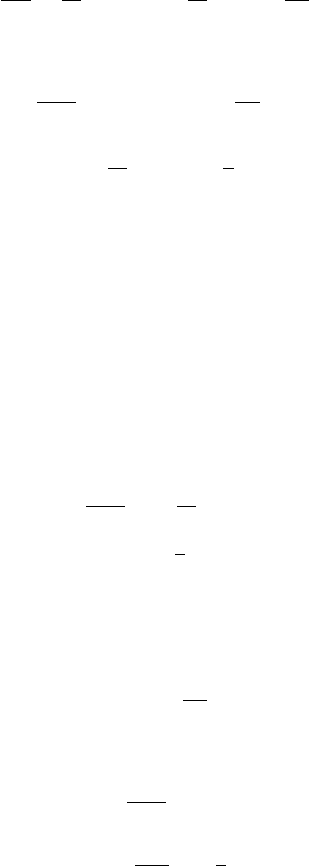
Then (1.218) and (1.219) become
∇
2
A − µ²
∂
2
A
∂t
2
= ∇
µ
∇ · A + µ²
∂ϕ
∂t

− µJ , (1.220)
∇
2
ϕ +
∂
∂t
∇ · A = −
%
²
. (1.221)
According to Helmholtz’s theorem, we know that a vector function is
completely specified by its divergence and curl. Since (1.214) gives only the
curl of A, we may specify the divergence of A in any way we choose. The
choices are called gauges. The differential equations as well as the physical
meaning of A and ϕ depend upon the gauge chosen.
(1) The Coulomb Gauge
Choose
∇ · A = 0. (1.222)
This choice is known as the Coulomb gauge, then (1.220) and (1.221) reduce
to
∇
2
A − µ²
∂
2
A
∂t
2
= µ²
∂
∂t
∇ϕ − µJ , (1.223)
∇
2
ϕ = −
%
²
. (1.224)
(2) The Lorentz Gauge
We may choose the divergence of A in another way:
∇ · A = −µ²
∂ϕ
∂t
. (1.225)
This choice is known as the Lorentz gauge and (1.220) and (1.221) reduce to
∇
2
A − µ²
∂
2
A
∂t
2
= −µJ , (1.226)
∇
2
ϕ − µ²
∂
2
ϕ
∂t
2
= −
%
²
. (1.227)
Under the Lorentz gauge, the equations for A and ϕ are of the same kind
and are independent of each other. J is the source of A and % is the source
of ϕ. Nevertheless, A and ϕ themselves are not independent of each other,
they are related to each other through the Lorentz condition (1.225).

1.5 Scalar and Vector Potentials 43
Equations (1.226) and (1.227) are known as d’Alembert’s equations. They
are inhomogeneous wave equations. The solutions of both equations are
waves. Substituting A and ϕ into (1.214) and (1.217), we may have E and
H. This is the basic method for the investigation of radiation problems.
In fact, with the Lorentz gauge we can obtain all of the components of
the electric and magnetic fields from A alone. By using the Lorentz gauge
(1.225) in (1.217), we obtain
E =
1
µ²
Z
∇(∇ · A)dt −
∂A
∂t
. (1.228)
Under the Coulomb gauge, the equation of the scalar potential ϕ, (1.224),
is Poisson’s equation, which is the same as in the static field. The solution of
Poisson’s equation ϕ is determined by the present distribution of the source
%. Does it violate the regulation of wave propagation with finite velocity
for the time-varying fields? In fact, the time-varying electric field (1.217)
consists of two parts, −∇ϕ and −∂A/∂t. Under the Coulomb gauge, the
first part −∇ϕ represents the electric field formed by the static source with
the present distribution an is called the Coulomb field. The second part
−∂A/∂t is the induction field. Both parts together represent the actual
field, which propagates with a finite velocity.
It can be seen that the physical meanings of A and ϕ under different
gauges are different.
1.5.2 Solution of d’Alembert’s Equations
In simple media, d’Alembert’s equations are linear differential equations; the
superposition principle is suitable for them. We may find the point-source
solution first, and the solution of an arbitrary source distribution can be found
by the superposition or integration of the point-source solution. Suppose a
point charge q(t) is placed at the origin of the coordinates. The charge density
is a δ function, %(x, t) = q(t)δ(x). Then the equation for ϕ, (1.227), become
∇
2
ϕ − µ²
∂
2
ϕ
∂t
2
= −
q(t)δ(x)
²
. (1.229)
The field excited by a point charge at the origin must be spherically
symmetrical, and (1.229) becomes one-dimensional spherical coordinate form,
1
r
2
∂
∂r
µ
r
2
∂ϕ
∂r

− µ²
∂
2
ϕ
∂t
2
= −
q(t)δ(x)
²
. (1.230)
This equation reduces to the following homogeneous equation except at the
origin:
1
r
2
∂
∂r
µ
r
2
∂ϕ
∂r

− µ²
∂
2
ϕ
∂t
2
= 0, r 6= 0. (1.231)
44 1. Basic Electromagnetic Theory
Let u(r, t) = rϕ(r, t), and substitute it into (1.231), to give
∂
2
u
∂r
2
= µ²
∂
2
u
∂t
2
. (1.232)
This is a one-dimensional homogeneous wave equation which we have seen
in (1.141). The solution was obtained as (1.149):
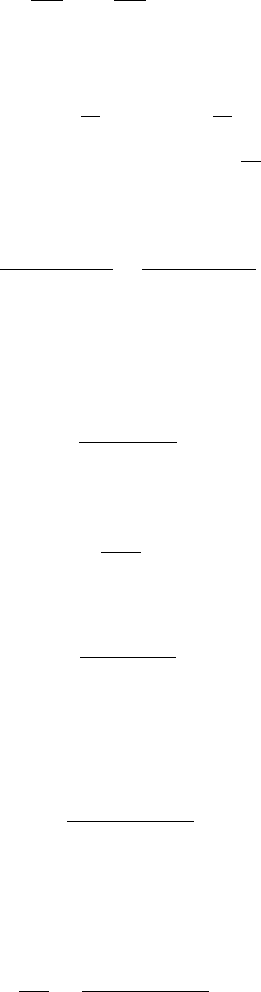
u(r, t) = Af
³
t −
r
v
p
´
+ Bf
³
t +
r
v
p
´
, (1.233)
where f represents an arbitrary function and v
p
= 1/
√
µ².
So, the solution of the one-dimensional spherical coordinate homogeneous
wave equation (1.231) is
ϕ(r, t) =
Af(t − r/v
p
)
r
+
Bf (t + r/v
p
)
r
. (1.234)
The solution includes two spherical waves propagating along +r (outward)
and −r (inward), respectively.
Since the solution of (1.230) is a wave excited by the point charge at the
origin, it must be an outward wave and the second term of (1.234) must be
zero:
ϕ(r, t) =
f(t − r/v
p
)
r
. (1.235)
In the static state, ∂/∂t → 0, the wave equation (1.229) reduces to Poisson’s
equation; the solution (1.235) must reduce to
ϕ(r) =
q
4π²r
. (1.236)
We have enough ground to suppose that the solution (1.235) must be in the
following form:
ϕ(r, t) =
q(t − r/v
p
)
4π²r
. (1.237)
This solution can be proven by substituting it into the left-hand side of (1.229)
and taking the volume integral inside a small sphere around the origin.
For a point charge located at an arbitrary point x
0
, ρ(x, t) = q(t)δ(x−x
0
),
the solution (1.237) becomes
ϕ(x, t) =
q(x
0
, t − r/v
p
)
4π²r
, (1.238)
where r(x, x
0
) denotes the distance between the source point x
0
and the field
point x, r = |x − x
0
|.
For an arbitrary volume charge distribution %(x
0
, t), according to the
principle of superposition we have
ϕ(x, t) =
1
4π²
Z
V
%(x
0
, t − r/v
p
)
r
dV
0
. (1.239)
1.5 Scalar and Vector Potentials 45
The solution of (1.226) excited by an arbitrary volume current J (x
0
, t) is
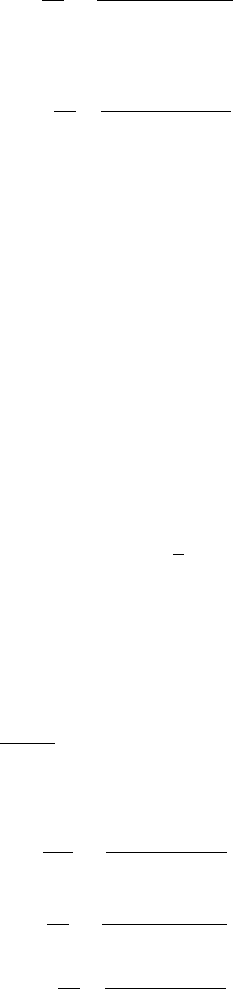
A(x, t) =
µ
4π
Z
V
J (x
0
, t − r/v
p
)
r
dV
0
, (1.240)
and that excited by an arbitrary line current I(x
0
, t) is
A(x, t) =
µ
4π
Z
l
I(x
0
, t − r/v
p
)
r
dl
0
. (1.241)
The solutions ϕ(x, t) and A(x, t) are known as the retarding potentials.
1.5.3 Complex d’Alembert Equations
For steady-state sinusoidal sources,
%(x
0
, t) = =[ρ(x
0
)e
j ωt
], J (x
0
, t) = =[J(x
0
)e
j ωt
],
the potentials may also be written in complex form,
ϕ(x, t) = =[ϕ(x)e
j ωt
], A(x, t) = =[A(x)e
j ωt
].
D’Alembert’s equations (1.226) and (1.227) become the following inho-
mogeneous Helmholtz equations,
∇
2
A + k
2
A = −µJ , (1.242)
∇
2
ϕ + k
2
ϕ = −
ρ
²
. (1.243)
The Lorentz gauge (1.225) becomes
∇ · A = −j ωµ²ϕ. (1.244)
The solution of (1.243) for a point charge located at x
0
is
ϕ(x, t) =
q e
−jkr
4π²r
e
jωt
, where r = |x − x
0
|. (1.245)
The sinusoidal solutions of (1.242) and (1.243) are
ϕ(x, t) =
1
4π²
Z
V
ρ(x
0
)e
j(ωt−kr)
r
dV
0
, (1.246)
A(x, t) =
µ
4π
Z
V
J(x
0
)e
j(ωt−kr)
r
dV
0
, (1.247)
A(x, t) =
µ
4π
Z
l
I(x
0
)e
j(ωt−kr)
r
dl
0
. (1.248)

46 1. Basic Electromagnetic Theory
The magnetic and electric fields are found by using (1.214) and (1.217):
H=
1
µ
∇ × A, (1.249)
E=−∇ϕ − j ωA. (1.250)
Rewrite the expression for E (1.250) by substituting the Lorentz equation
(1.244) into it:
E = −j ω
·
∇(∇ · A)
k
2
+ A
¸
. (1.251)
In a source-free region, from Maxwell’s equation (1.76),
∇ × H = j ω²E,
we have
E = −
j
ω²
∇ × H = −
j ω
k
2
∇ × ∇ × A. (1.252)
In a static or low-frequency state, ∂/∂t → 0, jω → 0, the Lorentz gauge
and the Coulomb gauge are no longer different: the solutions for A and H
become the Biot–savart law and the solutions for ϕ and E become Coulomb’s
law.
1.6 Hertz Vectors
The second auxiliary potential functions we will consider are the Hertz vectors
or polarization potentials [24, 96, 101]. It is possible under certain conditions
to define an electromagnetic field in terms of a set of vector functions named
electric Hertz vector and magnetic Hertz vector.
1.6.1 Instantaneous Hertz Vectors
The current density as the source includes an irrotational component and
a solenoidal component. We may express the irrotational component of the
current density by means of an equivalent polarization current,
J =
∂P
∂t
,
where P denotes the equivalent polarization vector. Using the equation of
continuity (1.6), we get
% = −∇ · P,
where % is the equivalent polarization charge density. Hence the d’Alembert’s
equation of vector potential A (1.226) become
∇
2
A − µ²
∂
2
A
∂t
2
= −µ
∂P
∂t
. (1.253)

1.6 Hertz Vectors 47
Define a vector function
π
e
, π
e
, called the electric Hertz vector, which
is related to A as follows:
A = µ²
∂
π
e
∂t
. (1.254)
Substituting it into (1.253) and integrating, we have the inhomogeneous wave
equation of
π
e
,
∇
2
π
e
− µ²
∂
2
π
e
∂t
2
= −
P
²
. (1.255)
Thus the electric Hertz vector
π
e
satisfies the inhomogeneous wave equation,
with the equivalent polarization vector P as its source.
Substituting (1.254) into the Lorentz equation (1.225), gives
ϕ = −∇ ·
π
e
. (1.256)
Substituting (1.254) and (1.256) into (1.217) and (1.214), we have
E = ∇(∇ ·
π
e
) − µ²
∂
2
π
e
∂t
2
, (1.257)
H = ²∇ ×
∂
π
e
∂t
. (1.258)
The electric Hertz vector
π
e
is suitable for solving problems in which the
source is an irrotational current.
Furthermore, we may express the solenoidal component of the current
density by means of an equivalent magnetization current,
J = ∇ × M,
where M denotes the equivalent magnetization vector. Then d’Alembert’s
equation (1.226) becomes
∇
2
A − µ²
∂
2
A
∂t
2
= −µ∇ × M. (1.259)
Define another vector function
π
m
, called the magnetic Hertz vector or
Fitzgerald vector, which is related to A as follows:
A = µ∇ ×
π
m
. (1.260)
Substituting it into (1.259), we have the inhomogeneous wave equation of
π
m
:
∇
2
π
m
− µ²
∂
2
π
m
∂t
2
= −M. (1.261)
We can see in (1.260) that for this choice ∇ · A = 0. From the Lorentz
condition (1.225), the time-varying component of ϕ must be zero, and as we

48 1. Basic Electromagnetic Theory
are not interested in the d-c component ϕ = 0. Substituting (1.260) into
(1.217) and (1.214), we have
E = −µ∇ ×
∂
π
m
∂t
, (1.262)
H = ∇ × ∇ ×
π
m
. (1.263)
The magnetic Hertz vector
π
m
is suitable for solving problems in which the
source is a solenoidal current.
In the general case, the source current density J includes both the irro-
tational component and the solenoidal component:
J =
∂P
∂t
+ ∇ × M. (1.264)
According to the theorem of superposition,
A = µ²
∂
π
e
∂t
+ µ∇ ×
π
m
, (1.265)
E = ∇(∇ ·
π
e
) − µ²
∂
2
π
e
∂t
2
− µ∇ ×
∂
π
m
∂t
, (1.266)
H = ∇ × ∇ ×
π
m
+ ²∇ ×
∂
π
e
∂t
. (1.267)
In the source-free region, P = 0 and M = 0, the Hertz vectors satisfy
homogeneous wave equations:
∇
2
π
e
− µ²
∂
2
π
e
∂t
2
= 0, (1.268)
∇
2
π
m
− µ²
∂
2
π
m
∂t
2
= 0. (1.269)
Applying these two equations and the vector identity (B.45), we find that
the expressions of E and H in the source-free region become
E = ∇(∇ ·
π
e
) − µ²
∂
2
π
e
∂t
2
− µ∇ ×
∂
π
m
∂t
, (1.270)
H = ∇(∇ ·
π
m
) − µ²
∂
2
π
m
∂t
2
+ ²∇ ×
∂
π
e
∂t
(1.271)
or
E = ∇ × ∇×
π
e
− µ∇ ×
∂
π
m
∂t
, (1.272)
H = ∇ × ∇ ×
π
m
+ ²∇ ×
∂
π
e
∂t
. (1.273)

1.6 Hertz Vectors 49
1.6.2 Complex Hertz Vectors
For the steady-state sinusoidal time-varying fields,
π
e
= Π
e
e
j ωt
, π
m
= Π
m
e
j ωt
,
where Π
e
and Π
m
denote the complex amplitudes of the Hertz vectors. Then
the equations (1.255) and (1.261) become
∇
2
Π
e
+ k
2
Π
e
= −
P
²
, (1.274)
∇
2
Π
m
+ k
2
Π
m
= −M. (1.275)
The expressions of the complex amplitudes of potentials and fields become
A = j ωµ² Π
e
+ µ∇ × Π
m
, (1.276)
ϕ = −∇ · Π
e
, (1.277)
E = ∇(∇ · Π
e
) − k
2
Π
e
− j ωµ∇ × Π
m
, (1.278)
H = ∇ × ∇× Π
m
+ j ω²∇ × Π
e
. (1.279)
In the source-free region, the equations of the complex amplitudes of the
Hertz vectors become Helmholtz’s equations:
∇
2
Π
e
+ k
2
Π
e
= 0, (1.280)
∇
2
Π
m
+ k
2
Π
m
= 0. (1.281)
The expressions for the fields become
E = ∇(∇ · Π
e
) + k
2
Π
e
− j ωµ∇ × Π
m
, (1.282)
H = ∇(∇ · Π
m
) + k
2
Π
m
+ j ω²∇ × Π
e
(1.283)
or
E = ∇ × ∇ × Π
e
− j ωµ∇ × Π
m
, (1.284)
H = ∇ × ∇× Π
m
+ j ω²∇ × Π
e
. (1.285)
The method for the solution of vector Helmholtz’s equations using Hertz
vector functions is given in Section 4.3.2.
50 1. Basic Electromagnetic Theory
1.7 Duality
In Section 1.1.6 we have seen that by introducing the equivalent magnetic
charge and magnetic current we convert Maxwell’s equations into dual equa-
tions [37]. The electromagnetic fields excited by an electric source and those
excited by a magnetic source are dual to each other.
∇ × E = −j ωµH ∇ × H = j ω²E
∇ × H = j ω²E + J ∇ × E = −j ωµH − J
m
∇ · ²E = ρ ∇ · µH = ρ
m
∇ · µH = 0 ∇·²E = 0
These two sets of equations take the same mathematical form. A systematic
interchange of symbols changes the first set of equations into the second set.
E → H
H → −E
J → J
m
ρ → ρ
m
µ → ²
² → µ
If we have the solutions to one problem, we can obtain the solutions to
the dual problem by means of interchange of symbols. For example, the
electromagnetic field of an a-c electric dipole and that of a small a-c current
loop are dual problems because the later can be seen as an a-c magnetic
dipole.
The boundary with a surface electric charge and current and the boundary
with a surface magnetic charge and current are dual boundary conditions.
n × (E
2
− E
1
) = 0 n × (H
2
− H
1
) = 0
n × (H
2
− H
1
) = J
s
n × (E
2
− E
1
) = −J
ms
n · (D
2
− D
1
) = ρ
s
n · (B
2
− B
1
) = ρ
ms
n · (B
2
− B
1
) = 0 n · (D
2
− D
1
) = 0
So, the short-circuit surface or electric wall and the open-circuit surface or
magnetic wall are dual boundary conditions.
short-circuit surface open-circuit surface
n × E = 0 n ×H = 0
n × H = J
s
n × E = −J
ms
n · D = ρ
s
n · B = ρ
ms
n · B = 0 n · D = 0
Note that the problems with not only dual equations but also dual boundary
conditions are dual problems. For example, an electric dipole beside a perfect
conductor surface and a magnetic dipole beside the same perfect conductor
surface are not dual problems. An electric dipole beside an electric wall
and a magnetic dipole beside a magnetic wall with the same shape are dual
problems.