
Zhang K., Li D. Electromagnetic Theory for Microwaves and Optoelectronics
Подождите немного. Документ загружается.

1.1 Maxwell’s Equations 11
Let
²
r
= I + χ
e
, ² = ²
0
²
r
= ²
0
(I + χ
e
), (1.47)
µ
r
= I + χ
m
, µ = µ
0
µ
r
= µ
0
(I + χ
m
). (1.48)
Then, the constitutive relations of linear, non-dispersive and anisotropic me-
dia become
D = ²
0
²
r
· E = ² · E, (1.49)
B = µ
0
µ
r
· H = µ · H, (1.50)
where ² is the tensor permittivity and µ is the tensor permeability, they are
constitutive tensors or matrices, their elements are constitutive parameters,
² =
²
xx
²
xy
²
xz
²
yx
²
yy
²
yz
²
zx
²
zy
²
zz
, (1.51)
µ =
µ
xx
µ
xy
µ
xz
µ
yx
µ
yy
µ
yz
µ
zx
µ
zy
µ
zz
. (1.52)
The anisotropic media characterized by symmetrical tensor permittivity
and permeability are reciprocal media, whereas the media characterized by
asymmetrical tensor permittivity and permeability are nonreciprocal media.
For lossless reciprocal media the permittivity and permeability are symmet-
rical real tensors. All isotropic media are undoubtedly recipro cal.
Detailed discussions of the reciprocal and nonreciprocal anisotropic media
and the electromagnetic fields and waves in them are given in Chapter 8.
(5) Bi-isotropic and Bi-anisotropic Media
Isotropic and anisotropic media become polarized when placed in an electric
field and become magnetized when placed in a magnetic field, without cross
coupling between the two fields. For such media, the constitutive relations
relate the two electric field vector functions or the two magnetic field vector
functions by either a scalar or a tensor. But in bi-isotropic and bi-anisotropic
media, cross coupling between the electric and magnetic fields exists. When
placed in an electric or magnetic field, a bi-isotropic or bi-anisotropic medium
becomes both polarized and magnetized [53].
The general constitutive relations of bi-anisotropic medium are given by
D = ² · E + ξ · H, (1.53)
B = ζ · E + µ · H, (1.54)
where ², ξ, ζ, and µ are all 3 × 3 matrices or tensors. Generally, some of
them are tensors and some are scalars.
12 1. Basic Electromagnetic Theory
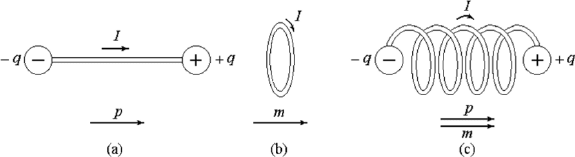
Figure 1.3: (a) Electric dipole, (b) magnetic dipole and (c) micro-helix.
If the above four tensors become scalars, the medium is bi-isotropic. The
constitutive relations of such a medium are
D = ²E + ξH, (1.55)
B = ζE + µH. (1.56)
This set of constitutive equations were conceived by Tellegen in 1948
for realizing the new circuit element, the “gyrator”, suggested by himself
[100]. He considered that the model of the medium had elements possessing
permanent electric and magnetic dipoles parallel or antiparallel to each other,
so that an applied electric field that aligns the electric dipoles simultaneously
aligns the magnetic dipoles, and an applied magnetic field that aligns the
magnetic dipoles simultaneously aligns the electric dipoles.
One of the physical models of bi-isotropic and bi-anisotropic media is the
micro-helix model. Molecules in isotropic and anisotropic media are consid-
ered to be a large amount of small electric dipoles and/or small current loops.
Molecules become aligned electric dipoles under the action of an electric field,
and become aligned molecular current loops, i.e., aligned magnetic dipoles,
under the action of a magnetic field, without cross coupling. In bi-isotropic
and bi-anisotropic media, molecules in the medium are considered to be a
large amount of conductive micro-helices shown in Fig. 1.3. Under the action
of a time-varying electric field, not only do charges of opposite signs appear
at the two ends of the helix but also, according to the continuous equation,
current arises in the helix. On the other hand, under the action of a time-
varying magnetic field, according to Lenz’s theorem, current arises in the
helix and again, according to the continuous equation, charges of opposite
signs appear at the two ends of the helix. The pair of charges at the two
ends form an electric dipole and the current in the helix forms a magnetic
dipole. In conclusion, aligned electric dipoles and magnetic dipoles appear
simultaneously under the action of an electric field or a magnetic field alone.
The medium is bi-isotropic if the above phenomena are isotropic, otherwise,
it is bi-anisotropic. This kind of media is also known as chiral media be-
cause such an object has the property of chirality or handiness and is either
right-handed or left-handed.
1.1 Maxwell’s Equations 13
The existence of bi-isotropic and bi-anisotropic media, or so-called magne-
toelectric materials, was theoretically predicted by Landau in 1957. Such ma-
terials were observed experimentally by Astrov in 1960 in anti-ferromagnetic
chromium oxide [9]. Now we know that a variety of magnetic crystal classes,
sugar arrays, amino acids, DNA, and organic polymers are among the natu-
ral chiral media, and wire helices and the M¨obius strip are considered to be
man-made chiral objects. An example of an artificial chiral medium is made
of randomly oriented and uniformly distributed lossless, small, wire helices.
1.1.3 Complex Maxwell’s Equations
The most important time-varying state of fields is the steady-state alternating
fields varying sinusoidally in time, that is, the time-harmonic fields [5, 38,
84, 96]. In linear media, the Maxwell’s equations are linear. A sinusoidal
excitation at a frequency ω produces a sinusoidal response, i.e., fields vary
sinusoidally with time. Any transient excitation and response, i.e., sources
and fields with time variations in arbitrary forms, may be considered as
a superposition of sinusoidal sources and fields of different frequencies, by
means of the method of Fourier analysis.
(1) Complex Vectors
When the time variation is harmonic, that is, the fields are in a steady si-
nusoidal state or a-c state, the mathematical analysis can be simplified by
using complex quantities or so-called phasors, which have been well devel-
oped in the analysis of a-c circuits. Suppose the circular frequency of the
time harmonic fields is ω, then the instantaneous quantity of a sinusoidal
time-dependent scalar function A(x, t) can be written as the imaginary part
of a complex scalar function or a scalar phasor as follows:
A(x, t) = A(x) sin(ωt + φ) = =
£
A(x)e
jφ
e
jωt
¤
= =
£
˙
A(x)e
jωt
¤
, (1.57)
where A(x) is the amplitude of the a-c scalar function, and
˙
A(x) = A(x)e
jφ
is called the complex amplitude or phasor of the function, which explains
the amplitude as well as the phase of the ac scalar function. The complex
amplitude A(x) is a function of the space coordinate x only and the time-
dependence is explained in terms of e
jωt
.
A sinusoidal time-dependent vector function A(x, t) may be decomposed
into three components, as shown in (1.1). Each of the components is a
sinusoidal time-dependent scalar function, and can be expressed in the form
of (1.57). So that,
A (x, t) =
ˆ
xA
x
(x, t) +
ˆ
yA
y
(x, t) +
ˆ
zA
z
(x, t)
=
ˆ
xA
x
(x) sin(ωt + φ
x
) +
ˆ
yA
y
(x) sin(ωt + φ
y
) +
ˆ
zA
z
(x) sin(ωt + φ
z
)
= =
£
ˆ
xA
x
(x)e
jφ
x
e
jωt
+
ˆ
yA
y
(x)e
jφ
y
e
jωt
+
ˆ
zA
z
(x)e
jφ
z
e
jωt
¤
= =
©£
ˆ
x
˙
A
x
(x) +
ˆ
y
˙
A
y
(x) +
ˆ
z
˙
A
z
(x)
¤
e
jωt
ª
, (1.58)

14 1. Basic Electromagnetic Theory
where
˙
A
x
(x) = A
x
(x)e
jφ
x
,
˙
A
y
(x) = A
y
(x)e
jφ
y
and
˙
A
z
(x) = A
z
(x)e
jφ
z
are
the complex scalars of three components, A
x
(x), A
y
(x) and A
z
(x) are the
amplitudes and φ
x
, φ
y
and φ
z
are the phases of the corresponding complex
scalars.
A complex vector may be constructed by three complex scalar components
as follows:
˙
A(x) =
ˆ
x
˙
A
x
(x) +
ˆ
y
˙
A
y
(x) +
ˆ
z
˙
A
z
(x) = <
£
˙
A(x)
¤
+ j=
£
˙
A(x)
¤
. (1.59)
And the instantaneous vector A(x, t) is described as
A(x, t) = =
£
˙
A(x)e
jωt
¤
= <
£
˙
A(x)
¤
sin ωt + =
£
˙
A(x)
¤
cos ωt, (1.60)
where
˙
A(x) denotes a vector phasor or a complex vector of the field, which
is a vector function of x and is independent of t.
In the remainder of this book, we omit the dot on the expressions for
phasors except in some necessary cases. The physical field is always obtained
by multiplying by a factor e
jωt
and taking the imaginary part. Note that
some authors use e
−jωt
instead of e
jωt
, and some authors take the real part
instead of the imaginary part. These differences will change the signs in some
equations but will not affect the physical field.
(2) Maxwell’s Equations in Complex Form
The partial derivative of the sinusoidal field with resp ect to time can b e
expressed as follows,
∂
∂t
A(x, t) = =
·
A(x)
∂
∂t
e
jωt
¸
= =
£
j ωA(x)e
jωt
¤
. (1.61)
Thus Maxwell’s equations (1.25)–(1.28) can b e changed into complex form
by replacing ∂/∂t with j ω:
I
l
E · dl = −j ω
Z
S
B · dS, ∇ × E = −j ωB, (1.62)
I
l
H · dl = j ω
Z
S
D · dS +
Z
S
J · dS, ∇ × H = j ωD + J , (1.63)
I
S
D · dS =
Z
V
ρdV, ∇ · D = ρ, (1.64)
I
S
B · dS = 0, ∇ · B = 0. (1.65)
These are Maxwell’s equations in complex form or the so-called frequency-
domain Maxwell equations.
For uniform simple media,
D = ²E, B = µH,

1.1 Maxwell’s Equations 15
² and µ are constants, and the equations in derivative form become
∇ × E = −j ωµH, (1.66)
∇ × H = j ω²E + σE + J , (1.67)
∇ · E =
ρ
²
, (1.68)
∇ · H = 0. (1.69)
The equation of continuity in the complex form is
I
S
J · dS = −j ω
Z
V
ρdV, ∇·J = −j ωρ. (1.70)
In source-free region, ρ = 0 and J = 0, Maxwell equations in complex
form become
∇ × E = −j ωµH, (1.71)
∇ × H = j ω²E + σE, (1.72)
∇ · E = 0, (1.73)
∇ · H = 0. (1.74)
In the medium with relatively low conductivity and at relatively high
frequency, so that σ ¿ ω², the source-free Maxwell equations in complex
form become
∇ × E = −j ωµH, (1.75)
∇ × H = j ω²E, (1.76)
∇ · E = 0, (1.77)
∇ · H = 0. (1.78)
These equations govern the behavior of steady-state sinusoidal electromag-
netic waves propagating in vacuum or nonconducting simple media.
1.1.4 Complex Permittivity and Permeability
For the steady-state sinusoidal time-dependent fields, by using the method of
complex phasor notation, the time derivatives of nth order in the constitutive
relations of dispersive media (1.39) and (1.40) can be replaced by the nth
power of j ω:
∂
∂t
→ j ω,
∂
2
∂t
2
→ −ω
2
,
∂
3
∂t
3
→ −j ω
3
, ···.
Then the equations (1.39) and (1.40) become [37]
D = ²E + j ω²
1
E − ω
2
²
2
E − j ω
3
²
3
E + ···,
B = µH + j ωµ
1
H − ω
2
µ
2
H − j ω
3
µ
3
H + ···.
16 1. Basic Electromagnetic Theory
Separating the real and the imaginary parts, we have
D =
¡
² − ω
2
²
2
+ ···
¢
E − j
¡
−ω²
1
+ ω
3
²
3
− ···
¢
E, (1.79)
B =
¡
µ − ω
2
µ
2
+ ···
¢
H − j
¡
−ωµ
1
+ ω
3
µ
3
− ···
¢
H. (1.80)
Let
²
0
(ω) = ² − ω
2
²
2
+ ···, ²
00
(ω) = −ω²
1
+ ω
3
²
3
− ···, (1.81)
µ
0
(ω) = µ − ω
2
µ
2
+ ···, µ
00
(ω) = −ωµ
1
+ ω
3
µ
3
− ···. (1.82)
The complex permittivity ˙²(ω) and the complex permeability ˙µ(ω) are defined
as follows
˙²(ω) = ²
0
(ω) − j ²
00
(ω), (1.83)
˙µ(ω) = µ
0
(ω) − j µ
00
(ω). (1.84)
They are both functions of frequency for dispersive media.
Thus, the constitutive relations (1.79) and (1.80) take the following com-
plex form:
D = ˙²E = (²
0
− j ²
00
)E, (1.85)
B = ˙µH = (µ
0
− j µ
00
)H. (1.86)
The complex Maxwell equations (1.66)–(1.69) become
∇ × E = −j ω ˙µ(ω)H = −j ωµ
0
H − ωµ
00
H, (1.87)
∇ × H = j ω ˙²(ω)E + σE + J = j ω²
0
E + ω²
00
E + σE + J, (1.88)
∇ · ˙²(ω)E = ∇ · (²
0
− j ²
00
)E = ρ, (1.89)
∇ · ˙µ(ω)H = ∇ · (µ
0
− j µ
00
)H = 0, (1.90)
In the above equations, ω²
00
E, and σE are terms with the same kind,which
describe the dissipation of the medium, σE expresses the dissipation caused
by conduction current namely Joule’s dissipation, and ω²
00
E expresses the dis-
sipation caused by the alternative polarization, i.e., polarization dissipation
or dielectric loss. Similarly, ωµ
00
H expresses the magnetization dissipation
or hysteresis loss.
The complex permittivity and permeability can also be expressed in polar
coordinate,
˙² = |˙²|e
−jδ
= |˙²|cos δ − j |˙²|sin δ, (1.91)
˙µ = |˙µ|e
−jθ
= |˙µ|cos θ − j |˙µ|sin θ, (1.92)

1.1 Maxwell’s Equations 17
where δ denotes the electric loss angle and θ denotes the magnetic loss angle.
The electric and magnetic loss tangents are defined as
tan δ =
²
00
²
0
, (1.93)
tan θ =
µ
00
µ
0
. (1.94)
Note that the real parts of the complex permittivity and permeability
are generally different from their static value. They are functions of the
frequency.
For dispersive lossless media, ²
00
= 0, µ
00
= 0, and ²
0
, µ
0
are functions
with respect to frequency. For some media, the complex permittivity and
permeability are approximately independent of frequency in certain frequency
band, they are non-dispersive lossy media.
For conductive media, σ and ω²
00
in (1.88) are factors of the same kind.
Equation (1.88) can be rewritten in the following form,
∇ × H = j ω ˙²E + J, (1.95)
where
˙²(ω) = ²
0
(ω) − j
h
²
00
(ω) +
σ
ω
i
. (1.96)
The loss tangent becomes
tan δ =
ω²
00
+ σ
ω²
0
, (1.97)
and the loss tangent due to the conductive dissipation is
tan δ =
σ
ω²
0
. (1.98)
Note that in the divergence equation (1.89), ˙² is still defined by (1.83),
instead of (1.96).
1.1.5 Complex Maxwell Equations in
Anisotropic Media
For sinusoidal time-dependent fields, the constitutive relations of anisotropic
media, (1.49) and (1.50), are written in complex form as follows:
D = ²
0
E + ²
0
˙
χ
e
· E = ²
0
(I +
˙
χ
e
) · E, (1.99)
B = µ
0
H + µ
0
˙
χ
m
· H = µ
0
(I +
˙
χ
m
) · H, (1.100)
D = ²
0
˙
²
r
· E =
˙
² · E, (1.101)
B = µ
0
˙
µ
r
· H =
˙
µ · H, (1.102)

18 1. Basic Electromagnetic Theory
where
˙
² and
˙
µ are complex tensors of rank 2, or complex matrices. The
complex Maxwell equations (1.62)–(1.65) become
∇ × E = −j ω
˙
µ · H, (1.103)
∇ × H = j ω
˙
² · E + σE + J , (1.104)
∇ · (
˙
² · E) = ρ, (1.105)
∇ · (
˙
µ · H) = 0. (1.106)
For dispersive anisotropic media, the elements of the
˙
² and
˙
µ tensors are func-
tions of frequency [38]. Generally, a medium is either electrically anisotropic
or magnetically anisotropic. For the details of the solution of (1.103)–(1.106)
and the fields and waves in anisotropic media, please refer to Chapter 8.
1.1.6 Maxwell’s Equations in Duality form
Since P. Dirac theoretically argued the existence of magnetic monopoles, the
search for monopoles has been renewed whenever a new energy region has
been opened up in high-energy physics or a new source of matter, such as
rocks from the deep sea or from the moon, have become available. There
is still no universally acknowledged experimental evidence for the existence
of magnetic charges or monopoles in nature [43]. Nevertheless, in applied
electromagnetism, to introduce the fictitious or equivalent magnetic charge
and the fictitious or equivalent magnetic current is beneficial for the analy-
sis of many engineering problems [24, 37]. For example, a small d-c current
loop can be seen as a magnetic dipole formed by two equal and opposite
equivalent magnetic charges, and an a-c current loop can be seen as an a-c
equivalent magnetic current element and two opposite a-c equivalent mag-
netic charges situated at the two ends of the equivalent magnetic current
element. When the equivalent magnetic charge and the equivalent magnetic
current are introduced, Maxwell’s equations become
I
l
E · dl = −
d
dt
Z
S
B · dS − I
m
, ∇×E = −
∂B
∂t
− J
m
, (1.107)
I
l
H · dl =
d
dt
Z
S
D · dS + I, ∇ × H =
∂D
∂t
+ σE + J , (1.108)
I
S
D · dS = q, ∇ · D = %, (1.109)
I
S
B · dS = q
m
, ∇·B = %
m
. (1.110)
where %
m
denotes the equivalent magnetic charge density and J
m
denotes the
equivalent magnetic current density. Note that the equivalent magnetic cur-
rent density J
m
, the result of the motion of the equivalent magnetic charge, is
1.2 Boundary Conditions 19
entirely different from the molecular current density J
M
, the electric current
due to magnetization.
The complex Maxwell equations become
I
l
E ·dl = −j ω
Z
S
B ·dS −
Z
S
J
m
·dS, ∇×E = −j ωB −J
m
, (1.111)
I
l
H ·dl = j ω
Z
S
D ·dS +
Z
S
J ·dS, ∇× H = j ωD + σE + J , (1.112)
I
S
D · dS =
Z
V
ρdV, ∇ · D = ρ, (1.113)
I
S
B · dS =
Z
V
ρ
m
dV, ∇·B = ρ
m
, (1.114)
In nonconducting media the above equations for an electric field are all
the same as those for a magnetic field. Fields E and H are therefore dual
quantities, and their equations are in duality form, see Section 1.7.
1.2 Boundary Conditions
The behavior of electromagnetic fields on the boundary or interface between
media is important in the solution of electromagnetic problems. In macro-
scopic theory, the boundary is considered as a geometrical surface. Maxwell’s
equations in derivative form are applicable only for the fields that are con-
tinuous and differentiable functions. The field functions and their derivatives
are discontinuous across the boundary between two media, whether they are
simple media or not. At this case, Maxwell’s equations in integral form
must be considered. When account is taken of the effects of polarization and
magnetization, the instantaneous Maxwell equations, the complex Maxwell
equations in integral form and the integral Maxwell equations in duality form
are given by (1.25)–(1.28), (1.62)–(1.65) and (1.111)–(1.114) (left column),
respectively.
1.2.1 General Boundary Conditions
By applying Maxwell’s equations in integral form, (1.62)–(1.65), on the
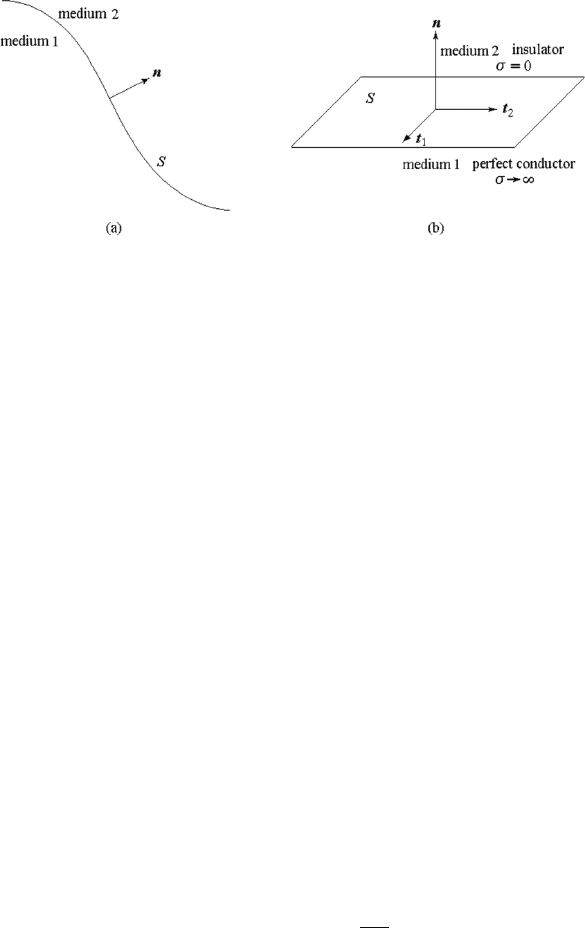
boundary between media, refereing to Fig. 1.4(a), we have the following
boundary equations:
n × (E
2
− E
1
) = 0, (1.115)
n × (H
2
− H
1
) = J
s
, (1.116)
n · (D
2
− D
1
) = ρ
s
, (1.117)
n · (B
2
− B
1
) = 0, (1.118)
20 1. Basic Electromagnetic Theory
Figure 1.4: (a) Boundary between two media and (b) boundary between a
perfect conductor and an insulator.
where n is the unit vector normal to the boundary and pointing from medium
1 to medium 2, J
s
is the surface current density in A/m; ρ
s
is the surface
charge density in C/m. Note that only free surface charge and true surface
current are included in the ρ
s
and J
s
, respectively, the bound charge and the
molecular current on the surface are not included.
By using (1.111)–(1.114), the boundary equations in duality form become
n × (E
2
− E
1
) = −J
ms
, (1.119)
n × (H
2
− H
1
) = J
s
, (1.120)
n · (D
2
− D
1
) = ρ
s
, (1.121)
n · (B
2
− B
1
) = ρ
ms
, (1.122)
where J
ms
is the equivalent surface magnetic current density and ρ
ms
is the
equivalent surface magnetic charge density [24, 37].
At the two sides of a boundary between conductive media with different
conductivities, from the equation of continuity in integral form (1.70), the
following boundary equation is obtained:
n · (J
2
− J
1
) = −j ωρ
s
. (1.123)
The instantaneous form of the above equation is
n · (J
2
− J
1
) = −
∂ρ
s
∂t
. (1.124)
Equations (1.119)–(1.122) and (1.123) are the general boundary equa-
tions. We must determine whether the surface charge and the surface current
exist or not by knowledge of the physical situation of the boundary. Here are
the boundary conditions for some special cases.