
Zhang K., Li D. Electromagnetic Theory for Microwaves and Optoelectronics
Подождите немного. Документ загружается.


6.1 Metallic Waveguide with Different Filling Media 321
Solving the above two equations for given ω and substituting the roots of k
x1
and k
x2
into (6.2) or (6.3), we get the longitudinal phase coefficient of the
TE
m0
mode:
β =
q
ω
2
µ
1
²
1
− k
2
x1
=
q
ω
2
µ
2
²
2
− k
2
x2
. (6.15)
When β = 0, the waveguide is cut off, ω = ω
c
. Then (6.2) and (6.3)
become
k
x1
= ω
c
√
µ
1
²
1
, k
x2
= ω
c
√
µ
2
²
2
.
Substituting these conditions into the characteristic equation (6.13), we ob-
tain
r
µ
1
²
1
tan ω
c
√
µ
1
²
1
h =
r
µ
2
²
2
tan ω
c
√
µ
2
²
2
(h − a). (6.16)
This is a transcendental equation and its mth root is the cutoff angular
frequency of the TE
m0
mode in a rectangular waveguide with two different
filling media.
Supposing µ
1
²
1
> µ
2
²
2
, we may then write
ω
c1
< ω
c
< ω
c2
, (6.17)
where ω
c1
= mπ/a
√
µ
1
²
1
, ω
c2
= mπ/a
√
µ
2
²
2
.
So, only the TE
m0
modes can satisfy the boundary conditions by itself
alone. The TE
mn
modes with n 6= 0 can not satisfy the boundary conditions,
i.e., cannot propagate in the waveguide alone. The modes with both m 6= 0
and n 6= 0 can exist in the waveguide only in the form of hybrid modes.
(2) TM Modes
For TM mo des, V = 0 and H
z
= 0. Applying the boundary conditions on
the conducting wall, we have the functions U
1
and U
2
for the two regions:
U
1
= A sin k
x1
x sin k
y
ye
−jβz
, 0 ≤ x ≤ h, (6.18)
U
2
= B sin k
x2
(x − a) sin k
y
ye
−jβz
, h ≤ x ≤ a, (6.19)
where k
y
= nπ/b.
The boundary conditions at x = h are such that the tangential compo-
nents of the electric and magnetic fields H
y
, E
y
, and E
z
on the two sides of
the boundary must be continuous, which gives us
H
y 1
(h) = H
y 2
(h) → B =
²
1
²
2
k
x1
k
x2
cos k
x1
h
cos k
x2
(h − a)
A, (6.20)
E
y 1
(h) = E
y 2
(h) → ²
1
k
x1
cot k
x1
h = ²
2
k
x2
cot k
x2
(h − a) (6.21)
and
E
z1
(h) = E
z2
(h) → (k
2
x2
+k
2
y
)²
1
k
x1
cot k
x1
h = (k
2
x1
+k
2
y
)²
2
k
x2
cot k
x2
(h−a).
(6.22)
322 6. Dielectric Waveguides and Resonators
As in our previous arguments for TE modes, the above two equations are
satisfied simultaneously only when the indices of refraction or the phase ve-
locities in the two media are equal, i.e.,
µ
1
²
1
= µ
2
²
2
.
For n = 0, i.e., TM
m0
modes, as we mentioned in the last chapter, all
the field components are zero. This means that TM
m0
modes cannot exist
in a rectangular waveguide. So, no TM mode alone can satisfy the boundary
conditions.
We come to the conclusion that only TE
m0
modes, i.e., modes with uni-
form fields along the transverse tangential direction of the boundary of the
two media, can exist in the waveguide with two different filling media. In
other words, the condition of existing TE or TM modes in the waveguide with
two different filling media is that the phase co efficient along the transverse
tangential direction must be zero. The fields of the other TE or TM modes
alone with nonuniform fields along the boundary cannot satisfy the boundary
conditions. Those other modes satisfying the boundary conditions must be
hybrid modes, i.e., HEM modes.
6.1.2 LSE and LSM Modes, HEM modes
We have mentioned in Section 4.7 that for rectangular geometry, we may
choose x or y rather than z as the special coordinate u
3
. In these choices, the
fields are expressed by LSE
(x)
and LSM
(x)
modes or by LSE
(y )
and LSM
(y )
modes, which are also denoted by TE
(x)
and TM
(x)
modes or TE
(y )
and
TM
(y )
modes, respectively. We have analyzed this kind of modes in rectan-
gular waveguides given in Section 5.3.
Now we try to find out whether LSE
(x)
and LSM
(x)
or LSE
(y )
and LSM
(y )
modes can satisfy the boundary conditions of the waveguide with two differ-
ent filling media. We again deal with the rectangular waveguide with two
different filling media aligned in x direction as shown in Fig. 6.1(a). The
relations of (6.2) and (6.3) are still valid.
(1) TE
(x)
Modes or LSE
(x)
Modes
For LSE
(x)
modes, U
(x)
= 0 and E
x
= 0. The general expressions for V
(x)
1
and V
(x)
2
are
V
(x)
1
= A sin(k
x1
x + φ
1
) cos(k
y 1
y + ψ
1
)e
−jβz
, 0 ≤ x ≤ h,
V
(x)
2
= B sin(k
x2
x + φ
2
) cos(k
y 2
y + ψ
2
)e
−jβz
, h ≤ x ≤ a,

6.1 Metallic Waveguide with Different Filling Media 323
Applying the field component expressions (4.153)–(4.158) and the boundary
conditions on the conducting wall, we have
E
z1
|
y =0
= jωµ
1
∂V
(x)
1
∂y
¯
¯
¯
¯
¯
y =0
= 0, sin ψ
1
= 0, ψ
1
= 0,
E
z2
|
y =0
= jωµ
2
∂V
(x)
2
∂y
¯
¯
¯
¯
¯
y =0
= 0, sin ψ
2
= 0, ψ
2
= 0,
E
z1
|
y =b
= jωµ
1
∂V
(x)
1
∂y
¯
¯
¯
¯
¯
y =b
= 0, sin k
y 1
b = 0, k
y 1
=
nπ
b
= k
y
,
E
z2
|
y =b
= jωµ
2
∂V
(x)
2
∂y
¯
¯
¯
¯
¯
y =b
= 0, sin k
y 2
b = 0, k
y 2
=
nπ
b
= k
y
,
E
z1
|
x=0
= jωµ
1
∂V
(x)
1
∂y
¯
¯
¯
¯
¯
x=0
= 0, sin φ
1
= 0, φ
1
= 0,
E
z2
|
x=a
= jωµ
2
∂V
(x)
2
∂y
¯
¯
¯
¯
¯
x=a
= 0, sin(k
x2
a + φ
2
) = 0, φ
2
= −k
x2
a.
Functions V
(x)
1
and V
(x)
2
become accordingly
V
(x)
1
= A sin k
x1
x cos k
y
ye
−jβz
, 0 ≤ x ≤ h, (6.23)
V
(x)
2
= B sin k
x2
(x − a) cos k
y
ye
−jβz
, h ≤ x ≤ a. (6.24)
Substituting these expressions into (4.153)–(4.158), we obtain the field-
component expressions in the two regions
Region 1, 0 ≤ x ≤ h:
E
y 1
= −jωµ
∂V
(x)
1
∂z
= −ωµ
1
βA sin k
x1
x cos k
y
ye
−jβz
, (6.25)
E
z1
= jωµ
∂V
(x)
1
∂y
= −jωµ
1
k
y
A sin k
x1
x sin k
y
ye
−jβz
, (6.26)
H
x1
=
¡
k
2
1
− k
2
x1
¢
V
(x)
1
=
¡
k
2
1
− k
2
x1
¢
A sin k
x1
x cos k
y
ye
−jβz
, (6.27)
H
y 1
=
∂
2
V
(x)
1
∂y ∂x
= −k
x1
k
y
A cos k
x1
x sin k
y
ye
−jβz
, (6.28)
H
z1
=
∂
2
V
(x)
1
∂z ∂x
= −jβk
x1
A cos k
x1
x cos k
y
ye
−jβz
. (6.29)
Region 2, h ≤ x ≤ a:
E
y 2
= −jωµ
∂V
(x)
2
∂z
= −ωµ
2
βB sin k
x2
(x − a) cos k
y
ye
−jβz
, (6.30)

324 6. Dielectric Waveguides and Resonators
E
z2
= jωµ
∂V
(x)
2
∂y
= −jωµ
2
k
y
B sin k
x2
(x − a) sin k
y
ye
−jβz
, (6.31)
H
x2
=
¡
k
2
2
− k
2
x2
¢
V
(x)
2
=
¡
k
2
2
− k
2
x2
¢
B sin k
x2
(x − a) cos k
y
ye
−jβz
,(6.32)
H
y 2
=
∂
2
V
(x)
2
∂y ∂x
= −k
x2
k
y
B cos k
x2
(x − a) sin k
y
ye
−jβz
, (6.33)
H
z2
=
∂
2
V
(x)
2
∂z ∂x
= −jβk
x2
B cos k
x2
(x − a) cos k
y
ye
−jβz
. (6.34)
Applying the boundary condition that states the tangential components
of fields must be continuous on the boundary x = h, we have
E
y 1
(h) = E
y 2
(h), E
z1
(h) = E
z2
(h),
which give
µ
1
A sin k
x1
h = µ
2
B sin k
x2
(h − a), (6.35)
and
H
y 1
(h) = H
y 2
(h), H
z1
(h) = H
z2
(h),
which give
k
x1
A cos k
x1
h = k
x2
B cos k
x2
(h − a). (6.36)
Then we get the eigenvalue equation of the LSE
(x)
mode by combining (6.35)
and (6.36):
µ
1
k
x1
tan k
x1
h =
µ
2
k
x2
tan k
x2
(h − a). (6.37)
Solving this equation and (6.14) for a given ω and substituting the roots of
k
x1
and k
x2
into (6.2) or (6.3), we have the longitudinal phase coefficient of
the TE
(x)
mn
or LSE
(x)
mn
mode:
β =
r
ω
2
µ
1
²
1
− k
2
x1
−
³
nπ
b
´
2
=
r
ω
2
µ
2
²
2
− k
2
x2
−
³
nπ
b
´
2
. (6.38)
For the cutoff state, β = 0, ω = ω
c
, then
k
x1
=
r
ω
2
c
µ
1
²
1
−
³
nπ
b
´
2
, k
x2
=
r
ω
2
c
µ
2
²
2
−
³
nπ
b
´
2
. (6.39)
Substituting (6.39) into the above eigenvalue equation (6.37), we have
µ
1
r
ω
2
c
µ
1
²
1
−
³
nπ
b
´
2
tan
"
r
ω
2
c
µ
1
²
1
−
³
nπ
b
´
2
h
#
=
µ
2
r
ω
2
c
µ
2
²
2
−
³
nπ
b
´
2
tan
"
r
ω
2
c
µ
2
²
2
−
³
nπ
b
´
2
(h−a)
#
.
(6.40)

6.1 Metallic Waveguide with Different Filling Media 325
The mth root of this transcendental equation is the cutoff angular frequency
of the LSE
(x)
mn
mode in a rectangular waveguide with two different filling
media.
For the LSE
(x)
m0
mode, n = 0, i.e., k
y
= 0, (6.40) reduces to the same form
as (6.16) for the cutoff frequency for the TE
m0
mode, and equation (6.37)
of k
x1
for LSE
(x)
m0
is also the same as the corresponding equation (6.13) for
the TE
m0
mode. Furthermore, we easily see that the field components of
the two modes are identical too. All the arguments put together mean that
the LSE
(x)
m0
mode is identical with the TE
(z)
m0
mode. The cutoff frequency of
the LSE
(x)
m0
mode is between the cutoff frequencies of the TE
m0
mode in the
waveguide filled with uniform medium 1 and the TE
m0
mode in the waveguide
filled with uniform medium 2.
The lowest LSE
(x)
mode is the LSE
(x)
10
mode, which is identical with TE
(z)
10
,
for which
π
a
√
µ
1
²
1
< ω
c
<
π
a
√
µ
2
²
2
if µ
2
²
2
< µ
1
²
1
.
The LSE
(x)
mn
or TE
(x)
mn
mode is a mixture of TE
(z)
and TM
(z)
modes, i.e.,
hybrid modes or HEM modes.
(2) TM
(x)
Modes or LSM
(x)
Modes
For LSM
(x)
modes, V
(x)
= 0 and H
x
= 0. Applying (4.153)–(4.158) and the
boundary conditions on the conducting wall, we get the expressions for U
(x)
1
and U
(x)
2
:
U
(x)
1
= A cos k
x1
x sin k
y
ye
−jβz
, 0 ≤ x ≤ h, (6.41)
U
(x)
2
= B cos k
x2
(x − a) sin k
y
ye
−jβz
, h ≤ x ≤ a, (6.42)
Substituting them into (4.153)–(4.158), we may obtain the field component
expressions in the two regions, which the reader can derive by the method
used previously.
Applying the boundary conditions that states the tangential components
of fields must be continuous on the boundary x = h, we have
E
y 1
(h) = E
y 2
(h), i.e.,
∂
2
U
(x)
1
∂y ∂x
¯
¯
¯
¯
¯
x=h
=
∂
2
U
(x)
2
∂y ∂x
¯
¯
¯
¯
¯
x=h
,
E
z1
(h) = E
z2
(h), i.e.,
∂
2
U
(x)
1
∂z ∂x
¯
¯
¯
¯
¯
x=h
=
∂
2
U
(x)
2
∂z ∂x
¯
¯
¯
¯
¯
x=h
,
which give
k
x1
A sin k
x1
h = k
x2
B sin k
x2
(h − a), (6.43)
326 6. Dielectric Waveguides and Resonators
and
H
y 1
(h) = H
y 2
(h), H
z1
(h) = H
z2
(h),
which give
²
1
A cos k
x1
h = ²
2
B cos k
x2
(h − a). (6.44)
Finally we obtain the eigenvalue equation of the LSE
(x)
mode from combining
the above two equations:
k
x1
²
1
tan k
x1
h =
k
x2
²
2
tan k
x2
(h − a). (6.45)
The longitudinal phase coefficient β is determined by this equation and (6.14)
and (6.2) or (6.3) in a manner similar to the previous derivation, which the
reader can work out as an exercise.
When β = 0, ω = ω
c
, substituting (6.39) into the eigenvalue equation
(6.45) gives
r
ω
2
c
µ
1
²
1
−
³
nπ
b
´
2
²
1
tan
"
r
ω
2
c
µ
1
²
1
−
³
nπ
b
´
2
h
#
=
r
ω
2
c
µ
2
²
2
−
³
nπ
b
´
2
²
2
tan
"
r
ω
2
c
µ
2
²
2
−
³
nπ
b
´
2
(h−a)
#
.
(6.46)
The mth root of this transcendental equation is the cutoff angular frequency
of the TM
(x)
mn
or LSM
(x)
mn
mode in a rectangular waveguide with two different
filling media.
By investigating the field-component expressions, we find that if n = 0,
i.e., k
y
= 0, all the field components would b e zero. So the LSM
(x)
m0
mode
cannot exist here.
We find that unlike (6.37), equation (6.45) has a set of near-zero roots,
k
x1
≈ 0 and k
x2
≈ 0. This mode is denoted by m = 0, i.e., by LSM
(x)
0n
modes.
For these modes,
tan x ≈ x, x ¿ 1,
and the eigenvalue equation (6.45) becomes
k
2
x1
²
1
h ≈
k
2
x1
²
1
(h − a). (6.47)
The equation for the cutoff frequency (6.46) becomes
1
²
1
·
ω
2
c
µ
1
²
1
−
³
nπ
b
´
2
¸
h ≈
1
²
2
·
ω
2
c
µ
2
²
2
−
³
nπ
b
´
2
¸
(h − a). (6.48)

6.2 Symmetrical Planar Dielectric Waveguides 327
So the cutoff angular frequency of the LSM
(x)
0n
mode can be solved as
ω
c
≈
nπ
b
√
µ
2
²
2
s
(²
2
/²
1
)h + (a − h)
(µ
1
/µ
2
)h + (a − h)
=
nπ
b
√
µ
1
²
1
s
h +
(²
1
/²
2
)(a − h)
h + (µ
2
/µ
1
)(a − h)
.
(6.49)
The cutoff frequency of the LSM
(x)
0n
mode lies between the cutoff frequen-
cies of the TE
(z)
0n
mode in the waveguide filled with uniform medium 1 and
the TE
(z)
0n
mode in the waveguide filled with uniform medium 2, i.e.,
nπ
b
√
µ
1
²
1
< ω
c
<
nπ
b
√
µ
2
²
2
.
For the LSM
(x)
0n
mode, both k
x1
and k
x2
are close but not equal to zero.
The fields of the LSM
(x)
0n
mode are similar to but not identical to those of
the TE
(z)
0n
mode, while the longitudinal electric field component in the TM
(x)
0n
mode is very small yet not zero. The lowest LSM
(x)
mode is the LSM
(x)
01
mode.
The waveguide with two different filling media aligned in the y direc-
tion as shown in Fig. 6.1(b) can also be analyzed by means of the same
method. The complete set of modes in this waveguide are LSE
(y )
mn
modes
(m = 0, 1, 2, 3, ···, n = 1, 2, 3, ···) and LSM
(y )
mn
modes (m = 1, 2, 3, ···, n =
0, 1, 2, 3, ···). The LSE
(y )
0n
modes are identical to the TE
(z)
0n
modes and the
LSM
(y )
m0
modes are similar to but not identical to the TE
(z)
m0
modes.
The most important conclusion drown in this section is that only the
modes with a uniform field in the transverse direction tangential to the
boundary between the media, in other words, with zero phase coefficient
along the transverse tangential direction, can be decomposed into TE and
TM modes. Otherwise they can only be hybrid modes.
6.2 Symmetrical Planar Dielectric
Waveguides
The slab waveguide is the simplest dielectric waveguide for millimeter wave
and optical wave transmission; it is also known as a planar dielectric waveg-
uide. A symmetrical planar dielectric waveguide is a dielectric slab of re-
fractive index n
1
=
√
µ
r1
²
r1
immersed in another medium of refractive index
n
2
=
√
µ
r2
²
r2
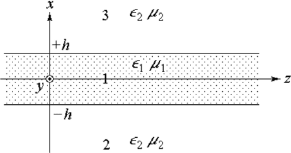
, as shown schematically in Fig. 6.2. The slab has a thick-
ness of 2h in the x direction and extends to infinity in the y and z direc-
tions. The whole space is divided into three regions, the slab or core region 1
(−h ≥ x ≥ h), the lower cladding region 2 (x ≤ −h), and the upper cladding
region 3 (x ≥ h).
The slab waveguide is a one-dimensional confined waveguide. We consider
the two-dimensional modes where fields are uniform along axis y and are
328 6. Dielectric Waveguides and Resonators
Figure 6.2: Symmetrical planar dielectric waveguide.
traveling waves along axis z. In the last section, we argued that, if the
fields are uniform along the transverse tangential direction of the boundary
of media, the fields of a single TE or TM mode alone can satisfy the boundary
conditions.
6.2.1 TM Modes
For TM modes, V = 0, U is a function of x and z only and is independent of
y, i.e., k
y
= 0. To satisfy the field-matching conditions on the slab surface,
fields in all the three regions must be traveling waves along z with the same
longitudinal phase coefficient k
z
= β.
In region 1, the core, −h ≤ x ≤ h, function U must be a standing waves
along x, and T denotes the transverse angular wave number.
U
1
= (A cos T x + B sin T x) e
−jβz
. (6.50)
Following the expressions of field components, (4.147)–(4.152), we have
E
x1
= jβT (A sin T x − B cos T x) e
−jβz
, (6.51)
E
z1
= T
2
(A cos T x + B sin T x) e
−jβz
, (6.52)
H
y 1
= jω²
1
T (A sin T x − B cos T x) e
−jβz
. (6.53)
In regions 2 and 3, for guided modes, function U must be a decaying
function along −x and +x, and τ denotes the transverse decaying factor.
Region 2, lower cladding, x ≤ −h:
U
2
= Ce
τx
e
−jβz
, (6.54)
E
x2
= −jβτ Ce
τx
e
−jβz
, (6.55)
E
z2
= −τ
2
Ce
τx
e
−jβz
, (6.56)
H
y 2
= −jω²
2
τCe
τx
e
−jβz
. (6.57)
Region 3, upper cladding, x ≥ h:
U
3
= De
−τx
e
−jβz
, (6.58)

6.2 Symmetrical Planar Dielectric Waveguides 329
E
x3
= jβτ De
−τx
e
−jβz
, (6.59)
E
z3
= −τ
2
De
−τx
e
−jβz
, (6.60)
H
y 3
= jω²
2
τDe
−τx
e
−jβz
. (6.61)
The relations among T , τ, and β are
β
2
+ T
2
= k
2
1
= ω
2
µ
1
²
1
, β
2
− τ
2
= k
2
2
= ω
2
µ
2
²
2
. (6.62)
The field-matching conditions on the boundary of the media are
E
z2
(−h, z)=E
z1
(−h, z) → −τ
2
Ce
−τh
=T
2
(A cos T h−B sin T h), (6.63)
E
z3
(h, z)=E
z1
(h, z) → −τ
2
De
−τh
=T
2
(A cos T h+B sin T h), (6.64)
H
y 2
(−h, z)=H
y 1
(−h, z) → ²
2
τCe
−τh
=²
1
T (A sin T h+B cos T h), (6.65)
H
y 3
(h, z)=H
y 1
(h, z) → ²
2
τDe
−τh
=²
1
T (A sin T h−B cos T h). (6.66)
They yield
D
C
=
A cos T h + B sin T h
A cos T h − B sin T h
=
A sin T h − B cos T h
A sin T h + B cos T h
. (6.67)
From (6.63) and (6.65), we obtain
²
2
τT
2
(A cos T h − B sin T h) = −²
1
T τ
2
(A sin T h + B cos T h), (6.68)
and from (6.64) and (6.66) we obtain
²
2
τT
2
(A cos T h + B sin T h) = −²
1
T τ
2
(A sin T h − B cos T h), (6.69)
The normal modes in the waveguide are classified as even modes and
odd modes. Whether a mode is even or odd is determined by the symmetry
property of the transverse field components which provide the power flow in
the longitudinal direction.
For even modes, A = 0 and B 6= 0, the ab ove two equations (6.68) and
(6.69) become
²
2
T h tan T h = ²
1
τh, (6.70)
and for odd modes, B = 0 and A 6= 0, (6.68) and (6.69) become
−²
2
T h cot T h = ²
1
τh. (6.71)
These are the eigenvalue equations for the even modes and the odd modes.
Since
tan
³
θ −
mπ
2
´
=
½
tan θ, m = 0, 2, 4, ···,
−cot θ, m = 1, 3, 5, ···,
equations (6.70) and (6.71) can be combined as one equation
²
2
T h tan
³
T h −
mπ
2
´
= ²
1
τh, (6.72)

330 6. Dielectric Waveguides and Resonators
where m is 0 or an even number for even modes and is an odd number for
odd modes.
From (6.62) we obtain
(T h)
2
+ (τh)
2
= (ωh)
2
(µ
1
²
1
− µ
2
²
2
). (6.73)
The transverse wave numbers T and τ and the longitudinal wave number β
are determined by (6.72), (6.73), and (6.62).
The coefficients for even modes and for odd modes can be obtained from
the boundary equations. For even modes:
A = 0, B =
τ
2
e
−τh
T
2
sin T h
C, D =−C. (6.74)
For odd modes:
A=−
τ
2
e
−τh
T
2
cos T h
C, B = 0, D =C. (6.75)
Substituting (6.74) or (6.75) into (6.51) to (6.61), we get the expressions
for the field components of the even TM modes or odd TM modes, respec-
tively, inside and outside the slab. This work is left to the reader. The
fields are standing waves in the core and are decaying in the cladding, along
the transverse direction x. They are traveling waves with the same phase
coefficient β along the longitudinal direction z, both in the core and in the
cladding. This kind of mode is known as a surface wave mode, since the fields
outside the dielectric slab are gathered in regions near the surface of the slab.
The impedance at the surface of the slab is defined as the ratio of the
tangential electric field to the tangential magnetic field. For TM modes,
Z
(TM)
S
=
E
z
(h)
H
y
(h)
= −
E
z
(−h)
H
y
(−h)
= j
τ
ω²
2
. (6.76)
This is an inductive reactance. We can see that an arbitrary cylindrical
system enclosed by an inductive surface can support TM surface waves.
6.2.2 TE Modes
For TE modes, U = 0, k
y
= 0, k
z
= β, and we have the V functions and the
expressions for field components in the three regions as follows:
Region 1, −h ≤ x ≤ h:
V
1
= (A cos T x + B sin T x) e
−jβz
, (6.77)
E
y 1
= −jωµ
1
T (A sin T x − B cos T x) e
−jβz
, (6.78)
H
x1
= jβT (A sin T x − B cos T x) e
−jβz
, (6.79)
H
z1
= T
2
(A cos T x + B sin T x) e
−jβz
; (6.80)