
Zhang K., Li D. Electromagnetic Theory for Microwaves and Optoelectronics
Подождите немного. Документ загружается.

6.4 Asymmetrical Planar Dielectric Waveguides 341
There is a fast wave in the core and a slow waves in the substrate and the
cladding.
6.4.1 TM Modes
The field components of TM modes in the three regions are as follows.
Region 1, −d ≤ x ≤ 0:
U
1
= (A cos T x + B sin T x) e
−jβz
, (6.106)
E
x1
= jβT (a sin T x − b cos T x) e
−jβz
, (6.107)
E
z1
= T
2
(a cos T x + b sin T x) e
−jβz
, (6.108)
H
y 1
= jω²
1
T (a sin T x − b cos T x) e
−jβz
. (6.109)
Region 2, x ≤ −d:
U
2
= Ce
τ
2
(x+d)
e
−jβz
, (6.110)
E
x2
= −jβτ
2
Ce
τ
2
(x+d)
e
−jβz
, (6.111)
E
z2
= −τ
2
2
Ce
τ
2
(x+d)
e
−jβz
, (6.112)
H
y 2
= −jω²
2
τ
2
Ce
τ
2
(x+d)
e
−jβz
. (6.113)
Region 3, x ≥ 0:
U
3
= De
−τ
3
x
e
−jβz
, (6.114)
E
x3
= jβτ
3
De
−τ
3
x
e
−jβz
, (6.115)
E
z3
= −τ
2
3
De
−τ
3
x
e
−jβz
, (6.116)
H
y 3
= jω²
2
τ
3
De
−τ
3
x
e
−jβz
. (6.117)
The tangential field-matching conditions on the boundaries of the media
are
E
z1
(−d, z) = E
z2
(−d, z), E
z1
(0, z) = E
z3
(0, z), (6.118)
H
y 1
(−d, z) = H
y 2
(−d, z), H
y 1
(0, z) = H
y 3
(0, z). (6.119)
Substituting the field-component expressions into the above, we have the
following boundary equations
¡
T
2
cos T d
¢
A −
¡
T
2
sin T d
¢
B + τ
2
2
C = 0 (6.120)
T
2
A + τ
2
3
D = 0 (6.121)
(²
1
T sin T d)A + (²
1
T cos T d)B − ²
2
τ
2
C = 0 (6.122)
²
1
T B + ²
3
τ
3
D = 0 (6.123)
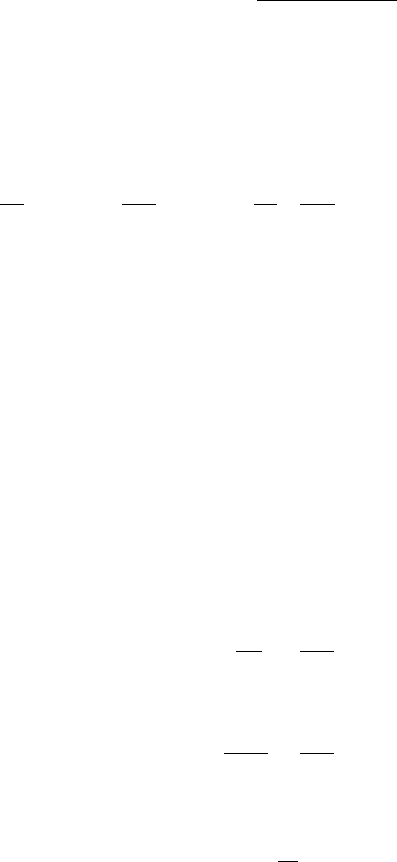
This is a set of fourth-order homogeneous linear equations, which are satisfied
by nontrivial solutions only when the determinant of the coefficients vanishes,
342 6. Dielectric Waveguides and Resonators
that is
¯
¯
¯
¯
¯
¯
¯
¯
T
2
cos T d −T
2
sin T d τ
2
2
0
T
2
0 0 τ
2
3
²
1
T sin T d ²
1
T cos T d −²
2
τ
2
0
0 ²
1
T 0 ²
3
τ
3
¯
¯
¯
¯
¯
¯
¯
¯
= 0.
Rearranging we obtain
tan(T d − mπ) =
²
1
T (²
3
τ
2
+ ²
2
τ
3
)
²
2
²
3
T
2
− ²
2
1
τ
2
τ
3
. (6.124)
This is the eigenvalue equation of the TM modes in an asymmetrical planar
dielectric waveguide. From this equation and (6.104), we can solve for the
longitudinal phase coefficient β.
From the boundary equations (6.120) to (6.123), the relations among field
coefficients are obtained as follows:
D = −
T
2
τ
2
3
A, B =
²
3
T
²
1
τ
3
A, C =
T
2
τ
2
2
µ
²
3
T
²
1
τ
3
sin T d − cos T d

A. (6.125)
Substituting them into (6.106)–(6.117), we have all the field components with
only one unknown coefficient A, which is determined by the amplitude of wave
in the waveguide.
6.4.2 TE Modes
By using the same method, we can derive the eigenvalue equation and the field
components of TE modes for an asymmetrical planar dielectric waveguide.
Another way of solving this problem is the impedance-matching approach
given by Kogelnik and Ramaswamy [50]. As an example, we discuss the TE
modes in an asymmetrical planar dielectric waveguide. The geometry is the
same as shown in Figure 6.9.
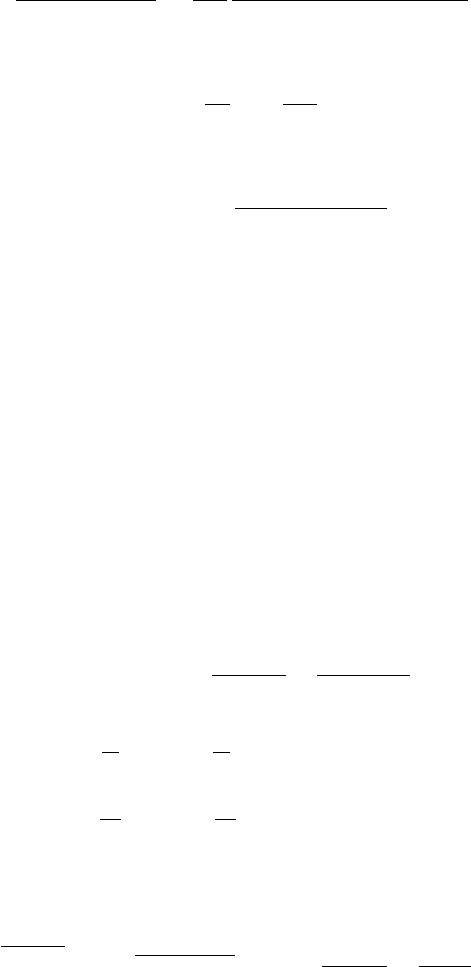
Applying the general expressions of the field components in rectangular
coordinates, (4.147)–(4.152), for the TE mode, ∂V /∂x = τ
2
V , we have the
impedance of the substrate at the lower boundary of the core:
Z
S
= −
E
y
H
z
= j
ωµ
2
τ
2
. (6.126)
The wave impedance of the guided layer in the x direction is
Z
C
=
η
1
cos θ
i
=
ωµ
1
T
, (6.127)
where θ
i
denotes the angle of incidence of the TEM wave on the boundary,
with
cos θ
i
=
T
k
1
.
6.4 Asymmetrical Planar Dielectric Waveguides 343
The impedance Z
S
is transformed by the guided layer of wave impedance Z
C
into an input impedance at the upper boundary Z
i
as follows:
Z
i
= Z
C
Z
S
+ jZ
C
tan T d
Z
C
+ jZ
S
tan T d
= j
ωµ
1
T
(ωµ
2
/τ
2
) + (ωµ
1
/T ) tan T d
(ωµ
1
/T ) − (ωµ
2
/τ
2
) tan T d
. (6.128)
Similarly the impedance of the cover at the upper boundary of the core is
Z
0
=
E
y
H
z
= −j
ωµ
3
τ
3
. (6.129)
Applying the impedance matching condition Z
i
= Z
0
, we have
tan(T d − mπ) =
µ
1
T (µ
3
τ
2
+ µ
2
τ
3
)
µ
2
µ
3
T
2
− µ
2
1
τ
2
τ
3
. (6.130)
This is the eigenvalue equation of the TE modes in an asymmetrical planar
dielectric waveguide.
The eigenvalue equations for the TM modes and TE modes are dual
equations. By exchanging µ for ², we can obtain one from another. The
fields of the TM modes and TE modes in planar dielectric waveguides are
also dual variables. By applying the principle of duality given in Section 1.7
on the expressions for the field components for TM modes, (6.106)–(6.117),
one readily obtains the expressions for the field components for TE modes.
For symmetrical planar dielectric waveguide, ²
3
= ²
2
, µ
3
= µ
2
and d = 2h,
the eigenvalue equations (6.124) and (6.130) reduce to (6.72) and (6.93).
6.4.3 Dispersion Characteristics of Asymmetrical
Planar Dielectric Waveguide
The eigenvalue equations for the TM modes and TE modes, (6.124) and
(6.130), can be summed up by the following single equation:
tan(T d − mπ) =
T (p + q)
T
2
− pq
=
p/T + q/T
1 − pq/T
2
, (6.131)
where
p =
²
1
²
2
τ
2
, q =
²
1
²
3
τ
3
, for TM modes,
and
p =
µ
1
µ
2
τ
2
, q =
µ
1
µ
3
τ
3
, for TE modes.
As we have mentioned in the previous section, the eigenvalue equations
can be expressed in terms of the normalized frequency V and normalized
guided index b:
V =
q
k
2
1
− k
2
2
d = ω
√
µ
1
²
1
− µ
2
²
2
d, b =
β
2
− k
2
2
k
2
1
− k
2
2
=
(τ
2
d)
2
V
2
, (6.132)
344 6. Dielectric Waveguides and Resonators
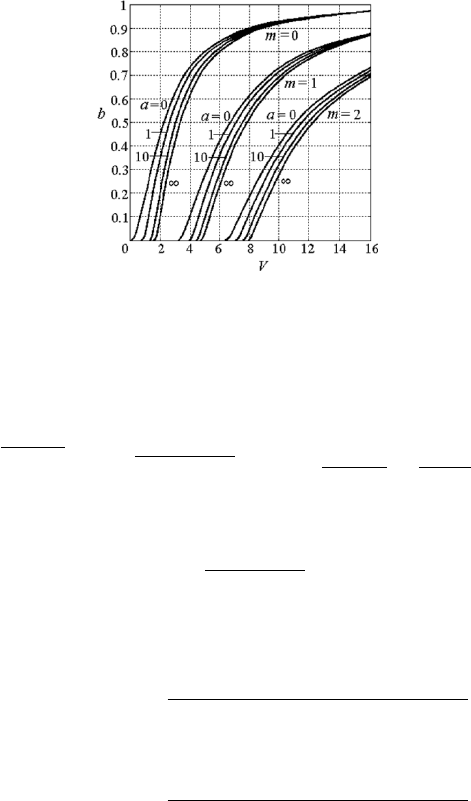
Figure 6.10: Normalized dispersion curves for asymmetrical planar dielectric
waveguide.
or
¯
V =
q
k
2
1
− k
2
3
d = ω
√
µ
1
²
1
− µ
3
²
3
d,
¯
b =
β
2
− k
2
3
k
2
1
− k
2
3
=
(τ
3
d)
2
¯
V
2
, (6.133)
and an asymmetrical parameter a is defined as
a =
²
2
µ
2
− ²
3
µ
3
²
1
µ
1
− ²
2
µ
2
. (6.134)
Then the eigenvalue equation (6.131) becomes
tan(V (1 − b)
1/2
− mπ) =
[b/(1 − b)]
1/2
+ [(b + a)/(1 − b)]
1/2
1 − [b(b + a)]
1/2
/(1 − b)
. (6.135)
or
tan(
¯
V (1 −
¯
b)
1/2
− mπ) =
[
¯
b/(1 −
¯
b)]
1/2
+ [(
¯
b + a)/(1 −
¯
b)]
1/2
1 − [
¯
b(
¯
b + a)]
1/2
/(1 −
¯
b)
. (6.136)
The normalized dispersion curves for asymmetrical planar dielectric
waveguides are shown in Fig. 6.10.
6.4.4 Fields in Asymmetrical Planar Dielectric
Waveguides
The transverse dependencies of fields in an asymmetrical dielectric slab
waveguide for guided modes and radiation modes are illustrated in Fig. 6.11.
For guided modes, the fields are standing waves along x in the core and
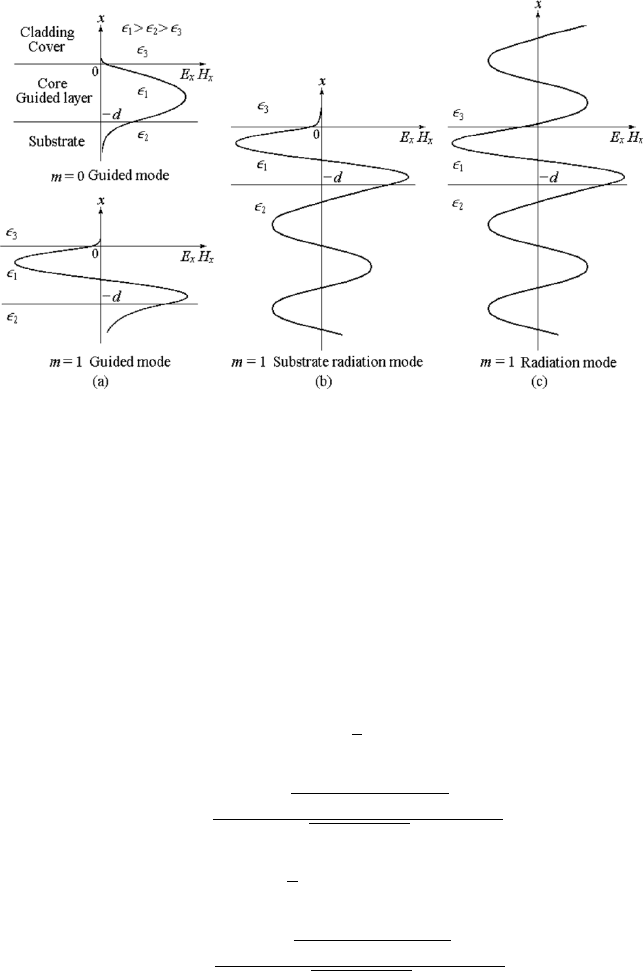
6.4 Asymmetrical Planar Dielectric Waveguides 345
Figure 6.11: Transverse dependence of fields in an asymmetrical dielectric
slab waveguide.
are decaying fields along x in the substrate and the cladding. For an op-
tical waveguide, the difference between the indices of the guided layer and
the substrate ranges from 10
−3
to 10
−1
. This means that the refractive in-
dex of the core is only slightly larger than that of the substrate, but the
difference between the indices of the core and the cladding is much larger,
i.e., ²
1
> ²
2
> ²
3
. Hence, for guided modes, the transverse decaying coeffi-
cient in the substrate is less than that in the cladding, τ
2
> τ
3
, as shown in
Fig. 6.11(a).
The cutoff condition of the core–substrate boundary is τ
2
= 0, which
corresponds to b = 0 and V
c
= arctan
√
a + mπ. Then we have the cutoff
frequency of the core–substrate boundary for the mth mode:
ω
(sub)
cm
=
arctan
p
(²
2
− ²
3
)/(²
1
− ²
2
) + mπ
√
µ
1
²
1
− µ
2
²
2
d
. (6.137)
The cutoff condition of the core–cladding b oundary is τ
3
= 0, which corre-
sponds to
¯
b = 0 and
¯
V
c
= arctan
√
a+mπ. Then we have the cutoff frequency
of the core–cladding boundary for the mth mode:
ω
(clad)
cm
=
arctan
p
(²
2
− ²
3
)/(²
1
− ²
2
) + mπ
√
µ
1
²
1
− µ
3
²
3
d
. (6.138)
For an optical waveguide, µ
1
= µ
2
= µ
3
= µ
0
and ²
1
> ²
2
> ²
3
, so we have
ω
(sub)
cm
> ω
(clad)
cm
.
346 6. Dielectric Waveguides and Resonators
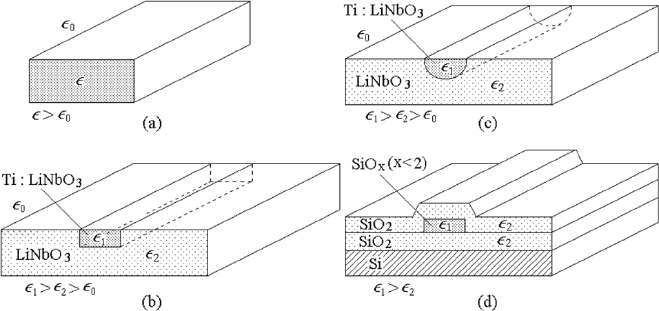
Figure 6.12: Rectangular dielectric waveguides.
When the operating frequency is higher than ω
(sub)
cm
, the mth mode is a
guided mode. When the operating frequency is lower than ω
(sub)
cm
but higher
than ω
(clad)
cm
, the fields in the substrate become transverse radiation fields but
those in the cladding are still decaying fields, and the mth mode becomes a
substrate radiation mode, as shown in Fig. 6.11(b). When the operating fre-
quency is ω
(clad)
cm
or lower, there are radiation fields in both the substrate and
the cladding, and the mode becomes a substrate–cladding radiation mode, as
shown in Fig. 6.11(c). We can see from (6.137) and (6.138) that, the cutoff
frequency of the dominant mode for asymmetrical planar dielectric waveg-
uide is not exactly zero but approximately zero, especially for weekly-guiding
waveguides.
6.5 Rectangular Dielectric Waveguides
For the millimeter wave bands, the commonly used dielectric waveguide is
simply a dielectric ro d with a rectangular cross section. In integrated optics,
a dielectric waveguide is usually made by thin-film deposition, doping, and
etching techniques on glass, ceramic, crystal, or semiconductor substrates.
This sort of waveguide is known as a strip waveguide or channel waveguide.
The cross sections of channel waveguides are not exactly rectangular, but to
make the problem solvable, we have to approximate the real waveguide by
a rectangular dielectric waveguide as shown in Fig. 6.12. The rectangular
dielectric waveguide is a two-dimensional confined waveguide.
As we mentioned before, only the modes with uniform fields in the trans-
verse tangential direction on the dielectric boundary can be separated into
TE and TM modes. For a rectangular dielectric waveguide, however, the
6.5 Rectangular Dielectric Waveguides 347
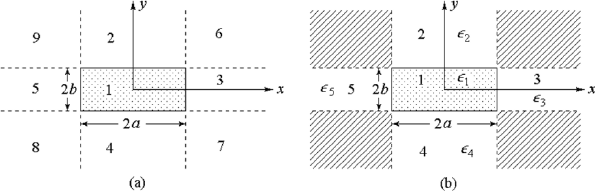
Figure 6.13: Subregions of a rectangular dielectric waveguide.
modes with uniform fields in both the x and the y direction cannot satisfy
the boundary conditions. No single TE or TM mode can exist independently
in the waveguide. There must be hybrid electric and magnetic (HEM) modes.
6.5.1 Exact Solution for
Rectangular Dielectric Waveguides
For a rectangular dielectric waveguide, the whole space has to be divided into
9 uniform subregions with 12 b oundaries as illustrated in Fig. 6.13(a). For
the exact solution, we have to write out expressions for 6×9 field components
and match the fields on all the 12 boundaries. Because of the symmetrical
property of the waveguide, we have to deal with the first quadrant only, i.e.,
4 subregions, regions 1, 2, 3, and 6, and 4 boundaries. The normal modes
for the rectangular waveguide are classified into four kinds, modes with odd
functions in both x and y, with even functions in both x and y, with odd
functions in x, even functions in y, and with odd functions in x, even functions
in y. For an example, HEM modes with even functions in both x and y are
to be investigated. The permittivity inside the core is ²
1
, and that outside
the core is ²
2
. For the dielectric waveguide, ²
1
> ²
2
, and µ
1
= µ
2
= µ
0
.
Considering the phase matching conditions at the four boundaries, the
functions U and V in four regions must be given by
U
1
= A cos(k
x
x) cos(k
y
y)e
−jβz
, (6.139)
V
1
= B cos(k
x
x) cos(k
y
y)e
−jβz
, (6.140)
U
2
= C cos(k
x
x)e
−τ
y
y
e
−jβz
, (6.141)
V
2
= D cos(k
x
x)e
−τ
y
y
e
−jβz
, (6.142)
U
3
= F e
−τ
x
x
cos(k
y
y)e
−jβz
, (6.143)
V
3
= Ge
−τ
x
x
cos(k
y
y)e
−jβz
, (6.144)
U
6
= Je
−τ
x
x
e
−τ
y
y
e
−jβz
, (6.145)
348 6. Dielectric Waveguides and Resonators
V
6
= Ke
−τ
x
x
e
−τ
y
y
e
−jβz
. (6.146)
For satisfying the Helmholtz’s equations, the phase coefficients and decay-
ing coefficients in the four regions must comply with the following relations,
β
2
+ k
2
x
+ k
2
y
= k
2
1
= ω
2
µ
0
²
1
, (6.147)
β
2
+ k
2
x
− τ
2
y
= k
2
2
= ω
2
µ
0
²
2
, (6.148)
β
2
− τ
2
x
+ k
2
y
= k
2
2
= ω
2
µ
0
²
2
, (6.149)
β
2
− τ
2
x
− τ
2
y
= k
2
2
= ω
2
µ
0
²
2
. (6.150)
Substituting (6.148) , (6.149) into (6.150), yields
β
2
+ k
2
x
+ k
2
y
= k
2
2
= ω
2
µ
0
²
2
. (6.151)
This equation, (6.151), is obviously inconsistent with the equation for region
1, (6.147). The only exception is the case of k
1
= k
2
, i.e. µ
1
²
1
= µ
2
²
2
, but it
is impossible for dielectric waveguides.
The conclusion is that, the boundary conditions for a rectangular dielec-
tric waveguide can not be satisfied by the fields with single transverse space
harmonics in x and y. The transverse functions of the fields must be series
with infinite terms, i.e., infinite space harmonics. The method and proce-
dure for the exact solution of a rectangular dielectric waveguide are similar
to those for the solution of the reentrant cavity given in Section 5.6. The
boundary equation can be expressed by an infinite linear algebraic equations
and all the coefficients are infinite series. The eigenvalue equation is obtained
by equating the determinant of the coefficients to zero, which can be solved
by numerical method. The roots of the equation are the cutoff frequencies of
the normal modes for the rectangular dielectric waveguide and the dispersion
relations are obtained.
6.5.2 Approximate Analytic Solution for Weekly
Guiding Rectangular Dielectric Waveguides [64]
To obtain the exact solution given in the last section is an onerous task. We
are going to give the approximate solution developed by E.A.J.Marcatilli [64].
The approximations are made as follows.
(1) For the guided modes in a rectangular dielectric waveguide shown in
Fig. 6.13(a), the fields in the core, i.e., the region 1, are standing waves in
both the x and the y directions; the fields in regions 2 and 4 are standing
waves in the x direction and are decaying fields in the y direction; the fields in
regions 3 and 5 are standing waves in the y direction and are decaying fields
in the x direction; the fields in regions 6, 7, 8, and 9 are all decaying fields
in both the x and the y directions. As a consequence, most of the guided
power flow is concentrated in the core; less power flows in regions 2–5 and
6.5 Rectangular Dielectric Waveguides 349
much less power flows in regions 6–9. The fields in regions 6–9 are allowed to
be ignored completely. In so doing the number of regions to be considered is
reduced to 5 and the number of boundaries is reduced to 4, which is shown
in Fig. 6.13(b), thus the problem is largely simplified.
(2) For weakly guiding optical waveguides, the refractive index of the core
is only slightly larger than those of the substrate and the cover or cladding,
so that the critical angle on the boundary is rather large. For guided mode,
the angle of incidence must be larger than the critical angle and close to π/2,
i.e. the wave vector of the incident wave is almost parallel to the z axis. In
this situation, the longitudinal components of the fields are much less than
the transverse components, and the wave is approximately the TEM mode.
(3) According to the exp erience that we have had in Section 6.1, the
TM
(y )
or E
(y )
modes and TM
(x)
or E
(x)
modes might satisfy the boundary
conditions. The TM
(y )
modes are also known as LSM
(y )
modes, in which
the dominant field components are E
y
and H
x
; while the TM
(x)
modes are
also known as LSM
(x)
modes, in which the dominant field components are
E
x
and H
y
. They are two modes of mutual perpendicular polarizations. The
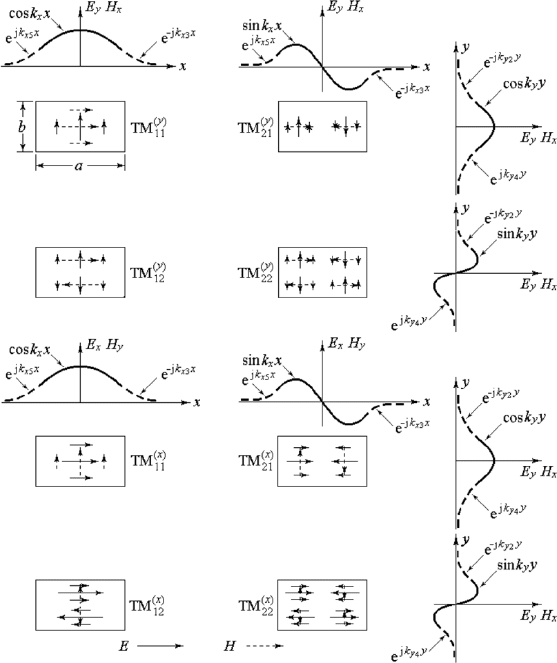
approximate field configurations of TM
(y )
and TM
(x)
modes in rectangular
dielectric waveguides are illustrated in Fig. 6.14.
We deal with the nonmagnetic dielectric waveguide, where the permittiv-
ities in the ith regions are ²
i
, i = 1, 2, 3, 4, 5, and the permeabilities in all
five regions are µ
0
.
Considering the boundary conditions, we establish relations for phase and
decaying coefficients. In region 1, the fields are standing waves in the x and y
directions, the transverse phase coefficients must be k
x1
= k
x
and k
y 1
= k
y
,
respectively. In regions 2 and 4, for the fields to be standing waves in the
x direction requires the same phase coefficient k
x2
= k
x4
= k
x
and decaying
fields in the y direction require the decaying coefficients to be τ
2
= jk
y 2
and
τ
4
= jk
y 4
, respectively. In regions 3 and 5, the fields are standing waves in the
y direction with the same phase coefficient k
y 3
= k
y 5
= k
y
and are decaying
fields in the x direction with decaying coefficients τ
3
= jk
x3
and τ
5
= jk
x5
,
respectively. The longitudinal phase coefficient of all five regions must be the
same value β. In order to satisfy Helmholtz’s equations, we must have
k
2
xi
+ k
2
yi
+ β
2
= k
2
i
= ω
2
µ
0
²
i
, i = 1, 2, 3, 4, 5. (6.152)
Considering the weakly guiding condition, we have
k
xi
¿ β, k
yi
¿ β.
For TM
(y )
or E
(y )
modes, we have V
(y )
= 0 and
U
(y )
1
= A
1
cos(k
x
x + φ) cos(k
y
y + ψ)e
−jβz
, (6.153)
U
(y )
2
= A
2
cos(k
x
x + φ)e
−jk
y2
y
e
−jβz
, (6.154)
U
(y )
3
= A
3
e
−jk
x3
x
cos(k
y
y + ψ)e
−jβz
, (6.155)
350 6. Dielectric Waveguides and Resonators
Figure 6.14: Approximate field configurations of TM
(y )
and TM
(x)
modes in
a rectangular dielectric waveguide.