
Zhang K., Li D. Electromagnetic Theory for Microwaves and Optoelectronics
Подождите немного. Документ загружается.

5.5 Waveguides and Cavities in Spherical Coordinates 291
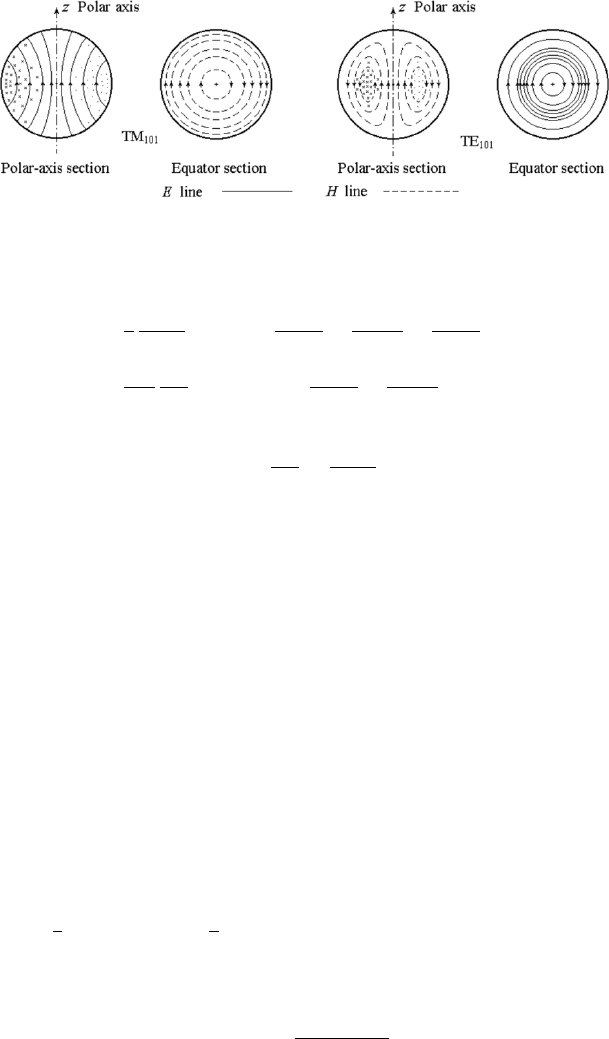
Figure 5.36: Fields of the TM
101
and TE
101
modes in a spherical cavity.
H
θ
=
1
r
∂
2
V
∂θ ∂r
= k
2
V
0
µ
sin kr
k
3
r
3
−
cos kr
k
2
r
2
−
sin kr
kr

sin θ, (5.274)
E
φ
=
jωµ
r
∂V
∂θ
= −jηk
2
V
0
µ
sin kr
k
2
r
2
−
cos kr
kr

sin θ, (5.275)
where
k =
x
11
a
=
4.493
a
. (5.276)
We can see that the TM
101
mode is the lowest mode in spherical cavity.
The field maps of the TM
101
and TE
101
modes in a a spherical cavity are
shown in Fig. 5.36.
5.5.2 Biconical Lines and Biconical Cavities
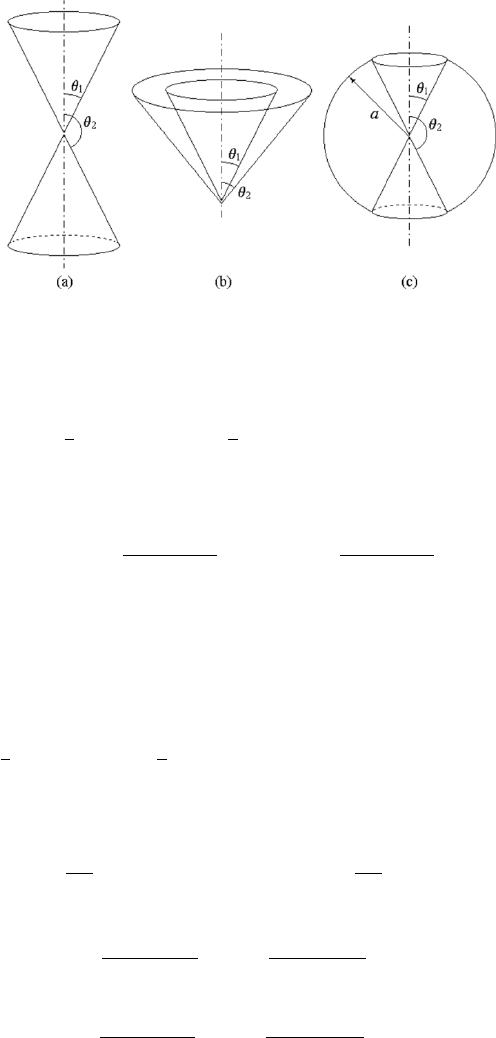
Biconical lines, shown in Fig. 5.37(a), (b), are spherical radial waveguides.
In a biconical line, the p olar axes, θ = 0 and θ = π, are excluded from
the field region, so the solutions must include two independent Legendre
functions, in which m is an integer because the field region includes the whole
circumference in φ, but ν is not necessarily an integer. So the two independent
solutions can be P
m
ν
(cos θ) and Q
m
ν
(cos θ) or P
m
ν
(cos θ) and P
m
ν
(−cos θ). The
orientation of φ = 0 is chosen such that Borgnis’ function becomes an even
function respect to φ.
(1) TM and TE Modes in Biconical Lines
The solution U for the TM mode in a biconical line becomes
U =
£
a
√
rH
(1)
ν+1/2
(kr) + b
√
rH
(2)
ν+1/2
(kr)
¤
[CP
m
ν
(cos θ)+DQ
m
ν
(cos θ)]cos(mφ).
Applying the short-circuit boundary condition U |
θ
1
= 0, we have
D = −C
P
m
ν
(cos θ
1
)
Q
m
ν
(cos θ
1
)
,
292 5. Metallic Waveguides and Resonant Cavities
Figure 5.37: Biconical lines and biconical cavity.
and then
U =
£
A
√
rH
(1)
ν+1/2
(kr) + B
√
rH
(2)
ν+1/2
(kr)
¤£
Q
m
ν
(cos θ
1
)P
m
ν
(cos θ)
−P
m
ν
(cos θ
1
)Q
m
ν
(cos θ)
¤
cos(mφ), (5.277)
where
A = a
C
Q
m
ν
(cos θ
1
)
, B =
C
Q
m
ν
(cos θ
1
)
.
Applying the short-circuit boundary condition U |
θ
2
= 0, we have
Q
m
ν
(cos θ
1
)P
m
ν
(cos θ
2
) − P
m
ν
(cos θ
1
)Q
m
ν
(cos θ
2
) = 0. (5.278)
This is the eigenvalue equation for the TM mode in a biconical line. The pth
root of this equation of mth order is denoted by ν
TM
mp
.
The solution V for the TE mode in a biconical line becomes
V =
£
a
√
rH
(1)
ν+1/2
(kr) + b
√
rH
(2)
ν+1/2
(kr)
¤
[CP
m
ν
(cos θ)+DQ
m
ν
(cos θ)]cos(mφ).
(5.279)
Applying the short-circuit boundary condition at θ = θ
1
and θ = θ
2
,
dV
dθ
¯
¯
¯
¯
θ
1
= 0 and
dV
dθ
¯
¯
¯
¯
θ
2
= 0,
we have
C
dP
m
ν
(cos θ)
dθ
¯
¯
¯
¯
θ
1
+ D
dQ
m
ν
(cos θ)
dθ
¯
¯
¯
¯
θ
1
= 0
and
C
dP
m
ν
(cos θ)
dθ
¯
¯
¯
¯
θ
2
+ D
dQ
m
ν
(cos θ)
dθ
¯
¯
¯
¯
θ
2
= 0.

5.5 Waveguides and Cavities in Spherical Coordinates 293
These homogeneous equations are satisfied by nontrivial solutions only when
their determinants vanish, that is
"
dP
m
ν
(cos θ)
dθ
¯
¯
¯
¯
θ
1
#"
dQ
m
ν
(cos θ)
dθ
¯
¯
¯
¯
θ
2
#
−
"
dQ
m
ν
(cos θ)
dθ
¯
¯
¯
¯
θ
1
#"
dP
m
ν
(cos θ)
dθ
¯
¯
¯
¯
θ
2
#
= 0.
(5.280)
This is the eigenvalue equation for the TE mode in a biconical line. The pth
root of this equation of mth order is denoted by ν
TE
mp
. Generally, ν
TM
mp
or
ν
TE
mp
is not an integer, it is an integer only when θ
1
and θ
2
are some special
angles.
The expressions for the field component in biconical line can be obtained
by substituting the above U or V into the field component formulas respect
to Borgnis’ potentials. They are spherical traveling waves in the +r and −r
directions.
(2) TEM Mode in Biconical Lines
The lowest-order mode in the biconical line is the one for which m = 0 and ν
takes the first root of (5.278) and (5.280), i.e., ν = 0. For m = 0 and ν = 0,
all the field components of the TE mode are zero and the function U for the
TM mode is given by
U =
£
A
√
rH
(1)
1/2
(kr)+B
√
rH
(2)
1/2
(kr)
¤
[Q
0
(cos θ
1
)P
0
(cos θ)−P
0
(cos θ
1
)Q
0
(cos θ)].
(5.281)
Considering
P
0
(cos θ) = 1, and Q
0
(cos θ) = ln cot
θ
2
,
and applying the expressions for the half-order Bessel functions in Appendix
C.5.1:
H
(1)
1/2
(x) = −j
r
2
πx
e
jx
, H
(2)
1/2
(x) = j
r
2
πx
e
−jx
,
yields
U =
µ
ln cot
θ
2
− ln cot
θ
1
2

¡
U
+
e
−jkr
− U
−
e
jkr
¢
, (5.282)
where
U
−
= −jA
r
2
πk
, U
+
= −jB
r
2
πk
.
Substituting (5.282) into (4.233) to (4.238), and using
d
dθ
ln cot
θ
2
= −
1
sin θ
,
we have the field components
E
θ
=
jk
r sin θ
¡
U
+
e
−jkr
+ U
−
e
jkr
¢
=
1
r sin θ
¡
E
+
e
−jkr
+ E
−
e
jkr
¢
, (5.283)

294 5. Metallic Waveguides and Resonant Cavities
H
φ
=
jω²
r sin θ
¡
U
+
e
−jkr
− U
−
e
jkr
¢
=
1
r sin θ
µ
E
+
η
e
−jkr
−
E
−
η
e
jkr

, (5.284)
E
r
= 0, E
φ
= 0, H
r
= 0, H
θ
= 0,
where
E
+
= jkU
+
, E
−
= jkU
−
.
This is the TM
00
mode in a biconical line, in which only the transverse com-
ponent of the electric field E
θ
and the transverse component of the magnetic
field H
φ
exist; they form two spherical TEM waves in the +r and −r direc-
tions. So the TM
00
mode in a biconical line is also known as the spherical
TEM mode, denoted by TEM
(r)
.
According to (3.70), the characteristic impedance of the spherical TEM
mode in biconical line becomes
Z
C
=
R
θ
2
θ
1
(E
±
θ
)rdθ
R
2π
0
±H
±
φ
r sin θdφ
=
η
2π
ln
tan(θ
2
/2)
tan(θ
1
/2)
. (5.285)
(3) Biconical Cavities
If the biconical line is closed by a short-circuit surface at r = a and the two
conical tips separated by an infinitesimal gap it becomes a biconical cavity,
shown in Fig. 5.37(c). Applying the boundary condition at r = a, we have
the expressions for the field components of the dominant TEM modes in a
biconical cavity as follows
E
θ
= E
m
sin k(a − r)
r sin θ
, E
θ
=
E
m
jη
cos k(a − r)
r sin θ
. (5.286)
The input impedance seen from the tip is
Z
in
=
V
in
I
in
= jZ
C
tan ka,
which is the same as the formula for a uniform transmission line. The reso-
nant condition for a biconical cavity is
ka =
pπ
2
, ω
p
=
pπ
2a
√
µ²
, p = 1, 2, 3 ···. (5.287)
The capacity-loaded biconical cavity or reentrant spherical cavity is used
in some active devices and gas-discharge microwave duplexers, refer to Prob-
lem 5.15.
5.6 Reentrant Cavities 295
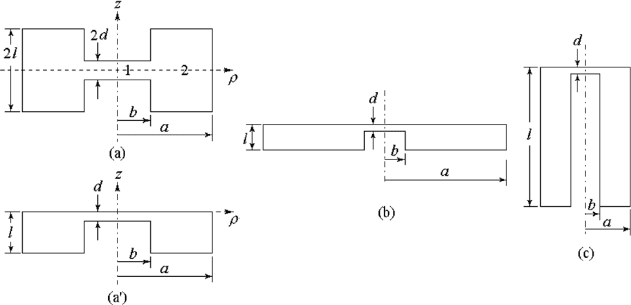
Figure 5.38: Reentrant cavities.
5.6 Reentrant Cavities
In microwave active devices, such as klystrons, microwave triodes and
tetrodes, Gunn diode oscillators, varactor parametric amplifiers, microwave
duplexers, and particle accelerators, it is essential for efficient energy transfer
between the carriers, i.e., electrons, protons, or holes, and the fields that the
electric field in the interactive region be strong enough and the transit time
of carriers across the field region b e small enough. Special shapes are em-
ployed which have a small gap in the interactive region and are known as the
small-gap cavities or reentrant cavities. Some examples of such cavities are
capacitance-loaded coaxial lines, capacitance-loaded radial lines, capacitance-
loaded biconical lines, and reentrant cylindrical cavities, shown in Fig. 5.38.
The reentrant cavity shown in Fig. 5.38(a) or (a’) is a circular cylindri-
cal cavity with a small gap at the central part of the cavity. The boundary
surface of z = constant is no longer uniform in the ρ direction, and the prob-
lem becomes a boundary-value problem with complicated boundaries. This
problem can be solved by means of the method given in Section 4.11. The
complicated boundary conditions for a reentrant cavity can not be satisfied
by the fields with simple sine or cosine functions, i.e., single harmonics in z.
The functions of the fields must be a series with infinite terms, or so called
infinite space harmonics.
The interesting mode in the circular cylindrical reentrant cavity is the
circumferential uniform TM mode, in which V = 0 and U is an even function
with respect to z, because the geometry of the cavity is symmetric with
respect to z = 0, refer to Fig. 5.38(a). The function U can then be expressed
by a series of space harmonics with even symmetrical functions with respect

296 5. Metallic Waveguides and Resonant Cavities
to z and each term of the series is given by the following general form
U = [a
1
J
0
(T ρ) + a
2
N
0
(T ρ)] cos βz. (5.288)
The field region of the reentrant cavity is divided into two sub-regions:
region 1, the gap region, ρ ≤ b and region 2, the cavity region, b ≤ r ≤ a.
Region 1. Region 1 includes the axis ρ = 0, so the coefficient of N
0
(T ρ) in
(5.288) is zero, a
2
= 0. Applying the short-circuit boundary conditions on
the surfaces of the gap z = ±d, we have
∂U
∂z
¯
¯
¯
¯
z=±d
= 0, i.e., sin βd = 0, β
m
=
mπ
d
, m = 0, 1, 2, 3, ···. (5.289)
Borgnis’ function in region 1 is then written as the following series:
U
1
=
∞
X
m=0
a
m
J
0
(T
m
ρ) cos β
m
z, (5.290)
where
T
m
=
p
k
2
− β
2
m
=
r
ω
2
µ² −
³
mπ
d
´
2
. (5.291)
The expressions for the field components in region 1 are then given by
E
z1
=
∞
X
m=0
T
2
m
a
m
J
0
(T
m
ρ) cos β
m
z, (5.292)
E
ρ1
=
∞
X
m=0
T
m
β
m
a
m
J
1
(T
m
ρ) sin β
m
z, (5.293)
H
φ1
=
∞
X
m=0
jω²T
m
a
m
J
1
(T
m
ρ) cos β
m
z, (5.294)
E
φ1
= 0, H
z1
= 0, H
ρ1
= 0.
Region 2. Region 2 does not include the axis ρ = 0, so neither the coefficient
of J
0
(tρ) nor the co efficient of N
0
(tρ) in (5.288) are zero. Applying the short-
circuit boundary conditions on the end surfaces of the cavity z = ±l gives
∂U
∂z
¯
¯
¯
¯
z=±l
= 0, i.e., sin βl = 0, β
n
=
nπ
l
, n = 0, 1, 2, 3, ···. (5.295)
Borgnis’ function in region 2 is then written as
U
2
=
∞
X
m=0
[a
1n
J
0
(T
n
ρ) + a
2n
N
0
(T
n
ρ)] cos β
n
z, (5.296)

5.6 Reentrant Cavities 297
where
T
n
=
p
k
2
− β
2
n
=
r
ω
2
µ² −
³
nπ
l
´
2
. (5.297)
In region 2, the function U
2
must satisfy the short-circuit boundary con-
dition on the cylindrical surface ρ = a, that is
U
2
|
ρ=a
= 0, i.e., a
1n
J
0
(T
n
a) + a
2n
N
0
(T
n
a) = 0,
so that
a
1n
N
0
(T
n
a)
= −
a
2n
J
0
(T
n
a)
= b
n
. (5.298)
Then the expression for U
2
becomes
U
2
=
∞
X
m=0
b
n
[N
0
(T
n
a)J
0
(T
n
ρ) − J
0
(T
n
a)N
0
(T
n
ρ)] cos β
n
z. (5.299)
The expressions for the field components in region 2 are then given by
E
z2
=
∞
X
n=0
T
2
n
b
n
[N
0
(T
n
a)J
0
(T
n
ρ) − J
0
(T
n
a)N
0
(T
n
ρ)] cos β
n
z, (5.300)
E
ρ2
=
∞
X
n=0
T
n
β
n
b
n
[N
0
(T
n
a)J
1
(T
n
ρ) − J
0
(T
n
a)N
1
(T
n
ρ)] sin β
n
z, (5.301)
H
φ2
=
∞
X
m=0
jω²T
n
b
n
[N
0
(T
n
a)J
1
(T
n
ρ) − J
0
(T
n
a)N
1
(T
n
ρ)] cos β
n
z, (5.302)
E
φ2
= 0, H
z2
= 0, H
ρ2
= 0.
The next step is to match the fields of the two regions at the boundary
ρ = b. The methods used to find a strict solution and approximate solutions
will be introduced in the next subsections.
5.6.1 Exact Solution for the Reentrant Cavity
According to the theory given in Section 4.1.2, for obtaining the exact so-
lution, both the tangential electric field and the tangential magnetic field of
the two regions must be continuous at the boundary ρ = b, i.e.,
E
z1
|
ρ=b
= E
z2
|
ρ=b
, H
φ1
|
ρ=b
= H
φ2
|
ρ=b
. (5.303)
The z component of the electric field in region 1 at ρ = b is obtained from
(5.292):
E
z1
(b) =
∞
X
m=0
A
m
cos
mπz
d
, where A
m
= T
2
m
a
m
J
0
(T
m
b). (5.304)

298 5. Metallic Waveguides and Resonant Cavities
The φ component of the magnetic field (5.294) in region 1 at ρ = b becomes
H
φ1
(b) =
∞
X
m=0
A
m
Y
m1
cos
mπz
d
, where Y
m1
=
jω²
T
m
J
1
(T
m
b)
J
0
(T
m
b)
. (5.305)
The z component of the electric field in region 2 at ρ = b is obtained from
(5.300):
E
z2
(b) =
∞
X
n=0
B
n
cos
nπz
l
, (5.306)
where
B
n
= T
2
n
b
n
[N
0
(T
n
a)J
0
(T
n
b) − J
0
(T
n
a)N
0
(T
n
b)]. (5.307)
The φ component of the magnetic field (5.294) in region 2 at ρ = b becomes
H
φ2
(b) =
∞
X
n=0
B
n
Y
n2
cos
nπz
l
, (5.308)
where
Y
n2
=
jω²
T
n
N
0
(T
n
a)J
1
(T
n
b) − J
0
(T
n
a)N
1
(T
n
b)
N
0
(T
n
a)J
0
(T
n
b) − J
0
(T
n
a)N
0
(T
n
b)
. (5.309)
The field-matching conditions at the cylindrical boundary ρ = b are
E
z2
(b)=E
z1
(b) →
∞
X
n=0
B
n
cos
nπz
l
=
∞
X
m=0
A
m
cos
mπz
d
, |z| ≤ d, (5.310)
E
z2
(b)=0 →
∞
X
n=0
B
n
cos
nπz
l
=0, d ≤ |z| ≤ l, (5.311)
H
φ2
(b)=H
φ1
(b) →
∞
X
n=0
B
n
Y
n2
cos
nπz
l
=
∞
X
m=0
A
m
Y
m1
cos
mπz
d
, |z| ≤ d. (5.312)
Considering the right-hand sides of (5.310) and (5.311) as the given func-
tion, we can find the coefficient of the Fourier series of the left-hand side, B
n
,
as
B
n
=
δ
n
l
Z
d
0
∞
X
m=0
A
m
cos
mπz
d
cos
nπz
l
dz =
d
l
∞
X
m=0
A
m
P
mn
. (5.313)
Then, considering the left-hand side of (5.312) as a given function, we can
find the coefficient of the Fourier series of the right-hand side, A
m
Y
m1
, as
A
m
Y
m1
=
δ
m
d
Z
d
0
∞
X
m=0
B
n
Y
n2
cos
nπz
l
cos
mπz
d
dz =
∞
X
n=0
B
n
Y
n2
P
mn
. (5.314)

5.6 Reentrant Cavities 299
In the above two expressions,
δ
n
, δ
m
=
½
1 n, m = 0,
2 n, m 6= 0,
P
mn
=
1 n = 0, m = 0,
0 n = 0, m 6= 0,
2
d
R
l
0
cos
mπz
d
cos
nπz
l
dz n 6= 0.
Substituting the expression for B
n
(5.313) into (5.314), and using p in-
stead of m in (5.313), we have
A
m
Y
m1
=
d
l
∞
X
n=0
∞
X
p=0
A
p
Y
n2
P
pn
P
mn
. (5.315)
Let
Q
mp
=
d
l
∞
X
n=0
Y
n2
P
pn
P
mn
. (5.316)
Then (5.315) becomes
∞
X
p=0
A
p
Q
mp
− A
m
Y
m1
= 0,
i.e.,
∞
X
p=06=m
Q
mp
A
p
+ (Q
mm
− Y
m1
)A
m
= 0. (5.317)
This is a set of homogeneous linear equations of infinite order, and the co-
efficients are an infinite series. The homogeneous equations are satisfied by
nontrivial solutions only when the determinant of the coefficients vanishes,
that is
¯
¯
¯
¯
¯
¯
¯
¯
¯
¯
¯
¯
Q
00
− Y
01
Q
01
Q
02
··· Q
0m
···
Q
10
Q
11
− Y
11
Q
12
··· Q
1m
···
Q
20
Q
21
Q
22
− Y
21
··· Q
2m
···
··· ··· ··· ··· ··· ···
Q
m0
Q
m1
Q
m2
··· Q
mm
− Y
m1
···
··· ··· ··· ··· ··· ···
¯
¯
¯
¯
¯
¯
¯
¯
¯
¯
¯
¯
= 0. (5.318)
This is the eigenvalue equation of the eigenvalue problem, which is an infinite
algebraic equation and all the coefficients are infinite series. The eigenvalue
equation can be solved by numerical method. The roots of this equation are
the natural frequencies of the cavity, which is involved in equations (5.305),
(5.309), (5.316), and (5.318).
The coefficients of the field components A
m
and B
n
are then found by
solving the linear equations (5.317) and using the relations of (5.313). One
of the coefficients cannot be determined, which is determined by the strength
of the excitation.
This is an exact solution of the reentrant cavity, the accuracy of the
solution depends upon how many terms are in the series and how many
equations are taken into account in the calculation. [83]

300 5. Metallic Waveguides and Resonant Cavities
5.6.2 Approximate Solution for the Reentrant Cavity
To obtain the exact solution given in the last subsection is an onerous task.
We try to find the approximate solution by means of the method given in
Section 4.11.
(1) Single-Term Approximation in the Gap Region
In region 1, the gap region, the width of the gap is much smaller than the
wavelength, 2d ¿ λ, so we may neglect the high-order space harmonics in
the series of the solutions (5.292)–(5.294), and take the term with m = 0 as
the trial functions,
m = 0, β
m
=
mπ
d
= 0, T
m
=
p
k
2
− β
2
m
= k.
The solutions (5.290)–(5.294) become
U
1
= a
0
J
0
(kρ), (5.319)
E
z1
= k
2
a
0
J
0
(kρ), (5.320)
H
φ1
= jω²ka
0
J
1
(kρ), (5.321)
E
ρ1
= 0, E
φ1
= 0, H
z1
= 0, H
ρ1
= 0.
In region 2, the cavity region, the length of the cavity is relatively large,
so we take the series solutions (5.299)–(5.302) as the trial functions.
The electric field and the magnetic field in region 1 at the boundary
between regions 1 and 2, ρ = b, are given by
E
z1
(b) = k
2
a
0
J
0
(kb) = A
0
, (5.322)
H
φ1
(b) = jω²ka
0
J
1
(kb) = A
0
Y
01
, where Y
01
=
jω²
k
J
1
(kb)
J
0
(kb)
. (5.323)
The electric field and the magnetic field in region 2 at the boundary ρ = b
are still given by expressions (5.306)–(5.309).
The field-matching condition of the electric field E
z
at the cylindrical
boundary ρ = b is that (5.306) equals (5.322):
∞
X
n=0
B
n
cos
nπz
l
=
½
A
0
, |z| ≤ d,
0, d ≤ |z| ≤ l.
(5.324)
The coefficient of the above Fourier series, B
n
, is
B
n
=
δ
n
l
Z
l
0
A
0
cos
nπz
l
dz, where δ
n
=
½
1, n = 0,
2, n 6= 0.
(5.325)
The integral in the above expression is
Z
l
0
cos
nπz
l
dz = d
sin(nπd/l)
nπd/l
= sinc
nπd
l
. (5.326)