
Zhang K., Li D. Electromagnetic Theory for Microwaves and Optoelectronics
Подождите немного. Документ загружается.


5.6 Reentrant Cavities 301
Then we have the final expression for the coefficient B
n
:
B
n
=
δ
n
d
l
A
0
sinc
nπd
l
. (5.327)
The exact matching conditions for the electric field E
z
and the magnetic
field H
φ
at the cylindrical boundary ρ = b cannot be satisfied simultaneously,
for they are both trial functions but are not true fields in the gap region. Once
the electric field E
z
is matched exactly at ρ = b, the magnetic field H
φ
can
only be matched approximately by applying the average matching condition
given in Section 4.11, which is
Z
2π
0
Z
d
0
H
φ1
(b)dz dφ =
Z
2π
0
Z
d
0
H
φ2
(b)dz dφ. (5.328)
Applying (5.323) and (5.308), we have
Z
d
0
A
0
Y
01
dz =
Z
d
0
∞
X
n=0
B
n
Y
n2
cos
nπz
l
dz.
Substituting (5.327) into the above expression gives
Y
01
d =
d
l
∞
X
n=0
δ
n
sinc
nπd
l
Y
n2
Z
d
0
cos
nπz
l
dz.
Applying the integral formula (5.326), we have
Y
01
=
d
l
∞
X
n=0
δ
n
Y
n2
µ
sinc
nπd
l

2
. (5.329)
Substituting the expressions for Y
01
and Y
n2
, (5.323) and (5.309), into the
above expression yields
J
1
(kb)
kbJ
0
(kb)
=
d
l
∞
X
n=0
δ
n
T
n
b
N
0
(T
n
a)J
1
(T
n
b) − J
0
(T
n
a)N
1
(T
n
b)
N
0
(T
n
a)J
0
(T
n
b) − J
0
(T
n
a)N
0
(T
n
b)
µ
sinc
nπd
l

2
,
(5.330)
where
T
n
=
p
k
2
− β
2
n
=
r
k
2
−
³
nπ
l
´
2
, k = ω
√
µ².
Equation (5.330) is the approximate eigenvalue equation of the cylindrical
reentrant cavity. The pth root of (5.330) is the eigenvalue, i.e., the natural
angular wave number of the TM
0p0
mode of the cavity, denoted by k
TM
0p0
.
The coefficients of the field components in region 2, b
n
, in terms of a
0
,
may be obtained from (5.307), (5.322), (5.327), and (5.330). Then we have
all the field components in the two regions with one unknown coefficient a
0
to be determined by the strength of the excitation of the cavity.

302 5. Metallic Waveguides and Resonant Cavities
The other approximate matching condition is the specific-point matching
condition. Instead of the average matching condition (5.328), the magnetic
field in the two sides are matched at a particular point on the boundary ρ = b,
z = 0:
H
φ1
(b, 0) = H
φ2
(b, 0). (5.331)
Applying (5.323) and (5.308) in the above equation and substituting (5.327)
into it, we have
A
0
Y
01
=
∞
X
n=0
B
n
Y
n2
. and Y
01
=
d
l
∞
X
n=0
δ
n
Y
n2
sinc
nπd
l
.
Substituting (5.323) and (5.309) into the above expression yields
J
1
(kb)
kbJ
0
(kb)
=
d
l
∞
X
n=0
δ
n
T
n
b
N
0
(T
n
a)J
1
(T
n
b) − J
0
(T
n
a)N
1
(T
n
b)
N
0
(T
n
a)J
0
(T
n
b) − J
0
(T
n
a)N
0
(T
n
b)
sinc
nπd
l
, (5.332)
The only difference between (5.330) and (5.332) is a factor sinc(nπd/l). Its
influence is small when d is not too large.
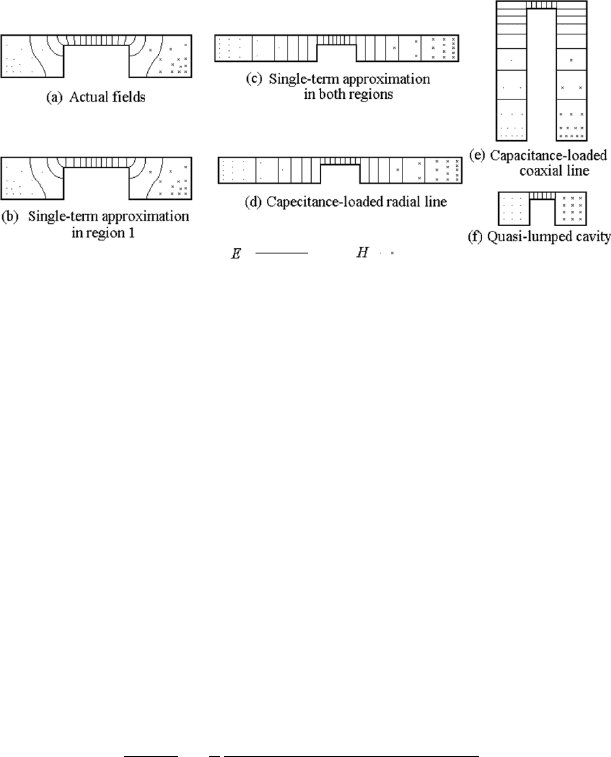
The field map in the reentrant cavities is shown in Fig. 5.39(a).
(2) Single-Term Approximation in Both Regions
If the length of the cavity region is also small, 2l ¿ λ, see Fig. 5.39(b),
we may neglect the high-order space harmonics in both the region 1 and
the region 2 and take the terms with n = 0 in (5.299)–(5.302) as the trial
functions. Then we have
n = 0, β
n
=
nπ
l
= 0, T
n
=
p
k
2
− β
2
n
= k,
U
2
= b
0
[N
0
(ka)J
0
(kρ) − J
0
(ka)N
0
(kρ)], (5.333)
E
z2
= k
2
b
0
[N
0
(ka)J
0
(kρ) − J
0
(ka)N
0
(kρ)], (5.334)
H
φ2
= jω²kb
0
[N
0
(ka)J
1
(kρ) − J
0
(ka)N
1
(kρ)]. (5.335)
The field components at the boundary ρ = b become
E
z2
(b) = k
2
b
0
[N
0
(ka)J
0
(kb) − J
0
(ka)N
0
(kb)] = B
0
, (5.336)
H
φ2
(b) = jω²kb
0
[N
0
(ka)J
1
(kb) − J
0
(ka)N
1
(kb)] = B
0
Y
02
, (5.337)
where
Y
02
=
jω²
k
N
0
(ka)J
1
(kb) − J
0
(ka)N
1
(kb)
N
0
(ka)J
0
(kb) − J
0
(ka)N
0
(kb)
. (5.338)
In region 1, the gap region, d < l ¿ λ, the trial functions are still
the single-term expressions (5.319)–(5.321), and the field components at the
boundary ρ = b are still (5.322) and (5.323).
5.6 Reentrant Cavities 303
Figure 5.39: Field maps in reentrant cavities of different approximations.
The field-matching condition for the electric field E
z
at the cylindrical
boundary ρ = b is (5.324) and (5.325) and the resulting relation between B
0
and A
0
is (5.327) with n = 0 is
B
0
l = A
0
d.
The physical meaning of this relation is that the potential differences at ρ = b
in regions 1 and 2 are equal.
The field-matching condition for the magnetic field H
φ
at ρ = b is that
(5.323) equals (5.337), which gives
A
0
Y
01
= B
0
Y
02
, i.e., Y
01
l = Y
02
d.
Substituting the expressions for Y
01
and Y
02
, (5.323) and (5.338), into the
above equation yields
J
1
(kb)
J
0
(kb)
=
d
l
N
0
(ka)J
1
(kb) − J
0
(ka)N
1
(kb)
N
0
(ka)J
0
(kb) − J
0
(ka)N
0
(kb)
. (5.339)
This approximate eigenvalue equation is just the single-term formulation of
(5.330) and (5.332).
(3) Uniform Field Approximation in the Gap Region,
Capacitance-Loaded Radial Lines
In the above two approaches, the field distributions in the gap region are
Bessel functions in the ρ direction, which is the field of the radial TEM
mode. If the radius of the gap region is small enough, then the electric field
in the gap will be approximately uniform and the magnetic field in the gap
will be infinitesimally small. In this case, the gap region can be considered as

304 5. Metallic Waveguides and Resonant Cavities
a parallel-plate capacitor and the cavity becomes a capacitance-loaded radial
line as shown in Fig. 5.39(c).
The approximate eigenvalue equation of a capacitance-loaded radial line
cavity can be obtained by means of admittance matching as follows. The
admittance of the capacitor is
Y
1
= jωC = jω
²πb
2
2d
. (5.340)
The voltage and the current in the shorted radial line at ρ = b are given
by
V = 2l E
z2
(b) = 2l B
0
, I = 2πbH
φ2
(b) = 2πbB
0
Y
02
,
and the input admittance of the shorted radial line at ρ = b is
Y
2
=
I
V
=
πb
l
Y
02
=
πb
l
jω²
k
N
0
(ka)J
1
(kb) − J
0
(ka)N
1
(kb)
N
0
(ka)J
0
(kb) − J
0
(ka)N
0
(kb)
. (5.341)
Let the two admittances be equal to each other. This gives
kb
2
=
d
l
N
0
(ka)J
1
(kb) − J
0
(ka)N
1
(kb)
N
0
(ka)J
0
(kb) − J
0
(ka)N
0
(kb)
. (5.342)
This is the eigenvalue equation of the capacitance-loaded radial line cavity.
If we consider the following approximate formulas for the Bessel functions,
lim
x→0
J
0
(x) = 1, lim
x→0
J
1
(x) =
x
2
,
then (5.339) reduces to (5.342).
(4) Capacitance-Loaded Coaxial Line Cavities and
Quasi-Lumped-Element Cavities
If the outer radius a is small and the length of the cavity l is large, the
cavity becomes a capacitance-loaded coaxial line as shown in Fig. 5.39(d).
Its eigenvalue equation is
jωC = j
1
Z
C
tan kl
,
kb
2
=
d
b
1
ln(a/b) tan kl
.
If all of a, l, and d are small, it becomes a resonant circuit with lumped
elements L and C, which is known as a quasi-lumped-element cavity, refer to
Fig. 5.39(e).
The capacitance-loaded biconical cavity or reentrant spherical cavity and
the ridge waveguide can also be analyzed by means of the above methods.
They are given as problems 5.15 and 5.16.
5.7 Principle of Perturbation 305
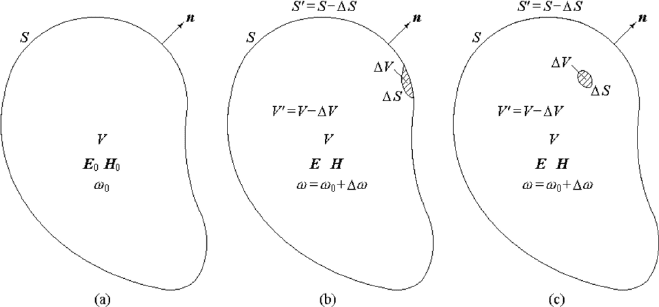
Figure 5.40: Cavity wall perturbations.
5.7 Principle of Perturbation
When some parameters such as the configuration of the boundary, the ma-
terial in the volume or the material of the boundary change slightly, the
electromagnetic system is said to be perturbed. If the solution of an unper-
turbed problem is known, then the solution of the perturbed problem, which
is slightly different from the unperturbed one, can be obtained by means of
the principle of perturbation.
We have already used the perturbational method for the calculation of
waveguide attenuation coefficients and resonator Q factors, in which the per-
turbation of the wall material is considered. In this section, the general
formulations of the principle of perturbation will be given. [37, 91]
5.7.1 Cavity Wall Perturbations
An ideal resonant cavity formed by a perfect-conductor surface S and enclos-
ing a lossless region V is shown in Fig. 5.40(a). The cavity wall perturbation
or the conductor perturbation of the cavity is to introduce a small deforma-
tion in the wall, shown in Fig. 5.40(b) or to introduce a small conductive
perturbing object into the cavity, shown in Fig. 5.40(c). Deformation of the
wall may also be considered as a conductive perturbing object stuck on the
wall.
Suppose the volume of the perturbing object is ∆V , the surface enclosing
the perturbing object is ∆S. The positive direction of ∆S is the outward
direction of the volume ∆V . The volume of the perturbed cavity is V
0
and
the surface enclosing it is S
0
. The positive direction of S
0
and S is the
outward direction of the cavity volume V
0
and V . So we have S
0
= S − ∆S,
306 5. Metallic Waveguides and Resonant Cavities
V
0
= V − ∆V .
Let ω
0
, E
0
, and H
0
represent the natural angular frequency and the fields
of the unperturbed cavity, and ω, E, and H represent the corresponding
quantities of the perturbed cavity. In both cases Maxwell’s equations must
be satisfied, that is
∇ × E
0
= −jω
0
µH
0
, (5.343)
∇ × H
0
= jω
0
²E
0
, (5.344)
∇ × E = −jωµH, (5.345)
∇ × H = jω²E. (5.346)
Scalar multiplying the equation (5.346) by E
∗
0
and the conjugate of the
equation (5.343) by H, we have
E
∗
0
· ∇ × H = jω²E · E
∗
0
, H · ∇ × E
∗
0
= jω
0
µH
∗
0
· H.
Subtracting these two equations and applying the vector identity (B.38),
∇ · (A × B) = B · ∇ × A − A · ∇ × B,
we have
∇ · (H × E
∗
0
) = jω²E · E
∗
0
− jω
0
µH · H
∗
0
. (5.347)
By the similar operations on the equation (5.344) and the equation (5.345),
we obtain
∇ · (H
∗
0
× E) = jωµH · H
∗
0
− jω
0
²E · E
∗
0
. (5.348)
These two equations, (5.347) and (5.348), are added and the sum is in-
tegrated throughout the volume of the perturbed cavity V
0
, and then the
divergence theorem is applied to the left-hand side. The resulting equation
is
I
S
0
(H ×E
∗
0
+H
∗
0
×E)·dS = j(ω−ω
0
)
Z
V
0
(²E ·E
∗
0
+µH ·H
∗
0
)dV. (5.349)
The second term of the surface integral vanishes, because the perturbed elec-
tric field E satisfies the short-circuit boundary condition on S
0
, n×E|
S
0
= 0.
Then the above equation becomes
I
S
0
H × E
∗
0
· dS = j(ω − ω
0
)
Z
V
0
(²E · E
∗
0
+ µH · H
∗
0
)dV. (5.350)
Since S
0
= S − ∆S, the left-hand side of the equation becomes
I
S
0
H × E
∗
0
· dS =
I
S
H × E
∗
0
· dS −
I
∆S
H × E
∗
0
· dS.

5.7 Principle of Perturbation 307
The first term of the right-hand side vanishes, because the unperturbed elec-
tric field E
0
and its conjugate E
∗
0
satisfies the short-circuit boundary condi-
tion on S, n × E
∗
0
|
S
= 0. Then we can rewrite (5.350) as
∆ω = ω − ω
0
=
j
H
∆S
H × E
∗
0
· dS
R
V
0
(²E · E
∗
0
+ µH · H
∗
0
)dV
. (5.351)
This is an exact formula for the change in the natural frequency due to the
perturbation of the cavity wall.
For practical application of the formula, we must replace the unknown
perturbed fields E and H by the unperturbed fields E
0
and H
0
. For small
perturbations this is certainly reasonable in the denominator, i.e.,
Z
V
0
(²E · E
∗
0
+ µH · H
∗
0
)dV ≈
Z
V
¡
²E
2
0
+ µH
2
0
¢
dV.
In the numerator, the tangential component of the perturbed magnetic field
is approximately equal to the unperturbed value when the deformation of the
wall is small, shallow, and smooth. With this approximation and applying
the complex Poynting theorem in the loss-less source-free volume ∆V , we can
rewrite the numerator of (5.351) as
I
∆S
H × E
∗
0
· dS ≈
I
∆S
H
0
× E
∗
0
· dS = jω
0
Z
∆V
¡
²E
2
0
− µH
2
0
¢
dV.
Substituting these two approximate expressions into (5.351), we have
∆ω
ω
0
=
ω − ω
0
ω
0
≈
R
∆V
¡
µH
2
0
− ²E
2
0
¢
dV
R
V
¡
²E
2
0
+ µH
2
0
¢
dV
. (5.352)
This is the perturbation formula for conductor perturbation or wall pertur-
bation of a cavity. Note that the denominator is proportional to the total
energy stored in the cavity, whereas the terms in the numerator are propor-
tional to the electric and magnetic energies removed by the perturbation.
Hence, (5.352) can be rewritten as
∆ω
ω
0
≈
∆W
m
− ∆W
e
W
, (5.353)
where W denotes the total energy stored in the original cavity, and ∆W
m
and
∆W
e
denote the time average magnetic energy and electric energy, respec-
tively, originally stored in the small volume ∆V . The perturbation formula
shows that an inward perturbation of the wall will raise the natural frequency
if it is made at a point with large magnetic field (high w
m
) and small electric
field (low w
e
), and will lower the natural frequency if it is made at a point
with large electric field (high w
e
) and small magnetic field (low w
m
).
The perturbation formula (5.352) or (5.353) is valid only when the in-
troduction of the perturbing object does not influence the fields outside the
308 5. Metallic Waveguides and Resonant Cavities
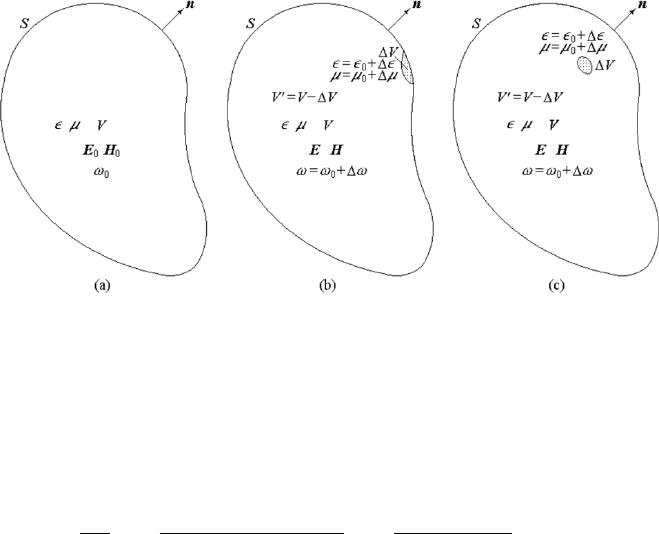
Figure 5.41: Material perturbation of a cavity.
perturbing body. This means that the perfect-conductor surface of the per-
turbing object is p erpendicular to the original electric field and parallel to
the original magnetic field. Otherwise, the perturbation formula must be
modified as follows:
∆ω
ω
0
= K
R
∆V
¡
µH
2
0
− ²E
2
0
¢
dV
R
V
¡
²E
2
0
+ µH
2
0
¢
dV
= K
∆W
m
− ∆W
e
W
, (5.354)
where K is a constant and depends upon the shape of the perturbing object
and the orientation of it in the fields. The constant K may be obtained by
means of experiment or quasi-static approach.
5.7.2 Material Perturbation of a Cavity
If an insulating object is introduced into the cavity, the natural frequency of
the cavity will change. This phenomena is known as material perturbation
of the cavity. [37]
Suppose the permittivity and permeability of the lossless material filling
an unperturbed cavity of volume V are ² and µ, and the fields and the natural
frequency of the cavity are E
0
, H
0
, and ω
0
, respectively. See Fig. 5.41(a).
The perturbed cavity is one in which a material object with volume ∆V and
medium constants ² + ∆² and µ + ∆µ is introduced in the cavity, shown
in Fig. 5.41(b), (c). Note that µ and ² in V and ∆µ and ∆² in ∆V are
not necessarily uniform. The volume of the perturbed cavity outside the
perturbation object is V
0
= V − ∆V . The fields and the natural frequency
of the perturbed cavity are E, H, and ω.
Fields E
0
and H
0
satisfy Maxwell’s equations in the volume V :
∇ × E
0
= −jω
0
µH
0
, ∇ × H
0
= jω
0
²E
0
. (5.355)
5.7 Principle of Perturbation 309
Fields E and H satisfy the following Maxwell equations in the volume V
0
:
∇ × E = −jωµH, ∇ × H = jω² E. (5.356)
But in the volume ∆V , fields E and H satisfy the the perturbed Maxwell
equations:
∇ × E = −jω(µ + ∆µ)H, ∇ × H = jω(² + ∆²)E. (5.357)
In the volume V
0
, we have
E
∗
0
· (∇ × H) = jω²E · E
∗
0
. (5.358)
In the volume ∆V , we have
E
∗
0
· (∇ × H) = jω(² + ∆²)E · E
∗
0
. (5.359)
In the volume V , i.e., in b oth V
0
and ∆V , we have
−H · (∇ × E
∗
0
) = −jω
0
²H
∗
0
· H. (5.360)
Adding equations (5.358) and (5.360), then applying the vector identity
(B.38), we have
∇ · (H × E
∗
0
) = jω²E · E
∗
0
− jω
0
µH · H
∗
0
, in V
0
. (5.361)
Adding equations (5.359) and (5.360), then applying the vector identity
(B.38), we have
∇ · (H × E
∗
0
) = jω(² + ∆²)E · E
∗
0
− jω
0
µH · H
∗
0
, in ∆V. (5.362)
By similar operations we obtain
∇ · (H
∗
0
× E) = jωµH · H
∗
0
− jω
0
²E · E
∗
0
, in V
0
, (5.363)
and
∇ · (H
∗
0
× E) = jω(µ + ∆µ)H · H
∗
0
− jω
0
²E · E
∗
0
, in ∆V. (5.364)
Adding the two equations (5.361) and (5.363), and adding the two equa-
tions (5.362) and (5.364), then integrating the sums throughout the volume
V and applying the divergence theorem to the left-hand side, we have
I
S
(H × E
∗
0
+ H
∗
0
× E) · dS = j(ω − ω
0
)
Z
V
(²E · E
∗
0
+ µH · H
∗
0
)dV
+ jω
Z
∆V
(∆²E · E
∗
0
+ ∆µH · H
∗
0
)dV. (5.365)
The surface integral on the left-hand side of the above equation vanishes,
because both the unperturbed and the perturbed electric fields E
0
and E

310 5. Metallic Waveguides and Resonant Cavities
satisfy the short-circuit boundary condition on the cavity boundary S, i.e.,
n × E
0
|
S
= 0 and n × E|
S
= 0:
I
S
(H × E
∗
0
+ H
∗
0
× E) · dS = 0.
Then (5.365) becomes
∆ω
ω
=
ω − ω
0
ω
= −
R
∆V
(∆²E · E
∗
0
+ ∆µH · H
∗
0
)dV
R
V
(²E · E
∗
0
+ µH · H
∗
0
)dV
. (5.366)
This is an exact formula for the change in the natural frequency due to the
material perturbation of the cavity.
For small perturbation, i.e., ∆² and ∆µ are small, we may replace E, H
by E
0
, H
0
, respectively, and replace ω by ω
0
except for the factor ω − ω
0
,
the perturbation formula becomes
∆ω
ω
0
=
ω − ω
0
ω
≈ −
R
∆V
¡
∆²E
2
0
+ ∆µH
2
0
¢
dV
R
V
¡
²E
2
0
+ µH
2
0
¢
dV
. (5.367)
The perturbation formula shows that any increase in µ and ² can only
decrease the natural frequency of a cavity, no matter whether the electric field
or the magnetic field is perturbated. In the above mathematical treatment
the volume ∆V has not been supposed to b e small. If the changes in the
medium constants extend all over the cavity, ∆V → V , the p erturbation
formula becomes
∆ω
ω
0
=
ω − ω
0
ω
0
≈ −
R
V
¡
∆²E
2
0
+ ∆µH
2
0
¢
dV
R
V
¡
²E
2
0
+ µH
2
0
¢
dV
. (5.368)
If ∆² or ∆µ is not small enough, but ∆V is small as compared with V ,
in the perturbation formula (5.366), the perturbed fields E and H in the
volume integral over ∆V may not be replaced by E
0
and H
0
, but E and H
in the volume integral over V may be replaced by E
0
and H
0
, because the
perturbation of the fields is limited to a small region inside and around ∆V .
The perturbation formula (5.366) becomes
∆ω
ω
≈ −
R
∆V
(∆²E · E
∗
0
+ ∆µH · H
∗
0
)dV
R
V
¡
²E
2
0
+ µH
2
0
¢
dV
≈ −K
R
∆V
¡
∆²E
2
0
+ ∆µH
2
0
¢
dV
R
V
¡
²E
2
0
+ µH
2
0
¢
dV
(5.369)
The ratio of the perturbed fields E and H inside the perturbation object to
the unperturbed fields E
0
and H
0
and the constant K can be approximately
obtained by using a quasi-static approximation and supposing that the un-
perturbed fields are uniform. This assumes that the time-varying fields inside
∆V are related to those outside ∆V in the same manner as the static fields,
because, in a region small compared to the wavelength, Helmholtz’s equation
can be approximated by Laplace’s equation.