
Zhang K., Li D. Electromagnetic Theory for Microwaves and Optoelectronics
Подождите немного. Документ загружается.


5.7 Principle of Perturbation 311
The application of the principle of perturbation is to calculate the natural
frequency of a deformed cavity or a dielectric loaded cavity. For an example,
we investigate a change in the natural frequency by means of a change in
the dimensions of a circular cylindrical cavity operating at the TM
010
mode.
Any change in the length of the cavity will not change the natural frequency
because the electric and magnetic fields are perturbed simultaneously. But
squeezing the central part of the end walls will lower the natural frequency
because the electric field is stronger at the central part, and reducing the
radius of the cavity or squeezing any part of the cylindrical wall will raise the
natural frequency because the magnetic field is stronger there.
The other application is to measure the field inside a cavity [32, 63].
This measurement is based on the fact that the resonant frequency change
of a cavity is proportional to the square of the field strength at the location
where the perturbation object is placed. For this purpose, the conductor
perturbation can only be used in the region where the electric field is superior
to the magnetic field or vice versa. Otherwise, the dielectric perturbation
object is used to measure the electric field and the magnetic perturbation
object is used to measure the magnetic field.
The previous perturbation formulas are obtained for the lossless perturba-
tion object. We leave the analysis of the perturbation by a lossy perturbation
object as an exercise.
5.7.3 Cutoff Frequency Perturbation of a Waveguide
Waveguide theory is a two-dimensional eigenvalue problem. The eigenvalue
of the problem, i.e., the cutoff frequency of the waveguide, is just the natural
frequency of the two-dimensional resonant cavity. So the two-dimensional
forms of the perturbation formulas (5.352) and (5.367) become the pertur-
bation formulas for waveguides.
The wall perturbation formula for the waveguide cutoff frequency is
∆ω
c
ω
c0
≈
R
∆S
¡
µH
2
0
− ²E
2
0
¢
dS
R
S
¡
²E
2
0
+ µH
2
0
¢
dS
, (5.370)
and the material perturbation formula for the waveguide cutoff frequency is
∆ω
c
ω
c0
≈ −
R
∆S
¡
∆²E
2
0
+ ∆µH
2
0
¢
dS
R
S
¡
²E
2
0
+ µH
2
0
¢
dS
, (5.371)
where S denotes the cross section of the waveguide and ∆S denotes the cross
section of the perturbation object. Note that the perturbation object must
be a uniform cylinder in the z direction.
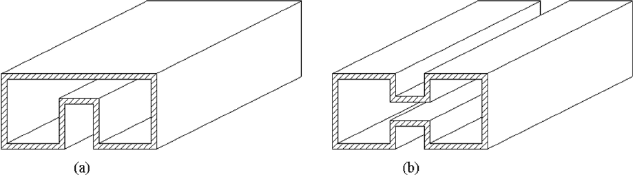
The wall perturbation formula (5.370) can help us to understand why the
single-mode frequency band of a ridge waveguide [22] shown in Fig. 5.42 is
broader than that of a rectangular waveguide. For the TE
10
mode, the ridge
is placed at the region of strong electric field and weak magnetic field, but for
312 5. Metallic Waveguides and Resonant Cavities
Figure 5.42: Ridge waveguides.
the TE
20
mode, the ridge is placed at the region of strong magnetic field and
weak electric field. In consequence, the cutoff frequency of the TE
10
mode for
the rigid waveguide is lower then that for the original rectangular waveguide,
and the cutoff frequency of the TE
20
mode for the rigid waveguide is higher
then that for the original rectangular waveguide.
The other feature of the ridge waveguide is that the characteristic
impedance of it is lower than that of the rectangular waveguide and is ad-
justable by means of adjusting the hight and the width of the ridge. So the
ridge waveguide can be used in impedance transformers or matching elements.
The field analysis of the ridge waveguide is given as a problem, see Prob-
lem 5.16.
5.7.4 Propagation Constant Perturbation of a
Waveguide
Consider a single-mode waveguide involves a perturbation in the permittivity
of the filling medium and the perturbation is considered to be sufficiently
weak so that the influences of the other modes can be neglected [23, 116].
The relative permittivity of the filling medium ²
r
in the original waveguide
is replaced by ²
r
+ ∆²
r
in the perturbed waveguide. In response of ²
r
+
∆²
r
, The propagation constant β of the waveguide is replaced by β + ∆β,
the transverse scalar wave function U
T
is replaced by U
T
+ ∆U
T
and the
transverse eigenvalue
T
2
= k
2
− β
2
= ²
r
k
2
0
− β
2
is replaced by
(T + ∆T )
2
= (²
r
+ ∆²
r
)k
2
0
− (β + ∆β)
2
,
where k
2
0
= ω²
0
µ
0
.
The equation (4.114) for the perturbed waveguide becomes
∇
2
T
(U
T
+ ∆U
T
) +
£
(²
r
+ ∆²
r
)k
2
0
− (β + ∆β)
2
¤
(U
T
+ ∆U
T
) = 0, (5.372)

5.7 Principle of Perturbation 313
where U
T
represents the transverse wave function for TM or TE modes, i.e.,
U
T
or V
T
, in Chapter 4. Multiplying this out and dropping the unperturbed
transverse wave equation, which is equal to zero, and neglecting the second-
order terms we obtain the first-order perturbed transverse wave equation
∇
2
T
∆U
T
+ ²
r
k
2
0
∆U
T
+ ∆²
r
k
2
0
U
T
− 2β∆βU
T
− β
2
∆U
T
= 0. (5.373)
Multiplying the above equation by U
∗
T
and integrating over the cross
section S of the waveguide, we get
2β∆β
Z
S
U
2
T
dS =
Z
S
∆²
r
k
2
0
U
2
T
dS +
Z
S
£
U
∗
T
∇
2
T
∆U
T
+ ²
r
k
2
0
∆U
T
U
∗
T
− β
2
∆U
T
U
∗
T
¤
dS.
(5.374)
It can be shown that the second integral on the right-hand side vanishes.
Multiplying the complex conjugate of the unperturbed transverse wave
equation, (4.114), by ∆U
T
gives
∆U
T
∇
2
T
U
∗
T
+ ∆U
T
¡
²
r
k
2
0
− β
2
¢
U
∗
T
= 0, (5.375)
where ²
r
and β are assumed to be real. Thus, the last two terms in the second
integral on the right-hand side of (5.374) can be replaced by −∆U
T
∇
2
T
U
∗
T
and to give,
Z
S
£
U
∗
T
∇
2
T
∆U
T
+ ²
r
k
2
0
∆U
T
U
∗
T
+ β
2
∆U
T
U
∗
T
¤
dS
=
Z
S
£
U
∗
T
∇
2
T
∆U
T
− ∆U
T
∇
2
T
U
∗
T
¤
dS =
Z
S
∇
T
·[U
∗
T
∇
T
∆U
T
− ∆U
T
∇
T
U
∗
T
] dS
=
I
l
[U
∗
T
∇
T
∆U
T
− ∆U
T
∇
T
U
∗
T
]·ndl =
I
l
·
U
∗
T
∂∆U
T
∂ n
− ∆U
T
∂ U
∗
T
∂ n
¸
dl, (5.376)
where the two dimensional Green theorem or Gauss theorem is used to con-
vert the surface integral over the cross section to a line integral around the
perimeter of the cross section, where n is the unit vector normal to the con-
tour of integration. The contour integral on the boundary is zero because
U
T
and ∆U
T
or ∂U
T
/∂ n and ∂∆U
T
/∂ n must vanish for guided mode in a
waveguide with short-circuit or open-circuit boundary. Then we have
Z
S
£
U
∗
T
∇
2
T
∆U
T
+ ²
r
k
2
0
∆U
T
U
∗
T
+ β
2
∆U
T
U
∗
T
¤
dS = 0.
Finally solving for ∆β in (5.374) we obtain the perturbation formula for
the propagation constant,
∆β =
R
S
∆²
r
k
2
0
U
2
T
dS
2β
R
S
U
2
T
dS
. (5.377)
In this expression, all quantities except for the perturbation of material, ∆²
r
,
are for the original unperturbed problem. One need not know the perturbed
field to evaluate the perturbed propagation constant to the first order in ∆²
r
.
314 5. Metallic Waveguides and Resonant Cavities
Note that, in (5.377), the perturbation of material, ∆²
r
, is not necessarily
uniform on the cross section although it has to be uniform along the axis z.
The perturbation formula for the propagation constant, (5.377), can also
be applied in the perturbation of dielectric waveguides, for which the surface
integral extends over the infinite cross section and the contour l is at infinity.
For guided modes in dielectric waveguides, U
T
and ∆U
T
vanish at infinity,
refer to the next chapter.
Problems
5.1 (1) Show that the magnetic field vector of the TE
10
mode in a rect-
angular waveguide is elliptically polarized, and point out the plane of
polarization.
(2) Find the position where the magnetic field vector becomes circularly
polarized.
(3) Find the positions where the magnetic field vector becomes linearly
polarized and point out the directions of the polarization.
5.2 Show that the conduction current on the wall of the rectangular cavity
of TE
101
mode is continuous with the displacement current in the space
inside the cavity.
5.3 The electric field of the TEM mode satisfies two-dimensional Laplace’s
equation on the transverse cross section, prove that it doesn’t satisfy
the three-dimensional Laplace’s equation.
5.4 The definition of energy velocity is v
e
= P/W , where P denotes the
average power flow through the cross section and W denotes the average
stored energy in a unit length of the waveguide.
Take the TE
10
mode in rectangular waveguide as an example, show that
the energy velocity is equal to the group velocity in the waveguide. Note
that the energy velocity is not always equal to the group velocity. See
Chapter 8.
5.5 Plot the ω–β diagrams of five low modes of two rectangular waveguides,
the ratios of the wide sides to the narrow sides of which are 1.5:1 and
3:1, respectively. Point out the difference of the sequences in the modes
between two waveguides.
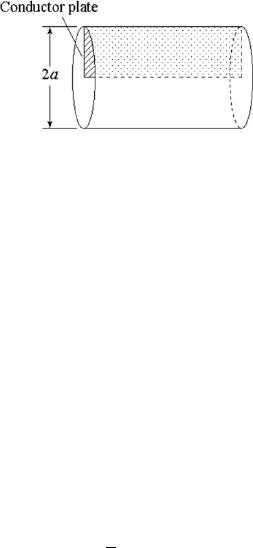
5.6 Derive the eigenvalue equation of a circular metallic waveguide with a
thin conducting plate in it shown in Fig. 5.43. Point out the difference of
mode distributions between it and normal circular metallic waveguide.
5.7 Find the ratio of the length l to the radius a of a circular cylindrical
cavity, such that the ratio of the natural frequencies of the dominant
mode to that of the adjacent mode is 1.5:1.
Problems 315
Figure 5.43: Problem 5.6. Circular waveguide with thin conducting plate.
5.8 (1) Derive the expression for the attenuation coefficient of the TE
nm
mode in a circular waveguide due to the loss on the wall made by a
good conductor.
(2) Show that the attenuation coefficient for the TE
0m
mode is a
monotonously decreasing function with respect to the increasing fre-
quency, and the attenuation coefficient for the mode with n 6= 0 has a
minimum at a certain frequency.
5.9 (1) Derive the expression for the attenuation coefficient of the TM
nm
mode in a circular waveguide due to loss on the wall made by a good
conductor.
(2) Show that the attenuation coefficient for the TM
nm
mode has a
minimum at frequency f =
√
3f
c
, where f
c
denotes the cutoff frequency
of the waveguide.
5.10 Take a lower mode as example, prove that the expressions for the fields
in the sectorial waveguide shown in Fig. 5.20(b) tend to those in the
rectangular waveguide when a − b ¿ a, a − b ¿ b, and α ¿ π.
5.11 Derive the expression for the Q factor of the TM
011
mode in a circular
cylindrical cavity due to the loss on a wall made by a go od conductor.
5.12 Derive the expression for the Q factors of the TM
101
and TE
101
modes
in a spherical cavity due to the loss on a wall made by a good conductor.
5.13 Derive the characteristic equation for the semi-spherical cavity, point
out the dominant mode, and give the expression of the natural fre-
quency of the dominant mode.
5.14 Derive the characteristic equation for the spherical-horn waveguide, and
describe the propagation characteristics of the dominant mode.
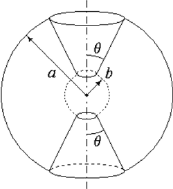
5.15
Derive the approximate characteristic equation of the dominant mo de
of a reentrant spherical cavity or capacity-loaded biconical cavity shown
in Fig. 5.44, using single-term approach in one region.
316 5. Metallic Waveguides and Resonant Cavities
Figure 5.44: Problem 5.15. Reentrant spherical cavity.
5.16 Derive the approximate cutoff frequency, phase coefficient and field dis-
tribution of the dominant mo de in a symmetric ridge waveguide shown
in Fig. 5.42(b), using single-term approach in one region. Suppose the
width and the hight of the waveguide are a and b, respectively, the
width of the ridge is c and the space between two ridges is d.
5.17 A dielectric rod of radius b and permittivity ² is inserted into a circular
cylindrical cavity with radius a and length l along the axis. Derive
the expression for the change in the natural frequency of the TM
010
mode due to the insertion of the dielectric rod, by using the principle
of perturbation .
5.18 Show that the factor K of a conducting spherical perturbing object for
the electric field is 3 and for the magnetic field is 3/2. [32, 63]
5.19 (1) Show that the factor K of a nonmagnetic dielectric thin needle as
a perturbing object is 1 if the electric field is tangential to the needle.
This approximation is independent of the cross-sectional shape of the
needle.
(2) Show that the factor K of a nonmagnetic dielectric thin disk as
a perturbing object is 1/²
r
if the electric field is normal to the disk.
Again this approximation is independent of the shape of the disk.
(3) Show that the factor K of a nonmagnetic dielectric spherical per-
turbing object is 3/(2 + ²
r
).
Hint, in the above two problems, use a quasi-static approximation and
suppose that the unperturbed fields are uniform.
5.20 Derive the perturbation formula for a cavity, including the change in the
natural frequency and the Q factor due to introducing a lossy dielectric
perturbation object.
Chapter 6
Dielectric Waveguides and
Resonators
We have seen in the last chapter that, for single-mode operation, the dimen-
sions of waveguides and cavities must be of the same order as the operating
wavelength. The reasonable dimensions for metal work are in centimeter and
millimeter range. For this reason, metallic waveguides and cavity resonators
including coaxial lines and coaxial cavities are extensively used in microwaves,
i.e., centimeter and millimeter wave bands.
In a metallic waveguide, the wave propagation can be understood as a
plane wave being totally reflected between conducting boundaries and fol-
lowing a zigzag path by successive reflections. The same phenomenon is
observed in a dielectric slab or rod if the index of the slab or rod is larger
than that of the surrounding medium, and if the condition of total internal
reflection is satisfied. Hence, a wave may be guided without loss by a piece
of dielectric material having no metal boundaries. This kind of transmission
system is known as a dielectric waveguide. A Dielectric waveguide with a
relatively smaller cross section is much easier to fabricate. For example, a
dielectric waveguide with the thickness of a few micrometer and the width
of dozens of micrometer can easily be made by means of micro electronic
technology. As a result, dielectric waveguides are successfully used for the
millimeter to micrometer wave band, including the infrared and visible light.
For use in the millimeter wave band, a dielectric waveguide can be made
in the simple form as a thin dielectric rod or wire with rectangular or circular
cross section or a dielectric strip as for a microwave integrated circuit. For the
optical or light-wave band, two types of dielectric waveguide have been de-
veloped, they are optical waveguides and optical fibers. Optical waveguides,
including the planar or slab waveguide and the strip or channel waveguide,
typically are composed of three layers of dielectric medium: a substrate, a
sheet or core, and a cover or cladding. The indices of refraction of the sub-
318 6. Dielectric Waveguides and Resonators
strate and of the cladding are slightly lower than that of the core, which
serves as the guiding layer. Optical fibers, on the other hand, are made ei-
ther of fused quartz (silica) or of plastic, with their diameters ranging from
a few micrometer to about 0.5 mm. The index of refraction decreases in the
radial direction, either gradually or abruptly. The former type is known as
a graded-index fiber and the latter type of fiber is known as a step-index
fiber. Planar and strip waveguides are the basic components in integrated
optics or photonic integrated circuits. The optical fiber as a distinguished
invention has been the most important long-distance transmission medium
in communication systems.
In a dielectric waveguide, although a large majority of the power flows
through the inner medium, namely the core, there is still stray power that
flows through the outer one, namely the cladding, and the wave is not to-
tally confined as with a metallic waveguide. The field solution of a dielectric
waveguide is composed of a number of guided modes or confined modes and
radiation modes, which form a complete set of orthogonal modes. For guided
modes, the fields in the cladding are decaying fields without transverse radi-
ation and the fields in the core are traveling waves with a small attenuation.
For radiation mo des, the fields in the cladding are traveling waves in the
transverse direction and the fields in the core become damping waves with
a large attenuation. The former corresponds to the case of total internal re-
flection from the dielectric boundaries, which occurs when the incident angle
is larger than the critical angle; and the latter corresponds to the case of
transmission through the boundaries, which occurs when the incident angle
is smaller than the critical angle. The frequency limit of the guided mode
is known as the critical frequency. Usually, it is also called the cutoff fre-
quency but the term cutoff for a dielectric waveguide has an entirely different
meaning than that for a metallic waveguide.
In the metallic waveguide with a uniform filling medium, the fields of a
TE or a TM mode alone can arrange themselves to satisfy the boundary con-
ditions. But in dielectric waveguides and metallic waveguides with different
filling media, any TE or TM modes can exist by itself only in the special
case when the fields are uniform along the transverse direction of the bound-
ary. Other than this special case, no TE or TM mode alone can satisfy the
boundary conditions, thus only hybrid modes can survive there.
Dielectric resonators, which have been developed rapidly and are widely
used in microwave integrated circuits, are also discussed in this chapter.
For the generality of the theory, we assume that both permittivity and
permeability are different for different media. In practical use, however, most
devices have made use of media with different permittivity, but the same
permeability µ
0
.
In order to make clear the nature and the influence of the dielectric bound-
ary on the wave modes, we start by the study of metallic waveguide filling
with different media and form a dielectric boundary inside the waveguide.
6.1 Metallic Waveguide with Different Filling Media 319
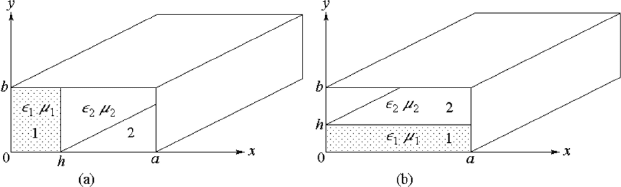
Figure 6.1: Metallic waveguides filled with two different media.
6.1 Metallic Waveguide with Different Filling
Media
The metallic waveguides discussed in the last chapter are filled with uniform
medium, in which any single TE or TM mode can exist independently. When
a waveguide is filled with different media or partially filled with a dielectric
medium, the electric and magnetic fields must satisfy the boundary condi-
tions not only on the metallic boundaries but also on the boundary between
different media. Rectangular metallic waveguides with two different section-
ally uniform filling media are shown in Fig. 6.1. [81]
6.1.1 The Possible TE and TM Modes
We deal with a waveguide with two different filling media aligned in the x
direction as shown in Fig. 6.1(a). In region 1, the constitutive parameters of
the medium are ²
1
, µ
1
and the angular wave numbers in three coordinates are
k
x1
, k
y 1
, and β
1
; whereas in region 2, the constitutive parameters are ²
2
, µ
2
and the angular wave numbers are k
x2
, k
y 2
, and β
2
. To satisfy the boundary
condition or so called phase matching condition between the two media, the
tangential angular wave numbers on both sides must be continuous:
β
1
= β
2
= β, k
y 1
= k
y 2
= k
y
. (6.1)
k
2
x1
+ k
2
y
+ β
2
= k
2
1
= ω
2
µ
1
²
1
, (6.2)
k
2
x2
+ k
2
y
+ β
2
= k
2
2
= ω
2
µ
2
²
2
. (6.3)
(1) TE Modes
For TE modes, U = 0 and E
z
= 0. Applying the boundary conditions on the
conducting wall, we have the functions V
1
and V
2
for the two regions
V
1
= A cos k
x1
x cos k
y
ye
−jβz
, 0 ≤ x ≤ h, (6.4)
V
2
= B cos k
x2
(x − a) cos k
y
ye
−jβz
, h ≤ x ≤ a, (6.5)

320 6. Dielectric Waveguides and Resonators
where k
y
= nπ/b. Substituting them into (4.147)–(4.152), we may obtain the
field-component expressions in the two regions.
The boundary conditions at x = h are such that the tangential compo-
nents of the electric and magnetic fields E
y
, H
y
, and H
z
on the two sides of
the boundary must be continuous, i.e.,
E
y 1
(h)=E
y 2
(h) → µ
1
∂V
1
∂x
=µ
2
∂V
2
∂x
, i.e., B =
µ
1
µ
2
k
x1
k
x2
A sink
x1
h
sink
x2
(h−a)
, (6.6)
H
y 1
(h) = H
y 2
(h) →
∂V
1
∂y
=
∂V
2
∂y
, (6.7)
and
H
z1
(h) = H
z2
(h) →
¡
k
2
x1
+ k
2
y
¢
V
1
=
¡
k
2
x2
+ k
2
y
¢
V
2
. (6.8)
Substituting (6.6) into (6.7) and (6.8), we obtain two eigenvalue equations,
µ
1
k
x1
tan k
x1
h = µ
2
k
x2
tan k
x2
(h − a) (6.9)
and
¡
k
2
x2
+ k
2
y
¢
µ
1
k
x1
tan k
x1
h =
¡
k
2
x1
+ k
2
y
¢
µ
2
k
x2
tan k
x2
(h − a). (6.10)
For guided modes, the above two equations are to be satisfied simultane-
ously, we ought to have
¡
k
2
x2
+ k
2
y
¢
=
¡
k
2
x1
+ k
2
y
¢
. i.e., k
2
1
= k
2
2
, µ
1
²
1
= µ
2
²
2
. (6.11)
This means that the indices of refraction or the phase velocities in the two
media must be equal. This case is trivial because the two different media act
like uniform medium.
The other possibility is
k
y
= 0, i.e., n = 0, (6.12)
which corresponds to TE
m0
modes. In this case,
H
y 1
= −jβ
∂V
1
∂y
= 0, and H
y 2
= −jβ
∂V
2
∂y
= 0.
Now (6.7) and (6.9) are no longer needed, and (6.10) alone gives the necessary
eigenvalue equation.
If we apply the condition k
y
= 0, the eigenvalue equation (6.10) becomes
µ
1
k
x1
tan k
x1
h =
µ
2
k
x2
tan k
x2
(h − a). (6.13)
Under the condition that k
y
= 0, from (6.2) and (6.3), we have
k
2
x1
− k
2
x2
= ω
2
(µ
1
²
1
− µ
2
²
2
). (6.14)